Unveiling the Glutamate-Glutamine Cycle: Advanced J-Suppression Techniques for Ultra-High-Field 7T MRS
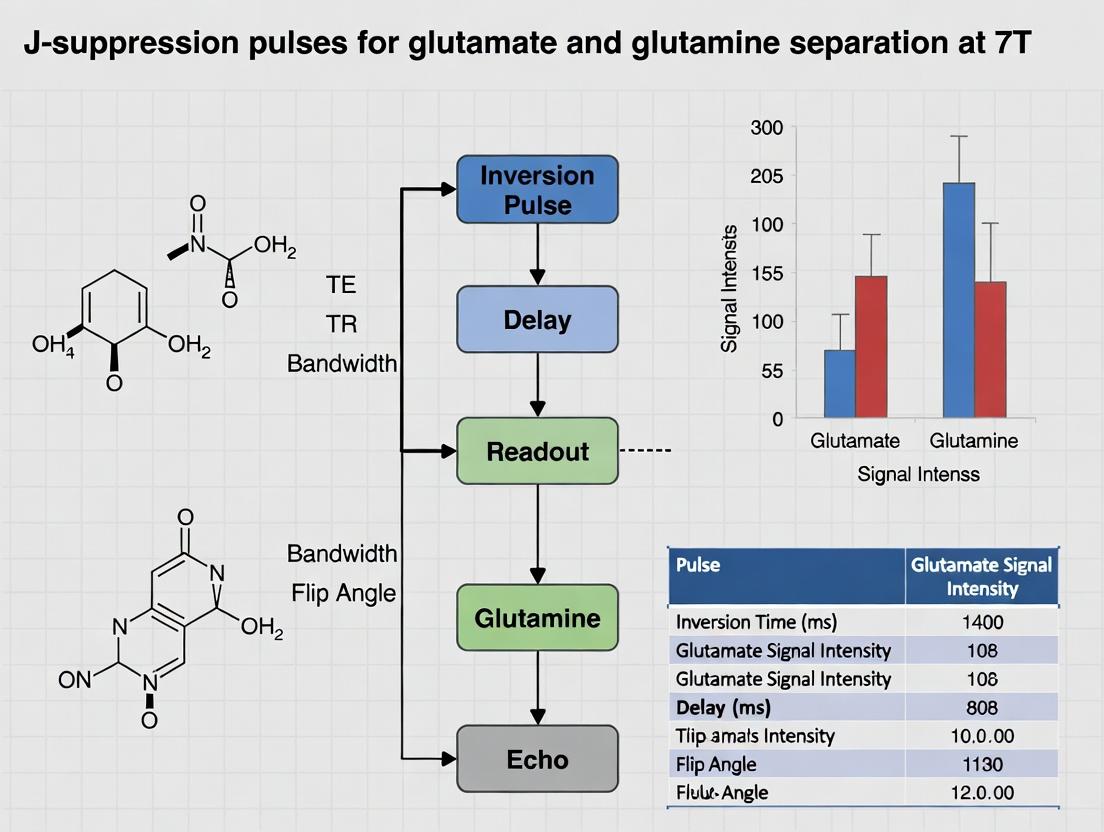
This comprehensive article explores the critical application of J-suppression (J-difference editing) pulses for resolving the overlapping glutamate (Glu) and glutamine (Gln) signals in proton magnetic resonance spectroscopy (¹H-MRS) at 7...
Unveiling the Glutamate-Glutamine Cycle: Advanced J-Suppression Techniques for Ultra-High-Field 7T MRS
Abstract
This comprehensive article explores the critical application of J-suppression (J-difference editing) pulses for resolving the overlapping glutamate (Glu) and glutamine (Gln) signals in proton magnetic resonance spectroscopy (¹H-MRS) at 7 Tesla. Targeted at neuroscientists, spectroscopists, and drug development professionals, it covers the neurobiological foundation of the Glu-Gln cycle, details cutting-edge pulse sequence methodologies, provides solutions for common acquisition and quantification challenges, and validates these techniques against other MRS approaches. The synthesis offers a roadmap for leveraging 7T J-suppression to advance research in neurological disorders, psychiatric conditions, and therapeutic monitoring.
The Glutamate-Glutamine Puzzle: Why 7T J-Suppression is a Neuroscientific Game-Changer
The Critical Role of Glu and Gln in Brain Metabolism and Signaling
Technical Support Center: J-Suppression Pulse Experiments for Glu/Gln Separation at 7T
This support center addresses common challenges in ¹H-MRS experiments focusing on glutamate (Glu) and glutamine (Gln) separation at high field (7T) using J-suppression pulses.
Troubleshooting Guides & FAQs
Q1: Why is my Glu/Gln separation poor despite using a published J-suppression pulse sequence (e.g., MEGA-PRESS, MEGA-SPECIAL)?
- A1: Poor separation typically stems from inadequate B0 homogeneity, imperfect pulse calibration, or macromolecule contamination.
- Action 1: Optimize Shimming. Perform advanced, voxel-specific shimming (e.g., FAST(EST)MAP). Target a water linewidth of <12 Hz for a 20x20x20 mm³ voxel.
- Action 2: Calibrate J-Suppression Pulses Precisely. The frequency selectivity of MEGA pulses is critical. Re-calibrate pulse power and frequency offset daily using a metabolite-nulled water scan.
- Action 3: Account for Macromolecules. Use a metabolite-nulled spectrum acquisition to model and subtract the macromolecule baseline, which obscures the Glu and Gln signals.
Q2: How can I minimize the chemical shift displacement error (CSDE) affecting my voxel localization at 7T?
- A2: CSDE is more pronounced at higher fields. Use pulses with large bandwidths (time-bandwidth product > 4) for both excitation and refocusing. Consider sequence designs like SPECIAL or sLASER that inherently minimize CSDE compared to PRESS. Always calculate the actual excited volume for Glu (2.35 ppm) and Gln (2.45 ppm) relative to the water frequency.
Q3: My quantified Gln values show high between-session variability. What are the key stability factors?
- A3: Gln concentration is lower and its signal is more susceptible to instability.
- Factor 1: Motion. Implement real-time motion correction (if available) and use stringent head immobilization.
- Factor 2: Sequence Timing. Ensure absolute consistency in TE, TR, and editing pulse timings. Even minor drifts affect the J-modulation.
- Factor 3: SNR. Ensure adequate SNR (>30:1 for NAA at your TE) by scanning long enough (typically >10 mins for a 20 cm³ voxel).
Q4: What are the best practices for quantifying Glu and Gln from J-suppressed spectra?
- A4: Always use a basis-set fitting approach with a priori knowledge.
- Simulate a Subject-Specific Basis Set. Use software (e.g., FID-A, VeSPA) to simulate the exact sequence (pulse shapes, timings, B0, B1+) and generate basis spectra for Glu, Gln, GABA, GSH, NAA, Cr, Cho, Asp, and MM.
- Fit the Edited Spectrum. Use LCModel or similar to fit the entire spectrum, not just the isolated peaks. This accounts for overlapping signals.
- Reference Properly. Reference concentrations to internal water (with correction for tissue composition) or total Creatine, but be consistent across all subjects/scans.
Table 1: Typical Quantification Precision for Glu and Gln at 7T using J-Suppression MRS (e.g., MEGA-PRESS, TE=68 ms)
| Metabolite | Chemical Shift (ppm) | Typical Gray Matter Concentration (IU) | Expected Cramér-Rao Lower Bounds (CRLB) | Key Spectral Overlap Challenges |
|---|---|---|---|---|
| Glutamate (Glu) | 2.35 (β,γ-CH₂) | 8.0 - 12.0 mmol/kg | 4-8% (Good) | NAA (2.6 ppm), NAAG, Macromolecules (2.2-2.4 ppm) |
| Glutamine (Gln) | 2.45 (β,γ-CH₂) | 3.0 - 5.5 mmol/kg | 10-20% (Acceptable) | Glutamate (2.35 ppm), GABA (2.29 ppm), Macromolecules |
Table 2: Common J-Suppression Sequence Parameters for Glu/Gln at 7T
| Sequence | Typical TE (ms) | Editing Pulse Target | Advantage | Disadvantage |
|---|---|---|---|---|
| MEGA-PRESS | 68-80 | 2.1-2.5 ppm (ON) vs. 1.8-2.0 ppm (OFF) | Robust, widely implemented | CSDE from 180° refocusing pulses |
| MEGA-SPECIAL | 26-40 | 2.1-2.5 ppm (ON) vs. 1.8-2.0 ppm (OFF) | Shorter TE, higher SNR, less CSDE | More sensitive to B1+ inhomogeneity |
Experimental Protocol: Glu/Gln Separation using MEGA-PRESS at 7T
1. Prescan & Calibration: a. Acquire a high-resolution anatomical scan for voxel placement (e.g., anterior cingulate cortex). b. Perform B0 shimming within the voxel. Target water linewidth < 0.12 ppm. c. Calibrate the frequency and power of the MEGA editing pulses (Gaussian, 14-20 ms) on the metabolite-nulled water signal. Center the ON pulse at 2.3 ppm (spanning Glu/Gln). Center the OFF pulse symmetrically upfield (e.g., 1.9 ppm).
2. Data Acquisition: a. Sequence: MEGA-PRESS. b. Voxel Size: 20-30 cm³ (e.g., 25x25x25 mm³). c. Key Parameters: TR = 2000-2500 ms, TE = 68 ms, 256 averages (128 ON, 128 OFF interleaved), total scan time ~10 minutes. d. Water Reference: Acquire an unsuppressed water scan (8 averages) from the same voxel for quantification.
3. Post-Processing & Quantification: a. Frequency/Phase Correction: Apply spectral registration or similar correction to each average. a. Subtraction: Generate the edited spectrum by subtracting the OFF from the ON averages. b. Fitting: Use LCModel with a basis set simulated for your exact sequence parameters (pulse shapes, durations, TE, B0). Include Glu, Gln, GABA, GSH, Asp, NAA, Cr, Cho, and simulated macromolecules. c. Output: Report metabolite concentrations (institutional units) and CRLBs. Discard data with Gln CRLB > 20% or poor fit.
Visualizations
Diagram 1: The Glutamate-Glutamine Cycle Between Neurons and Astrocytes
Diagram 2: MEGA-PRESS Experiment Workflow for Glu/Gln
The Scientist's Toolkit: Key Research Reagent Solutions
Table 3: Essential Reagents & Materials for Supporting 7T Glu/Gln MRS Research
| Item | Function & Relevance to Experiment |
|---|---|
| 7T MR Scanner with B0 > 700 MHz | Provides the fundamental high field strength necessary for increased spectral dispersion and SNR to resolve Glu and Gln. |
| Multi-Channel Transmit/Receive Head Coil (e.g., 32-ch) | Enables parallel imaging, advanced B1 shimming for uniform pulse power, and high sensitivity signal reception. |
| Advanced Shimming System (2nd/3rd order) | Critical for achieving the ultra-high B0 homogeneity required for clean J-suppression and spectral separation. |
| MEGA-PRESS or MEGA-SPECIAL Pulse Sequence | The core J-editing sequence; must be optimized for 7T B1+ characteristics and chemical shifts. |
| Spectral Simulation Software (FID-A, VeSPA) | Generates accurate, subject-specific basis spectra for reliable LCModel quantification. |
| LCModel or QUEST (jMRUI) | Performs quantitative time-domain fitting of the edited spectrum using the simulated basis set. |
| Phantom with Brain Metabolites (Glu, Gln, etc.) | Used for initial sequence validation, pulse calibration, and establishing quantification pipelines. |
Technical Support Center: Troubleshooting Guides & FAQs
FAQ: General Principles & Challenges
Q1: Why do glutamate (Glu) and glutamine (Gln) resonances overlap at lower magnetic field strengths (e.g., 3T)? A1: The proton NMR spectra of Glu and Gln are complex multiplets due to scalar coupling (J-coupling). The chemical shift difference (δ) between their key resonances (e.g., the H4 protons) is approximately 0.2 ppm. At 3T (127.7 MHz for ¹H), this translates to a frequency separation of only ~25.5 Hz. This small Δν is comparable to the linewidth and the coupling constants (J-coupling ~7-8 Hz), leading to significant spectral overlap, making quantification unreliable.
Q2: How does increasing field strength to 7T help? A2: Chemical shift separation (in Hz) scales linearly with field strength. At 7T (~297.2 MHz for ¹H), the same 0.2 ppm separation becomes ~59.4 Hz, improving dispersion. However, J-coupling (in Hz) remains constant. This increased Δν/J ratio improves the ability to resolve the multiplet structures.
Q3: What is the core function of a J-suppression pulse in this context? A3: J-suppression pulses, such as frequency-selective refocusing pulses or band-selective inversion pulses, are designed to selectively act on one spin system (e.g., Gln) while leaving the other (Glu) unaffected. By suppressing or modulating the J-evolution of one species, the resulting spectral editing simplifies the overlapping pattern, allowing for the isolation and quantification of individual metabolites.
Troubleshooting Guide: Common Experimental Issues
Issue 1: Incomplete Suppression of Target Metabolite (e.g., Gln)
- Symptoms: Residual Gln peaks visible under the Glu resonance, leading to overestimation of Glu.
- Potential Causes & Solutions:
- Cause: Incorrect pulse frequency calibration or offset.
- Solution: Precisely calibrate the frequency of the selective pulse on a phantom containing Gln. Ensure the transmitter frequency (
tof) is correctly set relative to water. - Cause: B1 field inhomogeneity causing imperfect inversion/refocusing.
- Solution: Use adiabatic selective pulses for better performance over a range of B1 strengths. Shim diligently to improve field homogeneity.
- Cause: Pulse bandwidth too narrow or too wide.
- Solution: Adjust pulse power/bandwidth to fully cover the Gln multiplet of interest without affecting the Glu resonance. Verify with simulation.
Issue 2: Poor Signal-to-Noise Ratio (SNR) in Edited Spectra
- Symptoms: Noisy spectra, difficult to fit or integrate.
- Potential Causes & Solutions:
- Cause: Long TE (Echo Time) required for J-evolution leading to T2 signal loss.
- Solution: Optimize TE to the specific J-coupling constant (e.g., TE ~ 1/(2J) = ~68 ms for J=7.3 Hz). Consider using a shorter TE with a more complex editing scheme.
- Cause: Voxel size too small.
- Solution: Increase voxel volume if anatomically permissible, as SNR scales with voxel size. At 7T, smaller voxels are feasible but require careful planning.
- Cause: Insufficient averages (NSA).
- Solution: Increase scan time (NSA) to improve SNR, balancing protocol length.
Issue 3: Contamination from Macromolecules or Overlapping Metabolites (e.g., GABA, GSH)
- Symptoms: Baseline distortions or unexpected peaks in the difference spectrum.
- Potential Causes & Solutions:
- Cause: Insufficient water and lipid suppression.
- Solution: Optimize VAPOR or similar water suppression. Use outer volume saturation (OVS) for lipid suppression.
- Cause: Editing pulses affecting nearby metabolites.
- Solution: Characterize the selectivity profile of your editing pulse sequence using metabolite phantoms. Use symmetric editing schemes (edit-ON/edit-OFF) to subtract out common contaminants.
Data Presentation
Table 1: Key Spectral Parameters for Glu and Gln at Different Field Strengths
| Parameter | Glutamate (Glu) | Glutamine (Gln) | Notes |
|---|---|---|---|
| Key ¹H Resonance | H4 proton at ~2.35 ppm | H4 proton at ~2.45 ppm | Primary target for separation |
| Chemical Shift Diff. (Δδ) | ~0.10 - 0.20 ppm | Depends on sequence, pH | |
| Coupling Constant (J) | ~7.3 - 7.8 Hz (for H3-H4) | ~7.0 - 7.3 Hz (for H3-H4) | Field-independent |
| Separation at 3T (Δν) | ~25.5 Hz (for Δδ=0.2 ppm) | Δν (Hz) = Δδ (ppm) * Larmor Freq. (MHz) | |
| Separation at 7T (Δν) | ~59.4 Hz (for Δδ=0.2 ppm) | Improved Δν/J ratio at higher field |
Table 2: Comparison of Spectral Editing Techniques for Glu/Gln Separation
| Technique | Principle | Advantages | Challenges at Lower Field |
|---|---|---|---|
| J-Difference Editing | Uses selective pulses to modulate J-coupling; subtracts two conditions. | High specificity if pulses are selective. | Very demanding pulse selectivity due to small Δν. |
| 2D J-Resolved Spectroscopy | Spreads signals into a second dimension based on J-coupling. | Can resolve all overlapping metabolites. | Long acquisition time; lower SNR per unit time. |
| Multiple Quantum Filtering | Filters signals based on quantum coherence order. | Excellent suppression of unwanted singles. | Complex setup; lower sensitivity. |
| BASING (Band Selective Inversion with Gradient Dephasing) | Inverts a selected band, uses gradients to dephase unwanted signals. | Robust to B1 inhomogeneity. | Requires accurate frequency setting; can affect nearby resonances. |
Experimental Protocols
Protocol 1: J-Difference Editing for Glu/Gln at 7T using a Selective Refocusing Pulse (MEGA-PRESS based) This protocol outlines a single-voxel J-difference editing experiment optimized for 7T.
- Subject/Phantom Preparation: Position subject in scanner. Acquire localizer images.
- Voxel Placement (e.g., 20x20x20 mm³): Place voxel in region of interest (e.g., anterior cingulate cortex). Avoid CSF and lipid-rich tissue boundaries.
- B0 Shimming: Perform automatic and manual higher-order shimming (e.g., FAST(EST)MAP) to achieve water linewidth < 15 Hz.
- Frequency Calibration: Set the scanner's central frequency (
tof) to the water peak (4.7 ppm). Then, calibrate the power and frequency of the selective Gaussian (or MEscher–GArwood, MEGA) pulse. The pulse should be centered precisely on the Gln H4 resonance at ~2.45 ppm with a bandwidth of 30-40 Hz. - Sequence Parameters (Example):
- Sequence: MEGA-PRESS
- TR/TE: 2000 ms / 68 ms (optimized for J=7.3 Hz)
- Readout: 128 averages (64 ON, 64 OFF) with water suppression (VAPOR).
- Selective Pulse: 20 ms Gaussian pulse, frequency-alternating between ON-resonance (2.45 ppm) and OFF-resonance (e.g., 7.5 ppm) in alternating scans.
- Oversampling: Enable to avoid ADC aliasing.
- Data Acquisition: Run the edit-ON and edit-OFF scans interleaved.
- Processing: Subtract the edit-OFF spectrum from the edit-ON spectrum. The resultant "difference" spectrum predominantly contains the edited signal of the target metabolite (Gln), with Glu contribution minimized.
Protocol 2: Verification and Quantification using Phantom
- Phantom Preparation: Create three separate 1L spherical phantoms with: a) 50 mM Glu, b) 50 mM Gln, c) 25 mM Glu + 25 mM Gln, all in pH 7.2 phosphate buffer.
- Data Acquisition: Run Protocol 1 on each phantom using identical parameters.
- Analysis: Fit the edited spectra in the phantom data using LCModel or JMRUI with an appropriate basis set. The basis set must be simulated or acquired using the exact same sequence parameters.
- Quantification: Use the water signal as an internal reference for absolute quantification, correcting for differential T1/T2 relaxation.
The Scientist's Toolkit: Research Reagent Solutions
Table 3: Essential Materials for Glu/Gln Separation Experiments
| Item | Function | Example/Notes |
|---|---|---|
| Metabolite Phantoms | For pulse calibration, sequence testing, and basis set creation. | Custom solutions of Glu, Gln, GABA, GSH, NAA, Cr, PCr in buffer at physiological pH (7.2). |
| Spectral Analysis Software | For processing, fitting, and quantifying edited spectra. | LCModel, Gannet, JMRUI, FSL-MRS. Requires a custom basis set matching your sequence. |
| Pulse Simulation Tool | To design and characterize selective pulses (bandwidth, profile). | MATLAB with pulseDesign toolboxes, Vespa simulator. |
| Adiabatic Pulse Libraries | Provides uniform inversion/refocusing over a range of B1 fields, improving robustness. | Hyperbolic secant (HS), frequency offset corrected inversion (FOCI) pulses. |
| High-Precision Syringe Pumps | For dynamic in-vivo studies measuring Glu/Gln turnover (e.g., during isotope infusion). | Enables stable infusion of ¹³C-labeled glucose or acetate. |
Visualizations
Title: J-Difference Editing Experimental Workflow
Title: Spectral Overlap at 3T vs 7T Concept
Title: Technical Support Role in Thesis Context
Technical Support Center: Troubleshooting & FAQs for 7T Glutamate/Glutamine Separation
Frequently Asked Questions (FAQ)
Q1: At 7T, my J-difference editing sequence for GABA is heavily contaminated by co-edited glutamate (Glu). How can I improve specificity? A: This is a common issue due to stronger J-coupling at ultra-high field. Implement a more selective J-suppression pulse, such as a frequency-selective symmetric or asymmetric pulse optimized for the C4 resonance of Glu. Ensure your pulse power is calibrated precisely for the 7T B1 field. Re-optimize the pulse duration and bandwidth to match the increased spectral dispersion. Using a density-weighted or fully adiabatic editing pulse can also improve performance.
Q2: My MEGA-PRESS SNR is lower than expected at 7T despite the theoretical increase. What are the primary culprits? A: Key factors to check:
- B0 Inhomogeneity: Shimming is more critical at 7T. Use advanced, volume-specific shimming (e.g., FASTESTMAP) and ensure subject positioning is consistent.
- B1+ Inhomogeneity: The editing pulse inversion profile may be non-uniform across the VOI. Use adiabatic pulses for inversion and refocusing where possible.
- Sequence Timing: Eddy currents are more pronounced. Ensure your gradient pre-emphasis is correctly calibrated and use optimized crusher gradients.
- Motion: Higher field exacerbates motion-induced artifacts. Implement prospective motion correction if available.
Q3: How do I best quantify the separation of the Glx (Glu+Gln) complex into individual Glu and Glin peaks for kinetic modeling? A: Utilize the enhanced spectral dispersion at 7T by employing a specialized PRESS or SPECIAL sequence with a very short TE (e.g., <10 ms) to minimize J-modulation. Then, fit the spectrum using a linear combination model (LCModel, jMRUI) with a basis set simulated specifically for 7T, accounting for the exact pulse sequence, bandwidth, and chemical shift displacement. Spectral fitting quality should be validated with phantom data.
Q4: My J-suppression pulses for glutamate are affecting the myo-inositol (ml) signal. How can I mitigate this? A: This indicates insufficient pulse selectivity. Design your suppression pulse to be centered precisely on the Glu C4 proton at 2.35 ppm with a narrower bandwidth. Consider using a double-banded suppression pulse that also targets the Gln C4 proton at 2.45 ppm while leaving the ml multiplet at 3.55 ppm unaffected. Always run a water-suppressed, single-pulse acquisition (NSA) as a reference to check for unintended metabolite suppression.
Troubleshooting Guide
| Symptom | Possible Cause | Diagnostic Step | Solution |
|---|---|---|---|
| Poor Glu/Gln spectral fitting error >15% | Incorrect basis set in LCModel/quantification tool. | Compare acquired phantom spectrum (containing Glu/Gln) with simulated basis set. | Generate a custom basis set using the exact sequence parameters (TE, TR, pulse shapes, timings) and 7T chemical shifts. |
| Asymmetric or distorted peak shapes in edited spectrum | B0 drift or poor shim during long acquisition. | Check the frequency drift plot from the scanner console. | Enable automatic frequency drift correction during the MRS sequence. Re-shim if drift > 5 Hz. |
| Low signal uniformity across VOI | B1+ inhomogeneity at 7T affecting editing pulses. | Acquire a B1+ map over the VOI. | Switch to adiabatic editing pulses (e.g., FOCI pulses) which are less sensitive to B1+ variations. |
| High residual water artifact in edited difference spectrum | Insufficient water suppression, exacerbated by B1+ inhomogeneity. | Inspect the unsuppressed water signal in the raw data. | Use a vendor-optimized, volume-localized water suppression scheme (e.g., VAPOR) and recalibrate power for each subject. |
Table 1: Metabolite Spectral Properties at 3T vs. 7T
| Metabolite | Chemical Shift (ppm) | Separation from Gln at 3T (Hz) | Separation from Gln at 7T (Hz) | Relative SNR Gain (7T vs 3T)* |
|---|---|---|---|---|
| Glutamate (Glu) C4 | ~2.35 | ~7.5 | ~17.5 | ~2.3x |
| Glutamine (Gln) C4 | ~2.45 | (Reference) | (Reference) | ~2.3x |
| GABA C3 | ~1.91 | ~162 | ~378 | ~2.3x |
| NAA | ~2.01 | ~132 | ~308 | ~2.3x |
*Theoretical SNR gain based on field strength; actual gains are sequence and subject-dependent.
Table 2: Common J-Suppression Pulse Parameters for Glu Editing at 7T
| Pulse Type | Typical Duration (ms) | Bandwidth (Hz) | Center Frequency (ppm) | Key Advantage |
|---|---|---|---|---|
| Gaussian | 20-40 | 40-60 | 2.35 | Simple, easy to calibrate |
| Sinc-shaped | 15-30 | 30-50 | 2.35/2.45 (double) | Improved selectivity |
| Adiabatic (e.g., BIR-4) | 10-20 | 100+ | Adjustable | Insensitive to B1+ inhomogeneity |
Experimental Protocol: Optimized J-Difference Editing for Glu/Gln at 7T
Objective: To acquire cleanly edited Glu and Gln signals from the anterior cingulate cortex using a MEGA-PRESS sequence at 7T.
Materials: See "Research Reagent Solutions" below.
Method:
- Subject Positioning & B0 Shimming: Position subject using high-resolution localizers. Perform global shim, followed by localized first- and second-order shimming (e.g., FASTESTMAP) on the target VOI (e.g., 30x25x20 mm³). Target a water linewidth of <18 Hz.
- B1+ Calibration: Calibrate the power for the 90° and 180° PRESS pulses and the water suppression pulses using a vendor-provided or external phantom procedure.
- Editing Pulse Calibration: Calibrate the power of the frequency-selective J-suppression (editing) pulse. A common method is to apply the pulse on-resonance with the Glu C4 peak (2.35 ppm) in a metabolite phantom and adjust power to achieve nulling of the Glu signal in a single-shot spectrum.
- Sequence Setup:
- Sequence: MEGA-PRESS.
- Editing Scheme: ON: Editing pulse at 2.35 ppm (Glu C4) and 2.45 ppm (Gln C4) in alternating scans. OFF: Editing pulse symmetrically placed on the opposite side of the water peak (e.g., at 7.46 ppm).
- Timing: TE = 68-80 ms (optimized for Glu/Gln J-coupling), TR = 2000-2500 ms.
- Averages: 200-300 ON and OFF scans each (64-128 scans per block).
- Water Suppression: Use VAPOR or equivalent.
- Motion Correction: Enable prospective motion correction if supported.
- Data Acquisition: Run the sequence, monitoring frequency drift. Pause to re-shim if drift exceeds protocol threshold.
- Processing: Subtract ON from OFF averages in the time domain. Apply modest apodization (3-5 Hz line-broadening). Zero-fill and Fourier transform. Fit the resulting difference spectrum (showing edited Glu and Gln at ~3.75 ppm) and the OFF spectrum (showing full metabolite profile) using a 7T-specific basis set.
Diagram Title: 7T J-Difference MRS Experiment Workflow
Diagram Title: Key Metabolic Pathways Linking Glu, Gln, and GABA
The Scientist's Toolkit: Research Reagent Solutions
| Item | Function in 7T Glu/Gln Research |
|---|---|
| 7T MRI/MRS Scanner | Essential hardware platform providing the main B0 field and RF systems for data acquisition. |
| Dedicated Head Coil (e.g., 32-channel) | High-density receive coil array critical for achieving the theoretical SNR gains at 7T. |
| Metabolite Phantom | Contains calibrated solutions of Glu, Gln, GABA, NAA, etc., for sequence validation, pulse calibration, and basis set creation. |
| Spectral Fitting Software (e.g., LCModel, jMRUI) | Used to decompose the overlapping 1H spectrum into individual metabolite contributions using a prior-knowledge basis set. |
| Basis Set Simulation Software (e.g, VE/AME, FID-A) | Generates the simulated metabolite spectra for the exact sequence parameters and 7T field strength, required for accurate quantification. |
| Adiabatic Pulse Libraries | Provides pulse shapes (BIR-4, FOCI) that are tolerant to B1+ inhomogeneity, crucial for uniform editing performance at 7T. |
| Prospective Motion Correction System | Hardware/software package to detect and correct for head motion in real-time, preventing spectral artifacts. |
Technical Support Center
Troubleshooting Guides & FAQs
Q1: My J-suppression pulse sequence fails to adequately separate the Glx (glutamate+glutamine) complex at 7T, resulting in residual co-edited signals. What are the primary causes and solutions?
A: Inadequate separation at ultra-high field (7T) often stems from miscalibrated pulse parameters relative to the evolving J-coupling. Key issues and fixes:
- Cause 1: Incorrect refocusing pulse bandwidth or timing misaligns with the J-evolution period of the target spin system (Glutamate's complex coupling vs. Glutamine's).
- Solution: Precisely calibrate the frequency and amplitude of your spectral-spatial (SPSP) or BASING pulses. Use a phantom containing both Glu and Gin to optimize pulse duration and inter-pulse delays (τ) to achieve maximum differential editing. Refer to Table 1 for typical 7T parameters.
- Cause 2: B0 inhomogeneity exceeding the bandwidth of the editing pulses, causing spatially varying performance.
- Solution: Implement aggressive and localized shimming prior to acquisition. Use a voxel-specific first- and second-order shim routine. For sequences like MEGA-PRESS or SPECIAL, ensure the editing pulse is applied at the precise chemical shift difference.
- Cause 3: Insufficient RF power (B1) leading to incomplete inversion/refocusing by the J-suppression pulse.
- Solution: Perform a dedicated B1+ calibration. Adjust pulse power to achieve a full 180° inversion across the entire voxel of interest. Consider using adiabatic pulses for more uniform inversion profiles at 7T.
Q2: I observe significant SNR loss in my edited Glutamine spectrum. How can I optimize my protocol to recover SNR?
A: SNR loss in editing sequences is common due to T2 decay during extended echo times (TE) and imperfect refocusing.
- Protocol Adjustment: Use the shortest TE possible that still allows for the complete J-evolution cycle necessary for separation. For Glu/Gln at 7T, TEs between 65-80 ms are often a compromise.
- Averaging & Voxel: Increase the number of averages (NSA) and consider a slightly larger voxel size, as SNR is proportional to voxel volume and sqrt(NSA). Ensure your TR is ≥ 3-5 times the T1 of the metabolites (approx. 1.2-1.5s at 7T).
- Sequence Choice: Consider using a semi-LASER or SPECIAL localization sequence with optimized J-editing modules, which may offer better inherent SNR than PRESS-based editing at ultra-high field.
Q3: How do I validate the specificity of my J-editing sequence for in-vivo Glutamine measurement?
A: Specificity validation is critical for thesis research.
- Phantom Validation: Acquire data from separate phantoms containing pure Glu, pure Gln, and a combined solution. Confirm the editing pulse only modulates the signal from the intended metabolite.
- In-vivo Correlation: Perform complementary experiments, such as 2D J-resolved spectroscopy, on the same subject/voxel to verify the coupled spin patterns of your assigned Gln peak.
- Quantitative Analysis: Fit your edited spectrum using linear combination modeling (LCModel, Gannet) with a basis set that includes both edited and non-edited metabolite spectra simulated with your exact sequence parameters.
Experimental Protocol: J-Suppression Edited MEGA-PRESS for Glu/Gln at 7T
Objective: To separately quantify glutamate (Glu) and glutamine (Gln) concentrations in the human prefrontal cortex at 7T.
1. Hardware & Preparation:
- 7T MRI scanner with high-performance B0 shims and a transmit/receive head coil.
- Subject positioned, head immobilized.
- Localizer scans acquired.
2. B0 Shimming:
- Perform global then localized first- and second-order shimming on the target voxel (e.g., 20x20x20 mm³).
- Target a water linewidth of < 18 Hz FWHM.
3. Sequence Setup (Key Parameters):
- Sequence: MEGA-PRESS with spectrally-selective J-suppression pulses.
- Localization: PRESS (TE1=14 ms, TE2=80 ms, TR=2000 ms).
- Editing Pulse: Frequency-selective Gaussian pulse (duration = 20 ms, bandwidth ~60 Hz).
- Editing Paradigm:
- ON Edit: Pulse applied at 3.75 ppm (coupled to Gln β-protons at 2.45 ppm).
- OFF Edit: Pulse applied symmetrically at 1.9 ppm (inactive region).
- Spectral Acquisition: Number of averages (NSA) = 256 (128 ON, 128 OFF), spectral width = 4000 Hz, data points = 2048.
4. Data Processing:
- Subtraction: Subtract OFF spectrum from ON spectrum to generate the difference ("edited") spectrum.
- Analysis: Fit the difference spectrum from 2.1 to 2.5 ppm using a basis set (simulated Glu, Gln, GABA, NAA, etc.) in LCModel.
- Quantification: Report Glu and Gln concentrations relative to Creatine (Cr) or water.
Data Presentation
Table 1: Typical J-Coupling Constants and Editing Parameters for Glu/Gln at 7T
| Metabolite | Resonant Proton | Chemical Shift (ppm) | J-Coupling Constant (Hz) | Key Editing Pulse Target (ppm) | Optimal TE for J-Evolution (ms) |
|---|---|---|---|---|---|
| Glutamate (Glu) | β-protons (coupled) | ~2.35 (multiplet) | 7.5-7.8 | 3.75 | 68, 132 (1/J) |
| Glutamine (Gln) | β-protons (coupled) | ~2.45 (multiplet) | 6.8-7.0 | 3.75 | 71, 142 (1/J) |
| NAA (Reference) | Methyl protons | 2.008 (singlet) | N/A | N/A | N/A |
Table 2: Troubleshooting Checklist for Poor Glu/Gln Separation
| Symptom | Likely Cause | Diagnostic Step | Corrective Action |
|---|---|---|---|
| Broad, asymmetric residual peaks | B0 inhomogeneity | Check water linewidth pre-scan | Re-shim voxel; use higher-order shims. |
| Low overall signal in both ON/OFF | Insufficient averages or short TR | Check protocol NSA/TR | Increase NSA; ensure TR > 1500 ms. |
| Gln peak absent in difference spectrum | Editing pulse miscalibrated | Test on pure Gln phantom | Re-calibrate pulse frequency/amplitude. |
| Poor subtraction (baseline artifacts) | Subject motion | Check raw FIDs for phase jumps | Use motion correction; reposition. |
The Scientist's Toolkit: Research Reagent & Essential Materials
| Item | Function in Glu/Gln 7T Research |
|---|---|
| Metabolite Phantoms | Solutions containing known concentrations of Glu, Gln, Cr, NAA, etc., for sequence calibration, validation, and basis set creation. |
| Spectral Analysis Software (LCModel, Gannet, jMRUI) | Processes raw MRS data, performs linear combination modeling to quantify metabolite concentrations from overlapping spectra. |
| Pulse Sequence Simulation Tool (VE/AS, FID-A) | Simulates the outcome of J-editing sequences under different coupling constants and timings to optimize protocols theoretically. |
| Adiabatic RF Pulses | Provide uniform inversion profiles across the voxel despite B1+ inhomogeneity, crucial for reliable editing at 7T. |
| High-Order B0 Shim System | Actively compensates for magnetic field inhomogeneity, essential for achieving narrow spectral lines and effective spectral editing. |
Mandatory Visualizations
Diagram 1: J-Coupling Editing Logic for Glutamine
Diagram 2: 7T MRS Workflow for Glu/Gln Thesis Research
Key Neurobiological Questions Addressed by Precise Glu/Gln Measurement
Technical Support Center
Troubleshooting Guides & FAQs
Q1: Why is my J-difference editing (e.g., MEGA-PRESS) spectrum showing poor Glu/Gln signal suppression at 7T? A: Poor suppression is often due to B0 inhomogeneity or incorrect pulse parameters. Ensure optimal shimming over the voxel. Pre-adjust the frequency and power of your J-suppression pulses using a water-unsuppressed scan. At 7T, the chemical shift displacement error is more pronounced; verify your pulse simulation for the exact editing band profile. Increase the pulse duration slightly for better selectivity, but be mindful of increased TE.
Q2: How can I address the significant overlap between Glu and Gln peaks in my 1H-MRS spectra even after editing? A: Utilize advanced acquisition sequences like SPECIAL, sLASER, or ultra-short TE STEAM to minimize J-modulation artifacts. For separation, implement a two-step analysis: 1) Use a basis set including Glu, Gln, and macromolecules in LCModel or QUEST fitting. 2) Employ spectral fitting tools (e.g., Gannet for MEGA-PRESS) that incorporate simulated 7T basis spectra. Consistent, vendor-provided pulse sequences are recommended for reproducibility.
Q3: What are common sources of quantification error for Glu/Gln, and how can I correct for them? A: Primary errors stem from: 1) Relaxation effects: Use sequence-specific T1 and T2 relaxation times (measured at 7T) for correction. 2) Partial volume effects: Employ high-resolution structural MRI (MP2RAGE at 7T) for precise tissue segmentation (GM/WM/CSF) and metabolite correction. 3) Subject motion: Use real-time motion correction hardware (e.g., volumetric navigators). See Table 1 for quantification parameters.
Table 1: Typical Quantification Parameters and Correction Factors for Glu/Gln at 7T
| Parameter | Typical Value (Glu) | Typical Value (Gln) | Correction Consideration |
|---|---|---|---|
| T1 Relaxation (ms) | ~1180 ms (Gray Matter) | ~1180 ms (Gray Matter) | Must be measured for your specific sequence & ROI. |
| T2 Relaxation (ms) | ~110 ms (Gray Matter) | ~130 ms (Gray Matter) | Critical for longer TE sequences. |
| Chemical Shift (ppm) | 2.35 (central multiplet) | 2.45 (central multiplet) | Basis set must match acquisition. |
| CRLB Threshold | <20% for reliability | <30% for reliability | Report CRLBs; exclude data above threshold. |
Q4: My experiment requires monitoring dynamic changes in Glu/Gln. How do I ensure temporal stability? A: For longitudinal or pharmacological studies: 1) Scanner Stability: Perform daily quality assurance (QA) with a phantom containing known Glu/Gln concentrations. 2) Subject Positioning: Use individual foam molds and laser alignment for consistent voxel placement. 3) Sequence Parameters: Lock all parameters (shim values, power calibrations) in a protocol. 4. Referencing: Use internal referencing (e.g., water signal) or the creatine peak, but be aware creatine may also change under some conditions.
Experimental Protocols
Protocol 1: Optimized J-Difference Editing for Glu/Gln Separation at 7T Objective: Acquire reliable, edited spectra for Glu and Gln from the anterior cingulate cortex. Method:
- Subject Preparation & Scanning: Acquire a high-resolution T1-weighted anatomical scan (MP2RAGE recommended) for voxel placement and tissue segmentation.
- Voxel Placement (ACC): Place a 2x2x2 cm³ voxel manually. Use the anatomical images to maximize gray matter content.
- B0 Shimming: Perform first- and second-order shimming using the manufacturer's automated shim tool over the placed voxel. Adjust manually if the water linewidth is >15 Hz.
- Sequence Setup: Select a MEGA-PRESS sequence with the following typical parameters: TR = 2000 ms, TE = 68 ms, 2048 data points, 320 averages (160 ON, 160 OFF). Set editing pulses to selectively target the 2.1-2.5 ppm region (ON) and an off-resonance control region (OFF). Pulse power must be calibrated.
- Spectral Acquisition: Run the sequence with respiratory gating if available. Save both ON and OFF sub-spectra.
- Processing: Use the Gannet Toolkit (v3.0+) for MEGA-PRESS. Load data, apply frequency-and-phase correction, perform subtraction, and fit the resulting difference spectrum using a simulated 7T basis set (Glu, Gln, GABA, GSH, Aspartate). Output quantified estimates in institutional units.
Protocol 2: Absolute Quantification of Glu and Glin using sLASER at 7T Objective: Obtain absolute concentrations (in mmol/kg) of Glu and Gln. Method:
- Localization & Shimming: Follow steps 1-3 from Protocol 1.
- Sequence Setup: Use an sLASER sequence (TE ~28-30 ms) for full spectra. Parameters: TR = 5000 ms (for reduced T1 weighting), 2048 points, 64 averages.
- Water Reference Scan: Acquire an identical scan with water suppression turned off (8 averages).
- Processing in LCModel: Process the water-suppressed spectrum using LCModel (v6.3+). Use a 7T-specific basis set simulated with the exact pulse sequence parameters (pulse shapes, durations, TE). Input the unsuppressed water spectrum for absolute quantification. Provide tissue fraction (GM, WM, CSF) from segmentation to correct for partial volume. The output provides concentrations in mmol/kg tissue water or mmol/kg wet weight.
Mandatory Visualization
Neurotransmitter Cycling Between Neurons and Astrocytes
Workflow for Precise Glu Gln Measurement via J Editing
The Scientist's Toolkit
Table 2: Key Research Reagent Solutions for Glu/Gln MRS Research
| Item | Function & Application |
|---|---|
| MR-Compatible Phantom | Contains solutions of known Glu/Gln concentration in mmol/L for sequence validation, daily QA, and calibration of quantification methods. |
| 7T-Specific Basis Sets | Simulated metabolite spectra (including Glu, Gln, GABA, GSH, etc.) for LCModel or Gannet, matching your exact sequence parameters (pulse shapes, TE, B0). |
| Analysis Software (LCModel, Gannet, jMRUI) | Used for spectral processing, fitting, and quantification. Gannet is specialized for edited MRS; LCModel is standard for unsuppressed short-TE spectra. |
| Tissue Segmentation Software (SPM, FSL, Freesurfer) | Processes high-resolution anatomical scans to determine the gray/white/CSF fraction within the MRS voxel for partial volume correction. |
| Relaxation Time Database | A lab-maintained reference of T1 and T2 values for metabolites at 7T in different brain regions, essential for absolute quantification and cross-study comparison. |
Implementing J-Suppression at 7T: Pulse Sequences, Protocols, and Best Practices
Troubleshooting Guides and FAQs
Q1: Why is my edited glutamate (Glu) signal weak or non-existent in my 7T MEGA-PRESS data? A: This is often due to miscalibrated J-suppression pulses. At 7T, B1+ inhomogeneity is more pronounced. First, ensure accurate pulse power calibration by running a B1+ map. The editing pulse should be applied at the exact chemical shift of the coupled proton (4.1 ppm for the β-protons of Glu/Gln). Verify the pulse bandwidth covers the target resonance but minimizes excitation of the NAA singlet at 2.0 ppm. Incorrect frequency alignment of the editing ON/OFF pulses is the most common cause.
Q2: What causes the residual water artifact to obscure the edited spectrum in my MEGA-SPECIAL experiment? A: MEGA-SPECIAL combines spectral editing and localization, making it sensitive to dynamic frequency shifts. This artifact typically arises from insufficient water suppression before the MEGA editing block or subject motion between scans. Implement robust pre-saturation (e.g., VAPOR) and ensure frequency drift correction (FASTMAP) is active. Check that the OVS (outer volume suppression) bands are correctly placed to avoid signal bleed-in from subcutaneous lipid and water.
Q3: In HERMES, how do I minimize co-editing of unwanted signals, like GABA contaminating the Glu/Gln separation? A: HERMES uses multiple selective pulses to edit multiple metabolites simultaneously. Co-editing occurs if the frequency profiles of the editing pulses overlap. Precisely calibrate the duration, shape (e.g., Gaussian, HSn), and amplitude of each selective pulse via simulation and phantom validation. Ensure your editing pulse frequencies are optimally set: for simultaneous GABA and Glu editing, common pairs are 1.9 ppm (GABA) & 4.1 ppm (Glu) ON, vs. 1.5 ppm & 4.1 ppm OFF.
Q4: My Gln-to-Glu ratio seems physiologically implausible. What could affect quantification? A: Key factors are overlapping signals and differential relaxation. At 7T, the improved spectral dispersion helps, but macromolecule (MM) baseline under the edited signals can vary. Acquire an MM-suppressed or metabolite-nulled spectrum. Also, Gln has a shorter T2 than Glu; ensure your TE (typically 68-80 ms for MEGA-PRESS) is not causing differential signal loss. Use a basis set for quantification that includes accurate 7T lineshapes and MM components.
Q5: How do I address increased SAR at 7T when running editing sequences with multiple pulses? A: 7T sequences are SAR-intensive. Use pulse shapes with lower RF peak power (e.g., asymmetric HSn pulses for editing). Increase TR if possible, though this lengthens scan time. Most scanner software calculates SAR; monitor it during sequence setup. Consider using parallel transmission (pTx) systems if available, as they can optimize B1+ homogeneity and potentially reduce local SAR hotspots.
Table 1: Key Parameters for J-Difference Editing Sequences at 7T
| Parameter | MEGA-PRESS (Glu/Gln) | MEGA-SPECIAL (Glu) | HERMES (GABA/Glu) |
|---|---|---|---|
| Typical TE (ms) | 68-80 | 80-106 | 80 |
| Standard TR (s) | 1.5 - 2.0 | 3.0 - 4.0 | 2.0 - 3.0 |
| Editing Pulse Target (ppm) | ON: 4.1, OFF: 7.5 | ON: 4.1, OFF: 7.5 | GABA: ON1.9/Off1.5, Glu: ON4.1 |
| Pulse Shape/Bandwidth | Gaussian (40-60 Hz) | HS8 (70-90 Hz) | Gaussian/HSn (40-70 Hz) |
| Typical Scan Time (mins) | 8-12 | 10-15 | 10-15 |
| Key Overlap Challenge | NAA (2.0 ppm) tail | Residual water/lipid | Co-editing of NAA, Asp |
Table 2: Expected Metabolite Concentrations (in Voxel) at 7T (Institutional Units)
| Metabolite | Approx. Conc. (Grey Matter) | Key Overlaps in Edited Spectrum |
|---|---|---|
| Glutamate (Glu) | 8.0 - 10.0 | Gln, NAA, Aspartate |
| Glutamine (Gln) | 1.5 - 2.5 | Glu, GABA, Glutathione |
| GABA | 1.0 - 1.5 | Gln, MM, Homoanserine |
Experimental Protocols
Protocol 1: MEGA-PRESS for Glu/Gln at 7T
- Subject/Phantom Placement: Position voxel (e.g., 20x30x30 mm³) in region of interest (e.g., anterior cingulate cortex). Shim to water linewidth < 18 Hz.
- Sequence Setup: Load a standard MEGA-PRESS sequence. Set TE = 68 ms, TR = 2000 ms, 320 averages (160 ON, 160 OFF).
- Pulse Calibration: Perform manual or automated B1+ calibration for the 4.1 ppm editing pulse. Power should be sufficient for a 180° inversion (typical duration 20-30 ms).
- Frequency Alignment: Set the editing pulse frequency to 4.10 ppm for ON scans and 7.5 ppm (or other inverted position) for OFF scans.
- Water Suppression: Enable CHESS water suppression with optimized pulses for 7T.
- Data Acquisition: Acquire interleaved ON and OFF scans. Use frequency correction (e.g., "water scan" every 16 averages).
- Processing: Subtract ON from OFF averages. Fit the resulting 3.75 ppm difference peak (Glu+Gln) and individual contributions using a basis set (e.g., Gannet, LCModel).
Protocol 2: HERMES for GABA and Glu at 7T
- Sequence Selection: Use a HERMES-edited PRESS sequence. Set TE = 80 ms, TR = 2000 ms.
- Pulse Definition: Configure four selective pulses within the TR period. Pulse A targets 1.89 ppm (GABA-ON), B targets 1.51 ppm (GABA-OFF), C targets 4.18 ppm (Glu-ON), D is a placebo at 4.18 ppm with opposite phase.
- Cycle Definition: Create four sub-experiments (A+C ON, B+C ON, A+D ON, B+D ON) to disentangle GABA and Glu signals.
- Acquisition: Acquire 64-80 averages per sub-experiment (256-320 total), interleaved.
- Processing: Use linear combination (e.g., (A+C) - (B+C) - (A+D) + (B+D)) to yield separate GABA and Glu difference spectra. Quantify using appropriate basis functions.
Visualization
J-Difference MEGA-PRESS Workflow for Glu/Gln
HERMES Four-Experiment Combination Logic
The Scientist's Toolkit
Table 3: Essential Research Reagent Solutions for J-Difference Editing
| Item | Function in Experiment |
|---|---|
| MR-Compatible Phantom | Contains solutions of metabolites (Glu, Gln, GABA, NAA, Cr) at physiological concentrations/pH for sequence validation and pulse calibration. |
| pH Buffer (e.g., PBS) | Maintains phantom solution at physiological pH (~7.2), critical for accurate chemical shift representation. |
| Sodium Azide Solution | Preservative added to metabolite phantom solutions to prevent bacterial degradation during long-term use. |
| Dielectric Padding Material | Bags filled with MRI-compatible fluid (e.g., perfluorocarbon) placed around the subject's head at 7T to improve B1+ field homogeneity and reduce SAR. |
| Spatial Localization Phantoms | Geometric phantoms filled with doped water used to verify voxel placement, shim performance, and gradient calibration. |
| Metabolite Basis Set Software | Software package (e.g., Gannet, LCModel, FID-A) containing simulated or measured basis spectra of metabolites at 7T for accurate spectral fitting. |
Technical Support Center: Troubleshooting Guides & FAQs
Context: This support center is framed within a thesis on advanced 7T MRS methods for J-suppression, frequency-selective editing, and optimal timing to separate glutamate (Glu) and glutamine (Gln) in neuropharmacology and drug development research.
Frequently Asked Questions (FAQs)
Q1: Despite using a published J-editing sequence, my Glu/Gln separation at 7T is poor, and I see significant macromolecular contamination. What are the primary optimization targets? A: The core issues typically relate to suboptimal refocusing, frequency selection, and timing. Primary targets are: 1) Refocusing Pulse Bandwidth/Profile: Ensure your 180° refocusing pulse bandwidth fully covers the J-coupled multiplet (~0.2 ppm range) but excludes the water resonance. A truncated sinc or SLR pulse is often superior to a simple Gaussian. 2) Frequency Selection Accuracy: B0 drift or miscalibrated transmitter frequency can misplace your editing band. Implement fast, automated frequency adjustment (e.g., FASTMAP) before each scan. 3) Timing: The echo time (TE) must be set precisely to 1/(2*J), where J is the coupling constant (~7.3 Hz for Glu/Gln). At 7T, TE = 68.5 ms. Even a 2-3 ms error drastically reduces editing efficiency.
Q2: My frequency-selective inversion pulse for spectral editing is not achieving complete nulling at the water frequency, leading to baseline distortion. How can I improve this? A: This indicates insufficient pulse design or miscalibration. Follow this protocol: 1) Pre-scan Pulse Calibration: Perform a single-pulse experiment with the selective pulse alone across a range of amplitudes to find the precise 180° flip angle. 2) Use Adiabatic Pulses: For superior frequency selectivity and B1-insensitivity, replace your standard sinc pulse with an adiabatic pulse (e.g., hyperbolic secant). 3) Increase Pulse Duration: Lengthening the pulse improves selectivity but consider T2 decay. A 20-30 ms duration is typical at 7T. 4) Check Shimming: Poor shim exacerbates water tailing. Optimize local shim (first and second order) over your voxel.
Q3: How do I verify that my refocusing and frequency-selective pulses are performing optimally within my full sequence before running a long-term patient study? A: Implement a two-step validation protocol: Step 1: Run the sequence on a phantom containing Glu, Gln, NAA, and Cr. Acquire both edited and non-edited spectra. Measure the signal at 2.35 ppm (Glu/Gln) and 3.0 ppm (Cr). Use the table below for target outcomes. Step 2: Perform a pulse rotation angle simulation using your actual pulse waveform and the system's calibrated B1. Compare the simulated frequency profile to the intended profile.
Table 1: Expected Phantom Validation Metrics for Glu/Gln Editing at 7T
| Metric | Target Value | Acceptable Range |
|---|---|---|
| Gln Signal at 2.45 ppm | >90% suppression in ON edit | 85-100% suppression |
| Glu Editing Efficiency | ~70% of theoretical max | 65-75% |
| Water Residual | <1% of unsuppressed signal | <5% |
| NAA Signal Change (ON vs OFF) | <5% variation | <10% |
Q4: The phased-array coil at 7T introduces significant phase variations across channels, disrupting my refocusing scheme. What is the solution? A: This requires combination in the k-space domain or specialized reconstruction. The recommended method is: 1) Acquire each coil channel's data separately (FIDs, not combined). 2) Apply the phase correction derived from a reference scan or the water signal individually per channel. 3) Combine channels using the singular value decomposition (SVD) or a sensitivity-based method (e.g., SENSE) after reconstruction. Do not use a simple sum-of-squares before phase-sensitive editing steps.
Experimental Protocols
Protocol 1: Calibration of Frequency-Selective Editing Pulses
- Setup: Place a standard brain metabolite phantom in the 7T scanner. Position an isotropic 20x20x20 mm³ voxel in the phantom center.
- Shimming: Perform automated, high-order shimming (up to 2nd or 3rd order). Target a water linewidth of <15 Hz.
- Pulse Amplitude Calibration:
- Run a pulse-acquire sequence with only the selective editing pulse (e.g., a 20 ms Gaussian 180° pulse).
- Vary the pulse amplitude in 1% steps from 80% to 120% of the nominal value.
- For each amplitude, acquire a spectrum. The correct amplitude nulls the water signal maximally.
- Profile Verification:
- Using the calibrated amplitude, shift the pulse frequency in 0.1 ppm steps from -2.0 to +2.0 ppm relative to water.
- Acquire a spectrum at each offset. Plot the resulting inversion profile.
Protocol 2: Optimizing TE for J-refocusing in Glu/Gln Editing (MEGA-PRESS)
- Theory: The optimal TE for refocusing J-evolution is TE = n/J, where n is an integer. For coupling constant J (~7.3 Hz), 1/(2J) = 68.5 ms.
- Experiment:
- Keep all sequence parameters (TR, pulses, voxel) constant.
- Acquire spectra with the editing pulse ON at the Gln resonance (2.45 ppm).
- Vary TE in 2 ms increments from 60 ms to 80 ms.
- For each TE, measure the peak area of the edited Glu signal at 3.75 ppm.
- Analysis: Plot Glu signal area vs. TE. The maximum will occur near 68.5 ms. The full-width at half-maximum of this curve indicates the timing sensitivity.
Mandatory Visualization
Title: 7T Glu/Gln Editing Sequence Workflow & Optimization Points
Title: J-Evolution and Optimal Refocusing Timing Diagram
The Scientist's Toolkit: Research Reagent & Solutions
Table 2: Essential Materials for 7T Glu/Gln MRS Methodology Development
| Item | Function & Rationale |
|---|---|
| Metabolite Phantom | Aqueous solution containing Glu (100mM), Gln (50mM), NAA (50mM), Cr (50mM), and Myo-Inositol (50mM) at pH ~7.2. Essential for sequence validation, pulse calibration, and quantifying editing efficiency without biological variability. |
| Adiabatic Pulse Waveforms (e.g., HS1, HS4) | Pre-calculated RF pulse shapes providing uniform flip angle over a wide range of B1 inhomogeneity. Critical for robust frequency-selective inversion/refocusing at high field (7T) where B1 varies across the voxel. |
| Spectral Fitting Software (e.g., LCModel, Gannet) | Advanced modeling software that uses a basis set of metabolite spectra (simulated at the exact sequence parameters) to deconvolve the overlapping Glu and Gln signals from edited spectra, providing quantitative concentrations. |
| B0 Field Map Sequence | A fast imaging sequence (e.g., dual-echo GRE) to map B0 inhomogeneity across the brain. Used for shim optimization and identifying regions where field homogeneity is sufficient for reliable spectral editing. |
| Ultra-High Field (7T) RF Coil | A dedicated, multi-channel transmit/receive head coil. Provides the necessary signal-to-noise ratio (SNR) and parallel imaging capabilities required for the demanding spatial and spectral resolution of Glu/Gln separation. |
Troubleshooting Guides & FAQs
Q1: During our J-difference editing experiment for Glx at 7T, we observe poor water suppression and subsequent baseline distortion in our edited spectra. What are the primary causes and solutions?
A: Poor water suppression in J-difference editing (e.g., MEGA-PRESS, MEGA-SPECIAL) at 7T is often due to increased B1+ inhomogeneity. This leads to imperfect performance of the frequency-selective editing pulses.
- Troubleshooting Steps:
- Pre-scan Calibration: Ensure B0 shimming is optimized specifically for your target voxel using advanced methods (e.g., FAST(EST)MAP). Re-run automated global and local shims.
- B1+ Calibration: Perform a dedicated B1+ calibration scan. Manually adjust the amplitude of the J-suppression (editing) pulses. The required power may differ from the scanner's calculated value.
- Voxel Placement: Avoid placing the voxel near tissue-air boundaries (e.g., sinuses, ear canals) which exacerbate B0/B1 inhomogeneity. Use OCCAM or similar tools for guidance.
- Sequence Parameters: Consult the table below for specific parameter adjustments to improve editing pulse performance.
Q2: Our glutamate-glutamine separation at 7T shows inconsistent fitting results, with high Cramér-Rao Lower Bounds (CRLB) for Gln. How can we improve data quality?
A: Inconsistent separation of Glu and Gln stems from low signal-to-noise ratio (SNR) and spectral overlap. At 7T, while chemical shift dispersion improves, J-coupling evolution becomes more complex.
- Troubleshooting Steps:
- Increase SNR: The most direct method is to increase voxel size or scan time. See the Scan Time Optimization Table.
- Optimize Acquisition Parameters: Use the shortest possible TE that allows for clean J-editing (often TE ~65-80 ms for MEGA-PRESS). Ensure your TR is sufficiently long (>2000 ms) to allow for T1 relaxation of Glx.
- Spectral Fitting: Use a basis set simulated with the exact acquisition parameters (TE, editing pulse sequence, timing) of your experiment. Model the macromolecule and lipid baseline appropriately. Consider using advanced fitting tools like Osprey or Gannet.
- Protocol Consistency: Adhere strictly to the voxel placement protocol below to minimize positional variance between subjects.
Q3: We are experiencing excessive head motion artifacts in our long-duration MRS scans. What protocols can mitigate this?
A: Long scan times (>10 minutes) for J-difference editing are highly susceptible to motion.
- Troubleshooting Steps:
- Comfort & Communication: Use comfortable but firm padding. Clearly instruct the participant to remain still and provide feedback between averages if possible.
- Real-time Motion Correction: If available, use vendor-specific (e.g., Siemens
PACE, PhilipsdBx) or third-party (e.g,FID Navigator) prospective motion correction. - Sequence Optimization: Break the scan into shorter, repeated blocks (e.g., 2 x 5-minute acquisitions) to allow for brief rest periods.
- Post-Processing: Use tools like
SPIDorFSLMCFLIRTto reject motion-corrupted averages before spectral averaging and fitting.
Table 1: Recommended Voxel Placement Parameters for 7T Glx J-Difference Editing
| Brain Region | Typical Size (mL) | Anatomical Landmarks (MPRAGE/T1) | Key Placement Consideration |
|---|---|---|---|
| Anterior Cingulate Cortex (ACC) | 3.0 x 2.0 x 2.0 (12 mL) | Centered on ACC, anterior to corpus callosum genu. | Avoid superior CSF from cingulate sulcus. |
| Posterior Cingulate Cortex (PCC) | 2.5 x 2.0 x 2.0 (10 mL) | Centered on PCC, posterior to corpus callosum splenium. | Avoid inferior CSF from parieto-occipital sulcus. |
| Medial Prefrontal Cortex (mPFC) | 3.0 x 2.5 x 2.0 (15 mL) | Centered on medial frontal gyrus, ventral to superior frontal sulcus. | Angled parallel to frontal bone; avoid frontal sinus. |
| Occipital Cortex (OC) | 2.5 x 2.5 x 2.0 (12.5 mL) | Centered on calcarine fissure. | Primary visual cortex; typically homogeneous B0. |
Table 2: Example MEGA-PRESS Acquisition Parameters for Glutamate-Glutamine Separation at 7T
| Parameter | ON-Resonance Edit (2.1 ppm) | OFF-Resonance Edit | Purpose/Rationale |
|---|---|---|---|
| Editing Pulse Frequency | 1.9 ppm (Glu-targeted) or 2.1 ppm (Glx-targeted) | 7.5 ppm (or symmetric, e.g., 1.5 ppm) | Selectively inverts coupled protons for J-difference. |
| Editing Pulse Bandwidth | 60-80 Hz | 60-80 Hz | Sufficiently narrow to avoid affecting other resonances. |
| TE / TR | 68-80 ms / 2000-3000 ms | 68-80 ms / 2000-3000 ms | Short TE maximizes signal; long TR accounts for long T1. |
| Averages (NAA) | 128-192 (ON+OFF) | 128-192 (ON+OFF) | Determines final SNR. See Table 3. |
| Water Suppression Method | VAPOR or similar | VAPOR or similar | Efficient, frequency-selective water suppression. |
Table 3: Scan Time Optimization for Target SNR at 7T
| Target Voxel Volume | Minimum NAA for Basic Glx | Minimum NAA for Glu/Gln Separation | Estimated Scan Time (TR=2000ms) | |
|---|---|---|---|---|
| 8 mL | 64 | 128 | 4 min 16 sec | 8 min 32 sec |
| 12 mL | 48 | 96 | 3 min 12 sec | 6 min 24 sec |
| 15 mL | 40 | 80 | 2 min 40 sec | 5 min 20 sec |
Note: NAA = Number of Averages (ON+OFF combined). Times exclude prescans and shimming. Based on a typical duty cycle.
Experimental Protocols
Protocol 1: Voxel Placement for 7T MRS in the Anterior Cingulate Cortex
- Subject Preparation: Screen for contraindications. Use earplugs and comfortable head padding to minimize motion.
- Localizer Scan: Acquire a high-resolution T1-weighted anatomical scan (e.g., MPRAGE, resolution ~1mm isotropic).
- Voxel Prescription:
- On the sagittal view, center the voxel on the ACC, immediately anterior and parallel to the corpus callosum genu.
- On the coronal view, adjust the anterior-posterior placement to fill the interhemispheric fissure, avoiding the cingulate sulcus superiority.
- On the axial view, ensure the voxel is centered midline and angled to be parallel to the frontal bone.
- Final typical dimensions: 30mm (AP) x 20mm (RL) x 20mm (FH).
- Shimming: Run a field map or automated shim (e.g.,
brainorvoxelshim mode). Follow with a manual adjustment if the water linewidth is >15 Hz.
Protocol 2: MEGA-PRESS Acquisition for J-Difference Editing of Glx
- Prescans: Run system calibration, B0 shim, and B1+ calibration for the placed voxel.
- Parameter Setup:
- Set editing pulse frequencies: ON = 1.9 ppm (Glu-optimized) or 2.1 ppm (Glx), OFF = 7.5 ppm.
- Set editing pulse parameters: Duration = 20ms, Bandwidth = 70 Hz, shape = Gaussian or sinc.
- Set acquisition core: TE = 68 ms, TR = 2000 ms, spectral width = 2000 Hz, points = 2048.
- Set averages: 96 ON and 96 OFF scans (192 NAA total).
- Enable water suppression (VAPOR) and outer volume saturation.
- Acquisition: Start scan. Monitor real-time frequency adjustment if available.
- Quality Check: Immediately post-scan, check the water residual, linewidth, and the crude difference spectrum for the expected Glx peak at ~3.75 ppm.
Protocol 3: Spectral Processing and Quantification
- Preprocessing: Use vendor tools or
Gannet(for MATLAB) to:- Apply frequency-and-phase correction to individual averages.
- Reject motion-corrupted averages.
- Subtract ON from OFF scans to create the difference spectrum.
- Perform eddy current correction and residual water removal (e.g., HLSVD).
- Fitting:
- Load a basis set simulated for your exact sequence parameters (TE, editing pulse timing) into
LCModelorOsprey. - Include basis functions for Glu, Gln, GABA, GSH, NAA, Cr, Cho, and simulated macromolecules.
- Fit the difference spectrum (3.0-4.2 ppm region) and the OFF spectrum (0.5-4.2 ppm).
- Output metabolite concentrations (in i.u. or mmol/kg) with CRLB.
- Load a basis set simulated for your exact sequence parameters (TE, editing pulse timing) into
- Quality Metrics: Report values only if: FWHM < 0.1 ppm, SNR > 20:1 (for NAA in OFF), and CRLB for Glu < 15% and Gln < 20%.
Diagrams
The Scientist's Toolkit: Key Research Reagent Solutions
| Item / Solution | Function in 7T Glx Research |
|---|---|
| Phantom Solution | Contains known concentrations of brain metabolites (Glu, Gln, GABA, NAA, Cr, Cho) in buffered saline at pH ~7.2. Used for sequence validation, SNR calibration, and testing fitting models. |
| Spectral Fitting Software (e.g., Osprey, Gannet, LCModel) | Specialized software for processing MRS data. Performs alignment, averaging, basis-set fitting, and quantification to extract metabolite concentrations from complex spectra. |
| Simulated Basis Set | A digital file containing the theoretical NMR spectrum of each pure metabolite, simulated using the exact timing, pulses, and TE/TR of your acquisition sequence. Essential for accurate fitting. |
| Advanced Shimming Tools (e.g., FAST(EST)MAP) | Protocol and software for performing higher-order B0 shim adjustments, critical for achieving the narrow spectral linewidths required for Glu/Gln separation at 7T. |
| Prospective Motion Correction Package (e.g., FID Navigator, PACE) | Integrated hardware/software solution that tracks head position in real-time and adjusts scanner gradients/RF to compensate, mitigating motion artifacts in long scans. |
Troubleshooting Guides & FAQs
Q1: My LCModel analysis of 7T J-difference edited MRS data shows poor fit (high CRLB) for Gln. What are the primary causes and solutions?
A: Poor Gln quantification at 7T often stems from suboptimal data quality or analysis parameters. Ensure your J-suppression pulse (e.g., MEGA-SPECIAL, MEGA-PRESS) is correctly frequency-aligned to the glutamate resonance. Check B0 shim quality; a linewidth (FWHM) of the unsuppressed water peak below 15 Hz is typically required. In the LCModel control file, verify that the basis set was simulated with the exact same sequence timing, J-suppression pulse shape/frequency, and TE as your acquisition. Increasing the number of signal averages (NSA) to 64 or more can significantly improve Gln SNR.
Q2: Gannet preprocessing fails with a "Time-domain data not found" error when loading my Siemens .twix file. How do I resolve this?
A: This common error in Gannet (v3.x and 4.x) often relates to file format or MATLAB path issues. First, ensure you are using the correct GannetLoad function for your scanner: use GannetLoad({'filename.dat'}) for the older VB/VD *.dat format and GannetLoad({'filename.twix'}) for the newer VE/VM *.twix format. Confirm the full path to the file is correct. If the error persists, the TWIX file may be corrupted; try re-exporting from the scanner or using Siemens' mapVBVD tool to check readability.
Q3: In Osprey, my quantification yields consistently lower GABA+ values compared to literature. What pipeline steps should I audit?
A: Systematically check the following Osprey workflow steps:
- Coil Combination: Verify that the RSS or SVD method is appropriate for your phased-array coil.
- Frequency & Phase Correction: Ensure the
robustSpecRegalgorithm is selected for edited MRS. Poor alignment drastically reduces apparent metabolite amplitude. - Subtraction: Inspect the
OFFandONspectra and their difference. Large residual water or poor subtraction indicates motion or frequency drift. - Coregistration & Tissue Segmentation: Confirm accurate voxel placement on the T1 image. Incorrect gray matter fraction will bias concentration correction. Use the integrated tissue overlays for visual verification.
- Basis Set: Use a basis set simulated for your specific sequence (e.g., MEGA-PRESS, HERMES), edit pulse target (e.g., 1.9 ppm for GABA), and exact TE/TR.
Q4: The water reference scaling seems unstable across my cohort in Osprey/LCModel. What parameters control this?
A: Water scaling reliability depends on:
- Reference Acquisition: A separate, unsuppressed water scan is more robust than using the edit-OFF water signal.
- Tissue Segmentation: Accurate CSF partial volume correction is critical. Use
SPM12orFSLwithin the pipeline. - Relaxation & Attentuation Corrections: In the Osprey
fitParamsstructure or LCModelCONTROLfile, verify the assumed T1 and T2 relaxation times for water and metabolites are appropriate for 7T and your tissue type. Default 3T values will introduce systematic error.
Q5: How do I choose between LCModel, Gannet, and Osprey for my 7T glutamate-glutamine separation project?
A: See the comparative table below.
Quantitative Pipeline Comparison
| Feature | LCModel | Gannet (for GABA/GSH) | Osprey |
|---|---|---|---|
| Primary Use | Fully automated, proprietary general MRS fitting | Streamlined, specialized pipeline for edited MRS (GABA, GSH, Lac) | Modular, open-source, full-processing pipeline for all MRS sequences |
| Quantification Method | Linear combination of model spectra in frequency domain | Time-domain spectral fitting (GABA) followed by water-reference scaling | Integrated processing & fitting (LCModel or simulated models) |
| 7T Glx/Gln Separation | Excellent. Uses a comprehensive simulated basis set. | Limited. Focus is on GABA/GSH; Gln is not a primary target. | Excellent. Flexible integration of advanced 7T basis sets for J-difference editing. |
| J-Suppression Pulse Handling | Must be perfectly simulated in the basis set. | Built-in for standard MEGA-PRESS sequences. | Explicitly modeled during basis set simulation step. |
| Key Advantage | "Gold-standard," robust, hands-off fitting. | Fast, user-friendly for specific applications. | Full transparency, customization, and integrated processing/quantification. |
| Cost | Commercial license required. | Free (MATLAB). | Free (MATLAB). |
Experimental Protocol: 7T MEGA-PRESS for Glutamate-Glutamine Separation
1. Acquisition Parameters (Siemens 7T Scanner):
- Sequence: MEGA-PPECIAL or MEGA-PRESS with asymmetric editing pulses.
- Voxel: 30x25x20 mm³ (15 mL) in the anterior cingulate cortex.
- TR/TE: 2000 ms / 68 ms (optimized for J-coupling evolution).
- Editing Pulses: Frequency-aligned to 4.6 ppm (Glx β-protons) or 3.75 ppm (Gln Hβ). OFF-frequency pulse symmetrically placed on the opposite side of water.
- Averages: 64 ON and 64 OFF scans (interleaved), total scan time ~10 minutes.
- Water Reference: Separate unsuppressed water scan (NSA=8) for quantification.
2. Osprey Processing Workflow:
- Load: Import raw .dat/.twix data.
- Process: Apply coil combination, frequency/phase correction, averaging, and subtraction.
- Fit: Use a basis set simulated with
FID-Acontaining Glu, Gln, GABA, GSH, NAA, Cr, PCr, and major contaminant signals (MM, lipid), with exact sequence parameters. - Coregister & Segment: Coregister MRS voxel to T1-weighted MP2RAGE image. Segment into GM, WM, CSF.
- Quantify: Output metabolite concentrations (in mmol/L or i.u.) corrected for tissue partial volume.
Title: 7T MRS Quantification Pipeline Workflow
The Scientist's Toolkit: Key Research Reagent Solutions
| Item | Function in 7T J-Suppression MRS Research |
|---|---|
| Phantom Solution (e.g., "Braino") | Aqueous solution containing metabolites (Glu, Gln, GABA, NAA, Cr, etc.) at known physiological concentrations for sequence validation and SNR/linewidth calibration. |
| SPM12 / FSL / FreeSurfer | Software for anatomical T1-image processing, tissue segmentation (GM, WM, CSF), and spatial normalization, essential for partial volume correction. |
| FID-A / Vespa Suite | Open-source MATLAB toolboxes for simulating magnetic resonance spectroscopy pulse sequences and generating accurate basis sets for LCModel/Osprey. |
| MATLAB Runtime & Toolboxes | Required computational environment (Signal Processing, Statistics, Optimization) for running Gannet, Osprey, and in-house analysis scripts. |
| Siemens IDEA / VE11C+ Sequence Environment | Platform for implementing and modifying advanced MRS sequences (e.g., MEGA-PPECIAL) with optimized J-suppression pulses at 7T. |
Title: J-Difference Editing Principle for Glu & Gln
Technical Support Center
Troubleshooting Guides & FAQs
Q1: During a J-difference editing experiment for GABA at 7T, we observe poor editing efficiency and weak signal in our difference spectrum (MEGA-PRESS). What could be the cause and how can we fix it?
A: Poor editing efficiency often stems from miscalibrated or miscalibrated editing pulses. First, verify the amplitude and frequency of your J-suppression/editing pulses on a phantom. Ensure the editing pulse frequency is centered precisely on the GABA resonance (1.9 ppm for the 3.0 ppm triplet, or 1.9 ppm for the 3.0 ppm triplet) and not the glutamate or glutamine (Glu/Gln) signals. Use a high-concentration GABA phantom to optimize. Secondly, check for B0 inhomogeneity. At 7T, shimming is critical. Use advanced shimming protocols (e.g., FASTMAP) and ensure voxel placement is consistent and avoids tissue-air boundaries. Thirdly, pulse power miscalibration can occur; calibrate the 180° editing pulse power carefully.
Q2: Our Glu/Gln separation using J-suppression sequences at 7T shows contamination from macromolecules and overlapping NAA signals. How can we improve specificity?
A: This is a common challenge. Implement a two-step approach: 1) Sequence Optimization: Use a dedicated, optimized J-suppression pulse shape (e.g., frequency-selective Gaussian or adiabatic pulses) with a narrower bandwidth to selectively target the J-coupling partners of Glu (2.35 ppm) while suppressing Gln more effectively. 2) Spectral Fitting: Employ advanced spectral fitting tools (e.g., LCModel, Gannet) with a basis set that explicitly includes macromolecule spectra acquired from inversion-recovery sequences at 7T. This allows the fitting algorithm to disentangle the contributions. Ensure your basis set matches your sequence timings exactly.
Q3: We are investigating glutamate dynamics in the prefrontal cortex in schizophrenia using 7T MRS. Patient movement leads to significant data loss. What strategies can we use?
A: For clinical populations, robust acquisition is key. 1) Hardware: Use a customized, comfortable head immobilization system. 2) Sequence: Implement real-time prospective motion correction (PROMO or similar) if your scanner supports it. 3) Acquisition Protocol: Use a higher acquisition rate (more averages, shorter TR if possible) to allow for post-acquisition rejection of motion-corrupted averages. Tools like GannetDetect can help identify and reject motion-corrupted individual scans (dynamics) based on frequency drift and linewidth metrics. 4) Voxel Size: Consider a slightly larger voxel to mitigate partial volume effects from minor movements.
Q4: In our 7T MRS study of glioma, we aim to separate Gln from Glu to assess tumor metabolism. The tumor region has severe B0 inhomogeneity. How can we proceed?
A: Tumor regions are notoriously challenging for shimming. 1) Local Shimming: Use vendor-provided or research higher-order (2nd/3rd order) shimming tools specifically for the voxel of interest. 2) Voxel Placement: Manually adjust voxel placement to avoid necrotic centers or bleedings which cause extreme susceptibility artifacts. 3) Sequence Choice: Consider using a shorter TE sequence (e.g., SPECIAL or semi-LASER) to minimize T2 weighting and signal loss due to inhomogeneity, even if J-editing is more complex. 4) Water Reference: Acquire a water reference from the exact same voxel for improved frequency alignment and eddy current correction during processing.
Q5: For neurodegeneration studies (e.g., Alzheimer's), we need to quantify myo-inositol (mI) alongside Glu/Gln at 7T. Does the J-suppression pulse interfere with mI quantification?
A: Yes, this is a critical consideration. Standard J-suppression pulses for Glu/Gln separation are typically tuned around 2.1-2.4 ppm and 3.7-3.8 ppm. The mI signal is a complex multiplet centered at 3.56 ppm. If your J-suppression pulse bandwidth is too broad, it may partially suppress the mI signal. You must: 1) Precisely characterize the frequency profile of your suppression pulses using a spectral simulation tool (e.g, FID-A, MARSS). 2) If significant interference is found, adjust the pulse power/bandwidth or consider using a separate, non-edited acquisition (TE-averaged or short-TE PRESS) specifically for mI quantification and co-register the data.
Table 1: Typical Metabolite Concentrations and J-Coupling Constants at 7T
| Metabolite | Chemical Shift (ppm, main resonance) | Concentration in Healthy Gray Matter (i.u.) | Key J-Coupling Constant (Hz) | Relevance to Case Studies |
|---|---|---|---|---|
| Glutamate (Glu) | 2.35 (β,γ-CH2) | 8.0 - 10.0 | J = 7.5 Hz (between 2.35 & 2.12 ppm) | ↓ in Schizophrenia, ↑ in Bipolar; Altered in AD |
| Glutamine (Gln) | 2.45 (β,γ-CH2) | 2.0 - 4.0 | J ≈ 7.0 Hz | ↑ in Hepatic encephalopathy; Altered in glioma |
| GABA | 3.00 (CH2) | 1.0 - 1.8 | J = 7.2 Hz (to 1.9 ppm) | ↓ in Depression, Anxiety, Schizophrenia |
| myo-Inositol (mI) | 3.56 (CH) | 4.0 - 6.0 | Complex multiplet | ↑ in Alzheimer's Disease (glial marker) |
| NAA | 2.01 (CH3) | 8.0 - 10.0 | N/A | ↓ in Neurodegeneration, Glioma |
Table 2: Comparison of Common 7T MRS Sequences for Glu/Gln Separation
| Sequence Name | Typical TE (ms) | Principle for Glu/Gln Separation | Advantages | Disadvantages |
|---|---|---|---|---|
| MEGA-PRESS (J-difference) | 68-80 | Selective inversion of J-coupled spins; subtraction yields target signal (GABA, Glu). | High specificity for target metabolite. | Indirect measurement; sensitive to motion/eddy currents; long TR required. |
| SPECIAL (Ultra-short TE) | 6-10 | Minimal evolution of J-coupling, allowing spectral fitting to separate Glu/Gln. | Captures all metabolites; less sensitive to T2 decay. | Requires excellent shim; fitting complexity for overlapping signals. |
| J-Resolved Spectroscopy | Variable (TE series) | Spreads signal into 2D (F1: J, F2: δ). | Visualizes J-couplings directly. | Very long scan time; low SNR per unit time. |
| Semi-LASER (TE-averaged) | Multiple TEs (e.g., 30-200) | T2 decay differences and J-modulation aid fitting. | Robust, good SNR, provides T2 information. | Requires advanced fitting models; longer scan time. |
Experimental Protocols
Protocol 1: Optimized MEGA-PRESS for GABA and Glu Editing at 7T
- Subject/Phantom Preparation: Secure head in 7T head coil using foam padding. Prescribe T1-weighted anatomical scan.
- Voxel Placement (e.g., 30x25x25 mm³ ACC): Place voxel on anatomy, avoiding CSF, bone, and sinuses.
- B0 Shimming: Perform first- and second-order shimming using a vendor-provided or FASTMAP protocol. Target a water linewidth of <15 Hz.
- Sequence Setup: Load MEGA-PRESS sequence. Set editing pulse (14 ms Gaussian) to alternate ON (1.9 ppm for GABA, or 2.1 ppm for Glu editing) and OFF (7.5 ppm) every other scan. Key parameters: TR = 1800 ms, TE = 68 ms, 320 averages (160 ON, 160 OFF), total scan time ~10 min.
- Water Reference: Acquire an unsuppressed water reference from the same voxel (16 averages).
- Processing: Use Gannet (v4.0) or similar. Steps: Frequency/phase correction of individual dynamics, reject motion-corrupted averages (>3 SD drift), Eddy-current correction using water reference, subtraction (ON-OFF), fit resulting difference spectrum to a Gaussian model (GABA) or to a basis set (Glu).
Protocol 2: Short-TE Semi-LASER for Broad Metabolite Quantification (Including mI)
- Localization: Use a vendor-implemented semi-LASER sequence (adiabatic full-passage pulses for refocusing).
- Parameterization: Set TE = 28 ms (minimum on most systems), TR = 2500 ms, 128 averages. Use VAPOR water suppression and outer volume saturation bands.
- Shimming: As in Protocol 1, aim for linewidth <12 Hz.
- Acquisition: Acquire metabolite scan followed by unsuppressed water reference.
- Processing & Quantification: Use LCModel (v6.3-1R) with a simulated basis set matching your exact sequence parameters (TE, TR, pulse shapes) at 7T. Include metabolites: Glu, Gln, GABA, mI, NAA, Cr, PCr, GPC, PCh, etc. Report concentrations relative to Cr+PCr or using water referencing.
Visualizations
Title: 7T J-Editing MRS Experimental Workflow
Title: Glutamate Glutamine Cycle & Signaling
The Scientist's Toolkit: Research Reagent Solutions
Table 3: Essential Materials for 7T Glu/Gln/GABA MRS Research
| Item/Category | Function/Description | Example Product/Note |
|---|---|---|
| 7T MRI Scanner | High magnetic field strength provides increased spectral dispersion and SNR for separating Glu, Gln, and GABA. | Major vendors: Siemens Terra, Philips Achieva, GE MR950. |
| Specialized MRS Sequences | Pulse sequences implementing J-suppression/editing for metabolite separation. | MEGA-PRESS, SPECIAL, semi-LASER. Often require research licenses. |
| Spectral Fitting Software | Deconvolves overlapping peaks in the MR spectrum to quantify individual metabolites. | LCModel, Gannet, jMRUI, TARQUIN. |
| Metabolite Basis Sets | Simulated or experimentally acquired spectra of pure metabolites at specific field strength and sequence parameters. | Crucial for accurate fitting. Must match your 7T system and sequence (TE, TR, pulse shapes). |
| Quality Assurance Phantoms | Physical phantoms containing known concentrations of metabolites for protocol validation and calibration. | Custom "Braino" phantoms (Glu, Gln, GABA, NAA, Cr, mI in buffer). |
| Motion Correction Tools | Hardware/software to mitigate subject movement artifacts. | PROMO (real-time), padding systems, post-processing tools in Gannet. |
| Advanced Shimming Tools | Software/hardware to improve B0 field homogeneity within the voxel. | FASTMAP, higher-order shim coils. |
Solving Common Challenges in 7T J-Suppression MRS: Artifacts, SNR, and Reliability
Minimizing and Correcting Subtraction Artifacts from Motion and Frequency Drift
FAQs & Troubleshooting Guide
Q1: What are the primary sources of subtraction artifacts in J-difference editing (e.g., for GABA, GSH) at 7T, and how can I identify them? A1: The primary sources are (1) Subject Motion: Even sub-millimeter movement between ON and OFF scans disrupts voxel alignment and B0 homogeneity. (2) B0 Frequency Drift: System instability or heating causes the resonant frequency to shift over time, misaligning the J-suppression pulse. Artifacts manifest as residual water signal, broad negative baselines, or implausible negative metabolite peaks in the difference spectrum. A tell-tale sign is correlated artifacts across multiple metabolites.
Q2: What practical steps can I take during a 7T Glutamate/Glutamine (Glu/Gln) J-difference experiment to minimize motion artifacts? A2:
- Advanced Head Padding: Use customized foam molds or vacuum-based pillows (e.g., Bite-Bar systems) for superior immobilization.
- Sequential Acquisition Order: Acquire interleaved ON and OFF scans (ON, OFF, ON, OFF...) rather than all ON then all OFF. This reduces the impact of slow drift.
- Real-Time Motion Tracking: Implement volumetric navigators (vNavs) embedded in the sequence. If motion exceeds a threshold (e.g., 0.2 mm), the scan can be re-triggered or adjusted.
- Shim Monitoring: Perform fast, automated shim updates between averages to correct for B0 changes induced by motion.
Q3: My subtraction spectrum shows a large, broad baseline artifact. Is this motion or frequency drift, and how do I correct it post-processing? A3: A broad, sinusoidal baseline is characteristic of frequency drift. Post-processing correction is essential:
- Frequency Drift Correction: Align each individual free induction decay (FID) to a common reference (e.g., the water peak or the largest metabolite peak) before averaging. Use spectral registration or time-domain frequency correction algorithms.
- Phase Correction: Apply consistent zero- and first-order phase correction across all sub-spectra.
- Advanced Modeling: Use tools like Osprey or Gannet, which incorporate modeling of residual eddy current effects and motion-induced lineshape changes.
Q4: Are there specific pulse sequence parameters I should optimize for Glu/Gln separation at 7T to reduce drift sensitivity? A4: Yes, consider these protocol adjustments:
- Pulse Bandwidth: Optimize the bandwidth of the J-suppression (editing) pulse. A narrower bandwidth increases selectivity but also sensitivity to drift. A slightly broader pulse may be more robust.
- TE Choice: Use a symmetric, shorter TE (e.g., TE = 68-80 ms for MEGA-PRESS) to maximize signal and minimize T2-related signal loss, which exacerbates artifact visibility.
- CRLB Thresholds: During quantification, set acceptable Cramér-Rao Lower Bounds (e.g., <20%) to automatically flag spectra corrupted by artifacts.
Key Quantitative Data on Artifact Impact
Table 1: Impact of Motion and Drift on Glu/Gln Quantification at 7T
| Artifact Source | Typical Magnitude | Estimated Glu Concentration Error | Common Correction Method |
|---|---|---|---|
| Subject Motion | >0.3 mm translation | Up to 20-30% | Volumetric Navigators (vNavs) |
| B0 Frequency Drift | >2 Hz/min | 15-25% | Spectral Registration Alignment |
| Respiratory Motion | B0 fluctuations ~0.5-1 Hz | ~10% | Cardiac gating/respiratory pacing |
| Poor Shimming | FWHM >18 Hz | Poor separation, failed fitting | FAST(EST)MAP automated shimming |
Experimental Protocol: J-Difference MEGA-PRESS for Glu/Gln with Artifact Mitigation
Aim: Acquire reliable Glu-edited spectra at 7T. Sequence: MEGA-PRESS editing sequence. Key Parameters:
- Editing Pulse: Frequency-selective pulse centered at 3.75 ppm (Glu ON) and symmetrically downfield (OFF). Pulse bandwidth: 44-55 Hz.
- TE/TR: 68 ms / 2000 ms.
- Navigators: Insert volumetric EPI-based navigator (vNav) before each average (~150 ms). Set rejection threshold to 0.3 mm translation.
- Order: Acquire 128 ON and 128 OFF averages in interleaved order.
- Shim: Perform first- and second-order shim adjustment using FASTESTMAP prior to scan. Enable online shim updates via vNavs.
- Post-Processing:
- Reject FIDs where vNav detected motion >0.5 mm.
- Apply frequency-and-phase correction (e.g., using SPIDER in FID-A toolbox) to align all FIDs.
- Separate, average, and subtract ON and OFF groups.
- Quantify using LCModel or Osprey with a basis set simulated for exact sequence parameters.
The Scientist's Toolkit: Key Research Reagent Solutions
Table 2: Essential Materials for Robust 7T J-Difference Spectroscopy
| Item | Function & Rationale |
|---|---|
| Custom Vacuum Head Immobilizer | Removes air to form a rigid, personalized mold around the head, drastically reducing motion. |
| Pre-emphasized MR-Compatible Phantoms | Phantoms with known Glu/Gln concentrations and T1/T2 times for sequence validation and artifact testing. |
| Spectral Registration Software (e.g., FID-A, Osprey) | Open-source toolboxes implementing time-domain frequency/phase correction algorithms. |
| B0 Field Camera (if available) | Directly monitors temporal B0 field dynamics during the scan for offline correction. |
| Metabolite Basis Sets for 7T | Simulated basis spectra (Glu, Gln, GABA, NAA, etc.) at your exact TE, pulse shape, and bandwidth for accurate quantification. |
Diagrams
Title: Workflow for Robust J-Difference MRS at 7T
Title: Root Causes of Subtraction Artifacts
Troubleshooting Guides & FAQs
Q1: Why is my J-suppressed glutamate (Glu) signal poor at the edges of the VOI at 7T, despite initial shimming? A: This is likely due to significant B0 inhomogeneity at ultra-high field, causing resonance frequency shifts that degrade spectral localization and J-suppression pulse performance. Solutions: 1) Implement high-order (2nd & 3rd) shimming using your system's advanced shim tools. 2) Reduce VOI size or reposition it away from tissue-air interfaces (e.g., sinuses). 3) For spectroscopy, consider dynamic shimming or FID acquisition to minimize echo-time-related dephasing.
Q2: My adiabatic inversion pulses for Gln suppression are failing, showing non-uniform inversion across the slice. What should I check? A: This indicates B1+ inhomogeneity. Adiabatic pulses require a specific threshold B1+ level to maintain their adiabatic condition. At 7T, B1+ can vary by >50% across the brain. Troubleshooting steps: 1) Map your B1+ field using a prescan sequence. 2) Adjust the adiabatic pulse power (often via the "Time-Bandwidth Product" or "Pulse Amplitude" settings) to ensure the minimum B1+ in your VOI meets the pulse's adiabatic threshold. 3) If hardware allows, use B1+ shimming with a multi-channel transmit array to improve homogeneity.
Q3: What is the most robust shim protocol before a Glu/Gln separation experiment at 7T? A: Follow this structured protocol:
- Global Shim: Run system's automated global shim over the whole brain.
- Local Shim: Perform a field map over your specific VOI. Use this map to calculate 1st through 3rd order shim currents. Most consoles have a "Fast Map" or "Field Map" shim option.
- Iterative Adjustment: If spectral linewidth (FWHM of water) is >15 Hz, manually adjust the Z² shim in small steps (~5-10 units) while monitoring the water signal FWHM in real-time.
- Validation: Acquire a non-water-suppressed single-voxel spectrum to check the achieved linewidth.
Q4: How do I choose between conventional and adiabatic pulses for spectral editing at 7T? A: Use this decision guide:
| Pulse Characteristic | Conventional (e.g., Gaussian) | Adiabatic (e.g., BIR-4, FOCI) |
|---|---|---|
| B1+ Inhomogeneity Robustness | Low - Performance degrades rapidly with varying B1+. | High - Maintains performance over a wide range of B1+ (adiabatic condition). |
| SAR | Lower | Significantly Higher |
| Duration | Shorter | Longer |
| Best Use Case | Central brain regions with good B1+ homogeneity; SAR-limited studies. | Whole-brain studies, regions near sinuses/ears; when B1+ uniformity is poor. |
Q5: Are there specific adiabatic pulse parameters I must optimize for 7T J-suppression? A: Yes. Key parameters for pulses like BIR-4 or hyperbolic secant are:
- Pulse Length & Shape: Trade-off between bandwidth (BW) and SAR. A 10-15 ms pulse often gives sufficient BW for selective inversion.
- Time-Bandwidth Product (TBW): Increase TBW for better frequency selectivity but higher SAR. Start with TBW=6-8.
- Power (B1,max): Set this based on your B1+ map to ensure the minimum B1 in the VOI is ≥ the pulse's adiabatic threshold (R/γ, where R is the sweep rate). A common safety step is to increase the nominal power by 30-50% above the system's calculated value.
Experimental Protocols
Protocol 1: B0 Field Mapping for High-Order Shim Calculation
Purpose: To acquire data for calculating 2nd and 3rd order shim corrections.
- Sequence: Use a dual-echo 3D GRE sequence provided by the vendor (e.g., "Field Mapping").
- Parameters: TE1 = 4 ms, TE2 = 6 ms, TR = 500 ms, Matrix = 64x64x40, Resolution ~3.5 mm isotropic. Prescribe to cover entire brain.
- Processing: The console software typically automatically computes phase difference maps and shim current adjustments. If performing offline, use
phase_diff = angle(img1 .* conj(img2))and unwrap the phase.
Protocol 2: B1+ Mapping for Adiabatic Pulse Calibration
Purpose: To measure the transmit field inhomogeneity and calibrate adiabatic pulse power.
- Sequence: Use the vendor's B1+ mapping sequence, often a "DREAM" or "Actual Flip-angle Imaging (AFI)" variant.
- Parameters (AFI Example): TR1/TR2 = 30/150 ms, TE = min full, Flip Angle = 60°, Matrix = 64x64, slice through your VOI.
- Analysis: The map outputs a B1+ ratio (actual/nominal flip angle). Identify the minimum B1+ ratio within your VOI. The required scaling factor for your adiabatic pulse power is
1 / (min B1+ ratio).
Protocol 3: Implementing an Adiabatic J-Suppression Pulse in a MEGA-PRESS Sequence
Purpose: To replace conventional pulses in a spectral editing sequence for improved uniformity.
- Sequence: Standard MEGA-PRESS for Glu/Gln.
- Edit Pulse Substitution: Replace the two frequency-selective inversion pulses (typically Gaussian) with adiabatic full-passage pulses (e.g., BIR-4 or hyperbolic secant).
- Parameterization:
- Set pulse duration to 14 ms.
- Set pulse BW to match the chemical shift difference between the coupled spins (e.g., ~1.9 ppm = ~240 Hz at 7T for Glu/Gln editing). BW = TBW / duration.
- Calculate initial power using the scanner's RF peak calculation, then scale it by the factor from Protocol 2.
- SAR Check: The sequence will likely exceed standard limits. Use SAR monitoring mode and prepare for potential scanning interruptions.
Diagrams
Diagram 1: Workflow for 7T Glu/Gln Experiment Setup
Diagram 2: Decision Logic for Pulse Choice at 7T
The Scientist's Toolkit: Key Research Reagent Solutions
| Item | Function in 7T Glu/Gln Research |
|---|---|
| Phantom Solution (e.g., "Braino") | Contains metabolite solutions (Glu, Gln, NAA, Cr, Cho) at physiological concentrations and pH for sequence calibration and quality assurance. |
| 3D-Printed VOI Guides | Patient-specific guides for reproducible VOI placement in longitudinal drug studies, minimizing setup-related B0 variance. |
| SAR Calculation Software (e.g., Sim4Life, REMCOM) | Models RF heating for custom adiabatic pulses to ensure safety compliance before in-vivo use. |
| Spectral Fitting Toolbox (e.g., LCModel, TARQUIN) | Essential for decomposing overlapping Glu and Gln peaks from the edited spectrum, providing quantitative concentrations. |
| B0/B1 Map Analysis Scripts (Python/Matlab) | Custom scripts to process field maps, calculate shim currents, and determine adiabatic pulse power scaling factors. |
| High-Permittivity Pads | Dielectric pads placed around the head to improve B1+ homogeneity at 7T by altering the electromagnetic field distribution. |
Optimizing Editing Pulse Bandwidth and Power for Robust Suppression
Technical Support Center
FAQs & Troubleshooting
Q1: During my MEGA-PRESS experiment for Gln and Glu separation at 7T, my edited signal yield is very low. What are the primary optimization parameters? A: Low edited signal is often due to insufficient suppression of the target resonance. Your primary levers are the editing pulse bandwidth (Δν) and power (B1, in µT). The critical relationship is defined by the pulse's bandwidth and its on-resonance suppression factor. Inadequate power leads to poor inversion profile edges, causing incomplete suppression. Start by calibrating your B1 field and ensure your editing pulse bandwidth fully covers the chemical shift range of your target (e.g., J-difference editing for Glu at ~3.75 ppm requires precise suppression of the coupled spin at ~1.9 ppm). See Protocol 1 for systematic optimization.
Q2: How do I quantify the performance of my editing pulse to diagnose issues? A: Performance is quantified by two key metrics: (1) Suppression Bandwidth (Hz): The spectral width over which the inversion efficiency exceeds a threshold (e.g., >99%). (2) On-resonance Inversion Efficiency (η): Ideally 1 (complete inversion). Measure this by applying a single editing pulse to water (or a phantom) and acquiring a non-localized FID. Fit the resulting inversion profile. Poor performance appears as a narrow suppression bandwidth or reduced η at your target power. See Table 1 for target benchmarks.
Table 1: Target Performance Metrics for 20 ms Gaussian Pulse (7T)
| B1 (µT) | Theoretical BW (Hz, FWHM) | Min. Practical Suppression BW (for >99% inversion) (Hz) | Typical On-Resonance Efficiency (η) |
|---|---|---|---|
| 15 | ~60 | ~40 | 0.98-0.99 |
| 20 | ~80 | ~60 | 0.99-1.00 |
| 25 | ~100 | ~75 | 1.00 |
Q3: My editing pulse seems effective on a phantom, but in vivo data shows high residual noise and poor Gln/Glu separation. What could be wrong? A: This points to B1 inhomogeneity and/or subject-specific frequency drift. The optimized pulse bandwidth must account for the in vivo B1 variation across your VOI. If your pulse's effective bandwidth is too narrow, parts of the voxel experience suboptimal suppression. Troubleshooting Steps: 1) Map your B1+ field in the brain region of interest. 2) Calculate the B1 variation (e.g., ±15% is common). 3) Re-optimize pulse power so that the minimum B1 in your VOI still achieves the required suppression bandwidth. A broader, more powerful pulse is often needed in vivo compared to phantom. See Protocol 2.
Q4: How do I balance pulse power (and SAR) with the need for robust suppression bandwidth?
A: This is the core engineering trade-off. Higher B1 linearly increases bandwidth but quadratically increases SAR. For a given pulse shape (e.g., Gaussian), the relationship is:
SAR ∝ (B1)² * Pulse Duration * Duty Cycle.
Strategy: Use the minimum pulse duration that allows your target bandwidth at acceptable B1. Consider composite or adiabatic pulses for wider bandwidths at moderate B1, but they have longer durations. Always calculate SAR for your specific sequence and compare to safety limits. See Table 2.
Table 2: Trade-off Analysis for Gaussian Editing Pulse (20 ms, 7T)
| Target Suppression BW (Hz) | Required B1 (µT, approx.) | Relative SAR | Robustness to B1 Inhomogeneity |
|---|---|---|---|
| 50 | 18 | 1.0 (baseline) | Low |
| 70 | 25 | 1.9 | Moderate |
| 90 | 32 | 3.2 | High |
Experimental Protocols
Protocol 1: Systematic Optimization of Pulse Bandwidth and Power Objective: Determine the optimal B1 for a given editing pulse shape to achieve target suppression bandwidth.
- Setup: Use a simple spherical phantom containing Glu (or relevant metabolite). Set up a single-voxel spectroscopy sequence with a single editing pulse and immediate FID readout (no gradients).
- B1 Calibration: Precisely calibrate the transmitter reference voltage for a standard 90° pulse.
- Sweep B1: Apply the editing pulse on-resonance with the coupled spin you wish to suppress (e.g., 1.9 ppm). Incrementally increase B1 power (from 10 to 35 µT in 5 µT steps). Acquire a spectrum at each step.
- Profile Acquisition: Repeat Step 3, but sweep the frequency offset of the editing pulse (±50-100 Hz around the target resonance) at each B1 level.
- Analysis: For each B1 level, plot signal intensity vs. offset to generate an inversion profile. Calculate the Suppression Bandwidth (Hz) where inversion >99%. The optimal B1 is the lowest value that provides a suppression bandwidth exceeding your in vivo chemical shift range plus B1 variation.
Protocol 2: In Vivo Validation and Adjustment for B1 Inhomogeneity Objective: Validate and adjust phantom-optimized pulses for human brain studies.
- Pre-scan B1 Mapping: Acquire a B1+ map over your standard VOI (e.g., anterior cingulate cortex) using a validated method (e.g., dual-TR AFI).
- Calculate B1 Range: Determine the mean and standard deviation of B1 in your VOI. Define your "minimum effective B1" as
Mean B1 - (2 * SD). - Adjust Pulse Power: Increase the nominal B1 of your editing pulse so that the minimum effective B1 in the VOI equals the B1 value that gave your target suppression bandwidth in Protocol 1.
- SAR Check: Re-calculate the sequence SAR with this new, higher nominal B1. Ensure it is within safe limits.
- In Vivo Test: Run a short MEGA-PRESS experiment (few averages) on a subject. Inspect the "diff" spectrum. Poor water suppression or abnormally high residuals in the off-state spectrum indicate insufficient bandwidth/power; consider a slightly broader pulse shape.
The Scientist's Toolkit: Key Research Reagent Solutions
Table 3: Essential Materials for 7T J-Suppression Pulse Experiments
| Item | Function | Example/Notes |
|---|---|---|
| 7T MRI/MRS Scanner | High-field platform providing increased spectral dispersion and SNR for Glu/Gln separation. | Systems from Siemens, Philips, GE, or Bruker. |
| 32-Channel Head Coil | High-sensitivity receive array for optimal SNR; crucial for B1+ transmission homogeneity. | Nova Medical, Siemens/Philips proprietary coils. |
| Spectroscopy Phantom | For pulse calibration and sequence testing. Contains metabolites of interest (e.g., Glu, Gln, NAA, Cr) in buffered, aqueous solution. | GE "Braino" phantom, custom-made phantoms with precise concentration. |
| B1 Mapping Sequence | Quantifies transmit field inhomogeneity, essential for adjusting pulse power. | Actual Flip-angle Imaging (AFI), DREAM, or B1-TRAP sequences. |
| MEGA-PRESS Sequence Package | Implements the J-difference editing method with dual-band (ON/OFF) editing pulses. | Vendor-provided (e.g., Siemens svs_edit) or open-source (e.g., FID-A, Gannet). |
| Spectral Processing & Fitting Toolbox | For data quantification, assessing suppression quality, and extracting metabolite concentrations. | LCModel, Gannet, jMRUI, FID-A. |
| Adiabatic Pulse Libraries | Optional. Provide broader, more uniform inversion profiles for challenging B1 environments. | BIR-4, FOCI, HSn pulses. |
Visualizations
Diagram 1: Root Causes of Poor J-Suppression
Diagram 2: Workflow for Optimizing Editing Pulses
Dealing with Macromolecule and GABA Contamination in the Edited Spectrum
Troubleshooting Guides & FAQs
Q1: Why do I observe a persistent broad baseline hump in my J-difference edited MRS spectrum at 7T?
A: This is characteristic of incomplete macromolecule (MM) suppression. At 7T, the T1 relaxation times of MM are shorter relative to metabolites, and their signals are more pronounced. If the J-suppression pulses (typically double-banded for Glu and Gln) are not correctly frequency-aligned or have insufficient bandwidth, they fail to adequately refocus MM signals co-edited with your target spins. This leads to MM contamination appearing as a broad baseline distortion under your Glx (Glu+Gln) peaks.
Q2: My edited GABA peak at 3.0 ppm overlaps with a co-edited signal. How can I confirm it's GABA and not MM+GABA?
A: The edited signal at 3.0 ppm contains contributions from both GABA and co-edited macromolecules (MM). To disentangle this, you must acquire a dedicated "MM-suppressed" or "MM-nulled" dataset. The most common protocol is to use a double-inversion recovery (DIR) sequence prior to the MEGA-PRESS editing to null the MM signal based on its shorter T1. Compare the peak integral from a standard MEGA-PRESS edit with the integral from the MM-nulled edit. The difference quantifies the MM contribution.
Q3: How do I optimize J-suppression pulses for Glu/Gln separation at 7T to minimize MM co-editing?
A: Follow this detailed protocol:
- Pulse Simulation: Use a Bloch simulator to design symmetric, double-band selective refocusing pulses. Center the two bands at 2.35 ppm (Glu Hβ) and 2.1 ppm (Gln Hβ). Target a bandwidth of 60-70 Hz per band to cover the J-coupling evolution without affecting the MM resonances at 0.9, 1.2, and 1.4 ppm.
- Power Calibration: Pre-calibrate the B1 amplitude for the suppression pulses on a phantom to achieve a full 180° rotation. Insufficient power leads to incomplete refocusing and increased MM signal.
- Frequency Alignment: Perform a water-suppressed, single-voxel scan without editing. Plot the spectrum and precisely determine the chemical shift of the Glu Hβ peak. Adjust the center frequency of your J-suppression pulse pair accordingly in your sequence parameter file. A misalignment of >5 Hz significantly increases MM contamination.
- Validation: Acquire data from a phantom containing Glu, Gln, and human-albumin-derived MM. Compare spectra with suppression pulses ON vs. OFF to visualize the specific suppression of Glu/Gln and the residual MM profile.
Q4: What are the typical correction factors for MM and GABA contamination at 7T?
A: Contamination factors vary by sequence, timing parameters (TE), and field strength. Below are generalized estimates for MEGA-PRESS (TE=68ms) and specific MM-suppression sequences at 7T.
Table 1: Estimated Contamination Levels in Edited Spectra at 7T
| Contaminant | Target Resonance | Typical Contribution to Edited Peak | Method for Quantification |
|---|---|---|---|
| Co-edited MM | GABA (3.0 ppm) | 40-55% | Double-Inversion Recovery (DIR) Nulling |
| Co-edited MM | Glx (3.75 ppm) | 20-35% | Metabolite Nulling (HERMES) |
| Unsuppressed MM Baseline | Glx & GABA | Variable Broad Hump | OFF-spectrum Subtraction |
| Eddy Currents/Phase | All Peaks | N/A (Line-shape distortion) | Spectral Registration |
Q5: Which advanced editing sequence should I use to inherently separate Glu, Gln, and MM at 7T?
A: HERMES (Hadamard Encoding and Reconstruction of MEGA-Edited Spectroscopy) is now the recommended sequence. It uses Hadamard combination of multiple frequency-selective pulses within a single scan to simultaneously acquire separate, co-regulated spectra for GABA, Glu, and Gln. Crucially, by toggling which spins are refocused, it can generate a "difference-of-differences" spectrum that inherently removes the co-edited MM signal from the Glu and Gln channels.
Detailed HERMES Protocol for 7T:
- Sequence Setup: Implement a four-edit condition HERMES scheme (edit pulses ON/OFF at two different frequencies). Standard frequencies: 1.9 ppm (GABA/Gln+) and 2.28 ppm (Glu/GABA+).
- Cycle Order: Use an acquisition order (e.g., ABBA) that interleaves the four conditions to minimize drift effects.
- Processing: Apply standard preprocessing (alignment, averaging). Then, combine the four averages (A, B, C, D) using the Hadamard matrix H4 to reconstruct pure, MM-reduced difference spectra for GABA, Glu, and Gln.
- GABA spectrum = (A + B - C - D)/2
- Glu spectrum = (A - B + C - D)/2
- Gln spectrum = (A - B - C + D)/2
Visualization: Experimental Workflow & Pathway
Title: Troubleshooting Pathway for MRS Contamination at 7T
Title: HERMES Hadamard Combination for MM Reduction
The Scientist's Toolkit: Research Reagent Solutions
Table 2: Essential Materials for 7T MRS Contamination Control
| Item | Function in Experiment |
|---|---|
| Anatomical MRI Phantom | For initial system calibration, B0 shimming, and pulse power calibration prior to in vivo scans. |
| Metabolite Phantom (Glu, Gln, GABA, NAA, Cr, Cho) | For validating chemical shift alignment, editing efficiency, and basic quantification accuracy of the sequence. |
| Macromolecule Phantom (Human Serum Albumin/Brain Extract) | Critical for directly characterizing the MM baseline and testing the efficacy of MM-suppression pulses and sequences (DIR, HERMES). |
| Bloch Equation Simulator Software (e.g., MATLAB, Python) | To design and optimize the bandwidth, shape, and power of frequency-selective J-suppression pulses for Glu/Gln separation. |
| Spectral Processing Toolbox (e.g., Gannet, FID-A, Osprey) | For consistent application of preprocessing steps (alignment, filtering) and modeling of edited spectra to separate MM and metabolite components. |
| Double-Inversion Recovery (DIR) Sequence Package | A pulse sequence add-on for the standard MEGA-PRESS sequence to acquire the MM-nulled dataset necessary for quantifying the MM contribution to GABA. |
| HERMES Sequence Package | An advanced, multi-edit pulse sequence that inherently separates GABA, Glu, and Gln while minimizing co-edited MM signals. |
Technical Support Center: Troubleshooting for Glutamate/Gln Separation at 7T
Troubleshooting Guides
Issue 1: Poor Spectral Separation and High Gln CRLB
- Problem: Inability to reliably distinguish Glutamate (Glu) from Glutamine (Gln) in your 7T MRS data, leading to CRLB estimates for Gln consistently above 20%.
- Cause & Diagnosis: This is often due to insufficient J-suppression efficiency from your chosen pulse sequence (e.g., MEGA-PRESS, SPECIAL, or J-difference editing). Check your sequence timing. For MEGA-PRESS editing of Glu/Gln, the editing pulse must be precisely set to 1.9 ppm for Glx editing, but optimal separation requires pulses specifically tailored for Glu vs. Gln. Poor shim (linewidth > 15 Hz) exacerbates the issue.
- Solution:
- Protocol Calibration: Verify and calibrate your J-suppression pulse (e.g., MEGA, BASING) frequency and bandwidth. Re-optimize the
TE(typically 68-80 ms for Glu/Gln separation at 7T). - Quality Control Check: Acquire a phantom with known Glu and Gln concentrations. Process the data with LCModel or similar. If CRLB remains high, the issue is sequence-related.
- Re-optimize: Ensure your pulse power is correctly calibrated for the specific J-coupling constant of interest (~4.6 Hz for Glu/Gln).
- Protocol Calibration: Verify and calibrate your J-suppression pulse (e.g., MEGA, BASING) frequency and bandwidth. Re-optimize the
Issue 2: Low SNR Leading to Unreivable Fits
- Problem: The fitted metabolite amplitudes have very large confidence intervals, and the fit reliability metric (e.g., Cramer-Rao Lower Bound) is poor for all metabolites.
- Cause & Diagnosis: Inadequate signal-to-noise ratio. This can stem from:
- Insufficient voxel size or number of averages (
NSA). - Incorrect receiver gain setting.
- Poor coil tuning or patient positioning.
- Suboptimal sequence parameters (e.g.,
TRtoo short).
- Insufficient voxel size or number of averages (
- Solution:
- Follow Protocol: Adhere strictly to validated experimental protocols. For 7T human brain MRS, a voxel size of ≥ 20-30 cm³ and 64-128 averages are often necessary for reliable Glu/Gln quantification.
- Pre-scan Check: Always perform a full system pre-scan, ensuring water suppression and shim are optimal. Target a water linewidth of < 15 Hz.
- Quantitative Check: Calculate the raw SNR of your unsuppressed water signal. Compare it to historical values from your coil. A significant drop indicates a hardware or setup problem.
Issue 3: Inconsistent Fit Results Between Software Packages
- Problem: Quantification of Glu and Gln concentrations yields different values when using LCModel vs. GANNET vs. jMRUI, creating uncertainty.
- Cause & Diagnosis: Differences in the basis sets, fitting algorithms, and handling of the macromolecule/lipid baseline. A basis set simulated with incorrect pulse sequence parameters is the most common culprit.
- Solution:
- Basis Set Match: Ensure the basis set used for fitting is simulated with the exact same sequence,
TE,TR, and pulse shapes as your experimental data. - Control Analysis: Process a standard phantom dataset through all software packages. They should yield highly concordant results. If not, investigate basis set simulation parameters.
- Report Metrics: Always report the SNR, linewidth, and CRLB values alongside concentrations. This allows others to judge fit reliability.
- Basis Set Match: Ensure the basis set used for fitting is simulated with the exact same sequence,
Frequently Asked Questions (FAQs)
Q1: What are acceptable CRLB values for Glu and Gln at 7T? A: CRLB is a fit reliability metric, not an error bar. As a rule of thumb:
- Excellent: CRLB < 10%
- Good/Reportable: CRLB between 10% and 20%
- Qualitative Only: CRLB between 20% and 30%
- Unreliable: CRLB > 30% For Glutamine (Gln), CRLB values are typically higher than for Glu due to lower concentration and spectral overlap. A Gln CRLB < 20-25% is often the target in high-quality 7T data.
Q2: How do I directly improve the SNR for my J-suppression experiment? A: Follow this priority list:
- Increase Voxel Size: The most direct method, but reduces spatial specificity.
- Increase Averages (NSA): Doubling NSA improves SNR by √2, but lengthens scan time.
- Optimize Coil Use: Use the highest-sensitivity coil available (e.g., 32-channel head coil vs. single-channel). Ensure proper coupling and tuning.
- Optimize TR: Use a
TR≥ 3-5 times the T1 of metabolites (≈ 1.2-1.5s at 7T) to allow for full longitudinal recovery, but this also increases scan time.
Q3: My fit shows a high CRLB for Gln but low CRLB for Glu. Does this mean my Gln concentration is wrong? A: Not necessarily "wrong," but it is highly uncertain. The high CRLB indicates that the fitting algorithm cannot uniquely determine the Gln amplitude within a small range. You should report the concentration with the associated CRLB (e.g., Gln = 1.2 ± 0.4 mM, CRLB 32%) and treat the value with caution. Conclusions should not be based solely on a metabolite with a CRLB > 30%.
Q4: What is the most critical step in the protocol for successful Glu/Gln separation at 7T? A: The precise calibration and application of the J-suppression (editing) pulses. Any imperfection in frequency, bandwidth, or power of these pulses directly blurs the intended selective manipulation of the J-coupled spin systems of Glu and Gln, leading to failed separation.
Table 1: Typical QC Metric Targets for 7T Glu/Gln MRS (in vivo human brain)
| Metric | Ideal Value | Acceptable Value | Method of Measurement |
|---|---|---|---|
| SNR (Glu Peak) | > 20:1 | > 10:1 | Measured in processed spectrum (LCModel) |
| Linewidth (FWHM) | < 12 Hz | < 18 Hz | From unsuppressed water signal |
| Glu CRLB | < 10% | < 15% | Output from fitting software (e.g., LCModel) |
| Gln CRLB | < 20% | < 25% | Output from fitting software |
| Fit Correlation (Glu-Gln) | < 0.7 | < 0.8 | Correlation matrix from LCModel output |
Table 2: Example Protocol Parameters for MEGA-PRESS Glu/Gln Editing at 7T
| Parameter | Value | Purpose / Note |
|---|---|---|
| Field Strength | 7 Tesla | Higher field improves spectral dispersion and SNR |
| Sequence | MEGA-PRESS | J-difference editing sequence |
| Voxel Location | Anterior Cingulate Cortex | Commonly studied region |
| Voxel Size | 30 x 25 x 20 mm (15 mL) | Trade-off between SNR and specificity |
| TR/TE | 2000 ms / 68 ms | Optimized for J-modulation and T2 decay |
| Editing Pulses | 14 ms Gaussian (ON @1.9 ppm, OFF @7.5 ppm) | Targets the β,γ-CH₂ protons of Glu/Gln |
| Averages (NSA) | 128 (64 ON, 64 OFF) | Ensures adequate SNR for difference spectrum |
| Scan Time | ~8.5 minutes | Total acquisition time |
Experimental Protocol: J-Suppression MEGA-PRESS for Glu/Gln at 7T
Objective: To acquire localized J-edited MR spectra for the separation and quantification of Glutamate (Glu) and Glutamine (Gln) in the human brain at 7 Tesla.
Detailed Methodology:
- Subject Positioning & Shimming: Position the subject in the 7T scanner using a high-sensitivity phased-array head coil. Acquire localizer images. Place the voxel of interest (e.g., 15 mL in the ACC). Perform automatic and manual shimming (e.g., FAST(EST)MAP) to achieve a water linewidth of < 15 Hz FWHM.
- Sequence Setup: Load the MEGA-PRESS sequence. Set parameters as in Table 2. Key parameters:
TE = 68 ms,TR = 2000 ms. Set the editing pulse frequency to 1.9 ppm for the ON condition and to a symmetrical off-resonance position (e.g., 7.5 ppm) for the OFF condition. Ensure the editing pulse bandwidth is sufficient to cover the multiplets of Glu and Gln. - Power Calibration: Perform water suppression power calibration and editing pulse power calibration. The editing pulse power must be set to achieve a 180° rotation at the target chemical shift.
- Acquisition: Run the scan, interleaving ON and OFF acquisitions to minimize drift. Collect 64 averages of each condition (128 total).
- Quality Control During Scan: Monitor the residual water signal and time-domain data for stability.
- Processing: Offline, combine the free induction decays (FIDs).
- Preprocessing: Apply frequency-and-phase correction (e.g., using the unsuppressed water signal or the OFF scans).
- Subtraction: Subtract the averaged ON and OFF spectra to create the J-edited difference spectrum, which highlights the coupled spins (Glu, Gln, GABA).
- Fitting: Fit the difference spectrum and the OFF (full) spectrum using a linear combination model (e.g., LCModel) with a basis set simulated to match the exact sequence parameters, including the MEGA editing pulses.
- Analysis: Extract metabolite concentrations (in institutional units or mM relative to Creatine) and the crucial QC metrics: SNR, linewidth, and CRLB for Glu and Gln.
Visualizations
Title: Experimental Workflow for 7T Glu/Gln MRS
Title: Factors Influencing CRLB in Spectral Fitting
The Scientist's Toolkit: Research Reagent Solutions
Table 3: Essential Materials for 7T Glu/Gln MRS Method Development
| Item | Function | Example / Specification |
|---|---|---|
| MRS Phantom | Validation and calibration. Contains solutions of known concentrations of metabolites (Glu, Gln, Cr, etc.) in a buffer at physiological pH. | "Braino" phantom with Glu (12.5 mM), Gln (7.5 mM), Na⁺, K⁺, pH 7.2. |
| Basis Set Simulation Software | Creates the theoretical metabolite spectra used by fitting algorithms to decompose the experimental signal. | LCModel basis file simulated with exact sequence parameters (Pulse shape, TE, BW). |
| Spectral Fitting Software | Performs the quantitative analysis of the MRS data, outputting concentrations and QC metrics. | LCModel, GANNET (for GABA/Glu), jMRUI-QUEST. |
| J-Suppression Pulse Sequence | The pulse sequence programmed on the MR scanner that performs the spectral editing. | MEGA-PRESS, SPECIAL-editing, semi-LASER with J-difference. |
| High-Sensitivity RF Coil | Signal detection. A multi-channel coil is essential for high SNR at 7T. | 32-channel receive head coil (Nova Medical). |
| Advanced Shimming Tool | Optimizes the magnetic field homogeneity (B0) within the voxel, crucial for narrow linewidths. |
FAST(EST)MAP, higher-order shimming routines. |
Benchmarking J-Suppression: Validation Against 2D MRS, Modeling, and Preclinical Findings
Technical Support Center
Troubleshooting Guides & FAQs
Q1: During J-suppressed PRESS at 7T, I observe poor water suppression and a distorted baseline. What are the primary causes and solutions? A: Poor water suppression in J-suppressed sequences at 7T is often due to increased B1+ inhomogeneity and chemical shift displacement error (CSDE). First, ensure your localization voxel is placed centrally in the coil's B1+ sweet spot. Use vendor-specific, adiabatic B1-insensitive rotation (BIR-4) pulses for refocusing and suppression when available, as they are more robust to B1+ variation. Manually shim to a water linewidth of less than 18 Hz. If baseline distortion persists, increase the bandwidth of your selective pulses (e.g., from 1.2 kHz to 2.5 kHz) to reduce CSDE, though this will require longer pulse durations and may affect TE.
Q2: My glutamate (Glu) to glutamine (Gln) separation with J-suppression pulses is suboptimal. The J-coupling evolution seems incomplete. How do I adjust the protocol? A: Incomplete J-evolution typically points to timing inaccuracies in the J-suppression module. The classic J-suppression pulse (e.g., a "J-difference editing" scheme) for Glu at 7T relies on precise refocusing of the 4.1 ppm Glu C4 proton's coupling to the C3 proton at ~2.35 ppm. Key parameters to check:
- TE1 (evolution period): This must be set precisely to 1/(2*J) = ~68 ms (for J=7.3 Hz). Recalibrate using a phantom containing Glu.
- Pulse Phase Cycling: Ensure the phase cycle of the frequency-selective 180° pulse in the J-suppression module is correctly implemented to subtract the coupled signal. A common error is incorrect phase indexing in the pulse sequence program.
- Pulse Bandwidth & Frequency: The frequency-selective pulse must be centered exactly on the C3 proton resonance (~2.35 ppm) with a narrow bandwidth (~50-60 Hz) to avoid affecting other resonances.
Q3: When switching from J-suppressed PRESS to ultra-short TE (UTE) PRESS/SVS to capture fast-relaxing species, my signal-to-noise ratio (SNR) is lower than expected. What should I optimize? A: UTE sequences (TE < 5 ms) use very short, high-bandwidth RF pulses and rapid gradient switching, which can lead to broader excitation profiles and increased eddy currents. First, verify that your transmit gain (VG) is properly calibrated for the very short pulse; it will likely need to be higher than for standard PRESS. Second, ensure your receiver gain is set optimally—perform a quick gain calibration on the unsuppressed water signal from your voxel. Third, the broad excitation can include unwanted lipid signals from outside the voxel. Apply robust outer volume saturation (OVS) bands, but ensure they do not affect your voxel due to chemical shift at 7T.
Q4: For absolute quantification of Glu and Gln, which method—J-suppression or UTE—is more reliable, and what are the key calibration steps? A: Both methods require meticulous calibration, but their challenges differ. J-suppression is susceptible to subject motion and B0 drift between edited and control scans. UTE is more robust to motion but requires careful handling of macromolecule baselines. A recommended quantification workflow is summarized in the table below.
Data Presentation
Table 1: Quantitative Comparison of J-Suppression vs. UTE PRESS/SVS at 7T for Glu/Gln Research
| Parameter | J-Suppression PRESS (e.g., MEGA-PRESS) | Ultra-Short TE (UTE) PRESS/SVS |
|---|---|---|
| Typical TE (ms) | 68-80 ms (for J-evolution) | 1 - 10 ms |
| Glu/Gln Separation Basis | Spectral editing based on J-coupling evolution. | Direct spectral fitting based on chemical shift, relying on optimal lineshape. |
| Key Advantage | High specificity for coupled spins (Glu C4). Can suppress overlapping NAA. | Captures full spectrum; minimal T2 relaxation losses; detects fast-relaxing compounds (e.g., myo-inositol, macromolecules). |
| Primary Limitation | Sensitive to B0 drift & motion; long TE reduces SNR for metabolites with short T2. | Requires advanced spectral fitting (LCModel, jMRUI) to resolve overlapping Glu/Gln; strong macromolecule contribution at short TE. |
| Typical SNR (Glu, relative) | ~1.0 (reference) | ~1.8 - 2.5 (due to minimal T2 losses) |
| Cramer-Rao Lower Bounds (CRLB) | Often <15% for Glu in good conditions. Gln CRLB can be high (>20%). | Dependent on basis set quality. Glu CRLB typically <10%, Gln ~15-25%. |
| Motion Sensitivity | High (difference editing). | Moderate (single acquisition). |
| Recommended Use Case | Specific, hypothesis-driven Glu/Gln studies where NAA overlap is a major concern. | Untargeted metabolomics, studies involving short-T2 species, or when motion is a significant factor. |
Experimental Protocols
Protocol A: J-Suppressed MEGA-PRESS for Glu Detection at 7T
- Subject/Phantom Preparation: Position subject in 7T scanner. Use a 32-channel head coil for reception.
- Localizer & Voxel Placement: Acquire a T1-weighted anatomical scan. Place an 8-20 mL voxel in the region of interest (e.g., anterior cingulate cortex). Avoid tissue boundaries.
- System Calibration: Adjust global shims (FASTmap) to achieve water linewidth < 18 Hz. Calibrate water suppression power (VAPOR).
- Sequence Setup: Load a MEGA-PRESS sequence. Set parameters: TR = 2000 ms, TE = 68 ms. Set the frequency-selective ("MEGA") pulse to 180°, bandwidth 60 Hz, centered at 2.35 ppm (ON) and symmetrically at the mirror frequency (OFF). Phase cycle ON and OFF scans.
- Acquisition: Run 256 averages (128 ON, 128 OFF). Total scan time: ~8.5 minutes.
- Processing: Subtract ON from OFF scans in the time domain. Apply apodization (3 Hz line broadening). Fourier transform. Fit the resulting ~3.75 ppm peak (Glu C4) using a Gaussian model or prior-knowledge fitting tool like Gannet.
Protocol B: Ultra-Short TE SVS for Broadband Metabolite Detection at 7T
- Subject/Phantom Preparation: Same as Protocol A.
- Localizer & Voxel Placement: Same as Protocol A.
- System Calibration: Shim to water linewidth < 15 Hz. Critical: Pre-scan calibration for the very short RF pulses (e.g., "UTE calibration scan") to set optimal transmit gain.
- Sequence Setup: Load a STEAM or SPECIAL sequence optimized for UTE. Set parameters: TR = 5000 ms, TE = 2-4 ms, TM = 10 ms (for STEAM). Use asymmetric slice-selective gradient pulses for minimal TE.
- Outer Volume Suppression (OVS): Apply 6-8 OVS bands placed tightly around the voxel to suppress lipid signal.
- Acquisition: Run 64-128 averages. Total scan time: 5-10 minutes.
- Processing: Apply eddy current correction and residual water filtering (HLSVD). Analyze spectrum from 0.5 to 4.2 ppm using LCModel with a basis set simulated for your exact sequence (TE, TM) and field strength (7T). Include a macromolecule basis in the fit.
Mandatory Visualization
Diagram 1: J-Suppression MEGA-PRESS Experimental Workflow
Diagram 2: Glutamate-Glutamine Cycle (Glu-Gln) Pathway
The Scientist's Toolkit: Research Reagent Solutions
| Item | Function in 7T MRS Glu/Gln Research |
|---|---|
| Glu/Gln Phantom | Aqueous solution with physiological concentrations of Glu, Gln, NAA, Cr, Cho, etc., plus salts. Used for pulse sequence calibration, SNR verification, and testing J-evolution timing. |
| Spectral Fitting Software (LCModel, jMRUI) | Deconvolutes the in vivo spectrum into individual metabolite contributions using a simulated basis set, providing concentration estimates and Cramér-Rao lower bounds. Essential for UTE data analysis. |
| J-Suppression Analysis Toolkit (e.g., Gannet) | An open-source MATLAB-based toolbox specifically designed for processing and quantifying GABA- and Glu-edited MEGA-PRESS spectra. |
| Adiabatic RF Pulses (BIR-4, HS4) | Pulses that provide uniform flip angles over a wide range of B1+ inhomogeneity. Critical for robust localization and water suppression at 7T. |
| Advanced Shimming Tools (e.g., FAST(EST)map) | Automated B0 shimming protocols that map field inhomogeneity and calculate higher-order shim currents to achieve optimal field homogeneity within the voxel. |
| Metabolite Basis Set for 7T | A set of simulated spectra for each metabolite at your exact sequence parameters (TE, TR) and 7T field strength. Must be generated for reliable quantification in fitting software. |
Technical Support Center: Troubleshooting & FAQs
Frequently Asked Questions
Q1: In our 7T glutamate/glutamine separation study using J-suppression pulses, the 2D L-COSY spectra show poor signal-to-noise ratio (SNR). What are the primary causes and solutions? A1: Poor SNR in 2D L-COSY at 7T often stems from:
- Insufficient t1 increments: Increase the number of t1 increments to at least 128-256 for adequate spectral resolution in F1.
- B0 inhomogeneity: Shimming must be optimized prior to every acquisition. Use advanced shimming protocols (e.g., FASTMAP).
- Pulse miscalibration: Pre-scan calibration of the 90° and 180° pulses is critical, especially for J-suppression schemes. Recalibrate if B1 field drift is suspected.
- Sample/loading: Ensure the RF coil is properly loaded and tuned/matched for the specific phantom or subject.
Q2: Our multi-quantum coherence (MQC) experiment for Gln detection shows contaminating signals from macromolecules. How can we suppress this? A2: Macromolecular contamination in MQC filters is common. Implement a dual-step suppression:
- Apply a frequency-selective inversion-recovery pre-pulse (e.g., a hyperbolic secant pulse) to null the broad macromolecular resonances based on their shorter T1.
- Follow with your standard MQC sequence (e.g., DQF or TQF). The combination of T1 nulling and coherence selection significantly improves Gln specificity.
Q3: The J-suppression pulses intended to collapse the Glu multiplet are also affecting the nearby NAA peak. How do we improve selectivity? A3: This indicates the frequency profile of your J-suppression band-selective pulse (e.g., a G4 Gaussian cascade) is too broad or has poor edges.
- Solution: Increase the pulse duration slightly to sharpen selectivity or switch to a pulse shape with superior out-of-band suppression (e.g., a frequency-selective AFP pulse). Re-optimize the pulse's center frequency and power on a phantom containing both Glu and NAA.
Q4: When correlating our 2D L-COSY Glu/Gln cross-peak volumes with the MQC-derived quantitation, the correlation coefficient is lower than expected (R<0.85). What steps should we take? A4: A low correlation suggests methodological discrepancies. Follow this protocol:
- Ensure consistent ROI: Use identical voxel placement and size between the two experiments.
- Correct for differential relaxation: Account for T1 and T2 differences of the coherences measured in L-COSY vs. MQC. Perform relaxation correction on both datasets.
- Check quantification basis sets: Verify that the basis functions used for simulating both L-COSY and MQC spectra incorporate identical chemical shifts and J-coupling constants at 7T.
- Common reference: Normalize all peak volumes to an internal concentration standard (e.g., creatine or tissue water) acquired under the same conditions.
Troubleshooting Guide: Common Error Messages & Fixes
| Error Message / Symptom | Probable Cause | Step-by-Step Resolution |
|---|---|---|
| "Phase twists" in 2D L-COSY cross-peaks. | Incorrect phase cycling or poor t1 quadrature detection. | 1. Verify the phase cycle table matches the pulse sequence code. 2. Check receiver phase for the t1 dimension. 3. Re-process with careful adjustment of the 0th and 1st order phase in F1. |
| No signal in Triple-Quantum Filtered (TQF) experiment. | MQC creation/selection pulses are miscalibrated or B0 homogeneity is severely compromised. | 1. Perform a B0 map of the voxel; reshim if ΔB0 > 20 Hz. 2. Calibrate the excitation/conversion pulses (typically 90° pulses) for the TQ pathway on a Gln phantom. 3. Systematically adjust the filter pathway phases. |
| High residual water artifact in 2D spectrum. | Water suppression failed or was saturated by outer-volume suppression pulses. | 1. Re-optimize VAPOR or CHESS water suppression power and frequency offset. 2. Ensure outer-volume suppression bands are positioned away from the target voxel. 3. Post-process with a dedicated water filter (e.g., HSVD). |
| Inconsistent Gln quantification between MQC sessions. | Instability in B1+ field leading to varying MQC efficiency. | 1. Implement a B1+ power calibration scan before each session. 2. Use a adiabatic MQC excitation/conversion pulse for better B1+ insensitivity. 3. Include a quality control phantom scan in each session to monitor system stability. |
Summarized Quantitative Data from Recent Literature (7T Glu/Gln Studies)
Table 1: Comparison of 2D L-COSY and MQC Method Performance Metrics
| Metric | 2D L-COSY (J-suppressed) | Triple-Quantum Filtered (TQF) MRS | Double-Quantum Filtered (DQF) MRS |
|---|---|---|---|
| Gln Cramer-Rao Lower Bound (%) | 8-12% | 15-20% | 10-15% |
| Glu/Gln Separation Reliability | Excellent (visual cross-peaks) | Good (indirect) | Moderate |
| Typical Scan Time (mins) | 15-20 | 10-15 | 8-12 |
| Key Artifact Source | t1 noise ridges, lipid contamination | B1+ inhomogeneity, co-edited signals | Coherence selection efficiency |
| Correlation with HPLC (R²) | 0.92 - 0.95 | 0.85 - 0.90 | 0.88 - 0.92 |
Table 2: Optimized Sequence Parameters for 7T Human Brain (Protocol)
| Parameter | 2D L-COSY Value | MQC (TQF) Value | Purpose & Notes |
|---|---|---|---|
| TR | 2000 ms | 2500 ms | Allows for T1 recovery; MQC may require longer TR. |
| TE / Total Filter Time | 30 ms (for J-suppression) | 75-85 ms (effective TE) | Min for J-evolution (L-COSY); Optimized for Gln TQ coherence (TQF). |
| Voxel Size | 3x3x3 cm³ | 2.5x2.5x2.5 cm³ | Smaller voxel for MQC due to SNR constraints. |
| t1 Increments | 128 | N/A | Determines F1 resolution. |
| Averages | 8 per t1 | 128-256 | Adjusted for SNR targets. |
| J-Supp Pulse | G4, 25 ms, centered at 3.75 ppm | N/A | Targets Glu β,γ CH2 protons. |
| MQC Selection | N/A | Three 90° pulses, phase-cycled | Selects Triple-Quantum Coherence of Gln. |
Detailed Experimental Protocols
Protocol 1: J-Suppressed 2D L-COSY for Glu/Gln Separation at 7T
- Subject Preparation & Shimming: Position subject in 7T scanner. Acquire localizer scans. Use a field mapping tool (e.g., FAST(EST)MAP) over the target voxel (e.g., anterior cingulate cortex) to achieve a water linewidth of < 18 Hz.
- Sequence Setup: Load the J-suppressed L-COSY sequence. Key parameters: TR=2000ms, TE=30ms, spectral width=80 ppm in F2 (4 kHz) and 50 ppm in F1 (2.5 kHz), 128 t1 increments, 8 averages per increment. Set the J-suppression pulse (a 25ms G4 Gaussian cascade) to 3.75 ppm with a bandwidth of 60 Hz.
- Water Suppression: Activate and calibrate the VAPOR module for >98% water suppression.
- Prescan Calibration: Run power calibration for the 90° and 180° pulses. Adjust the transmitter gain.
- Acquisition: Start scan. Total time ~17 minutes.
- Processing: Use dedicated software (e.g., FID-A, Gannet-based tools). Apply apodization (sine-bell in both dimensions), zero-filling to 1024x1024 points, 2D FFT, and phase correction. Reference to NAA at 2.01 ppm. Integrate the Glu (β,γ-CH2) and Gln (β,γ-CH2) cross-peaks in the 2.1-2.4 ppm (F2) x 2.1-3.0 ppm (F1) region.
Protocol 2: Triple-Quantum Filtered (TQF) MRS for Gln Quantification at 7T
- System Calibration: Perform a global B1+ map to ensure homogeneity over the target region.
- Sequence Setup: Load the TQF sequence. Parameters: TR=2500ms, effective TE=78ms (optimized for Gln TQ coherence), 256 averages, voxel size 2.5x3.0x2.5 cm³. The sequence consists of: [90° - τ1 - 180° - τ1 - 90°] - τ2 - 90° - Acquire, where τ1 and τ2 are set for Gln's J-coupling.
- Phase Cycling: Implement the standard 8-step phase cycle to select the triple-quantum coherence pathway.
- Shimming & Water Suppression: Shim to a linewidth < 16 Hz. Use CHESS water suppression.
- Acquisition: Acquire data (~11 mins). Collect an identical, unsuppressed water reference scan for eddy current correction and quantification.
- Processing & Quantification: Apply eddy current correction using the water reference. Fit the processed spectrum in the 3.6-3.8 ppm region (Gln H4) using LCModel or a similar tool with a basis set simulated for the exact TQF sequence. Quantify using the water reference method, correcting for T1 and T2 relaxation and the efficiency of the TQ filter.
The Scientist's Toolkit: Key Research Reagent Solutions
| Item | Function in 7T Glu/Gln MRS Research |
|---|---|
| Brain Metabolite Phantom | Contains solutions of Glu, Gln, NAA, Cr, etc., at physiological concentrations and pH. Used for pulse calibration, sequence testing, and as a daily QA/QC standard. |
| J-Suppression Pulse Library | A set of pre-defined, optimized shaped pulses (Gaussian, Sinc, AFP) for selective spectral editing. Essential for targeting specific multiplets like the Glu β,γ-CH2. |
| 7T MRS Basis Set Simulator | Software (e.g, FID-A, VeSPA) to simulate basis spectra for any sequence (L-COSY, MQC) using quantum mechanical models, incorporating correct 7T chemical shifts and J-couplings. |
| Advanced Shimming Toolbox | Protocols and software for B0 homogeneity optimization (e.g., FASTMAP, B0 shim coils). Critical for achieving high-resolution spectra at ultra-high field. |
| Spectral Fitting & Analysis Suite | Tools like LCModel, Tarquin, or in-house Matlab/Python scripts for quantifying 1D MQC or 2D L-COSY data, providing concentrations with CRLB. |
Diagrams
Diagram 1: 7T J-Suppressed L-COSY Workflow for Glu/Gln
Diagram 2: MQC Coherence Selection Pathway for Gln
Diagram 3: Thesis Research Integration Logic
Cross-Validation with Biochemical Models and ¹³C MRS Flux Data
Technical Support Center: Troubleshooting & FAQs
Frequently Asked Questions
Q1: During ¹³C MRS flux estimation at 7T, my J-suppression pulse sequence fails to adequately separate glutamate (Glu) and glutamine (Gln) C4 peaks. What are the primary culprits?
A: Inadequate separation typically stems from: 1) B0 inhomogeneity specific to your 7T scanner and head coil, degrading pulse performance; 2) Incorrect pulse center frequency offset by even a few Hz; 3) Pulse power miscalibration, leading to incomplete J-coupling suppression; 4) Chemical shift displacement error between Glu and Gln at high field, causing voxel misregistration. First, re-shim and optimize the center frequency on your phantom/volume of interest. Then, verify pulse power settings via a power calibration scan.
Q2: How do I validate that my cross-validation approach for flux analysis is robust against overfitting, especially with limited subject numbers?
A: Use a nested cross-validation scheme. An inner loop performs hyperparameter tuning for your biochemical model (e.g., adjusting prior distributions), while an outer loop assesses the final model's predictive error. For small N (<15), consider leave-one-out or leave-two-out cross-validation in the outer loop. Crucially, the flux data used to test the model must be completely unseen during any stage of its training/parameter fitting in the inner loop.
Q3: When integrating ¹³C MRS data with a two-compartment metabolic model (neuronal/astroglial), the flux solution is highly sensitive to starting guesses. How can I stabilize this?
A: This indicates a poorly constrained or non-identifiable model. Solutions include: 1) Implement Markov Chain Monte Carlo (MCMC) sampling instead of single-point optimization to map the posterior probability landscape of fluxes. 2) Introduce additional physiological constraints as informed priors (e.g., from literature on Vtca/Vcyc ratios). 3) Fix well-established fluxes (like citrate synthase rate) based on literature values to reduce degrees of freedom.
Q4: What are the critical quality control (QC) metrics for ¹³C MRS time-series data before flux fitting?
A: The table below summarizes key QC metrics and their acceptable thresholds.
| QC Metric | Measurement Method | Acceptable Threshold | Rationale |
|---|---|---|---|
| SNR (C4-Glu peak) | Peak height / RMS noise (pre-injection spectrum) | > 10:1 | Ensures reliable peak integration. |
| Linewidth (FWHM) | Measured on unsuppressed water signal or a major ¹³C peak. | < 12-15 Hz at 7T | Impacts spectral resolution for Glu/Gln separation. |
| Frequency Drift | Track center frequency of a reference peak over time. | < 2-3 Hz/hour | Prevents misalignment of spectral arrays. |
| Phantom Test Recovery | Fit known flux in a ¹³C-labeled phantom. | Within 10% of known value | Validates the entire pipeline (processing + model). |
Troubleshooting Guides
Issue: Poor Convergence in Metabolic Flux Analysis (MFA) Software (e.g., INCA, WCMFA).
Symptoms: Software fails to find a solution, reports large confidence intervals, or results change dramatically with minor changes to input data.
- Check Data Consistency: Ensure your measured ¹³C labeling data (MID) and extracellular fluxes (e.g., uptake/secretion rates) are on the same scale (e.g., µmol/g/min).
- Review Network Stoichiometry: Manually verify the reaction network's mass and isotopic balancing, especially for exchange reactions (e.g., Glu-Gln).
- Parameterization: Simplify by reducing variable fluxes. Fix some fluxes to literature values and re-run to test sensitivity.
- Solver Settings: Increase iteration limits and adjust convergence tolerance parameters (e.g.,
ftolandxtolin least-squares solvers).
Issue: Low SNR in Dynamic ¹³C MRS Data at 7T, Hampering Reliable MID Extraction.
Symptoms: Noisy spectra, large confidence intervals in fitted peak areas, inability to track labeling kinetics.
- Pre-Scan: Ensure optimal B0 shimming (use FAST(EST)MAP). Confirm RF coil tuning and matching.
- Acquisition: Use a pulse sequence with J-suppression and optimal outer-volume suppression to maximize signal from your voxel. Consider dynamic shim updating if available. Increase scan averages (at the cost of temporal resolution).
- Processing: Apply apodization (line broadening) judiciously (e.g., 5-10 Hz) to improve SNR at the cost of resolution. Use co-processing of all time-series spectra with consistent phasing and frequency alignment (e.g., using the LCModel
& concatenateoption).
Experimental Protocol: Integrated ¹³C MRS Flux Estimation and Model Cross-Validation
Title: Protocol for In Vivo Cerebral Metabolic Flux Estimation at 7T Using [1-¹³C]Glucose and Two-Compartment Modeling with k-fold Cross-Validation.
I. ¹³C MRS Data Acquisition (7T Scanner)
- Subject/Animal Preparation: Standard preparation protocol. Establish venous/arterial line for [1-¹³C]Glucose infusion.
- Localization & Shimming: Acquire anatomical scans. Perform high-order shimming on the target voxel (e.g., posterior cingulate cortex). Target water linewidth < 12 Hz.
- J-Suppressed ¹H-observed ¹³C MRS Sequence:
- Use a SPECIAL or semi-LASER localization sequence combined with J-suppression pulses (e.g., 90°-180°-180°-90° sequence targeting the Glu/Gln C3-C4 coupling at ~7.4 Hz).
- Key Parameters (Example): TR = 2.5 s, TE = 25 ms, 2048 data points, spectral width = 4000 Hz, 8-step phase cycling. Voxel size: ~20-30 mL.
- Acquire a pre-infusion baseline (5-10 min).
- Tracer Infusion: Start hyperpolarized or high-enrichment [1-¹³C]Glucose infusion (e.g., 20% wt/vol solution at 0.2 g glucose/kg/min).
- Dynamic Acquisition: Continuously acquire spectra in blocks of 1-2 minutes for 90-120 minutes.
II. Data Processing & MID Extraction
- Spectral Processing: Apply consistent frequency alignment, phasing, and baseline correction across all dynamic spectra (use tools like LCModel, jMRUI).
- Quantification: Fit the Glu C4 (34.1 ppm), Gln C4 (31.9 ppm), Asp C3 (37.7 ppm), and other relevant peaks. Report areas as normalized fractional enrichment or concentration relative to baseline total ¹³C signal.
- MID Construction: For each metabolite (Glu C4, Gln C4), calculate the fraction of total signal at each isotopic enrichment state (M+0, M+1, M+2, etc.) over time.
III. Metabolic Modeling & Cross-Validation
- Model Definition: Implement a two-compartment (neuronal/astroglial) biochemical network (e.g., including TCA cycles, Glu-Gln exchange, neurotransmitter cycling).
- Data Integration: Input the time-dependent MIDs and measured blood enrichment as model inputs.
- k-fold Cross-Validation:
- Randomly partition the dynamic MID data from N subjects into k (e.g., 5) folds.
- For i = 1 to k:
- Training Set: Use data from k-1 folds.
- Model Fitting: Optimize unknown fluxes (e.g., Vtca, Vcyc) to fit the training set MIDs.
- Test Set: Use the held-out i-th fold.
- Prediction: Use the fitted model to predict the MID time courses in the test set.
- Error Calculation: Compute the root-mean-square error (RMSE) between predicted and actual MIDs for the test set.
- Performance Metric: Calculate the average RMSE across all k folds. This is the cross-validation error, estimating model generalizability.
Visualizations
Title: Cross-Validation Workflow for 13C MRS Flux Modeling
Title: Simplified Neuronal-Astrocyte Glu-Gln Cycle & TCA
The Scientist's Toolkit: Research Reagent Solutions
| Item | Function in Experiment |
|---|---|
| [1-¹³C]Glucose (99% enrichment) | Tracer substrate for glycolysis and the TCA cycle. Labels C4 of Glu/Gln via acetyl-CoA. |
| J-Suppression RF Pulse Sequence | Custom pulse sequence element to suppress ¹³C-¹³C J-coupling, improving resolution of Glu/Gln peaks. |
| Metabolic Modeling Software (INCA, WCMFA, MATLAB) | Software for isotopically non-stationary MFA. Integrates MIDs to estimate metabolic flux rates. |
| High-Field (7T+) MR Scanner with ¹H/¹³C Coil | Provides the high SNR and spectral resolution necessary for separating Glu and Gln resonances. |
| LCModel or jMRUI Software | For consistent, model-based quantification of ¹³C MRS spectra and MID extraction. |
| MCMC Sampling Toolbox (e.g., PyMC3, Stan) | Used for Bayesian flux estimation, providing posterior distributions and credibility intervals. |
| Physiological Monitoring Equipment | For measuring blood gases, glucose, and ¹³C enrichment, required as model inputs. |
FAQs & Troubleshooting Guides
Q1: Our MEGA-PRESS J-suppression sequence yields poor Gln (glutamine) signal at 7T. The Glx (combined Glu/Gln) peak looks fine, but specific separation fails. What are the most common causes? A1: Poor Gln separation typically stems from inaccurate frequency selective pulse (FSP) calibration or B0 inhomogeneity.
- Primary Checks:
- FSP Calibration: Re-run calibration for the FSP targeting the 2.4 ppm resonance (Gln C4 proton). Use a high-resolution water-scout or a metabolite-unsuppressed PRESS voxel to find the exact chemical shift. Even a 5 Hz error can reduce suppression by >50%.
- B0 Shimming: Voxel-specific B0 shim quality is critical. Use advanced 2nd/3rd order shimming protocols. Target a water linewidth of <20 Hz for a 20x20x20 mm³ voxel. Re-shim if linewidth exceeds this.
- Pulse Power (B1+): Ensure correct B1+ calibration for the editing pulses. B1+ inhomogeneity at 7T can cause spatial variation in suppression efficiency. Perform a B1+ map of your volume of interest.
Q2: We observe significant signal loss in our edited Glu spectrum when comparing multi-site data. Our protocol is "identical." What standardization steps are mandatory? A2: Subtle protocol deviations cause major reproducibility issues. Standardize these parameters:
| Parameter | Typical Value at 7T | Tolerance | Impact of Deviation |
|---|---|---|---|
| FSP Bandwidth | 45-55 Hz | ±2 Hz | <5 Hz: Incomplete suppression; >5 Hz: Partial suppression of target Glu signal. |
| FSP Pulse Shape & Duration | e.g., 20 ms Gaussian | Identical shape required | Different shapes alter passband/stopband profiles, changing editing efficiency. |
| TE (Total) | 68-80 ms (for MEGA-PRESS) | ±0.5 ms | Alters J-modulation and overall signal attenuation, affecting Glu/Gln ratio. |
| Voxel Positioning | Anatomically defined | Use MNI-coordinate based planning | Gray/white matter and CSF fraction differences alter metabolite concentrations. |
| Water Suppression | e.g., VAPOR scheme | Identical pulse powers & timings | Affects overall baseline and potential residual water eddy currents. |
Q3: Our quantification yields inconsistent Glu/Gln ratios between sessions. Which post-processing steps are most sensitive and require rigid protocol adherence? A3: Inconsistent processing is a major source of variance.
- Frequency & Phase Correction: Use the same algorithm (e.g., spectral registration) across all sites. Apply correction to the individual transients before averaging.
- Baseline Modeling: Use identical polynomial order or spline flexibility for all datasets. Over-fitting can artificially inflate Gln estimates.
- Basis Set: For linear combination modeling (e.g., LCModel, Osprey), the simulated basis set must use the exact same sequence timing, pulse shapes, and bandwidths as the acquired data. A basis set from a different 7T scanner profile will fail.
- Spectral Range for Fitting: Fix the fitting range (e.g., 1.8 – 4.2 ppm). Excluding the residual water region (4.5 – 5.0 ppm) is standard.
Experimental Protocol: Standardized MEGA-PRESS for Glu/Gln Separation at 7T This protocol assumes a 7T scanner with a head coil and B1+ shimming capabilities.
- Subject Preparation & Safety: Screen for 7T MRI compatibility. Use earplugs/headphones. Secure head with foam padding to minimize motion.
- Localizer & Planning: Acquire high-resolution T1-weighted anatomical images. Position a 20x20x20 mm³ voxel in the anterior cingulate cortex (ACC) using anatomical landmarks (e.g., corpus callosum). Record the scanner coordinates in MNI space.
- Advanced Shimming: Run a field map using a double-echo GRE sequence. Apply 2nd-order volumetric shimming, targeting the selected voxel. Optimize until the unsuppressed water linewidth is ≤ 20 Hz.
- B1+ Calibration: Perform a pre-scan B1+ calibration (often vendor-specific "pre-scan normalize") to ensure accurate flip angles for PRESS and editing pulses.
- Frequency Selective Pulse (FSP) Calibration:
- Run a short, metabolite-unsuppressed PRESS acquisition (TR=2000 ms, TE=35 ms) from the target voxel.
- Analyze the spectrum to identify the exact frequency (in ppm/Hz) of the Gln peak at ~2.44 ppm relative to water at 4.7 ppm. Adjust the FSP center frequency accordingly.
- MEGA-PRESS Acquisition:
- Sequence: Standard MEGA-PRESS with symmetric editing pulses.
- Key Parameters:
- TR = 2000 ms
- TE = 68 ms (or 80 ms for improved J-modulation)
- FSP: Gaussian pulse, 20 ms duration, 50 Hz bandwidth, centered on 2.44 ppm (Gln C4).
- Editing Scheme: ON (FSP applied at 2.44 ppm during first TE/2); OFF (FSP applied symmetrically at 1.9 ppm or 3.0 ppm).
- Averages: 256 (128 ON, 128 OFF interleaved).
- Total Scan Time: ~8:30 mins.
- Quality Control (QC) in Real-Time:
- Monitor the residual water linewidth and peak amplitude. Abort and re-shim if linewidth increases >25%.
- Check the FID signal for stable amplitude, indicating minimal motion.
The Scientist's Toolkit: Key Reagent Solutions for 7T MR Spectroscopy
| Item/Reagent | Function in Glu/Gln Research |
|---|---|
| MR-Compatible Phantom | Contains solutions of known Glu/Gln concentrations (e.g., 50 mM Glu, 10 mM Gln in PBS, pH 7.2). Used for initial sequence validation, testing suppression efficiency, and multi-site calibration. |
| Structural Imaging Sequence (e.g., MP2RAGE) | Provides high-contrast T1-weighted images for precise, reproducible voxel placement and tissue segmentation (gray/white matter/CSF fraction calculation). |
| Spectral Analysis Software (e.g., Osprey, LCModel, Gannet) | For consistent, model-based quantification. Osprey is specifically designed for standardized MRS processing pipelines, crucial for multi-site studies. |
| Digital Phantom/Basis Set Simulator (e.g, FID-A, MARSS) | Simulates the exact MEGA-PRESS output for a given set of sequence parameters and metabolite concentrations. Essential for creating accurate basis sets for quantification. |
| Data & Protocol Sharing Platform (e.g, COBIDAS, OpenNeuro) | Standardized repositories for sharing raw MRS data, sequence code, and processing scripts to ensure full reproducibility across labs. |
Visualization: MEGA-PRESS J-Suppression Logic for Glu/Gln
Visualization: Multi-Site Study Standardization Workflow
Technical Support Center
Troubleshooting Guides & FAQs
Q1: Why is my glutamate (Glu) signal not fully suppressed in my J-difference editing experiment at 7T, leading to contamination in the glutamine (Gln) measurement?
A: Incomplete J-suppression of Glu often stems from miscalibrated pulse parameters or B1+ inhomogeneity.
- Protocol Check: Re-optimize the frequency-selective suppression pulse (e.g., Gaussian, BASING) on a phantom containing Glu and NAA. Pre-scan calibration for power (B1) and center frequency is critical at 7T.
- Methodology: Acquire a voxel in a Glu phantom. Run the J-suppression sequence, systematically varying the pulse power in 5% increments from 80% to 120% of the calibrated value. The optimal power yields minimum signal at the Glu resonance (2.35 ppm). Create a B1+ map for your coil to identify spatial regions of unreliable suppression.
- Solution: Implement FASTMAP or similar B0 shimming. Use adiabatic pulses for better inversion uniformity across the voxel. Consider a vendor-provided or custom B1+ calibration sequence before the main experiment.
Q2: During Glu/Gln separation at 7T, my spectra show poor SNR after applying J-suppression pulses. What are the main causes and solutions?
A: J-suppression sequences inherently lose signal from the target metabolite. Poor SNR exacerbates this.
- Protocol Check: Review your sequence timing (TE, TR) and voxel size. Long TEs for J-evolution can cause T2 signal loss. A TR too short leads to saturation.
- Methodology: For a standard MEGA-PRESS J-difference sequence targeting Gln, a common TE is ~68 ms to allow for J-modulation. At 7T, T1 times are longer; ensure TR > 2000 ms for brain metabolites. Compare the SNR from a standard PRESS localization (TE=30 ms) to your J-suppression sequence to quantify inherent signal loss.
- Solution: Increase averages but respect scan time limits. Use a 32-channel or phased-array head coil for receive sensitivity. Post-processing with advanced spectral fitting (e.g., LCModel) can improve reliability in low-SNR conditions.
Q3: When should I avoid J-suppression and choose an alternative method like 2D J-resolved or full modeling?
A: J-suppression has specific limitations that dictate its applicability.
- Scenario 1: Multiple Overlapping Coupled Spins. If your target analyte (e.g., Gln) is overlapped by signals from multiple J-coupled metabolites beyond just Glu, single J-suppression is insufficient.
- Protocol: Test by running both a J-suppression sequence and a 2D J-resolved sequence on a standard solution (Glu+Gln+GSH+Myo-inositol).
- Solution: Employ 2D J-resolved spectroscopy, which spreads signals into a second spectral dimension, separating multiple overlapped J-coupled species.
- Scenario 2: Absolute Quantification Needed. J-difference editing is relative and sensitive to subtraction errors.
- Protocol: Compare the coefficient of variation (CV) for Gln concentration using J-difference vs. spectral fitting of data from a short-TE PRESS sequence in the same subject cohort.
- Solution: Use a quantitative spectral fitting approach (like LCModel or TARQUIN) with a basis set that includes the full multiplet structure of Glu and Gln, preferably acquired at 7T.
Data Presentation: Method Comparison for Glu/Gln Separation at 7T
| Method | Core Principle | Typical Accuracy (Gln) | Typical Precision (CV) | Key Strength | Primary Limitation | Optimal Use Case |
|---|---|---|---|---|---|---|
| J-Suppression (J-difference) | Selective suppression of Glu spin system, leaving Gln for subtraction. | Moderate (Highly dependent on subtraction quality) | 10-20% (in vivo) | High specificity for targeted pair; conceptually straightforward. | Sensitive to motion, B0 drift; loses signal from target; only isolates one partner. | Studies focused only on the Glu/Gln ratio where highest specificity is needed. |
| Spectral Fitting (e.g., LCModel) | Linear combination of model spectra (basis sets) to fit the acquired spectrum. | Good to High | 5-15% (with good SNR & shim) | Quantifies all visible metabolites simultaneously; robust to mild artifacts. | Requires high-quality basis sets; Gln can be correlated with Glu and GSH in fit. | General metabolic profiling where absolute concentrations of Glu, Gln, and others are needed. |
| 2D J-Resolved Spectroscopy | Spreads J-coupling into a second spectral dimension (F1). | High | 8-12% (requires long scan) | Resolves all J-coupled species without subtraction; less motion-sensitive. | Long acquisition times; complex post-processing. | Investigating multiple coupled metabolites (Gln, Glu, GSH, Lac, etc.) in a single experiment. |
Experimental Protocols
Protocol 1: Optimizing J-Suppression Pulse for Glu at 7T (Phantom)
- Phantom: Prepare 100mM solutions of NAA, Glu, and Gln in phosphate-buffered saline (pH 7.2).
- Localization: Use a standard PRESS sequence. Voxel size: 20x20x20 mm³. TR/TE = 3000/30 ms. Acquire a reference spectrum.
- J-Suppression Calibration: Implement a MEGA-PRESS sequence with frequency-selective pulses (e.g., 14 ms Gaussian) applied at 2.35 ppm (Glu β-proton) and symmetrically about 4.1 ppm (Glu α-proton) during the TE period.
- Parameter Sweep: Acquire spectra varying the suppression pulse power (µT) in 10 steps around the nominal 180° flip angle. Use the unsuppressed water signal as reference.
- Analysis: Plot Glu peak amplitude (at 2.35 ppm) vs. pulse power. Identify the power that nulls the Glu signal, confirming successful J-suppression.
Protocol 2: In Vivo Glutamine Quantification via J-Difference Editing at 7T
- Subject & Setup: Position subject in 7T scanner. Use a volume transmit/ phased-array receive head coil. Secure head with padding to minimize motion.
- Localizer & Shimming: Acquire anatomical localizers. Place an ~8 cm³ voxel in the target region (e.g., anterior cingulate cortex). Perform automated high-order B0 shimming (e.g., FASTMAP).
- B1+ Calibration: Run vendor B1+ mapping sequence to adjust nominal power for uniform excitation.
- Sequence: Run MEGA-PRESS sequence. TR/TE = 2000/68 ms. Averages = 256 (128 ON, 128 OFF). Frequency-selective pulses are applied at 1.9 ppm (EDIT ON - suppresses Glu) and symmetrically at 7.5 ppm (EDIT OFF - control) during TE. Total scan time: ~8.5 mins.
- Processing: Average EDIT ON and OFF scans separately. Subtract OFF from ON to yield the "difference" spectrum containing primarily Gln (and GSH). Fit the Gln peak at ~3.75 ppm using AMARES or similar, relative to an internal (e.g., water) or external reference.
The Scientist's Toolkit: Key Research Reagent Solutions
| Item | Function in J-Suppression / 7T MRS Research |
|---|---|
| Metabolite Phantoms (Glu, Gln, NAA, GSH) | Essential for pulse sequence calibration, testing suppression efficiency, and validating spectral fitting models. |
| pH Buffer (e.g., PBS) | Maintains physiological pH in phantoms, ensuring metabolite chemical shifts are accurate. |
| Spectral Fitting Software (LCModel, jMRUI) | Deconvolutes in vivo spectra into individual metabolite contributions; required for quantification with any method. |
| B0 Shimming Tool (FASTMAP) | Critical at 7T to achieve narrow linewidths, which improves spectral resolution and suppression pulse accuracy. |
| Adiabatic Pulses | Provide uniform inversion across a voxel despite B1+ inhomogeneity, improving reliability of suppression pulses. |
| MRS Sequence Package (MEGA-PRESS, sLASER) | Vendor or open-source implementation of localization and editing sequences. |
Visualizations
Title: J-Suppression Editing Workflow and Failure Points
Title: Decision Tree for Glu/Gln Separation Method at 7T
Conclusion
J-suppression techniques at 7T represent a powerful and refined tool for non-invasively dissecting the tightly coupled glutamate-glutamine cycle in the living human brain. By combining the foundational understanding of neurochemistry with robust methodological implementation, effective troubleshooting, and rigorous validation, researchers can obtain reliable, specific measures of these crucial metabolites. This capability opens new avenues for identifying metabolic biomarkers, understanding pathophysiology in disorders like schizophrenia, epilepsy, and depression, and objectively monitoring treatment efficacy in drug development. Future directions include the integration of J-editing with dynamic acquisition, whole-brain mapping, and further sequence optimization at even higher field strengths to push the boundaries of metabolic imaging and its clinical impact.