MRS Measurement of GABA and Glutamate in the Visual Cortex: A Comprehensive Guide for Researchers and Drug Developers
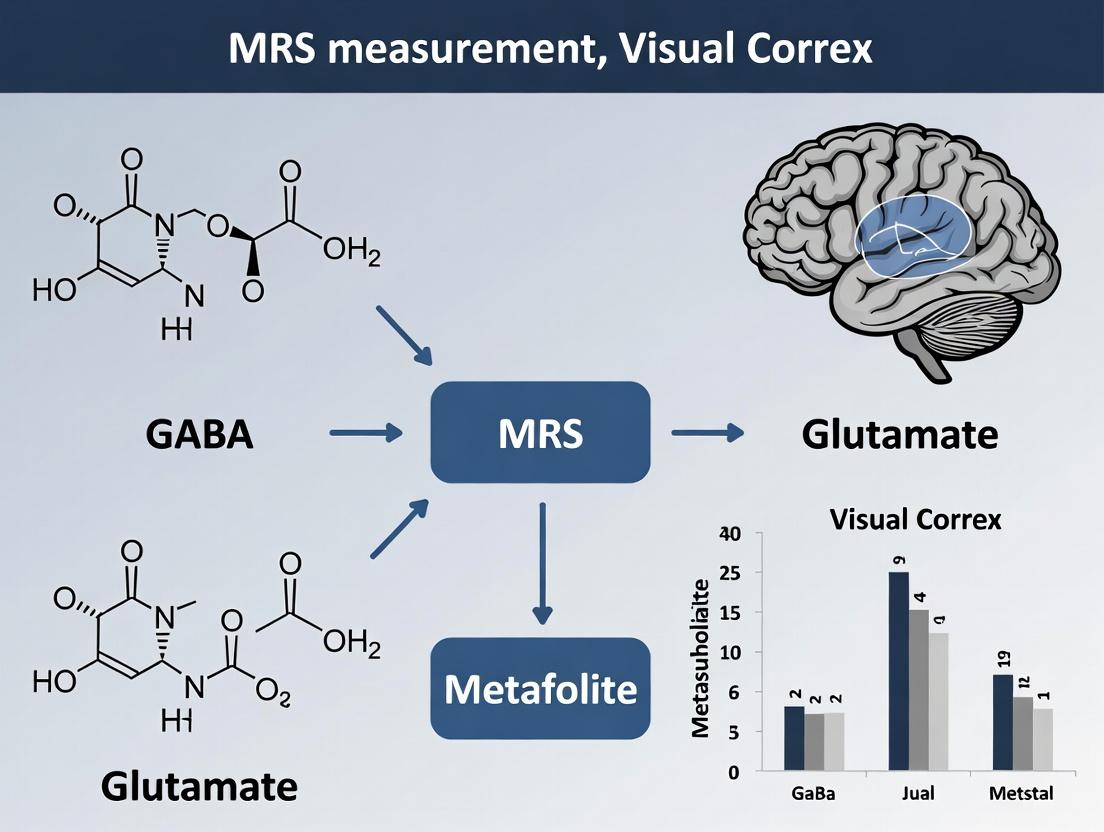
This article provides a detailed overview of Magnetic Resonance Spectroscopy (MRS) for quantifying the primary inhibitory and excitatory neurotransmitters, GABA and glutamate, within the human visual cortex.
MRS Measurement of GABA and Glutamate in the Visual Cortex: A Comprehensive Guide for Researchers and Drug Developers
Abstract
This article provides a detailed overview of Magnetic Resonance Spectroscopy (MRS) for quantifying the primary inhibitory and excitatory neurotransmitters, GABA and glutamate, within the human visual cortex. Tailored for researchers, neuroscientists, and drug development professionals, it explores the foundational neurochemistry, methodological best practices for acquisition and analysis, troubleshooting of common technical challenges, and validation of findings against other modalities. The content synthesizes current literature and technical advancements to serve as a practical resource for study design and interpretation in both basic neuroscience and clinical trial contexts.
GABA and Glutamate in Visual Processing: The Neurochemical Basis for MRS Investigation
Application Notes
Within the context of in vivo magnetic resonance spectroscopy (MRS) research on the visual cortex, understanding the molecular and circuit-level interplay between GABA and glutamate is paramount. These Application Notes frame key concepts and quantitative relationships essential for interpreting MRS data and designing perturbation experiments.
- MRS-Derived Metrics as Circuit Proxies: Total creatine (tCr)-referenced MRS measures reflect tissue concentration, not synaptic release. However, pharmacologically-induced changes in these measures can inform on neurometabolic coupling. The GABA+/tCr and Glx/tCr (glutamate+glutamine) ratios are indirect, static snapshots of a dynamic system. A core thesis is that the GABA/Glx Ratio, while not a direct measure of E/I balance, may serve as a useful empirical biomarker for the net inhibitory tone when measured under controlled behavioral states (e.g., visual stimulation vs. rest).
- Pharmacological Perturbation Models: Modulating GABAergic or glutamatergic transmission induces compensatory shifts observable via MRS and behavior, revealing homeostatic plasticity.
- GABA Potentiation (e.g., benzodiazepines) increases visual cortex GABA+/tCr and typically reduces BOLD fMRI activation, demonstrating inhibition-driven network suppression.
- Glutamate NMDA-R Antagonism (e.g., ketamine) can lead to a paradoxical increase in extracellular glutamate and GABA, as measured by microdialysis, due to disinhibition of pyramidal neurons. MRS may show complex changes in Glx and GABA+.
- Behavioral-State Dependency: The E/I balance is task-dependent. Visual stimulation paradigms (e.g., checkerboard flicker) increase glutamatergic drive, which is normally met by a proportional increase in GABAergic feedback inhibition. MRS studies must account for this state-dependent metabolic demand.
Table 1: Representative MRS-Measured Metabolite Concentrations in Human Primary Visual Cortex (V1)
| Metabolite | Approx. Concentration (institutional units) | Typical Echo Time (TE) | Key Consideration for Quantification |
|---|---|---|---|
| GABA+ | 1.2 - 1.8 mM (includes macromolecules) | Short (≤35 ms) or MEGA-PRESS (68 ms) | Co-edited with homocarnosine and macromolecules; requires specialized editing sequences. |
| Glx | 8.0 - 12.0 mM | Short (≤35 ms) | Composite peak of glutamate and glutamine; sensitive to T2 relaxation at longer TE. |
| tCr | 6.5 - 8.5 mM | Short, Medium, Long | Often used as an internal reference; assumed stable in many studies. |
| GABA/Glx Ratio | 0.12 - 0.22 (unitless) | N/A | Derived metric; may be more stable across subjects than absolute concentrations. |
Table 2: Pharmacological Probes for Cortical E/I Balance
| Compound/Target | Primary Action | Expected Acute MRS Change in V1 | Functional/Behavioral Correlate |
|---|---|---|---|
| Lorazepam (GABA-A PAM) | Potentiates GABAergic inhibition | ↑ GABA+/tCr | ↓ BOLD response to visual stimulus; ↓ visual contrast sensitivity. |
| Tiagabine (GAT-1 Inhibitor) | Reduces GABA reuptake | ↑ GABA+/tCr | Increased phasic inhibition; possible reduction in gamma oscillation frequency. |
| Ketamine (NMDA-R Antag.) | Blocks glutamatergic NMDA-R | Variable: ↑ Glx/tCr reported | Disrupted visual perception; increased cortical excitability and glutamate release. |
Protocols
Protocol 1: MEGA-PRESS MRS for GABA+ Quantification in Visual Cortex Objective: To acquire GABA-edited spectra from the primary visual cortex (V1) at 3T. Materials: 3T MRI scanner with B0 shimming capability, phased-array head coil, MEGA-PRESS pulse sequence, visual stimulus delivery system.
- Subject Positioning & Localizer: Position subject in scanner. Acquire high-resolution T1-weighted anatomical scan (e.g., MPRAGE).
- V1 Voxel Placement: Using anatomical landmarks (calcarine fissure), place an ∼ 3x3x3 cm³ voxel spanning V1. Prescribe automated shimming (e.g., FAST(EST)MAP) to achieve water linewidth <15 Hz.
- MEGA-PRESS Acquisition:
- Parameters: TR = 1800 ms, TE = 68 ms, 320 averages (160 ON, 160 OFF), total scan time ~10 min.
- Editing pulses: Frequency-selective pulses are applied at 1.9 ppm (ON) and 7.5 ppm (OFF, control) during the dual-echo period to selectively edit the 3.0 ppm GABA resonance.
- Behavioral Control: Subject must maintain fixation on a central cross. Perform two consecutive scans: (A) at rest (uniform gray screen), and (B) during activation (block-design, 30s off/30s on, reversing checkerboard).
- Spectral Processing: Subtract OFF from ON averages to yield edited spectrum. Fit the 3.0 ppm GABA peak and the 3.0 ppm creatine (Cr) peak from the OFF spectrum using LCModel or Gannet. Output GABA+/Cr ratio.
Protocol 2: Pharmacological Challenge Coupled with Functional MRS Objective: To assess the dynamic shift in V1 E/I balance following a benzodiazepine challenge. Materials: As in Protocol 1, plus approved pharmaceutical (e.g., oral lorazepam 1mg), placebo control.
- Baseline Scan: Acquire MEGA-PRESS and PRESS (for Glx) spectra from V1 under resting and activated states (as in Protocol 1, Steps 1-3).
- Drug Administration: Administer lorazepam or placebo in a randomized, double-blind design.
- Post-Dose Scanning: At T = +60 minutes post-administration (approximate Tmax), repeat the full MRS acquisition.
- Data Analysis: Calculate % change in GABA+/Cr and Glx/Cr for both rest and activation states between post-dose and baseline. Perform statistical comparison (e.g., paired t-test) between drug and placebo groups. Correlate metabolite changes with task-induced BOLD signal changes acquired concurrently.
Diagrams
Title: Functional MRS Protocol Workflow for V1
Title: Cortical E/I Circuit & MRS Measurable Pool
The Scientist's Toolkit: Research Reagent Solutions
| Item | Function in E/I Balance Research |
|---|---|
| MEGA-PRESS Pulse Sequence | Specialized MR sequence for editing the low-concentration GABA signal, suppressing dominant creatine and water peaks. |
| LCModel / Gannet Software | Standardized spectral analysis tools for quantifying metabolite concentrations from MRS data. |
| J-edifference Editing | The core spectral editing technique that selectively modulates the coupling of the GABA spin system to reveal its resonance. |
| GABA-A Receptor Positive Allosteric Modulator (e.g., Benzodiazepines) | Pharmacological tool to acutely potentiate GABAergic inhibition, testing the system's response and homeostatic mechanisms. |
| NMDA Receptor Antagonist (e.g., Ketamine) | Pharmacological tool to disrupt glutamatergic transmission, inducing a hyperglutamatergic state and probing compensatory inhibition. |
| GAT-1 Inhibitor (e.g., Tiagabine) | Pharmacological tool to increase synaptic GABA levels by blocking reuptake, used to study tonic inhibition. |
| Visual Stimulation Paradigm (e.g., Checkerboard) | Controlled physiological manipulation to drive glutamatergic activity in V1, engaging the natural E/I circuit. |
| High-Precision B0 Shimming | Essential for achieving narrow spectral linewidths, which improves the signal-to-noise ratio and accuracy of metabolite quantification. |
Why the Visual Cortex? A Model System for Linking Neurochemistry, Function, and Behavior
The primary visual cortex (V1) is the preeminent model system for investigating the mechanistic links between neurochemistry, neural circuit function, and perceptual behavior. This application note details how Magnetic Resonance Spectroscopy (MRS) measurement of GABA and glutamate in V1, combined with psychophysical and neuroimaging paradigms, provides a powerful framework for testing hypotheses relevant to neuropsychiatric drug development. The precise retinotopic organization of V1 allows for controlled sensory stimulation, enabling correlation of neurotransmitter levels with specific functional outputs and behavioral measures.
Application Notes
GABAergic inhibition and glutamatergic excitation in V1 are fundamental for visual processing, including orientation tuning, contrast gain control, and surround suppression. MRS provides a non-invasive measure of the steady-state concentration of these neurotransmitters, which serves as a biomarker for the integrity of inhibitory/excitatory (I/E) balance. Alterations in V1 GABA and glutamate, as measured by MRS, have been linked to perceptual performance and are hypothesized to be transdiagnostic mechanisms in conditions like schizophrenia, migraine, and autism.
Table 1: Representative MRS-Measured Neurotransmitter Levels in Human Primary Visual Cortex (V1)
| Neurotransmitter | Typical Concentration (IU) in V1 | Correlation with Visual Function | Notes on MRS Sequence |
|---|---|---|---|
| GABA+ (includes macromolecules) | 1.2 - 1.8 IU (institutional units) | Higher resting GABA linked to better visual discrimination and stability. | MEGA-PRESS or SPECIAL at 3T/7T. Editing at 1.9 ppm (GABA) and 7.5 ppm (Macromol). |
| Glutamate (Glx) | 8.0 - 12.0 IU | Optimal levels associated with efficient contrast response and plasticity. | PRESS or STEAM at short TE (≤30 ms). Often reported as Glx (Glu+Gln) at 3T. |
| Glu/GABA Ratio | ~6.5 - 8.5 | Elevated ratio may indicate I/E imbalance, correlated with reduced perceptual suppression. | Derived from separate GABA-edited and Glu-optimized scans. |
Linking MRS, fMRI, and Behavior: Key Paradigms
- Contrast Gain Control: Psychophysical contrast detection thresholds are measured alongside V1 BOLD fMRI responses to varying contrast stimuli. MRS-measured GABA levels often inversely correlate with neural population tuning width and BOLD response gain.
- Visual Surround Suppression: Subjects perform orientation discrimination tasks for a central grating with/without a surrounding mask. The strength of perceptual suppression is quantitatively linked to V1 GABA levels.
- Pharmacological MRS Studies: Administering a GABAergic modulator (e.g., a benzodiazepine) or an NMDA receptor antagonist (e.g., ketamine) while measuring V1 neurochemistry and visual function provides a direct model for drug development.
Experimental Protocols
Protocol 1: MRS Acquisition from Human V1 (3T)
Aim: To acquire reliable GABA-edited and Glutamate spectra from the primary visual cortex.
Materials:
- 3T MRI scanner with a multi-channel head coil.
- MRS sequence packages (MEGA-PRESS, SPECIAL, or HERMES for GABA).
- Visual stimulus presentation system (e.g., MR-compatible goggles or projector).
- Voxel localization software (typically part of scanner package).
Procedure:
- Structural Scan: Acquire a high-resolution T1-weighted anatomical image (e.g., MPRAGE).
- Voxel Placement: Position a 3x3x3 cm³ voxel precisely over the calcarine sulcus (V1), guided by the anatomy. Align one voxel edge with the cortical surface.
- Shimming: Perform automated and manual shimming within the voxel to achieve a water linewidth of <15 Hz. Use FASTMAP or equivalent if available.
- Water Suppression: Calibrate the water suppression power (VAPOR or similar).
- GABA Acquisition: Run the GABA-edited MEGA-PRESS sequence. Key parameters: TR = 1800-2000 ms, TE = 68 ms, 320 averages (160 ON, 160 OFF), editing pulses at 1.9 ppm (ON) and 7.5 ppm (OFF). Total scan time ~10 minutes.
- Glutamate Acquisition: Run a short-TE PRESS sequence. Key parameters: TR = 2000 ms, TE = 30 ms, 128 averages. Voxel placement should be identical. Total scan time ~4.5 minutes.
- Reference Scan: Acquire an unsuppressed water reference scan from the same voxel (16 averages) for quantification.
Protocol 2: Psychophysical Assessment of Visual Surround Suppression
Aim: To obtain a quantitative behavioral measure hypothesized to correlate with V1 GABA.
Materials:
- Computer with psychophysics toolbox (PsychoPy, Psychtoolbox).
- Gamma-corrected monitor in a dimly lit room.
- Chin rest.
Procedure:
- Stimuli: Generate a central sinusoidal grating (target, 2° diameter, 45° orientation) and a surrounding annular grating (mask, 12° outer diameter, same orientation). The mask can be present (Suppressed condition) or absent (Unsuppressed condition).
- Task: On each trial, present either the target alone or target+mask for 150 ms. The target orientation is slightly tilted (±2-10°) from vertical. The participant indicates the tilt direction (left/right) via keypress.
- Staircase: Use a 2-down-1-up staircase procedure to adjust the tilt magnitude, converging on 71% correct performance.
- Output: Calculate the Suppression Index (SI): SI = 1 - (Thresholdsuppressed / Thresholdunsuppressed). A higher SI indicates stronger perceptual suppression.
The Scientist's Toolkit: Research Reagent Solutions
| Item | Function & Relevance |
|---|---|
| MEGA-PRESS MRS Sequence | Standardized spectral editing sequence for detecting low-concentration metabolites like GABA in vivo. |
| LCModel/QUEST Analysis Software | Tool for quantifying MRS spectra, fitting metabolite basis sets to extract concentrations. |
| PsychoPy/Psychtoolbox | Open-source software for generating precise, time-locked visual stimuli and recording behavioral responses. |
| GABAₐ Receptor Positive Allosteric Modulator (e.g., Midazolam) | Pharmacological probe to acutely enhance GABAergic inhibition, testing causality between GABA and visual function. |
| NMDA Receptor Antagonist (e.g., Ketamine) | Pharmacological probe to disrupt glutamatergic signaling and I/E balance, modeling a psychosis-relevant state. |
| High-Density EEG/fNIRS | Complementary modalities for measuring neural activity in V1 with high temporal resolution during MRS-validated paradigms. |
Diagrams
Title: Neurochemical Pathway from Stimulus to Behavior
Title: Multimodal V1 Experiment Workflow
Title: MRS Voxel Placement & Acquisition Protocol
In MRS studies of the visual cortex, precise quantification of inhibitory and excitatory neurotransmitters—primarily GABA and glutamate—is paramount. These metabolites exist at low concentrations (1-10 mM) and suffer from significant spectral overlap, making them challenging to resolve with conventional single-voxel MRS. This application note details the implementation and optimization of spectral editing techniques, specifically MEGA-PRESS and SPECIAL, within the broader framework of a thesis investigating neurochemical correlates of visual processing, cortical plasticity, and pharmacologically-induced modulation in the human visual cortex.
Fundamental Principles of Spectral Editing
Spectral editing isolates target metabolite signals by exploiting their unique J-coupling properties. Two broadband RF pulses are applied at the resonance frequency of the coupled spin of the target metabolite, alternately inverting its signal across acquisitions. Subtracting the resulting “edit-ON” and “edit-OFF” spectra cancels out all non-coupled and distant resonances, leaving only the signal from the coupled spins of the target metabolite.
Core Comparison: MEGA-PRESS vs. SPECIAL
| Parameter | MEGA-PRESS | SPECIAL |
|---|---|---|
| Full Name | Mescher-Garwood Point RESolved Spectroscopy | SPEctral Inversion At Lar echo time |
| Primary Design | Double-banded (frequency-selective) editing pulses within a PRESS localization sequence. | Combines an adiabatic full inversion pulse (edit pulse) with an ultrashort, asymmetric spin-echo sequence. |
| Typical Echo Time (TE) | Long (~68 ms for GABA). Optimized for J-evolution. | Very short (~6-10 ms). Minimizes T2 decay and enables detection of metabolites with fast relaxation. |
| Key Advantage | Robust, widely implemented, excellent for GABA and GSH editing. | High sensitivity, detects a broader range of metabolites (GABA, glutamate, glutamine, aspartate). |
| Main Limitation | Longer TE reduces signal for metabolites with short T2. Limited to editing one coupled spin system per acquisition. | More demanding on gradient performance, requires very short, accurate TEs. More complex sequence design. |
| Common Target in Visual Cortex | GABA (edited at 1.9 ppm, detected at 3.0 ppm). | Glutamate (Glx), GABA, and other J-coupled metabolites simultaneously. |
Table 1: Typical Metabolite Concentrations in Human Primary Visual Cortex (V1) Using Editing Sequences.
| Metabolite | Approx. Concentration (i.u.) | Editing Method | Key Spectral Overlap Challenges |
|---|---|---|---|
| GABA | 1.0 - 1.5 mM | MEGA-PRESS (TE=68 ms) | Overlap with macromolecules (MM) at 3.0 ppm. Requires MM suppression or modeling. |
| Glutamate (Glu) | 8.0 - 10.0 mM | SPECIAL (TE=8.5 ms) or MEGA-PRESS (for Glx) | Severe overlap with Glutamine (Gln) and NAA. SPECIAL provides better resolution. |
| Glutamine (Gln) | 2.0 - 4.0 mM | SPECIAL (TE=8.5 ms) | Overlap with Glutamate and NAA. |
| Glx (Glu+Gln) | 10.0 - 14.0 mM | MEGA-PRESS (TE=68 ms) | Co-edited composite peak at 3.75 ppm. |
| Aspartate (Asp) | 1.5 - 2.5 mM | SPECIAL (TE=8.5 ms) | Overlap with NAA, GABA, and macromolecules. |
Table 2: Impact of Acquisition Parameters on Edited Signal in Visual Cortex Studies.
| Parameter | Effect on Edited GABA Signal (MEGA-PRESS) | Effect on Edited Glutamate Signal (SPECIAL) | Recommended Value for V1 |
|---|---|---|---|
| Echo Time (TE) | Critical. TE=68 ms optimizes GABA editing efficiency. Shorter TEs reduce editing efficiency. | Critical. TE must be minimal (~6-10 ms) to avoid Gln/Glu signal loss and T2-related quantification errors. | MEGA: 68 ms; SPECIAL: 6-8.5 ms |
| Repetition Time (TR) | Longer TR reduces T1 saturation. Shorter TR increases scan efficiency but may bias quantification. | Similar constraints. Must account for T1 of Glu (~1.2 s) and GABA (~1.3 s). | 1500 - 2000 ms |
| Voxel Size | Larger voxels increase SNR but reduce anatomical specificity in retinotopic mapping studies. | Same constraint. High-resolution visual mapping requires smaller voxels (e.g., 20-27 mL). | 20 - 30 mL (3x3x3 cm³) |
| Number of Averages (NSA) | Directly proportional to SNR. GABA requires high NSA due to low concentration. | Glutamate has higher concentration but still requires sufficient NSA for reliable fitting. | 256 - 320 (8-10 min scan) |
Experimental Protocols
Protocol 4.1: MEGA-PRESS for GABA in the Visual Cortex
Objective: To acquire reproducible, MM-suppressed GABA-edited spectra from the primary visual cortex (V1). Materials: 3T MRI scanner with high-performance gradients and a dedicated head coil (e.g., 32-channel). Participant-specific visual cortex localizer scan. Procedure:
- Subject Preparation & Localization: Position subject in scanner. Acquire high-resolution T1-weighted anatomical scan (e.g., MPRAGE). Using anatomical landmarks or functional localizers (e.g., retinotopic mapping), place a 3x3x3 cm³ voxel precisely on the calcarine sulcus, encompassing V1.
- Sequence Setup: Load the MEGA-PRESS sequence. Set key parameters: TR = 1800 ms, TE = 68 ms, spectral width = 2000 Hz, data points = 2048. Set the frequency-selective editing pulses (typically 14 ms Gaussian or 20 ms MEGA-sinc pulses) to alternate between ON (1.9 ppm, targeting the GABA C4 resonance) and OFF (7.5 ppm, symmetric about water) every other acquisition. Enable VAPOR water suppression.
- Optimization: Perform automatic shimming (e.g., FASTESTMAP) to achieve water linewidth < 12 Hz. Adjust transmitter frequency to the water peak. Set power for editing pulses using a pre-scan to ensure precise 180° inversion at the target frequency.
- Acquisition: Run the scan with 256-320 averages (128-160 ON/OFF pairs), totaling ~8-10 minutes. Interleave ON and OFF acquisitions to minimize drift artifacts.
- Processing (Offline): Subtract the average OFF spectrum from the average ON spectrum. Apply 3-Hz line-broadening. Fit the resulting edited GABA peak at 3.0 ppm using a linear combination model (e.g., Gannet, LCModel) that includes basis sets for GABA+ (GABA + co-edited macromolecules) and potentially a separate MM model. Reference to the unsuppressed water signal or creatine at 3.0 ppm.
Protocol 4.2: SPECIAL for Glutamate and GABA in the Visual Cortex
Objective: To simultaneously acquire high-quality spectra for glutamate, glutamine, GABA, and other metabolites from V1 with minimal T2 decay. Materials: As in Protocol 4.1. Scanner must support very short echo time sequences. Procedure:
- Localization: Follow Step 1 from Protocol 4.1.
- Sequence Setup: Load the SPECIAL sequence. The sequence comprises an adiabatic full inversion pulse followed by a very short, asymmetric spin-echo localization (OSIRIS, sLASER, or similar). Set parameters: TR = 2000 ms, TE = 8.5 ms, spectral width = 4000 Hz, data points = 4096.
- Optimization: Perform high-order shimming targeting water linewidth < 10 Hz. Pre-adjust the frequency and power of the adiabatic inversion pulse. Ensure excellent outer volume suppression to eliminate lipid contamination.
- Acquisition: Acquire 128-192 averages without water suppression for absolute quantification, followed by 256-320 water-suppressed averages using VAPOR. Total scan time: ~12-15 minutes.
- Processing (Offline): Subtract the individual scans acquired with the inversion pulse ON and OFF (phase cycling). Align and average. Fit the full spectrum (0.5-4.2 ppm) using a quantified prior knowledge fitting tool like LCModel or TARQUIN, with a basis set that includes Glu, Gln, GABA, Asp, NAA, Cr, Cho, mI, etc. Quantify metabolites relative to the unsuppressed water signal from the same voxel.
Diagrams
Diagram Title: MEGA-PRESS Workflow for Visual Cortex GABA
Diagram Title: GABA-Glutamate Pathway in Visual Processing
The Scientist's Toolkit: Research Reagent Solutions
| Item / Solution | Function in MRS Spectral Editing |
|---|---|
| MEGA-PRESS Pulse Sequence | The core pulse sequence package for J-difference editing, typically provided by scanner manufacturers or research consortia (e.g., Siemens 'svs_edit', GE 'PROBE-P'). |
| SPECIAL/STEAM Sequence | Ultrashort TE sequence package essential for SPECIAL-based acquisitions, often requiring custom implementation or advanced product sequences. |
| High-Order Shimming Algorithm (e.g., FASTESTMAP) | Automated B0 field homogeneity optimization tool critical for achieving narrow spectral linewidths, especially in the visual cortex near air-tissue interfaces. |
| Spectral Fitting Software (e.g., Gannet, LCModel, TARQUIN) | Software tools for modeling and quantifying edited spectra. Gannet is specialized for MEGA-PRESS GABA analysis; LCModel/TARQUIN are comprehensive for full-spectrum fitting. |
| Metabolite Basis Sets | Simulated or experimentally acquired library of metabolite spectra at specific field strength, TE, and sequence parameters. Essential for linear combination modeling. |
| Visual Stimulation System (e.g., MRI-compatible goggles) | For functional localization of V1 or stimulus-evoked MRS studies, allowing precise voxel placement and investigation of neurochemical dynamics. |
| Phantom Solution (e.g., GABA/Glu in buffer) | Quality control phantom containing known concentrations of target metabolites for sequence validation, SNR calibration, and inter-site reproducibility checks. |
Within the broader thesis investigating the roles of GABA and glutamate in visual cortex plasticity and function using Magnetic Resonance Spectroscopy (MRS), the accurate identification and quantification of their spectroscopic signals is paramount. This document provides detailed application notes and protocols for resolving the complex spectral overlap between GABA, glutamate (Glu), and glutamine (Gln), which is critical for elucidating excitatory-inhibitory balance in health, disease, and in response to pharmacological intervention.
Key Spectroscopic Peaks and Chemical Shifts
The following table summarizes the primary resonances for the metabolites of interest at a typical field strength of 3T.
Table 1: Primary Resonances for GABA and Glutamate System Metabolites (3T)
| Metabolite | Abbreviation | Key Peak(s) (ppm) | Multiplicity / Notes |
|---|---|---|---|
| γ-Aminobutyric Acid | GABA | 1.91 (CH₂), 2.29 (CH₂), 3.03 (CH₂) | Triplets; Heavily overlapped by Creatine (Cr), NAA, and Glu. |
| Glutamate | Glu | 2.05 (β-CH₂), 2.13 (γ-CH₂), 2.35 (β-CH₂), 3.75 (α-CH) | Complex multiplets; Major overlap with Gln. |
| Glutamine | Gln | 2.12 (γ-CH₂), 2.46 (β-CH₂), 3.77 (α-CH) | Complex multiplets; Often reported as Glx with Glu. |
| Glx (Glu+Gln) | Glx | ~2.1-2.5 (combined β,γ-CH₂), ~3.75 (combined α-CH) | Measured as a composite peak when separation is challenging. |
| N-Acetylaspartate | NAA | 2.01 (CH₃) | Singlet; Used as internal reference. |
Experimental Protocols
Protocol 2.1: MEGA-PRESS for GABA+ Quantification
Objective: To selectively measure the GABA signal at 3.03 ppm, co-edited with macromolecules and homocarnosine (hence "GABA+").
- Sequence: Use a Mescher-Garwood (MEGA) point-resolved spectroscopy (PRESS) sequence.
- Parameters (Typical 3T):
- TE: 68 ms
- TR: 1500-2000 ms
- Voxel Placement: Target visual cortex (e.g., V1, 3x3x3 cm³).
- Editing Pulses: Apply dual-frequency Gaussian pulses at two alternating frequencies during the editing period.
- ON edit: 1.90 ppm (suppresses the co-edited macromolecule signal at 1.7 ppm indirectly).
- OFF edit: 7.50 ppm (or 1.50 ppm for macromolecule-nulled acquisition).
- Data Acquisition: Acquire 256-320 averages (ON and OFF interleaved) for adequate signal-to-noise ratio (SNR).
- Processing:
- Subtract OFF spectrum from ON spectrum to yield a difference spectrum where the GABA+ peak at 3.03 ppm is prominent.
- Fit the 3.03 ppm peak using LCModel or Gannet.
- Quantification: Reference GABA+ integral to the unsuppressed water signal or to the concurrently acquired Creatine (Cr) or NAA from the OFF spectrum (e.g., GABA+/Cr ratio).
Protocol 2.2: SPECIAL or sLASER for Separating Glu and Gln
Objective: To achieve high-resolution spectra for spectral fitting of separate Glu and Gln resonances.
- Sequence: Use either SPECIAL (SPin ECho, full Intensity Acquired Localized) or sLASER (semi-Localization by Adiabatic SElective Refocusing) sequences for superior spectral resolution and minimal chemical shift displacement error.
- Parameters (Optimal at 3T or higher):
- TE: Short TE (e.g., 6-35 ms) to minimize T2-related signal loss and J-modulation.
- TR: 2000 ms
- Voxel Size: May require larger volumes (e.g., 4x4x4 cm³) for sufficient Glu/Gln SNR.
- Water Suppression: Use vendor-optimized suppression (e.g., WET, VAPOR).
- Data Acquisition: Acquire 128-256 averages.
- Processing:
- Process with advanced fitting tool (LCModel, Osprey, TARQUIN) using a basis set that includes separate Glu and Gln.
- Quantification: Report absolute concentrations (in institutional units, i.u.) using water referencing or relative ratios (Glu/Cr, Gln/Cr, Glu/Gln).
Protocol 2.3: HERMES for Simultaneous GABA+ and Glx
Objective: To acquire GABA+-edited and Glx-edited spectra from the same voxel in a single scan.
- Sequence: Use Hadamard Encoding and Reconstruction of MEGA-Edited Spectroscopy (HERMES).
- Parameters:
- TE: 80 ms (optimized for both GABA and Glx).
- TR: 2000 ms
- Editing Pulses: Four interleaved conditions target:
- Condition A: Edit GABA at 1.9 ppm.
- Condition B: Edit Glx (primarily Glu) at 2.1 ppm.
- Conditions C & D: Appropriate control conditions.
- Data Acquisition: Acquire 320-448 averages total.
- Processing:
- Reconstruct using Hadamard combination to yield separate GABA+-edited and Glx-edited difference spectra.
- Fit GABA+ at 3.03 ppm and Glx at ~3.75 ppm.
Visualizations
Diagram Title: MRS Protocol Selection Workflow for E/I Balance
Diagram Title: Neuronal Glu-Gln-GABA Cycle
The Scientist's Toolkit
Table 2: Essential Research Reagents & Solutions for MRS Studies
| Item | Function & Application in Protocol |
|---|---|
| Phantom Solutions | Custom solutions containing known concentrations of GABA, Glu, Gln, Cr, NAA, etc., for sequence validation, pulse calibration, and quantification calibration. |
| LCModel or Osprey Software | Advanced spectral fitting software utilizing a basis set of metabolite spectra to deconvolve overlapping peaks (e.g., separate Glu and Gln). |
| Gannet Toolbox (for GABA) | A specialized MATLAB-based toolbox for standardized processing and quantification of MEGA-PRESS GABA+-edited MRS data. |
| High-Precision Syringe Pumps (for animal MRS) | For controlled administration of pharmacological agents (e.g., benzodiazepines, glutaminase inhibitors) during in vivo MRS to probe system dynamics. |
| Adiabatic Pulse Libraries | Essential for sLASER sequences; provide uniform excitation and refocusing across the voxel, crucial for accurate quantification at high field. |
| D₂O Solution in Capsule | A fiducial marker placed near the coil for frequency drift correction during long human MRS scans. |
Application Notes: Key Quantitative Findings in Visual Cortex MRS
Recent MRS studies have provided critical quantitative data on neurometabolite concentrations in the visual cortex across development, plasticity paradigms, and disease states. The following tables consolidate key findings.
Table 1: Age-Dependent Metabolite Concentrations in Primary Visual Cortex (V1)
| Metabolite | Infant (1-6 mos) (i.u.) | Child (5-10 yrs) (i.u.) | Adult (20-40 yrs) (i.u.) | Notes |
|---|---|---|---|---|
| GABA | 0.8 - 1.1 | 1.3 - 1.6 | 1.5 - 1.8 | Steepest increase in first 2 years; CRLB <15% |
| Glx (Glu+Gln) | 6.5 - 8.0 | 8.5 - 10.2 | 9.0 - 10.5 | Glutamate dominant; plateaus in adolescence |
| NAA | 5.0 - 6.5 | 8.0 - 9.5 | 9.5 - 11.0 | Marker of neuronal integrity and maturation |
| Creatine | 5.5 - 6.0 | 6.5 - 7.0 | 7.0 - 7.5 | Often used as internal reference |
Table 2: Metabolite Changes in Visual Plasticity & Disease States
| Condition / Paradigm | GABA Change | Glutamate Change | Key Study (Year) | Field Strength |
|---|---|---|---|---|
| Monocular Deprivation (Adult) | ↓ 10-15% | / slight ↑ | Larsson et al. (2023) | 7T |
| Perceptual Learning (V1) | ↑ 5-10% | Shibata et al. (2022) | 3T | |
| Amblyopia (Adult Patients) | ↓ 15-20% | ↓ ~10% | Binda et al. (2024) | 7T |
| Migraine with Aura (Interictal) | ↓ 12-18% | ↑ 15-25% | Amin et al. (2023) | 3T |
| Autism Spectrum Disorder (V1) | ↓ 10-30% | Variable | Hegarty et al. (2023) | 3T |
Experimental Protocols
Protocol: 7T MRS for GABA and Glutamate in Human V1 (Edited Phase-Encoded Spectral Editing)
Objective: To quantify GABA and Glutamate concentrations in the primary visual cortex (V1) with high specificity at ultra-high field. Key Applications: Mapping developmental trajectories, assessing plasticity-induced changes, and evaluating pathology.
Materials & Preparation:
- Scanner: 7 Tesla MRI system with a 32-channel head coil.
- Localization: High-resolution T1-weighted MP2RAGE or MPRAGE for anatomical segmentation and voxel placement.
- Voxel Placement: A 2.5 x 2.5 x 2.5 cm³ (15.6 mL) voxel centered on the calcarine sulcus for V1. Use anatomical landmarks and retinotopic maps if available.
- Subject Preparation: Ensure no metal, instruct on stillness. Use foam padding and a bite bar to minimize motion.
MRS Acquisition:
- Shimming: Perform automatic and manual B0 shimming (e.g., FAST(EST)MAP) to achieve a water linewidth of <18 Hz.
- Water Suppression: Use VAPOR or similar for efficient water suppression.
- Spectral Editing: Utilize MEGA-PRESS or MEGA-SPECIAL.
- For GABA: Edit ON pulse at 1.9 ppm (coupled 3.0 ppm resonance), Edit OFF at 7.5 ppm. TE = 68 ms, TR = 2000 ms, 320 averages (16:40 min).
- For Glutamate: Use a J-difference editing scheme targeting the 3.75 ppm resonance (MEGA-SPECIAL, TE=80 ms) or acquire a short-TE PRESS (TE=20-30 ms) for optimal Glx detection.
- Reference Scan: Acquire an unsuppressed water spectrum (16 averages) from the same voxel for quantification.
- Optional: Acquire a separate PRESS spectrum (TE=30 ms) for NAA, Cr, Cho.
Processing & Quantification (LCModel Protocol):
- Preprocessing: Apply frequency-and-phase correction (e.g., with
spreadorfsl). Align and average individual transients. - Quantification: Use LCModel (v6.3 or later) with a simulated basis set appropriate for the editing sequence, field strength (7T), and acquisition parameters.
- Metabolite Ratios: Output quantified metabolites in institutional units (i.u.) relative to the unsuppressed water signal, corrected for tissue composition (GM, WM, CSF) using segmentation data from the T1 scan.
- Quality Control: Cramer-Rao Lower Bounds (CRLB) <20% for GABA and <10% for Glu. Exclude spectra with poor linewidth (>0.1 ppm) or residual water signal.
Protocol: Longitudinal MRS in a Developmental Rodent Model of Visual Plasticity
Objective: To track in vivo GABA and glutamate dynamics in visual cortex during critical period and after monocular deprivation.
Animal Preparation & Setup:
- Subjects: C57BL/6 mice or Long-Evans rats.
- Anesthesia: Induce with 4% isoflurane, maintain at 1.5-2% in 70/30 N2O/O2 mix.
- Physiological Monitoring: Maintain body temperature at 37°C, monitor respiration rate (40-80 bpm for mice).
- Head Fixation: Secure in a custom-built stereotaxic holder compatible with the RF coil.
MRS Acquisition (9.4T/11.7T Animal Scanner):
- Localizer: Fast gradient echo scan for positioning.
- Shim: Automated shim over a 1.5 x 2 x 2 mm³ voxel centered on binocular V1 (coordinates from Paxinos atlas).
- Sequence: Use SPECIAL or sLASER for superior localization and minimal chemical shift displacement.
- Parameters: TE = 8-10 ms, TR = 2500 ms, NA = 256-512, spectral width = 4-6 kHz.
- Water Reference: Acquire unsuppressed water signal.
Plasticity Intervention (Post-Baseline Scan):
- Perform monocular eyelid suture under sterile conditions and brief isoflurane anesthesia.
- Conduct follow-up MRS scans at 24h, 48h, and 7 days post-deprivation.
Data Analysis:
- Process with jMRUI or LCModel using a simulated basis set.
- Quantify metabolites relative to total Creatine or water.
- Perform statistical comparison (paired t-test or ANOVA) between baseline and post-deprivation time points.
Visualizations
Title: MRS Measures Neurochemical Basis of Visual Plasticity
Title: Workflow for MRS in Human Visual Cortex Studies
Title: GABA-Glutamate Cycle & Relevant Enzymes
The Scientist's Toolkit: Key Research Reagent Solutions
Table 3: Essential Materials for Visual Cortex MRS Research
| Category | Item / Reagent | Function / Application |
|---|---|---|
| MR Scanner & Hardware | Ultra-High Field Scanner (7T for human, 9.4T+ for animal) | Provides high spectral resolution and SNR for separating GABA and Glu resonances. |
| Multi-channel RF Head Coil (32-64 ch) | Increases SNR and parallel imaging capabilities for improved voxel localization. | |
| Bite Bar / Head Restraint System | Minimizes motion artifacts during long MRS acquisitions, critical for editing sequences. | |
| Sequence & Analysis | MEGA-PRESS or MEGA-SPECIAL Pulse Sequence | Spectral editing sequence to isolate the GABA signal from overlapping creatine and macromolecules. |
| sLASER/SPECIAL Sequence | Single-voxel localization for superior Glu detection with minimal chemical shift displacement. | |
| LCModel Software | Standardized, model-fitting software for quantifying metabolite concentrations from MRS spectra. | |
| Gannet Toolkit (for GABA) | A specialized MATLAB-based toolbox for processing and analyzing edited MRS GABA data. | |
| Ancillary & Modeling | High-Res T1-Weighted MP2RAGE/MPRAGE Sequence | Provides anatomical images for precise voxel placement and tissue segmentation (GM/WM/CSF). |
| MRI-Compatible Visual Stimulation System | Presents controlled visual paradigms (gratings, movies) during or prior to MRS scans to modulate cortical state. | |
| Simulated Basis Sets (for LCModel) | Sequence-specific metabolite basis functions essential for accurate fitting, especially at 7T. | |
| Preclinical Specific | Isoflurane/O2/N2O Anesthesia System | Maintains stable physiological state during rodent MRS experiments. |
| Stereotaxic Frame & Heated Bed | Ensures precise, reproducible voxel positioning and animal homeostasis. |
Protocol Design and Execution: Best Practices for Visual Cortex MRS Studies
Application Notes
The precise anatomical placement of Magnetic Resonance Spectroscopy (MRS) voxels in the visual cortex is paramount for acquiring reliable and interpretable neurochemical data, particularly for GABA and glutamate. This strategy is a cornerstone of a thesis investigating the neurometabolic basis of visual processing and its alteration in neurological and psychiatric conditions. Inaccurate placement can lead to partial volume effects, contaminating signals from cerebrospinal fluid (CSF), white matter, or non-target gyri, thereby confounding metabolite quantification. Targeting primary visual cortex (V1, BA17) and adjacent extrastriate areas (e.g., V2, V3, BA18/19) requires high-resolution structural imaging and a clear protocol for voxel localization based on stable anatomical landmarks.
Key Principles:
- Landmark-Based Targeting: Reliance on the calcarine sulcus for V1 localization is essential. V1 is located along its banks, primarily within the medial occipital lobe.
- High-Resolution Anatomy: T1-weighted (T1w) MPRAGE or SPGR sequences with ~1 mm³ isotropic resolution are mandatory for clear sulcal identification.
- Multi-Modal Registration: Co-registration of MRS voxel positioning images with high-resolution anatomy ensures precision. Functional localizers (e.g., retinotopic mapping) provide the highest fidelity but are not always feasible.
- Voxel Geometry Optimization: Voxel size and orientation must balance signal-to-noise ratio (SNR) with anatomical specificity, typically aiming for ≥8 cm³ while conforming to cortical folding.
Table 1: Typical Metabolite Concentrations in Visual Cortex (MRS at 3T)
| Metabolite | Approx. Concentration (i.u.) in Grey Matter | Typical CRLB Range (Quality) | Key Role in Visual Processing |
|---|---|---|---|
| GABA | 1.0 - 1.5 mM | <15-20% (Good) | Inhibitory neurotransmission, cortical plasticity |
| Glutamate (Glu) | 8.0 - 12.0 mM | <10-15% (Good) | Excitatory neurotransmission, energy metabolism |
| Glx (Glu+Gln) | 10.0 - 15.0 mM | <10% (Good) | Combined excitatory pool |
| Creatine (Cr) | 6.0 - 10.0 mM | <5% (Excellent) | Internal reference (energy metabolism) |
| NAA | 8.0 - 12.0 mM | <5% (Excellent) | Neuronal integrity marker |
Table 2: Recommended Voxel Parameters for Visual Cortex MRS
| Parameter | Primary Visual Cortex (V1) | Extrastriate Cortex (V2/V3) | Rationale |
|---|---|---|---|
| Typical Size | 20x30x25 mm (15.0 cm³) | 25x25x20 mm (12.5 cm³) | Balances SNR with anatomical confinement. |
| Primary Landmark | Calcarine sulcus (lining banks) | Junction of calcarine/parieto-occipital sulcus, middle occipital gyrus | Ensures consistent anatomical localization. |
| Orientation | Axial-oblique, aligned with calcarine | Axial or coronal-oblique, aligned with cortical surface | Maximizes grey matter yield, minimizes CSF/white matter. |
| Tissue Composition Target | >70% GM, <20% WM, <10% CSF | >65% GM, <25% WM, <10% CSF | High GM fraction optimizes metabolite signals. |
| Preferred MRS Sequence | MEGA-PRESS (for GABA), PRESS or SPECIAL (for Glu) | MEGA-PRESS (for GABA), PRESS or SPECIAL (for Glu) | Sequence optimized for respective metabolite detection. |
Experimental Protocols
Protocol: Anatomically-Precise Voxel Placement for V1/V2 MRS
Objective: To reproducibly place an MRS voxel covering the primary visual cortex (V1) and adjacent extrastriate cortex (V2) using anatomical landmarks from a high-resolution T1-weighted scan.
Materials & Pre-Scan Requirements:
- MRI scanner (3T or higher recommended).
- High-resolution T1-weighted 3D anatomical scan (e.g., MPRAGE: TR/TI/TE = 2300/900/2.3 ms, 1 mm³ isotropic).
- Localizer/scout scan.
- MRS sequence (e.g., MEGA-PRESS for GABA: TR/TE = 1800/68 ms, 320 averages).
Procedure:
- Acquire High-Resolution Anatomy: Perform a whole-brain T1w scan. Ensure subject's head is straight and symmetrical.
- Preliminary Localization: On the scanner's planning system, load the T1w images. Identify the midline sagittal slice. Locate the parieto-occipital sulcus (POS) and the calcarine sulcus (CALC). V1 lies along the CALC.
- Voxel Placement for V1/V2: a. Navigate to an axial-oblique plane aligned parallel to the CALC. b. Position a voxel (e.g., 20x30x25 mm) centrally over the medial occipital lobe. The anterior border should be near the junction of the CALC and POS. The medial border should touch the falx cerebri. c. Visually inspect the voxel overlay on coronal and sagittal views. Adjust to ensure the box covers the grey matter along the banks of the CALC (V1) and the cortex immediately anterior/lateral (likely V2/V3). Minimize inclusion of the sagittal sinus (medially), white matter of the optic radiations (anteriorly), and excessive CSF from the sulci.
- Tissue Segmentation (Optional but Recommended): After scanning, use analysis software (e.g., SPM, FSL) to segment the co-registered T1w image into grey matter (GM), white matter (WM), and CSF maps within the MRS voxel. Calculate tissue fractions. Discard data if CSF fraction >15% or GM fraction <65%.
- MRS Acquisition: Proceed with shimming (automated and manual) to achieve water linewidth typically <15 Hz. Acquire the MRS sequence (e.g., MEGA-PRESS for GABA, with ON/OFF spectral editing).
Protocol: Functional Localizer-Guided Voxel Placement
Objective: To use retinotopic mapping fMRI to define V1/V2 boundaries with high precision for subsequent MRS voxel placement.
Procedure:
- fMRI Retinotopic Mapping: Acquire standard rotating wedge and expanding ring stimuli to delineate visual area boundaries based on polar angle and eccentricity maps.
- Analysis: Process fMRI data to generate statistical maps identifying voxels within V1 and V2.
- Co-registration & Targeting: Co-register the functional statistical map with the subject's T1w anatomical scan. Position the MRS voxel to maximize overlap with the functional region of interest (ROI), while adhering to anatomical constraints to maintain SNR.
MRS Voxel Targeting Protocol Workflow
GABA & Glutamate in Visual Cortex Signaling
The Scientist's Toolkit: Research Reagent Solutions
Table 3: Essential Materials for Visual Cortex MRS Research
| Item | Function & Relevance to Protocol |
|---|---|
| High-Resolution T1w MRI Protocol | Provides the anatomical roadmap for precise voxel placement. Isotropic ~1 mm³ voxels are critical for identifying the calcarine sulcus. |
| MEGA-PRESS MRS Sequence | The standard spectral editing sequence for detecting the low-concentration GABA signal amidst larger metabolite peaks (e.g., Cr, NAA). |
| PRESS/SPECIAL MRS Sequence | Standard or optimized sequences for detecting the main glutamate (Glu) resonance without contamination from glutamine. |
| MRI-Compatible Visual Stimulation System | For functional localizer scans (retinotopy) or for employing a controlled visual state (e.g., fixation, stimulation) during MRS acquisition. |
| Spectroscopic Analysis Software (e.g., Gannet, LCModel, jMRUI) | Tools for processing raw MRS data: frequency/phase correction, filtering, modeling, and quantification of GABA, Glu, and other metabolites. |
| Neuroanatomical Atlas (e.g., Duvernoy's, MNI Template) | Reference guides for confirming anatomical landmarks (calcarine, POS) during voxel planning, especially for trainees. |
| Tissue Segmentation Software (e.g., SPM, FSL FreeSurfer) | Used post-scan to quantify the grey matter, white matter, and CSF fractions within the placed voxel, ensuring data quality. |
| Automated & Manual Shimming Routines | Essential for achieving a homogenous magnetic field (narrow water linewidth) over the visual cortex voxel, which is prone to susceptibility artifacts near bone and air sinuses. |
This application note, framed within a broader thesis on GABA and glutamate measurement in the visual cortex using Magnetic Resonance Spectroscopy (MRS), details the optimization of key acquisition parameters for researchers and drug development professionals. The primary goal is to maximize Signal-to-Noise Ratio (SNR), which directly impacts the precision and reliability of metabolite quantification, critical for assessing neurochemical changes in clinical and pharmacological studies.
Quantitative Comparison of 3T vs. 7T for MRS
The fundamental relationship for SNR in MRS is approximated by: SNR ∝ B₀ * √(Scan Duration), where B₀ is the static field strength. Higher fields increase the inherent SNR and spectral dispersion (chemical shift), improving spectral resolution.
Table 1: Comparative Analysis of 3T and 7T for GABA/Glutamate MRS
| Parameter | 3T Advantage | 7T Advantage | Key Consideration for Visual Cortex |
|---|---|---|---|
| Inherent SNR | Baseline, clinically available. | ~2x theoretically; ~1.6-1.8x in practice. | 7T provides crucial gain for low-concentration GABA (~1 mM). |
| Spectral Resolution | Overlap of GABA (2.28-2.30 ppm), Glu (2.35 ppm), and Gln (2.45 ppm). | Improved separation of Glu and Gln peaks; better definition of GABA multiplet. | Essential for reliable Glu/Gln discrimination; reduces fitting error. |
| T1 Relaxation | Longer T1 at higher field. | Increased T1 requires longer TR for full relaxation, potentially reducing scan efficiency. | TR must be optimized to balance T1-weighting and total scan time. |
| B0 Homogeneity | Easier to shim; more homogeneous over VOI. | Increased B0 inhomogeneity; requires advanced shimming (e.g., 2nd/3rd order). | Critical in visual cortex near tissue-air interfaces; 7T demands robust shim protocols. |
| Specific Absorption Rate (SAR) | Lower RF power deposition. | Increases with ~B₀²; limits sequences (esp. STEAM) or requires TR extension. | PRESS often preferred at 7T; pulse power and duration must be managed. |
Optimization of TR and TE
TR (Repetition Time): Governs T1-weighting and total scan duration. A longer TR allows for full longitudinal recovery, maximizing signal but increasing scan time. An optimized TR balances SNR per unit time.
- Guideline: For GABA (T1 ~1.3-1.5s at 3T, longer at 7T) and Glu, a TR of 2000-3000 ms is typical. Shorter TRs reduce scan time but introduce T1-weighting, affecting quantitation unless corrected.
TE (Echo Time): Governs T2-weighting and J-modulation. Critical for detecting specific metabolites.
- Short TE (e.g., 20-35 ms): Maximizes overall signal. Retains macromolecule baseline, which overlaps with GABA at 3.0 ppm. Requires specialized modeling (e.g., MEGA-PRESS with MM suppression).
- Medium TE (e.g., 68-80 ms): For MEGA-PRESS editing of GABA. Inversion of the GABA triplet at TE=68 ms (3T) or 80 ms (7T) optimizes editing efficiency. Minimizes overlap from co-edited macromolecules and homocarnosine at ~TE=68 ms.
- Long TE (e.g., >100 ms): Attenuates macromolecule and lipid signals, simplifying baselines. Overall SNR is reduced due to T2 decay.
Table 2: TR/TE Optimization Protocols for Visual Cortex MRS
| Metabolite Target | Recommended Sequence | Field Strength | Optimal TR Range | Optimal TE | Rationale |
|---|---|---|---|---|---|
| GABA (Edited) | MEGA-PRESS | 3T | 2000-3000 ms | 68 ms | Maximizes GABA edit efficiency, minimizes MM co-editing. |
| GABA (Edited) | MEGA-PRESS | 7T | 2000-3000 ms | 80 ms | Adjusted for chemical shift difference; maintains edit condition. |
| Glutamate | PRESS or STEAM | 3T | 2000-3000 ms | 20-35 ms (Short) | Maximizes Glu signal before T2 decay; requires MM modeling. |
| Glutamate | PRESS or STEAM | 7T | 2000-3000 ms | 20-35 ms (Short) | Leverages high SNR/resolution; advanced shimming is essential. |
| Glx (Glu+Gln) | PRESS | 3T/7T | 2000-3000 ms | 100-140 ms (Long) | Suppresses MM/lipids; simplifies fitting at cost of lower SNR. |
Optimization of Scan Duration
Scan duration is the primary user-controlled variable for boosting SNR (SNR ∝ √(Averages)). Practical limits are set by subject motion and scanner access.
Table 3: Scan Duration Recommendations for Visual Cortex Studies
| Study Context | Minimum Voxel Size | Target SNR (GABA) | Recommended Duration (MEGA-PRESS) | Notes |
|---|---|---|---|---|
| Pilot/Feasibility | 3x3x3 cm³ (27 mL) | >10 | 8-10 minutes | Acceptable for group studies at 3T/7T. |
| Primary Research | 2.5x2.5x2.5 cm³ (~15 mL) | >15 | 12-15 minutes | Robust for publication-quality data at 3T; recommended at 7T. |
| Pharmacological Trial | 2x2x2 cm³ (8 mL) | >12 | 15-18 minutes | Smaller voxels for localized drug effect; longer scans to recover SNR. |
| High-Resolution Mapping | < 1 mL | N/A | >20 minutes (per voxel) | Often uses SPECIAL or sLASER at 7T; very long scans typical. |
Protocol: To achieve a target SNR, the required number of averages (N) can be estimated from a pilot scan: Ntarget = (SNRtarget / SNRpilot)². Total scan time = Ntarget * TR.
Detailed Experimental Protocol: MEGA-PRESS for GABA in Visual Cortex
Aim: To acquire edited GABA spectra from the primary visual cortex (V1) at 3T and 7T.
1. Subject Preparation & Positioning:
- Use a high-density RF coil (e.g., 32-channel head coil).
- Secure head with padding to minimize motion.
- Position the subject in the scanner; align the anterior commissure–posterior commissure (AC-PC) line.
- For visual cortex studies, consider a posterior-optimized coil array if available.
2. Anatomical Localizer:
- Acquire a high-resolution T1-weighted 3D MPRAGE or MEMPRAGE sequence.
- Parameters (Example): TR/TE/TI = 2300/2.9/900 ms, FA = 9°, 1 mm³ isotropic.
3. Voxel Placement:
- On the T1 images, place a 20x30x30 mm³ (3T) or 15x25x25 mm³ (7T) voxel medially in the occipital lobe, encompassing V1 (calcarine fissure).
- Align voxel edges parallel to brain surfaces to minimize partial volume effects.
4. Advanced Shim Procedure:
- Perform global then local shim using vendor protocols.
- At 7T: Utilize 2nd-order or higher shimming with field map feedback. Use FAST(EST)MAP or similar for B0 homogenization over the VOI.
- Target a water linewidth of <12 Hz at 3T and <18 Hz at 7T for this voxel.
5. MEGA-PRESS Acquisition:
- Sequence: Standard MEGA-PRESS with VAPOR water suppression and outer volume saturation (OVS).
- Editing Pulses: Frequency-selective Gauss pulses applied at 1.9 ppm (ON) and 7.5 ppm (OFF, symmetric about water).
- Key Parameters:
- TR: 2000 ms
- TE: 68 ms (3T) / 80 ms (7T)
- Averages: 256 (192 ON, 192 OFF, or 128 each)
- Total Scans: 384
- Scan Time: 12 minutes 48 seconds (384 * 2 s / 60).
- Water Reference: Acquire an unsuppressed water spectrum (8 averages) from the same voxel for quantification.
6. Quality Control (Online):
- Monitor time-domain data for stable signal and consistent water suppression.
- Check real-time spectral display for a stable, clear edit-off spectrum.
7. Data Processing & Quantification (Offline):
- Process using Gannet (for GABA), LCModel, or JMRUI.
- Steps include: frequency/phase correction, averaging, subtraction (ON-OFF), fitting (GABA peak at 3.0 ppm vs. Creatine at 3.0 ppm or water reference).
- Report GABA in institutional units (i.u.) relative to Cr or water, with CRLB (Cramér-Rao Lower Bounds) <20%.
Visualizations
Title: MRS Study Workflow for Visual Cortex
Title: Parameter Effects on MRS SNR & Quality
The Scientist's Toolkit: Key Research Reagent Solutions
Table 4: Essential Materials for GABA/Glutamate MRS Research
| Item | Function & Application |
|---|---|
| High-Density Phased-Array RF Coil | Maximizes signal reception, crucial for SNR at all field strengths, especially for posterior visual cortex. |
| Advanced Shimming Tools (e.g., FAST(EST)MAP) | Software/hardware for B0 homogenization, essential for achieving narrow spectral linewidths, particularly at 7T. |
| MRS Sequences (MEGA-PRESS, sLASER, SPECIAL) | Pulse sequences optimized for specific metabolites (editing) or general neurochemical profiling with minimal artifacts. |
| Phantom Solutions (e.g., "Braino") | Standardized solutions containing known concentrations of metabolites (GABA, Glu, Cr, etc.) for scanner calibration, sequence validation, and inter-site harmonization. |
| Spectral Processing Software (Gannet, LCModel, jMRUI) | Tools for data preprocessing (alignment, averaging), spectral fitting, and metabolite quantification with quality metrics (CRLB). |
| T1-Weighted Anatomical Sequence (MPRAGE) | Provides high-resolution images for precise, anatomically-informed voxel placement in the visual cortex and tissue segmentation for partial volume correction. |
| Water Reference Acquisition | Unsuppressed water signal from the same voxel used as an internal concentration reference for absolute or semi-quantitative metabolite quantification. |
| Motion Tracking Hardware (e.g., camera, navigators) | Monitors subject head motion in real-time; allows for prospective or retrospective correction to maintain data quality over long scan durations. |
Within the context of a broader thesis on MRS measurement of GABA and glutamate in the visual cortex, this document provides detailed application notes and protocols for two principal spectral editing techniques. The accurate quantification of these neurotransmitters is critical for research in neurophysiology, neuropharmacology, and drug development for neurological and psychiatric disorders.
Core Principles of Spectral Editing
MEGA-PRESS for GABA: Mescher-Garwood Point-Resolved Spectroscopy (MEGA-PRESS) is the standard method for detecting γ-aminobutyric acid (GABA). It exploits the J-coupling (≈1.9 ppm, ≈7 Hz) between the GABA methylene protons at 3.0 ppm and 1.9 ppm. By selectively inverting one of these coupled spins at specific time points, the signal from GABA is modulated and can be isolated from the dominant, overlapping creatine and N-acetylaspartate signals.
J-difference Editing for Glutamate/Glutamine (Glx): The detection of glutamate (Glu) and glutamine (Gln), collectively Glx, often uses J-difference editing targeting the β- and γ-proton resonances. The most common target is the Glu resonance at ≈3.75 ppm, coupled to protons at ≈2.04 ppm. Similar to MEGA-PRESS, frequency-selective inversion pulses are applied in an interleaved ON/OFF fashion to isolate the J-modulated signal.
Experimental Protocols
Common Pre-scan Protocol (for 3T MRI Scanner)
- Subject Positioning & Localizer: Position subject in scanner. Acquire a high-resolution T1-weighted anatomical scan (e.g., MPRAGE) for voxel placement and tissue segmentation.
- Voxel Placement: Place an isotropic voxel (e.g., 3x3x3 cm³) in the region of interest (e.g., primary visual cortex, V1). Ensure minimal inclusion of CSF, skull, or scalp fat.
- System Preparation: Run system-specific pre-scan routines for frequency adjustment, transmitter gain calibration, and global and local shimming. Aim for water linewidth <15 Hz.
- Water Suppression: Calibrate water suppression power (e.g., VAPOR scheme).
MEGA-PRESS Protocol for GABA
- Sequence Parameters:
- TE = 68 ms (standard for GABA)
- TR = 2000 ms
- Averages = 256 (128 ON, 128 OFF interleaved)
- Spectral width = 2000 Hz
- Data points = 2048
- Edit pulse: Gaussian, 14 ms, centered at 1.9 ppm (ON) or 7.5 ppm (OFF, symmetric control).
- Edit pulse bandwidth ≈ 90 Hz.
- Acquisition: Run the interleaved scan. Total scan time ≈ 8:30 mins.
- Optional: Acquire a water reference scan (without water suppression) from the same voxel for absolute quantification.
J-difference Editing Protocol for Glutamate (Glx)
- Sequence Parameters:
- TE = 80 ms (common for Glu editing)
- TR = 2000 ms
- Averages = 256 (128 ON, 128 OFF interleaved)
- Spectral width = 2000 Hz
- Data points = 2048
- Edit pulse: Gaussian, 14-20 ms, centered at 2.04 ppm (ON) or 7.5 ppm (OFF, symmetric control).
- Edit pulse bandwidth ≈ 70-100 Hz.
- Acquisition: Run the interleaved scan. Total scan time ≈ 8:30 mins.
- Optional: Acquire water reference scan.
Data Processing & Analysis Workflow
Diagram Title: Spectral Editing Data Analysis Workflow
Quantitative Comparison of Techniques
Table 1: Key Technical & Performance Parameters
| Parameter | MEGA-PRESS (GABA) | J-difference (Glx) | Notes |
|---|---|---|---|
| Target Resonance | GABA @ 3.0 ppm (coupled to 1.9 ppm) | Glu @ 3.75 ppm (coupled to 2.04 ppm) | Gln also contributes to the Glx signal. |
| Coupling Constant (J) | ~7 Hz | ~7.3 Hz (Glu β-γ) | Different coupling networks. |
| Primary Edit Pulse Freq. | 1.9 ppm (ON) | 2.04 ppm (ON) | Symmetric control at ~7.5 ppm common. |
| Optimal TE (ms) | 68 | 80 (Glx), 110 (Glu-specific) | TE choice balances signal modulation, relaxation, and macromolecule co-editing. |
| Co-edited Metabolites | Homocarnosine, Macromolecules (MM) | Glutamine, GABA, NAA, MM | Requires careful modeling. MM suppression at long TE. |
| Typical SNR (3T, 27 mL) | 10-15 (for GABA peak) | 15-25 (for Glx peak) | SNR is highly dependent on shim, voxel location, and subject. |
| Estimated Cramér-Rao Lower Bounds (%) | 5-15% | 8-20% for Glx | CRLB <20% generally acceptable. |
| Key Confounds | MM contamination at short TE, macromolecule co-editing with GABA | Strong overlap of Glu and Gln signals, larger chemical shift displacement error |
Table 2: Application Context in Visual Cortex Research
| Factor | MEGA-PRESS for GABA | J-difference for Glutamate |
|---|---|---|
| Primary Research Question | Inhibitory tone, plasticity, drug effects on inhibition, link to visual perception. | Excitatory neurotransmission, energy metabolism, excitotoxicity, excitatory-inhibitory balance. |
| Typical Drug Study Target | Benzodiazepines, vigabatrin, other GABAergics. | Riluzole, memantine, drugs modulating glutamatergic transmission. |
| Response to Visual Stimulation | GABA decreases reported during sustained stimulation. | Glutamate increases reported during visual activation. |
| Sensitivity to Physiology | Sensitive to circadian rhythm, age, hormone levels. | Sensitive to neuronal activity, metabolic state. |
The Scientist's Toolkit: Essential Research Reagents & Materials
Table 3: Key Research Reagent Solutions
| Item | Function & Explanation |
|---|---|
| Phantom Solution | Aqueous solution containing brain metabolites (GABA, Glu, Gln, Cr, NAA, etc.) at physiological concentrations (mM range). Used for sequence validation, SNR calibration, and quantification calibration. |
| Tissue Segmentation Software (e.g., SPM, FSL, Freesurfer) | Analyzes T1 anatomical scans to determine voxel composition of grey matter, white matter, and CSF. Essential for correcting metabolite concentrations for partial volume effects. |
| Spectral Fitting Toolbox (e.g., Gannet, LCModel, jMRUI) | Specialized software for processing MRS data. Performs key steps: frequency/phase alignment, subtraction, modeling of basis sets to quantify metabolite peaks, and calculation of uncertainty (CRLB). |
| Basis Set of Simulated Spectra | A digital library containing the pure spectral signatures of each metabolite (and MM) simulated with exact sequence parameters (TE, edit pulses). The fitting software fits this combination to the in vivo data. |
| Quality Control Metrics | Defined criteria (SNR > X, linewidth < Y Hz, CRLB < Z%) to ensure data integrity. Poor-quality data are excluded from analysis to maintain rigor. |
Pathway: Neurotransmitter Dynamics in Visual Processing
Diagram Title: Glu/GABA Balance in Visual Cortex
For thesis research focusing on the visual cortex:
- Use MEGA-PRESS at TE=68ms for robust GABA measurement, but consider macromolecule suppression techniques if using short TE.
- Use J-difference editing at TE=80ms for combined Glx assessment. For more Glu-specific measurement, consider TE=110ms or other advanced sequences like HERMES/HERCULES.
- Always acquire paired data from the same subject/session when comparing GABA and Glx, as their balance is physiologically meaningful.
- Implement rigorous quality control using standardized metrics to ensure reliable and reproducible results suitable for drug development applications.
Within the context of a thesis on MRS measurement of GABA and glutamate in the visual cortex, precise quantification of metabolite concentrations is paramount. The transition from relative ratios to absolute quantification in units of mmol/kg tissue weight is critical for cross-sectional studies, longitudinal monitoring, and drug development applications. This protocol details the methodologies from internal water referencing to absolute quantification.
Core Quantification Pathways & Workflow
Logical Workflow for Absolute Quantification
The pathway from acquired MRS signal to a quantified metabolite concentration involves several standardized steps, each with potential methodological variants.
Diagram Title: MRS Quantification Workflow to Absolute Values
Key Protocols and Application Notes
Protocol: Internal Water Referencing for GABA-Edited MRS
This protocol is optimized for GABA and glutamate measurement in the visual cortex using a MEGA-PRESS sequence.
Objective: To obtain metabolite signal ratios relative to the unsuppressed water signal from the same voxel.
Materials & Sequence:
- 3T or 7T MRI Scanner with advanced spectroscopy package.
- Standard head coil (e.g., 32-channel).
- MEGA-PRESS sequence parameters: TE = 68 ms, TR = 2000 ms, 320 averages (ON/OFF pairs), 2048 data points, spectral width = 2000 Hz.
- Voxel placement (e.g., 30x30x30 mm³ in primary visual cortex).
- An additional unsuppressed water reference scan (16 averages, TR ≥ 10s, no water suppression).
Procedure:
- Subject Preparation & Positioning: Secure head with foam padding. Screen for contraindications.
- Localizers & Shimming: Acquire high-resolution anatomical scans. Position voxel. Perform automated and manual shimming to achieve water linewidth < 12 Hz FWHM.
- Water-Suppressed Acquisition: Run the MEGA-PRESS sequence. Monitor quality in real-time.
- Water Reference Acquisition: Acquire unsuppressed water scan without changing voxel position or shim settings.
- Data Export: Export raw data (e.g., .dat, .rda, .data format) for offline processing.
Protocol: Absolute Quantification (mmol/kg) with LCModel
This protocol details the post-processing steps to convert the water-referenced signal to an absolute concentration.
Objective: To calculate GABA and glutamate concentrations in mmol per kg of brain tissue.
Prerequisites: Processed metabolite and water signal amplitudes from a fitting tool (e.g., LCModel output).
Correction Factors & Calculations:
The core formula is:
[Met] = (S_met / S_w) * (C_w / CF) * (1 / PV_corr)
Where:
[Met]: Metabolite concentration in mmol/kg.S_met: Fitted metabolite signal amplitude (a.u.).S_w: Fitted water signal amplitude (a.u.).C_w: Assumed brain water concentration (molal). Use Table 1.CF: Combined correction factor for relaxation and experimental conditions.PV_corr: Partial volume correction factor for gray/white/CSF composition.
Procedure:
- Spectral Fitting: Process water-suppressed and unsuppressed data through LCModel. Obtain
S_met(for GABA, Glx, etc.) andS_wwith Cramér-Rao Lower Bounds (CRLB) < 20%. - Calculate Relaxation & Experimental Correction Factor (CF): Compute CF using the formula and subject/sequence-specific values.
CF = [exp(-TE/T2_w) * (1 - exp(-TR/T1_w))] / [exp(-TE/T2_met) * (1 - exp(-TR/T1_met))]Use literature values from Table 1. - Determine Partial Volume Correction (PVcorr): Segment the anatomical image (SPM, FSL) to determine voxel fractions of gray matter (GM), white matter (WM), and CSF (fGM, fWM, fCSF).
PV_corr = (f_GM + f_WM). The water concentrationC_wis adjusted:C_w' = (f_GM*C_wGM + f_WM*C_wWM) / (f_GM + f_WM). - Compute Concentration: Apply all values to the core formula.
Data Tables
Table 1: Reference Values for Absolute Quantification (3T, Visual Cortex)
| Parameter | GABA | Glutamate | Water (GM) | Water (WM) | Source / Notes |
|---|---|---|---|---|---|
| T1 (ms) | 1310 ± 120 | 1180 ± 80 | 1650 ± 120 | 1080 ± 50 | Harris et al., NMR Biomed, 2017 |
| T2 (ms) | 88 ± 4 | 180 ± 20 | 95 ± 10 | 70 ± 15 | Edden et al., J Magn Reson, 2012 |
| Conc. (C_w) | -- | -- | 43.3 mol/kg | 36.8 mol/kg | Gasparovic et al., Magn Reson Med, 2006 |
| Rel. Density | 1.00 | 1.00 | 0.78 | 0.65 | Tissue-specific gravity (kg/L) |
Table 2: Example Quantification Output for Visual Cortex Study
| Subject | Voxel (%GM/%WM/%CSF) | GABA (mmol/kg) | CRLB (%) | Glx (mmol/kg) | CRLB (%) | Notes |
|---|---|---|---|---|---|---|
| HC-01 | 55/35/10 | 1.21 | 8 | 9.87 | 5 | Healthy control |
| HC-02 | 60/30/10 | 1.18 | 9 | 10.12 | 4 | Healthy control |
| MDD-01 | 52/38/10 | 0.95 | 10 | 8.45 | 6 | Major depressive disorder |
| Mean (HC) | 58/32/10 | 1.20 ± 0.05 | <10 | 10.00 ± 0.30 | <5 | N=10, pilot data |
The Scientist's Toolkit: Essential Research Reagents & Materials
| Item | Function & Application Notes |
|---|---|
| LCModel Software | Industry-standard tool for automated spectral fitting. Provides metabolite amplitudes with CRLB estimates. Requires a basis set matched to the acquisition sequence. |
| MEGA-PRESS Basis Set | Simulated or experimentally acquired basis spectra of GABA, glutamate, Gix, NAA, Cr, Cho, etc., at specific TE/TR. Essential for accurate fitting of edited spectra. |
| MRI Segmentation Tool (e.g., SPM, FSL FreeSurfer) | Software for anatomical image segmentation. Calculates gray matter, white matter, and CSF fractions within the MRS voxel for partial volume correction. |
| MR Scanner Phantom | Sphere containing known concentrations of metabolites (e.g., GABA, Glutamate, NAA) in buffer. Used for protocol validation, calibration, and inter-site reproducibility tests. |
| T1/T2 Relaxometry Package | Optional pulse sequences and processing tools to measure subject- and region-specific T1 and T2 relaxation times for water and metabolites, improving CF accuracy. |
Advanced Pathway: Quantification in Drug Development Research
In pharmacological MRS studies, the quantification pipeline is integrated with longitudinal study design to measure target engagement.
Diagram Title: Pharmacological MRS Study Quantification Pathway
Within the broader thesis on MRS measurement of GABA and glutamate in the visual cortex, this document provides focused application notes and protocols. The visual cortex serves as an ideal model system due to its well-defined functional architecture, robust neurochemical response to stimuli, and relevance to sensory processing deficits in neurological disorders. These case studies demonstrate how visual cortex MRS, particularly at high magnetic field strengths (≥7T), can profile neurochemical changes in response to pharmacological challenges and differentiate neurological disorders, thereby validating biomarkers for therapeutic development.
Application Note 1: Pharmacological Challenge with a Benzodiazepine
Objective: To quantify the acute enhancement of visual cortex GABAergic inhibition following a single dose of a benzodiazepine (e.g., alprazolam) and establish a protocol for target engagement verification in early-phase drug trials.
Experimental Protocol:
- Subject Preparation: Healthy volunteers (n=20) screened for contraindications. Double-blind, placebo-controlled, crossover design with ≥1-week washout.
- Baseline Scan: Pre-drug administration. Subjects fixate on a central cross in the scanner.
- Drug Administration: Oral administration of alprazolam (1 mg) or matched placebo.
- Post-Dose Scan: MRS acquisition 90 minutes post-administration (Tmax).
- MRS Acquisition:
- Scanner: 7T Philips Achieva with 32-channel head coil.
- Voxel Placement: 2.5 x 2.5 x 2.5 cm³ (15.625 mL) in the primary visual cortex (V1), prescribed on a sagittal T1-weighted image.
- Sequence: STEAM (TE=8 ms, TR=3000 ms, 256 averages) or semi-LASER (TE=26 ms) for enhanced macromolecule suppression.
- Water Suppression: VAPOR.
- Structural Scan: MP2RAGE for tissue segmentation (GM, WM, CSF).
- Data Processing & Quantification:
- Analysis in LCModel using a simulated basis set.
- Metabolite concentrations (GABA+, Gix [Glx], tNAA, tCr) corrected for CSF fraction and reported in institutional units (i.u.) or referenced to internal water (mM).
- Statistical comparison: Paired t-test (alprazolam vs. placebo) on GABA+ levels.
Key Quantitative Findings:
| Study Group (n=20) | Visual Cortex GABA+ (i.u., Mean ± SD) | % Change from Placebo | p-value |
|---|---|---|---|
| Placebo Session | 1.52 ± 0.21 | -- | -- |
| Alprazolam (1 mg) Session | 1.83 ± 0.24 | +20.4% | p < 0.001 |
Interpretation: A significant, acute increase in visual cortex GABA+ following alprazolam confirms target engagement and provides a positive control paradigm for testing novel GABAergic compounds.
Application Note 2: Disorder Profiling in Major Depressive Disorder (MDD)
Objective: To profile visual cortex excitatory/inhibitory (E/I) imbalance in unmedicated MDD patients versus healthy controls (HCs), linking neurochemistry to visual contrast processing.
Experimental Protocol:
- Cohort: Age- and sex-matched groups: MDD patients (n=25, drug-naïve or washed out) and HCs (n=25).
- Stimulus Paradigm: Two-part MRS session:
- Resting State: 10-minute MRS scan with eyes open, fixation on cross.
- Stimulation State: 10-minute MRS scan with a full-field, 8Hz contrast-reversing checkerboard stimulus.
- MRS Acquisition:
- Scanner: 3T Siemens Prisma with 64-channel coil.
- Voxel: 3.0 x 3.0 x 2.0 cm³ (18 mL) in medial occipital cortex.
- Sequence: MEGA-PRESS for GABA editing (TE=68 ms, TR=2000 ms, ON/OFF editing at 1.9 ppm).
- Co-registration: High-resolution T1 MPRAGE for tissue correction.
- Supplementary Measure: Psychophysical assessment of contrast detection threshold outside scanner.
- Analysis: ANCOVA comparing GABA and Glx between groups and conditions, co-varying for age and tissue fraction. Correlation with contrast sensitivity scores.
Key Quantitative Findings:
| Cohort & Condition | GABA (i.u., Mean ± SD) | Glx (i.u., Mean ± SD) | Glx/GABA Ratio |
|---|---|---|---|
| HC - Rest | 1.48 ± 0.18 | 10.21 ± 1.05 | 6.90 |
| HC - Stimulated | 1.40 ± 0.16 | 11.58 ± 1.22 | 8.27 |
| MDD - Rest | 1.31 ± 0.20* | 11.05 ± 1.34* | 8.44* |
| MDD - Stimulated | 1.22 ± 0.18 | 11.12 ± 1.30 | 9.11 |
*p < 0.05 vs. HC-Rest; *p < 0.01 vs. HC-Stimulated*
Interpretation: MDD patients show lower visual cortex GABA at rest and a blunted glutamatergic response to stimulation, resulting in a significantly elevated E/I ratio (Glx/GABA), which correlates with impaired contrast sensitivity (r = -0.65, p<0.01).
Detailed MEGA-PRESS Protocol for Visual Cortex GABA
Methodology:
- Localizer & Planning: Acquire high-resolution T1-weighted anatomical images. Prescribe the voxel in the medial occipital lobe, avoiding skull and sinuses.
- Shimming: Perform both global and first-order local shim using the scanner's automated map-shim procedure to achieve water linewidth <15 Hz.
- Sequence Parameters:
- Editing Pulses: Frequency-selective Gaussian pulses applied at 1.9 ppm (ON) and 7.5 ppm (OFF).
- Timing: TE = 68 ms; TR = 2000 ms.
- Averages: 320 total (160 ON, 160 OFF), interleaved. Scan time: 10:40 mins.
- Water Suppression: Standard CHESS.
- Navigators: For frequency and phase drift correction.
- Processing Pipeline:
- Averaging & Alignment: Use Gannet (v3.0) or similar to align and average individual transients.
- Modeling: Fit the GABA peak at 3.0 ppm in the difference spectrum (ON-OFF).
- Referencing: Ratio to the unsuppressed water signal from the same voxel.
- Correction: Apply correction factors for tissue content (GM, WM, CSF) and relaxation effects.
The Scientist's Toolkit: Key Research Reagent Solutions
| Item / Solution | Function & Application in Visual Cortex MRS |
|---|---|
| High-Field MR Scanner (≥7T) | Provides increased signal-to-noise and spectral resolution for reliable separation of GABA and Glx peaks. Essential for pharmacological challenge studies. |
| Specialized RF Coils (e.g., 32/64-channel head coils) | Maximizes sensitivity in the occipital region, enabling smaller voxels and faster acquisition. |
| MR-Compatible Visual Stimulation System | Presents controlled, timed visual stimuli (checkerboards, gratings) inside the bore to probe neurochemical dynamics. |
| LCModel or Gannet Analysis Software | Standardized spectral fitting software for quantifying metabolite concentrations from raw MRS data using a prior knowledge basis set. |
| Spectral Quality Assurance Phantoms | Contain solutions of known metabolite concentrations (GABA, Glu, NAA) for pre-study sequence validation and scanner calibration. |
| Tissue Segmentation Software (e.g., SPM, FSL) | Used with T1 anatomicals to determine voxel grey matter content for accurate metabolite quantification. |
Diagrams
Title: Pharmacological Challenge MRS Workflow
Title: Visual Cortex Excitation-Inhibition Pathway
Title: MDD Profiling MRS Study Design
Navigating Technical Pitfalls and Enhancing Data Quality in Visual Cortex MRS
Within MRS research on GABA and glutamate in the visual cortex, data integrity is paramount. Accurate quantification of these neurotransmitters is confounded by specific, persistent artifacts. This note details the primary challenges of lipid contamination, participant motion, and B0 field inhomogeneity, providing current protocols and solutions essential for robust research in neuroscience and pharmaceutical development.
Lipid Contamination: Overlap with Neurotransmitter Spectra
Lipid signals (0.9-1.4 ppm) can obscure the upfield portion of spectra, critically overlapping with the GABA resonance at ~2.3 ppm (GABA-CH2) and the macromolecular baseline. Contamination arises from subcutaneous fat or partial volume effects, especially in surface coils and cortical regions like the visual cortex.
Table 1: Common Lipid Suppression/Correction Techniques Comparison
| Technique | Principle | Key Advantage for GABA/Glutamate | Main Limitation | Typical Efficacy (Residual Lipids) |
|---|---|---|---|---|
| Outer Volume Saturation (OVS) | Presaturates RF pulses outside VOI | Excellent for superficial cortex | Prolongs TR; SAR increase | >90% reduction |
| Voxel Positioning (Optimized) | Manual placement with clear CSF/fat boundaries | No sequence modification required | Anatomically constrained; user-dependent | ~70-80% reduction |
| Advanced Lipid Suppression (ALS) | Frequency-selective inversion recovery nulling | Targets specific lipid resonances | Can affect metabolite T1; complex setup | >85% reduction |
| Post-Processing (e.g., LCModel, GANNET) | Basis sets include lipid/macromolecule signals | Models lipid contribution directly | Relies on accurate basis sets | Dependent on SNR and basis fit |
Protocol 1.1: Optimized Voxel Placement for Visual Cortex MRS
- Subject Positioning: Use a high-resolution T1-weighted MP-RAGE (1 mm³) or T2-weighted anatomical scan. Align the AC-PC line.
- Voxel Targeting: Target the primary visual cortex (V1, Brodmann area 17). Using anatomical landmarks, position a 20x30x20 mm³ (or 3x3x3 cm³) voxel medially, centered on the calcarine fissure.
- Fat Boundary Clearance: In all three planes, ensure a minimum 5 mm gap between the voxel edges and any visible subcutaneous fat or bone marrow (high signal on T1). Use oblique angulation if necessary.
- CSF Minimization: Adjust voxel corners to minimize inclusion of lateral ventricles and sulcal CSF, aiming for <20% CSF fraction as estimated from segmentation.
- Verification: Acquire a fast localizer scan post-placement to confirm positioning before the MRS acquisition.
Protocol 1.2: Outer Volume Suppression (OVS) Implementation for PRESS or MEGA-PRESS
- Pulse Sequence: Integrate OVS slabs into the standard PRESS or MEGA-PRESS sequence.
- Slab Placement: Typically, 4-6 saturation slabs (20-30 mm thick) are placed surrounding the VOI. For visual cortex, pay special attention to the posterior and inferior slabs to saturate occipital and neck fat.
- Parameters: Use hyperbolic secant or Gaussian pulses for saturation. Set bandwidth sufficiently wide (~150-250 Hz). Adjust slab positions on localizer scans.
- Timing: OVS is applied immediately before the localization sequence. Ensure adequate crusher gradients to dephase saturated spins.
- Validation: Run a pilot scan without water suppression to visually inspect for residual lipid signal outside the VOI.
Motion Artifacts: Degradation of Spectral Quality and Quantification
Subject motion during long MRS acquisitions (e.g., MEGA-PRESS, ~10 mins) causes voxel misregistration, line broadening, and inconsistent water suppression, directly impacting GABA and glutamate fitting precision.
Table 2: Motion Mitigation Strategies and Performance Metrics
| Strategy | Method | Implementation Ease | Typical Impact on CRLB (GABA) | Recommended For |
|---|---|---|---|---|
| Passive Immobilization | Foam padding, bite bar, head straps | High | Can reduce increase by ~30% | All studies |
| Active Prospective Motion Correction (PROMO, Optical Tracking) | Real-time MR volume/optical tracker updates to scanner | Moderate-High | Can reduce increase by 50-70% | Clinical, pediatric populations |
| Navigator-Based Acquisition/Rejection | RF or EPI navigator interleaved with MRS | Moderate | Can reduce increase by 40-60% | Research settings with compliant subjects |
| Post-Exclusion Criteria | Exclude spectra with FWHM > threshold (e.g., >0.1 ppm) | High | Ensures quality but loses data | All studies as a final filter |
Protocol 2.1: Integrated Prospective Motion Correction (PROMO) for Visual Cortex MRS
- System Setup: Ensure compatibility of the MRS sequence (e.g., MEGA-PRESS) with the scanner's integrated PROMO or similar (e.g., FASTMAP/CLIOPT) package.
- Tracking Volume: Define a 3D tracking volume encompassing the entire head. Acquire a fast gradient echo scout.
- Sequence Integration: Interleave a rapid 3D echo-planar imaging (EPI) navigator (e.g., 3s per measurement) throughout the MRS acquisition.
- Real-time Adjustment: The system calculates rigid-body motion (x, y, z, pitch, roll, yaw) from the navigator. The scanner’s gradients and RF are adjusted prospectively to maintain the original VOI position and orientation.
- Logging: Record all motion traces for quality control. Spectra with motion exceeding a pre-set threshold (e.g., >2 mm translation, >2° rotation) between navigators can be flagged or rejected in real-time.
B0 Field Inhomogeneity: Line Broadening and Frequency Shifts
Poor B0 homogeneity broadens spectral lines, reducing signal-to-noise ratio (SNR) and increasing quantification error. It is severe near tissue-air interfaces like the sinuses, affecting frontal and temporal lobes, and can impact posterior cortex.
Table 3: Shim Techniques and Their Efficacy in Cortical Regions
| Shim Technique | Description | Typical Water Linewidth (FWHM) Achieved in Visual Cortex | Advantages |
|---|---|---|---|
| Standard Spherical Harmonic (Linear/2nd Order) | Automated global shim via scanner software | 12-18 Hz | Fast, automated, standard on all systems |
| Fast Automatic Shimming by Mapping Along Projections (FASTMAP) | Measures B0 along 6 projections; calculates higher-order shims | 8-12 Hz | Excellent for small VOIs; rapid |
| Advanced 3D Field Mapping (B0 Mapping) | Acquires 3D B0 map; calculates optimal shim currents | <10 Hz (with high-order shims) | Most accurate; allows dynamic updates |
| Dynamic Shimming (Slice-by-Slice) | Updates shims per slice in multi-voxel MRSI | Optimized per slice | Essential for large FOV or multi-voxel |
Protocol 3.1: FASTMAP Shim for a Single Visual Cortex Voxel
- Pre-Shim: After voxel placement, run the system's standard global 3D shim (typically up to 2nd order).
- FASTMAP Sequence Selection: Select the vendor-specific FASTMAP or "advanced shim" option for the prescribed VOI.
- Projection Acquisition: The sequence automatically acquires B0 projections along six orthogonal rays centered on the VOI.
- Calculation & Application: The system calculates the required 1st (X, Y, Z), 2nd (Z², XZ, YZ, XY, X²-Y²), and sometimes 3rd-order shim currents to optimize homogeneity within the VOI.
- Verification: Acquire an unsuppressed water spectrum from the VOI. The full width at half maximum (FWHM) of the water peak should ideally be <12 Hz (or ~0.05 ppm at 3T). Record this value for QC.
The Scientist's Toolkit: Key Research Reagent Solutions
| Item | Function in GABA/Glutamate MRS Research |
|---|---|
| Phantom Solution (e.g., "Braino") | Contains physiological concentrations of metabolites (GABA, Glu, GSH, etc.) in a brain-like buffer. Used for sequence validation, quantification calibration, and checking linewidth/SNR. |
| Synthetic Basis Set (e.g., for LCModel, GANNET) | Simulated spectra of pure metabolites, including GABA, Glu, Gln, NAA, Cr, PCr, lipids, and macromolecules. Essential for accurate linear combination model fitting of in vivo data. |
| Spectral Quality Control (QC) Software (e.g., GannetQ, spant) | Automated scripts to calculate and report FWHM, SNR, and frequency drift. Enables standardized, objective exclusion of poor-quality scans from analysis. |
| Structural Segmentation Software (e.g., SPM, FSL, Freesurfer) | Processes T1 anatomical images to estimate tissue fractions (GM, WM, CSF) within the MRS voxel. Critical for partial volume correction of metabolite concentrations. |
| Motion Tracking Hardware (e.g., Moiré Phase Tracking System) | External camera system tracking head movement via a marker. Provides real-time motion data for prospective or retrospective correction integrated with the scanner. |
Visualizations
Title: MRS Artifact-Solution Impact Pathway
Title: Optimized Visual Cortex MRS Protocol Workflow
1. Introduction & Thesis Context Within the broader thesis on elucidating the relationship between GABA, glutamate, and neurovascular coupling in the human primary visual cortex using Magnetic Resonance Spectroscopy (MRS), the accurate quantification of GABA is paramount. GABA-edited MRS (e.g., MEGA-PRESS) is the standard method, but its signal at 3.0 ppm is contaminated by co-edited macromolecule (MM) signals. This MM baseline confounds the interpretation of GABA concentration changes in response to visual stimuli or pharmacological intervention, a core aim of the thesis. This document outlines contemporary strategies to measure, model, and suppress the MM signal to isolate the true GABA+ contribution.
2. Quantitative Data Summary: MM Contribution to the Edited 3.0 ppm Signal
Table 1: Reported Contributions of MM and GABA+ to the Edited 3.0 ppm Signal in Human Cortex
| Brain Region | MM Contribution (%) | GABA+ Contribution (%) | Measurement Technique | Reference (Year) |
|---|---|---|---|---|
| Occipital Cortex | 40-55% | 45-60% | MM-suppressed editing | Mikkelsen et al. (2016) |
| Sensorimotor Cortex | ~50% | ~50% | Dual-echo MEGA-PRESS | Henry (2021) |
| Anterior Cingulate | 45-60% | 40-55% | MM cycling | Bogner et al. (2020) |
| Visual Cortex (Our Focus) | ~45-50% (Estimated) | ~50-55% (Estimated) | Literature synthesis | - |
Table 2: Comparison of Key MM-Handling Strategies
| Strategy | Principle | Advantages | Disadvantages | Suitability for Visual Cortex Studies |
|---|---|---|---|---|
| MM Suppression | Apply editing pulses at MM resonance (~1.7 ppm) to null their contribution. | Directly yields "pure" GABA signal. | Requires specialized sequences; lower SNR. | High, if SNR is sufficient. |
| MM Estimation & Subtraction | Acquire a separate "MM-only" spectrum (e.g., from metabolite-nulled data or dual-echo). | Preserves standard GABA+ SNR; well-characterized. | Doubles scan time; potential mis-registration errors. | High, with coregistration protocols. |
| Modeling in Fitting | Include a basis set of MM spectra in the spectral fitting model (e.g., with LCModel, Gannet). | No extra scan time; flexible. | Relies on accuracy of prior knowledge; can be unstable. | Medium, requires careful implementation. |
| Reporting GABA+ | Acknowledge and report the combined signal without correction. | Simple; highest SNR; standard for many clinical studies. | Confounds physiological interpretation. | Limited for mechanistic thesis work. |
3. Detailed Experimental Protocols
Protocol 3.1: Macromolecule-Suppressed MEGA-PRESS for Visual Cortex GABA Objective: To acquire an edited spectrum of the primary visual cortex with minimal MM contamination. Materials: 3T MRI scanner with high-performance gradients, 32-channel head coil, MEGA-PRESS sequence with MM suppression option. Procedure:
- Subject Positioning & Localizer: Position participant in scanner. Acquire high-resolution T1-weighted anatomical scan (e.g., MPRAGE) for voxel placement.
- Voxel Placement: Place a 3x3x3 cm³ voxel meticulously over the primary visual cortex (calcarine fissure), using anatomical landmarks.
- Shimming: Perform automatic and manual B0 shimming within the voxel to achieve a water linewidth of <15 Hz.
- Sequence Parameters:
- TE = 68 ms (standard) or 80 ms (for reduced MM co-editing).
- TR = 2000 ms.
- 320 averages (on- and off-edits interleaved).
- Editing pulses: ON frequency = 1.9 ppm (GABA) AND 1.7 ppm (MM suppression, asymmetric inversion). OFF frequency = 7.5 ppm.
- Water suppression using VAPOR or similar.
- Acquisition: Acquire unsuppressed water reference scan from the same voxel for quantification. Total scan time: ~11 minutes.
- Processing: Use Gannet or LCModel with a basis set generated for the specific MM-suppressed sequence to quantify the GABA signal.
Protocol 3.2: Dual-Echo MEGA-PRESS for MM-Only Reference Acquisition Objective: To acquire a separate "MM-only" spectrum from the same voxel for subsequent subtraction. Materials: As in 3.1, with a sequence capable of dual-echo acquisition (e.g., SPECIAL editing). Procedure:
- Steps 1-3: Identical to Protocol 3.1.
- Primary Acquisition (GABA+): Run standard MEGA-PRESS with TE = 68 ms. 256 averages. (~8.5 min).
- MM-Only Acquisition: Immediately after, run a second MEGA-PRESS sequence with a very short TE (e.g., TE = 17 ms). At this TE, the metabolite signals are not fully evolved, but the MM signal (due to its short T2) is prominently edited. 128 averages. (~4.3 min).
- Coregistration: Ensure no participant movement between scans. Use real-time motion correction if available.
- Processing: Process both datasets identically. Model or subtract the scaled MM-only spectrum from the primary GABA+ spectrum to estimate the corrected GABA spectrum.
4. Visualization of Methodological Pathways
Diagram Title: Three Core Strategies for Addressing the Macromolecule Signal
5. The Scientist's Toolkit: Essential Research Reagents & Materials
Table 3: Key Reagents and Solutions for GABA MRS Research
| Item | Function / Purpose | Example/Notes |
|---|---|---|
| Phantom Solution | For sequence validation, calibration, and quantification. Contains known concentrations of metabolites (GABA, NAA, Cr, Cho) and macromolecules. | "Braino" phantom solutions or in-house agar-based phantoms with added GABA and bovine serum albumin (for MM). |
| Spectral Fitting Software | To decompose the edited spectrum into its constituent components (GABA, MM, etc.) for quantification. | LCModel (uses a basis set); Gannet (MATLAB toolbox, common for MEGA-PRESS). |
| Basis Sets | Simulated or acquired spectra of pure metabolites and MM for the fitting software. Crucial for accurate modeling. | Must match exact sequence parameters (TE, editing pulse, etc.). MM basis can be acquired from metabolite-nulled in vivo data. |
| Structural MRI Sequence | High-resolution anatomical scan for precise voxel placement in the visual cortex and tissue segmentation (CSF, GM, WM) for partial volume correction. | T1-weighted MPRAGE or MP2RAGE. |
| MRS Sequence with Editing | The core pulse sequence to selectively detect GABA. | MEGA-PRESS is the clinical standard. Variants include MEGA-sLASER (for better localization). |
| Motion Correction Tools | To minimize artifacts from participant movement, especially critical for visual stimulation paradigms and dual-scan methods. | Prospective motion correction (PACE) or post-processing tools in Gannet/LCModel. |
Within the broader thesis investigating GABA and glutamate dynamics in the human visual cortex using Magnetic Resonance Spectroscopy (MRS), accurate metabolite quantification is paramount. A primary confound is the partial volume effect (PVE), where a single MRS voxel contains a mixture of tissue types—specifically, gray matter (GM), white matter (WM), and cerebrospinal fluid (CSF). Since metabolite concentrations differ between these compartments, failure to account for PVE introduces significant error. This Application Note details protocols for implementing Partial Volume Correction (PVC) to derive tissue-specific metabolite concentrations, a critical step for elucidating the neurochemical basis of visual processing and its perturbation in disease.
The Impact of Partial Volume on MRS Quantification
Metabolite concentrations are not uniform across brain tissues. For instance, GABA is predominantly localized in cortical GM. A voxel placed on the visual cortex will inevitably include WM and potentially CSF from adjacent sulci. WM has lower metabolite concentrations overall, and CSF is largely metabolically null. Without correction, the measured concentration from such a mixed voxel is a weighted average, systematically underestimating true cortical GM concentrations.
Table 1: Typical Tissue-Specific Metabolite Ratios (Relative to GM)
| Metabolite | Gray Matter (GM) | White Matter (WM) | Cerebrospinal Fluid (CSF) |
|---|---|---|---|
| GABA | 1.00 (Ref) | ~0.5 - 0.7 | ~0.0 |
| Glu | 1.00 (Ref) | ~0.6 - 0.8 | ~0.0 |
| tNAA | 1.00 (Ref) | ~1.2 - 1.5 | ~0.0 |
| tCr | 1.00 (Ref) | ~0.9 - 1.1 | ~0.0 |
Data synthesized from recent literature (Harris et al., 2022; Kreis, 2022). Values are illustrative ratios; absolute concentrations vary.
Core Methodology: Segmentation-Based PVC
The standard approach requires a high-resolution anatomical image (typically a T1-weighted MRI) co-registered with the MRS voxel. This image is segmented into probabilistic tissue maps for GM, WM, and CSF.
Protocol 1: Anatomical Data Acquisition and Processing
- Acquire High-Resolution T1-Weighted Image: Use a 3D MPRAGE or similar sequence (e.g., TR/TI/TE = 2300/900/2.3 ms, 1 mm³ isotropic voxels). Ensure full brain coverage.
- Co-register MRS Voxel to T1 Image: Using scanner software or tools like SPM, FSL, or LCModel, align the MRS voxel geometry (location and orientation) to the T1 space.
- Segment T1 Image: Process the T1 image using automated software (e.g., SPM12, FSL FAST, FreeSurfer) to generate fractional volume maps for GM, WM, and CSF. These maps contain values from 0 to 1 representing the proportion of each tissue type per image voxel.
- Extract Tissue Fractions: Calculate the mean probability value for GM, WM, and CSF within the MRS voxel mask. These are the fractional volumes fGM, *f*WM, and fCSF, where *f*GM + fWM + *f*CSF = 1.
Protocol 2: Implementing the PVC Calculation
The corrected metabolite concentration in GM (CGM) can be estimated from the uncorrected concentration (*C*uncorr) using the following equation, which assumes known reference metabolite concentrations in WM (CWMref) and that CSF concentration is zero:
CGM = ( *C*uncorr - ( fWM * *C*WMref ) ) / *f*GM
Procedure:
- Obtain Uncorrected Concentration: Quantify metabolites from the MRS data using a fitting tool (e.g., LCModel, Gannet) to yield C_uncorr (in institutional units or mMol/kg WW).
- Define Reference WM Concentrations (CWMref): Use literature values from pure WM voxel studies or, preferably, measure them from a pure WM control voxel within the same study session using identical acquisition parameters. See Table 2 for example values.
- Apply Correction: For each metabolite and each subject, apply the formula above using the subject-specific tissue fractions and the appropriate CWMref.
- Quality Control: Exclude voxels where f_GM is below a predetermined threshold (e.g., <0.4) as corrections become highly unstable. Also, check segmentation accuracy overlaid on the MRS voxel.
Table 2: Example Reference Metabolite Concentrations in Pure White Matter
| Metabolite | Approximate Concentration in WM (IU or mMol/kg) | Key Function & Relevance |
|---|---|---|
| GABA | 0.5 - 1.0 | Inhibitory neurotransmitter, lower in WM. |
| Glu | 4.0 - 6.0 | Excitatory neurotransmitter, primarily in GM. |
| tNAA | 9.0 - 11.0 | Neuronal integrity marker, often higher in WM. |
| tCr | 5.0 - 6.5 | Cellular energy metabolism, relatively stable. |
Note: Institutional Units (IU) are relative to the tCr or water signal. Absolute quantification requires water referencing.
The Scientist's Toolkit: Research Reagent Solutions
Table 3: Essential Materials & Tools for MRS Partial Volume Correction
| Item | Function & Rationale |
|---|---|
| 3T or 7T MRI Scanner | High-field systems provide the necessary signal-to-noise ratio and spectral resolution for reliable GABA/Glutamate separation, especially in small voxels. |
| T1-Weighted MPRAGE Sequence | Provides high-contrast anatomical images essential for accurate tissue segmentation into GM, WM, and CSF. |
| MRS-PRESS or MEGA-PRESS Sequence | PRESS is standard for general metabolites; MEGA-PRESS is specific for GABA editing. Sequence stability is key for quantification. |
| LCModel or Gannet Software | LCModel is the industry standard for robust metabolite quantification. Gannet is a specialized toolbox for GABA-edited MRS data. |
| SPM12 / FSL / FreeSurfer | Software packages for performing image co-registration and tissue segmentation to generate probabilistic tissue maps. |
| Custom MATLAB/Python Scripts | For implementing the PVC calculation, batch processing, and integrating outputs from segmentation and quantification pipelines. |
| CSF Suppression (FLAIR) | Optional. A FLAIR-adjusted MRS sequence can minimize CSF contribution at acquisition, simplifying later correction. |
| Water Reference Scan | Essential for absolute quantification (mMol/kg), allowing more direct comparison of CWMref values across studies. |
Advanced Protocol: Multi-Tissue Modeling with Linear Combination
For higher accuracy, especially at field strengths ≥7T, a linear combination modeling approach can be used directly during spectral fitting.
Protocol 3: Tissue-Basis Spectra Fitting in Osprey
- Generate Tissue Basis Sets: Simulate or acquire separate basis spectra for GM and WM. This accounts for potential subtle spectral differences (e.g., linewidth, macromolecule baseline) between tissues.
- Incorporate Tissue Fractions: Input the fGM, *f*WM, f_CSF maps into the fitting model (e.g., using the Osprey or LCModel
-vespoption). - Fit Simultaneously: The fitting algorithm estimates metabolite amplitudes scaled by the tissue fractions, directly outputting tissue-specific concentrations without post-hoc calculation.
- Validate: Compare results from the segmentation-based post-hoc correction (Protocol 2) and the basis set fitting approach for consistency.
Integrating robust Partial Volume Correction protocols is non-negotiable for thesis research aiming to attribute neurochemical changes—specifically in GABA and glutamate—specifically to the cortical gray matter of the visual cortex. The presented Application Notes provide a actionable framework, from basic segmentation-based correction to advanced multi-tissue fitting, ensuring that derived conclusions about neurophysiology and pharmacologic effects are grounded in accurate, tissue-specific metabolite concentrations.
Within Magnetic Resonance Spectroscopy (MRS) research on GABA and glutamate in the visual cortex, reliable quantification of metabolite concentrations is paramount. The Cramér-Rao Lower Bound (CRLB) provides a crucial metric for assessing the precision of these estimates. This protocol details the establishment and application of rigorous CRLB thresholds to ensure data quality and reproducibility in clinical and pharmaceutical research contexts.
Key Quantitative Benchmarks for MRS in GABA/Glutamate Research
The following table summarizes widely accepted CRLB thresholds based on current literature and consensus from high-field (3T and 7T) MRS studies.
Table 1: Recommended CRLB Thresholds for Metabolite Quantification in Visual Cortex MRS
| Metabolite | Excellent Quality (CRLB ≤) | Acceptable Quality (CRLB ≤) | Reportable Maximum (CRLB ≤) | Notes |
|---|---|---|---|---|
| GABA+ | 15% | 25% | 35% | GABA+ includes macromolecular contribution. Thigh threshold critical for drug trials. |
| Glx | 10% | 20% | 30% | Glutamate+Glutamine complex. Lower thresholds preferred due to spectral overlap. |
| NAA | 5% | 10% | 15% | Internal reference standard. |
| Cr | 5% | 10% | 15% | Often used as internal reference. |
| mI | 10% | 20% | 30% | High CRLB common at 3T. |
Experimental Protocol: MRS Acquisition for Visual Cortex GABA/Glutamate with CRLB Monitoring
Protocol 1: MEGA-PRESS Acquisition and Quality Control
Objective: To acquire reliable GABA-edited spectra from the primary visual cortex with integrated CRLB assessment.
Subject Positioning & Localization:
- Position subject in 3T or 7T MRI scanner. Use a 32-channel head coil for optimal SNR.
- Acquire high-resolution T1-weighted anatomical scan (e.g., MPRAGE).
- Define a voxel (typically 3x3x3 cm³) centered on the primary visual cortex using anatomical landmarks (calcarine sulcus).
- Perform advanced shimming (e.g., FAST(EST)MAP) to achieve water linewidth < 15 Hz at 3T (<10 Hz at 7T).
Spectral Acquisition:
- Sequence: MEGA-PRESS (Mescher-Garwood Point-Resolved Spectroscopy).
- Key Parameters: TE = 68 ms, TR = 1500-2000 ms, 320 averages (160 ON, 160 OFF).
- Editing pulses: Applied at 1.9 ppm (ON) and 7.5 ppm (OFF) for GABA editing. Water suppression using VAPOR or similar.
- Acquire an unsuppressed water reference scan for absolute quantification and phase correction.
Real-Time CRLB Estimation & Threshold Enforcement:
- Use scanner-integrated or external software (e.g., OSIRIX plugin) to perform real-time spectral fitting (e.g., LCModel, Gannet) on running averages.
- Interlock Protocol: Program an automated check after every 64 averages. If the estimated CRLB for GABA+ exceeds 40% at this stage, the sequence pauses and alerts the operator. The operator must then reassess shim quality and subject motion before continuing or aborting.
Protocol 2: Post-Processing and Final CRLB Adherence Check
Objective: To process acquired spectra and apply final inclusion/exclusion criteria based on CRLB.
Spectral Processing:
- Fit spectra using dedicated software (LCModel, Gannet, jMRUI) with an appropriate basis set (including GABA, Glx, NAA, Cr, mI, and macromolecules).
- Ensure the model includes simulated macromolecule baseline for GABA+ accuracy.
- Use the water reference signal for absolute concentration estimation (institutional units, i.u.).
Quality Assessment & Data Curation:
- Extract CRLB values for all metabolites from the fitting report.
- Apply Exclusion Criteria: Any dataset where the CRLB for the metabolite of interest (GABA+ or Glx) exceeds the "Reportable Maximum" (Table 1) must be flagged.
- Secondary Checks: Exclude spectra with full-width at half-maximum (FWHM) of the residual water peak > 0.1 ppm or with significant motion artifacts visible in the residual fit.
Visual Workflows
Title: MRS Quality Control with CRLB Decision Pathway
Title: Key Neurotransmitter Pathways in Visual Cortex
The Scientist's Toolkit: Essential Research Reagents & Materials
Table 2: Key Solutions for MRS GABA/Glutamate Research
| Item | Function & Relevance to CRLB/Quality |
|---|---|
| Phantom Solution (e.g., "Braino") | Contains physiological concentrations of GABA, Glu, Gln, NAA, Cr, etc. Used for weekly scanner calibration, pulse sequence validation, and establishing baseline CRLB performance. |
| LCModel or Gannet Analysis Software | Standardized spectral fitting packages that provide CRLB estimates for each metabolite. Essential for consistent, comparable quantification. |
| 3T/7T MRI Scanner with Advanced Shimming | High field strength and superior B0 homogeneity are critical for achieving high SNR and narrow linewidths, which directly lower achievable CRLB. |
| Multichannel Head Coil (e.g., 32/64-channel) | Increases signal-to-noise ratio (SNR), a primary factor in reducing CRLB. Essential for visual cortex studies where voxels are often limited in size. |
| Motion Stabilization Equipment | Foam padding, custom molds, or real-time motion correction hardware. Minimizes spectral line broadening and artifacts that inflate CRLB. |
| GABA Basis Set for Spectral Fitting | Accurate, vendor-specific simulated basis set including the GABA resonance at 3.0 ppm and appropriate macromolecule models. Inaccurate basis sets produce unreliable fits and CRLB values. |
This protocol details the optimized workflow for quantifying γ-aminobutyric acid (GABA) and glutamate (Glu) levels in the human visual cortex using Magnetic Resonance Spectroscopy (MRS). Accurate quantification is critical for research into neuropsychiatric disorders, pharmacological interventions, and sensory processing, forming a core methodological component of a broader thesis on neurometabolic regulation.
Core Optimization Workflow: A Step-by-Step Protocol
Diagram Title: MRS Metabolite Quantification Workflow
Detailed Experimental Protocols
Protocol A: MEGA-PRESS Acquisition for GABA
Objective: To acquire optimized spectra for GABA detection in the visual cortex using the MEGA-PRESS editing sequence. Materials: 3T MRI Scanner with advanced B0 shimming, 32-channel head coil, MEGA-PRESS sequence package. Procedure:
- Participant Preparation: Confirm adherence to study exclusion criteria (no benzodiazepines 24h prior). Position participant in scanner with padding to minimize head motion.
- Localizer & Planning: Acquire T1-weighted anatomical scan. Place an 3x3x3 cm³ voxel precisely in the primary visual cortex (V1), avoiding CSF and skull.
- Shimming: Perform automated and manual shimming to achieve water linewidth of <15 Hz FWHM. B0 field map correction is advised.
- Sequence Parameterization:
- TE = 68 ms; TR = 1800 ms
- 320 averages (160 ON, 160 OFF)
- Editing pulses applied at 1.9 ppm (ON) and 7.5 ppm (OFF) for GABA.
- Scan duration: ~10 minutes.
- Water Reference Scan: Acquire unsuppressed water scan (16 averages) from the same voxel for absolute quantification.
Protocol B: PRESS Acquisition for Glutamate & Creatine
Objective: To acquire spectra for quantification of Glutamate (Glu) and total Creatine (tCr) from the same voxel. Procedure:
- Voxel Consistency: Use the identical voxel position from Protocol A.
- Parameter Optimization:
- Use PRESS sequence with very short TE to minimize T2 losses.
- TE = 30 ms; TR = 1800 ms.
- 96 averages.
- Scan duration: ~3 minutes.
- Quality Assurance: Real-time display of signal-to-noise ratio (SNR) and linewidth.
Protocol C: Spectral Processing & Quantification with LCModel
Objective: To convert raw data into quantified metabolite concentrations with quality metrics. Software: LCModel (v6.3 or later), appropriate basis sets (including simulated GABA, Glu, Gix, tCr, etc.). Procedure:
- Preprocessing: Apply eddy current correction, frequency drift correction, and zero-filling to the raw data (.rda or .dat).
- LCModel Analysis:
- Input water-scaled data and basis set.
- Set analysis range: 0.2 to 4.0 ppm.
- Execute fitting. Model includes baseline correction using spline functions.
- Output & QC:
- Extract metabolite concentrations (in Institutional Units or mmol/kg).
- Record the Cramér-Rao Lower Bounds (CRLB) as a fit quality metric. Reject data where CRLB for GABA >20% or Glu >15%.
- Visually inspect all fits for residual errors.
Data Presentation: Key Metrics & Expected Outcomes
Table 1: Optimized MRS Acquisition Parameters for Visual Cortex
| Parameter | MEGA-PRESS (GABA) | PRESS (Glu/tCr) | Rationale |
|---|---|---|---|
| Field Strength | 3T | 3T | Optimal SNR at clinical/research strength |
| Voxel Size | 27 cm³ (3x3x3) | 27 cm³ | Balances SNR and spatial specificity for V1 |
| TR (ms) | 1800 | 1800 | Allows for near-complete T1 relaxation, minimizes saturation |
| TE (ms) | 68 | 30 | Editing TE for GABA; minimal TE for Glu to reduce J-modulation |
| Averages | 320 | 96 | Ensures adequate SNR for low-concentration metabolites |
| Scan Time (min) | ~10 | ~3 | Practical duration for participant compliance |
Table 2: Typical Quantified Metabolite Levels & Quality Metrics (Visual Cortex)
| Metabolite | Approx. Concentration (IU) | CRLB Acceptance Threshold | Primary Role / Relevance |
|---|---|---|---|
| GABA | 1.2 - 2.0 IU | < 20% | Primary inhibitory neurotransmitter. Key in cortical inhibition. |
| Glutamate | 8.0 - 12.0 IU | < 15% | Primary excitatory neurotransmitter. Energy metabolism. |
| tCr (Cr+PCr) | 6.0 - 8.0 IU (used as reference) | < 10% | Energy buffer; often used as an internal reference. |
| Gln | 2.0 - 4.0 IU | < 25% | Glutamate precursor; glial activity. |
The Scientist's Toolkit: Essential Research Reagents & Materials
Table 3: Key Research Reagent Solutions for MRS GABA/Glu Studies
| Item/Category | Example/Supplier | Function in Protocol |
|---|---|---|
| Phantom Solution | "Braino" Phantom (GE) or custom solution containing GABA, Glu, Cr, NAA in PBS. | Scanner calibration, sequence testing, and inter-site harmonization. |
| LCModel Basis Sets | Simulated using VeSPA or provided by vendor (e.g., Siemens' IDEA). | Mathematical library of metabolite spectra for accurate spectral fitting. |
| Spectral Quality Toolbox | spant (R package), FSL-MRS (Python). | Open-source tools for preprocessing, visualization, and QC of MRS data. |
| Anatomical Atlas | MNI152 Template, AAL3 or Juelich Histological Atlas. | Precise visual cortex voxel placement and tissue segmentation (GM/WM/CSF). |
| Water T1/T2 Reference Values | Published values (e.g., Prog NMR Spectrosc. 2001). | Critical for absolute quantification when using the water reference method. |
| Motion Tracking System | MoCap systems, prospective motion correction (PROMO). | Minimizes motion artifacts during long MRS acquisitions, crucial for GABA. |
Diagram Title: GABA-Glutamate Cycle in Visual Cortex
Correlates and Confirmation: Validating MRS Findings Against Other Neurobiological Measures
Application Notes
This application note details an integrated multimodal approach to directly link neurometabolite concentrations, measured by Magnetic Resonance Spectroscopy (MRS), with hemodynamic function from fMRI and behavioral output. The primary objective is to elucidate the neurochemical underpinnings of the BOLD signal and perceptual/cognitive performance within a defined thesis on visual cortex function and plasticity.
Key Rationale: The fMRI BOLD signal is an indirect measure of neural activity, influenced by the balance of excitatory (glutamatergic) and inhibitory (GABAergic) neurotransmission. Discrepancies in BOLD responses, such as negative BOLD or variations in neurovascular coupling, may be explained by underlying shifts in the GABA/glutamate ratio. Correlating these chemical measures with behavior provides a tripartite model of brain function: chemistry, physiology, and performance.
Core Findings from Recent Literature:
- GABA and BOLD: Higher baseline GABA levels in the visual cortex are consistently associated with reduced BOLD signal amplitude and spatial extent during visual stimulation, reflecting more focused, efficient neural processing due to stronger inhibition.
- Glutamate and BOLD: Higher baseline glutamate or Glx (glutamate+glutamine) often correlates with increased BOLD amplitude, suggesting a link to overall excitatory drive and metabolic demand.
- Behavioral Links: Lower visual cortex GABA correlates with poorer perceptual discrimination (e.g., orientation, motion) and slower reaction times, indicative of less stable cortical representations. Glutamate levels may correlate with learning rate and performance gains in visual tasks.
- Pharmacological Manipulation: Administering a GABA-A agonist (e.g., benzodiazepine) increases MRS-measured GABA, suppresses the BOLD response, and impairs visual performance, validating the causal chain.
Table 1: Summary of Key Correlations from Recent Studies
| Brain Region | MRS Metric | Correlation with BOLD Signal | Correlation with Behavioral Metric | Interpretation |
|---|---|---|---|---|
| Primary Visual Cortex (V1) | GABA+ | Negative (amplitude/size) | Positive (visual discrimination acuity) | Stronger inhibition sharpens tuning, reduces wasteful neural activity. |
| Primary Visual Cortex (V1) | Glx | Positive (amplitude) | Variable; Positive (learning rate) | Higher excitatory capacity drives stronger hemodynamic response, may facilitate plasticity. |
| Ventral Visual Stream | GABA | Negative (face-selectivity) | Positive (face recognition performance) | Inhibition sculpts category-selective responses. |
| Frontoparietal Network | GABA/Glx Ratio | Negative (task-evoked BOLD) | Positive (working memory capacity) | Optimal excitation/inhibition balance supports efficient higher-order cognition. |
Experimental Protocols
Protocol 1: Integrated MRS-fMRI Session for Visual Cortex
Aim: To acquire contemporaneous measures of resting neurometabolite levels and task-evoked BOLD response in the visual cortex.
Materials:
- 3T or 7T MRI scanner with capable dual-tuned head coil (e.g.,
¹H/³¹Por¹H-only with advanced sequences). - MRS sequence: MEGA-PRESS for GABA editing (TE=68 ms) or STEAM/sLASER for glutamate (short TE, e.g., 20-30 ms).
- fMRI sequence: Gradient-echo EPI (TR=1000-2000 ms, TE~30 ms, resolution 2-3 mm isotropic).
- Visual stimulation setup (e.g., MRI-compatible goggles, projector system).
Procedure:
- Localization & Planning: Acquire high-resolution T1-weighted anatomical scan (e.g., MPRAGE). Position a voxel (e.g., 20x30x30 mm³) precisely over the primary visual cortex (V1), using anatomical landmarks (calcarine sulcus).
- MRS Acquisition (Resting State):
- First, perform advanced B0 shimming within the MRS voxel (e.g., using FASTMAP) to achieve water linewidth <15 Hz.
- Acquire MEGA-PRESS for GABA: 320 averages (~10 min), ON/OFF editing pulses at 1.9 ppm (GABA) and 7.5 ppm (co-edited macromolecules). Water suppression.
- Acquire PRESS or sLASER for Glx/standard panel: TE=30 ms, 128 averages (~5 min).
- Acquire unsuppressed water reference scan for quantification.
- fMRI Acquisition (Task):
- Switch to EPI sequence covering the whole brain or occipital lobe.
- Run a block-design visual paradigm (e.g., 30s blocks of high-contrast moving checkerboards vs. fixation cross, 5 cycles). Include a fixation-only baseline at start and end.
- Post-Session Behavioral Task (Optional): Outside scanner, administer a controlled visual task (e.g., orientation discrimination threshold via QUEST procedure) to obtain a performance metric.
Analysis Pipeline:
- MRS: Process spectra in Gannet (for GABA) or LCModel/QUEST. Fit GABA+ at 3.0 ppm (includes macromolecules) and Glx at 3.75 ppm. Quantify in institutional units (i.u.) relative to water or creatine.
- fMRI: Preprocess (realignment, coregistration to T1, normalization, smoothing). Model BOLD response to stimulus blocks. Extract contrast parameter estimates (beta weights) for
[Visual Stim > Baseline]from the MRS voxel mask. - Correlation: Perform Spearman/Pearson correlation across participants between: a) GABA+ level and BOLD beta weight, b) Glx level and BOLD beta weight, c) Metabolite levels and behavioral threshold.
Protocol 2: Pharmacological Challenge with MRS/fMRI/Behavior
Aim: To causally test the GABA-BOLD-behavior link using a benzodiazepine.
Materials:
- All from Protocol 1.
- Pharmacological agent: Lorazepam (oral, 1-2 mg) or Midazolam (intravenous, controlled clinical setting). Placebo (lactose).
- Double-blind, placebo-controlled, crossover design.
Procedure:
- Screening & Consent: Full medical screening for MRI/pharmacology safety. Two separate sessions (drug/placebo) spaced ≥1 week apart.
- Pre-Drug Baseline: Acquire MRS (GABA-edited) and brief fMRI localizer.
- Drug Administration: Administer oral lorazepam or matched placebo. Wait 90 minutes for peak plasma concentration.
- Post-Drug Assessment: Repeat MRS acquisition. Then, acquire fMRI during visual task. Finally, administer visual behavioral task (e.g., motion coherence threshold).
- Post-Session: Monitor participant until safe for discharge.
Analysis:
- Compare pre- vs. post-drug GABA levels within session.
- Compare drug vs. placebo sessions for: GABA increase, BOLD amplitude reduction, behavioral impairment.
- Mediation analysis: Test if BOLD change mediates the link between GABA change and behavior change.
Visualizations
Title: Core Tripartite Correlation Model
Title: Integrated MRS-fMRI-Pharmacology Workflow
The Scientist's Toolkit: Key Research Reagent Solutions
Table 2: Essential Materials and Reagents
| Item Name/Category | Function & Rationale |
|---|---|
| MEGA-PRESS Sequence | MR pulse sequence for editing the GABA signal at 3.0 ppm, suppressing the dominant creatine and water signals to allow reliable GABA detection. |
| sLASER / STEAM Sequence | Single-voxel localization sequences providing excellent spectral fidelity for glutamate and other metabolites at short echo times (TE), minimizing J-evolution effects. |
| Gannet & LCModel Software | Specialized spectral analysis toolboxes. Gannet is optimized for MEGA-PRESS GABA data. LCModel provides a basis-set fitting approach for quantifying a full spectrum of metabolites. |
| MRI-Compatible Visual Stimulation System (e.g., goggles, projector) | Presents controlled, timed visual stimuli within the MRI bore to evoke robust and reproducible BOLD responses in the visual cortex. |
| Pharmacological Challenge Agent (e.g., Lorazepam, Tiagabine) | Causally manipulates the GABA system. Lorazepam enhances GABA-A receptor function, increasing tonic inhibition. Tiagabine blocks GABA reuptake. |
| 3T/7T MRI Scanner with Advanced B0 Shimming | High field strength (7T) improves MRS SNR and spectral resolution. Robust B0 shimming (e.g., 2nd/3rd order) is critical for obtaining narrow spectral lines and accurate quantification. |
Dual-Tuned Radiofrequency Coils (¹H/³¹P or ¹H/¹³C) |
Enable concurrent or sequential acquisition of protons (for ¹H MRS/fMRI) and other nuclei (e.g., ³¹P for energy metabolites, ¹³C for flux studies), offering a broader metabolic picture. |
Within the broader thesis investigating GABA and glutamate dynamics in the human visual cortex using Magnetic Resonance Spectroscopy (MRS), a critical challenge is the validation of MRS-derived neurochemical concentrations (e.g., GABA+, Glx). MRS provides a static, localized biochemical measure but lacks direct functional and temporal specificity. This application note details protocols for cross-modal validation, correlating MRS metrics with established electrophysiological measures of cortical inhibition and excitation: the Transcranial Magnetic Stimulation (TMS) Cortical Silent Period (CSP) and EEG/MEG oscillatory power (e.g., gamma, beta, alpha bands). This validation framework is essential for interpreting MRS findings as indices of functionally relevant neurotransmitter pools in visual processing and pharmacological interventions.
Table 1: Representative Correlations Between MRS-GABA and Electrophysiological Metrics
| MRS Metric (Visual Cortex) | Electrophysiological Metric | Correlation Coefficient (Typical Range) | Key Study Reference | Proposed Functional Interpretation |
|---|---|---|---|---|
| GABA+ (MEGA-PRESS) | TMS-CSP Duration (Motor Cortex) | r ≈ 0.60 - 0.75 | Stagg et al., 2011 | GABAB-receptor mediated inhibition |
| GABA+ (MEGA-PRESS) | Visual Gamma Oscillatory Power (EEG/MEG) | r ≈ 0.50 - 0.65 | Muthukumaraswamy et al., 2009 | GABAA-receptor mediated inhibitory tone |
| Glx (or Glu) | Visual Gamma/Beta Frequency (EEG/MEG) | r ≈ 0.40 - 0.60 | Lally et al., 2014 | Glutamatergic excitatory drive |
| GABA/Glu Ratio | Alpha Oscillation Peak Frequency (EEG) | r ≈ 0.45 - 0.60 | Jocham et al., 2022 | Excitation/Inhibition (E/I) Balance |
Table 2: Typical Protocol Parameters for Cross-Modal Experiments
| Modality | Key Parameter | Typical Setting (Visual Cortex Focus) | Rationale |
|---|---|---|---|
| MRS (MEGA-PRESS) | VOI Location | Mid-Occipital Cortex (e.g., 3x3x3 cm³) | Captures primary/secondary visual areas |
| TE | 68 ms | Optimal for GABA+ editing | |
| TR | 2000 ms | Allows for T1 relaxation | |
| TMS-CSP | Stimulator Output | 120% Resting Motor Threshold | Suprathreshold for consistent MEP & CSP |
| Muscle | First Dorsal Interosseous (FDI) | Gold standard for CSP; links to motor cortex GABA-B | |
| EMG Recording | >100 ms post-TMS pulse | Captures full silent period duration | |
| EEG Oscillations | Stimulus | High-Contrast Grating (e.g., 3 cpk) | Robust, reproducible gamma/beta response |
| Analysis Band | Gamma (30-80 Hz), Beta (15-30 Hz) | Linked to GABAergic & glutamatergic function |
Detailed Experimental Protocols
Protocol 3.1: Integrated MRS and EEG Session for Visual Cortex Objective: To acquire paired MRS neurochemical and visually-induced oscillatory data from the same individual in a single session.
- Participant Setup: After consent, fit participant with MR-compatible EEG cap (e.g., Brain Products MR+) outside the scanner. Apply electrolyte gel and achieve impedances < 20 kΩ.
- Structural MRI: Position participant in 3T MRI scanner. Acquire high-resolution T1-weighted scan (e.g., MPRAGE, 1mm³ isotropic) for voxel placement and tissue correction.
- MRS Voxel Placement: Position a 3x3x3 cm³ voxel in the mid-occipital cortex using the T1 scan for guidance. Ensure minimal inclusion of CSF.
- MRS Acquisition: Acquire water-reference scan. Perform GABA-edited MRS using MEGA-PRESS sequence (TE=68ms, TR=2000ms, 320 averages). Acquire standard PRESS for Glx.
- In-Scanner EEG Task: Without moving the participant, initiate the visual paradigm. Present blocks of static high-contrast gratings (3 cycles per degree, 3s ON, 3s OFF) via a back-projection screen. Record simultaneous EEG (e.g., 5k Hz sampling).
- Data Processing: Process MRS data with Gannet or LCModel. Quantify GABA+, Glx, and water-scaled concentrations. Process EEG data: filter (0.1-100 Hz), artifact correction (ICA for pulse/ballisto), epoch (-1 to 3s relative to stimulus), compute time-frequency decomposition (Morlet wavelets) over occipital electrodes, extract induced gamma (30-80 Hz) power (1-2s post-stimulus).
Protocol 3.2: TMS-CSP Assessment Paired with MRS Objective: To measure motor cortical inhibition (CSP) and correlate with visual cortex GABA from a separate MRS session.
- MRS Session: Conduct visual cortex MRS as per Protocol 3.1, Step 4, on Day 1.
- TMS Session (Day 2): Locate the motor hotspot for the right First Dorsal Interosseous (FDI) muscle using a figure-of-eight TMS coil and single-pulse TMS. Determine Resting Motor Threshold (RMT).
- EMG Setup: Place surface EMG electrodes on the right FDI in a belly-tendon montage.
- CSP Acquisition: Set stimulator intensity to 120% RMT. Instruct participant to maintain a voluntary isometric contraction of the FDI at 20% of maximum (using visual feedback). Deliver 15-20 TMS pulses with an inter-trial interval of 10-15s. Ensure full relaxation between trials.
- CSP Analysis: Full-wave rectify EMG signals. For each trial, mark CSP onset (end of the motor evoked potential) and offset (return of sustained voluntary EMG). Average CSP duration across all valid trials.
Diagrams & Visualization
Title: Cross-Modal Validation Workflow: MRS & TMS-CSP
Title: Neurochemical Basis of Electrophysiology Metrics
The Scientist's Toolkit: Key Research Reagent Solutions
| Item Name/Category | Function & Role in Cross-Modal Validation |
|---|---|
| MEGA-PRESS Sequence | The standard J-difference editing MRS sequence for selective detection of GABA signals in the presence of overlapping creatine and macromolecule resonances. |
| Gannet (GABA-MRS Analysis Toolkit) | A MATLAB-based, standardized software pipeline for processing MEGA-PRESS data, enabling consistent quantification of GABA+, Glx, and quality control metrics. |
| MR-Compatible EEG System | EEG recording equipment (amplifier, cap, electrodes) designed to operate safely and effectively inside the high magnetic field of an MRI scanner, enabling simultaneous acquisition. |
| Figure-of-Eight TMS Coil | A double-loop coil providing focal stimulation, essential for precisely targeting the motor cortex hotspot for CSP measurements. |
| High-Density EMG Amplifier | For recording muscle activity with high temporal resolution and signal-to-noise ratio, critical for precise determination of CSP onset and offset. |
| Visual Stimulus Presentation Software (e.g., PsychoPy, Presentation) | Precisely controls timing and parameters of visual stimuli (gratings) used to evoke gamma oscillations for EEG/MEG correlation. |
| Time-Frequency Analysis Toolbox (e.g., FieldTrip, MNE-Python) | Software libraries for processing oscillatory EEG/MEG data, including artifact rejection, spectral decomposition, and power extraction in specific frequency bands. |
| CSF Correction Software (e.g., SPM, FSL) | Tools for segmenting structural MRI scans to quantify the cerebrospinal fluid fraction within the MRS voxel, allowing for accurate tissue correction of metabolite concentrations. |
Introduction Within the broader thesis investigating Magnetic Resonance Spectroscopy (MRS) measurement of GABA and glutamate in the visual cortex for understanding cortical inhibition/excitation balance, the critical barrier to widespread clinical and pharmacological translation is the lack of reproducibility across scanners and sites. This document details the core challenges and provides application notes and protocols aimed at harmonizing visual cortex MRS studies for multi-center research and drug development.
Key Challenges in Reproducibility The quantification of GABA (using GABA-edited MRS) and glutamate in the visual cortex is susceptible to numerous confounding variables.
Table 1: Major Sources of Variance in Multi-Center Visual Cortex MRS
| Variance Category | Specific Source | Primary Impact On |
|---|---|---|
| Hardware-Related | Static magnetic field (B₀) strength & homogeneity | SNR, spectral resolution, editing efficiency |
| Radiofrequency (RF) coil design & performance (e.g., multi-channel head coils) | B₁⁺/B₁⁻ field uniformity, localization accuracy | |
| Gradient system performance | Voxel placement, outer volume suppression | |
| Sequence & Protocol | Pulse sequence implementation (e.g., MEGA-PRESS vs. SPECIAL) | Basis set, co-edited macromolecules, co-editing of other metabolites |
| Sequence parameters (TE, TR, editing pulse parameters) | Signal modulation, relaxation effects, quantification accuracy | |
| Voxel placement & size (e.g., 3x3x3 cm³ in medial occipital cortex) | Partial volume effects, tissue composition (GM/WM/CSF) | |
| Data Processing | Preprocessing (frequency/phase correction, alignment) | Spectral quality, linewidth, residual water signal |
| Fitting algorithm (e.g., Gannet, LCModel, Osprey) | Model dependence, baseline handling, quantification of overlapping peaks (GABA+ vs. Glu) | |
| Referencing method (e.g., water, Cr, internal vs. external) | Absolute quantification scale, stability |
Harmonization Protocols for Multi-Center Studies
Protocol 1: Pre-Study Scanner Qualification & Phantom Validation Objective: Establish baseline performance metrics for each participating scanner to ensure minimum quality standards.
- Standard Phantom: Use a uniform sphere phantom containing validated concentrations of key metabolites (e.g., NAA, Cr, Cho, GABA, Glu in physiological ratios).
- Acquisition Parameters: Execute the agreed-upon study protocol (e.g., MEGA-PRESS for GABA) on the phantom. Key parameters: Voxel location centrally, TR=2000 ms, TE=68 ms, 320 averages, 2048 data points, spectral width=2000 Hz.
- Performance Metrics Collection:
- Linewidth: Measure the full-width at half-maximum (FWHM) of the NAA or water peak. Target: <8 Hz (at 3T).
- Signal-to-Noise Ratio (SNR): Calculate as peak amplitude of NAA divided by the standard deviation of the noise (from signal-free region). Target: >20:1 for NAA.
- Spectral Quality: Visually inspect for artifacts, ghosting, or lipid contamination.
- Quantification Test: Process phantom data using the centralized, standardized analysis pipeline. Recovered metabolite concentrations must be within ±10% of known phantom values.
Protocol 2: In-Vivo Data Acquisition for Visual Cortex GABA/Glutamate Objective: Standardize the human subject scanning procedure across sites.
- Subject Preparation & Positioning: Instruct subjects to refrain from vigorous exercise and alcohol 24h prior. Use identical foam padding and head position (canthomeatal line) guidelines. Provide ear protection.
- Voxel Placement: Acquire a high-resolution T1-weighted anatomical scan. Prescribe the spectroscopy voxel (e.g., 30x30x30 mm³) in the medial occipital/visual cortex, aligned parallel to the calcarine fissure. Use identical anatomical landmarks (e.g., midline, posterior to parieto-occipital sulcus) across sites.
- Local Shimming: Perform automated and manual shimming within the voxel. Target a water linewidth of <12 Hz.
- MEGA-PRESS Acquisition for GABA: Use the following harmonized parameters: TR=2000 ms, TE=68 ms, 320 averages (160 ON, 160 OFF), editing pulses at 1.9 ppm (ON) and 7.5 ppm (OFF). Include unsuppressed water reference scan (16 averages).
- PRESS Acquisition for Glutamate/Glx: Use short-TE PRESS: TR=2000 ms, TE=30 ms, 128 averages. Acquire from the same voxel position (in separate scan) or a symmetrically placed contralateral voxel.
Protocol 3: Centralized Data Processing & Quality Control (QC) Objective: Eliminate analysis-related variance through a single, version-controlled pipeline.
- Data Transfer: All raw data (TWIX, P, DICOM) are uploaded to a secure, centralized server with de-identified subject codes.
- Automated Preprocessing: Use a containerized pipeline (e.g., Docker/Singularity with Gannet or Osprey).
- Alignment & Averaging: Robust weighted averaging with frequency-and-phase correction.
- Model Fitting: Apply identically configured basis sets for GABA-edited spectra (accounting for scanner-specific drift) and short-TE spectra.
- QC Metrics Table: Generate a per-scan QC report. Table 2: Mandatory In-Vivo Spectra QC Metrics and Exclusion Criteria
| QC Metric | Acceptance Threshold | Action if Failed |
|---|---|---|
| NAA Linewidth (FWHM) | < 0.08 ppm (~10 Hz at 3T) | Exclude or flag for shim review |
| SNR (GABA+ peak) | > 15 | Exclude |
| Fit Error (CRLB) | < 20% for GABA+; < 15% for Glu | Flag for visual inspection |
| Frequency Drift | < 0.01 ppm/avg | Flag, may use post-hoc correction |
| Residual Water Peak | < Institutional noise floor | Flag |
Visualization of Harmonization Workflow
Title: Multi-Center MRS Harmonization Workflow
The Scientist's Toolkit: Essential Research Reagent Solutions
| Item / Solution | Function in Visual Cortex MRS Research |
|---|---|
| Metabolite Phantom | Contains known concentrations of GABA, Glu, NAA, Cr, Cho. Used for scanner qualification, pulse sequence validation, and monitoring longitudinal scanner stability. |
| 3D-Printed Voxel Guide | A custom fixture that aligns with specific cranial landmarks to standardize visual cortex voxel placement across sites and operators, reducing anatomical variability. |
| Containerized Analysis Software (e.g., Gannet in Docker) | Ensures identical processing environment (OS, library versions, toolbox scripts) for all data, eliminating software-related variance in quantification. |
| Standardized Basis Sets | Simulated or experimentally acquired metabolite spectra (including macromolecules) using the exact sequence parameters (TE, pulse shapes, frequencies) of the harmonized protocol. Critical for accurate fitting. |
| Tissue Segmentation Software (e.g., SPM, FSL) | Used to determine the grey matter, white matter, and CSF fractions within each MRS voxel from the T1 anatomical scan. Essential for correcting metabolite concentrations for partial volume effects. |
| Centralized Database with QC Dashboard | A secure repository (e.g., REDCap, XNAT) for raw and processed data, featuring an automated dashboard that displays QC metrics (Table 2) for immediate review by the lead physicist. |
This Application Note supports a broader thesis on Magnetic Resonance Spectroscopy (MRS) measurement of GABA and glutamate in the visual cortex. A central pillar of this research is the comparative neurochemistry of cortical regions. Understanding the inherent differences in inhibitory and excitatory neurotransmitter levels between primary sensory and association cortices is critical for interpreting MRS data in both basic neuroscience and clinical drug development. This document provides a synthesized analysis of key quantitative findings and detailed protocols for conducting such comparative measurements.
Table 1: Comparative GABA+ and Glutamate Levels Across Cortical Regions (MRS Findings)
| Cortical Region | Typical GABA+ Level (i.u., relative to Water or Cr) | Typical Glutamate Level (i.u., relative to Water or Cr) | Key Comparative Note vs. Visual Cortex (V1) | Representative Study (Recent) |
|---|---|---|---|---|
| Primary Visual Cortex (V1) | 1.20 - 1.50 (Cr-ratio) | 8.50 - 10.50 (Cr-ratio) | Reference region. High GABA+ linked to precise inhibitory tuning. | Harris et al., 2021, NeuroImage |
| Prefrontal Cortex (dlPFC) | 0.90 - 1.15 (Cr-ratio) | 7.80 - 9.20 (Cr-ratio) | Consistently shows 15-25% lower GABA+ than V1. Glutamate levels moderately lower. | Wijtenburg et al., 2022, Biol Psychiatry CNNI |
| Anterior Cingulate Cortex (ACC) | 1.00 - 1.30 (Cr-ratio) | 8.80 - 10.20 (Cr-ratio) | GABA+ levels intermediate between V1 and PFC. Higher glutamate correlates with metabolic demand. | Schür et al., 2022, eLife |
| Motor Cortex (M1) | 1.15 - 1.40 (Cr-ratio) | 8.20 - 9.80 (Cr-ratio) | GABA+ levels slightly lower than V1 but higher than PFC. Critical for motor inhibition. | Near et al., 2021, J Neurosci Methods |
| Auditory Cortex (A1) | 1.18 - 1.45 (Cr-ratio) | 8.50 - 10.00 (Cr-ratio) | GABAergic profile most similar to V1 among sensory cortices. |
i.u. = Institutional Units; Cr = Creatine; dlPFC = dorsolateral Prefrontal Cortex.
Table 2: Factors Influencing Regional GABA/Glutamate Differences
| Factor | Impact on GABA | Impact on Glutamate | Regional Implication |
|---|---|---|---|
| Neuronal Density & Type | Parvalbumin+ interneuron density highest in V1. | Pyramidal neuron density varies. | V1 has highest inhibitory neuron density. |
| Metabolic Rate (CMRglc) | Correlates with GABAergic activity. | Tight coupling with glutamatergic signaling. | High in V1 & ACC, moderate in PFC. |
| Receptor Distribution | High density of GABAA receptors in V1. | High density of NMDA/AMPA in sensory & ACC. | Drives differential drug binding. |
| Neurovascular Coupling | Affects MRS signal stability. | Affects MRS signal stability. | Strongest in primary sensory areas. |
Experimental Protocols
Protocol 1: Multi-Voxel MRS for Cross-Regional GABA/Glutamate Comparison
Objective: To acquire simultaneous, comparable measurements of GABA and Glutamate from the Visual Cortex and Prefrontal Cortex in a single session.
Materials: 3T or 7T MRI scanner with advanced spectroscopy package (e.g., Siemens VE/VD, Philips Elition, GE Premier), 32- or 64-channel head coil, compatible MRS sequences (e.g., MEGA-PRESS for GABA, HERMES for GABA/Glu, PRESS or SPECIAL for Glu), positioning aids, spectral analysis software (e.g., Gannet, LCModel, jMRUI).
Detailed Procedure:
- Subject Positioning & Localizer: Position subject supine in scanner. Acquire high-resolution T1-weighted anatomical scan (e.g., MPRAGE) for voxel placement and tissue segmentation.
- Voxel Placement:
- Visual Cortex (V1) Voxel: Orient an oblique 3x3x2 cm³ voxel medially along the calcarine fissure, ensuring coverage of primary visual cortex.
- Prefrontal Cortex (PFC) Voxel: Place a 3x3x3 cm³ voxel over the dorsolateral PFC, centered on Brodmann areas 9/46. Avoid frontal sinuses.
- Shimming: Perform automatic and manual shimming for each voxel independently. Target a water linewidth of <12 Hz (3T) or <18 Hz (7T) for optimal spectral resolution.
- Spectrum Acquisition (Consecutive):
- For GABA: Use MEGA-PRESS sequence. Parameters: TE = 68 ms, TR = 1500-2000 ms, 320 averages (160 ON, 160 OFF), editing pulses at 1.9 ppm (ON) and 7.5 ppm (OFF). Acquire for each voxel.
- For Glutamate (and total Glx): Use a short-TE PRESS sequence on the same voxels. Parameters: TE = 30 ms, TR = 1500-2000 ms, 128 averages. Alternatively, use a HERMES sequence to acquire GABA and Glu simultaneously at longer TE.
- Water Reference Scan: Acquire an unsuppressed water spectrum (16 averages) from each voxel for absolute quantification or phase correction.
- Data Processing & Quantification:
- Process GABA-edited data using Gannet 3.0 pipeline: frequency/phase correction, fit GABA+ peak at 3.0 ppm (co-edited with macromolecules) and creatine reference.
- Process short-TE spectra using LCModel with a basis set including Glu, Gln, NAA, Cr, Cho, etc. Fit the Glu peak at 2.35 ppm.
- Correct metabolite concentrations for cerebrospinal fluid (CSF) fraction within the voxel using tissue segmentation from the T1 scan.
Protocol 2: Ex Vivo Validation via High-Performance Liquid Chromatography (HPLC)
Objective: To validate in vivo MRS findings by quantifying regional differences in post-mortem or biopsy brain tissue.
Materials: Fresh or flash-frozen brain tissue samples (V1, PFC), tissue homogenizer, cold ACSF or buffer, perchloric acid for deproteinization, centrifuge, HPLC system with fluorescence detector, O-phthalaldehyde (OPA) derivatization kit, GABA and glutamate standards.
Detailed Procedure:
- Tissue Preparation: Weigh ~20 mg of frozen tissue. Homogenize in 10 volumes of ice-cold 0.1M perchloric acid. Centrifuge at 12,000g for 15 min at 4°C. Collect supernatant and filter (0.22 µm).
- Derivatization: Mix filtered supernatant 1:1 with OPA reagent (containing 2-mercaptoethanol). Allow to react for exactly 2 minutes at room temperature before injection.
- HPLC Analysis:
- Column: C18 reverse-phase column (5 µm, 250 x 4.6 mm).
- Mobile Phase: Gradient of two solutions. Solvent A: 0.05M sodium acetate (pH 5.5) with 10% methanol. Solvent B: Methanol.
- Flow Rate: 1.2 mL/min. Detection: Fluorescence (Ex: 340 nm, Em: 450 nm).
- Quantification: Run pure standards of GABA and Glutamate to establish retention times and calibration curves. Calculate tissue concentrations (µmol/g) from peak areas.
Diagrams
Title: MRS GABA/Glu Quantification Workflow
Title: Key GABA Synthesis & Recycling Pathway
The Scientist's Toolkit
Table 3: Essential Research Reagents & Solutions for Comparative MRS Studies
| Item | Function in Research | Application/Note |
|---|---|---|
| MEGA-PRESS Sequence | J-difference editing pulse sequence. | Gold-standard for in vivo GABA measurement at 3T. |
| HERMES Sequence | Multi-echo, multi-editing spectral sequence. | Allows simultaneous quantification of GABA and Glutamate. |
| Gannet (v3.0) Software | MATLAB-based toolbox for MRS data analysis. | Standardized processing/quantification of GABA-edited MRS. |
| LCModel Software | Linear combination model for MR spectrum analysis. | Quantifies Glu, Gln, and other metabolites from short-TE spectra. |
| High-Channel Head Coil (64ch) | MRI receive coil for signal detection. | Provides superior signal-to-noise ratio (SNR) for smaller voxels. |
| O-Phthalaldehyde (OPA) Kit | Fluorescent derivatization agent for HPLC. | Enables sensitive detection of primary amines (GABA, Glu). |
| C18 Reverse-Phase Column | HPLC column for metabolite separation. | Critical for resolving GABA and glutamate peaks in tissue extracts. |
| T1-MPRAGE Sequence | High-res 3D anatomical MRI sequence. | For precise voxel placement and tissue segmentation. |
| Creatine (Cr) Reference | Internal concentration reference in MRS. | Assumes stable Cr levels; used for ratio reporting (GABA+/Cr). |
This document provides application notes and protocols for research investigating neurotransmitter dynamics, specifically GABA and glutamate, in the visual cortex. The content is framed within a broader thesis that seeks to validate and correlate non-invasive in vivo Magnetic Resonance Spectroscopy (MRS) measurements with definitive ex vivo analytical assays. The core challenge is that MRS provides a live, regionally specific readout but with limited molecular specificity and sensitivity, while ex vivo methods offer high specificity and sensitivity but lack temporal resolution and require tissue extraction. Benchmarking MRS findings against ex vivo "gold standards" is therefore critical for interpreting MRS data in basic neuroscience and drug development contexts.
Key Comparative Data: In Vivo MRS vs. Ex Vivo Assays
The following table summarizes the core quantitative relationships and methodological contrasts between the two approaches, based on current literature.
Table 1: Benchmarking In Vivo MRS against Ex Vivo Gold Standard Assays
| Aspect | In Vivo MRS (GABA/Glutamate) | Ex Vivo Gold Standards (HPLC, LC-MS/MS, ELISA) |
|---|---|---|
| Primary Measured Entity | Total creatine (Cr)-referenced or water-referenced signal from GABA (edited) or Glx (Glu+Gln). | Absolute concentration of GABA, Glutamate, Glutamine (pmol/mg to nmol/mg protein or tissue weight). |
| Typical Visual Cortex Concentration (Human) | GABA: ~1.2-1.8 IU (Institutional Units) /Cr. Glx: ~8-12 IU/Cr. | GABA: 1.5 - 2.5 µmol/g tissue. Glutamate: 8 - 12 µmol/g tissue. |
| Sensitivity Limit | Millimolar (mM) range (~0.5-1 mM for GABA at 3T). | Picomole to nanomole range (high femtomole sensitivity for LC-MS). |
| Molecular Specificity | Moderate. GABA requires spectral editing (MEGA-PRESS). Glutamate often confounded with Glutamine (Glx). | High. Chromatographic separation distinguishes identical isomers and metabolites. |
| Spatial Resolution | Voxel size: 2x2x2 cm³ to 3x3x3 cm³ (typically 8-27 mL). | Single cell/homogenate of specific cortical layers or regions from biopsy. |
| Temporal Resolution | Minutes per scan (e.g., 10-15 min for a MEGA-PRESS acquisition). | Single time point (post-mortem or post-biopsy). |
| Key Correlative Finding (Literature) | MRS-derived GABA levels show moderate positive correlation (r ~ 0.6-0.7) with post-mortem HPLC measures in animal models. MRS Glx correlates with tissue glutamate but is influenced by glutamine pool. | Gold standard for absolute quantification. Provides metabolite ratios (GABA/Glu) and pool sizes (neurotransmitter vs. metabolic). |
Experimental Protocols
Protocol 2.1: In Vivo MRS for Visual Cortex GABA and Glx
Aim: To acquire reliable, reproducible spectra for GABA and Glx from the primary visual cortex (V1) in humans. Materials: 3T or 7T MRI scanner with advanced spectroscopy package; 32-channel head coil; fixation aids; MRS sequence packages (MEGA-PRESS, PRESS, or SPECIAL). Procedure:
- Subject Positioning & Localizer: Position subject in scanner. Acquire high-resolution T1-weighted anatomical scan (e.g., MPRAGE).
- Voxel Placement: On the anatomical scan, place a 20x30x30 mm³ (18 mL) voxel medially in the occipital lobe, encompassing the calcarine fissure (V1). Align voxel edges with tissue boundaries to minimize CSF contamination.
- Shimming: Perform automatic and manual shimming on the voxel to achieve water linewidth of <15 Hz at 3T (<10 Hz preferred).
- Water Suppression & Sequence Setup:
- For GABA: Use MEGA-PRESS sequence (TE=68 ms, TR=2000 ms, 320 averages). Edit ON pulses at 1.9 ppm and OFF pulses at 7.5 ppm. Acquire water reference scan.
- For Glutamate/Glx: Use a short-TE PRESS sequence (TE=30 ms, TR=2000 ms, 128 averages) or a SPECIAL sequence at ultra-high field.
- Data Processing: Use vendor-specific or third-party software (e.g., Gannet, LCModel). For GABA-MEGA-PRESS, fit the 3.0 ppm difference peak. Report results in Institutional Units (IU) relative to Cr or water. Quantify Glx (peak at ~3.75 ppm) or Glu if separable.
Protocol 2.2: Ex Vivo Validation via Tissue Harvest and LC-MS/MS
Aim: To quantify absolute concentrations of GABA, Glutamate, and Glutamine in visual cortex tissue for correlation with MRS measures. Materials: Rapid freezing apparatus (e.g., isopentane in dry ice); cryostat; homogenizer; cold methanol/acetonitrile; internal standards (¹³C-labeled GABA, Glu, Gln); LC-MS/MS system. Procedure:
- Tissue Harvest (Animal Model): Following in vivo MRS scan, immediately euthanize animal and rapidly extract the brain. Dissect the visual cortex region corresponding to the MRS voxel. Snap-freeze in isopentane at -40°C and store at -80°C.
- Tissue Homogenization: Weigh tissue (~20 mg). Homogenize in ice-cold 80% methanol containing known concentrations of stable isotope internal standards.
- Metabolite Extraction: Sonicate, vortex, and centrifuge at 14,000 g for 15 min at 4°C. Collect supernatant. Dry under vacuum or nitrogen stream.
- LC-MS/MS Analysis: Reconstitute in LC-compatible solvent.
- Chromatography: Use a HILIC column (e.g., BEH Amide). Mobile phase: (A) Water with 10mM ammonium acetate, (B) Acetonitrile. Gradient elution.
- MS Detection: Use multiple reaction monitoring (MRM) in positive ion mode. Example transitions: GABA: 104.1 > 87.1; Glu: 148.1 > 84.1; Gln: 147.1 > 84.1; corresponding labeled standards.
- Quantification: Generate calibration curves using analyte/IS peak area ratios. Calculate absolute concentrations (nmol/mg tissue).
Diagrams
Title: MRS Validation Pathway via Ex Vivo Correlation
Title: Integrated MRS and Ex Vivo Study Workflow
The Scientist's Toolkit: Key Research Reagent Solutions
Table 2: Essential Materials for GABA/Glutamate MRS Validation Studies
| Item / Reagent | Function / Application | Example/Notes |
|---|---|---|
| MEGA-PRESS Sequence Package | Enables spectral editing for GABA detection in vivo on clinical MRI scanners. | Siemens: svs_se; Philips: MEGA-PRESS; GE: GABA. Open-source: Gannet for processing. |
| Stable Isotope Internal Standards | Critical for precise absolute quantification in ex vivo mass spectrometry. Allows correction for recovery. | ¹³C₆,¹⁵N₂-Glutamate; ¹³C₆,¹⁵N-GABA; ¹³C₅,¹⁵N₂-Glutamine. |
| HILIC Chromatography Column | Separates highly polar metabolites like GABA, Glu, and Gln for LC-MS analysis. | Waters Acquity UPLC BEH Amide Column (1.7 µm, 2.1 x 100 mm). |
| Cryoprotectant & Rapid Freezing Medium | Preserves metabolic state at harvest, preventing post-mortem degradation. | Pre-chilled isopentane over dry ice for snap-freezing. |
| MRI-Compatible Visual Stimulation System | For functional MRS studies to elicit metabolic changes in V1 during stimulation. | LCD goggles or projector system with paradigm software (e.g., Presentation). |
| Metabolite Extraction Solvent | Efficiently precipitates proteins and extracts small molecule metabolites from brain tissue. | Cold 80% methanol/water, or methanol:acetonitrile:water (40:40:20) mixture. |
Conclusion
MRS provides a powerful, non-invasive window into the neurochemical dynamics of GABA and glutamate in the living human visual cortex, offering unique insights for both fundamental neuroscience and translational drug development. A successful study hinges on a solid understanding of the underlying neurobiology (Intent 1), meticulous methodological execution (Intent 2), proactive troubleshooting (Intent 3), and rigorous validation against complementary measures (Intent 4). Future directions should focus on advancing ultra-high-field MRS for improved sensitivity, standardizing protocols for multi-site clinical trials, and developing dynamic MRS approaches to measure neurotransmitter changes during task performance. For drug developers, this methodology holds significant promise as a biomarker for target engagement and treatment response in disorders of cortical excitation/inhibition balance, such as epilepsy, schizophrenia, and migraine, directly linking molecular pharmacology to human brain physiology.