Genetically Encoded Dopamine Sensors: A Comprehensive Guide for Neuroscience Research and Drug Development
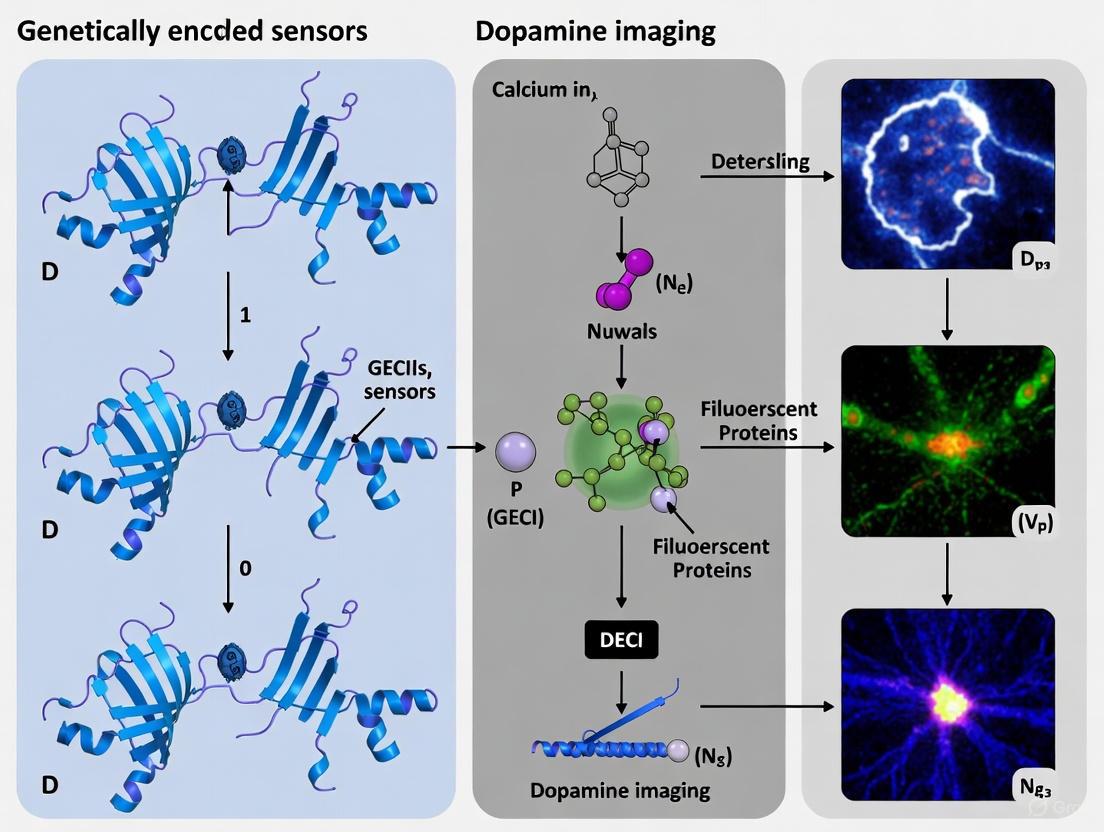
This article provides a comprehensive overview of genetically encoded fluorescent sensors for dopamine imaging, a revolutionary technology enabling high-resolution analysis of neurochemical dynamics.
Genetically Encoded Dopamine Sensors: A Comprehensive Guide for Neuroscience Research and Drug Development
Abstract
This article provides a comprehensive overview of genetically encoded fluorescent sensors for dopamine imaging, a revolutionary technology enabling high-resolution analysis of neurochemical dynamics. Tailored for researchers, scientists, and drug development professionals, it covers the foundational principles of sensor engineering, explores diverse methodological applications in vivo and in vitro, addresses key troubleshooting and optimization challenges, and offers a comparative validation of the expanding sensor toolkit. By synthesizing the latest advances, this guide aims to empower the selection and implementation of these powerful tools to unravel dopamine's role in brain function, behavior, and neurological disorders.
The New Frontier in Neurochemical Imaging: Understanding Genetically Encoded Dopamine Sensors
Dopamine is a crucial monoamine neurotransmitter governing a wide array of brain functions, including motor control, reward, motivation, and learning [1]. Disruptions in dopaminergic signaling are implicated in numerous neurological and psychiatric disorders, such as Parkinson's disease, addiction, and schizophrenia [2]. For decades, our understanding of these processes has been driven by a suite of classical detection methods. However, the pursuit of finer mechanistic insights now reveals the significant constraints of these traditional tools. Microdialysis, fast-scan cyclic voltammetry (FSCV), and electrophysiology have been workhorses in neuroscience, yet each possesses inherent limitations that restrict our ability to observe the true spatiotemporal dynamics of dopamine signaling [3]. The emergence of genetically encoded sensors presents a transformative opportunity, necessitating a clear assessment of the methodological landscape this new technology aims to address.
Limitations of Traditional Dopamine Detection Methods
A critical evaluation of traditional methods reveals a consistent trade-off between temporal resolution, spatial precision, and chemical specificity.
Microdialysis
Microdialysis is considered a gold standard for its ability to measure a broad range of neurochemicals, including non-electroactive substances like neurotransmitters, amino acids, and neuropeptides [4]. Despite this broad scope, its limitations are profound.
- Poor Temporal and Spatial Resolution: The technique involves perfusing a probe with a semipermeable membrane and collecting dialysates over minutes, making it incapable of tracking sub-second dopamine transients that are fundamental to neural computation [3]. Furthermore, the probes are large (approximately 300 μm in diameter), causing significant tissue displacement and damage upon implantation [4]. This damage triggers a foreign body response, creating a gradient of disrupted dopamine activity around the probe track. Studies using FSCV have shown that evoked dopamine responses can be reduced by ~90% at a distance of 200 μm from a microdialysis probe and are completely lost when measured directly at the probe surface [4].
- Tissue Damage and Neurochemical Disruption: The implantation injury leads to instability in dopamine measurements for up to 24 hours post-implantation [4]. Histochemical studies clearly show traumatic injury near probe tracks, and the technique is seldom used for chronic, longitudinal studies due to these confounding effects [4].
Table 1: Key Limitations of Microdialysis
| Limitation | Impact on Dopamine Measurement |
|---|---|
| Low Temporal Resolution (minutes) | Cannot resolve rapid, phasic dopamine release events. |
| Large Probe Size (~300 μm) | Causes significant tissue damage and disrupts the local neurochemical environment. |
| Low Spatial Resolution | Provides poor anatomical specificity relative to neural circuits. |
| Limited Chemical Specificity | Requires subsequent analysis (e.g., HPLC) to identify and quantify dopamine in dialysate. |
Fast-Scan Cyclic Voltammetry (FSCV)
FSCV offers a dramatic improvement in temporal resolution, enabling detection of dopamine fluctuations on a sub-second timescale [5]. However, it faces other significant challenges.
- Limited Neurochemical Scope and Interferents: FSCV requires target molecules to be electroactive. This excludes a vast array of crucial neurochemicals [4]. Furthermore, its ability to distinguish dopamine from other molecules with similar redox potentials, such as norepinephrine, pH shifts, and changes in oxygenated blood flow, is limited and requires rigorous validation [5].
- Technical Complexity and Validation Challenges: The technique is often described as a "black art" to master [3]. Ensuring reliable measurements requires adherence to a set of "Five Golden Rules" for validation, which include identifying the electrochemical signature, anatomical confirmation, and pharmacological validation [5]. These validation steps are difficult or impossible to perform in a clinical setting, creating a major barrier to human translation [5].
- Tissue Interaction and Biofouling: While FSCV carbon-fiber microelectrodes are much smaller than microdialysis probes, they are still subject to issues like electrode biofouling, material deterioration, and signal loss during chronic recordings [5].
Table 2: Key Limitations of Fast-Scan Cyclic Voltammetry (FSCV)
| Limitation | Impact on Dopamine Measurement |
|---|---|
| Requires Electroactive Molecules | Cannot detect many key neurotransmitters (e.g., glutamate, GABA). |
| Susceptibility to Interferents | Distinguishing dopamine from pH changes, other catecholamines, and metabolites is challenging. |
| Technical "Black Art" | Requires significant expertise, limiting its broad adoption. |
| Stringent Validation Needed | Difficult to apply validation "Golden Rules" in clinical human studies. |
Electrophysiology
Electrophysiology, including patch-clamp recording, provides exquisite temporal resolution for measuring the electrical activity of neurons—the action potentials that ultimately drive neurotransmitter release [3].
- Indirect Measure of Neurotransmission: The primary limitation is that electrophysiology measures the electrical signal but cannot identify the specific neurotransmitters or neuromodulators released as a consequence of that activity [3]. While it can infer dopamine neuron activity based on firing patterns, it cannot directly measure dopamine concentration or dynamics in the extracellular space.
The following diagram summarizes the operational principles and core limitations of each traditional method within the experimental workflow.
The Emergence of Genetically Encoded Sensors
Driven by the limitations of traditional methods, the field has developed a new class of tools: genetically encoded fluorescent sensors for dopamine. These sensors, such as the dLight and GRAB-DA series, are engineered proteins that combine a dopamine receptor (the sensing domain) with a fluorescent protein (the reporter domain) [3] [1]. Upon binding dopamine, the sensor undergoes a conformational change that alters its fluorescence intensity, allowing direct, optical readout of dopamine dynamics with high specificity [1].
The following diagram illustrates the fundamental design and signal transduction mechanism of these GPCR-based sensors.
Advantages Over Traditional Methods
Genetically encoded sensors directly address the critical gaps left by traditional methods:
- High Spatiotemporal Resolution: They enable detection of dopamine transients with sub-second kinetics and wave-like propagation across brain regions, a phenomenon previously difficult to observe [3] [1].
- Genetic and Cellular Specificity: Using viral vectors or transgenic animals, sensors can be targeted to specific cell types, brain regions, or even subcellular compartments, allowing researchers to probe dopamine signaling within defined neural circuits [1].
- Multiplexing Potential: The optical nature of these sensors allows for simultaneous recording of dopamine and other neurochemicals or calcium indicators in the same animal, providing a more integrated view of brain signaling [1].
- Ease of Use: Compared to the technical challenges of FSCV, sensor-based detection using fiber photometry or microscopy is more accessible to a wider range of neuroscience laboratories [3].
Table 3: Comparative Analysis of Dopamine Detection Methods
| Method | Temporal Resolution | Spatial Resolution | Chemical Specificity | Key Advantage | Primary Limitation |
|---|---|---|---|---|---|
| Microdialysis | Minutes | Poor (~mm) | High (with HPLC) | Broad neurochemical scope | Severe tissue damage; low resolution |
| FSCV | Sub-second (ms-sec) | Good (~μm) | Moderate (with validation) | High temporal resolution for electroactive molecules | Limited molecule scope; technically complex |
| Electrophysiology | Millisecond | Single cell | None (indirect) | Direct measure of neuronal firing | Does not measure dopamine directly |
| Genetically Encoded Sensors | Sub-second | Single synapse to circuit | High | Cell-specific, high resolution in intact circuits | Requires genetic manipulation |
Experimental Protocols for Method Validation
Protocol: Validating FSCV Measurements Using the "Five Golden Rules"
This protocol is essential for ensuring data accuracy and rigor in FSCV experiments, particularly in pre-clinical models [5].
Objective: To confirm that electrochemical signals recorded in vivo are specific for dopamine. Materials: FSCV setup with carbon-fiber microelectrode, reference electrode, stereotaxic equipment, stimulating electrode, and pharmacology agents.
Electrochemical Signature Identification:
- Implant the working electrode in the target brain region (e.g., striatum).
- Apply the standard triangular waveform (e.g., -0.4 V to +1.3 V and back, 10 Hz).
- Record background-subtracted cyclic voltammograms during electrical stimulation of dopamine pathways (e.g., medial forebrain bundle).
- Verify that the observed oxidation and reduction peaks align with the known signature for dopamine (e.g., oxidation at ~+0.6 V, reduction at ~-0.2 V).
Anatomical Validation:
- After the experiment, perfuse the animal and section the brain.
- Histologically verify the placement of the working and stimulating electrodes.
Kinetic Validation:
- Analyze the kinetics of the recorded signal. Electrically evoked dopamine release should show a rapid rise (milliseconds) followed by a slower decay (seconds) due to uptake via the dopamine transporter.
Pharmacological Validation:
- Administer a dopamine uptake inhibitor (e.g., nomifensine, 10 mg/kg i.p.). This should increase the amplitude and duration of the evoked dopamine signal.
- Administer a dopamine synthesis inhibitor (e.g., α-methyl-p-tyrosine) or a receptor agonist/antagonist to observe predictable changes in signal, further confirming chemical identity.
Protocol: Assessing Tissue Damage in Microdialysis
Objective: To evaluate the impact of microdialysis probe implantation on local dopamine circuitry. Materials: Microdialysis probe, FSCV setup, histology equipment.
- Probe Implantation: Implant a microdialysis probe into the striatum of an anesthetized rodent.
- FSCV Measurement at Varying Distances:
- Using a separate FSCV electrode, measure electrically evoked dopamine release at varying distances (e.g., 0 μm, 200 μm, 500 μm, 1000 μm) from the implanted microdialysis probe.
- Allow a stabilization period of several hours post-implantation before measurements.
- Data Analysis: Plot the amplitude of the evoked dopamine signal as a function of distance from the microdialysis probe. A significant gradient (e.g., 90% reduction at 200 μm) indicates substantial local tissue disruption [4].
- Histological Corroboration: Perfuse the animal and use immunohistochemistry (e.g., for tyrosine hydroxylase or glial fibrillary acidic protein) to visualize tissue damage and glial activation along the probe track.
Research Reagent Solutions
The following table details key reagents and tools essential for research in dopamine detection.
Table 4: Key Research Reagents for Dopamine Detection Studies
| Item | Function/Application | Example(s) |
|---|---|---|
| dLight Sensors | Genetically encoded fluorescent sensor for monitoring dopamine dynamics with high temporal resolution. | dLight1, dLight1.1, dLight1.2 [3] |
| GRAB-DA Sensors | Genetically encoded fluorescent sensor based on the human dopamine D2 receptor. | GRABDA1m, GRABDA2m, GRAB_DA4m [1] |
| 123I-FP-CIT (DaTscan) | SPECT radioligand for imaging the dopamine transporter (DAT) in the clinical diagnosis of parkinsonism. | DaTSCAN [6] |
| Carbon-Fiber Microelectrode | Working electrode for FSCV; provides high spatial and temporal resolution for electroactive neurotransmitters. | 7 μm diameter carbon fiber [4] |
| Microdialysis Probe | For sampling extracellular fluid across a semipermeable membrane to measure a wide range of neurochemicals. | ~300 μm diameter probe [4] |
| Nomifensine | Dopamine uptake inhibitor; used for pharmacological validation of dopamine signals in FSCV. | Nomifensine maleate [4] |
| AAV-hSyn-DIO-dLight | Adeno-associated virus vector for cell-type-specific expression of dLight sensor in Cre-recombinase expressing neurons. | AAV serotype (e.g., AAV1, AAV5) [1] |
Traditional methods for dopamine detection—microdialysis, FSCV, and electrophysiology—have provided foundational knowledge but are constrained by significant limitations in resolution, specificity, and minimal invasiveness. The critical need to observe dopamine dynamics within the intact complexity of neural circuits has driven the development and adoption of genetically encoded sensors. These new tools illuminate the brain's chemical dialogue with unprecedented clarity, enabling discoveries such as the wave-like propagation of dopamine and its fast, coordinated fluctuations with other neuromodulators like acetylcholine [3]. As these sensors continue to evolve, they will undoubtedly accelerate the pace of discovery in basic neuroscience and the development of novel therapeutics for brain disorders.
Genetically encoded sensors for dopamine, primarily from the dLight and GRABDA families, are engineered proteins that transform the transient, invisible event of dopamine binding into a stable, measurable fluorescent signal [3] [7]. These tools have revolutionized neuroscience by enabling the real-time visualization of dopamine dynamics in living brains with high spatiotemporal resolution, molecular specificity, and cell-type-specific targeting [8] [3]. Their development addresses the limitations of classical techniques like fast-scan cyclic voltammetry and microdialysis, which often struggle with molecular specificity or temporal resolution [8] [3].
The core scaffold for these sensors is a native dopamine G protein-coupled receptor (GPCR), which has evolved for high specificity and affinity for dopamine [7]. The fundamental engineering principle involves coupling the conformational change in the receptor upon dopamine binding to a change in the brightness of a fluorescent protein, allowing dopamine concentration to be reported optically [9] [7].
The Molecular Mechanism of Signal Conversion
The process by which dopamine binding is converted into a fluorescent readout can be broken down into a sequence of key molecular events, illustrated in the following diagram.
Key Stages in the Signaling Mechanism
- Dopamine Binding: The sensor is in a basal, low-fluorescent state. The extracellular domain of the GPCR scaffold serves as the recognition module, waiting for its specific ligand [7].
- Conformational Change in the GPCR: Dopamine binding stabilizes an active receptor conformation. The most critical structural rearrangement is the outward movement and rotation of transmembrane helix 6 (TM6), accompanied by shifts in TM5 and TM7 [9]. This movement is central to the sensor's function.
- Mechanical Transduction to the Fluorescent Protein: A circularly permuted green fluorescent protein (cpGFP) is strategically inserted into the third intracellular loop (ICL3) of the GPCR, which connects TM5 and TM6 [9] [7]. The conformational change, particularly the movement of TM5 and TM6, mechanically pulls on the cpGFP.
- Fluorescence Enhancement: This mechanical pull alters the chromophore environment within the cpGFP, reducing the quenching effect of nearby amino acids and leading to a significant increase in fluorescence intensity [8] [7]. The magnitude of this increase is proportional to the concentration of dopamine, providing a quantitative optical readout.
Quantitative Properties of Key Dopamine Sensors
The palette of available sensors allows researchers to select a tool matched to their experimental needs, based on quantitative properties like affinity, dynamic range, and selectivity.
Table 1: Key Performance Metrics of Selected dLight and GRABDA Sensors
| Sensor Name | GPCR Scaffold | Affinity (EC₅₀) | Dynamic Range (ΔF/F₀) | Dopamine vs. Norepinephrine Selectivity | Primary Application Context |
|---|---|---|---|---|---|
| dLight1.1 | D1R | 40 nM | 2.3 | 12-fold | High-affinity detection in sparsely innervated regions [10] |
| dLight1.3b | D1R | Not Specified | 6.6 | 16-fold | Conditions requiring maximum brightness change [10] |
| GRABDA1M | D2R | 4 nM - 1.8 µM | 1.9 | 21-fold | High-affinity detection of low DA concentrations [10] |
| GRABDA1H | D2R | 1 nM | 2.5 | 8-fold | Ultra-high-affinity detection of subtle fluctuations [10] |
| GRABDA2M | D2R | 4 nM - 1.8 µM | 4.8 | 14-fold | Balanced high dynamic range and high affinity [10] |
Table 2: Sensor Selection Guide Based on Experimental Goals
| Experimental Goal | Recommended Sensor Properties | Example Sensors |
|---|---|---|
| High Affinity for Sparse DA | Low nM affinity | GRABDA1H, GRABDA1M [8] [10] |
| Fast Kinetics for Rapid Release | Fast on/off rates (kon, koff) | dLight1.3 variants [8] |
| Maximum Signal Change | Large dynamic range (ΔF/F₀) | dLight1.3b, GRABDA2M [10] |
| Multiplexing with Other Sensors | Red-shifted emission spectrum | RdLight1 [8] |
Detailed Experimental Protocols and Applications
Protocol: Using DA "Sniffer Cells" for In Vitro Dopamine Detection
This protocol utilizes stable cell lines (e.g., Flp-In T-REx 293 cells) with inducible expression of dLight or GRABDA sensors for quantitative, high-throughput dopamine measurements without viral delivery [10].
Workflow Overview:
Step-by-Step Methodology:
- Cell Culture and Sensor Induction:
- Culture Flp-In T-REx 293 sniffer cell lines expressing the sensor of choice (e.g., dLight1.3b for large signals or GRABDA1H for high sensitivity) [10].
- Induce sensor expression by adding tetracycline (e.g., 1 µg/mL) to the culture medium 24 hours before the experiment.
- Experimental Setup:
- Plate induced cells into a clear-bottom, black-walled 96-well plate at a density of ~50,000 cells per well.
- Allow cells to adhere overnight in a culture incubator (37°C, 5% CO₂).
- Sample Application and Fluorescence Recording:
- Replace the culture medium with a physiological buffer (e.g., HEPES-buffered saline).
- Establish a baseline fluorescence (F₀) using a plate reader (e.g., excitation 488 nm, emission 510-540 nm).
- Apply the sample containing dopamine (e.g., supernatant from stimulated neuronal cultures, brain tissue homogenate, or drug solution).
- Monitor the fluorescence intensity (F) in real-time for 1-10 minutes.
- Validation and Data Analysis:
- Pharmacological Validation: In separate wells, pre-incubate cells with a dopamine receptor antagonist (e.g., 10 µM SCH-23390 for dLight1 or 10 µM raclopride for GRABDA) for 15 minutes before sample application to confirm the response is sensor-specific [10].
- Quantification: Calculate the fluorescence change as ΔF/F = (F - F₀)/F₀.
- Concentration-Response: Generate a standard curve by applying known concentrations of dopamine (e.g., 1 nM to 10 µM) to the sniffer cells. Fit the data with a sigmoidal curve to quantify dopamine in unknown samples.
Protocol: In Vivo Dopamine Imaging via Fiber Photometry
This protocol describes the use of fiber photometry in freely moving mice to record dopamine dynamics in specific brain regions with subsecond resolution [8] [3].
Key Steps:
- Sensor Delivery:
- Inject an adeno-associated virus (AAV) encoding the sensor (e.g., AAV-hSyn-dLight1.1 or AAV-hSyn-GRABDA1h) into the target brain region (e.g., nucleus accumbens or dorsal striatum) of an anesthetized mouse. Use a cell-type-specific promoter (e.g., hSyn for pan-neuronal expression) for targeted sensor expression.
- Optical Implant:
- Implant an optical fiber (e.g., 400 µm core diameter) above the viral injection site to allow for light delivery and fluorescence collection.
- Data Acquisition:
- After a 2-4 week recovery and sensor expression period, tether the mouse to a fiber photometry system.
- Deliver excitation light (e.g., ~465-488 nm for green sensors) through the optical fiber and record the emitted fluorescence signal (~500-540 nm) from the sensor.
- Simultaneously record the animal's behavior (e.g., on video) to correlate dopamine transients with specific actions or stimuli.
- Data Processing:
- Process the raw fluorescence signal to remove motion artifacts and bleaching effects. This often involves isosbestic control signals or digital filtering.
- Align the fluorescence traces with behavioral timestamps to identify stimulus-locked or action-locked dopamine release events.
The Scientist's Toolkit: Essential Research Reagent Solutions
Table 3: Key Reagents for GPCR-Based Dopamine Sensor Research
| Reagent / Tool | Function & Utility | Example Use Cases |
|---|---|---|
| dLight & GRABDA Sensor Families | Core detection tools with varying affinity and kinetics for different experimental contexts [8] [10] | In vivo photometry (dLight1.3), in vitro sniffer assays (GRABDA1H) |
| AAV Vectors for Sensor Expression | Enables targeted, efficient, and long-term sensor expression in specific brain regions and cell types in vivo [3] | Neuronal circuit-specific dopamine recording (e.g., AAV-hSyn-dLight) |
| "Sniffer" Cell Lines | Stable, inducible cell lines for radioactivity-free, high-throughput in vitro and ex vivo dopamine measurements [10] | Measuring DA release from cultured neurons, tissue content, drug screening |
| DA Receptor Antagonists | Pharmacological controls to validate the specificity of the sensor signal [10] | SCH-23390 (D1R-antagonist) for dLight; Raclopride (D2R-antagonist) for GRABDA |
| Fiber Photometry Systems | Integrated hardware for real-time fluorescence recording in freely behaving animals [8] [3] | Correlating dopamine dynamics with behavioral tasks like reward learning |
Genetically encoded fluorescent sensors for dopamine represent a transformative technological advancement in neuroscience, enabling real-time detection of neuromodulator dynamics with high spatiotemporal resolution in living systems. These tools have emerged as superior alternatives to traditional methods like microdialysis and fast-scan cyclic voltammetry (FSCV), which face limitations in temporal resolution, spatial precision, and molecular specificity [8] [11]. The core design principle of these sensors involves integrating a dopamine-sensitive G-protein coupled receptor (GPCR) domain with a circularly permuted fluorescent protein (cpFP). Dopamine binding induces a conformational change in the receptor, which alters the chromophore environment of the cpFP and results in a measurable change in fluorescence intensity [8] [1] [12]. This molecular design allows researchers to optically monitor dopamine fluctuations as they occur in vivo during behavioral experiments, providing unprecedented insight into the roles of dopamine in reward, motivation, learning, and motor control [13] [1].
The two primary families of dopamine sensors—dLight and GRABDA—along with the spectrally distinct RdLight platform, have distinct properties and applications. When implementing these tools, researchers must consider that there is no universal 'one-size-fits-all' sensor [8]. Sensor properties—most critically their affinity, dynamic range, kinetics, and spectral characteristics—must be carefully matched to the experimental context, including the brain region of interest (with its specific local dopamine levels), the temporal dynamics of the behavior under study, and the requirements for multiplexing with other optical tools [8] [10]. This application note provides a comprehensive guide to the dLight, GRABDA, and RdLight platforms, offering detailed comparisons, experimental protocols, and implementation frameworks to inform their effective application in basic neuroscience and drug discovery research.
The dLight Sensor Platform
Design Principles and Development
The dLight sensor platform was engineered through a systematic approach of replacing the third intracellular loop of human dopamine receptors (D1, D2, or D4) with a circularly permuted green fluorescent protein (cpGFP) module derived from GCaMP6 [12]. This strategic design creates a chimeric protein that binds dopamine with high affinity and undergoes a conformational change that directly translates into an increase in cpGFP fluorescence. A critical feature of the dLight design is its decoupling from downstream signaling cascades, meaning sensor expression does not appear to interfere with native GPCR signaling pathways, thereby providing a pure reporting function without perturbing the underlying biology [12]. The dLight1 series encompasses multiple variants (e.g., dLight1.1, dLight1.2, dLight1.3a, dLight1.3b) with engineered differences in their dynamic ranges and affinities for dopamine, offering researchers a toolkit to match sensor properties to specific experimental needs [10] [12].
Key Sensor Variants and Properties
Table 1: Characteristics of Key dLight Sensor Variants
| Sensor Variant | Dynamic Range (ΔF/F0) | Detection Range | DA Affinity (EC50) | Key Applications |
|---|---|---|---|---|
| dLight1.1 | ~230% [12] | ~40 nM - 17 µM [10] | Lower affinity | General purpose in vivo imaging |
| dLight1.2 | ~316% [10] | ~40 nM - 17 µM [10] | Medium affinity | Behaviorally-relevant transients |
| dLight1.3a | ~498% [10] | ~40 nM - 17 µM [10] | Medium affinity | High signal-to-noise applications |
| dLight1.3b | ~661% [10] | ~40 nM - 17 µM [10] | Medium affinity | Maximum brightness applications |
The dLight platform exhibits high molecular specificity for dopamine over other neurotransmitters, though some cross-reactivity with noradrenaline has been observed. Quantitative assessment reveals approximately 12-18 fold selectivity for dopamine over noradrenaline across different dLight variants [10]. The sensors demonstrate fast kinetics compatible with tracking the rapid dynamics of dopamine release and clearance, with performance characteristics suitable for detecting phasic dopamine signals that occur on subsecond timescales during behavioral tasks [8] [12]. This combination of properties has established dLight as a powerful tool for investigating dopamine dynamics in contexts ranging from reward processing to aversive learning [13].
Figure 1: dLight Sensor Design Principle. Dopamine binding to the receptor domain induces a conformational change that alters the cpGFP environment, resulting in increased fluorescence.
The GRABDA Sensor Platform
Structural Basis and Engineering
The GRABDA (GPCR Activation-Based Dopamine) sensor platform shares a similar conceptual framework with dLight but incorporates distinct engineering approaches. GRABDA sensors are also constructed by inserting a cpGFP into a dopamine receptor scaffold, but utilize different insertion points and receptor conformations to achieve their signaling properties [14] [1]. The GRAB family includes sensors derived from both D1-like and D2-like dopamine receptors, with the latter generally exhibiting higher affinity for dopamine,
reflecting the innate pharmacological properties of their parent receptors [10]. This fundamental design difference results in GRABDA sensors being particularly sensitive to lower concentrations of dopamine, making them exceptionally suited for monitoring dopamine dynamics in brain regions with sparse dopaminergic innervation [8] [14]. The GRABDA platform continues to evolve with the recent development of next-generation sensors with improved signal-to-noise ratios and additional spectral variants [1].
Key Sensor Variants and Properties
Table 2: Characteristics of Key GRABDA Sensor Variants
| Sensor Variant | Dynamic Range (ΔF/F0) | Detection Range | DA Affinity (EC50) | Selectivity (DA:NE) |
|---|---|---|---|---|
| GRABDA1M | ~186% [10] | ~4 nM - 1.8 µM [10] | High affinity | 21:1 [10] |
| GRABDA1H | ~249% [10] | ~1 nM - 1.8 µM [10] | Very high affinity | 8:1 [10] |
| GRABDA2M | ~477% [10] | ~4 nM - 1.8 µM [10] | High affinity | 14:1 [10] |
GRABDA sensors exhibit exceptional sensitivity to low dopamine concentrations, with the GRABDA1H variant capable of detecting dopamine at concentrations as low as 1 nM [10]. This remarkable sensitivity makes these sensors ideally suited for investigating dopamine signaling in sparsely innervated brain regions such as the prefrontal cortex, hippocampus, and amygdala, where dopamine concentrations are significantly lower than in the densely innervated striatum [8]. The GRABDA platform has been successfully implemented across diverse model organisms including flies, fish, and mice [14], demonstrating its broad utility in comparative neuroscience and its robustness across different experimental preparations.
The RdLight Sensor Platform
Spectral Advantages and Multiplexing Capabilities
The RdLight platform represents a spectral extension of the dLight design principle, incorporating red-shifted fluorescent proteins rather than green cpGFP. This critical engineering achievement enables multiplexed imaging with green indicators such as GCaMP (for calcium imaging) or other green-emitting neurotransmitter sensors [8] [15]. The red-shifted spectral properties of RdLight sensors provide several distinct experimental advantages beyond multiplexing, including reduced tissue autofluorescence, decreased light scattering, and potentially deeper tissue penetration when using two-photon microscopy techniques [8] [15]. While comprehensive quantitative characterization of RdLight sensors is less extensively documented in the searched literature compared to their green counterparts, their development addresses a critical need in modern neuroscience for tools that enable simultaneous monitoring of multiple neural signals within the same circuit or even the same cell [8].
The availability of red-shifted dopamine sensors like RdLight, along with other recently developed red and yellow variants (YdLight), creates exciting opportunities for investigating interactions between dopamine and other signaling molecules. For example, researchers can now simultaneously monitor dopamine release (using RdLight) and neuronal activity (using GCaMP) in the same population of cells, or track the coordinated release of dopamine and other neuromodulators such as acetylcholine or norepinephrine [8] [12]. This multi-modal imaging approach is transforming our understanding of how neuromodulators interact to shape neural circuit function and behavior.
Comparative Analysis of Sensor Properties
Performance Characteristics Across Platforms
Table 3: Comprehensive Comparison of Dopamine Sensor Families
| Sensor Property | dLight Platform | GRABDA Platform | RdLight Platform |
|---|---|---|---|
| Parent Receptor | D1-like [12] | D1-like & D2-like [14] [1] | D1-like [8] |
| Dynamic Range | High (up to 661% ΔF/F0) [10] | Moderate to High (186-477% ΔF/F0) [10] | Similar to dLight (quantitative data limited) [8] |
| Affinity Range | Lower affinity variants (nM-µM range) [10] | Higher affinity variants (low nM range) [10] [14] | Variants with different affinities available [8] |
| Detection Range | ~40 nM - 17 µM [10] | ~1 nM - 1.8 µM [10] | Not fully characterized in searched literature |
| Selectivity (DA:NE) | 12-18:1 [10] | 8-21:1 [10] | Preserved from dLight design [8] |
| Kinetics | Fast (subsecond resolution) [8] [12] | Fast (subsecond resolution) [14] [1] | Fast (subsecond resolution) [8] |
| Spectral Class | Green [12] | Green [14] | Red [8] |
| Key Applications | Striatal regions with high DA, behavior studies [8] [13] | Sparsely innervated regions, low DA concentrations [8] [14] | Multiplexing with green indicators [8] |
Guidelines for Sensor Selection
Choosing the appropriate dopamine sensor requires careful consideration of multiple experimental parameters. The following guidelines summarize key selection criteria based on sensor properties and experimental needs:
Match sensor affinity to expected dopamine concentrations: For densely innervated regions like dorsal striatum and nucleus accumbens, dLight sensors are often optimal. For sparsely innervated regions like prefrontal cortex, hypothalamus, and hippocampus, the higher-affinity GRABDA sensors (particularly GRABDA1H and GRABDA1M) are preferable [8] [10].
Prioritize dynamic range for signal detection: When detecting small phasic changes in dopamine against a stable baseline, sensors with higher dynamic range (dLight1.3b, GRABDA2M) provide superior signal-to-noise ratio [10].
Consider temporal requirements: For experiments requiring resolution of rapidly changing dopamine signals (e.g., during reward prediction error tasks), sensors with faster kinetics are essential [8] [1].
Plan for multiplexing experiments: When simultaneously imaging dopamine with other green fluorescent indicators (e.g., GCaMP for calcium), RdLight sensors enable spectral separation [8] [12].
Account for molecular specificity needs: In brain regions with overlapping dopamine and norepinephrine signaling, consider sensors with higher selectivity ratios (e.g., GRABDA1M with 21:1 selectivity) [10].
Figure 2: Dopamine Sensor Selection Guide. A decision tree for selecting the optimal dopamine sensor based on experimental parameters including brain region, multiplexing needs, and kinetic requirements.
Experimental Protocols and Implementation
In Vivo Imaging Using Fiber Photometry
Purpose: To measure dopamine dynamics in specific brain regions of freely behaving animals. Workflow:
- Sensor Expression: Deliver sensor to target brain region using stereotaxic injection of adeno-associated virus (AAV) encoding the dopamine sensor (e.g., AAV-hSyn-dLight1.1 or AAV-hSyn-GRABDA1M). Allow 3-6 weeks for adequate expression [8] [1].
- Optic Cannula Implantation: Implant a fiber optic cannula above the target region and secure to the skull with dental cement [1].
- Signal Acquisition: Connect the implanted fiber to a fiber photometry system. Excite the sensor at appropriate wavelengths (e.g., ~470 nm for green sensors). Collect emitted fluorescence through the same fiber [1].
- Data Processing: Calculate ΔF/F as (F - F₀)/F₀, where F₀ is the baseline fluorescence. Apply appropriate filtering and analyze dopamine transients time-locked to behavioral events [8] [1].
Key Considerations:
- Include motion and bleaching correction in analysis pipeline.
- Use isosbestic control signals when possible to account for motion artifacts.
- For GRABDA sensors, consider the higher sensitivity and potential saturation in high dopamine regions [10].
In Vitro Detection Using Sniffer Cells
Purpose: To create a versatile, virus-free platform for dopamine detection in cell culture systems and tissue preparations. Workflow:
- Cell Line Generation: Stably transfer Flp-In T-REx 293 cells with inducible dLight or GRABDA constructs using the Flp-In system to ensure homogeneous expression [10].
- Sensor Induction: Treat sniffer cells with tetracycline (1 μg/mL, 24 hours) to induce sensor expression before experiments [10].
- Sample Application: Plate induced sniffer cells and apply biological samples (e.g., neuronal culture medium, brain slice supernatant, or tissue homogenate) [10].
- Fluorescence Detection: Measure fluorescence changes using plate readers or fluorescence microscopy. For microscopy, use appropriate filter sets (e.g., 470/40 nm excitation, 525/50 nm emission for green sensors) [10].
- Quantification: Generate standard curves with known dopamine concentrations for quantification [10].
Key Applications:
- Recording endogenous dopamine release from cultured neurons.
- Measuring dopamine content in striatal tissue samples.
- High-throughput screening of dopamine transporter (DAT) ligands and uptake inhibitors [10].
Multiplexed Imaging with Calcium Indicators
Purpose: To simultaneously monitor dopamine signaling and neuronal activity in the same population of cells. Workflow:
- Dual Sensor Expression: Co-express a red-shifted dopamine sensor (RdLight) with a green calcium indicator (GCaMP) in the target brain region using appropriate viral vectors [8] [12].
- Microscopy Setup: Use a two-photon microscope with dual-channel detection capabilities. Optimize laser wavelengths for simultaneous excitation of both sensors (e.g., 920-940 nm for GCaMP and RdLight) [8].
- Spectral Separation: Implement appropriate emission filters to cleanly separate green (500-550 nm) and red (580-630 nm) emission signals [8] [12].
- Data Analysis: Register and analyze signals from both channels, calculating ΔF/F for each sensor independently. Correlate dopamine transients with calcium dynamics to infer relationships between neuromodulator release and neuronal activity [12].
Representative Findings: This approach has revealed how footshock stress decreases dopamine signaling in nucleus accumbens (detected by dLight) while increasing overall neuronal activity (detected by jRGECO1a), demonstrating complex relationships between neuromodulator availability and circuit output [12].
Research Reagent Solutions
Table 4: Essential Research Reagents for Dopamine Sensor Implementation
| Reagent / Tool | Function / Application | Implementation Notes |
|---|---|---|
| AAV-hSyn-dLight1.X | In vivo sensor expression under neuronal promoter | Use for specific expression in neurons; optimize titer for brain region [8] [12] |
| AAV-hSyn-GRABDAX | In vivo expression of GRABDA sensors | Higher affinity variants ideal for sparsely innervated regions [8] [14] |
| Fiber Optic Cannulas | Light delivery/collection for photometry | Match fiber diameter to target region size; consider numerical aperture [1] |
| BacMam 2.0 Technology | Gene delivery for primary neurons | Enables transduction of difficult-to-transfect cells including neurons [16] |
| CellLight Reagents | Organelle-specific labeling in live cells | Use for morphological reference in imaging experiments [16] |
| Rhod-3 AM | Red-shifted calcium indicator | Compatible with multiplexing using green dopamine sensors [16] |
| Tetrodotoxin (TTX) | Voltage-gated sodium channel blocker | Use to confirm action potential-dependent dopamine release [10] |
| Dopamine Receptor Antagonists | Pharmacological validation of sensor response | Confirm specificity of fluorescent responses (e.g., SCH23390 for D1-based sensors) [10] |
| DAT Inhibitors (Nomifensine) | Dopamine transporter blockade | Use to probe reuptake mechanisms and increase extracellular dopamine [10] |
Applications in Psychiatric Research and Drug Discovery
Genetically encoded dopamine sensors are revolutionizing psychiatric research by enabling precise functional characterization of neurochemical dysregulation in disease models and providing mechanistic insights into therapeutic interventions. These tools have been particularly impactful in several key areas:
Depression and Stress Models: dLight has revealed how increased anhedonia in female animals correlates with decreased dopamine release in the dorsomedial striatum, highlighting sex-specific mechanisms in depression [13]. GRABNE (a norepinephrine sensor) has enabled observations that low corticosterone rats display increased hippocampal norepinephrine levels correlated with decreased REM sleep, informing our understanding of biological risk factors for stress susceptibility [13].
Substance Use Disorders: dLight has been instrumental in demonstrating how heroin use changes dopamine-driven reward circuits, enhancing reward responses upon entry to drug-associated environments [13]. The dynorphin-binding sensor kLight has elucidated how morphine withdrawal induces endogenous dynorphin release in prefrontal cortex, a mechanism known to cause aversion and disrupt cognition [13].
Drug Safety Assessment: dLight has been employed to compare the effects of ketamine and cocaine on addiction-related functional changes, providing evidence that ketamine does not induce the full array of neuroadaptive changes associated with cocaine, informing safety assessments of ketamine as an antidepressant [13].
Parkinson's Disease Research: Dopamine sensors have enabled high-sensitivity detection of dopamine deficits along disease progression. Using dLight, researchers have demonstrated that disruption of mitochondrial complex I corresponds with progressive loss of dopaminergic signaling first in dorsal striatum, with eventual depletion in substantia nigra, modeling the staging of dopamine depletion in Parkinson's disease [13].
These applications demonstrate how genetically encoded dopamine sensors are transforming our understanding of psychiatric disease mechanisms and creating new opportunities for therapeutic development through their ability to provide direct, real-time readouts of neurochemical dynamics in disease models and during drug interventions.
The study of dopamine neurotransmission has been revolutionized by the development of genetically encoded sensors, enabling the real-time detection of this crucial neuromodulator with high spatiotemporal precision in behaving animals. These tools have addressed significant limitations of traditional methods such as microdialysis and fast-scan cyclic voltammetry, which offered insufficient temporal resolution or low molecular specificity [17] [1]. The core architecture of these modern sensors strategically integrates circularly permuted green fluorescent protein (cpGFP) with dopamine receptor scaffolds through precision-optimized linkers [18]. This document details the principles, optimization protocols, and practical applications of these biosensor components, providing a framework for their use in advanced neuroscience research and drug development.
Core Engineering Principles
The Central Component: Circularly Permuted GFP (cpGFP)
The functionality of genetically encoded biosensors hinges on the unique properties of circularly permuted GFP (cpGFP). In a standard GFP, the N- and C-termini are located distantly from the central chromophore. Circular permutation involves fusing the original termini with a peptide linker and creating new termini at a site near the chromophore [19]. This strategic relocation imparts greater conformational flexibility to the FP, making the chromophore's fluorescence highly sensitive to environmental changes.
Molecular Mechanism: The new termini are typically formed within a surface-oriented loop, placing the chromophore in a more labile structural context. When integrated into a sensor, the cpGFP is flanked by linkers and embedded within a sensory domain. Conformational changes in the sensory domain upon ligand binding are directly transferred to the cpGFP, altering the chromophore's protonation state or local environment, which in turn modulates fluorescence intensity [19] [15]. This design is the foundation for single-FP-based intensity sensors, simplifying optical setup compared to FRET-based systems.
Historical Development: The tolerance of GFP for circular permutation was first reported in 1999 [19]. This discovery paved the way for seminal sensors like camgaroo1 and GCaMP, which inserted cpGFP into calmodulin. The success of these early sensors established cpGFP as the reporter module of choice for a generation of biosensors targeting ions, neurotransmitters, and neuromodulators [20].
The Sensing Module: Dopamine Receptor Scaffolds
The molecular specificity of dopamine sensors is conferred by their sensing module, derived from native dopamine receptors. These G-protein coupled receptors (GPCRs) undergo specific conformational rearrangements upon dopamine binding.
Scaffold Selection: The human dopamine D2 receptor (D2R) is a preferred scaffold due to its high affinity for dopamine and excellent membrane trafficking properties [18]. The development of GRABDA sensors involved inserting cpGFP into the third intracellular loop (ICL3) of the D2R, a region known to undergo significant movement during receptor activation [18].
Mechanism of Activation: Upon dopamine binding, the receptor transitions to an active state, characterized by an outward movement of transmembrane helix 6 (TM6) [21]. This structural shift is mechanically transmitted to the integrated cpGFP, resulting in a measurable increase in fluorescence. A key engineering success has been mutating these chimeric sensors to decouple them from native G-protein and β-arrestin signaling pathways, allowing them to report dopamine binding without interfering with normal cellular physiology or causing sensor internalization [18].
The Critical Bridge: Linker Optimization
The peptide linkers connecting the cpGFP to the dopamine receptor scaffold are not mere passive connectors; they are critical determinants of sensor performance. Optimal linkers efficiently transduce the conformational change from the receptor to the cpGFP.
Performance Impact: The length, flexibility, and amino acid composition of these linkers are paramount. For instance, during the development of the STEP biosensor, systematic linker optimization increased the dynamic range (ΔF/F0) from 1.0 to 3.4 [20]. Suboptimal linkers can dampen or completely prevent the fluorescence change, rendering the sensor non-functional.
Optimization Strategies: Linker optimization is typically achieved through randomized mutagenesis of linker sequences followed by high-throughput screening. The goal is to identify linkers that provide the appropriate mechanical coupling without restricting the necessary conformational flexibility of either the receptor or the cpGFP [20].
Performance Characterization & Quantitative Data
Rigorous characterization of sensor performance is essential for selecting the appropriate tool for a given experimental context. Key parameters include dynamic range, affinity, kinetics, and specificity.
Table 1: Performance Characteristics of Representative Dopamine Sensors
| Sensor Name | Dynamic Range (ΔF/F0) | Affinity (EC50 / Kd) | On Kinetics (ton) | Off Kinetics (toff) | Key Features |
|---|---|---|---|---|---|
| GRABDA1m | ~90% [18] | ~130 nM [18] | 60 ± 10 ms [18] | 0.7 ± 0.06 s [18] | Medium affinity, fast off-kinetics |
| GRABDA1h | ~90% [18] | ~10 nM [18] | 140 ± 20 ms [18] | 2.5 ± 0.3 s [18] | High affinity for low-concentration detection |
| dLight1 | ~90% [1] | ~10 nM - ~4 μM variants [1] | Sub-second [1] | Sub-second to seconds [1] | Expanded palette for multiplexing [1] |
| G-Flamp1 (cAMP) | 1100% [22] | 2.17 μM (for cAMP) [22] | 0.20 s [22] | 0.087 s [22] | Highlights performance potential of cpGFP design |
Beyond the core performance metrics, several other factors are critical for in vivo application:
- Molecular Specificity: GRABDA sensors show high specificity for dopamine over other neurotransmitters like glutamate, GABA, and acetylcholine. A modest cross-reactivity with norepinephrine exists but is minimal at physiological concentrations due to a ~10-fold lower EC50 for DA than for NE [18].
- Brightness & Photostability: These sensors exhibit approximately 70% of the brightness of EGFP and photostability comparable to or better than other cpEGFP-based sensors, enabling sustained imaging sessions [18].
- Spectral Properties: Most first-generation sensors are green fluorescent. However, red-shifted variants are being actively developed to enable multiplexed imaging with other optogenetic actuators or sensors [20] [1].
Detailed Experimental Protocols
Protocol: Sensor Characterization in Cell Culture
This protocol outlines the steps for validating the basic function and pharmacological properties of a dopamine sensor in heterologous cells and neurons.
Applications: Initial validation, dose-response characterization, and specificity testing.
Materials:
- Plasmids: Sensor plasmid (e.g., GRABDA1m, GRABDA1h).
- Cell Lines: HEK293T cells.
- Culture Reagents: Standard cell culture media and transfection reagents.
- Imaging Setup: Epifluorescence or conf microscope, perfusion system.
- Pharmacological Agents: Dopamine hydrochloride, receptor antagonists (e.g., Haloperidol, Eticlopride), other neurotransmitters for specificity tests.
Procedure:
- Cell Culture & Transfection: Culture HEK293T cells in standard conditions. Transiently transfect cells with the sensor plasmid using a standard method (e.g., PEI, calcium phosphate).
- Image Acquisition: 24-48 hours post-transfection, mount coverslips on the microscope stage. Use a 488 nm laser for excitation and collect emission at 510-540 nm. Maintain temperature at 35-37°C.
- Dose-Response Measurement:
- Continuously perfuse cells with buffer.
- Apply increasing concentrations of dopamine (e.g., 1 nM to 100 μM) for 10-30 seconds each, with a 3-5 minute washout period between applications.
- Record fluorescence changes (F).
- Data Analysis:
- Calculate ΔF/F0 = (F - F0) / F0, where F0 is the baseline fluorescence.
- Plot ΔF/F0 against dopamine concentration and fit with a sigmoidal (e.g., Hill) equation to determine EC50 and maximum ΔF/F0.
- Specificity & Pharmacology:
- Repeat the above, applying a saturating dose of dopamine in the presence or absence of antagonists (e.g., 10 μM Haloperidol) to confirm the response is receptor-mediated.
- Apply other neurotransmitters (e.g., NE, serotonin, glutamate) at physiologically relevant concentrations to test for cross-reactivity.
Protocol: In Vivo Dopamine Imaging with Fiber Photometry
This protocol describes the use of fiber photometry to record bulk dopamine signals in specific brain regions of freely behaving mice.
Applications: Monitoring dopamine dynamics during behavior, learning, and in disease models.
Materials:
- Viral Vector: AAV encoding sensor (e.g., AAV-hSyn-GRABDA1m).
- Animals: Mice (e.g., C57BL/6J).
- Surgical Equipment: Stereotaxic apparatus, microsyringe.
- Implants: Optical ferrule and fiber cannula.
- Recording System: Fiber photometry system (LEDs, dichroic mirrors, detectors), behavior arena.
Procedure:
- Stereotaxic Surgery:
- Anesthetize the mouse and secure it in the stereotaxic frame.
- Inject AAV-hSyn-GRABDA1m (e.g., 300-500 nL) into the target brain region (e.g., nucleus accumbens) using coordinates from a brain atlas.
- Implant an optical fiber cannula above the injection site.
- Allow 2-4 weeks for viral expression and recovery.
- Photometry Recording:
- Tether the mouse to the photometry system via a patch cord.
- Deliver 470 nm excitation light and collect emitted light (e.g., >500 nm).
- Simultaneously record behavioral video.
- Behavioral Paradigm:
- Conduct experiments such as Pavlovian conditioning (pairing a tone with a reward) or open field exploration.
- Data Processing:
- Demodulate the recorded signals to obtain 465 nm (sensor) and 405 nm (isosbestic control) channels.
- Fit the 405 nm signal to the 465 nm channel to generate a fitted baseline.
- Calculate ΔF/F = (465 nm signal - fitted baseline) / fitted baseline.
- Align dopamine signals (ΔF/F) with behavioral timestamps (e.g., cue onset, reward delivery).
The Scientist's Toolkit: Essential Research Reagents
A successful research program in this field relies on a core set of reagents and tools.
Table 2: Essential Research Reagents and Materials
| Item Name | Function/Description | Example Use Case |
|---|---|---|
| cpGFP-based Dopamine Sensors (e.g., GRABDA, dLight series) | Core biosensor; fluorescence increases upon dopamine binding [1] [18]. | Monitoring real-time dopamine release in vivo. |
| Adeno-Associated Viral (AAV) Vectors | Gene delivery vehicle for sensor expression in specific brain regions [13]. | Targeted expression of GRABDA in mouse nucleus accumbens. |
| Cell-Type Specific Promoters (e.g., hSyn, Gfa) | Drives sensor expression in neurons or astrocytes, respectively [13]. | Restricting sensor expression to dopaminergic or excitatory neurons. |
| Fiber Photometry System | Optical setup for recording bulk fluorescence signals in freely moving animals [1]. | Recording mesolimbic dopamine dynamics during behavioral tasks. |
| Two-Photon Microscope | High-resolution imaging system for cellular/subcellular resolution [15]. | Imaging dopamine release at specific spines or axonal varicosities. |
| Dopamine Receptor Antagonists (e.g., Haloperidol) | Pharmacological blocker used to confirm sensor response is dopamine-specific [18]. | Control experiments to verify signal specificity in vitro and ex vivo. |
Signaling Pathways and Experimental Workflows
The following diagrams illustrate the core sensor architecture and a generalized workflow for sensor development and application.
Advanced Applications and Future Perspectives
Genetically encoded dopamine sensors have become indispensable in preclinical research, enabling discoveries in reward processing, motivation, and the pathophysiology of psychiatric disorders.
Mechanistic Studies of Behavior: GRABDA and dLight sensors have been used to demonstrate that dopamine dynamics in the nucleus accumbens encode reward prediction error and are crucial for reinforcement learning [1]. Furthermore, they have revealed how drugs of abuse like heroin and cocaine hijack these natural dopamine signaling pathways, inducing long-lasting changes in circuit function [13].
Drug Discovery and Pharmacodynamics: These sensors provide a direct readout of drug efficacy on neural systems. For instance, they have been used to assess the addictive potential of ketamine by comparing its effects on dopamine release to those of known addictive substances like cocaine [13]. This application positions the sensors as powerful tools for screening novel therapeutic compounds and understanding their temporal effects on neuromodulation.
Future Directions: The field is rapidly advancing toward multiplexed imaging, where sensors of different colors (e.g., for dopamine and glutamate) are used simultaneously to dissect complex neurochemical interactions [20] [1]. Ongoing efforts focus on developing improved sensors with near-infrared fluorescence for deeper tissue penetration, as well as enhanced versions with greater sensitivity and specificity to uncover finer details of dopamine signaling in health and disease [1]. The recent development of a generalized grafting strategy for engineering neuropeptide sensors suggests that the principles honed in dopamine sensor development will continue to propel the creation of new tools for neuroscience [21].
The understanding of neuromodulatory signaling in the brain has been fundamentally transformed by the development of genetically encoded sensors. For decades, neuroscientists relied on techniques like fast-scan cyclic voltammetry (FSCV) and microdialysis to study neurotransmitters, but these methods faced significant limitations in spatiotemporal resolution and molecular specificity [3] [23]. The advent of genetically encoded sensors for dopamine, particularly those based on G-protein-coupled receptors (GPCRs), has enabled unprecedented observation of neuromodulator dynamics in living, behaving animals [8]. This technological breakthrough has led to the groundbreaking discovery that dopamine, and other neuromodulators like acetylcholine, propagate through the brain in rapid, wave-like patterns—overturning previous conceptions of slow, uniform signaling and revealing a previously hidden layer of complexity in neural communication [3].
The Sensor Revolution: From Calcium to Neuromodulators
The genetically encoded sensor revolution began with calcium indicators. GCaMP sensors, first developed in 2001, detect fluctuations in calcium concentration as a proxy for neuronal action potentials [3]. Their success motivated researchers to develop similar sensors for neurochemicals. In 2018, two teams independently described the first generation of high-performance dopamine sensors: dLight1 and GRAB-DA [3]. Both sensors were built by engineering a fluorescent protein into a dopamine receptor, creating a construct that changes its fluorescence intensity upon dopamine binding [8].
These GPCR-based sensors offer several critical advantages over previous methods:
- High Molecular Specificity: They can distinguish dopamine from similar molecules, a challenge for voltammetry [3] [8].
- Superior Temporal Resolution: They track dopamine release at subsecond timescales, capturing dynamics invisible to microdialysis [8].
- Genetic Targeting: They can be expressed in specific cell types or brain regions using viral vectors or transgenic animals [3].
- High Sensitivity: They detect dopamine at submicromolar to nanomolar concentrations, allowing measurement even in sparsely innervated brain regions [8].
Table: Key Genetically Encoded Dopamine Sensors
| Sensor Name | Key Characteristics | Optimal Use Cases |
|---|---|---|
| dLight1 [3] | Green fluorescent sensor; based on dopamine receptor; high sensitivity and specificity. | Monitoring phasic dopamine release in striatal regions. |
| GRAB-DA [3] | Green fluorescent sensor; high dynamic range and molecular specificity. | Detecting dopamine transients in various brain regions. |
| RdLight1 [8] | Red-shifted sensor; enables multiparametric imaging. | Experiments combining with other green-light-based sensors or optogenetics. |
| dLight3.8 [24] | Latest generation; substantially expanded dynamic range; enables fluorescence lifetime imaging. | Capturing the full amplitude and temporal complexity of dopamine signaling across brain regions. |
Revealing Dopamine Waves and Fast Neuromodulation
The Discovery of Dopamine Waves
The classical view suggested that when dopamine neurons were activated, the neuromodulator would be released uniformly across brain regions. This was overturned in the late 2010s when Arif Hamid and colleagues used the dLight sensor to track dopamine in the striatum of mouse brains [3]. Contrary to expectations, they discovered that dopamine was released in rapid, wave-like patterns [3]. This finding demonstrated that dopamine transmission carries information in a more complex and dynamic spatiotemporal pattern than previously imagined.
Fast Co-transmission of Dopamine and Acetylcholine
Building on the discovery of dopamine waves, Nicolas Tritsch's lab employed a dual-color imaging approach using GRAB-based sensors for both dopamine and acetylcholine. Their 2023 study revealed that both neuromodulators exhibit coordinated, sub-second fluctuations in the striatum [3]. Rather than maintaining stable baseline levels, their concentrations fluctuate with ultra-fast kinetics, suggesting these molecules interact to shape neural processing on a timescale much faster than traditionally thought [3].
Experimental Protocols for Key Discoveries
Protocol: Imaging Dopamine Waves In Vivo
This protocol outlines the key methodology used to discover wave-like dopamine propagation [3] [8].
1. Sensor Expression:
- Construct Delivery: Inject an adeno-associated virus (AAV) carrying the dLight1 gene under a synapsin promoter into the striatum of mice.
- Wait Period: Allow 3-6 weeks for robust sensor expression in neuronal tissue.
2. Surgical Preparation and Imaging:
- Cranial Window Implantation: For imaging, implant a chronic cranial window above the striatum.
- Fiber Photometry: Alternatively, for a simpler setup, stereotactically implant an optical fiber above the viral injection site.
- Head-Fixation: For superior optical stability, secure the animal's head under a two-photon microscope.
3. Data Acquisition and Analysis:
- Stimulus Presentation: During imaging, present sensory stimuli or rewards known to evoke dopamine neuron activity.
- Fluorescence Recording: Record fluorescence changes (excitation: ~470 nm, emission: ~520 nm) at a high frame rate (>30 Hz).
- Wave Analysis: Process videos to extract fluorescence (ΔF/F) and apply motion correction. Use spatiotemporal correlation analysis to identify propagating wave fronts of dopamine release.
Protocol: Simultaneous Imaging of Dopamine and Acetylcholine Dynamics
This protocol describes the approach for revealing fast co-transmission [3].
1. Dual-Sensor Expression:
- Viral Co-injection: Co-inject two AAVs into the striatum: one expressing a green GRAB-DA sensor and another expressing a red GRAB-ACh sensor.
2. Two-Color Imaging:
- Microendoscope Setup: Use a head-mounted microendoscope (e.g., miniscope) equipped with dual LED light sources (e.g., 470 nm and 560 nm) and appropriate emission filters.
- Simultaneous Recording: Record fluorescence from both sensors simultaneously in freely behaving mice.
3. Cross-Correlation Analysis:
- Signal Processing: Calculate ΔF/F for each sensor's signal and filter to remove noise and slow drifts.
- Temporal Analysis: Perform cross-correlation analysis on the two processed time-series to quantify the sub-second temporal relationship between dopamine and acetylcholine transients.
Signaling Pathways and Experimental Workflows
GPCR-Based Dopamine Sensor Mechanism
The following diagram illustrates the fundamental working mechanism of dLight and GRAB sensors at the molecular level.
In Vivo Dopamine Imaging Workflow
This diagram outlines the complete experimental pipeline from sensor preparation to data analysis.
The Scientist's Toolkit: Essential Research Reagents
Table: Key Research Reagent Solutions for Dopamine Imaging
| Reagent / Tool | Function / Description | Example Use Case |
|---|---|---|
| dLight Sensor Variants [8] [24] | Genetically encoded dopamine sensors with varying affinities (nM to μM range). | dLight1.3b for high-concentration regions (striatum); dLight3.8 for broad-spectrum detection. |
| GRAB-DA Sensors [3] [8] | Family of GPCR-based dopamine sensors with high specificity and rapid kinetics. | GRAB-DA1h for detecting subtle tonic changes; GRAB-DA2m for tracking phasic bursts. |
| AAV Delivery Vectors [8] | Adeno-associated viruses used to deliver sensor genes to specific brain regions. | AAV9-synapsin-dLight1.3b for neuronal-specific expression in cortex and striatum. |
| Fiber Photometry Systems [3] [8] | Systems using an implanted optical fiber to record bulk fluorescence in freely moving animals. | Measuring population-level dopamine dynamics in nucleus accumbens during reward learning. |
| Head-Mounted Microscopes [8] | Miniaturized microscopes (miniscopes) for cellular-resolution calcium or dopamine imaging. | Imaging dopamine release simultaneously with neuronal calcium activity in freely behaving mice. |
| Analysis Software | Custom and commercial software for processing fluorescence time-series data (e.g., Python, MATLAB). | Calculating ΔF/F, extracting transient kinetics, and correlating with behavioral timestamps. |
The discovery of dopamine waves and fast neuromodulation represents a paradigm shift in neuroscience, largely enabled by the precision of genetically encoded sensors. These tools have revealed that neuromodulatory transmission is far more dynamic and spatially organized than previously understood, operating on a sub-second timescale that directly shapes neural processing and behavior [3].
Future developments will focus on creating even more sensitive sensors like dLight3.8 [24], expanding the color palette for multiplexed imaging of multiple neurotransmitters simultaneously, and improving quantitative interpretation of sensor outputs [23]. As these tools continue to evolve, they will further illuminate the intricate chemical language of the brain, offering profound insights for understanding neural circuitry and developing novel therapeutics for neurological and psychiatric disorders.
From Bench to Behavior: Methodologies and Cutting-Edge Applications of Dopamine Sensors
In vivo imaging has revolutionized our capacity to decipher brain function by enabling real-time observation of neural activity in behaving animals. Central to this revolution are genetically encoded sensors, which convert specific neurochemical events into fluorescent signals, allowing researchers to track dynamics that were previously inaccessible [17]. For dopamine research in particular, these sensors have illuminated fundamental processes related to reward, motivation, and learning [3] [1]. When combined with optical recording techniques like fiber photometry and two-photon microscopy, they provide powerful platforms for investigating neurochemical signaling with high spatiotemporal precision. This application note details the principles, protocols, and practical considerations for implementing these complementary imaging modalities in the context of dopamine research, providing drug development professionals and neuroscientists with actionable methodologies for in vivo investigation.
Fiber Photometry: Monitoring Bulk Neurochemical Signals
Working Principle: Fiber photometry is a fiber-optic based technique that measures bulk fluorescence signals from genetically encoded sensors expressed in specific brain regions [25] [26]. The fundamental setup involves implanting an optical fiber into the brain of a freely moving animal to deliver excitation light and collect emitted fluorescence simultaneously [27]. The collected fluorescence is converted into electrical signals for analysis, providing a readout of neural activity or neurotransmitter dynamics [27].
For dopamine detection, the principle relies on GPCR-based sensors such as dLight or GRAB-DA, which embed a circularly-permuted green fluorescent protein (cpEGFP) into dopamine receptors [18] [1]. Upon dopamine binding, conformational changes in the receptor alter the fluorescence intensity of the cpEGFP, enabling real-time detection of dopamine transients with sub-second kinetics and nanomolar affinity [18].
Key Advantages: The primary strengths of fiber photometry include its compatibility with freely-moving behaviors, relatively low implementation cost, and ability to detect signals from deep brain structures with minimal tissue damage compared to microendoscopy approaches [26] [27]. It provides an excellent balance between temporal resolution and behavioral naturalism, particularly suited for correlating neurochemical dynamics with complex behaviors.
Two-Photon Microscopy: Cellular Resolution Imaging
Working Principle: Two-photon microscopy is a laser-scanning technique that uses near-infrared light for excitation, enabling imaging at greater depths with reduced scattering compared to single-photon methods [28] [27]. This technology leverages the simultaneous absorption of two photons for fluorophore excitation, which confines the excitation volume to a focal point, thereby minimizing photobleaching and photodamage [28]. This allows for long-term, high-resolution imaging of cellular and subcellular structures.
When applied to dopamine research, two-photon microscopy can track sensor fluorescence at single-cell or even dendritic spine resolution, revealing how specific neurons and microcircuits respond to dopamine release [28]. This is particularly valuable for understanding the spatial distribution of dopamine signals within complex brain regions.
Key Advantages: The exceptional spatial resolution of two-photon microscopy enables researchers to distinguish activity patterns across hundreds of neurons simultaneously while resolving subcellular structures [28]. The near-infrared excitation light penetrates tissue more effectively with less scattering, and the confined excitation volume minimizes tissue damage, facilitating long-term chronic imaging studies [28] [27].
Table 1: Quantitative Comparison of Fiber Photometry and Two-Photon Microscopy
| Parameter | Fiber Photometry | Two-Photon Microscopy |
|---|---|---|
| Spatial Resolution | Bulk signal (100s-1000s of neurons) [26] | Single cell to subcellular (μm) [28] |
| Temporal Resolution | Sub-second to milliseconds [18] | Typically 1-10 Hz (for field scanning) [28] |
| Imaging Depth | Limited by fiber placement, suitable for deep structures [29] | ~500 μm cortical depth, deeper with special approaches [29] |
| Behavioral Compatibility | Freely moving [26] | Head-fixed (with treadmills/VR) [29] [28] |
| Tissue Damage | Minimal from thin fiber [27] | Minimal scattering, but GRIN lenses cause damage [27] |
| Target Applications | Neurotransmitter dynamics during natural behaviors [25] [18] | Microcircuit analysis, structural plasticity [28] |
| Implementation Cost | Relatively low [25] | High (specialized laser systems) [27] |
Experimental Protocols for Dopamine Imaging
Sensor Selection and Expression
Choosing Dopamine Sensors: The selection of appropriate genetically encoded dopamine sensors is foundational to experimental success. Key sensor families include:
- GRAB-DA series: These GPCR-activation-based dopamine sensors offer high sensitivity (EC₅₀ from ~10 nM for DA1h to ~130 nM for DA1m) and large fluorescence changes (ΔF/F₀ ~90%) [18].
- dLight series: Similarly based on engineered dopamine receptors, these sensors provide variants with differing affinities suitable for detecting various concentration ranges of dopamine [3] [1].
Selection Criteria: Choose sensors based on affinity (high-affinity sensors for tonic dopamine, lower-affinity for phasic bursts), dynamic range (magnitude of fluorescence change), and kinetics (response speed) matched to your experimental questions [30] [1]. For multiplexing with other sensors or optogenetics, consider spectral variants with non-overlapping excitation/emission profiles.
Viral Delivery Protocol:
- Anesthetize the animal using appropriate anesthesia (e.g., isoflurane) and secure in a stereotaxic apparatus [27].
- Shave the scalp and make a midline incision to expose the skull [27].
- Level the skull by adjusting the stereotaxic apparatus to ensure bregma and lambda are in the same horizontal plane [27].
- Identify target coordinates relative to bregma using a brain atlas [27].
- Drill a small craniotomy (~1 mm diameter) at the target coordinates [27].
- Load purified viral vector (e.g., AAV-sensor) into a nanoliter injector [27].
- Lower the injection needle slowly to the target depth [27].
- Inject virus (200-500 nL total volume) at a slow, controlled rate (30-60 nL/min) to minimize tissue damage and allow for proper diffusion [27].
- Wait 5-10 minutes after injection before slowly retracting the needle to prevent backflow [27].
Surgical Implantation for Fiber Photometry
Fiber Implantation Protocol:
- Following virus injection, drill an additional hole for an anchoring skull screw [27].
- Secure the skull screw without penetrating the brain tissue [27].
- Position the fiber optic cannula (200-400 μm diameter) using a stereotaxic adapter and lower it to the target brain region [27].
- Apply a thin layer of dental acrylic to the skull, ensuring robust adhesion [27].
- Build a stable headcap by applying dental cement around the fiber implant and skull screw, leaving at least 4-5 mm of the ferrule exposed for future connection [27].
- Allow the cement to dry completely before carefully unscrewing the stereotaxic adapter [27].
- Administer post-operative analgesics and allow the animal to recover for at least 1-2 weeks for sensor expression and surgical recovery [27].
Imaging During Behavior
Fiber Photometry Recording:
- Connect the implanted fiber to the photometry system via a patch cord after the expression period [26].
- Habituate the animal to the tethering procedure in the experimental apparatus [29].
- Record a stable baseline fluorescence signal before behavioral testing [26].
- Synchronize fluorescence acquisition with behavioral monitoring using timestamps or TTL pulses [25] [26].
- Record throughout the behavioral session, which may include Pavlovian conditioning, operant tasks, or natural behaviors like social interactions [18] [1].
Two-Photon Imaging:
- Habituate animals extensively to head-fixation (typically 3-7 days) to minimize stress [29].
- Position the animal under the objective lens, using a treadmill or virtual reality system for behavioral engagement [28].
- Locate the expression region and identify cells or processes of interest [28].
- Acquire images at appropriate frame rates (typically 5-30 Hz for GCaMP) during behavioral tasks [28].
- Monitor animal behavior simultaneously with locomotion, pupil tracking, or lick monitoring [28].
The experimental workflow below illustrates the key decision points in establishing an in vivo dopamine imaging study.
Advanced Applications and Recent Innovations
Chemogenetic Sensitivity Tuning
A recent breakthrough in dopamine imaging involves chemogenetic approaches to modulate sensor sensitivity in real-time. Researchers have demonstrated that positive allosteric modulators (PAMs) selective for human dopamine D1 receptors can be used to boost the affinity of D1-based dopamine sensors without affecting endogenous mouse receptor function [30].
The compound DETQ has been shown to produce an ~8-fold leftward shift in the EC₅₀ of dLight1.3b, decreasing it from approximately 2 µM to 244 nM [30]. This creates a stable 31-minute window of enhanced sensitivity without apparent effects on animal behavior, enabling researchers to detect both tonic and phasic dopamine signaling within a single recording session [30]. This approach is particularly valuable for drug development applications where understanding concentration-dependent effects of compounds on dopamine signaling is crucial.
Multiplexed Imaging and Circuit Analysis
Advanced applications increasingly combine multiple sensors or integrate imaging with complementary techniques:
- Two-color imaging with spectrally distinct sensors allows simultaneous monitoring of dopamine and other neuromodulators like acetylcholine, revealing coordinated signaling patterns [3].
- Integration with optogenetics enables perturbation of specific pathways while monitoring dopamine release downstream, establishing causal relationships in neural circuits [26] [1].
- Combined fiber photometry and electrophysiology provides correlated measures of neurochemical release and electrical activity [26].
Table 2: Research Reagent Solutions for Dopamine Imaging
| Reagent Type | Specific Examples | Function and Application |
|---|---|---|
| Dopamine Sensors | GRAB-DA1h, GRAB-DA1m, dLight1.1, dLight1.3b [18] [1] | Genetically encoded indicators that fluoresce upon dopamine binding with varying affinities and kinetics |
| Control Sensors | DA1m-mut, DA1h-mut (C118A, S193N) [18] | Mutant sensors incapable of dopamine binding for controlling for motion artifacts and autofluorescence |
| Sensitivity Modulators | DETQ (D1-PAM) [30] | Positive allosteric modulator that temporarily increases dopamine sensor affinity for detecting low concentration signals |
| Viral Vectors | AAV-hSyn-GRAB-DA1m, AAV-CAG-dLight1.3b [18] [1] | Adeno-associated viruses for cell-type specific sensor expression in target brain regions |
| Reference Sensors | GCaMP (calcium), jRCaMP (red calcium) [29] [28] | Activity indicators for normalizing dopamine signals to neural activity or motion artifacts |
Data Analysis and Interpretation
Signal Processing and Normalization
Preprocessing Steps:
- Demodulate signals if using alternating wavelengths (isosbestic control and sensor excitation) [25].
- Calculate ΔF/F by (F - F₀)/F₀, where F₀ represents baseline fluorescence [26].
- Remove motion artifacts and bleaching effects using high-pass filtering or polynomial fitting [25] [26].
- Align fluorescence traces with behavioral timestamps for trial-based or event-triggered averaging [26].
Signal Validation: Control experiments should include verification of specificity using receptor antagonists, assessment of photobleaching, and confirmation of signal linearity with appropriate physiological responses [25] [18]. The use of mutant control sensors (incapable of dopamine binding) helps distinguish specific dopamine signals from artifacts [18].
Analytical Approaches
For Fiber Photometry:
- Event-triggered averaging aligns fluorescence traces to specific behavioral events (e.g., lever presses, reward delivery) [26] [1].
- Trial classification compares dopamine dynamics across different trial types or behavioral outcomes [1].
- Correlation analysis examines relationships between dopamine signals and continuous behavioral variables (e.g., velocity, motivation) [1].
For Two-Photon Microscopy:
- Cell segmentation identifies regions of interest (ROIs) corresponding to individual neurons [28].
- Deconvolution approaches estimate spike rates from calcium sensor fluorescence [28].
- Population analysis techniques (PCA, clustering) identify ensembles of neurons with similar response properties [28].
The signaling pathway below illustrates the molecular mechanism of GRAB-DA sensors, which forms the basis for interpreting fluorescence data.
Fiber photometry and two-photon microscopy provide complementary approaches for investigating dopamine dynamics in behaving animals, each with distinct advantages for specific research questions in basic neuroscience and drug development. Fiber photometry offers unparalleled sensitivity for monitoring neurochemical release in freely moving animals engaged in complex behaviors, while two-photon microscopy provides exquisite spatial resolution for dissecting circuit mechanisms at cellular and subcellular levels.
Future developments in dopamine imaging will likely focus on improved sensor design with expanded dynamic range and reduced perturbation of endogenous signaling [1], multi-color imaging capabilities for simultaneous monitoring of multiple neuromodulators [1], and miniaturized microscopes that combine the cellular resolution of two-photon imaging with the behavioral freedom of fiber photometry [29]. For drug development applications, these technologies offer increasingly sophisticated platforms for evaluating compound effects on dopamine signaling with spatiotemporal precision previously unattainable, potentially accelerating the development of treatments for Parkinson's disease, addiction, schizophrenia, and other dopamine-related disorders.
The intricate coordination of neurochemical signals such as dopamine (DA), calcium (Ca²⁺), and other neurotransmitters forms the fundamental basis of neural computation, behavior, and cognitive function [3]. For decades, neuroscientists have sought to decode these dynamic interactions, but technical limitations have restricted most studies to observing single neurochemical events in isolation. The recent development of genetically encoded sensors has revolutionized our capacity to monitor these signals with high spatiotemporal resolution in living organisms [3] [1]. This application note details standardized protocols for multiplexed imaging, enabling researchers to simultaneously track multiple neurotransmitters and intracellular signals, thereby revealing the complex network dynamics that underlie brain function and dysfunction.
The core principle behind this breakthrough leverages G protein-coupled receptor (GPCR) activation-based sensors,
exemplified by the GRAB (GPCR Activation-Based Sensor) family [18] [1]. These sensors integrate a conformationally sensitive circularly permuted fluorescent protein (cpFP) with a native neurotransmitter receptor. Upon ligand binding, the receptor undergoes a structural change that alters the fluorescence of the cpFP, enabling real-time detection of neurotransmitter release with high specificity and sensitivity [18]. The critical advancement for multiplexing lies in the engineering of these sensors with distinct spectral profiles, allowing for simultaneous, non-interfering detection of multiple analytes.
The Scientist's Toolkit: Key Research Reagents and Materials
The following table catalogues essential genetically encoded sensors and molecular tools for multiplexed imaging of dopamine, calcium, and other key neurochemicals.
Table 1: Key Research Reagents for Multiplexed Neurotransmitter Imaging
| Reagent Name | Target | Key Characteristics | Primary Application |
|---|---|---|---|
| GRAB(_{DA}) sensors [18] [1] | Dopamine | ΔF/F(0) ~90%; EC({50}): ~10 nM (DA1h) to ~130 nM (DA1m); subsecond kinetics | High-resolution detection of phasic and tonic dopamine release |
| HaloDA1.0 [31] | Dopamine | Far-red/NIR emission; >900% ΔF/F(_0); subsecond kinetics; compatible with green/red sensors | Multiplexed imaging with other spectral channels; deep-tissue imaging |
| GRAB(_{ACh}) sensors [1] | Acetylcholine | High specificity for ACh over other monoamines; subsecond kinetics | Simultaneous tracking of dopaminergic and cholinergic transmission |
| GCaMP series [3] | Calcium Ions (Ca²⁺) | High ΔF/F(_0); various kinetics and affinities available | Proxy for neuronal activity; correlation of firing with neurotransmitter release |
| dLight series [3] [1] | Dopamine | Based on D1 or D2 receptor; high sensitivity and specificity | Alternative dopamine sensor for multiplexing configurations |
| rGRAB sensors [1] | Dopamine | Red-shifted emission spectra | Spectral multiplexing with green-emitting sensors |
Sensor Characteristics and Performance Metrics
Selecting the appropriate sensors for a multiplexed experiment requires careful consideration of their quantitative performance metrics. The following table summarizes the key characteristics of several foundational sensors.
Table 2: Quantitative Performance Metrics of Genetically Encoded Sensors
| Sensor | Target | Emission Color | Max ΔF/F(_0) | EC₅₀ (Affinity) | Kinetics (On/Off) | Molecular Basis |
|---|---|---|---|---|---|---|
| GRAB(_{DA1h}) [18] | Dopamine | Green | ~90% | ~10 nM | ~140 ms / ~2.5 s | D2R-cpEGFP |
| GRAB(_{DA1m}) [18] | Dopamine | Green | ~90% | ~130 nM | ~60 ms / ~0.7 s | D2R-cpEGFP |
| HaloDA1.0 [31] | Dopamine | Far-Red | >900% | Not Specified | Subsecond | cpHaloTag-GPCR |
| GCaMP6s [3] | Calcium | Green | High | High Affinity | Slow | CaM-M13-cpEGFP |
| GRAB(_{ACh3.0}) [1] | Acetylcholine | Green | >400% | ~100 nM | Subsecond | mAChR-cpEGFP |
Experimental Protocol: Multiplexed Imaging in vivo
This protocol describes a standardized procedure for conducting three-color multiplexed imaging in the brain of a behaving mouse, simultaneously tracking dopamine, acetylcholine, and calcium. The strategy leverages the spectral orthogonality of far-red, green, and red sensors [31].
Materials
- Genetic Constructs: AAVs expressing HaloDA1.0 (far-red dopamine sensor) [31], GRAB(_{ACh3.0}) (green acetylcholine sensor) [1], and jRGECO1a (red calcium indicator).
- Animals: Adult mice (e.g., C57BL/6J).
- Stereotaxic Surgery Equipment: Stereotaxic frame, microsyringe pump, drill.
- Imaging System: Multiphoton microscope or fiber photometry system equipped with multiple excitation lasers (e.g., 488 nm, 561 nm, 640 nm) and corresponding emission filters.
- Software: For data acquisition (e.g., Micromanager, Prairie View) and analysis (e.g., Python, ImageJ, custom scripts).
Procedure
Step 1: Sensor Expression via Stereotaxic Injection
- Anesthetize the mouse and secure it in a stereotaxic frame.
- Identify the target brain region (e.g., striatum for dopamine and acetylcholine) and calculate stereotaxic coordinates.
- Prepare a mixture of AAVs (titer ~10¹²-10¹³ vg/mL) encoding the three sensors. Note: Titration may be required to balance expression levels.
- Perform a craniotomy and inject 500-1000 nL of the virus mixture into the target region at a slow, constant rate (e.g., 100 nL/min).
- Allow 3-6 weeks for robust sensor expression before imaging.
Step 2: Optical Window or Fiber Cannula Implantation
- For microscopy, implant a chronic cranial window above the infected region to provide optical access.
- For fiber photometry, implant a ferrule-based optical cannula targeted to the same coordinates. Ensure the fiber core diameter and numerical aperture are suitable for collecting signals from the expressed sensors.
Step 3: Multiplexed Data Acquisition
- Connect the awake, behaving mouse to the imaging setup. For fiber photometry, tether the mouse to a commutator to allow free movement.
- Simultaneously excite the sensors using their respective wavelengths:
- 640 nm for HaloDA1.0 (far-red)
- 488 nm for GRAB(_{ACh3.0}) (green)
- 561 nm for jRGECO1a (red)
- Collect emitted fluorescence through separate, spectrally distinct detection channels to minimize cross-talk.
- Synchronize fluorescence acquisition with behavioral monitoring and/or optogenetic stimulation using a trigger signal (e.g., TTL).
- Record a stable baseline for at least 10 minutes before administering stimuli or starting behavioral tasks.
Step 4: Data Processing and Analysis
- Preprocess raw fluorescence traces (F) for each channel:
- Perform motion correction for imaging data.
- Calculate the baseline fluorescence (F₀) by fitting a robust low-pass filter to the raw trace.
- Compute ΔF/F₀ as (F - F₀)/F₀.
- Perform spectral unmixing if significant cross-talk is detected between channels.
- Align neurochemical signals with behavioral event markers (e.g., reward delivery, lever press).
- Analyze cross-correlations between the different neurotransmitter and calcium signals to infer functional interactions.
Multiplexed Imaging Experimental Workflow: The end-to-end protocol spans from viral injection to data analysis, highlighting critical stages for successful multiplexed neurotransmitter detection.
Signaling Pathways and Sensor Architecture
Understanding the molecular design of genetically encoded sensors is crucial for their proper application and for interpreting the data they generate. The following diagram illustrates the core architecture of GPCR-based GRAB sensors and their relationship to native signaling pathways.
Sensor Mechanism vs Native Signaling: GRAB sensors (bottom) are engineered from native GPCRs (top) but are minimally coupled to downstream signaling pathways, acting primarily as fluorescent reporters of neurotransmitter binding [18] [1].
Applications and Data Interpretation
Multiplexed imaging with these tools has begun to reshape fundamental neurobiological concepts. Key applications include:
- Decoding Neurochemical Interactions: A seminal application revealed supra-second waves of dopamine in the striatum, contradicting the long-held belief of uniform release, and has been used to show rapid, coordinated fluctuations between dopamine and acetylcholine on a sub-second timescale [3] [1]. This interplay is crucial for reinforcement learning and action selection.
- Elucidating Circuit-Specific Signaling: The high spatiotemporal resolution of these sensors allows investigators to correlate specific behavioral states with neurochemical dynamics in defined neural circuits, such as during reward-seeking, seizure activity, or drug exposure [31].
- Investigating Neurological and Psychiatric Disorders: The ability to track multiple elements of neurochemical networks simultaneously provides a powerful platform for modeling disease states and screening potential therapeutic compounds that target specific receptor types or signaling interactions.
Concluding Remarks
The integration of spectrally distinct, genetically encoded sensors represents a paradigm shift in neuroscience, moving the field from observing single signals to monitoring the rich, interactive tapestry of neurochemical communication. The protocols and tools detailed herein provide a roadmap for implementing this cutting-edge technology. As the palette of sensors continues to expand—with ongoing improvements in brightness, kinetics, and spectral diversity—our capacity to deconstruct the complex logic of brain function in health and disease will grow exponentially. Future developments will likely focus on increasing the number of simultaneously measurable signals and combining neurotransmitter imaging with other modalities, such as electrophysiology and voltage imaging, for a truly holistic view of brain activity.
The study of neuromodulator dynamics, particularly dopamine (DA), is fundamental to understanding brain function and developing treatments for neurological and psychiatric disorders. Genetically encoded sensors have revolutionized our ability to monitor neurochemical signals with high spatiotemporal resolution. This application note details integrated methodologies employing DA "sniffer" cell lines and ex vivo brain slice cultures to form a versatile, high-throughput toolkit for investigating DA neurotransmission. These approaches provide a critical bridge between simplified in vitro systems and complex in vivo models, enabling precise, physiologically relevant investigation of DA release, uptake, and modulation within preserved neural circuitry.
The Scientist's Toolkit: Research Reagent Solutions
The following table catalogues essential reagents and tools for implementing sniffer cell and brain slice assays.
Table 1: Key Research Reagent Solutions for Dopamine Sensing Assays
| Reagent/Tool Name | Type | Primary Function in Assays | Key Characteristics |
|---|---|---|---|
| dLight & GRABDA Sensors [32] [18] | Genetically Encoded Sensor | Direct, optical detection of extracellular dopamine. | High molecular specificity, sub-second kinetics, nanomolar affinity; variants offer a range of affinities and dynamic ranges. |
| DA Sniffer Cell Lines [32] | Stable Cell Line | Engineered platform for multimodal dopamine detection. | Inducible expression of DA sensors; enable virus- and radioactivity-free detection in plate readers and microscopes. |
| Organotypic Brain Slices [33] [34] | Ex Vivo Tissue Model | Provides a biologically relevant scaffold with native brain architecture. | Preserves cytoarchitecture, cellular diversity, and extracellular matrix; ideal for studying invasion and neurotransmission. |
| DETQ [30] | Positive Allosteric Modulator (PAM) | Chemogenetic tool to boost affinity of hmDRD1-based dLight sensors. | Allows on-demand tuning of sensor sensitivity; selective for human DRD1 over mouse DRD1. |
| ST-ChroME [35] | Opsin | Fast, soma-targeted opsin for high-fidelity presynaptic stimulation. | Enables precise, single-cell resolution optogenetic activation in connectivity mapping. |
Quantitative Sensor Characterization
Selecting the appropriate genetically encoded sensor is crucial for experimental success. The following tables provide a quantitative comparison of common DA sensors to guide this selection.
Table 2: Characterized Performance of Dopamine Sniffer Cell Lines [32]
| Sensor Name | Dynamic Range (ΔF/F₀) | EC₅₀ (nM) | Detection Range (10-90%, nM) | Kinetics (kₒff, min⁻¹) |
|---|---|---|---|---|
| dLight1.1 | 2.29 ± 0.06 | 350 | 40 – 3,100 | 120 ± 17 |
| dLight1.2 | 3.16 ± 0.20 | 1,200 | 140 – 10,000 | 130 ± 17 |
| dLight1.3a | 4.98 ± 0.24 | 1,300 | 130 – 14,000 | 150 ± 4.8 |
| dLight1.3b | 6.61 ± 0.47 | 2,100 | 190 – 17,000 | 115 ± 10 |
| GRABDA1M | 1.86 ± 0.07 | 75 | 4.0 – 1,400 | 80 ± 6.0 |
| GRABDA1H | 2.49 ± 0.04 | 4.6 | 0.78 – 27 | 9.2 ± 0.42 |
| GRABDA2M | 4.77 ± 0.22 | 130 | 8.6 – 1,800 | 45 ± 4.3 |
Table 3: Chemogenetic Potentiation of dLight1.3b with D1-PAM [30]
| Condition | EC₅₀ for DA (nM) | Potentiation Factor (α) | Key Utility |
|---|---|---|---|
| dLight1.3b (Baseline) | ~2,000 | - | Detection of high [DA] (phasic release) |
| dLight1.3b + DETQ | 244 | 8.6 | Tunable sensitivity; reveals tonic and phasic release |
| dLight1.3b_L143I (Mutant) | 142 (with DETQ) | 10.8 | Enhanced DETQ potency for greater sensitivity boost |
Experimental Protocols
Protocol A: Dopamine Sniffer Cell Co-culture for Neuronal Release
Purpose: To detect and quantify endogenous DA release from cultured neurons or following application of pharmacological agents [32].
Workflow Diagram:
Materials:
- Cells: Primary neuronal culture, stable Flp-In T-REx 293 sniffer cell line (e.g., expressing dLight1.3b or GRABDA1H).
- Media: Appropriate neuronal culture medium, DMEM for sniffer cells, tetracycline.
- Equipment: Fluorescent microscope or plate reader with controlled temperature and CO₂.
Procedure:
- Culture Preparation: Establish primary neuronal cultures from the brain region of interest (e.g., ventral midbrain) on glass coverslips or in a multi-well plate.
- Sniffer Cell Induction: One day before the assay, induce sensor expression in sniffer cells by adding tetracycline (e.g., 1 µg/mL) to the culture medium.
- Co-culture Setup: On the day of the assay, gently plate the induced sniffer cells onto the neuronal culture at a sub-confluent density. Allow cells to adhere for 1-2 hours.
- Image Acquisition: Place the co-culture on the microscope stage or in the plate reader. Define imaging parameters (e.g., exposure time, interval) and acquire a baseline fluorescence recording for 1-2 minutes.
- Stimulation: Apply the stimulus to evoke DA release directly to the culture medium while continuously recording. Common stimuli include:
- Depolarization: High KCl (e.g., 50-60 mM) solution.
- Pharmacological: Amphetamine (10 µM) to induce DA efflux via the dopamine transporter (DAT).
- Electrical Field Stimulation (if using specialized chambers).
- Data Analysis: Calculate the fluorescence change (ΔF/F₀) over time. Fit the rise and decay kinetics. The peak ΔF/F₀ can be correlated to DA concentration using a prior calibration curve.
Protocol B: Ex Vivo Brain Slice Invasion & Neurotransmission Assay
Purpose: To model glioblastoma (GBM) cell invasion into brain tissue or to study stimulus-evoked DA release within a native tissue microenvironment [33] [32] [18].
Workflow Diagram:
Materials:
- Animals: 6-week-old C57BL/6J mice or other appropriate models.
- Solutions: Brain slicing solution (oxygenated HBSS with glucose, MgCl₂), artificial cerebrospinal fluid (ACSF), brain slice culture medium (e.g., DMEM/F-12 with 25% FBS).
- Equipment: Vibratome (e.g., Leica VT1000 S), millicell cell culture inserts, confocal microscope.
Procedure: Part 1: Slice Preparation and Culture
- Dissection: Rapidly extract the brain and place it in ice-cold, carbogenated (95% O₂/5% CO₂) slicing solution.
- Sectioning: Using a vibratome, prepare 250-400 µm thick coronal sections containing the region of interest (e.g., striatum for DA studies, cortex for invasion assays) in cold slicing solution.
- Recovery: Transfer slices to a holding chamber with oxygenated ACSF at 32-34°C for at least 30 minutes to recover.
- Culture: Place slices on millicell inserts in a culture plate with serum-containing medium at the air-liquid interface. Maintain cultures in an incubator (35°C, 5% CO₂).
Part 2a: Studying DA Release in Slices
- Sensor Expression: Inject AAVs encoding GRABDA or dLight sensors into the brain region in vivo 2-4 weeks before slicing, or infect slices ex vivo by adding AAV drops to the culture medium.
- Stimulation & Imaging: Transfer a slice to a recording chamber under a confocal microscope, continuously perfused with oxygenated ACSF at 32°C.
- Evoke DA release using a bipolar electrode placed in the striatum or by optogenetic stimulation of dopaminergic terminals. Simultaneously, record sensor fluorescence at a high frame rate.
- Analyze the spatial spread and temporal dynamics of the evoked DA transients.
Part 2b: GBM Invasion Assay (BraInZ Method) [33]
- Spheroid Implantation: Generate GFP-expressing GBM spheroids in 96-well round-bottom plates. Carefully place a single spheroid onto the surface of each organotypic brain slice.
- Culture: Maintain co-cultures for several days to allow tumor cell invasion.
- Embedding and Re-sectioning: Fix slices, stain, and embed them in a 4% agar block. Re-section the agar-embedded slice in the Z-direction (perpendicular to the original plane) onto slides.
- Imaging and Quantification: Image the re-sectioned slices using confocal microscopy. Use the "BraInZ" ImageJ macro to quantify the depth and extent of GBM cell invasion beneath the original spheroid location.
Protocol C: Chemogenetic Potentiation for Tonic DA Detection
Purpose: To use the D1-PAM DETQ to boost dLight sensor sensitivity on-demand, enabling detection of low, tonic levels of DA alongside phasic release [30].
Workflow Diagram:
Materials:
- Animal/Preparation: Mice or brain slices expressing the human DRD1-based dLight1.3b sensor.
- Chemicals: DETQ (Tocris), vehicle solution.
- Equipment: Fiber photometry system or microscope for in vivo/ex vivo imaging.
Procedure:
- Baseline Recording: In an animal expressing dLight1.3b or in prepared brain slices, record baseline fluorescence and a response to a known, sub-saturating evoked DA release (e.g., single-pulse optical stimulation).
- DETQ Administration: Administer DETQ (e.g., 5 mg/kg, i.p.) to the animal or apply DETQ (e.g., 100 nM) to the perfusate for brain slices.
- Monitoring: Continue fluorescence recording. The potentiation effect in vivo is stable approximately 31 minutes post-injection.
- Data Interpretation: Compare pre- and post-DETQ fluorescence. The baseline fluorescence level after DETQ reflects an increased sensitivity to ambient tonic DA. Evoked responses will show a larger amplitude ΔF/F₀ for the same stimulus, allowing detection of events that were previously sub-threshold.
The integration of sniffer cells and ex vivo brain slices with genetically encoded sensors creates a powerful, scalable platform for dopamine research. Sniffer cells offer a radiotracer-free, high-throughput alternative for screening pharmacological effects on DA release and uptake [32]. The ex vivo brain slice model provides an irreplaceable physiologically relevant microenvironment, preserving the native architecture and cell-cell interactions crucial for studying complex processes like GBM invasion and circuit-specific neurotransmission [33] [34].
The ability to chemogenetically tune sensor sensitivity with tools like DETQ addresses a significant limitation of fixed-affinity sensors, finally enabling the simultaneous investigation of tonic and phasic DA signaling in a single preparation [30]. Furthermore, combining these assays with optogenetic stimulation and advanced imaging such as two-photon microscopy and compressive sensing allows for high-resolution, causal dissection of synaptic connectivity and neuromodulatory dynamics [36] [35].
In conclusion, this toolkit provides researchers and drug development professionals with a versatile set of validated methods to probe dopamine dynamics from the cellular to the circuit level, accelerating the discovery of novel therapeutics for a wide spectrum of brain disorders.
Dopamine (DA) is a crucial neuromodulator involved in a spectrum of brain functions, from fundamental motor control to complex motivational processes and higher-order cognition [37] [38]. Imbalances in dopaminergic signaling are implicated in numerous neuropsychiatric disorders, including Parkinson's disease, schizophrenia, addiction, and depression [39] [38]. For decades, our understanding of dopamine was limited by the spatial and temporal resolution of available detection methods. Techniques like microdialysis offer chemical specificity but operate on a timescale of seconds to minutes, while fast electrochemical methods like Fast-Scan Cyclic Voltammetry (FSCV) lack molecular specificity and the ability to be targeted to specific cell types [39] [38].
The development of genetically encoded fluorescent dopamine sensors, such as the dLight and GRABDA families, has revolutionized the field by enabling optical recording of dopamine dynamics with high spatiotemporal resolution and high molecular specificity in behaving animals [39] [40]. These sensors are engineered by coupling a circularly permuted green fluorescent protein (cpGFP) into the third intracellular loop of dopamine receptors (e.g., DRD1, DRD2). Dopamine binding induces a conformational change that alters the sensor's fluorescence intensity, allowing for real-time monitoring of dopamine transients [39]. This application note details how these powerful tools are being applied to dissect dopamine's roles in reward learning, aversion, and motor control, providing detailed protocols for key experiments.
The Scientist's Toolkit: Key Research Reagents
The following table summarizes essential reagents for conducting dopamine imaging experiments with genetically encoded sensors.
Table 1: Key Research Reagent Solutions for Dopamine Imaging
| Reagent / Tool | Function / Description | Example Use Cases |
|---|---|---|
| dLight Sensors [39] [40] | Genetically encoded DA indicators based on the human D1 receptor. Variants (dLight1.1, 1.2, 1.3a/b) offer a range of affinities and dynamic ranges. | In vivo fiber photometry or 2P imaging of DA dynamics in striatum and cortex during behavior. |
| GRABDA Sensors [40] | Genetically encoded DA indicators based on the D2 receptor. Variants (GRABDA1M, 1H, 2M) offer high sensitivity to low DA concentrations. | Detecting subtle, tonic changes in DA; ex vivo slice imaging. |
| AAV Vectors | Adeno-associated viruses for delivering sensor genes to specific brain regions (e.g., AAV9.hSynapsin1.dLight1.2) [39]. | Targeted expression of sensors in neuronal populations via stereotactic injection. |
| DA Receptor Antagonists | Pharmacological blockers (e.g., SCH-233990 for D1, haloperidol for D2) to verify sensor specificity [39]. | Confirming that observed fluorescent signals are specific to DA receptor binding. |
| "Sniffer" Cell Lines [40] | Stable cell lines (e.g., Flp-In T-REx 293) with inducible expression of dLight or GRABDA sensors. | In vitro and ex vivo assays for recording endogenous DA release and uptake. |
Dopamine in Reward Learning and Aversion
Theoretical Framework: Beyond the Homogenous Reward Signal
Traditional theories posited that midbrain dopamine neurons exclusively transmit a reward prediction error signal—a phasic burst of activity when a reward is better than expected and a pause when it is worse [37]. However, recent research using modern sensors reveals a more complex and heterogeneous system. It is now understood that dopamine neurons can be categorized into distinct types supporting different brain networks [37]:
- Value-Coding Neurons: These are excited by rewarding events and inhibited by aversive events. They are thought to support brain networks for seeking goals, evaluating outcomes, and value learning [37].
- Salience-Coding Neurons: These are excited by both rewarding and aversive events. They support brain networks for orienting, cognitive processing, and general motivation [37].
This heterogeneity explains how dopamine can play a role in both positive motivation (reward seeking) and negative motivation (aversion).
Experimental Protocol: Imaging Reward Prediction Error in the Striatum
This protocol outlines how to use fiber photometry with dLight to record dopamine dynamics in the ventral striatum during a classical conditioning task.
Objective: To capture phasic dopamine signals representing reward prediction error in the nucleus accumbens of behaving mice.
Materials:
- Adult wild-type or transgenic mice.
- AAV encoding dLight1.1 or dLight1.2 (e.g., AAV9-hSyn-dLight1.2) [39].
- Stereotactic surgical setup.
- Fiber photometry system (laser, dichroic mirror, photodetector).
- Behavioral chamber with cue light, tone generator, and liquid reward delivery port.
Procedure:
- Stereotactic Injection: Anesthetize the mouse and inject AAV9-hSyn-dLight1.2 into the nucleus accumbens (e.g., +1.3 mm AP, ±1.5 mm ML, -4.3 mm DV from Bregma). Allow 3-4 weeks for viral expression.
- Optic Cannula Implantation: Implant an optical fiber cannula above the injection site to enable light delivery and collection.
- Behavioral Habituation: Habituate the mouse to the behavioral chamber and headpiece tether.
- Classical Conditioning:
- Day 1 (Learning): Present a neutral auditory cue (e.g., 2 kHz tone, 2 s) that terminates with the delivery of a liquid reward (e.g., 10% sucrose). Each session consists of 50-100 trials with a variable inter-trial interval.
- Day 2 (Probe Test): Introduce occasional "reward omission" trials where the cue is presented but no reward is delivered.
- Data Acquisition & Analysis:
- Record the dLight fluorescence signal (excitation ~470-490 nm) throughout the behavioral session.
- Align fluorescence data to cue onset.
- Calculate the average change in fluorescence (ΔF/F) for cue presentations and reward deliveries across different trial types (early learning, well-learned, and reward omission).
- The prediction error signal is evidenced by a dopamine transient at the unexpected reward during early learning, a transfer of the signal to the predictive cue after learning, and a dip below baseline (negative signal) on reward omission trials [37].
Expected Results and Interpretation
Using this protocol, you will observe distinct dopamine dynamics that correlate with reward prediction error. During initial learning, a large phasic dopamine signal will occur at the delivery of the unpredicted reward. As learning progresses, this phasic signal will shift to occur at the predictive cue, with little to no response at the now-expected reward. On probe trials where the reward is omitted, a measurable decrease in dopamine (a "dip" below baseline) will follow the expected time of reward delivery. These data provide a real-time, optical readout of the theoretical reward prediction error signal, confirming dopamine's fundamental role in reinforcement learning [37].
Diagram 1: Dopamine signaling shifts from outcome to cue with learning.
Dopamine in Motor Control
Theoretical Framework: The Nigrostriatal Pathway
The dopaminergic neurons of the substantia nigra pars compacta (SNc) project primarily to the dorsal striatum, forming the nigrostriatal pathway, which is classically associated with the initiation and control of voluntary movement [38]. The degeneration of these neurons is the hallmark of Parkinson's disease, which is characterized by bradykinesia, tremor, and rigidity. Dopamine in the dorsal striatum modulates the activity of medium spiny neurons (MSNs) to facilitate the selection and execution of appropriate motor programs.
Experimental Protocol: Two-Photon Imaging of Dopamine during Spontaneous Locomotion
This protocol describes how to use two-photon (2P) microscopy to image spatially distinct dopamine transients in the dorsal striatum during spontaneous motor behavior.
Objective: To correlate sub-second dopamine release in the dorsal striatum with the initiation and execution of spontaneous locomotion.
Materials:
- Mice expressing dLight1.3b in the dorsal striatum (via AAV injection).
- Head-plate for head-fixed 2P imaging.
- Two-photon microscope.
- Treadmill or wheel for measuring locomotion.
Procedure:
- Animal Preparation: Perform stereotactic injection of AAV-hSyn-dLight1.3b into the dorsal striatum. After 3-4 weeks, implant a cranial window above the striatum and fix a head-plate for stabilization.
- Habituation: Habituate the head-fixed mouse to run on a treadmill or wheel while under the microscope objective.
- Imaging and Behavior:
- Use a two-photon microscope (excitation ~920 nm) to image a field of view (FOV) within the dorsal striatum at high frame rate (~10-30 Hz).
- Simultaneously record the mouse's locomotor activity (wheel revolutions or treadmill speed).
- Record for multiple 10-minute sessions.
- Data Analysis:
- Identify regions of interest (ROIs) corresponding to dopamine release hotspots (e.g., axonal varicosities).
- Extract fluorescence traces (F) for each ROI and calculate ΔF/F.
- Align the fluorescence data to the onset of locomotion bouts.
- Perform cross-correlation analysis between the fluorescence signal and locomotor velocity.
- Spatially map the ROIs that show the strongest correlation with movement initiation.
Expected Results and Interpretation
This experiment will reveal transient increases in dopamine concentration within specific hotspots in the dorsal striatum that are time-locked to the onset of locomotion [39]. The data will demonstrate that dopamine release is not uniform but is spatially heterogeneous, with specific axonal release sites being more engaged during motor behavior. This protocol can be extended to disease models (e.g., Parkinson's disease models) to investigate how these precise release patterns are disrupted, providing insights into the circuit-level underpinnings of motor deficits.
Investigating Cognitive Function and the Inverted U-Curve
Theoretical Framework: Prefrontal Dopamine and Working Memory
Dopamine in the prefrontal cortex (PFC) is critical for high-level cognitive functions, including working memory—the ability to hold and manipulate information over short periods. A seminal theory in systems neuroscience posits that prefrontal dopamine influences working memory performance according to an inverted U-shaped function [41]. Both insufficient and excessive levels of dopamine receptor stimulation (particularly via D1-type receptors, D1DRs) can impair working memory performance, with optimal performance occurring at an intermediate level.
Supporting Meta-Analysis Data
A quantitative meta-analysis of 75 studies confirmed this inverted U-shaped relationship. The analysis found that the relationship was much stronger for manipulations of prefrontal D1DRs alone, explaining 26% of the variance in working memory performance, compared to manipulations of prefrontal dopamine alone, which explained only 10% of the variance [41]. This underscores the critical role of D1DR signaling in mediating dopamine's effects on cognition.
Table 2: Quantitative Relationship Between Prefrontal Dopamine Signaling and Working Memory Performance (Meta-Analysis) [41]
| Factor | Relationship with Working Memory | Variance Explained (R²) |
|---|---|---|
| Prefrontal D1DRs | Strong Inverted U-Shape | 26% |
| Prefrontal Dopamine | Inverted U-Shape | 10% |
| Combined (DA & D1DR) | Negative Quadratic Fit | 10% |
Diagram 2: D1 receptor activation and working memory follow an inverted U-curve.
In Vitro and Ex Vivo Applications: The "Sniffer Cell" Platform
Protocol: Using dLight Sniffer Cells to Measure Endogenous Dopamine Release
Genetically encoded sensors can also be deployed in vitro using a "sniffer cell" system, which provides a versatile, radiotracer-free method for detecting dopamine in culture systems and tissue preparations [40].
Objective: To record stimulus-evoked dopamine release from acute striatal brain slices using HEK293T cells stably expressing dLight1.1 (sniffer cells).
Materials:
- Stable Flp-In T-REx 293 cell line with inducible dLight1.1 expression [40].
- Acute coronal striatal slices (300 µm) from adult mice.
- Artificial cerebrospinal fluid (aCSF).
- Electrical field stimulation setup.
- Fluorescence microscope or plate reader.
Procedure:
- Prepare Sniffer Cells: Culture sniffer cells and induce dLight1.1 expression with tetracycline 24-48 hours before the experiment.
- Prepare Tissue: On the day of the experiment, plate the sniffer cells in a imaging chamber or multi-well plate. Transfer an acute striatal slice onto the bed of sniffer cells, ensuring close contact.
- Image Acquisition:
- Perfuse the slice with oxygenated aCSF.
- Image dLight fluorescence (excitation ~480 nm, emission ~515 nm) at a fast frame rate.
- Deliver a single or train of electrical pulses (e.g., 1 pulse, 0.5 ms) via a bipolar electrode placed in the striatal tissue to evoke dopamine release.
- Data Analysis:
- Measure the fluorescence change (ΔF/F) in the sniffer cells directly beneath the slice.
- The amplitude and kinetics of the fluorescence transient report the concentration and clearance of released dopamine.
Quantitative Sensor Comparison for Experimental Planning
Selecting the appropriate sensor is critical for experimental success. The table below provides a head-to-head comparison of key sensor properties to guide this choice [40].
Table 3: Head-to-Head Comparison of Genetically Encoded Dopamine Sensors [40]
| Sensor Name | Dynamic Range (ΔF/F % or F/F₀) | Apparent Affinity (EC₅₀) | Detection Range | Primary Receptor Base |
|---|---|---|---|---|
| dLight1.1 | ~230% (F/F₀ = 2.29) [40] | ~330 nM [39] | 40 nM - 17 µM [40] | D1 |
| dLight1.2 | ~340% (F/F₀ = 3.16) [40] | ~770 nM [39] | 40 nM - 17 µM [40] | D1 |
| dLight1.3b | ~930% (F/F₀ = 6.61) [40] | ~1680 nM [39] | 40 nM - 17 µM [40] | D1 |
| GRABDA1M | F/F₀ = 1.86 [40] | Not Reported | 4 nM - 1.8 µM [40] | D2 |
| GRABDA1H | F/F₀ = 2.49 [40] | Not Reported | 1 nM - 1.8 µM [40] | D2 |
Diagram 3: A decision tree for selecting a genetically encoded dopamine sensor.
The integration of genetically encoded sensors represents a paradigm shift in neuropharmacology, enabling unprecedented resolution for probing receptor-specific mechanisms in live cells and intact neural circuits. These biosensors have transformed our ability to monitor neurochemical signaling in real-time, moving beyond traditional endpoint assays to capture the dynamic interplay of neurotransmitters, receptors, and intracellular signaling cascades. This technological advancement is particularly crucial for investigating the dopaminergic system, where subtle fluctuations in dopamine release and receptor activation underlie critical brain functions and numerous neuropsychiatric disorders. The application of these sensors within the drug discovery pipeline allows for the direct pharmacological profiling of candidate compounds against native receptors in their physiological environment, potentially de-risking the development of novel therapeutics targeting GPCRs and other signaling molecules [3] [1] [42].
The fundamental design of these sensors typically involves fusion of a natural receptor or ligand-binding domain to a fluorescent or bioluminescent reporter protein. Upon binding of the target molecule or activation of the receptor, a conformational change occurs that alters the spectral properties of the sensor, providing an optical readout of biochemical activity. This generalizable platform has been successfully adapted for a wide range of targets, from ions and small molecules to enzyme activities and G-protein activation, making it exceptionally versatile for pharmacological applications [43].
Sensor Platforms for Dopamine and Receptor Signaling
The cornerstone of this approach is the development of highly specific, sensitive, and rapid sensors for dopamine and downstream signaling effectors. The following table summarizes key sensor classes relevant to dopaminergic pharmacology.
Table 1: Genetically Encoded Sensors for Dopaminergic Signaling Profiling
| Sensor Name/Class | Target | Design Principle | Key Features & Applications |
|---|---|---|---|
| dLight1 & GRAB-DA [3] [1] | Dopamine | GPCR-based (dopamine receptor) with cpEGFP | High temporal resolution; detects dopamine waves in striatum; used in fiber photometry and microscopy in freely moving mice. |
| GRAB Series Sensors [3] [1] | Dopamine, Norepinephrine, Acetylcholine | GPCR-based design with circularly permuted fluorescent protein (cpFP) | Generalizable platform; high sensitivity and specificity; enables multiplexed imaging of multiple neuromodulators. |
| Cameleon & GCaMP [3] [43] | Ca²⁺ | FRET-based or single FP-based (cpGFP) | Proxies for neuronal activity; measures voltage spikes and calcium influx downstream of receptor activation. |
| Gi/o Nluc-BRET Sensors [42] | Gi/o protein activation | Nanoluc luciferase inserted in Gα subunit, Venus-tagged Gγ subunit (BRET) | Monitors activation of specific Gi/o subtypes (Gi1, Gi2, Gi3, GoA, GoB) by endogenous GPCRs in primary neurons; high sensitivity for native receptor signaling. |
| Receptor-HIT [44] | Receptor Heteromers | Proximity-based (e.g., BRET) reporter system | Detects and characterizes novel pharmacology of receptor complexes (e.g., AT1R-CCR2), identifying heteromer-specific drug effects. |
Application Notes & Experimental Protocols
Protocol 1: Profiling Gi/o-Coupled Receptor Responses in Primary Neurons
This protocol utilizes highly sensitive Nluc-based BRET biosensors [42] to characterize the Gi/o-coupling efficacy and selectivity of compounds at endogenous GPCRs in mouse cerebellum granule neurons (CGNs).
Key Reagent Solutions:
- GαNluc Constructs: Mammalian expression vectors for Gαi1, Gαi2, Gαi3, GαoA, GαoB, or Gαz with Nanoluciferase (Nluc) inserted in the helical domain.
- VenusGγ2 Construct: Mammalian expression vector for the Gγ2 subunit with Venus fused to its N-terminus.
- Cell Culture Reagents: Neurobasal medium, B-27 supplement, glutamine, penicillin/streptomycin, poly-D-lysine coating solution.
- BRET Substrate: Commercially available furimazine solution.
- Ligands: Agonists, antagonists, and allosteric modulators for the GPCR of interest (e.g., baclofen for GABAB receptors).
Methodology:
- Cell Preparation & Transfection: Isolate and culture primary CGNs from postnatal day 5-7 mice. At days in vitro (DIV) 5-7, co-transfect neurons with a mixture of a specific GαNluc and the VenusGγ2 construct using a method suitable for primary neurons (e.g., calcium phosphate, lipofection). Use a 1:3 DNA mass ratio (GαNluc:VenusGγ2) as a starting point.
- BRET Measurement: 48 hours post-transfection, harvest and transfer cells to a 96-well microplate. Conduct BRET measurements at 37°C using a compatible plate reader. First, add the furimazine substrate and measure the basal luminescence ( donor emission at 480 nm) and the BRET signal ( acceptor emission at 530 nm). The BRET ratio is calculated as (530 nm emission / 480 nm emission).
- Ligand Stimulation & Kinetics: To establish a dose-response curve, add increasing concentrations of the receptor agonist (e.g., baclofen) and monitor the BRET ratio in real-time. The activation of the Gi/o-coupled receptor induces GDP/GTP exchange and a conformational change in the Gα subunit, leading to a decrease in the BRET ratio.
- Data Analysis: Plot the kinetic traces of the BRET ratio change. For dose-response curves, calculate the maximum BRET change (ΔBRET) for each agonist concentration and fit the data using a non-linear regression (e.g., sigmoidal dose-response curve) to determine the EC₅₀ value.
Protocol 2: Monitoring Endogenous Dopamine Dynamics with dLight/GRAB Sensors
This protocol details the use of dLight or GRAB dopamine sensors to visualize stimulus-evoked dopamine release in the striatum of freely moving mice, providing direct functional readouts of dopaminergic system integrity and drug effects [3] [1].
Key Reagent Solutions:
- Viral Vectors: Recombinant adeno-associated virus (AAV) encoding dLight1.1 or GRAB-DA1h under a neuron-specific promoter (e.g., synapsin).
- Fiber Photometry System: Includes a light source (LED or laser), fluorescence detector, optical fibers, and data acquisition software.
- Stereotaxic Surgery Equipment: Stereotaxic frame, microsyringe pump, drill.
- Animal Behavior Setup: Operant chambers or open field arenas.
Methodology:
- Sensor Expression: Perform stereotaxic surgery on mice to inject AAVs encoding the dopamine sensor into the Ventral Tegmental Area (VTA) or Substantia Nigra pars compacta (SNc). Implant an optical fiber cannula above the target recording region (e.g., striatum).
- Signal Acquisition: After a 3-4 week expression period, connect the implanted optical fiber to the fiber photometry system. Excite the sensor at ~470-480 nm and record the emitted fluorescence at ~500-550 nm (for cpEGFP-based sensors) in the freely moving mouse.
- Pharmacological Stimulation: To profile a compound's effect on dopamine release, systemically administer (e.g., IP or SC) the drug candidate and record the resulting changes in fluorescence. As a positive control, a stimulant such as cocaine or amphetamine can be used.
- Data Processing: Process the acquired fluorescent traces. Calculate ΔF/F as (F - F₀)/F₀, where F is the fluorescence signal and F₀ is the baseline fluorescence. Align the fluorescence transients to the time of stimulus or drug administration to quantify the amplitude and kinetics of the dopamine response.
The Scientist's Toolkit: Essential Research Reagents
Table 2: Key Reagents for Receptor Profiling with Genetically Encoded Sensors
| Reagent / Material | Function / Role in Experiment |
|---|---|
| AAV-hSyn-dLight1.1 | Enables targeted, high-level expression of the dopamine sensor in neurons for in vivo imaging [3] [1]. |
| Gαi1Nluc & VenusGγ2 Plasmids | Critical components for the sensitive BRET-based Gi/o sensor to monitor activation of specific G-protein subtypes by endogenous receptors [42]. |
| Primary Neuron Culture (CGNs) | Provides a native neuronal environment for profiling endogenous GPCR pharmacology, avoiding artifacts from recombinant overexpression [42]. |
| Fiber Photometry System | Allows real-time detection of sensor fluorescence in deep brain structures of freely behaving animals [1]. |
| Coelenterazine h / Furimazine | Substrates for Renilla luciferase and Nanoluc luciferase (respectively) in BRET-based assays; chemical energy source for light emission [43] [42]. |
Data Analysis and Interpretation
Quantitative analysis of sensor data is critical for robust pharmacological profiling. For BRET-based G-protein assays, the key parameter is the maximum decrease in BRET ratio (ΔBRET) from baseline, which reflects the efficacy of a ligand in activating the G-protein pathway [42]. Dose-response curves generated from these values yield EC₅₀ estimates for potency. A critical advantage of the Gi/o Nluc sensors is the ability to profile the activation of individual Gα subunit subtypes (Gi1, Gi2, Gi3, GoA, GoB), revealing ligand bias and system bias that may be unique to the native neuronal environment.
For fluorescent dopamine sensors, the primary readout is the normalized fluorescence change (ΔF/F). The amplitude of ΔF/F correlates with the concentration of extracellular dopamine, while the rise and decay kinetics provide information about release and reuptake dynamics [3] [1]. Pharmacological experiments can quantify how a drug candidate modulates the amplitude, duration, or frequency of endogenous dopamine transients, offering insights into its mechanism of action, such as direct receptor agonism/antagonism or indirect modulation of release.
Integration into the Drug Discovery Pipeline
The application of these sensor technologies can be strategically aligned with key stages of the drug discovery pipeline to improve decision-making and reduce attrition.
- Target Identification & Validation: Sensors like GRAB-DA can be used to map dopamine release patterns in disease models, validating dopaminergic pathways as therapeutic targets [3].
- Lead Optimization: The Gi/o BRET sensors in neurons are ideal for medium-throughput screening of compound libraries to identify leads with the desired efficacy and selectivity for specific G-protein pathways, while also flagging potential off-target effects early [42].
- Mechanism of Action & Biased Signaling: These assays can dissect whether a drug candidate selectively engages G-protein versus β-arrestin pathways (using complementary sensors) or activates specific Gi/o subtypes, defining a "biased" profile that may lead to safer therapeutics [44] [42].
- In Vivo Efficacy & Safety: Fiber photometry with dopamine sensors in behaving animals provides direct evidence of a compound's functional impact on the intended neurochemical system in a physiologically relevant context, bridging the gap between in vitro assays and complex behavioral outcomes [3] [1].
By providing high-fidelity, real-time functional data on receptor signaling in native environments, genetically encoded sensors significantly de-risk the translation of drug candidates from recombinant cells to pre-clinical models, enhancing the efficiency and success rate of the central nervous system (CNS) drug discovery pipeline.
Navigating Technical Challenges: A Troubleshooting Guide for Sensor Implementation
The adoption of genetically encoded sensors for dopamine imaging has revolutionized neuroscience, enabling real-time detection of neurochemical dynamics with high spatiotemporal resolution in living brains [1] [11]. These sensors, primarily utilizing G protein-coupled receptor activation-based (GRAB) and dLight designs, incorporate circularly permuted fluorescent proteins (cpFPs) fused to dopamine receptor domains, creating a conformational change upon dopamine binding that modulates fluorescence intensity [1] [31]. However, the introduction of these engineered protein systems into biological environments presents significant challenges that can compromise experimental validity. Sensor toxicity, overexpression artifacts, and unintended biological perturbations represent critical caveates that researchers must address through careful experimental design and rigorous controls [45] [46]. The very mechanisms that make these sensors functional—their reliance on endogenous receptor structures and their capacity for high-level expression—also create vulnerabilities for cellular systems, particularly in long-term studies of neurodegenerative conditions like Parkinson's disease where dopamine signaling is already compromised [1] [47]. Understanding these limitations is paramount for accurate data interpretation and advancing therapeutic development based on sensor-derived findings.
Quantitative Assessment of Sensor Artifacts
Table 1: Key Quality Assessment Parameters for Genetically Encoded Sensors
| Parameter | Target Value | Calculation Method | Experimental Implication | ||
|---|---|---|---|---|---|
| Z'-factor | > 0.5 [45] | ( Z' = 1 - \frac{3σ{c+} + 3σ{c-}}{ | μ{c+} - μ{c-} | } ) | Assay suitability for high-throughput screening; values >0.5 indicate excellent separation between positive (c+) and negative (c-) controls |
| Dynamic Range | High (varies by sensor) | Ratio of sensor parameters (fluorescence intensity, FRET ratio) in absence of stimulus vs. maximal sensor response [45] | Determines detectable signal change magnitude; affects signal-to-noise ratio | ||
| Signal-to-Background Ratio | Application-dependent | Mean signal / Mean background [45] | Impacts detectability in tissue with autofluorescence | ||
| Signal-to-Noise Ratio | Application-dependent | (Mean signal - Mean background) / Standard deviation of background [45] | Determines ability to distinguish true signal from noise | ||
| Expression Heterogeneity | Minimal | Coefficient of variation in expression levels across cells [45] | Critical for intensiometric sensors; may require monoclonal cell lines |
Table 2: Documented Artifact Profiles of Dopamine Sensors
| Sensor Series | Reported Perturbations | Expression-Related Concerns | Downstream Signaling Interference |
|---|---|---|---|
| GRABDA sensors | Limited direct toxicity reports [1] | Overexpression may saturate membrane trafficking systems [1] | Typically engineered to minimize G-protein coupling [1] |
| dLight sensors | No major toxicity documented [1] | Variable expression in different neuron types may bias sampling [1] | Designed with reduced coupling to intracellular signaling [1] |
| Far-red sensors (HaloDA1.0) | Enables reduced overall expression for multiplexing [31] | Lower expression requirements minimize burden [31] | Not reported to activate downstream effectors [31] |
Mechanisms of Sensor-Induced Perturbations
Cellular Toxicity and Stress Responses
The introduction and expression of foreign genetic material in cells inevitably creates metabolic burden that can trigger stress responses and viability issues. While most modern dopamine sensors are engineered for minimal direct toxicity, several indirect pathways can compromise cellular health. Sustained high-level expression of sensor proteins consumes transcriptional and translational resources, potentially diverting energy from essential cellular processes [46]. This is particularly problematic in neuronal systems with high metabolic demands and limited regenerative capacity. Additionally, the trafficking and membrane localization of dopamine sensors, which are based on G-protein coupled receptor structures, may compete with endogenous receptor systems for secretory pathway resources and membrane real estate [1]. In extreme cases, improper sensor folding can trigger unfolded protein responses, creating endoplasmic reticulum stress and activating apoptotic pathways [46]. These effects are especially concerning in disease modeling contexts, such as Parkinson's research where dopaminergic neurons are already vulnerable to cellular stress [47].
Overexpression Artifacts and Saturation Effects
Sensor overexpression represents one of the most significant yet subtle sources of experimental artifact in dopamine imaging. Excessive sensor concentration can create a "sponge effect" whereby significant amounts of released dopamine are buffered by sensors rather than engaging endogenous receptors, effectively interfering with the normal neurotransmission being measured [1]. This saturation artifact is particularly problematic for sensors with very high affinity for dopamine, as they may not accurately represent the rapid kinetics of dopamine signaling in intact systems. Furthermore, heterogeneous sensor expression across cellular populations can create sampling biases, where regions with higher sensor expression appear to have greater dopamine transients simply due to measurement sensitivity rather than biological reality [45] [1]. For intensiometric sensors that lack internal rationetric controls, variation in expression levels directly confounds signal interpretation, as the same dopamine concentration would produce different absolute fluorescence values in cells with different sensor expression levels [45].
Disturbance of Endogenous Signaling Pathways
Perhaps the most insidious caveat of genetically encoded dopamine sensors is their potential to interfere with the very biological processes they are designed to monitor. While most contemporary sensors are engineered to minimize G-protein coupling, their foundation in native dopamine receptor structures creates inherent potential for engaging downstream signaling cascades [1]. Even partially functional sensors can activate or compete with second messenger systems, altering cellular physiology and potentially triggering adaptive changes in dopamine receptor expression over time. Additionally, the structural similarity between sensor components and endogenous proteins may disrupt normal protein-protein interactions or promote sequestration of signaling partners [46]. In the context of Parkinson's disease research, where α-synuclein aggregation and DJ-1 function are already compromised, such disturbances could significantly alter disease progression in model systems, leading to misleading conclusions about therapeutic efficacy [47].
Diagram Title: Sensor-Induced Perturbation Pathways
Experimental Protocols for Artifact Detection and Mitigation
Protocol 1: Comprehensive Sensor Toxicity Assessment
Purpose: To evaluate the impact of dopamine sensor expression on cellular viability and function, particularly in the context of Parkinson's disease-relevant models.
Materials:
- THP-1 cells or iPSC-derived dopaminergic neurons [48]
- Sensor plasmids (GRABDA, dLight, HaloDA1.0) [1] [31]
- HyPer7 H₂O₂ sensor as positive control for stress response [48]
- Cell viability assays (MTT, Calcein-AM/propidium iodide)
- Apoptosis detection kit (Annexin V)
- ER stress markers (BiP, CHOP antibodies)
Procedure:
- Transfert cells with sensor constructs using optimized protocols for the specific cell type, including empty vector and untransfected controls.
- Monitor expression levels daily using fluorescence microscopy, ensuring comparable expression across experimental groups.
- At 24, 48, and 72 hours post-transfection, assess viability using Calcein-AM (live cells) and propidium iodide (dead cells) staining.
- Quantify apoptosis using Annexin V staining at timepoints corresponding to peak sensor expression.
- Measure ER stress markers via immunoblotting for BiP and CHOP at 48 hours post-transfection.
- For neuronal cultures, additionally assess neurite outgrowth, complexity, and mitochondrial function using tetramethylrhodamine methyl ester (TMRM) staining.
Validation Metrics:
- <10% reduction in viability compared to controls
- No significant increase in apoptosis markers
- Absence of sustained ER stress activation
- Preservation of normal mitochondrial membrane potential
Protocol 2: Quantifying Sensor Expression Heterogeneity
Purpose: To establish standardized expression levels that minimize artifacts while maintaining adequate signal-to-noise ratio.
Materials:
- Cells stably expressing dopamine sensors
- Fluorescence-activated cell sorting (FACS) capabilities
- Quantitative fluorescence microscopy with reference standards
- Monoclonal cell line development reagents
Procedure:
- Transfert cells and select stable pools using appropriate antibiotics.
- Analyze sensor expression levels across the population using FACS, calculating coefficient of variation (CV).
- If CV exceeds 25%, proceed with single-cell cloning to establish monoclonal lines.
- Characterize multiple monoclonal lines with varying expression levels to identify optimal clones.
- Validate dopamine response kinetics and amplitude in selected clones compared to primary cultures.
- Establish a reference expression level using fluorescent bead standards for cross-experiment consistency.
Validation Metrics:
- Expression CV < 25% across experimental samples
- Consistent signal amplitude in response to standardized dopamine pulses
- Preservation of endogenous dopamine response kinetics
Protocol 3: Functional Interference Assessment
Purpose: To evaluate whether sensor expression alters endogenous dopamine signaling and related pathways.
Materials:
- Wild-type and sensor-expressing cells
- cAMP detection kit (ELISA or FRET-based)
- Phospho-ERK antibodies for downstream signaling assessment
- Radiolabeled dopamine ligands for binding studies
- Electrophysiology setup for neuronal cultures
Procedure:
- Stimulate sensor-expressing and control cells with varying dopamine concentrations (10 nM - 100 μM).
- Measure cAMP accumulation at multiple timepoints to detect alterations in D1/D5 receptor signaling.
- Assess ERK phosphorylation as a marker for downstream signaling pathway activation.
- Perform competitive binding assays with radiolabeled dopamine to detect receptor occupancy changes.
- In neuronal cultures, measure firing rate and pattern changes using patch-clamp electrophysiology.
- For Parkinson's-relevant models, assess α-synuclein aggregation propensity in sensor-expressing cells [47].
Validation Metrics:
- No significant difference in dose-response curves between sensor-expressing and control cells
- <20% alteration in maximal cAMP response
- Preservation of normal electrical activity patterns in neuronal cultures
- No enhancement of α-synuclein aggregation pathology
Diagram Title: Sensor Validation Workflow
The Scientist's Toolkit: Essential Research Reagents
Table 3: Critical Reagents for Sensor Validation Studies
| Reagent/Category | Specific Examples | Function in Caveat Assessment | Key Considerations |
|---|---|---|---|
| Viability Indicators | Calcein-AM, Propidium iodide, MTT, Annexin V | Quantify cellular toxicity from sensor expression | Use multiple assays targeting different cell death pathways |
| Stress Response Markers | Anti-BiP, anti-CHOP antibodies, HyPer7 H₂O₂ sensor [48] | Detect ER and oxidative stress from sensor overexpression | Include positive stress controls (e.g., tunicamycin) |
| Expression Standardization Tools | Fluorescent bead standards, FACS capabilities, monoclonal line development | Control for expression heterogeneity artifacts | Establish consistent expression levels across experiments |
| Endogenous Signaling Reporters | cAMP FRET sensors [1], phospho-ERK antibodies | Detect interference with native dopamine signaling | Compare signaling in sensor-expressing vs. naive cells |
| Parkinson's-Relevant Pathology Assays | α-synuclein aggregation assays, DJ-1 oxidation status tests [47] | Assess sensor impact on disease-relevant pathways | Critical for disease modeling studies |
| Advanced Sensor Designs | HaloDA1.0 far-red sensors [31], next-generation GRAB sensors [1] | Reduce perturbation through improved sensor technology | Lower expression requirements, minimal signaling interference |
The powerful insights provided by genetically encoded dopamine sensors in neuroscience and drug development must be tempered by rigorous assessment of their potential artifactual effects. Through systematic implementation of the protocols outlined herein, researchers can identify and mitigate the critical caveats of sensor toxicity, overexpression artifacts, and biological perturbation. The recommended approach emphasizes validation across multiple dimensions: quantitative assessment of cellular health, standardization of expression levels, and confirmation of preserved endogenous function. Particularly in the context of Parkinson's disease research, where dopamine systems are fundamentally compromised, these controls are essential for generating meaningful data. Future developments in sensor technology, including the ongoing refinement of far-red indicators with reduced perturbation profiles [31], promise to alleviate some current limitations. However, the principles of careful validation and artifact detection will remain foundational to scientifically sound application of these powerful tools in both basic research and therapeutic development.
In the field of neuroscience research, the ability to accurately detect dopamine dynamics is crucial for understanding its roles in reward, motivation, and motor control. Genetically encoded fluorescent sensors have revolutionized this field by enabling real-time monitoring of dopamine fluctuations in living systems with high spatiotemporal resolution [1]. The effectiveness of these measurements hinges critically on the signal-to-noise ratio (SNR), a key performance parameter that determines the smallest detectable dopamine concentration change amid background interference. SNR optimization requires careful consideration of three fundamental parameters: sensor affinity, expression levels, and effective dilution through sensor distribution. This application note provides a structured framework for researchers to systematically optimize these parameters, enhancing the fidelity of dopamine imaging experiments in both in vitro and in vivo settings.
Dopamine Sensor Properties and Selection
Quantitative Comparison of Available Dopamine Sensors
Selecting an appropriate dopamine sensor is the foundational step in experimental design. The sensor's intrinsic properties, particularly its affinity and dynamic range, must align with the expected dopamine concentrations in your biological system. The table below summarizes key characteristics of widely used genetically encoded dopamine sensors.
Table 1: Characteristics of Genetically Encoded Dopamine Sensors
| Sensor Name | Sensor Family | Dynamic Range (ΔF/F₀ %) | Affinity (EC₅₀) | Detection Range | Primary Receptor Basis |
|---|---|---|---|---|---|
| dLight1.1 [49] | dLight | ~129% [49] | ~40 nM (Est.) [49] | 40 nM - 17 µM [49] | D1-like [1] |
| dLight1.3b [49] | dLight | ~561% [49] | Information Missing | Information Missing | D1-like [1] |
| GRABDA1h [49] | GRABDA | ~149% [49] | ~10 nM [18] | 1 nM - 1.8 µM [49] | D2-like [18] |
| GRABDA1m [49] | GRABDA | ~86% [49] | ~130 nM [18] | 4 nM - 1.8 µM [49] | D2-like [18] |
| GRABDA2M [49] | GRABDA | ~377% [49] | Information Missing | Information Missing | D2-like [1] |
| HaloDA1.0 [50] | HaloDA | Up to ~900% (dye-dependent) [50] | 27 - 410 nM (dye-dependent) [50] | Information Missing | D1-like [50] |
Sensor Selection Protocol
Objective: To select the optimal dopamine sensor for a specific experimental context based on expected dopamine concentration and required dynamic range.
- Estimate Endogenous Dopamine Levels: Consult literature to determine approximate dopamine concentrations in your model system (e.g., brain region, cell culture). For example, physiological DA concentrations are typically in the 10-100 nM range [18].
- Match Affinity to Concentration: Select a sensor with an EC₅₀ value close to or slightly below the expected basal dopamine level. This ensures the sensor operates in its steepest response range, maximizing sensitivity to fluctuations.
- Prioritize Dynamic Range for Small Changes: If detecting subtle dopamine transients is critical, choose a sensor with a large dynamic range (e.g., dLight1.3b, GRABDA2M, or HaloDA1.0), as this provides a larger signal change per unit concentration change [49] [50].
- Verify Specificity: Confirm the sensor's selectivity for dopamine over norepinephrine (NE) for your experimental conditions. Table 2 shows the selectivity factors for various sensors, which is crucial in brain regions with significant noradrenergic innervation [49].
Table 2: Dopamine Sensor Selectivity Over Norepinephrine
| Sensor | DA over NE Selectivity (EC₅₀(NA)/EC₅₀(DA)) |
|---|---|
| dLight1.1 [49] | 12-fold |
| dLight1.3a [49] | 18-fold |
| GRABDA1h [49] | 8-fold |
| GRABDA1M [49] | 21-fold |
Optimizing Sensor Expression and Delivery
Controlling Expression Levels
Precise control of sensor expression is critical to avoid overwhelming the native system and to maximize SNR. Overexpression can lead to aberrant subcellular localization, impaired trafficking, and accelerated dopamine buffering.
Protocol: Titrating Sensor Expression In Vivo
- Viral Vector Selection: Use adeno-associated viral (AAV) vectors with cell-type-specific promoters (e.g., CaMKIIα for neurons, GFAP for astrocytes) to restrict expression to the target population [1].
- Viral Titer Dilution: Perform a pre-experimental titer dilution series. Prepare AAV stocks at varying concentrations (e.g., 1x10¹², 5x10¹¹, 1x10¹¹ GC/mL).
- Stereotaxic Injection: Inject these diluted preparations into the target brain region of animal models (e.g., mice). Allow 3-4 weeks for adequate expression [50].
- Expression Validation: Image the expression to identify the titer that yields robust fluorescence with correct membrane localization, as seen in successful studies where sensors trafficked efficiently to the plasma membrane in neurons [18].
"Sniffer Cell" System for In Vitro Applications
For in vitro and ex vivo assays, stable "sniffer cell" lines provide a consistent, tunable sensor expression system, eliminating the need for viral delivery in each experiment.
Protocol: Utilizing Inducible DA Sniffer Cell Lines
- Cell Line Generation: Generate stable Flp-In T-REx 293 cell lines with inducible expression of the chosen DA sensor, ensuring homogeneous expression levels [49].
- Induction Titration: Induce sensor expression using a tetracycline concentration series (e.g., 0.1 - 1000 ng/mL) for 24-48 hours.
- Expression Level Assessment: Use fluorescence microscopy or flow cytometry to measure baseline fluorescence (F₀), selecting the induction level that provides a strong, detectable F₀ without promoting aggregation.
- Functional Validation: Apply a saturating DA concentration (e.g., 10 µM) to confirm a robust fluorescence increase (ΔF/F₀). Sniffer cells have shown dynamic ranges (F/F₀) from 1.86 for GRABDA1M to 6.61 for dLight1.3b [49].
The Scientist's Toolkit: Research Reagent Solutions
Table 3: Essential Reagents for Dopamine Sensor Experiments
| Reagent / Material | Function / Application | Example Use Case |
|---|---|---|
| GRABDA, dLight, HaloDA Sensors [18] [49] [50] | Core sensing element; determines affinity, dynamic range, and spectral properties. | Detecting dopamine release in vivo with fiber photometry or in brain slices with microscopy [18] [1]. |
| AAV Vectors with Cell-Specific Promoters [1] | Targeted in vivo delivery of sensor genes to specific cell types. | Expressing HaloDA1.0 in the mouse nucleus accumbens to monitor dopaminergic projections [50]. |
| Inducible Flp-In T-REx 293 Cell Line [49] | Provides a stable, consistent, and tunable platform for in vitro sensor expression. | Creating "sniffer cells" for high-throughput, radiotracer-free screening of dopamine uptake/release [49]. |
| Receptor Antagonists (e.g., SCH-23390, Haloperidol) [18] [49] | Pharmacological blockers to confirm signal specificity and block downstream coupling. | Validating that a fluorescence increase is specific to DA by blocking the D1 receptor with SCH-23390 [18]. |
| Far-Red Fluorescent Dyes (e.g., JF646, SiR650) [50] | Chemical dyes for labeling HaloTag-based sensors; tune sensor performance and enable multiplexing. | Labeling HaloDA1.0 with SiR650 for far-red multiplexed imaging with other green/red sensors [50]. |
| DAT Inhibitors (e.g., GBR-12909) [50] | Compounds that block dopamine reuptake, increasing extracellular DA and probe signal. | Enhancing the amplitude and duration of optically evoked DA responses in vivo, as shown with GBR [50]. |
Workflow for Systematic SNR Optimization
The following diagram illustrates a logical, iterative workflow for optimizing the key parameters discussed in this note to achieve a high SNR in dopamine imaging experiments.
Diagram: Workflow for Systematic SNR Optimization. This diagram outlines the iterative process of selecting a sensor, optimizing its expression, and validating the resulting Signal-to-Noise Ratio (SNR) before proceeding with the final experiment.
Optimizing the signal-to-noise ratio in dopamine imaging is a multifaceted process that requires deliberate selection of sensor affinity, precise control over expression levels, and strategic use of delivery systems. By following the protocols and guidance outlined in this application note—starting with a sensor whose EC₅₀ matches the expected dopamine concentration, titrating its expression to achieve optimal membrane localization without buffering, and systematically validating the SNR—researchers can significantly enhance the quality and reliability of their data. The ongoing development of sensors with improved dynamic range, selectivity, and spectral properties, such as the far-red HaloDA1.0, continues to expand the tools available for dissecting the intricate dynamics of dopaminergic signaling in health and disease.
Genetically encoded sensors for neuromodulators have revolutionized neuroscience research, enabling high-resolution detection of neurotransmitters in living animals [3]. A significant challenge, however, is ensuring these sensors report only on their intended target molecule. Cross-reactivity—the unwanted activation of a sensor by molecules other than its primary target—presents a particular problem for monoamine imaging because structurally similar molecules like norepinephrine (NE) and dopamine (DA) can cross-activate one another's sensors [51]. This application note details the sources of this cross-reactivity and provides validated experimental protocols to ensure specific interpretation of sensor signals in the context of dopamine imaging research.
The core issue stems from the fundamental design of GPCR-based fluorescent sensors. While these sensors typically show high specificity for individual neurotransmitters during in vitro testing in transfected cells, this selectivity often breaks down in the complex environment of the brain [51]. A critical determining factor is the local innervation density of neuromodulatory axons. For instance, a norepinephrine sensor can report dopamine release in brain regions with dense dopaminergic innervation (like the dorsal striatum), and conversely, a dopamine sensor can respond to norepinephrine in regions with prominent noradrenergic input (like the primary motor cortex) [51].
Quantitative Analysis of Sensor Cross-Reactivity
The following tables summarize key quantitative findings on sensor cross-reactivity and the anatomical factors that influence it.
Table 1: Innervation Density and Sensor Crosstalk Between Brain Regions
| Brain Region | Primary Innervation | Density Ratio (Primary:Secondary) | Observed Sensor Crosstalk |
|---|---|---|---|
| Dorsal Striatum | Dopamine | ~350:1 (DA:NE) | GRABNE signals are >90% dopamine-driven [51] |
| Primary Motor Cortex (M1) | Norepinephrine | ~15:1 (NE:DA) | GRABDA signals are ~50% norepinephrine-driven [51] |
Table 2: In Vivo Sensor Performance and Specificity Validation
| Sensor Name | GPCR Basis | Primary Analytic | Key Cross-Reactant | Loss-of-Function Validation Method |
|---|---|---|---|---|
| GRABNE2h | α2 adrenergic receptor | Norepinephrine | Dopamine | RIM cKO in DA neurons; LC lesion [51] |
| nLightG | α1 adrenergic receptor | Norepinephrine | Dopamine | RIM cKO in DA neurons; LC lesion [51] |
| GRABDA2m | D2 dopamine receptor | Dopamine | Norepinephrine | LC lesion with 6-OHDA [51] |
Experimental Protocols for Establishing Sensor Specificity
To ensure data generated with genetically encoded sensors are interpreted correctly, the following control experiments are essential. These protocols are designed to be integrated into the experimental timeline, either before or concurrently with the main imaging study.
Protocol 1: Genetic Silencing of Specific Innervation
This protocol uses cell-type-specific knockout of the protein RIM to abolish neurotransmitter release, thereby allowing you to determine what fraction of a sensor's signal originates from that specific cell type [51].
Materials:
- RIM floxed (RIM(^{fl/fl})) mice
- DAT-IRES-Cre or NET-IRES-Cre mice (for targeting dopamine or norepinephrine neurons, respectively)
- Appropriate viral vector for sensor expression (e.g., AAV-hSyn-GRABNE2h or AAV-hSyn-GRABDA2m)
- Stereotaxic surgery equipment
- Brain slice electrophysiology or imaging setup
Procedure:
- Cross RIM(^{fl/fl}) mice with DAT-IRES-Cre mice to generate RIM cKO(_{DA}) experimental mice and RIM(^{fl/fl}) (Cre-negative) control littermates.
- Inject an AAV encoding the sensor of interest (e.g., GRABNE2h) into the target brain region (e.g., dorsal striatum) of both control and cKO mice.
- After 3-4 weeks for viral expression, prepare acute brain slices.
- Place the slice in a recording chamber and electrically stimulate the presynaptic inputs.
- Record sensor fluorescence transients in response to single pulses and trains of stimuli (e.g., 20 stimuli at 20 Hz).
- Quantitative Analysis: Compare the peak fluorescence amplitude ((\Delta F/F0)) and signal kinetics between control and RIM cKO({DA}) slices. A strong reduction (e.g., >90%) in the cKO indicates the signal is primarily driven by the targeted neurotransmitter [51].
Protocol 2: Specific Lesion of Norepinephrine Terminals
This protocol uses 6-hydroxydopamine (6-OHDA) to selectively lesion norepinephrine neurons originating from the locus coeruleus (LC), helping to quantify the noradrenergic contribution to a sensor's signal [51].
Materials:
- Wild-type mice
- 6-Hydroxydopamine hydrobromide (6-OHDA)
- Desipramine hydrochloride (a selective norepinephrine reuptake inhibitor)
- Stereotaxic surgery equipment
- Anesthesia system (e.g., isoflurane)
- Antibody for NET (for post-hoc verification)
Procedure:
- Pre-treat mice with desipramine (e.g., 25 mg/kg, i.p.) 30 minutes before surgery to protect dopamine neurons.
- Anesthetize the mouse and secure it in a stereotaxic frame.
- Inject 6-OHDA (e.g., 1-2 µg/µl in 0.1% ascorbic acid-saline) unilaterally into the LC. Coordinate example (from Bregma): AP: -5.4 mm, ML: ±1.0 mm, DV: -4.0 mm.
- Perform a sham surgery (vehicle injection) on the contralateral hemisphere as an internal control.
- Allow 7-10 days for degeneration.
- Express the sensor in a target region (e.g., M1 cortex) and perform brain slice imaging or in vivo fiber photometry as in Protocol 1.
- Quantitative Analysis: Compare evoked fluorescence transients between the lesioned and control hemispheres. A significant reduction indicates a substantial norepinephrine component. Post-hoc immunohistochemistry for NET should confirm the loss of NE terminals on the lesioned side [51].
The Scientist's Toolkit: Essential Research Reagents
Table 3: Key Reagents for Managing Sensor Cross-Reactivity
| Reagent / Tool | Function / Purpose | Example Use Case |
|---|---|---|
| DAT-IRES-Cre / NET-IRES-Cre Mice | Enables cell-type-specific genetic manipulations in dopamine or norepinephrine neurons. | Crossing with RIM floxed mice to eliminate release from specific neuron populations [51]. |
| RIM Floxed (RIM(^{fl/fl})) Mice | Allows conditional knockout of RIM, a protein essential for vesicular release. | Generating RIM cKO(_{DA}) mice to test if a GRABNE signal is dopamine-dependent [51]. |
| 6-Hydroxydopamine (6-OHDA) | A neurotoxin that selectively lesions catecholaminergic neurons. | Lesioning norepinephrine terminals when combined with desipramine pre-treatment [51]. |
| Desipramine | A selective norepinephrine reuptake inhibitor (NRI). | Pre-treatment to protect norepinephrine neurons, making 6-OHDA lesion more specific to dopamine neurons, or vice-versa with other drugs [51]. |
| Nomifensine | A potent dopamine and norepinephrine reuptake inhibitor. | Pharmacological blockade of transporters to probe release mechanisms in auxiliary experiments [52]. |
Cross-reactivity in genetically encoded sensors is not a failure of the tool but an inherent property that must be experimentally managed. The protocols outlined herein are not optional controls but essential experiments for assigning a chemical identity to observed fluorescence transients. The key takeaways for researchers are:
- Innervation Density is Predictive: The relative density of dopaminergic versus noradrenergic axons in your brain region of interest is a strong predictor of potential cross-reactivity [51].
- Specificity is Context-Dependent: A sensor's specificity is not an absolute value but depends on the biological context in which it is used.
- Genetic Controls are Gold Standard: Genetic silencing of specific neurotransmitter release provides the most definitive evidence for the source of a sensor's signal.
- Pharmacological Inhibition is Insufficient: While useful for confirming sensor engagement, pharmacological blockade of receptors does not validate which endogenous neurotransmitter is causing the activation [51].
Integrating these validation protocols into dopamine imaging research workflows is critical for producing rigorous, interpretable, and reproducible data, thereby strengthening conclusions about dopamine dynamics in health and disease.
Genetically encoded sensors have revolutionized neuroscience by enabling real-time monitoring of neurotransmission with submillisecond temporal and nanometer-scale spatial resolution, a significant advancement over traditional methods like patch clamping or microdialysis which are constrained by insufficient resolution, low sensitivity, and invasiveness [11]. For dopamine imaging research, two sensor properties are paramount for obtaining accurate, reproducible data: kinetics, the speed of the sensor's fluorescence response to changes in dopamine concentration; and photostability, its resistance to photobleaching under prolonged or intense illumination. Mismatched sensor selection can lead to profound experimental artifacts—a sensor with slow kinetics will fail to capture rapid phasic dopamine release, while poor photostability can cause signal decay during long-term imaging of tonic levels. This application note provides a structured framework for selecting and validating genetically encoded dopamine sensors based on these critical parameters, ensuring that your experimental design is optimally aligned with your scientific questions in drug development and neurophysiological research.
Sensor Operating Principles and Key Performance Metrics
Fundamental Sensor Architecture and Signaling Mechanisms
Most modern genetically encoded dopamine sensors are engineered from G protein-coupled receptors (GPCRs), such as the dopamine D1 or D2 receptors [53] [30]. The core design involves replacing the receptor's intracellular loops with a circularly permuted fluorescent protein (cpFP). Dopamine binding induces a conformational change in the receptor, which alters the chromophore environment of the cpFP, resulting in a measurable change in fluorescence intensity. These sensors are incorporated into cells or organisms as plasmid DNA, leading the cell's transcriptional and translational machinery to express a fully functional, protein-based sensor [43].
This molecular mechanism creates a direct link between the biochemical event (neurotransmitter binding) and an optical signal, allowing researchers to monitor dopamine dynamics in live cells, tissues, and behaving animals with cellular and subcellular resolution.
Diagram 1: Biosensor signaling pathway from dopamine binding to fluorescence output.
Quantitative Performance Parameters for Sensor Selection
To make an informed sensor selection, researchers must evaluate the following key performance parameters, which are typically reported in sensor characterization studies:
- Dynamic Range (ΔF/F0): The maximum fractional change in fluorescence upon saturation with dopamine, expressed as a percentage. A higher dynamic range provides a larger signal-to-noise ratio.
- Affinity (Kd or EC50): The dopamine concentration at which half of the maximum fluorescence response is observed. Lower Kd values indicate higher affinity.
- Kon and Koff Rates: The association (Kon) and dissociation (Koff) rate constants, which determine how quickly the sensor binds and releases dopamine.
- Photostability: Often quantified as the number of trials before photobleaching halves the signal or the half-life of the fluorescence under constant illumination.
- Brightness: The intrinsic fluorescence intensity of the sensor, which impacts the signal-to-noise ratio in imaging experiments.
Table 1: Key Performance Metrics for Dopamine Sensor Evaluation
| Performance Metric | Definition | Experimental Impact | Ideal Range for Dopamine Imaging |
|---|---|---|---|
| Dynamic Range (ΔF/F0) | Maximum fluorescence change upon saturation | Determines signal-to-noise ratio | >100% for robust detection [53] |
| Affinity (Kd/EC50) | [Dopamine] at half-maximal response | Sets detection sensitivity range | nM for tonic; µM for phasic release [30] |
| Rise Time (τ-on) | Time to reach peak response after [DA] increase | Limits temporal resolution for detection | <100 ms for phasic transmission [11] |
| Decay Time (τ-off) | Time for signal to decay after [DA] removal | Determines spike discrimination ability | <500 ms for train resolution [54] |
| Photostability | Resistance to photobleaching | Limits duration of reliable imaging | High trial count for longitudinal studies [55] |
Experimental Protocols for Sensor Validation
Protocol 1: In Vitro Characterization of Sensor Kinetics and Photostability
Purpose: To quantitatively determine the kinetic profile and photobleaching resistance of a dopamine sensor in a controlled cell culture system before in vivo application.
Materials:
- HEK293T cells (ATCC CRL-3216)
- Sensor plasmid (e.g., dLight1.3b [30])
- Lipofectamine 3000 transfection reagent
- Imaging buffer (e.g., Hanks' Balanced Salt Solution, HBSS)
- Dopamine hydrochloride stock solution (1 mM to 1 M in ascorbic acid)
- Confocal or epifluorescence microscope with perfusion system
- DETQ (a D1 receptor positive allosteric modulator, for affinity tuning [30])
Methodology:
- Cell Culture and Transfection: Culture HEK293T cells in DMEM + 10% FBS. At 60-80% confluency, transfect with sensor plasmid using Lipofectamine 3000 according to manufacturer's protocol.
- Imaging Preparation: 24-48 hours post-transfection, plate cells on poly-D-lysine coated glass-bottom dishes. Replace medium with imaging buffer before experimentation.
- Kinetic Assay:
- Using a fast perfusion system, apply a range of dopamine concentrations (1 nM - 100 µM) in randomized order.
- Record fluorescence at 100-500 Hz sampling rate.
- For each concentration, measure rise time (10-90% of ΔF) and decay time (90-10% of ΔF) after washout.
- Fit concentration-response data to a Hill equation to determine EC50 and Hill coefficient.
- Photostability Assay:
- Continuously illuminate the sensor at relevant excitation intensity (e.g., 470 nm LED at 1 mW/mm²).
- Apply brief, maximal dopamine pulses every 30 seconds.
- Plot normalized ΔF/F0 versus time and calculate the half-life of signal degradation.
Data Analysis: Kinetic parameters should be derived from at least 3 independent transfections (n ≥ 3). Compare photostability half-lives across sensor variants to select the most stable candidate for longitudinal studies.
Protocol 2: In Vivo Validation of Sensor Performance in behaving Animals
Purpose: To verify that the sensor maintains appropriate kinetics and stability for detecting endogenous dopamine signals in the intact brain during behavioral tasks.
Materials:
- Wild-type or transgenic mice (e.g., C57BL/6J, 8-16 weeks old)
- AAV vector expressing sensor (e.g., AAV9-hSyn-dLight1.3b)
- Stereotaxic surgery equipment
- Fiber photometry system or two-photon microscope
- Behavioral apparatus with cue presentation capability
- DETQ for chemogenetic sensitivity enhancement (1-3 mg/kg, i.p.) [30]
Methodology:
- Stereotaxic Injection: Anesthetize mouse and inject 500 nL AAV (≥10¹² GC/mL) into target region (e.g., striatum) at 0.5 µL/min. Allow 3-4 weeks for expression.
- Optical Implant: For photometry, implant optical fiber (400 µm core) above injection site.
- Photometry Recording:
- Record fluorescence (470 nm excitation) synchronized with behavioral events.
- For kinetics validation: Use optogenetic stimulation of dopamine neurons to evoke precise, brief dopamine release.
- Measure sensor response latency and rise time to evoked release.
- Stability Assessment:
- Record baseline fluorescence for 5 minutes before each behavioral session.
- Monitor ΔF/F0 to unexpected reward or cue across multiple sessions/days.
- Quantify signal-to-noise ratio degradation over time.
Data Interpretation: Successful kinetic performance is demonstrated by sensor responses that align with expected dopamine transients (typically <500 ms rise time). Photostability is confirmed by consistent response amplitudes across trials and days with minimal baseline drift.
Diagram 2: Experimental workflow from sensor selection to specialized application.
Advanced Applications and Sensor Tuning Strategies
Chemogenetic Tuning of Sensor Affinity for Multi-Modal Dopamine Detection
A significant challenge in dopamine imaging is that physiological DA levels vary extensively across brain areas and between tonic and phasic firing modes [30]. No single sensor can optimally capture both modalities due to fixed affinity properties. Recently, a chemogenetic approach has been developed using positive allosteric modulators (PAMs) to dynamically tune sensor sensitivity.
The D1-selective PAM DETQ binds specifically to the human dopamine D1 receptor-based sensors without activating endogenous mouse receptors. Administration of DETQ produces an ~8-fold leftward shift in the EC50 of dLight1.3b, enhancing its sensitivity from ~2 µM to 244 nM [30]. This creates a "window of potentiation" (approximately 31 minutes in vivo) where both tonic and phasic DA can be detected with the same sensor.
Implementation Protocol:
- Establish baseline recording with dLight1.3b or dLight1.3bL143I (a variant with 3-fold increased DETQ potency).
- Administer DETQ (1-3 mg/kg, i.p.) while continuing recording.
- Analyze data comparing pre- and post-DETQ response amplitudes to both spontaneous and evoked signals.
This approach reveals region-specific and metabolic state-dependent differences in tonic DA levels that may be undetectable with the unpotentiated sensor.
Matching Sensor Color for Multiplexed Imaging and Integrated Optogenetics
The development of color-shifted sensors (e.g., red GECIs like RCaMPs) enables new experimental designs [56]. Red-shifted indicators reduce tissue scattering and autofluorescence, facilitate deep-tissue imaging, and allow seamless integration with channelrhodopsin-2 (ChR2) optogenetics without spectral overlap.
Table 2: Research Reagent Solutions for Advanced Dopamine Imaging Applications
| Reagent / Tool | Supplier Examples | Key Function | Application Notes |
|---|---|---|---|
| dLight1.3b | Addgene (Plasmid #111053) | Primary DA sensor | Medium affinity; ideal for phasic release [30] |
| RCaMP variants | Addgene (Plasmid #111456) | Red fluorescent Ca²⁺ sensor | Enables multiplexing with green DA sensors [56] |
| DETQ | Tocris Bioscience (Cat. #6287) | D1 PAM for sensitivity tuning | Creates 31-min window for enhanced DA detection [30] |
| AAV-hSyn-DIO | Addgene (Viral Service) | Cell-specific targeting | Enables Cre-dependent sensor expression |
| 8-OHDPAT | Sigma-Aldrich | 5-HT1A agonist | Specificity control for serotonin sensors [53] |
| WAY-100635 | Tocris Bioscience | 5-HT1A antagonist | Validates sensor specificity [53] |
The expanding toolkit of genetically encoded dopamine sensors requires researchers to make informed decisions based on kinetic properties and photostability characteristics. For investigating rapid, phasic dopamine signaling during reward prediction or cue presentation, prioritize sensors with fast kinetics (rise time <100 ms) even at the expense of absolute sensitivity. Conversely, for studying tonic dopamine levels in psychiatric models or drug effects, emphasize high affinity and superior photostability. The emerging capability to dynamically tune sensor sensitivity using chemogenetic approaches like DETQ potentiation now enables comprehensive assessment of both tonic and phasic dopamine signaling within a single experimental session. By applying the validation protocols and selection frameworks outlined in this application note, researchers can optimize their experimental design to capture the full complexity of dopamine dynamics with high fidelity, accelerating both basic neuroscience discovery and drug development pipelines.
Validating in vivo recordings is a critical step in ensuring the reliability and biological relevance of data obtained from living organisms, particularly when using advanced tools like genetically encoded sensors. Within the broader context of dopamine imaging research, proper validation provides the foundation for translating experimental observations into meaningful neuroscientific discoveries and therapeutic developments [3]. The complexity of in vivo systems, characterized by inherent biological variability and technical challenges, necessitates a rigorous, structured framework for assay validation [57]. This framework must demonstrate that the measurement procedure is acceptable for its intended purpose—whether identifying new chemical entities, evaluating structure-activity relationships, or elucidating fundamental neurobiological processes [57]. This protocol outlines comprehensive best practices for validating in vivo recordings, with specific emphasis on applications involving genetically encoded dopamine sensors such as GRABDA and dLight, providing researchers with a standardized approach to ensure data integrity and physiological relevance throughout their experimental workflows [18] [3].
Validation Framework for In Vivo Assays
The validation of in vivo assays should follow a structured, evidence-building process that addresses key sources of data integrity throughout its lifecycle. For digital measures specifically, including those derived from genetically encoded sensors, the In Vivo V3 Framework provides comprehensive guidance adapted from clinical validation standards [58]. This framework encompasses three distinct but interconnected stages:
- Verification: Ensures that digital technologies accurately capture and store raw data. This involves confirming that the sensors, such as GRABDA variants, properly traffic to the plasma membrane and function as intended in the cellular environment [18] [58].
- Analytical Validation: Assesses the precision and accuracy of algorithms that transform raw data into meaningful biological metrics. This includes characterizing sensor performance parameters such as dynamic range, kinetics, and specificity [18] [58].
- Clinical Validation: Confirms that these digital measures accurately reflect the biological or functional states in animal models relevant to their specific context of use, such as dopamine release during behavior [58].
This holistic approach ensures addressing data integrity from raw data capture through biological interpretation, strengthening the translational line of sight between preclinical findings and potential clinical applications [58].
Table 1: Validation Stages for In Vivo Recordings with Genetically Encoded Sensors
| Validation Stage | Primary Objective | Key Considerations for Dopamine Sensors |
|---|---|---|
| Verification | Ensure accurate capture and storage of raw data | Sensor membrane trafficking; fluorescence baseline stability; proper expression levels |
| Analytical Validation | Confirm precision/accuracy of derived metrics | Signal-to-noise ratio; affinity (EC50); kinetics (on/off rates); specificity against neuromodulators |
| Clinical Validation | Establish biological relevance in specific context | Correlation with behavior; pharmacological responses; relevance to disease models |
Pre-Study Validation Considerations
Sensor Selection and Characterization
Choosing appropriate genetically encoded sensors represents the foundational step in pre-study validation. For dopamine imaging, GRABDA sensors (including DA1m with ~130 nM affinity and DA1h with ~10 nM affinity) and dLight provide distinct advantages for different experimental contexts [18] [3]. Consider the following during sensor selection:
- Affinity Requirements: Match sensor affinity (EC50) to expected endogenous dopamine concentrations. DA1h (high affinity, ~10 nM EC50) is suitable for detecting basal dopamine levels, while DA1m (medium affinity, ~130 nM EC50) may be preferable for detecting phasic release events [18].
- Kinetic Properties: Evaluate on/off rates relative to temporal resolution requirements. DA1m exhibits faster off-rate (0.7 ± 0.06 s) compared to DA1h (2.5 ± 0.3 s) [18].
- Control Sensors: Always employ DA-insensitive control sensors containing mutations (e.g., C118A and S193N) that prevent dopamine binding to control for artifacts [18].
- Expression Optimization: Determine optimal expression levels that provide sufficient signal while minimizing cellular toxicity, which can occur with excessive GPCR-based sensor expression [3].
Experimental Design and Power Analysis
Robust experimental design incorporates appropriate statistical considerations before implementing the assay:
- Randomization: Implement proper randomization techniques for animal assignment to experimental groups to minimize confounding factors [57].
- Sample Size Determination: Conduct power analysis to ensure adequate sample size for detecting biologically meaningful effects, not merely statistically significant differences [57].
- Blinding: Whenever possible, implement blinded data collection and analysis to prevent experimental bias.
- Inclusion/Exclusion Criteria: Predefine explicit inclusion criteria for studies intended for aggregation, including standard conditions for animal age, weight, and baseline measurements [59].
Experimental Protocols for Sensor Validation
Protocol: In Vitro Sensor Characterization in Cultured Cells
This protocol establishes baseline sensor performance before in vivo application.
Materials:
- HEK293T cells or cultured neurons
- GRABDA sensor plasmids (DA1m, DA1h, and mutant controls)
- Imaging system with perfusion capability
- Dopamine hydrochloride solution
- Selective antagonists (haloperidol, eticlopride, SCH-23390)
- Other neurotransmitters for specificity testing (norepinephrine, serotonin, glutamate, etc.)
Procedure:
- Cell Preparation and Transfection:
- Culture HEK293T cells or primary neurons according to standard protocols.
- Transfect with GRABDA sensor variants (DA1m, DA1h, and mutant controls) using appropriate transfection methods.
- Allow 24-48 hours for sensor expression, confirming proper membrane trafficking via fluorescence microscopy [18].
Dose-Response Characterization:
- Using a perfusion system, apply dopamine across a range of concentrations (e.g., 1 nM - 10 μM).
- Record fluorescence changes (excitation: ~480 nm, emission: ~510 nm) for each concentration.
- Plot ΔF/F0 against dopamine concentration to determine EC50 values [18].
- Repeat with norepinephrine to establish specificity (DA1h shows ~10-fold lower EC50 for DA vs NE) [18].
Kinetic Analysis:
- Apply saturating dopamine concentration (e.g., 10 × EC50) using rapid perfusion.
- Measure rise time (τon) from 10% to 90% of maximum response.
- Apply antagonist (haloperidol, 10 μM) after dopamine response plateaus to measure decay time (τoff) [18].
Pharmacological Specificity Testing:
- Apply various neurotransmitters (norepinephrine, serotonin, glutamate, GABA) at physiologically relevant concentrations.
- Confirm that responses are blocked by D2R antagonists (haloperidol, eticlopride) but not D1R antagonists (SCH-23390) [18].
Downstream Signaling Interference Assessment:
- Treat cells with pertussis toxin (PTX, 100 ng/mL, 24 hours) to disrupt Gi/o protein coupling.
- Apply GTPγS (100 μM) to assess G protein independence.
- Compare EC50 values with and without these treatments to confirm minimal coupling to endogenous signaling pathways [18].
Protocol: In Vivo Validation in Model Organisms
This protocol validates sensor performance in living animals during relevant behaviors.
Materials:
- Model organisms (mice, rats, flies, or fish)
- Viral vectors for sensor expression (AAV, lentivirus)
- Stereotaxic surgery equipment
- Fiber photometry or microscopy system
- Behavioral apparatus
- Pharmacological agents (dopamine agonists/antagonists)
Procedure:
- Stereotaxic Injection and Sensor Expression:
Signal Verification and Basal Recording:
Pharmacological Validation:
- Administer dopamine-releasing agents (e.g., amphetamine, 2-5 mg/kg i.p.) while recording sensor fluorescence.
- Apply dopamine antagonists (e.g., haloperidol, 0.1-1 mg/kg i.p.) to confirm response blockade.
- Compare responses with those from control sensors to distinguish specific dopamine signals from motion artifacts or hemodynamic changes [18].
Behavioral Correlation:
- Record sensor responses during behavioral tasks with known dopamine correlates (e.g., reward delivery, conditioned cues).
- Confirm that response dynamics match expected dopamine signaling patterns [3].
- For fiber photometry, calculate Z-scores based on baseline periods to normalize signals across animals [3].
Cross-Method Validation:
- Where feasible, compare GRABDA signals with established methods like fast-scan cyclic voltammetry (FSCV) or microdialysis in the same experimental paradigm.
- Confirm that sensor responses align temporally and quantitatively with established measures [3].
Data Transformation and Analysis
Data Normalization and Cleaning
In vivo data requires careful transformation before analysis to account for biological and technical variability:
- Baseline Normalization: Normalize raw data to reflect percentage-based deviation from baseline, which yields aggregate data with less standard error and greater uniformity [59]. Express signals as ΔF/F0 = (F - F0)/F0, where F0 is baseline fluorescence.
- Data Tyding: Structure data in a tidy format with one observation per row and one variable per column to facilitate analysis [59]. Exclude parameters vulnerable to observer bias (e.g., subjective activity ratings) unless standardized assessments are employed [59].
- Handling Missing Data: Determine whether features with missing data should be dropped or imputed based on the amount of missingness and biological importance [59]. Common reasons for missing data in vivo include animals reaching unscheduled humane endpoints or observations recorded on different schedules.
Data Aggregation and Summarization
Serial in vivo data often requires distillation into discrete values for statistical analysis:
- Temporal Data Summarization: Convert serially collected data (e.g., viral titers, fluorescence traces) into discrete values using appropriate summary measures [59]. Common approaches include:
- Mean peak response
- Area under the curve (AUC)
- Latency to peak
- Duration above threshold
- Data Type Transformation: Consider converting continuous variables to categorical when biologically appropriate (e.g., classifying weight loss as mild, moderate, or severe) to increase statistical power [59].
- Aggregation Level Decision: Determine whether data are best represented at the individual animal level or as group means/medians, considering sample size and variability [59].
Table 2: Quantitative Data Analysis Approaches for In Vivo Recordings
| Analysis Type | Appropriate Statistical Methods | Presentation Format | Application Example |
|---|---|---|---|
| Univariate Analysis | Descriptive statistics (mean, median, SD, skewness, kurtosis) | Histograms, line graphs, descriptive tables | Baseline dopamine levels across animal cohorts |
| Univariate Inferential Analysis | T-test, chi-square | Summary tables of test results | Comparing dopamine responses between treatment groups |
| Bivariate Analysis | T-tests, ANOVA, correlation | Summary tables, scatter plots | Correlation between dopamine release and behavioral output |
| Multivariate Analysis | Multiple regression, MANOVA, logistic regression | Summary tables with coefficients | Modeling dopamine responses based on multiple predictors |
Control Experiments and Specificity Testing
Rigorous control experiments are essential for establishing the validity and specificity of in vivo recordings:
Specificity Controls
- Pharmacological Blockade: Demonstrate that sensor responses are abolished by co-application of selective dopamine receptor antagonists (e.g., haloperidol, eticlopride) but not by antagonists for other receptors [18].
- Mutant Controls: Express and validate DA-insensitive control sensors (e.g., with C118A/S193N mutations) in parallel experiments to control for non-specific fluorescence changes [18].
- Cross-Reactant Profiling: Systematically test structurally similar molecules (especially norepinephrine) at physiological concentrations to establish specificity boundaries [18].
Artifact Controls
- Motion Artifact Controls: Implement movement tracking simultaneous with recording to distinguish true neuromodulator signals from motion artifacts.
- Photobleaching Assessment: Continuously illuminate sensors at experimental intensities to quantify photobleaching rates and establish appropriate correction factors [18].
- Hemodynamic Controls: When using fluorescence measurements, monitor hemodynamic changes (e.g., with isosbestic points or separate hemodynamic sensors) to account for vascular contributions to signal changes.
Biological Validation Controls
- Genetic Identity Confirmation: Verify cell-type-specific expression using intersectional genetic strategies or post-hoc immunohistochemistry.
- Physiological Response Validation: Confirm that observed signals align with established physiological principles and known biology of the system under study.
- Replication Across Preparations: Repeat key findings across multiple animal models (e.g., mice, fish, flies) when possible to demonstrate generalizability [18].
The Scientist's Toolkit: Research Reagent Solutions
Table 3: Essential Reagents for In Vivo Dopamine Sensor Validation
| Reagent/Category | Specific Examples | Function and Application |
|---|---|---|
| Genetically Encoded Dopamine Sensors | GRABDA1m, GRABDA1h, dLight1 | Direct detection of dopamine dynamics with high spatiotemporal resolution; DA1h for high-affinity detection, DA1m for broader dynamic range [18] [3] |
| Control Sensors | GRABDA-mut (C118A, S193N) | DA-insensitive controls for artifact identification; essential for validating signal specificity [18] |
| Pharmacological Agents | Haloperidol, Eticlopride, SCH-23390 | D2R antagonists (haloperidol, eticlopride) for blocking dopamine responses; D1R antagonist (SCH-23390) for testing specificity [18] |
| Viral Delivery Vectors | AAVs, Lentiviruses | Efficient in vivo sensor delivery with cell-type-specific promoters for targeted expression [18] [3] |
| Cell Viability Assays | ATP-based (CellTiter-Glo), tetrazolium reduction (MTT, MTS), resazurin reduction | Assessment of sensor toxicity and overall cell health during validation; ATP assays offer superior sensitivity [60] |
| Calcium Indicators | GCaMP series | Simultaneous monitoring of neuronal activity alongside dopamine release; enables correlation of dopamine dynamics with neural activity [3] |
Data Presentation and Visualization Standards
Effective presentation of quantitative data from in vivo recordings requires adherence to established standards:
- Table Design Principles: Number tables sequentially, provide brief but descriptive titles, ensure clear column and row headings, present data in logical order (e.g., chronological, by importance), and include footnotes for explanatory notes where necessary [61].
- Graphical Standards: Select visualization methods based on data type and communication goals:
- Histograms: Display frequency distributions of quantitative data with contiguous, rectangular columns [61].
- Line Diagrams: Illustrate time trends of events with time on the x-axis and measured variable on the y-axis [61].
- Scatter Diagrams: Visualize correlation between two quantitative variables [61].
- Statistical Reporting: Include appropriate measures of variability (standard deviation, standard error, confidence intervals) and exact p-values for statistical tests rather than thresholds [62].
- Data Sharing Preparation: Compile data in tidy digital formats (e.g., CSV) with one observation per row and one variable per column, including associated metadata and code for complete reproducibility [59].
Workflow and Signaling Pathway Diagrams
In Vivo Dopamine Sensor Validation Workflow
GRABDA Sensor Mechanism and Control Strategy
Interpretation and Reporting Guidelines
Biological Relevance Assessment
When interpreting validation results, consider these critical aspects:
- Domain Expertise Integration: Apply strong biological knowledge and common sense when determining the relevance of statistical correlations or machine learning features derived from in vivo data [59].
- Performance Expectation Management: Recognize that in vivo data may not always yield high statistical correlations or performance metrics, as these systems are used precisely because simpler models cannot fully predict multifactorial biological outcomes [59].
- Contextual Meaning: Evaluate findings within the broader biological context, ensuring they align with established knowledge of the model pathogen(s) or physiological systems under study [59].
Validation Documentation
Comprehensive reporting should include:
- Detailed Methods: Complete description of sensor variants, expression methods, experimental conditions, and analysis parameters [18] [57].
- Raw Data Preservation: Never eliminate raw data; rather, maintain it alongside transformations and modifications with accompanying code to ensure reproducibility [59].
- Negative Results: Report null findings and validation failures that inform the boundaries of the methodology.
- Cross-Validation: For machine learning applications, employ appropriate validation techniques (e.g., cross-validation, external validation datasets) to prevent overfitting, despite challenges in obtaining sufficient in vivo data for this purpose [59].
Framework Application
The systematic application of this validation framework for in vivo recordings using genetically encoded sensors will enhance the reliability, reproducibility, and biological relevance of dopamine imaging research, ultimately strengthening the translational potential of findings in basic neuroscience and drug development [59] [57] [58].
Choosing the Right Tool: A Comparative Analysis of Dopamine Sensor Properties and Performance
Genetically encoded fluorescent sensors for dopamine have revolutionized the study of neuromodulation, enabling researchers to observe dopamine dynamics with high spatiotemporal resolution in behaving animals. These tools are primarily built upon a core design principle: the fusion of a circularly permuted fluorescent protein (cpFP) into a dopamine receptor, which translates ligand binding into a fluorescent signal [39] [3]. Among the most advanced sensors are the dLight (based on the D1 receptor), GRABDA (based on the D2 receptor), and RdLight (red-shifted variants) families [63] [39] [64]. Their performance is critically defined by three key parameters: affinity (EC50, the dopamine concentration producing a half-maximal response), dynamic range (ΔF/F0, the maximum fluorescence change), and kinetics (the speed of the fluorescence response) [1] [64] [8]. This application note provides a detailed, quantitative comparison of these sensor families and outlines essential protocols for their effective use in neuroscience research and drug development.
Sensor Engineering and Signaling Principle
All dLight, GRABDA, and RdLight sensors operate on a shared fundamental mechanism. The core design involves the insertion of a circularly permuted fluorescent protein (cpGFP for green sensors; cpmApple for red sensors) into the third intracellular loop (IL3) of a G-protein coupled receptor (GPCR)—either the human dopamine D1 receptor (DRD1) or D2 receptor (DRD2) [63] [39]. Upon dopamine binding, the receptor undergoes a conformational change that is allosterically transmitted to the cpFP. This alters the chromophore's environment, leading to a measurable increase in fluorescence intensity [1]. A key advantage of this design is that the extensive engineering disrupts the receptor's ability to couple to endogenous G-proteins and β-arrestin pathways, making these sensors metabolically inert and minimizing interference with native cellular signaling [63] [39]. The following diagram illustrates this general principle and the structural basis for the different sensor families.
Quantitative Sensor Performance Comparison
Selecting the optimal sensor requires a careful balance of affinity, dynamic range, and kinetic properties tailored to the specific experimental context, such as the expected dopamine concentrations in the brain region of interest and the required temporal resolution [64] [8].
Table 1: Comprehensive Performance Comparison of Key Dopamine Sensors
| Sensor Name | Sensor Family | Apparent Affinity (EC50) | Dynamic Range (ΔF/F0 %) | Activation Kinetics (τon) | Deactivation Kinetics (τoff) | Primary Excitation/Emission |
|---|---|---|---|---|---|---|
| dLight1.1 | dLight (D1-based) | 330 nM [39] | 230% [39] | <100 ms [63] | Medium [39] | Green [39] |
| dLight1.2 | dLight (D1-based) | 770 nM [39] | 340% [39] | <100 ms [63] | Medium [39] | Green [39] |
| dLight1.3b | dLight (D1-based) | 1680 nM [39] | 930% [39] | <100 ms [63] | Fast [39] | Green [39] |
| GRABDA1h | GRABDA (D2-based) | 4 nM [63] | 100% [63] | <100 ms [63] | Slow [63] | Green [63] |
| GRABDA1m | GRABDA (D2-based) | 95 nM [63] | 150% [63] | <100 ms [63] | Medium [63] | Green [63] |
| GRABDA2m | GRABDA (D2-based) | 90 nM [63] | 340% [63] | <100 ms [63] | Medium [63] | Green [63] |
| RdLight1 (rDA1m) | RdLight (D2-based) | 95 nM [63] | 150% [63] | <100 ms [63] | Medium [63] | Red [63] |
| RdLight1 (rDA1h) | RdLight (D2-based) | 4 nM [63] | 100% [63] | <100 ms [63] | Slow [63] | Red [63] |
Table 2: Sensor Selection Guide Based on Experimental Needs
| Experimental Goal | Recommended Sensor(s) | Rationale |
|---|---|---|
| Detecting phasic (transient) release in densely innervated areas (e.g., Striatum) | dLight1.3b, GRABDA2m | High dynamic range provides excellent signal-to-noise for transient events [63] [39]. |
| Detecting tonic (basal) levels in sparsely innervated areas (e.g., Cortex, Hippocampus) | GRABDA1h, RdLight1h | Very high affinity (nM) allows detection of low nanomolar basal dopamine levels [63] [8]. |
| Fast-paced behavioral tasks requiring rapid signal clearance | dLight1.3b, GRABDA2m | Faster off-kinetics prevent signal summation and allow resolution of closely spaced events [63] [39]. |
| Multiplexing with other green indicators (e.g., GCaMP) | RdLight1 (rDA1m/rDA1h) | Red fluorescence spectrum avoids spectral overlap with green sensors [63]. |
| Combining with blue-light optogenetics (e.g., ChR2) | RdLight1 (rDA1m/rDA1h) | Red-shifted excitation minimizes photostimulation artifacts [63]. |
| Pharmacological screening of D1 receptor ligands | dLight1 family | Based on D1 receptor; fluorescence reports ligand efficacy [39] [64]. |
| Pharmacological screening of D2 receptor ligands | GRABDA/RdLight family | Based on D2 receptor; fluorescence reports ligand efficacy [63] [64]. |
Detailed Experimental Protocols
Protocol: In Vitro Characterization of Sensor Affinity and Specificity in HEK293T Cells
This protocol is foundational for validating sensor performance and is adapted from methods used in the seminal characterization studies [63] [39] [10].
1. Reagent Solutions:
- Sensor Plasmids: dLight1.3b (Addgene #111055), GRABDA2m (Addgene #140558), or RdLight1 (Addgene #140563).
- Cell Line: HEK293T cells (ATCC CRL-3216).
- Imaging Buffer: Hanks' Balanced Salt Solution (HBSS) with 20 mM HEPES, pH 7.4.
- Dopamine Stock Solution: 100 mM in 0.1 M ascorbic acid (to prevent oxidation), stored at -80°C.
- Antagonist Stocks: 10 mM Haloperidol (D2 antagonist) in DMSO; 10 mM SCH-23390 (D1 antagonist) in DMSO.
2. Methodology:
- Cell Culture and Transfection: Plate HEK293T cells on poly-D-lysine-coated glass-bottom dishes. At 60-70% confluency, transfert with the sensor plasmid using a standard calcium phosphate or PEI protocol.
- Image Acquisition: 24-48 hours post-transfection, image cells on an epifluorescence or confocal microscope equipped with a environmental chamber (37°C). Use appropriate filters: 488 nm excitation/510-550 nm emission for green sensors; 560 nm excitation/580-620 nm emission for red sensors.
- Dose-Response Curve:
- Perfuse cells with imaging buffer to establish a baseline (F0).
- Apply increasing concentrations of dopamine (e.g., 1 nM to 100 µM) in a cumulative manner, recording the fluorescence (F) at each concentration.
- Include control wells pre-treated with 10 µM antagonist for 10 minutes to confirm the response is receptor-mediated.
- Data Analysis:
- Calculate ΔF/F0 = (F - F0) / F0 for each dopamine concentration.
- Fit the data to a four-parameter logistic (sigmoidal) equation to determine the EC50 value.
Protocol: Recording Endogenous Dopamine Release in Acute Brain Slices
This ex vivo protocol allows for the investigation of dopamine release and pharmacology in a preserved neural circuit environment [39] [10].
1. Reagent Solutions:
- Artificial Cerebrospinal Fluid (aCSF): 126 mM NaCl, 2.5 mM KCl, 1.2 mM NaH2PO4, 2.4 mM CaCl2, 1.2 mM MgCl2, 11 mM Glucose, 21.4 mM NaHCO3; saturated with 95% O2/5% CO2.
- Cutting Solution: N-Methyl-D-glucamine (NMDG)-based protective recovery solution.
- Drugs: Amphetamine (10 µM) to evoke non-exocytotic dopamine release, Nomifensine (10 µM) to block the dopamine transporter (DAT).
2. Methodology:
- Sensor Expression: Inject an AAV (e.g., AAV9.hSyn.dLight1.3b) into the mouse dorsal striatum 3-4 weeks prior to slicing to achieve robust sensor expression in neurons [39].
- Slice Preparation: Anesthetize the animal, extract the brain, and prepare 250-300 µm thick coronal slices containing the striatum in ice-cold NMDG-based cutting solution. Allow slices to recover in oxygenated aCSF at 34°C for at least 30 minutes.
- Stimulation and Imaging:
- Place a slice in a submersion chamber on a two-photon microscope, continuously perfused with oxygenated aCSF at 32°C.
- To evoke dopamine release, deliver a single or a train of electrical pulses (e.g., 1 ms, 400 µA) through a bipolar stimulating electrode placed in the striatum.
- Image sensor fluorescence at a high frame rate (>10 Hz). The evoked dopamine transient will appear as a rapid increase in fluorescence followed by a slower decay.
- Pharmacology: Bath apply drugs like Nomifensine to observe increased dopamine transient amplitude and duration due to reuptake inhibition.
Protocol: Fiber Photometry in Freely Behaving Mice
This in vivo protocol is the standard for correlating dopamine dynamics with specific behavioral tasks [3] [1].
1. Reagent Solutions:
- Virus: AAV9.hSyn.GRABDA2m or AAV9.hSyn.dLight1.2 (titer > 1e12 vg/mL).
- Sterile Saline: 0.9% NaCl for virus dilution if needed.
2. Methodology:
- Surgery:
- Anesthetize the mouse and secure it in a stereotaxic frame.
- Inject 300-500 nL of the AIV sensor virus into the target brain region (e.g., Nucleus Accumbens: AP +1.5 mm, ML ±0.8 mm, DV -4.3 mm from Bregma).
- Implant an optical ferrule attached to an optical fiber (400 µm core diameter) directly above the injection site.
- Secure the implant with dental cement.
- Data Acquisition:
- After a 3-4 week recovery and expression period, attach the mouse to a fiber photometry system via a patch cord.
- The system delivers excitation light (e.g., 465 nm for green sensors) and records the emitted fluorescence, which is filtered and focused onto a CMOS sensor.
- Synchronize fluorescence recording with a video tracker of the animal's behavior.
- Data Processing:
- Downsample the fluorescence trace (F) and fit a baseline (F0) using a robust smoothing algorithm.
- Calculate ΔF/F0 = (F - F0) / F0.
- Align the ΔF/F0 trace to behavioral events (e.g., lever presses, reward delivery) to generate peri-event time histograms.
The Scientist's Toolkit: Essential Research Reagents
Table 3: Key Reagent Solutions for Dopamine Sensor Experiments
| Reagent / Material | Function / Application | Example & Notes |
|---|---|---|
| Sensor AIVs | In vivo and ex vivo expression of the dopamine sensor. | AAV9.hSyn.dLight1.3b [39]; AAV9.hSyn.GRABDA2m [63]. Serotype 9 ensures broad neural transduction. |
| D2 Receptor Antagonist | Validating D2-based sensors (GRABDA, RdLight); blocking endogenous D2 receptors. | Haloperidol (10 µM) [63]. Completely blocks sensor response to DA. |
| D1 Receptor Antagonist | Validating D1-based sensors (dLight); blocking endogenous D1 receptors. | SCH-23390 (10 µM) [39]. Completely blocks dLight response to DA. |
| Dopamine Transporter (DAT) Inhibitor | Probing dopamine reuptake mechanisms; increases amplitude and duration of DA transients. | Nomifensine (10 µM) [10]. A common DAT blocker used in ex vivo slice experiments. |
| False Fluorescent Neurotransmitter (FFN) | Complementary tool for visualizing dopamine release sites. | FFN102 [1]. A fluorescent substrate for VMAT2 that labels monoamine vesicles. |
| Sniffer Cell Lines | In vitro assay platform for high-throughput pharmacology and sensor characterization. | Stable HEK293 cell lines expressing dLight or GRABDA sensors [10]. Enable virus-free, plate reader-based DA detection. |
The choice between dLight, GRABDA, and RdLight sensors is not a matter of superiority but of strategic application. dLight1.3b, with its exceptional dynamic range and fast kinetics, is ideal for capturing robust, fast transients in regions like the striatum. The GRABDA series, particularly the high-affinity GRABDA1h and optimized GRABDA2m, are indispensable for probing subtle dopamine signaling in sparsely innervated regions or for monitoring tonic levels. RdLight sensors unlock the power of multiplexed imaging and integration with blue-light optogenetics. By leveraging the quantitative comparisons and detailed protocols outlined in this document, researchers can make informed decisions to deploy these powerful tools effectively, thereby accelerating discovery in dopamine neuroscience and neuropharmacology.
The ability to visualize neuromodulator dynamics with high spatiotemporal resolution is fundamental to decoding brain function. Genetically encoded sensors for dopamine, based on G protein-coupled receptors (GPCRs) and circularly permuted fluorescent proteins (cpFPs), have revolutionized neuroscience research [18]. A single-color sensor, however, provides an isolated snapshot of a complex, interconnected neurochemical landscape. The development of a spectrum of color-shifted sensors—green, yellow, and critically, red-shifted—enables multiplexed imaging of dopamine alongside other signaling molecules within the same preparation. This application note details the properties, experimental protocols, and key applications of these spectral variants, providing a framework for their use in advanced multiplexed experiments.
The Dopamine Sensor Color Spectrum
The expansion of the dopamine sensor palette has been driven by strategic protein engineering. Initial GRABDA sensors (GRABDA1m and GRABDA1h) utilized cpEGFP, emitting in the green spectrum (peak emission ~510 nm) and offering a high dynamic range (ΔF/F0 ~90%) with nanomolar affinity (EC50 ~10-130 nM) [18]. Subsequent efforts created yellow and red variants. A significant breakthrough came with the development of far-red sensors like HaloDA1.0, which employs a novel cpHaloTag–chemical dye system instead of a cpFP, shifting emission to the far-red to near-infrared spectrum [65] [31]. This spectral separation is the key enabler for simultaneous multi-color experiments.
Table 1: Characteristics of Representative Color-Shifted Dopamine Sensors
| Sensor Name | Spectral Class | Molecular Scaffold | Dynamic Range (ΔF/F0) | Affinity (EC50) | Primary Application |
|---|---|---|---|---|---|
| GRABDA1h | Green | cpEGFP / D2R [18] | ~90% [18] | ~10 nM [18] | High-sensitivity detection of tonic dopamine [18] |
| GRABDA1m | Green | cpEGFP / D2R [18] | ~90% [18] | ~130 nM [18] | Detection of phasic dopamine release [18] |
| dLight1.3b | Green | cpGFP / DRD1 [30] | Information Missing | ~2 µM [30] | Monitoring broad concentration ranges; can be chemogenetically tuned [30] |
| HaloDA1.0 | Far-Red | cpHaloTag / D2R & Synthetic Dye [65] [31] | Up to 900% [31] | Information Missing | Multiplexed imaging with green & red sensors [65] |
Experimental Protocols for Sensor Validation and Use
In Vitro Characterization in Cultured Cells
Purpose: To determine the sensor's basic pharmacological properties, including affinity, dynamic range, and molecular specificity.
Materials:
- Sensor Plasmid: DNA encoding the sensor (e.g., GRABDA, dLight, HaloDA1.0).
- Cell Line: HEK293T cells or cultured primary neurons.
- Imaging Setup: Confocal or epifluorescence microscope with a temperature-controlled chamber and perfusion system.
- Agonists/Antagonists: Dopamine (DA), norepinephrine (NE), D2R antagonist (e.g., Haloperidol, Eticlopride), D1R antagonist (e.g., SCH-23390).
Procedure:
- Cell Culture & Transfection: Culture HEK293T cells in standard DMEM medium. Transfect with the sensor plasmid using a standard transfection reagent (e.g., PEI, Lipofectamine).
- Imaging Preparation: 24-48 hours post-transfection, mount cells on the microscope stage in a physiological buffer (e.g., Hanks' Balanced Salt Solution, HBSS).
- Dose-Response Measurement: Apply increasing concentrations of DA (e.g., 1 nM to 100 µM) via a perfusion system. For each concentration, record the fluorescence intensity (Ex/Em wavelengths specific to the sensor).
- Data Analysis: Plot the normalized fluorescence change (ΔF/F0) against DA concentration. Fit the data with a dose-response curve (e.g., Hill equation) to extract the EC50 value.
- Specificity Test: Apply other neurotransmitters (e.g., NE, serotonin, acetylcholine) at physiologically relevant concentrations (1-100 nM) and measure the fluorescence response. Co-apply DA with specific antagonists to confirm the response is blocked [18].
In Vivo Multiplexed Imaging in Live Mice
Purpose: To simultaneously monitor dopamine and another neurochemical (e.g., acetylcholine or calcium) in the brain of a behaving animal.
Materials:
- Subjects: Adult mice.
- Viral Vectors: AAVs encoding the far-red dopamine sensor (e.g., HaloDA1.0) and a second green or red sensor (e.g., for acetylcholine or calcium).
- Dye: Synthetic cell-permeable dye for HaloDA1.0 (e.g., JF646-cadaverine) [65].
- Surgical Equipment: Stereotaxic frame, microsyringe for viral injections.
- Imaging Setup: A two-photon or confocal microscope capable of simultaneous multi-channel imaging, equipped with a photometry system for behaving animals.
Procedure:
- Stereotaxic Surgery: Inject AAVs encoding HaloDA1.0 and the complementary sensor into the same brain region (e.g., nucleus accumbens or striatum) of an anesthetized mouse.
- Recovery & Expression: Allow 2-4 weeks for adequate sensor expression.
- Dye Loading: Inject the synthetic HaloTag dye intravenously or intracranially; it crosses the blood-brain barrier and labels the HaloDA1.0 sensor [65].
- Habituation & Imaging: Habituate the mouse to the imaging setup. For photometry, implant an optical fiber above the injection site. For imaging through a cranial window, use a two-photon microscope.
- Simultaneous Recording: During behavioral paradigms (e.g., Pavlovian conditioning, foot shock), record fluorescence signals from all sensor channels concurrently [65].
- Data Processing: Align the fluorescence traces temporally. Analyze the correlation or timing between dopamine transients and signals from the other neurochemical.
Visualizing Sensor Engineering and Signaling Pathways
GPCR-Based Sensor Engineering Logic
The following diagram illustrates the core engineering principle behind GPCR-based fluorescent dopamine sensors.
Diagram 1: Sensor engineering workflow.
Multiplexed Imaging Experimental Workflow
This workflow outlines the key steps for a successful multiplexed imaging experiment in vivo.
Diagram 2: In vivo multiplexed imaging workflow.
The Scientist's Toolkit: Essential Research Reagents
Table 2: Key Reagents for Dopamine Sensor Experiments
| Reagent / Tool | Function | Example Use Case |
|---|---|---|
| GRABDA Sensors (e.g., DA1h, DA1m) | Genetically encoded sensors for detecting extracellular dopamine with high spatiotemporal resolution [18]. | Monitoring tonic vs. phasic dopamine release in striatum during behavior [18]. |
| HaloDA1.0 Sensor | Far-red dopamine sensor enabling spectral multiplexing [65] [31]. | Simultaneous imaging of dopamine, acetylcholine, and cAMP in the same brain region [65]. |
| D1-PAM (DETQ) | Positive allosteric modulator to chemogenetically boost affinity of dLight1.3b on-demand [30]. | Enhancing sensor sensitivity to capture a wider range of DA concentrations within an experiment [30]. |
| Viral Vectors (AAV) | Delivery system for sensor genes into specific brain regions [18] [65]. | Achieving cell-type-specific expression of dopamine sensors in vivo. |
| Synthetic HaloTag Dye | Binds to HaloDA1.0 sensor and provides far-red fluorescence readout [65]. | Enabling in vivo imaging with the HaloDA1.0 far-red sensor platform. |
Dopamine (DA) transmission orchestrates vital functions from motor control to reward processing, and its dysregulation is implicated in numerous brain disorders including Parkinson's disease, schizophrenia, and addiction [30] [66] [38]. Genetically encoded dopamine sensors have revolutionized our ability to monitor these dynamics with high spatiotemporal resolution, yet a significant limitation persists: their intrinsic, fixed affinity [30] [11]. Each sensor operates optimally within a limited concentration range, dictated by its dissociation constant (Kd), making it challenging to capture the full spectrum of extracellular DA dynamics—from low nanomolar (nM) tonic signals to high nanomolar or even micromolar (μM) phasic release events—within a single experimental session [30] [67].
This application note frames the challenge of sensor selection within the physiological context of dopamine signaling modes. Volume transmission, the predominant mode for monoamines, involves dopamine diffusing over considerable distances (hundreds of nanometers to micrometers) from often non-synaptic release sites to activate extra-synaptic receptors [66] [68]. This generates relatively low, "tonic" baseline DA levels. In contrast, recent evidence confirms the existence of precise synaptic transmission at structured "dopamine hub synapses," where DA is released into a confined synaptic cleft, resulting in much higher, localized, "phasic" concentrations [67] [68]. Selecting a sensor with an appropriate affinity is therefore paramount, as a low-affinity (sub-μM Kd) sensor will miss subtle tonic shifts, while a high-affinity (low-nM Kd) sensor may saturate during phasic bursts, obscuring critical information about release magnitude [30]. Herein, we detail a chemogenetic strategy and practical protocols for on-demand affinity tuning, empowering researchers to dynamically adjust sensor sensitivity to capture multi-modal DA signaling.
A Chemogenetic Strategy for On-Demand Affinity Tuning
Core Concept: Leveraging a Positive Allosteric Modulator (PAM)
Traditional sensor development relies on creating separate, static genetic constructs. A transformative alternative is a chemogenetic approach that uses a small molecule to dynamically modulate the affinity of a single sensor construct [30]. The cornerstone of this method is the administration of DETQ, a selective positive allosteric modulator (PAM) for the human dopamine D1 receptor (hmDRD1) [30].
Mechanism of Action: DETQ binds to an allosteric site on the hmDRD1-based sensor, distinct from dopamine's orthosteric binding site. This binding increases the sensor's affinity for dopamine without activating the sensor itself or altering the maximal fluorescent response, effectively left-shifting the sensor's dose-response curve [30]. The principle is illustrated below.
Quantitative Affinity Enhancement
The potentiation effect of DETQ is robust and quantifiable. The table below summarizes the key performance metrics for the dLight1.3b sensor and an optimized variant before and after DETQ application.
Table 1: Affinity Tuning of Dopamine Sensors with DETQ PAM
| Sensor Variant | Basal DA EC₅₀ (nM) | +DETQ DA EC₅₀ (nM) | Fold Left-Shift (α) | DETQ Kb (nM) | Key Application |
|---|---|---|---|---|---|
| dLight1.3b | ~2000 [30] | 244 [30] | 8.6 [30] | 54 [30] | General-purpose affinity boost |
| dLight1.3b L143I | ~2000 (assumed) | 142 [30] | 10.8 [30] | 17.7 [30] | Enhanced PAM potency; lower DETQ dose required |
| AlloLite-ctr (Control) | ~2000 (assumed) | ~1250 [30] | 1.6 (insignificant) [30] | N/A [30] | Control for DETQ-specific effects |
Key Advantages and Selectivity
This strategy offers several critical benefits for rigorous in vivo research:
- Human Receptor Selectivity: DETQ exhibits >30-fold higher potency for the hmDRD1 (used in the sensor) over the endogenous mouse DRD1 (Kb of 11.4 nM vs. 312 nM) [30]. This selectivity minimizes confounding effects on native mouse physiology and behavior [30].
- On-Demand Temporal Control: Systemic administration of DETQ creates a defined window (~31 minutes) of enhanced sensor sensitivity, allowing researchers to probe different signaling modes within the same recording session [30].
- Sensor and Modality Flexibility: The principle is compatible with various hmDRD1-based sensors (e.g., dLight) and can be used across one-photon, two-photon, and fiber photometry imaging modalities [30].
Experimental Protocols
Protocol 1: In Vivo Tuning of Dopamine Sensor Affinity with DETQ
This protocol describes how to use DETQ to enhance sensor sensitivity for detecting both tonic and phasic dopamine signals in an awake, behaving mouse.
Research Reagent Solutions
- AAV-sensor: AAV expressing a hmDRD1-based DA sensor (e.g., AAV9-hSyn-dLight1.3b).
- DETQ: Prepare a 1 mg/mL stock solution in sterile physiological saline. Protect from light and store at -20°C.
- Implant Components: Cannula or optical fiber for targeted brain region, fiber photometry system.
Procedure
- Sensor Expression: Stereotactically inject AAV-sensor into the target brain region (e.g., striatum, cortex). Allow 3-6 weeks for robust sensor expression.
- Implant Surgery: Implant an optical fiber or cannula above the region of interest for photometry measurements.
- Baseline Recording: After full recovery and habituation, record baseline fluorescence (∼10-20 minutes) in the behavior paradigm of choice.
- DETQ Administration: Intraperitoneally inject DETQ at 1-3 mg/kg. Note the time of injection.
- Potentiated Recording: Commence experimental recordings within the stable 31-minute post-injection window [30]. Monitor behavior to confirm the absence of DETQ-induced behavioral confounds.
- Data Analysis: Calculate ΔF/F and compare the amplitude and detection rate of DA transients (e.g., behaviorally evoked) pre- and post-DETQ administration.
Protocol 2: Validating Specificity Using a Control Sensor
To control for potential nonspecific effects of DETQ or environmental factors, use the AlloLite-ctr sensor, which is engineered to be DETQ-insensitive [30].
Procedure
- Cohort Preparation: Prepare a separate cohort of animals expressing the AlloLite-ctr sensor following steps 1-2 of Protocol 1.
- Parallel Experimentation: Run the same experimental timeline (Baseline → DETQ Injection → Post-Injection recording) as for the experimental group.
- Specificity Analysis: Confirm that the fluorescence signals from the AlloLite-ctr sensor show no significant potentiation following DETQ administration, validating that observed effects are due to specific sensor potentiation.
The experimental workflow, from sensor expression to data interpretation, is summarized below.
The Scientist's Toolkit: Key Research Reagents
Table 2: Essential Reagents for Dopamine Sensor Affinity Tuning
| Item | Function/Description | Example/Target |
|---|---|---|
| DETQ | Selective positive allosteric modulator (PAM) for hmDRD1; the key chemogenetic tool. | Kb = 54 nM for dLight1.3b; 1-3 mg/kg i.p. for in vivo [30] |
| Tunable Sensor | Genetically encoded sensor based on hmDRD1. | dLight1.3b, dLight1.3b L143I [30] |
| Control Sensor | Engineered sensor insensitive to PAM; critical for control experiments. | AlloLite-ctr [30] |
| AAV Vector | Delivery vehicle for sustained sensor expression in target neurons. | AAV9-hSyn [30] |
| Optical Fiber | Enables in vivo fluorescence recording in deep brain structures. | 400 μm core, 0.48 NA for photometry |
Application to Dopamine Transmission Modes
The ability to tune affinity on-demand directly addresses the challenge of detecting dopamine across its different spatiotemporal scales.
- Revealing Tonic Dopamine Levels: Baseline, low-nM tonic DA levels are often below the detection threshold of standard sensors. Applying DETQ boosts sensitivity, allowing for the quantification of region-specific and metabolic state-dependent differences in tonic DA [30].
- Enhancing Phasic Dopamine Detection: While phasic, high-concentration bursts are detectable with standard sensors, DETQ potentiation significantly improves the signal-to-noise ratio. This enables more reliable single-trial detection of behaviorally evoked DA release in areas like the cortex and striatum without requiring signal averaging [30].
- Bridging Volume and Synaptic Transmission: This approach allows researchers to move beyond the artificial dichotomy of volume vs. synaptic transmission. By adjusting sensitivity, the same sensor can be used to investigate how local, high-concentration "hub synapse" signals [68] contribute to the broader, lower-concentration landscape of volume transmission [66] [67].
The chemogenetic affinity tuning strategy detailed in these Application Notes provides a powerful and flexible framework for advanced dopamine imaging. By moving beyond fixed-affinity sensors, researchers can now dynamically adjust the detection sensitivity of their tools to match the physiological question at hand. This methodology illuminates the complex interplay between tonic and phasic dopamine, and between volume and synaptic transmission, offering a more complete picture of dopaminergic signaling in health and disease. The provided protocols and reagent toolkit offer a clear path for implementation, empowering scientists to extract deeper insights from their neurochemical recordings.
Genetically encoded sensors have revolutionized neuroscience research by enabling direct, real-time detection of neurotransmitter dynamics in vivo. A critical step in validating these molecular tools is demonstrating their robust functionality across diverse model organisms, each offering unique experimental advantages. This Application Note details the performance and validation protocols for the GPCR-Activation-Based-DA (GRABDA) family of dopamine sensors, which have been extensively characterized in mice (Mus musculus), flies (Drosophila melanogaster), and zebrafish (Danio rerio), providing the research community with versatile tools for probing dopamine signaling with high spatiotemporal precision [18].
Sensor Performance and Quantitative Characteristics
The GRABDA platform features two primary sensor variants engineered to cover different physiological dopamine concentration ranges. The following table summarizes their key photophysical and biochemical properties.
Table 1: Key Characteristics of GRABDA Sensor Variants
| Parameter | GRABDA1m | GRABDA1h |
|---|---|---|
| Apparent Affinity (EC₅₀) | ~130 nM [18] | ~10 nM [18] |
| Maximal Fluorescence Change (ΔF/F₀) | ~90% [18] | ~90% [18] |
| Sensor Brightness | ~70% of EGFP [18] | ~70% of EGFP [18] |
| On Rate (τon) | 60 ± 10 ms [18] | 140 ± 20 ms [18] |
| Off Rate (τoff) to Haloperidol | 0.7 ± 0.06 s [18] | 2.5 ± 0.3 s [18] |
| Key Application | Detecting higher, phasic dopamine release [18] | Detecting lower, tonic dopamine concentrations [18] |
Beyond these core parameters, the GRABDA sensors exhibit excellent molecular specificity. Both sensors show minimal cross-reactivity to other neurotransmitters like serotonin, acetylcholine, and glutamate, and while they can respond to norepinephrine (NE), their affinity for DA is approximately 10-fold higher, making them selective for DA at physiological concentrations [18]. Furthermore, the sensors were engineered to have minimal coupling to native GPCR signaling pathways (G-protein and β-arrestin), ensuring they act as pure measurement tools without significantly interfering with native cellular physiology [18].
Experimental Models and Validation Protocols
In Vitro Characterization in Cultured Cells and Brain Slices
Protocol: Sensor Expression and Validation in Mouse Brain Slices
- Objective: To validate sensor response to evoked dopamine release in an ex vivo setting.
- Materials:
- Acute brain slices (e.g., striatum) from transgenic mice or wild-type mice with viral vector injection.
- Artificial Cerebrospinal Fluid (aCSF).
- Local electrical or optogenetic stimulation setup.
- D2 receptor antagonist (e.g., Haloperidol or Eticlopride) for control experiments.
- Widefield or two-photon fluorescence microscopy system.
- Methods:
- Sensor Expression: Express GRABDA sensors in the desired brain region using transgenic animals or local injection of adeno-associated viral (AAV) vectors.
- Slice Preparation: Prepare acute coronal brain slices (300-400 μm thick) in ice-cold, oxygenated aCSF.
- Imaging: Place a slice in a recording chamber under a microscope, continuously perfused with oxygenated aCSF at ~32°C.
- Stimulation and Recording: Use a fine-tip stimulation electrode placed near the imaging area. Deliver a single or a train of electrical pulses (e.g., 1 pulse, 0.5 ms duration) while simultaneously recording fluorescence.
- Data Analysis: Calculate ΔF/F₀ and plot the transient response over time. A single stimulus should elicit a rapid fluorescence increase that decays back to baseline [18].
- Pharmacological Controls: Apply the D2 antagonist Haloperidol (e.g., 10 μM) to confirm the signal is specific to dopamine binding. The antagonist should block the fluorescence response to subsequent stimulation [18].
In Vivo Validation Across Model Organisms
The true power of GRABDA sensors is demonstrated through their application in live, behaving animals. The following table summarizes key validation findings across different model organisms.
Table 2: In Vivo Validation of GRABDA Sensors Across Model Organisms
| Model Organism | Experimental Preparation | Key Demonstrated Capability |
|---|---|---|
| Mouse (M. musculus) | Freely moving; head-fixed on a treadmill [18] | • Reports optogenetically elicited DA release in the nigrostriatal pathway.• Reveals dynamic mesoaccumbens DA signaling during Pavlovian conditioning and sexual behaviors [18]. |
| Zebrafish (D. rerio) | Larval fish [18] | Detects endogenous DA release in the intact brain. |
| Fruit Fly (D. melanogaster) | Freely moving or restrained [18] | Detects endogenous DA release in the intact brain. |
Protocol: Detecting Dopamine Dynamics During Behavior in Freely Moving Mice
- Objective: To measure natural dopamine transients in specific brain circuits during defined behavioral tasks.
- Materials:
- Adult mice (e.g., C57BL/6).
- AAV vectors expressing GRABDA1m or GRABDA1h (e.g., synapsin promoter).
- Stereotaxic surgery equipment.
- Chronic implantable lens (e.g., gradient-index (GRIN) lens).
- Miniature fluorescent microscope (e.g., miniscope).
- Behavioral apparatus (e.g., conditioning chamber).
- Methods:
- Sensor Implantation: Perform stereotaxic surgery to inject AAV-GRABDA into the target brain region (e.g., nucleus accumbens). Implant a GRIN lens above the injection site for miniscope imaging.
- Recovery and Expression: Allow 2-4 weeks for surgical recovery and robust sensor expression.
- Habituation: Habituate the animal to the miniscope tether and behavioral arena.
- Behavioral Imaging:
- For Pavlovian conditioning, present a conditioned stimulus (CS+, e.g., tone) followed by an unconditioned stimulus (US, e.g., reward).
- Simultaneously, record fluorescence video data at a high frame rate (e.g., 20 Hz).
- Data Processing:
- Use analysis software (e.g., AQuA2) to extract fluorescence traces from regions of interest [69].
- Align fluorescence data with behavioral timestamps (CS+, US, lever presses, etc.).
- Observe and quantify distinct dopamine transients time-locked to behavioral events, such as a signal at the CS+ that emerges over learning [18].
The Scientist's Toolkit: Essential Research Reagents
Table 3: Key Reagents for GRABDA Sensor-Based Research
| Reagent / Tool | Function / Description | Example Use Case |
|---|---|---|
| GRABDA1m Sensor | Genetically encoded sensor with medium affinity (~130 nM) for DA [18]. | Ideal for detecting relatively high, phasic dopamine release events. |
| GRABDA1h Sensor | Genetically encoded sensor with high affinity (~10 nM) for DA [18]. | Ideal for detecting low, tonic levels of dopamine or release in sparse innervation regions. |
| AAV Delivery Vectors | Adeno-associated viruses for efficient in vivo gene delivery [18]. | Enables cell-type-specific (via promoters) and region-specific (via stereotaxic injection) sensor expression in the brain. |
| D2R Antagonists (Haloperidol/Eticlopride) | Pharmacological blockers of the dopamine D2 receptor [18]. | Serves as a critical control to confirm the specificity of the observed fluorescent signal. |
| AQuA2 Software | An advanced data analysis platform for quantifying spatiotemporal molecular dynamics [69]. | Detects and quantifies transient dopamine release events from complex miniscope or microscopy video data. |
Signaling Pathways and Experimental Workflows
GRABDA Sensor Engineering Strategy
Diagram 1: Sensor Engineering Strategy.
In Vivo Dopamine Sensing Workflow
Diagram 2: In Vivo Sensing Workflow.
The study of dopaminergic signaling is fundamental to understanding brain functions such as reward, learning, and motor control, as well as the pathophysiology of numerous neuropsychiatric disorders [38]. For decades, the ability to observe dynamic neurochemical interactions in live organisms has been limited by technological constraints. Existing genetically encoded sensors for dopamine, primarily based on naturally fluorescent proteins, have been confined to the green and red spectral ranges, restricting researchers to dual-color imaging and limiting the complexity of observable neurochemical networks [70]. The recent development of the HaloDA1.0 sensor represents a significant paradigm shift, combining chemigenetic engineering with synthetic dyes to overcome these spectral limitations and enable unprecedented multiplex imaging of neurochemical signaling in vivo [71] [65].
HaloDA1.0 is a single-protein chemigenetic dopamine sensor that innovatively merges a G protein-coupled receptor (GPCR) activation-based (GRAB) strategy with a cpHaloTag-chemical dye system [70]. This hybrid approach leverages the dopamine-sensing capability of a modified human D1 receptor (D1R) with the spectral flexibility of synthetic rhodamine derivatives, creating a sensor with far-red to near-infrared emission capability [71].
The fundamental operating principle involves a conformational change trigger mechanism: upon dopamine binding to the modified D1 receptor, the protein undergoes a structural rearrangement that propagates to the covalently attached cpHaloTag. This change alters the chemical environment of the synthetic dye bound to the cpHaloTag, shifting its equilibrium from a closed, non-fluorescent lactone form to an open, fluorescent zwitterionic state, thereby producing a measurable increase in fluorescence intensity [70]. This mechanism enables direct optical reporting of dopamine binding events with high temporal precision.
Table 1: Core Components of the HaloDA1.0 Sensor System
| Component | Type | Function |
|---|---|---|
| Engineered D1 Receptor | Protein-based sensing module | Recognizes and binds extracellular dopamine with high specificity; undergoes conformational change upon binding |
| cpHaloTag | Optimized circularly permutated protein | Covalently binds to synthetic dye; transduces receptor conformational change into fluorescent signal |
| Synthetic Dye (e.g., JF646, SiR650) | Small molecule chemical dye | Serves as fluorescent reporter; shifts from non-fluorescent to fluorescent state upon dopamine binding |
Figure 1: HaloDA1.0 Sensor Mechanism. The diagram illustrates the conformational change in the D1 receptor-cpHaloTag complex upon dopamine binding, which induces a shift in the synthetic dye from a non-fluorescent to a fluorescent state.
Performance Benchmarks and Quantitative Characterization
Rigorous characterization of HaloDA1.0 has established its performance parameters across multiple criteria. The sensor demonstrates exceptional sensitivity to dopamine with a half-maximal effective concentration (EC50) of approximately 150 nM when labeled with the JF646 dye, and an unprecedented maximum ΔF/F0 response of up to 900% in HEK293T cells [70]. This high dynamic range enables detection of subtle fluctuations in dopamine concentration within physiological contexts.
The spectral properties of HaloDA1.0 are particularly noteworthy. When conjugated with JF646, the sensor exhibits excitation and emission peaks at 645 nm and 660 nm, respectively, placing it firmly in the far-red spectrum [70]. This spectral profile is pivotal for its multiplexing capabilities, as it minimizes spectral overlap with green and red fluorescent sensors and indicators. The sensor's performance is tunable based on dye selection, with various rhodamine derivatives producing ΔF/F0 responses ranging from 110% to 1300% and EC50 values from 27 nM to 410 nM [70].
Table 2: Quantitative Performance Metrics of HaloDA1.0 with Different Synthetic Dyes
| Dye Label | Max ΔF/F0 (%) | EC50 (nM) | Excitation Peak (nm) | Emission Peak (nm) | On-rate (τon) | Off-rate (τoff) |
|---|---|---|---|---|---|---|
| JF646 | ~900 | 150 | 645 | 660 | 40 ms | 3.08 s |
| SiR650 | Not specified | Not specified | Not specified | Not specified | 90 ms | 2.96 s |
| Various Rhodamine Derivatives | 110 - 1300 | 27 - 410 | Green to NIR range | Green to NIR range | Not specified | Not specified |
Pharmacological characterization confirms that HaloDA1.0 retains the specificity profile of the native D1 receptor, showing 15-19-fold higher sensitivity to dopamine compared to norepinephrine and minimal response to other neurochemicals [70]. The sensor is activated by the D1R agonist SKF-81297 but not by the D2R-specific agonist quinpirole, and its dopamine-induced fluorescence increase is blocked by the D1R-specific antagonist SCH-23390 [70]. Crucially, HaloDA1.0 exhibits minimal coupling to downstream Gs- and β-arrestin-mediated signaling pathways, making it an inert observer that does not significantly interfere with native cellular processes [70].
Experimental Protocols and Methodologies
Sensor Expression and Dye Labeling
A. Mammalian Cell Culture (HEK293T)
- Transfect cells with plasmid encoding HaloDA1.0 using standard transfection methods (e.g., calcium phosphate, lipofectamine)
- Incubate for 24-48 hours to allow for protein expression
- Add selected HaloTag ligand-dye conjugate (e.g., JF646, SiR650) to culture medium at recommended concentration (typically 100-500 nM)
- Incubate with dye for 15-60 minutes at 37°C or room temperature
- Wash cells thoroughly with dye-free buffer to remove unbound dye
- Proceed with imaging in physiological buffer [70]
B. In Vivo Application (Mouse Brain)
- Inject virus encoding HaloDA1.0 (e.g., AAV) into target brain regions (e.g., striatum, nucleus accumbens) using stereotactic surgery
- Allow 2-4 weeks for adequate sensor expression
- Inject selected dye intravenously or intraperitoneally; the JF646 dye used in development crosses the blood-brain barrier efficiently
- For long-term experiments (> few days), consider periodic re-injection of dye due to signal fading [65]
Multiplex Imaging Protocol
Three-Color Imaging in Acute Brain Slices or Live Animals:
- Prepare sensor-expressing tissue following the protocols above
- Select compatible sensor combinations:
- Establish optical pathways with appropriate filter sets to minimize cross-talk between channels
- Acquire simultaneous time-series data using confocal or two-photon microscopy systems capable of multi-channel detection
- Apply reference standards for spectral unmixing if significant bleed-through occurs
- Process data with motion correction and channel alignment algorithms [71] [70]
Figure 2: In Vivo Experimental Workflow. The diagram outlines the key steps from sensor expression to data analysis for multiplex neurochemical imaging in live animals.
The Scientist's Toolkit: Essential Research Reagents
Successful implementation of the HaloDA platform requires specific reagents and materials. The core components include the HaloDA1.0 genetic construct, which is typically packaged in adeno-associated viral (AAV) vectors for in vivo applications, and compatible synthetic dyes. The unique advantage of this system is the ability to tune sensor properties by selecting different dye labels, with JF646 and SiR650 identified as optimal for far-red imaging in initial studies [70].
For multiplexed experiments, compatible secondary sensors are essential. The green and red GRAB sensors for neurotransmitters such as acetylcholine (ACh-GRAB) and red fluorescent calcium indicators (e.g., jRCaMP1b) have been successfully paired with HaloDA1.0 [70]. Optical equipment must be capable of far-red excitation and emission detection, with confocal or two-photon microscopy systems representing the gold standard. For behavioral experiments integrated with imaging, appropriate optogenetic hardware for stimulation and behavioral monitoring systems are required.
Table 3: Essential Research Reagents for HaloDA Experiments
| Reagent Category | Specific Examples | Function/Application |
|---|---|---|
| Genetic Constructs | HaloDA1.0 plasmid, AAV-HaloDA | Provides genetic code for sensor expression in target cells |
| Synthetic Dyes | JF646, SiR650, other rhodamine derivatives | Covalently bind to cpHaloTag; serve as fluorescent reporters |
| Secondary Sensors | GRAB-ACh (green/red), cAMP sensors, Ca²⁺ indicators | Enable simultaneous monitoring of multiple signaling molecules |
| Optical Equipment | Confocal/two-photon microscope with far-red capability | Hardware for sensor excitation and fluorescence detection |
| Pharmacological Tools | SKF-81297 (agonist), SCH-23390 (antagonist) | Validate sensor specificity and function through control experiments |
Applications in Neurochemical Network Analysis
The HaloDA1.0 sensor enables researchers to address previously intractable questions about dopaminergic signaling within complex neurochemical networks. A key demonstration involved simultaneous monitoring of dopamine, acetylcholine, and the intracellular second messenger cAMP in the nucleus accumbens of mice during consumption of rewarding sucrose solution or exposure to mild foot shocks [71] [65]. These experiments revealed how positive and negative stimuli differentially regulate dopamine and acetylcholine dynamics, and how these neurotransmitters collectively influence downstream cAMP signaling, providing unprecedented insight into the temporal coordination of neuromodulatory systems.
The far-red emission profile of HaloDA1.0 also facilitates deep-tissue imaging and combination with optogenetic interventions. Researchers have successfully paired the sensor with optogenetic stimulation of specific neural pathways while monitoring consequent dopamine release and calcium dynamics in target regions [65]. This capability enables precise dissection of causal relationships between neural activity, neurotransmitter release, and postsynaptic responses, moving beyond correlation to establish mechanism in intact neural circuits.
Limitations and Future Directions
Despite its transformative potential, the HaloDA platform presents certain limitations that warrant consideration. The synthetic dye component has limited longevity in vivo, typically fading after several days and potentially requiring re-injection for long-term experiments [65]. This contrasts with purely genetically encoded sensors that maintain continuous expression. Additionally, not all standard confocal microscope systems are configured for three-color imaging, particularly in the far-red spectrum, potentially requiring hardware upgrades for full implementation [65].
Future iterations of the technology will likely focus on improving dye stability and brain penetrance, potentially through novel dye chemistries or delivery methods. The success of this chemigenetic approach with a dopamine receptor also establishes a blueprint for developing similar sensors for other neuromodulators that act through GPCRs, potentially creating a comprehensive toolkit for multi-neurochemical imaging [65]. As these tools evolve, they will further illuminate the intricate balance of neurochemical signals that underlie behavior in health and disease.
Conclusion
Genetically encoded dopamine sensors have fundamentally transformed neuroscience by providing an unprecedented window into the dynamics of a crucial neuromodulator. The foundational engineering of these tools has enabled methodological breakthroughs, from multiplexed imaging in behaving animals to high-throughput pharmacological screens. While considerations around optimization and validation remain crucial for accurate implementation, the comparative sensor landscape now offers a versatile toolkit for diverse research questions. Future directions point toward further expansion of the color palette, enhanced photostability, and the development of sensors for an even broader range of neurochemicals. The continued refinement and application of these sensors hold immense promise for deconstructing the neural circuits of behavior and accelerating the development of novel therapeutics for psychiatric and neurological disorders.
References
- 1. Review Genetically encoded dopamine sensors: principles ... [https://www.sciencedirect.com/science/article/abs/pii/S2352154625000087]
- 2. Recent Advances in Imaging of Dopaminergic Neurons for ... [https://pmc.ncbi.nlm.nih.gov/articles/PMC3335602/]
- 3. How genetically encoded sensors have lit up neuroscience [https://www.nature.com/articles/d41586-025-03639-8]
- 4. A review of the effects of FSCV and microdialysis ... [https://pmc.ncbi.nlm.nih.gov/articles/PMC4437820/]
- 5. Defining a Path Toward the Use of Fast-Scan Cyclic ... [https://www.frontiersin.org/journals/neuroscience/articles/10.3389/fnins.2021.728092/full]
- 6. Imaging Dopaminergic Neurotransmission in ... [https://jnm.snmjournals.org/content/63/Supplement_1/27S]
- 7. GPCR-based sensors for imaging neurochemicals with ... [https://pmc.ncbi.nlm.nih.gov/articles/PMC6819231/]
- 8. GPCR-Based Dopamine Sensors—A Detailed Guide to Inform ... [https://pmc.ncbi.nlm.nih.gov/articles/PMC7672611/]
- 9. Probing spatiotemporally organized GPCR signaling using ... [https://www.nature.com/articles/s12276-025-01485-2]
- 10. Multimodal detection of dopamine by sniffer cells ... [https://www.nature.com/articles/s42003-022-03488-5]
- 11. Genetically encoded sensors illuminate in vivo detection for ... [https://pmc.ncbi.nlm.nih.gov/articles/PMC11964776/]
- 12. A DLight-ful New View of Neuromodulation - PMC [https://pmc.ncbi.nlm.nih.gov/articles/PMC6519934/]
- 13. Applications of functional neurotransmitter release imaging ... [https://www.nature.com/articles/s41386-024-01903-5]
- 14. A Genetically Encoded Fluorescent Sensor Enables Rapid ... [https://www.sciencedirect.com/science/article/pii/S0092867418308456]
- 15. Fluorescence Imaging of Neural Activity, Neurochemical ... [https://pmc.ncbi.nlm.nih.gov/articles/PMC9940643/]
- 16. Neurons in Living Color: Imaging Tools for Live-Cell Studies [https://www.thermofisher.com/us/en/home/references/newsletters-and-journals/bioprobes-journal-of-cell-biology-applications/bioprobes-issues-2011/bioprobes-66-october-2011/neurons-imaging-tools-live-cell-studies.html]
- 17. Genetically encoded sensors illuminate in vivo detection ... [https://www.sciencedirect.com/science/article/pii/S2667242125000375]
- 18. A genetically-encoded fluorescent sensor enables rapid and ... [https://pmc.ncbi.nlm.nih.gov/articles/PMC6092020/]
- 19. Circularly Permuted Fluorescent Protein-Based Indicators [https://www.mdpi.com/1422-0067/20/17/4200]
- 20. Maximizing the performance of protein-based fluorescent ... [https://pmc.ncbi.nlm.nih.gov/articles/PMC10586770/]
- 21. A tool kit of highly selective and sensitive genetically encoded ... [https://pmc.ncbi.nlm.nih.gov/articles/PMC11205257/]
- 22. A high-performance genetically encoded fluorescent ... [https://www.nature.com/articles/s41467-022-32994-7]
- 23. Past, Present, and Future of Tools for Dopamine Detection [https://www.sciencedirect.com/science/article/abs/pii/S0306452223002956]
- 24. Sensitive dLight3 for imaging broad-spectrum dopamine ... [https://pubmed.ncbi.nlm.nih.gov/40894030/]
- 25. Lights, fiber, action! A primer on in vivo fiber photometry [https://www.sciencedirect.com/science/article/pii/S0896627323008905]
- 26. Fiber photometry in neuroscience research: principles, ... [https://pmc.ncbi.nlm.nih.gov/articles/PMC11582208/]
- 27. More About Fiber Photometry: Working Principle and Process [https://www.rwdstco.com/more-about-fiber-photometry-working-principle-and-process/]
- 28. Advances in two-photon imaging for monitoring neural ... [https://www.frontiersin.org/journals/neuroscience/articles/10.3389/fnins.2025.1597151/full]
- 29. Deep-brain optical recording of neural dynamics during ... [https://pmc.ncbi.nlm.nih.gov/articles/PMC10843303/]
- 30. A chemogenetic approach for dopamine imaging with ... [https://www.nature.com/articles/s41467-024-49442-3]
- 31. Li Yulong Lab Develops Far-Red Dopamine Sensor for ... [https://newsen.pku.edu.cn/news_events/news/research/14998.html]
- 32. Multimodal detection of dopamine by sniffer cells ... [https://pmc.ncbi.nlm.nih.gov/articles/PMC9187629/]
- 33. Development and validation of an advanced ex vivo brain ... [https://pmc.ncbi.nlm.nih.gov/articles/PMC9923402/]
- 34. Modeling the Human Brain With ex vivo Slices and in vitro ... [https://pmc.ncbi.nlm.nih.gov/articles/PMC8908416/]
- 35. High-throughput synaptic connectivity mapping using in ... [https://www.nature.com/articles/s41593-025-02024-y]
- 36. Application of optogenetics and in vivo imaging approaches ... [https://pmc.ncbi.nlm.nih.gov/articles/PMC9190069/]
- 37. Dopamine in motivational control: rewarding, aversive, and ... [https://pmc.ncbi.nlm.nih.gov/articles/PMC3032992/]
- 38. The Chemical Tools for Imaging Dopamine Release - PMC [https://pmc.ncbi.nlm.nih.gov/articles/PMC8532025/]
- 39. Ultrafast neuronal imaging of dopamine dynamics with designed... [https://pmc.ncbi.nlm.nih.gov/articles/PMC6287765/]
- 40. Multimodal detection of dopamine by sniffer cells expressing... [https://www.nature.com/articles/s42003-022-03488-5?error=cookies_not_supported&code=c8ef8e0d-3552-4c8b-a1b9-260753dfa899]
- 41. Quantifying the inverted U: A meta-analysis of prefrontal ... [https://pmc.ncbi.nlm.nih.gov/articles/PMC9364670/]
- 42. Specific pharmacological and Gi/o protein responses of ... [https://www.nature.com/articles/s41467-024-46177-z]
- 43. Design and application of genetically encoded biosensors [https://pmc.ncbi.nlm.nih.gov/articles/PMC3433949/]
- 44. Profiling novel pharmacology of receptor complexes using ... [https://pmc.ncbi.nlm.nih.gov/articles/PMC8421044/]
- 45. Drug Screening with Genetically Encoded Fluorescent Sensors [https://pmc.ncbi.nlm.nih.gov/articles/PMC7794770/]
- 46. Seeing Neurodegeneration in a New Light Using ... [https://www.mdpi.com/1422-0067/24/2/1766]
- 47. Interaction Between α-Synuclein and DJ-1 in Parkinson's ... [https://pmc.ncbi.nlm.nih.gov/articles/PMC12467892/]
- 48. Construction of genetically encoded biosensors for ... [https://www.biophysics-reports.org/article/doi/10.52601/bpr.2025.250008]
- 49. Multimodal detection of dopamine by sniffer cells expressing... [https://www.nature.com/articles/s42003-022-03488-5?error=cookies_not_supported&code=b39d9a59-71fd-4b43-a2fa-a9a2c1dfb733]
- 50. HaloDA1.0 Enables Multiplex Dopamine In Vivo Imaging [https://www.linkedin.com/pulse/science-yulong-lis-team-develops-haloda10-far-red-dopamine-xiao-bu-y9hzc]
- 51. Innervation density governs crosstalk of GPCR-based ... [https://pmc.ncbi.nlm.nih.gov/articles/PMC11601633/]
- 52. Designing a norepinephrine optical tracer for imaging ... [https://www.nature.com/articles/s41467-018-05075-x]
- 53. Next generation genetically encoded fluorescent sensors ... [https://www.nature.com/articles/s41467-022-35200-w]
- 54. Optimizing Strategies for Developing Genetically Encoded ... [https://www.frontiersin.org/journals/cellular-neuroscience/articles/10.3389/fncel.2019.00053/full]
- 55. Quantitative assessment of photostability and ... [https://pubmed.ncbi.nlm.nih.gov/25793560/]
- 56. Genetically encoded calcium indicators for multi-color neural ... [https://pmc.ncbi.nlm.nih.gov/articles/PMC3586699/]
- 57. In Vivo Assay Guidelines - Assay Guidance Manual - NCBI [https://www.ncbi.nlm.nih.gov/books/NBK92013/]
- 58. Validation framework for in vivo digital measures - PMC [https://pmc.ncbi.nlm.nih.gov/articles/PMC11751004/]
- 59. Data alchemy, from lab to insight: Transforming in vivo ... [https://pmc.ncbi.nlm.nih.gov/articles/PMC11361667/]
- 60. The Assay Guidance Manual: A Guide for In Vitro and ... [https://www.promega.com/resources/pubhub/tpub_191-the-assay-guidance-manual/]
- 61. Presentation of Quantitative Data [https://ihatepsm.com/blog/presentation-quantitative-data]
- 62. Presenting the Results of Quantitative Analysis [https://pressbooks.ric.edu/socialdataanalysis/chapter/writing-about-quantitative-data/]
- 63. Next-generation GRAB sensors for monitoring dopaminergic ... [https://pmc.ncbi.nlm.nih.gov/articles/PMC7648260/]
- 64. GPCR-Based Dopamine Sensors-A Detailed Guide to ... [https://pubmed.ncbi.nlm.nih.gov/33126757/]
- 65. New dopamine sensor powers three-color imaging in live ... [https://www.thetransmitter.org/methods/new-dopamine-sensor-powers-three-color-imaging-in-live-animals/]
- 66. Mechanisms of neuromodulatory volume transmission - PMC [https://pmc.ncbi.nlm.nih.gov/articles/PMC11540752/]
- 67. A computational model for synaptic and volume transmission [https://journals.plos.org/ploscompbiol/article?id=10.1371/journal.pcbi.1008410]
- 68. A synaptomic analysis reveals dopamine hub synapses in ... [https://www.nature.com/articles/s41467-022-30776-9]
- 69. Fast, accurate, and versatile data analysis platform for the ... [https://www.sciencedirect.com/science/article/pii/S0092867425002855]
- 70. In vivo multiplex imaging of dynamic neurochemical networks ... [https://pmc.ncbi.nlm.nih.gov/articles/PMC11703222/]
- 71. In vivo multiplex imaging of dynamic neurochemical networks ... [https://www.cns.ac.cn/publication/2025-03-21-HaloDA]