Excitation and Inhibition in Sight: How Glutamate and GABA Shape the Visual Cortex's Response to Contrast
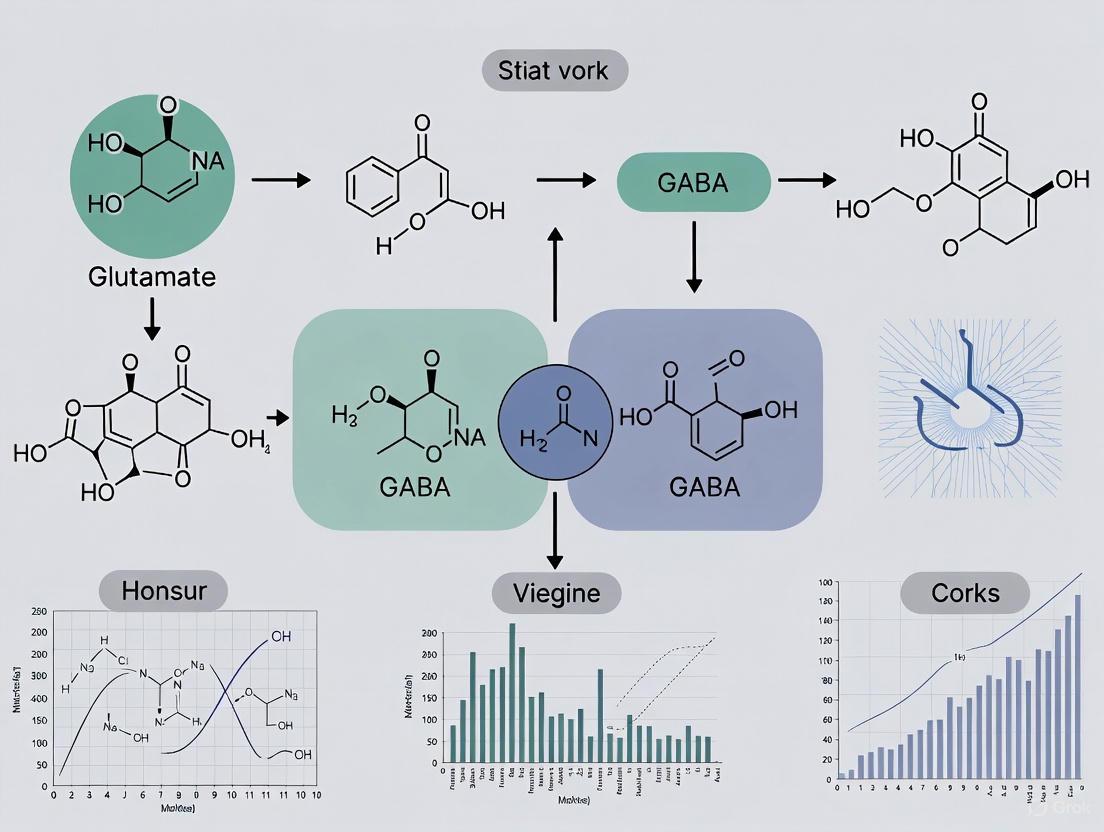
This article synthesizes current research on the dynamic roles of glutamate and GABA in the human visual cortex's response to varying image contrasts.
Excitation and Inhibition in Sight: How Glutamate and GABA Shape the Visual Cortex's Response to Contrast
Abstract
This article synthesizes current research on the dynamic roles of glutamate and GABA in the human visual cortex's response to varying image contrasts. Aimed at researchers and drug development professionals, it explores the foundational neurochemistry, advanced methodological approaches like combined fMRI-MRS, and key challenges in interpreting neurotransmitter dynamics. We examine how the excitatory-inhibitory (E/I) balance, as probed by magnetic resonance spectroscopy, underpins neural specificity and contrast coding. The content further validates these principles through clinical correlations in visual pathologies like glaucoma and discusses the implications for developing targeted therapeutic strategies that modulate cortical E/I balance for treating visual processing disorders.
Neurochemical Foundations of Vision: How Glutamate and GABA Code for Image Contrast
Fundamental Neurobiology of Glutamate and GABA
In the mammalian central nervous system, neuronal communication is predominantly governed by the interplay between the primary excitatory neurotransmitter, glutamate, and the primary inhibitory neurotransmitter, gamma-aminobutyric acid (GABA). These two neurotransmitters operate in a dynamic balance to regulate neural excitability, a process critical for all brain functions, from basic sensory processing to complex cognition [1] [2].
Glutamate is the most abundant excitatory neurotransmitter in the brain. Its release leads to the depolarization of postsynaptic neurons, facilitating the propagation of neural signals. Beyond its role in fast synaptic transmission, glutamate is integral to synaptic plasticity, learning, and memory consolidation [2]. However, precise regulation of extracellular glutamate is essential, as excessive levels can lead to excitotoxicity, a process of neuronal damage implicated in various neurological disorders [2].
GABA, synthesized directly from glutamate via the enzyme glutamic acid decarboxylase (GAD), serves the opposing inhibitory function. Activation of GABA receptors typically results in neuronal hyperpolarization, reducing the likelihood of action potential generation and dampening neural activity. This inhibition is crucial for preventing neuronal hyperactivity and maintaining network stability [3] [1].
The close metabolic relationship between glutamate and GABA creates a functional yin-and-yang balance. Their opposing actions allow for fine-tuning of neural circuit activity, ensuring that excitation and inhibition are properly balanced for optimal brain function [1] [4]. Disruptions in this excitation-inhibition (E/I) balance are linked to numerous pathologies, including epilepsy, anxiety disorders, schizophrenia, and neurodegenerative diseases [3] [4] [2].
Receptor Subtypes and Signaling Mechanisms
Both glutamate and GABA exert their effects through multiple receptor classes with distinct signaling mechanisms.
Glutamate Receptors are divided into two major families:
- Ionotropic glutamate receptors are ligand-gated ion channels that mediate fast excitatory synaptic transmission. They are further classified into NMDA, AMPA, and kainate receptors, each with unique pharmacological and functional properties [2].
- Metabotropic glutamate receptors (mGluRs) are G-protein coupled receptors that modulate synaptic activity through second messenger systems, leading to slower, longer-lasting modulatory effects [2].
GABA Receptors are classified into three main types:
- GABA-A receptors are ligand-gated chloride channels that mediate fast inhibitory postsynaptic potentials. They are heteropentameric structures assembled from various subunits, creating diverse receptor subtypes with distinct pharmacological profiles [3] [2].
- GABA-B receptors are G-protein coupled receptors that mediate slow and prolonged inhibitory effects through second messenger systems, affecting both pre- and postsynaptic sites [3].
- GABA-C receptors are primarily composed of ρ subunits and are mainly found in the retina, where they contribute to visual signal processing [3].
Table 1: Receptor Types for Glutamate and GABA
| Neurotransmitter | Receptor Class | Signaling Mechanism | Key Physiological Roles |
|---|---|---|---|
| Glutamate | Ionotropic (NMDA, AMPA, Kainate) | Ligand-gated cation channels | Fast excitatory synaptic transmission, synaptic plasticity |
| Metabotropic (mGluRs I, II, III) | G-protein coupled, second messengers | Modulation of synaptic transmission, neuronal excitability | |
| GABA | GABA-A | Ligand-gated chloride channels | Fast inhibitory synaptic transmission, hyperpolarization |
| GABA-B | G-protein coupled, second messengers | Slow inhibition, modulation of neurotransmitter release | |
| GABA-C (ρ) | Ligand-gated chloride channels | Retinal signal processing |
The Glutamate-GABA Balance in Visual Processing
The visual cortex provides an exemplary model system for investigating the functional interplay between glutamate and GABA. Research using advanced neuroimaging and spectroscopic techniques has revealed how the dynamics of these neurotransmitters underpin fundamental visual processes, including contrast response and binocular depth perception.
Neurotransmitter Dynamics Across Visual States
Functional magnetic resonance spectroscopy (fMRS) studies have quantified how GABA and glutamate levels change during different visual processing states. In a pivotal study examining the occipital cortex across three functional states, researchers observed contrasting dynamics between these neurotransmitters [5]:
- GABA levels decreased when participants opened their eyes in darkness compared to a baseline eyes-closed state
- Glutamate levels remained stable during eyes open in darkness but increased significantly during visual stimulation with a flickering checkerboard pattern [5]
These state-dependent neurotransmitter changes correlate with the amplitude of fMRI signal fluctuations, and importantly, visual discriminatory performance correlates specifically with GABA levels, but not glutamate levels [5]. This highlights the crucial role of inhibitory tone in shaping visual perception.
Table 2: Neurotransmitter Dynamics During Visual Processing
| Visual State | GABA Concentration | Glutamate/Glx Concentration | Functional Correlation |
|---|---|---|---|
| Eyes Closed (Baseline) | Baseline level | Baseline level | Baseline neural activity |
| Eyes Open (Darkness) | Decreased | Remains stable | Altered cortical excitability |
| Eyes Open (Visual Stimulation) | Further decrease (context-dependent) | Increased | Enhanced visual processing, correlates with BOLD signal |
Binocular Disparity Processing and E/I Balance
Recent research has specifically investigated how GABA and glutamate regulate the processing of binocular disparity, a fundamental cue for depth perception. The visual system must solve the "correspondence problem" - correctly matching features between the left and right eye's images while suppressing false matches [6].
A 2025 study measured GABA+ and Glx (glutamate-glutamine complex) concentrations in the human visual cortex during presentation of correlated (true depth cue) and anticorrelated (false depth cue) random dot stereograms. The findings revealed distinct patterns of neurotransmitter modulation across visual areas [6]:
- In the early visual cortex (EVC), correlated disparity increased Glx over anticorrelated and rest conditions
- In the lateral occipital cortex (LO), a ventral stream area important for object recognition, anticorrelated disparity decreased GABA+ and increased Glx
- The Glx/GABA+ ratio showed increased excitatory over inhibitory drive during anticorrelated disparity processing in LO [6]
These findings suggest that GABAergic inhibition contributes to the suppression of false matches in the ventral visual stream, a process essential for robust stereoscopic vision. The region-specific neurotransmitter dynamics illustrate how the E/I balance is differentially regulated across the visual hierarchy to support distinct computational goals.
Experimental Approaches and Methodologies
Research on glutamate and GABA in visual processing employs sophisticated neuroimaging and electrophysiological techniques that allow for non-invasive measurement and manipulation of neurotransmitter systems in humans and animal models.
Magnetic Resonance Spectroscopy (MRS) Protocols
Functional MRS (fMRS) has emerged as a powerful method for quantifying neurotransmitter dynamics during visual processing. Typical experimental parameters from recent studies include [5] [6]:
- Voxel Placement: A 25×25×25 mm³ MRS voxel is carefully positioned in the visual cortex, aligned along the midline and rotated to avoid lipid signal contamination from the skull
- Acquisition Parameters: Studies commonly use MEGA-PRESS pulse sequences with TR/TE = 2000/68 ms, 256 single averages (128 edit-ON and 128 edit-OFF scans), bandwidth = 1200 Hz
- Experimental Design: Block designs comparing neurotransmitter levels across different visual conditions (e.g., eyes closed, eyes open in darkness, visual stimulation) with counterbalanced order
- Data Acquisition: MRS data are typically acquired before EPI sequences to avoid gradient-induced frequency drifts
For binocular disparity studies, specialized visual stimulation systems are employed:
- MRI-compatible stereoscopes for dichoptic presentation
- Random dot stereograms with correlated and anticorrelated disparity patterns
- Control conditions featuring blank gray screens with fixation crosses
These protocols enable researchers to quantify stimulus-dependent changes in GABA+ and Glx concentrations with sufficient temporal resolution to track neural events related to visual processing.
Electrophysiological Approaches
Historically, microelectrophoretic administration of neurotransmitters combined with single-unit recording has been used to study the effects of glutamate and GABA on visual neuronal responses. Foundational studies in cat visual cortex demonstrated that [7]:
- Glutamate application enlarges receptive field sizes and increases response amplitudes within the receptive field
- GABA application decreases neuronal excitability, potentially leading to complete response blockade
- In some cases, glutamate can indirectly inhibit certain cells, likely through activation of local inhibitory interneurons
These classic approaches continue to inform modern research by providing cellular-level insights into neurotransmitter effects on specific response properties of visual neurons.
Molecular Crosstalk and Homeostatic Regulation
Recent discoveries have revealed unexpected molecular interactions between the glutamatergic and GABAergic systems that blur the traditional distinction between excitatory and inhibitory neurotransmission.
Direct Glutamate Modulation of GABA-A Receptors
A groundbreaking 2022 study identified a novel allosteric glutamate-binding site on GABA-A receptors, demonstrating that glutamate can directly potentiate GABA-evoked currents [4]. This crosstalk exhibits several remarkable characteristics:
- Mechanism: Glutamate binds at a novel site located at the α+/β- subunit interface of the GABA-A receptor, distinct from the GABA binding site
- Potency: The EC₅₀ of glutamate potentiation is approximately 180 μM, with the lowest effective dose around 30 μM
- Subunit Dependence: The potentiation does not require the γ subunit; in fact, the presence of the γ subunit significantly reduces glutamate potency
- Physiological Impact: Genetic impairment of this glutamate potentiation in knock-in mice resulted in increased neuronal excitability, decreased thresholds to noxious stimuli, and increased seizure susceptibility [4]
This direct interaction represents a rapid homeostatic feedback mechanism where the excitatory neurotransmitter can immediately enhance inhibitory transmission to maintain E/I balance.
Diagram 1: Molecular crosstalk between glutamate and GABA-A receptors. Glutamate binds to a novel allosteric site on GABA-A receptors, potentiating GABA-evoked chloride influx and enhancing neuronal inhibition. This mechanism provides rapid homeostatic regulation of excitation-inhibition (E/I) balance [4].
Research Reagents and Methodological Toolkit
Studies investigating glutamate and GABA in visual processing rely on specialized research reagents and methodological approaches.
Table 3: Essential Research Reagents and Methodologies
| Category | Specific Reagents/Tools | Research Application | Key Functions |
|---|---|---|---|
| GABAergic Agents | Bicuculline, Gabazine | GABA-A receptor antagonism | Blocking fast inhibitory transmission |
| Muscimol, Isoguvacine | GABA-A receptor agonism | Enhancing inhibitory tone | |
| Baclofen | GABA-B receptor activation | Modulating slow inhibition | |
| Glutamatergic Agents | NMDA, AMPA, Kainate | Receptor subtype activation | Selective excitation |
| CNQX, AP5 | Receptor subtype blockade | Isolating receptor contributions | |
| Enzyme Markers | Anti-GAD antibodies | GABAergic neuron identification | Labeling GABA synthesis enzyme |
| Anti-GDH antibodies | Glutamatergic activity mapping | Visualizing glutamate metabolism | |
| Methodological Approaches | fMRS (MEGA-PRESS) | In vivo neurotransmitter quantification | Measuring GABA+ and Glx dynamics |
| Microelectrophoresis | Cellular-level drug application | Precise receptor manipulation | |
| Binocular stereoscopes | Dichoptic visual stimulation | Presenting disparity cues |
Visual Processing Workflow and Neurotransmitter Dynamics
The following diagram integrates the experimental workflow and neurotransmitter dynamics in visual processing research:
Diagram 2: Experimental workflow in visual processing research. Different visual stimuli engage distinct processing mechanisms across the visual hierarchy, resulting in region-specific neurotransmitter dynamics measurable with fMRS, which ultimately correlate with behavioral performance [5] [6].
The intricate interplay between glutamate and GABA forms the fundamental neurochemical basis for visual processing in the cerebral cortex. The E/I balance maintained by these neurotransmitters enables the precise neural computations required for contrast response, binocular disparity processing, and ultimately, visual perception. Advanced neuroimaging techniques, particularly fMRS, have revealed that these neurotransmitters exhibit dynamic, state-dependent changes across different visual areas, reflecting their specialized roles in the visual processing hierarchy. Furthermore, the recently discovered direct molecular crosstalk between glutamate and GABA-A receptors adds a new layer of complexity to our understanding of how E/I balance is rapidly regulated at the synaptic level. Continuing research on these mechanisms promises to advance not only our fundamental knowledge of visual neuroscience but also our understanding of various neurological and psychiatric disorders where E/I balance is disrupted.
The contrast response function (CRF) describes how neural activity in the visual system changes in response to variations in stimulus contrast, serving as a fundamental bridge between visual perception and its underlying neural mechanisms. Understanding the CRF provides critical insights into how the brain transforms physical light patterns into conscious visual experience. Research over recent decades has established that this transformation involves complex interactions between hemodynamic responses, excitatory and inhibitory neurotransmission, and hierarchical cortical processing.
This technical review examines the CRF through the lens of neurochemical signaling, particularly focusing on the roles of the primary excitatory and inhibitory neurotransmitters glutamate and GABA. We synthesize evidence from advanced neuroimaging techniques, including functional magnetic resonance imaging (fMRI), magnetic resonance spectroscopy (MRS), and computational modeling, to present a comprehensive framework of how contrast information is processed across the visual hierarchy. The balance between glutamate and GABA signaling appears crucial for shaping contrast-dependent neural responses and maintaining the exquisite sensitivity of visual processing across varying stimulus conditions.
Neurochemical Foundations of Contrast Processing
Glutamate and GABA Dynamics During Visual Stimulation
The interplay between excitatory and inhibitory neurotransmission forms the neurochemical basis for contrast processing in the visual cortex. Simultaneous measurement of BOLD-fMRI and neurochemical concentrations using MR spectroscopy at 7 Tesla has revealed distinct response patterns for glutamate and GABA across different contrast levels.
Table 1: Neurochemical Responses to Varying Image Contrasts in Human V1
| Contrast Level | Glutamate Response | GABA Response | BOLD Signal |
|---|---|---|---|
| 3% | No significant change | Steady | Linear increase |
| 12.5% | No significant change | Steady | Linear increase |
| 50% | No significant change | Steady | Linear increase |
| 100% | Significant increase | Steady | Linear increase |
As illustrated in Table 1, glutamate concentrations show a significant increase only at the highest contrast level (100%), while GABA levels remain steady across all contrast intensities [8]. This suggests that excitatory neurotransmission has a higher activation threshold compared to the hemodynamic response measured by BOLD fMRI, which increases linearly with contrast. The dissociation between neurochemical and hemodynamic responses at lower contrast levels indicates a potential sensitivity threshold for detecting glutamate changes during visual processing.
The temporal dynamics between these neurotransmitter systems are equally important. Research has demonstrated that in the visual cortex, GABA and Glx (glutamate-glutamine complex) concentrations drift in opposite directions during rest, with GABA decreasing and Glx increasing over time [9]. Furthermore, GABA concentrations predict subsequent opposite changes in Glx approximately 120 seconds later, revealing a dynamic interplay between excitation and inhibition that may optimize contrast sensitivity.
Metabolic Demands of Contrast Processing
The relationship between neurochemical signaling and energy metabolism presents a complex picture of contrast processing. The BOLD response reflects a composite measure of blood flow, blood volume, and oxygen demand resulting from neuronal activity energy requirements [8]. Both excitatory and inhibitory signaling consume energy, leading to increased local BOLD signals, making the interpretation of BOLD responses ambiguous without complementary neurochemical measures.
The MRS-visible glutamate signal comprises both the neurotransmitter pool and glutamate involved in energy metabolism, necessitating careful interpretation of functional MRS studies [8]. This dual role of glutamate in both neurotransmission and metabolism highlights the intricate relationship between information processing and energy utilization in contrast coding.
Neural Contrast Response Functions Across Cortical Areas
Hierarchical Processing of Contrast Information
The visual system processes contrast information through a distributed network of cortical areas, each with distinct response properties. Research using Relational Neural Control (RNC) has revealed systematic changes in how contrast information is represented across the visual hierarchy [10].
Table 2: Representational Relationships Across Visual Cortical Areas
| Cortical Area Comparison | Representational Alignment | Representational Disentanglement | Hierarchical Distance Effect |
|---|---|---|---|
| V1 vs. V2 | High | Low | Small effect |
| V1 vs. V3 | Moderate | Moderate | Moderate effect |
| V1 vs. V4 | Low | High | Large effect |
| V2 vs. V3 | Moderate | Moderate | Moderate effect |
| V2 vs. V4 | Low | High | Large effect |
| V3 vs. V4 | Moderate | Moderate | Moderate effect |
As shown in Table 2, representational alignment decreases while disentanglement increases with stepwise distance between visual areas in the processing hierarchy [10]. This indicates that visual areas further apart in the processing hierarchy share less representational content, reflecting their specialized roles in contrast and form processing.
The neural contrast sensitivity function (nCSF) approach has further elucidated how different cortical locations respond to varying combinations of contrast and spatial frequency. This method has demonstrated systematic variations in nCSF properties according to eccentricity and position in the visual hierarchy, with the peak spatial frequency that a cortical location responds to decreasing with eccentricity and across the visual hierarchy [11].
Center-Surround Interactions in Contrast Processing
Contrast processing involves not only responses to local stimulus features but also complex interactions between center and surround regions. The Stabilized Supralinear Network (SSN) model effectively explains several key phenomena of surround suppression in V1, where responses to a center stimulus are modulated by surrounding stimuli [12].
The SSN model accounts for three crucial features of surround suppression:
- Suppression of both inhibitory and excitatory currents received by a cell
- Strongest suppression when surround orientation matches the center stimulus
- Feature-specific suppression of plaid components matching the surround orientation
These center-surround interactions reflect sophisticated computational mechanisms that enhance contrast discrimination and optimize visual processing for natural scenes, where contextual information plays a crucial role in perception.
Methodological Approaches for Assessing Contrast Responses
Combined fMRI-MRS Protocol
The simultaneous acquisition of fMRI and MRS data provides a powerful approach for investigating the relationship between hemodynamic responses and neurochemical dynamics during contrast processing.
Figure 1: Experimental workflow for combined fMRI-MRS studies of contrast response functions
Key Experimental Parameters:
- Magnetic Field Strength: 7 Tesla for improved signal-to-noise ratio
- MRS Voxel: 8 cm³ positioned in occipital lobe, centered on calcarine sulcus
- Visual Stimuli: Contrast-reversing checkerboards (8 Hz) at four contrast levels
- Stimulation Protocol: Block design with 64 s baseline and 64 s stimulation
- MRS Sequence: Short-echo semi-LASER (TE = 36 ms, TR = 4 s) with VAPOR water suppression
This protocol enables the correlation of BOLD signal changes with dynamic alterations in glutamate and GABA concentrations, providing insights into the neurochemical underpinnings of contrast processing [8].
Population Receptive Field (pRF) Mapping with Contrast Variation
Traditional pRF mapping uses single high-contrast stimuli to identify visual field representations in the cortex. Recent advances have incorporated varying contrast levels to measure contrast sensitivity across the visual field without requiring precise fixation, making the method suitable for patients with visual impairments [13].
The enhanced pRF approach incorporates:
- Large-field stimulation (40° diameter) covering central and peripheral vision
- Multiple contrast levels to characterize subtle sensitivity changes
- Structural retinotopic atlas as an alternative when pRF mapping is infeasible
- Model-based analysis to estimate contrast sensitivity at each visual field location
This method has successfully characterized known sensitivity differences across eccentricities and visual quadrants, demonstrating greater sensitivity in V1 regions receiving input from horizontal versus vertical quadrants and lower versus upper quadrants [13].
Neural Contrast Sensitivity Function (nCSF) Modeling
The nCSF approach models how neuronal populations respond to contrast as a function of spatial frequency, providing a neural equivalent of the behavioral contrast sensitivity function.
Experimental Protocol:
- Stimuli: Static sinewave gratings with systematic variation in contrast (0.25-80%) and spatial frequency (0.5-18 c/deg)
- Design: Blocked presentation with increasing and decreasing contrast sequences
- Analysis: Asymmetric parabolic function to model nCSF, with CRF modeling the transition from no response to full response
- Validation: Parameter recovery simulations and comparison with known cortical organizational principles
This method has shown that nCSF properties vary systematically with eccentricity, polar angle, and across the visual hierarchy, providing a quantitative framework for assessing neural contrast sensitivity in both healthy and clinical populations [11].
The Scientist's Toolkit: Research Reagent Solutions
Table 3: Essential Materials and Methods for Contrast Response Research
| Research Tool | Specifications & Purpose | Example Implementation |
|---|---|---|
| High-Field MRI | 7T Siemens scanner with 32-channel head coil; enhances signal-to-noise for fMRI and MRS | Provides high-resolution BOLD and neurochemical data [8] |
| MRS Sequence | Short-echo semi-LASER (TE=36ms); optimizes detection of neurometabolites | Quantifies glutamate and GABA concentrations during visual stimulation [8] |
| Visual Stimulation System | Gamma-linearized projector with PsychToolbox; precise contrast control | Presents contrast-varying stimuli (3-100% Michelson contrast) [8] [11] |
| Dielectric Pad | BaTiO₃/deuterated water suspension; improves transmit field efficiency | Enhances signal quality in occipital cortex [8] |
| Encoding Models | Deep-neural-network-based models; predict fMRI responses from visual features | Generates in silico fMRI responses for large image sets [10] |
| Stabilized Supralinear Network Model | Biologically-constrained computational model; simulates V1 circuit dynamics | Explains center-surround interactions and contrast normalization [12] |
Clinical Implications and Future Directions
The research methodologies and findings described herein have significant implications for understanding and diagnosing visual disorders. Abnormalities in contrast processing characterize numerous ophthalmological and neurological conditions, including amblyopia, glaucoma, multiple sclerosis, and Parkinson's disease [11]. The development of non-invasive methods to assess neural contrast sensitivity offers promising avenues for early detection and monitoring of these conditions.
Future research directions should focus on:
- Translating nCSF methods to clinical populations with various visual impairments
- Investigating pharmacological manipulations of GABA and glutamate systems on contrast processing
- Developing integrated models that incorporate neurochemical, hemodynamic, and perceptual aspects of contrast coding
- Exploring developmental trajectories of contrast response functions across the lifespan
- Linking individual differences in neurochemical balances to contrast perception abilities
The continued refinement of methods for assessing the contrast response function will enhance our understanding of visual processing and provide valuable tools for diagnosing and monitoring visual disorders, ultimately contributing to the development of targeted therapeutic interventions.
In the neural circuitry of the visual cortex, the balance between excitatory and inhibitory signaling is paramount for processing visual information. Glutamate, the primary excitatory neurotransmitter, and GABA (gamma-aminobutyric acid), the primary inhibitory neurotransmitter, engage in a dynamic interplay that governs neuronal responses to sensory input. A fundamental question in visual neuroscience is determining the precise stimulus intensity at which glutamate-mediated signaling transitions from being negligible to functionally significant. This threshold dictates how the cortex encodes contrast, forms representations of the visual world, and maintains stability against runaway excitation. Framed within broader research on cortical contrast response, this review synthesizes current findings on the neurochemical and perceptual thresholds of glutamate signaling, detailing the experimental methodologies that enable their quantification and the theoretical models that explain their underlying logic.
Neurochemical Foundations of Contrast Response
The response of the visual cortex to varying stimulus intensities is not linear. At the neurochemical level, this is reflected in the dynamic concentrations of glutamate and GABA, which can be measured in vivo using Magnetic Resonance Spectroscopy (MRS). A key concept in understanding contrast perception is the "dipper function"—a non-linear relationship where the detection of a contrast increment is actually facilitated (threshold is lowered) by the presence of a low-contrast "pedestal" stimulus, before becoming harder again at higher pedestal contrasts [14].
The dipper function is formally quantified as the difference between the absolute contrast threshold (C0) and the minimum increment threshold (Cmin), divided by the maximum threshold (Cmax): DM = (C0 - Cmin) / Cmax [14]. Research has shown that the strength of this dipper effect is strongly correlated with GABA concentration in the visual cortex [14]. Higher GABA levels are associated with a more pronounced dipper function, indicating that inhibition plays a critical role in this fundamental perceptual non-linearity.
Table 1: Key Neurochemical and Perceptual Metrics in Contrast Response
| Metric | Description | Relationship to GABA/Glutamate | Experimental Measure |
|---|---|---|---|
| Dipper Magnitude (DM) | Strength of facilitation at low contrast pedestals [14] | Positively correlated with GABA concentration [14] | Contrast discrimination task |
| Contrast Detection Threshold (C0) | Minimum contrast to detect a stimulus [14] | Inversely related to GABA; high GABA reduces neural noise, potentially lowering C0 [14] | 2-alternative forced choice (2AFC) task |
| Glx/GABA+ Ratio | Balance of excitatory to inhibitory neurochemical drive [15] | Increased during visual stimulation (e.g., correlated disparity); signifies excitatory drive [15] | Functional Magnetic Resonance Spectroscopy (fMRS) |
| Neural Variability (SDBOLD) | Moment-to-moment BOLD signal fluctuation [16] | Modulation by stimulus complexity is GABA-dependent; follows an inverted-U relationship [16] | fMRI time-series analysis |
Beyond baseline states, visual stimulation induces rapid, region-specific neurochemical shifts. A 2025 fMRSI (functional Magnetic Resonance Spectroscopic Imaging) study demonstrated that visual stimulation produces distinct spatial maps of GABA and glutamate (Glu) responses, with Glu increases observed in the visual cortex and GABA increases in both the thalamus and visual cortex [17]. Furthermore, the specific visual feature being processed dictates the neurochemical response. For instance, viewing correlated binocular disparity (a valid depth cue) in the early visual cortex (EVC) increases Glx levels compared to a rest condition [15]. In the higher-level lateral occipital cortex (LO), viewing anticorrelated disparity (a false depth cue) decreases GABA+ and increases Glx, shifting the Glx/GABA+ ratio toward excitation [15]. This suggests a flexible, feature-specific mechanism for regulating the excitatory-inhibitory balance.
Quantifying Thresholds: From Perception to Neurochemistry
The GABAergic Regulation of Perceptual Thresholds
The link between GABA concentration and perceptual thresholds is mechanistic, not merely correlative. Computational modeling using the Wilson-Cowan framework—a classic model comprising interacting excitatory and inhibitory neural populations—indicates that GABA's role implements a form of suppressive gain control [14]. Higher GABAergic inhibition has a dual effect:
- Reducing intrinsic neural noise, which can improve signal detection at near-threshold contrasts.
- Reducing neural response gain, which paradoxically can decrease neural sensitivity to high-contrast stimuli while improving perceptual discrimination [14].
This gain control mechanism is crucial for aligning the brain's dynamic range with the statistics of sensory input. The importance of GABA is further highlighted by pharmacological and aging studies. Administering lorazepam, a GABAA receptor agonist, alters how neural variability (SDBOLD) scales with stimulus complexity. Its effect follows an inverted-U function: individuals with lower baseline GABA levels show a drug-related increase in variability modulation, while those with higher baseline GABA show no change or a reduction [16]. As older adults typically have lower visual cortex GABA levels, they also exhibit a reduced ability to modulate neural variability in response to complex stimuli, which is linked to poorer visual discrimination performance [16].
Temporal Dynamics of Glutamate and GABA
The threshold for significant glutamate signaling is not static but fluctuates over time. MRS studies reveal a temporal interdependency between the two neurotransmitters during rest. In the visual cortex, GABA+ and Glx concentrations drift in opposite directions over time, with GABA+ decreasing and Glx increasing [9]. Crucially, a change in GABA+ concentration predicts an opposite change in Glx approximately 120 seconds later [9]. This predictive relationship is region-specific, being absent in the posterior cingulate cortex, and suggests a homeostatic feedback loop where inhibition proactively gates subsequent excitation in the visual system [9].
Table 2: Neurochemical Responses to Visual Stimulation Across Cortical Areas
| Visual Cortex Area | Stimulus Type | GABA Response | Glutamate/Glx Response | Functional Implication |
|---|---|---|---|---|
| Early Visual Cortex (EVC) [15] | Correlated Binocular Disparity | No significant change | Increase over anticorrelated and rest | Enhances processing of valid depth signals |
| Lateral Occipital Cortex (LO) [15] | Anticorrelated Binocular Disparity | Decrease | Increase | Suppression of invalid depth cues; shift to excitatory drive |
| Visual Cortex (General) [17] | Broad Visual Stimulation | Increase (in visual cortex & thalamus) | Increase (in visual cortex) | Coordinated excitatory signaling and localized inhibition |
| Visual Cortex (at rest) [9] | No stimulation (Eyes closed) | Gradual decrease over time | Gradual increase over time | Underlying homeostatic balance between systems |
Experimental Protocols for Probing Neurochemical Thresholds
Functional Magnetic Resonance Spectroscopy (fMRS)
Purpose: To measure dynamic changes in neurometabolite concentrations (e.g., GABA and Glx) in the human brain during controlled visual stimulation [17] [15]. Workflow:
- Voxel Placement: A spectroscopic voxel is positioned over the target visual area (e.g., early visual cortex EVC or lateral occipital complex LOC) using anatomical scans [15].
- Stimulus Presentation: Participants are presented with block-designed conditions within the MRI scanner. For disparity studies, conditions include correlated disparity, anticorrelated disparity, and a rest condition (blank gray screen with fixation) [15].
- Data Acquisition: Spectra are acquired using a MEGA-PRESS sequence, an editing sequence that isolates the GABA signal from overlapping metabolites. A typical protocol uses: TE = 68 ms, TR = 3000 ms, and 256 transients [9].
- Quantification: Acquired spectra are fitted to estimate the concentration of GABA+ (including macromolecules) and Glx, often referenced to the internal water signal or creatine. Concentrations are compared across stimulus conditions to identify task-evoked neurochemical changes [15].
Contrast Discrimination Task with Psychophysical Modeling
Purpose: To behaviorally measure contrast detection thresholds and relate them to individual differences in visual cortex GABA concentration [14]. Workflow:
- Stimuli: Participants view two sinusoidal grating patches presented on either side of a fixation point [14].
- Task Procedure: In a two-alternative forced-choice (2AFC) design, participants identify which patch has the higher contrast. One grating serves as the "pedestal" (base contrast), and the other is the pedestal plus a contrast increment [14].
- Threshold Estimation: An adaptive staircase procedure (e.g., QUEST) is used across multiple blocks with different pedestal contrasts (e.g., 0 to 0.4) to estimate the contrast increment required for 82% correct performance at each pedestal level [14].
- Model Fitting: The resulting "dipper function" (threshold vs. pedestal contrast) is fit with a sigmoidal Contrast Response Function (CRF) or the Wilson-Cowan neural population model. Model parameters (e.g., suppression strength, response criterion) are then correlated with MRS-derived GABA levels [14].
Molecular Logic of Synaptic Signaling
The response of a neuron to glutamatergic input is fundamentally determined by the molecular composition of its postsynaptic density. Super-resolution proteometric imaging of individual synapses in the mouse neocortex reveals that glutamatergic synapses are not uniform but cluster into distinct subclasses based on their glutamate receptor content [18]. These subclasses appear to define a functional logic:
- Large, AMPAR-rich synapses are thought to represent potentiated, high-efficacy connections that strongly transmit excitatory signals.
- Small, NMDAR-rich "silent" synapses contain NMDA receptors but lack detectable AMPA receptors. These synapses are inefficient at driving the postsynaptic neuron under baseline conditions but are primed for plasticity [18].
Crucially, the ultrastructural features of a synapse (e.g., spine head size, neck diameter) are a better predictor of its receptor content than the identity of its parent neuron [18]. This suggests that the threshold for significant glutamate signaling is set at the level of the individual synapse, with its specific proteometric profile determining its contribution to network activity.
Visual Stimulus to Perception Pathway: This diagram illustrates the pathway from visual contrast input to perceptual outcome, highlighting the opposing roles of glutamatergic (excitatory) and GABAergic (inhibitory) signaling in shaping the stimulus intensity threshold.
The Scientist's Toolkit: Essential Reagents and Methods
Table 3: Key Research Reagent Solutions and Methodologies
| Tool / Reagent | Primary Function | Application Context |
|---|---|---|
| MEGA-PRESS MRS [9] | Isolates and quantifies in vivo concentrations of GABA+ and Glx from a brain voxel. | Measuring neurochemical dynamics during rest or visual stimulation tasks. |
| fMRSI (functional MRSI) [17] | Generates high-resolution spatio-temporal maps of neurotransmitter changes across the brain. | Localizing GABA and Glu responses to specific visual areas (e.g., V1, thalamus) during stimulation. |
| AAV-CaMKIIα-ChR2/eArch3.0 [19] | Enables optogenetic activation (ChR2) or inhibition (eArch) of glutamatergic neurons in animal models. | Causally testing the role of specific neuronal populations (e.g., V2M glutamatergic neurons) in pain and perception. |
| GABAA Agonist (e.g., Lorazepam) [16] | Pharmacologically enhances GABAergic inhibition in the human brain. | Causally probing the role of GABA in perceptual tasks and neural variability. |
| Wilson-Cowan Model [14] | A biophysical model of interacting excitatory and inhibitory neural populations. | Simulating and interpreting the effects of GABA and glutamate on contrast response functions. |
| Array Tomography [18] | Multiplex super-resolution imaging of synaptic proteins in ultrastructural context. | Classifying synapse subtypes and quantifying receptor content (e.g., AMPA/NMDA ratio) at single-synapse level. |
Determining the threshold at which glutamate signaling becomes significant reveals a core operating principle of the visual cortex: excitation is granted significance only through its dynamic regulation by inhibition. The threshold is not a fixed value but a fluid interface, shaped by the immediate sensory environment, the internal neurochemical state, and the historical pattern of activity that has shaped synaptic micro-architecture. GABAergic suppression of neural noise and gain establishes the baseline against which glutamatergic signals must compete, a relationship quantified by the non-linear dipper function in contrast perception. The development of high-resolution fMRSI and single-synapse proteometry is transforming our understanding, showing that these thresholds are set locally within specialized synaptic circuits and are modulated over time by predictive neurochemical interactions. This refined understanding of excitatory-inhibitory balance provides a critical foundation for developing therapeutic strategies for neurological disorders where this balance is disrupted, from neuropathic pain to psychiatric conditions.
GABA's Role in Maintaining Neural Specificity and Stabilizing Baseline Activity
This technical review examines the critical role of γ-aminobutyric acid (GABA) in regulating neural specificity and stabilizing baseline activity in the visual cortex, with implications for therapeutic development. GABAergic inhibition serves as a fundamental mechanism for sharpening neuronal response properties, maintaining excitation-inhibition balance, and optimizing sensory processing. We synthesize recent human and animal studies demonstrating that GABA levels directly predict neural specificity metrics and that GABA decline leads to degraded sensory representations. The intricate crosstalk between GABA and glutamate receptors reveals sophisticated homeostatic regulation of cortical circuits. For researchers and drug development professionals, this review provides validated experimental protocols, key reagent solutions, and emerging targets for modulating GABAergic function to restore neural processing fidelity in neurological disorders.
In the visual cortex, neural specificity refers to the precise and distinct response patterns of neuronal populations to different visual features, a fundamental property enabling efficient sensory and cognitive functions. This specificity is dynamically shaped by GABAergic inhibition, which sharpens neuronal tuning and reduces response confusability. The balance between glutamatergic excitation and GABAergic inhibition (E/I balance) constitutes a core mechanism governing visual processing, from basic contrast detection to complex pattern recognition. Recent research framed within visual cortex contrast response studies demonstrates that GABA plays a particularly crucial role in maintaining neural specificity by preventing the overlapping representations of different visual stimuli, thereby ensuring efficient encoding of visual information. When this GABAergic regulation falters, as occurs in aging and neurodegenerative conditions, the resulting degradation of neural specificity manifests as measurable impairments in visual perception and cognition.
Mechanisms of GABAergic Regulation of Neural Specificity
Sharpening Neural Response Profiles
GABAergic inhibition enhances neural specificity through multiple complementary mechanisms that collectively sharpen neuronal response profiles:
Contrast Normalization: In primary visual cortex (V1), GABA-mediated inhibition implements a normalization mechanism where responses to chromatic and achromatic stimuli become interdependent. This normalization effect optimally adjusts the dynamic range of neuronal responses to varying contrast levels, with GABA acting as a key implementation signal [20] [21].
Feature Selectivity: GABAergic interneurons sharpen the selectivity of visual neurons for specific stimulus features by suppressing responses to non-preferred features. This lateral inhibition creates more distinct neural population responses to different visual categories, effectively reducing pattern confusability [22].
Temporal Precision: By controlling the timing and duration of excitatory responses, GABAergic signaling ensures that visual information is processed with millisecond precision, preventing the temporal blurring of successive visual inputs that would degrade motion perception and dynamic scene analysis.
Regulating Neural Variability and Signal-to-Noise
Moment-to-moment neural variability in the blood oxygen level-dependent (BOLD) signal scales with stimulus complexity, and GABA serves as a critical regulator of this variability modulation:
Higher baseline GABA levels in the visual cortex enable greater modulation of neural variability in response to increasingly complex stimuli. This variability modulation capacity is significantly reduced in older adults with lower GABA concentrations, resulting in compromised visual discrimination performance [16]. The relationship follows an inverted-U function, where pharmacologically increasing GABA activity with benzodiazepines boosts variability modulation in individuals with low baseline GABA, but has reduced effects or even slightly impairs it in those with already high GABA levels.
Molecular Crosstalk Mechanisms
The traditional view of separate excitatory (glutamate) and inhibitory (GABA) systems has been challenged by discoveries of direct molecular crosstalk:
Allosteric Glutamate Binding to GABAA Receptors: Glutamate directly binds to a novel allosteric site on GABAA receptors at the α+/β− subunit interface, potentiating GABA-evoked currents. This potentiation does not require γ subunits and is actually reduced in their presence. In HEK293 cells expressing recombinant α1β2 GABAA receptors, glutamate (EC50 ≈ 180 μM) potentiated GABA-evoked currents by over 3-fold, primarily by increasing GABA binding affinity (reducing EC50 from 13.19 μM to 5.46 μM) [4].
Co-transmission and Co-release: Many neurons co-release glutamate and GABA from the same synaptic terminals, often from different synaptic vesicles with distinct release properties. At supramammillary nucleus (SuM) to dentate gyrus synapses, glutamate and GABA are co-released from different vesicle populations, exhibiting different paired-pulse ratios, calcium sensitivities, and short-term plasticity profiles [23].
Homeostatic Regulation of Neuronal Excitability
The newly discovered glutamate-GABAA receptor interaction represents a rapid feedback mechanism for homeostatically regulating neuronal excitation:
Genetic impairment of this glutamate potentiation in knock-in mice results in increased neuronal excitability phenotypes, including decreased thresholds to noxious stimuli and enhanced seizure susceptibility, demonstrating its critical role in maintaining excitation-inhibition balance [4].
Quantitative Evidence: GABA, Neural Specificity, and Behavior
GABA Levels Predict Neural Specificity and Behavioral Performance
Table 1: Quantitative Relationships Between GABA Levels and Functional Measures
| Brain Region | GABA Measure | Functional Correlation | Effect Size | Population | Citation |
|---|---|---|---|---|---|
| Visual Cortex | GABA+ (MRS) | Neural specificity (fMRI) | β = 0.337, p = 0.020 | Glaucoma patients | [22] |
| Visual Cortex | GABA+ (MRS) | Variability modulation (ΔSDBOLD) | Inverted-U function | Young vs. older adults | [16] |
| Motor Cortex | GABA/NAA ratio | Reaction time | r = 0.572, p = 0.0001 | Subarachnoid hemorrhage | [24] |
| Frontal Cortex | GABA+/Cr (MRS) | Cognitive performance | Stabilization in oldest-old | Cognitively-intact >85yo | [25] |
Multiple studies demonstrate that GABA levels quantitatively predict neural function and behavioral performance. In glaucoma patients, visual cortex GABA levels decrease with disease severity, and this reduction specifically predicts degraded neural specificity independent of age or retinal structural damage [22]. The association remains significant after controlling for age, gray matter volume, and retinal impairments, suggesting a specific role for GABA in maintaining distinct neural representations.
Aging and Neurodegenerative Conditions
Age-related GABA decline contributes significantly to degraded neural processing, though this relationship may stabilize in the cognitively-intact oldest-old:
Table 2: GABA Alterations in Aging and Neurological Conditions
| Condition | GABA Change | Neural Specificity Impact | Behavioral Manifestation | Citation |
|---|---|---|---|---|
| Normal Aging | Gradual reduction | Reduced variability modulation | Poorer visual discrimination | [16] |
| Glaucoma | Severity-dependent decrease | Degraded visual cortex specificity | Visual cognitive impairments | [22] |
| Subarachnoid Hemorrhage | Left motor cortex reduction | Impaired cortical inhibition | Prolonged reaction times | [24] |
| Successful Aging (85+ yo) | Stabilization | Maintained neural specificity | Intact cognitive performance | [25] |
Individual participant meta-analysis reveals that age-related GABA differences follow a nonlinear trajectory, with stabilization in cognitively-intact oldest-old adults (85+ years). This flattening slope suggests a survivorship effect, where maintained GABAergic function may be neuroprotective and necessary for intact cognition in advanced age [25].
Experimental Approaches and Methodologies
Core Research Protocols
Magnetic Resonance Spectroscopy (MRS) for GABA Quantification
Protocol: MEGA-PRESS MRS for GABA Measurement
Voxel Placement: Position 30×30×30 mm³ voxel in target region (e.g., visual cortex, frontal midline). Align precisely using structural landmarks [25].
Sequence Parameters: Implement MEGA-PRESS editing sequence with the following specifications:
- Editing pulses: ON at 1.9 ppm, OFF at 7.46 ppm
- TE: 68 ms, TR: 2000 ms
- Averages: 320 (160 ON, 160 OFF)
- Scan duration: 10:48 minutes
- Spectral width: 4000 Hz with 4096 data points [25]
Water Suppression: Apply chemical shift selective water suppression (CHESS) with transversal saturation band placed along the skull.
Data Processing:
- Analyze vendor-native data in Gannet 3.3.1 (MATLAB)
- Reference to creatine (Cr) or unsuppressed water signal (H₂O)
- Apply α-correction for gray/white matter differences
- Quality control: fit error <15%, visual inspection of spectra [25]
fMRI Neural Specificity Assessment
Protocol: Measuring Neural Specificity with fMRI
Stimulus Design: Present multiple categories of visual stimuli (e.g., faces, houses) in block or event-related design. Use HMAX computational modeling to objectively quantify stimulus complexity [16].
Image Acquisition: Acquire BOLD images with standard parameters (e.g., TR=2000ms, TE=30ms, voxel size=3×3×3mm³).
Neural Specificity Quantification:
- Extract activation patterns for each stimulus category
- Calculate pattern discriminability (e.g., Pearson correlation, Mahalanobis distance)
- Higher discriminability indicates better neural specificity [22]
Brain Signal Variability Analysis:
- Calculate moment-to-moment BOLD signal variability (SDBOLD)
- Compute variability modulation (ΔSDBOLD) as difference between complex and simple stimuli
- Relate variability measures to GABA levels and behavior [16]
The Scientist's Toolkit: Key Research Reagents
Table 3: Essential Research Reagents for GABA-Neural Specificity Studies
| Reagent/Category | Specific Examples | Research Application | Function | Citation |
|---|---|---|---|---|
| GABA Agonists | Lorazepam | Pharmacological fMRI/MRS | GABAA receptor positive allosteric modulator | [16] |
| Viral Vectors | AAV-DIO-ChR2-eYFP | Optogenetics | Cre-dependent Channelrhodopsin expression | [23] |
| MRS Analysis Software | Gannet 3.3.1 | GABA quantification | MEGA-PRESS data processing | [25] |
| Computational Models | HMAX model | Visual stimulus analysis | Objective complexity quantification | [16] |
| Transgenic Animals | VGluT2-Cre mice | Circuit mapping | Selective targeting of glutamatergic neurons | [23] |
Research Workflow Integration
The integrated experimental approach to studying GABA's role in neural specificity combines neurochemical, functional, and behavioral assessments:
Implications for Therapeutic Development
The precise regulation of GABAergic signaling represents a promising target for therapeutic interventions in conditions characterized by degraded neural specificity:
Glaucoma and Neurodegenerative Disorders: The association between GABA reduction and degraded visual cortex specificity in glaucoma suggests GABAergic enhancers could preserve visual function beyond intraocular pressure management [22].
Age-Related Cognitive Decline: The demonstration that GABA stabilization correlates with successful cognitive aging in the oldest-old indicates that GABAergic therapies might prolong cognitive health [25].
Post-Stroke Motor Recovery: The correlation between motor cortex GABA levels and reaction time in subarachnoid hemorrhage patients suggests GABA modulation could improve motor recovery [24].
Precision Pharmacology: The inverted-U relationship between GABA levels and neural variability modulation indicates that therapeutic efficacy will depend on individual baseline GABA levels, necessitating patient stratification [16].
Future drug development should target specific GABA receptor subunits and regulatory mechanisms identified in recent studies, particularly the novel glutamate binding site on GABAA receptors [4] and the distinct release properties of co-transmitting neurons [23].
The Excitation/Inhibition (E/I) balance hypothesis posits that optimal sensory processing relies on a precise, dynamic equilibrium between excitatory (primarily glutamatergic) and inhibitory (primially GABAergic) neurotransmission. This balance is not static but is actively modulated by sensory input and is fundamental to encoding stimulus properties, shaping neural selectivity, and governing perceptual outcomes. The visual cortex serves as a predominant model for investigating these principles, with visual contrast response representing a key paradigm for quantifying how neural circuits adjust their gain and dynamic range to incoming information. Disruptions to this delicate balance are implicated in a range of neurological and neuropsychiatric disorders, underscoring the hypothesis's clinical relevance. This whitepaper synthesizes current research to provide an in-depth technical guide on the E/I balance in sensory processing, with a specific focus on the roles of glutamate and GABA in visual contrast response.
Neurotransmitter Dynamics in the Visual Cortex
GABA and glutamate, the principal inhibitory and excitatory neurotransmitters in the central nervous system, exhibit distinct and often opposing dynamics during visual processing, which can be measured in vivo using functional Magnetic Resonance Spectroscopy (fMRS).
A pivotal fMRS study investigated the dynamics of GABA and the glutamate-glutamine complex (Glx) in the human occipital cortex across three functional states: eyes closed, eyes open in darkness, and visual stimulation [26]. The study revealed that compared to the eyes-closed baseline, GABA levels decreased when participants opened their eyes in darkness, whereas Glx levels remained stable [26]. During active visual stimulation, Glx levels increased, demonstrating a clear dissociation in the dynamics of these neurotransmitters in response to changing visual input [26].
The temporal dynamics of these neurotransmitters are also critical. Research tracking GABA+ and Glx over time in the visual cortex while participants were at rest (eyes closed) found that their concentrations drift in opposite directions; GABA+ decreases while Glx increases over time [9]. Furthermore, a predictive relationship was uncovered: the concentration of GABA+ predicts the concentration of Glx approximately 120 seconds later, such that a change in GABA+ is correlated with a subsequent opposite change in Glx [9]. This temporal interplay suggests a homeostatic mechanism where inhibition gates subsequent excitation over a specific time window, a phenomenon localized to the visual cortex and not observed in the posterior cingulate cortex [9].
Table 1: Dynamics of GABA and Glutamate in the Visual Cortex During Visual Processing
| Visual State | GABA Level | Glutamate/Glx Level | Correlation with fMRI/BOLD |
|---|---|---|---|
| Eyes Closed (Baseline) | Baseline level | Baseline level | Not applicable |
| Eyes Open (Darkness) | Decreases [26] | Remains stable [26] | GABA and Glx correlate with the amplitude of fMRI signal fluctuations in relevant states [26] |
| Active Visual Stimulation | Not reported (studies show mixed results [9]) | Increases [26] | GABA and Glx correlate with the amplitude of fMRI signal fluctuations in relevant states [26] |
| At Rest (Over Time) | Decreases over time [9] | Increases over time [9] | Not applicable |
These neurotransmitter levels are not only state-dependent but also directly linked to perceptual performance. In the visual cortex, the level of GABA, but not Glx, has been found to correlate with visual discriminatory performance, highlighting the specific role of inhibitory neurotransmission in refining perceptual acuity [26].
E/I Balance and Contrast Response Functions
Contrast response functions (CRFs) describe how neural activity changes with the contrast of a visual stimulus and serve as a key metric for probing E/I balance in the visual system. The shape of the CRF is determined by the complex interaction between excitatory and inhibitory inputs.
In the early visual cortex (e.g., V1), neural ensembles exhibit a quasi-linear CRF, where response increases proportionally with contrast [27]. This linearity at the population level can be understood as an aggregate of individual neurons with compressive nonlinear CRFs that have different contrast-gain characteristics [27]. At higher cortical levels (e.g., V2, V4), CRFs become markedly nonlinear, characterized by response amplification at low contrasts and saturation at high contrasts [27]. This amplification is particularly effective over the range of contrasts most common in natural scenes (0.0 to 0.3) [27].
The differential CRFs across cortical hierarchies suggest that E/I balance is implemented differently at each level. In early, stimulus-dependent regions, neural responses track physical contrast linearly, while in higher, percept-related regions, responses are amplified and saturated, reflecting the transition to processing perceptual attributes [27]. Therefore, the shape of a psychophysically or physiologically measured CRF can indicate the relative level of cortical processing underlying a visual phenomenon. A quasi-linear CRF suggests a greater contribution from early/low-level processing (e.g., V1), while a compressive nonlinear CRF implies involvement of higher cortical levels [27].
Table 2: Characteristics of Contrast Response Functions (CRFs) Across Cortical Levels
| Cortical Level | CRF Shape | Proposed Neural Basis | Functional Role |
|---|---|---|---|
| Early (e.g., V1) | Quasi-linear [27] | Averaging of individual neurons' nonlinear CRFs with different contrast gains [27] | Linear tracking of physical stimulus contrast; stimulus-dependent [27] |
| Higher (e.g., V2, V4) | Compressive Nonlinear (amplification at low contrasts, saturation at high contrasts) [27] | Pooling of inputs from lower levels via probability summation [27] | Representation of perceptual brightness contrast; percept-related [27] |
The relationship between neural firing and hemodynamic signals used in neuroimaging (like the BOLD signal in fMRI or intrinsic optical signals) is also nonlinear. In cat primary visual cortex, the CRF measured by optical imaging saturates at lower contrasts than the CRF derived from single-unit recordings [28]. This indicates that hemodynamically driven signals represent a more complex signature of neural activity than just firing rates, potentially reflecting metabolic demands and subthreshold activity [28].
Computational Models and Emergent Properties
Computational modeling provides a powerful tool to formalize the E/I balance hypothesis, generate testable predictions, and bridge scales from cellular mechanisms to system-level observations.
Neural Population Models of E-I Balance
Computational models based on leaky integrate-and-fire (LIF) neurons have been used to simulate the effects of varying E/I balance on cortical activity. These models typically consist of populations of excitatory (pyramidal) and inhibitory neurons [29]. Simulations have demonstrated that increasing the level of background "noise" – modeled as randomly timed excitatory inputs mediated by AMPA receptors – leads to a higher level of excitation in the E/I balance, resulting in a stronger local field potential (LFP, a proxy for EEG), greater NMDA current in pyramidal cells, and an increased spike rate [29]. This provides a mechanistic link between the cellular level and the systemic level, showing how increased noise can lead to aberrant excitation, which is observed in conditions like schizophrenia [29].
E-I Balance in Chronic Pain Circuits
While not in the visual cortex, the analysis of E-I balance in dorsal horn neural subcircuits mediating allodynia (a chronic pain symptom) offers a clear example of how circuit dysregulation leads to pathology. Computational models of these subcircuits indicate that disruption of E-I balance occurs primarily through two mechanisms: downregulation of inhibitory signaling, which "releases" excitatory neurons from inhibitory control, or upregulation of excitatory neuron responses, allowing them to "escape" inhibitory control [30]. The specific mechanism and subcircuit components involved vary, predicting the high interindividual variability observed in allodynia [30].
Emergent Categorization from Object Recognition
Further supporting the role of experience-dependent processing in shaping neural representations, a convolutional neural network (CNN) trained for object recognition on natural images developed a categorical representation of color at the level where objects are represented for classification [31]. When probed with a color classification task, the network's internal representations showed largely invariant color category borders, even when the training colors for the classifier were shifted [31]. This suggests that the development of basic visual skills, such as object recognition, can contribute to the emergence of categorical perception without an explicit communicative drive, providing a model for how E-I interactions in hierarchical circuits can give rise to perceptual categories [31].
Experimental Protocols and Methodologies
Functional Magnetic Resonance Spectroscopy (fMRS)
Objective: To measure the dynamics of neurometabolites (GABA and Glx) in the human visual cortex during different states of visual processing.
Protocol Details:
- Participants: Healthy adults with normal or corrected-to-normal vision, screened for MRI contraindications [9].
- Stimuli & Task: Participants are exposed to blocks of different visual conditions in the scanner: (1) Eyes closed (baseline), (2) Eyes open in darkness, and (3) Active visual stimulation (e.g., a checkerboard pattern or movie) [26]. For resting state dynamics, participants simply keep their eyes closed for the duration of the scan [9].
- Data Acquisition: Spectra are acquired using a MEGA-PRESS sequence on a 3T MRI scanner [9]. Example parameters: TE = 68 ms; TR = 3000 ms; 256 transients; a 14.28 ms Gaussian editing pulse is applied at 1.9 ppm (ON) and 7.5 ppm (OFF) for GABA editing [9]. Automated and manual shimming is conducted to achieve a narrow water linewidth (e.g., ~12 Hz) [9]. A T1-weighted anatomical scan is acquired for precise voxel placement in the visual cortex [26].
- Data Analysis: Spectra are analyzed using specialized software (e.g., Gannet, LCModel) to quantify the concentration of GABA+ (including macromolecules) and Glx. For dynamic analyses, a moving average window (e.g., ~6 minutes) is used to reveal low-frequency trends, or data is combined across participants to achieve higher temporal resolution [9]. Concentrations are often reported relative to the internal water signal or creatine.
Contrast Response Function (CRF) Mapping
Objective: To characterize the relationship between visual stimulus contrast and neural response across different cortical areas.
Protocol Details:
- Animal Model (e.g., cat): Animals are anesthetized and prepared for physiological recording. Vital signs are monitored and maintained within a normal physiological range [28].
- Stimuli: Visual stimuli (e.g., moving gratings) are presented on a monitor. The orientation and/or direction of motion are fixed for a given recording site. The contrast of the grating is varied systematically across a range (e.g., from 0% to 100%) in a randomized order [28].
- Data Acquisition - Electrophysiology: Single-unit or multi-unit activity is recorded extracellularly using metal microelectrodes inserted into the visual cortex (e.g., area 18) [28]. The mean firing rate in response to each contrast level is calculated.
- Data Acquisition - Intrinsic Optical Signal Imaging: The cortical surface is illuminated with light, and a camera captures changes in light reflectance. Differential images are created by subtracting images obtained during presentation of one stimulus direction/orientation from those of the opposite direction/orientation [28]. The magnitude of the optical signal is quantified for each contrast level.
- Data Analysis: Response versus contrast data are plotted and fitted with a Naka-Rushton function or similar sigmoidal curve to derive parameters like baseline response, semi-saturation contrast (C~50~), and maximum response [27] [28]. CRFs from different measurement techniques (electrophysiology vs. optical imaging) or different cortical areas are compared.
Signaling Pathways and Neural Circuits
The following diagram illustrates the core E/I signaling pathway in a canonical cortical microcircuit, as observed in sensory processing regions like the visual cortex.
Diagram 1: Core E/I Signaling in a Cortical Microcircuit. The pathway shows how sensory input drives glutamate release, activating both excitatory pyramidal neurons and inhibitory interneurons. The inhibitory interneurons release GABA, which provides feedback inhibition to the pyramidal neurons. The dynamic interaction between these excitatory (blue) and inhibitory (red) signals establishes the E/I Balance (yellow), which controls the gain and precision of the network's output.
The experimental workflow for investigating E/I balance and contrast response integrates the methodologies described above, as outlined in the following diagram.
Diagram 2: Experimental Workflow for E/I and Contrast Response Research. The workflow begins with subject/animal preparation and stimulus presentation. Data is acquired through one or more neuroimaging or electrophysiology techniques. The resulting data are analyzed to extract quantitative metrics (neurotransmitter levels, hemodynamic responses, neural firing rates/CRFs), which are then integrated, often with the aid of computational models, to form a comprehensive assessment of E/I balance.
The Scientist's Toolkit: Research Reagent Solutions
Table 3: Essential Reagents and Tools for E/I Balance and Contrast Response Research
| Tool / Reagent | Function / Application | Key Details / Rationale |
|---|---|---|
| 3T/7T MRI Scanner with MEGA-PRESS | In vivo quantification of GABA and Glx concentrations in the human brain. | MEGA-PRESS is an edited MRS sequence specifically designed for detecting low-concentration metabolites like GABA. Higher field strength (7T) improves signal-to-noise ratio and spectral resolution [26] [9]. |
| fMRI-Compatible Visual Stimulation System | Presentation of controlled visual stimuli (e.g., contrast gratings, movies) during scanning. | Allows for correlation of neurotransmitter dynamics or BOLD signals with specific visual processing states. Systems must be non-magnetic and often use projectors or LCD screens viewed via a mirror [26]. |
| Intrinsic Optical Signal Imaging Setup | Mapping of functional architecture and contrast responses in animal models. | Involves a light source, high-sensitivity camera, and data acquisition software to capture activity-dependent changes in cortical reflectance. Provides high spatial resolution for columnar-level mapping [28]. |
| Extracellular Recording Electrophysiology | Measuring action potential firing rates of single neurons or neural populations in response to contrast. | Uses metal or glass microelectrodes to record neural activity in vivo. The gold standard for directly relating stimulus contrast to neural output and constructing CRFs [28]. |
| Leaky Integrate-and-Fire (LIF) Model | Computational simulation of E/I balance in neural populations. | A simplified spiking neuron model used to simulate network dynamics, investigate the effects of noise, and test hypotheses about circuit-level dysregulation of E/I balance [29]. |
| Psychophysics Toolbox | Design and control of visual psychophysical experiments in humans. | A software library (for MATLAB or Python) that provides routines for generating precise visual stimuli and managing task timing, crucial for linking neural E/I balance to perceptual performance [26] [27]. |
Probing the Living Brain: MRS and fMRI Methodologies for Visual Neurochemistry
The quest to understand the complex relationship between brain neurochemistry and hemodynamics represents a central challenge in modern neuroscience. Combined functional Magnetic Resonance Imaging and Magnetic Resonance Spectroscopy (fMRI-MRS) has emerged as a revolutionary approach that enables simultaneous acquisition of hemodynamic and neurochemical measures during brain activation [32]. This advanced neuroimaging technique provides unprecedented insights into the neurovascular and neurometabolic coupling that underlies brain function, offering a more comprehensive understanding of neural activity than either method could provide alone.
Within the specific context of visual cortex contrast response research, combined fMRI-MRS offers a powerful tool for investigating the roles of the brain's primary excitatory and inhibitory neurotransmitters—glutamate and GABA—in shaping visual processing. By capturing dynamic changes in these neurotransmitters alongside traditional blood-oxygen-level-dependent (BOLD) signals, researchers can directly probe the excitatory-inhibitory balance that governs neural responses to visual stimuli [33]. This technical guide explores the principles, methodologies, and applications of combined fMRI-MRS, with particular emphasis on its transformative potential for visual neuroscience and drug development.
Technical Foundations of Combined fMRI-MRS
Fundamental Principles
Combined fMRI-MRS represents a significant technological advancement that addresses fundamental limitations of each individual method. While BOLD-fMRI measures changes in blood oxygenation as an indirect proxy of neural activity, it cannot differentiate between excitatory and inhibitory neural processes or provide direct information about neurotransmitter dynamics [33]. Conversely, traditional MRS quantifies static neurochemical concentrations but typically lacks the temporal resolution to track rapid changes associated with neural processing.
The integrated approach of combined fMRI-MRS leverages recent advancements in high-field MR systems to simultaneously capture both types of information within the same repetition time (TR). This simultaneous acquisition is crucial as it ensures that hemodynamic and neurochemical measurements reflect identical brain states and experimental conditions, eliminating potential confounds associated with sequential measurements [32]. The core innovation lies in specialized pulse sequences that interleave BOLD-fMRI and MRS acquisitions, typically with a brief delay (e.g., 250 ms) to minimize potential eddy current effects from the echo-planar imaging (EPI) readout [32].
Key Neurochemical Targets in Visual Processing
For visual cortex contrast response research, two neurotransmitters are of particular importance:
Glutamate: As the primary excitatory neurotransmitter in the brain, glutamate drives neural activation in response to visual stimuli. Task-related increases in visual cortex glutamate concentrations reflect heightened excitatory neurotransmission during visual processing [32] [33].
GABA (γ-aminobutyric acid): As the main inhibitory neurotransmitter, GABA regulates and sharpens neural responses, contributing to contrast gain control and other normalization processes in visual perception [34] [33].
The dynamic balance between glutamate and GABA (the E/I balance) is essential for efficient visual information processing, and combined fMRI-MRS provides a unique window into this relationship during controlled visual stimulation.
Experimental Design and Protocol Specifications
Simultaneous Acquisition Parameters
The following table summarizes key parameters from a seminal 7T fMRI-MRS study investigating visual cortex responses to flickering checkerboard stimuli:
Table 1: Experimental Parameters for Combined fMRI-MRS at 7T [32]
| Parameter Category | Specific Setting | Additional Technical Notes |
|---|---|---|
| MR System | 7T whole-body scanner (Siemens) | Single transmit, 32 receive channels head coil |
| BOLD-fMRI Acquisition | 3D EPI, resolution=4.3×4.3×4.3 mm; TE=25 ms; TR=4 s; 16 slices | Flip angle=5°; FOV=240 mm |
| MRS Acquisition | Short-echo semi-LASER; TE=36 ms; TR=4 s | VAPOR water suppression; outer volume suppression |
| Visual Stimulation | Block design (64 s cycles); contrast-reversing checkerboard (8 Hz flicker) | 4 stimulation blocks interleaved with baseline; central fixation task |
| Voxel Placement | 2×2×2 cm in occipital lobe | Centered along midline and calcarine sulcus |
| Special Considerations | Dielectric pad (BaTiO3/deuterated water) behind occiput | Improves transmit field efficiency (>100%) in target region |
Visual Stimulation Paradigms
Effective visual stimulation paradigms for combined fMRI-MRS studies of contrast response should incorporate several key design considerations:
Block duration: Short blocks (e.g., 64 s) are effective for capturing transient neurochemical changes while maintaining practical experiment duration [32].
Stimulus characteristics: Contrast-reversing checkerboards effectively target the visual cortex with minimal generalization to other cortical regions [32]. For color processing investigations, uniform color stimuli or chromatic gratings can be employed to selectively activate color-sensitive neurons [35].
Control conditions: Appropriate baseline conditions (e.g., uniform gray or black screens) are essential for quantifying stimulus-induced changes.
Attention control: Incorporating a simple performance task (e.g., detecting color changes in a fixation dot) helps maintain consistent attention levels across participants [32].
Data Processing and Analytical Approaches
Advanced processing pipelines are required for analyzing combined fMRI-MRS data:
fMRI preprocessing: Standard pipelines including motion correction, spatial smoothing, temporal filtering, and statistical parametric mapping [32].
MRS processing: Quality assessment based on spectral quality metrics (e.g., signal-to-noise ratio, linewidth), followed by quantitative analysis using specialized tools like LCModel [34].
Integrated analysis: Correlation analyses between BOLD and neurotransmitter time courses; statistical comparison of metabolite concentrations during stimulation versus baseline periods [32].
Table 2: Representative Neurochemical and Hemodynamic Changes During Visual Stimulation [32]
| Measurement Type | Baseline Condition | Stimulation Condition | Statistical Significance |
|---|---|---|---|
| BOLD-fMRI Signal | Baseline level | 1.43±0.17% increase | Significant (p<0.05) |
| Glutamate Concentration | Baseline level | 0.15±0.05 I.U. increase (~2%) | Significant (p<0.05) |
| BOLD-Glutamate Correlation | Not applicable | R=0.381 | p=0.031 |
| Glutamate (Sham Stimulation) | No significant change | No significant change | Not significant |
The Scientist's Toolkit: Essential Research Reagents and Materials
Successful implementation of combined fMRI-MRS requires specific hardware, software, and experimental components:
Table 3: Essential Research Materials for Combined fMRI-MRS Experiments
| Item Category | Specific Examples | Function/Purpose |
|---|---|---|
| High-Field MR System | 7T scanner with multi-channel head coil | Provides necessary signal-to-noise ratio and spectral resolution for detecting neurochemical changes |
| Dielectric Padding | BaTiO3/deuterated water suspension pad | Enhances transmit field efficiency in target brain regions (>100% improvement) [32] |
| Specialized Pulse Sequences | semi-LASER (Localization by Adiabatic Selective Refocusing) | Enables precise spatial localization with minimal chemical shift displacement [32] |
| Visual Presentation System | MRI-compatible projection systems with high luminance stability | Preserves precise visual stimulus characteristics in the MR environment |
| Spectral Processing Software | LCModel, jMRUI | Quantifies neurochemical concentrations from MR spectra with appropriate baseline modeling [34] |
| fMRI Analysis Platforms | FSL, SPM | Processes BOLD data with standard preprocessing and statistical analysis pipelines [32] |
Signaling Pathways and Experimental Workflows
Neurovascular Coupling in Visual Processing
The following diagram illustrates the fundamental relationship between neural activity, neurotransmitter dynamics, and hemodynamic responses in the visual cortex:
Neurovascular Coupling Pathway - This diagram illustrates how visual stimuli trigger neural activity that alters the excitatory/inhibitory balance, leading to measurable neurochemical and hemodynamic changes.
Combined fMRI-MRS Experimental Workflow
The experimental pipeline for combined fMRI-MRS studies involves multiple coordinated steps:
Experimental Workflow - This workflow outlines the sequential steps for conducting combined fMRI-MRS experiments, from participant preparation to integrated data analysis.
Excitatory-Inhibitory Balance Framework
The conceptual framework of excitatory-inhibitory balance is fundamental to interpreting combined fMRI-MRS findings:
E/I Balance Framework - This diagram shows how visual stimulation disrupts the excitatory/inhibitory balance, leading to a new metabolic state with altered glutamate and GABA levels.
Applications in Visual Cortex Research and Drug Development
Insights into Visual Processing Mechanisms
Combined fMRI-MRS has yielded significant insights into visual processing mechanisms. A foundational 7T study demonstrated a significant correlation (R=0.381, p=0.031) between glutamate and BOLD-fMRI time courses during visual stimulation with flickering checkerboards, providing direct evidence for the relationship between excitatory neurotransmission and hemodynamic responses [32]. This study also revealed approximately 2% increases in glutamate concentrations during 64-second stimulation blocks, highlighting the dynamic nature of neurochemical changes even during relatively brief visual stimulation.
The technique is particularly valuable for investigating specialized visual processes such as color perception. fMRI studies have identified a progression of color specialization from V4 through ventral occipital areas VO1 and VO2 [35], and combined fMRI-MRS could elucidate the neurotransmitter dynamics underlying these specialized responses. Furthermore, the approach can reveal how different stimulus attributes (e.g., contrast, color, motion) engage distinct neurochemical responses in visual areas.
Implications for Drug Development
For pharmaceutical researchers, combined fMRI-MRS offers a powerful tool for evaluating target engagement and mechanism of action for novel compounds targeting neurotransmitter systems:
GABAergic drugs: Compounds designed to modulate GABA signaling (e.g., for epilepsy, anxiety) can be evaluated for their effects on visual processing and cortical inhibition.
Glutamatergic therapeutics: Drugs targeting glutamate receptors (e.g., for neurodegenerative disorders) can be assessed for their impact on excitatory neurotransmission and neurovascular coupling.
Biomarker development: The technique facilitates identification of neurochemical biomarkers for treatment response and disease progression.
The non-invasive nature of combined fMRI-MRS enables repeated measurements within the same individuals, supporting longitudinal studies of treatment efficacy and disease modification.
Future Directions and Methodological Advancements
The field of combined fMRI-MRS continues to evolve rapidly, with several promising directions emerging:
Event-related fMRS: Recent advances now enable event-related fMRS with temporal resolution in the order of seconds, allowing tracking of neurochemical dynamics at time scales relevant to cognitive operations [36].
Field strength advancements: Increasing availability of ultra-high field scanners (7T and above) provides enhanced spectral resolution and signal-to-noise ratio for detecting smaller neurochemical changes.
Multimodal integration: Combining fMRI-MRS with other techniques such as EEG, PET, and transcranial magnetic stimulation offers complementary insights into brain function.
Advanced analytical approaches: Machine learning and multivariate pattern analysis techniques are being applied to extract more information from complex neurochemical-hemodynamic datasets.
These technological developments will further enhance the utility of combined fMRI-MRS for visual neuroscience and drug development, potentially enabling more personalized therapeutic approaches based on individual neurochemical profiles.
Functional Magnetic Resonance Spectroscopy (fMRS) is an advanced neuroimaging technique that enables the non-invasive, in vivo measurement of dynamic changes in brain neurochemistry during cognitive tasks and sensory stimulation. Within the context of visual processing, the balance between the primary inhibitory neurotransmitter γ-aminobutyric acid (GABA) and the primary excitatory neurotransmitter glutamate (Glu) is theorized to play a crucial role in shaping neural responses to visual stimuli, particularly in contrast response and disparity detection [26] [37]. This technical guide explores the core principles, methodologies, and applications of fMRS for tracking real-time glutamate and GABA dynamics, with a specific focus on research investigating the excitatory-inhibitory (E/I) balance within the visual cortex.
Core Principles of fMRS
Technical Basis and Comparison with Other Modalities
fMRS is an extension of conventional Magnetic Resonance Spectroscopy (MRS), leveraging the same physical principles to quantify biochemical compounds but with a specific focus on capturing task-induced neurometabolic changes. While static MRS measures baseline metabolite levels, fMRS acquires data in blocks or events time-locked to external stimulation, allowing investigators to observe the temporal dynamics of neurotransmitters such as Glu and GABA [37]. This is distinct from functional MRI (fMRI), which measures the blood-oxygen-level-dependent (BOLD) signal—an indirect correlate of neural activity. fMRS provides a more direct window into the neurochemical underpinnings of brain function by quantifying the concentrations of the key neurotransmitters themselves [26].
A significant technical challenge in fMRS, particularly at common clinical field strengths like 3 Tesla (3T), is the reliable separation of the signals of interest. GABA is present in low concentrations (1-2 mM) and its signal overlaps with more abundant metabolites. Similarly, glutamate's signal overlaps with that of glutamine (Gln) and glutathione [37]. Consequently, the composite measure Glx (Glutamate + Glutamine) is often reported in fMRS studies at 3T. Specialized spectral-editing techniques, such as MEGA-PRESS, are frequently employed to resolve the GABA signal from this overlapping spectral background [37].
fMRS Experimental Paradigms
fMRS studies typically employ one of two primary experimental designs, each with distinct advantages and limitations:
- Block Designs: These paradigms contrast metabolite measurements between acquisition blocks that are long in duration (often several minutes) and contain numerous, repeated stimuli. This design benefits from a higher signal-to-noise ratio (SNR) due to the large number of averaged transients (signal acquisitions) but provides limited insight into the transient, stimulus-locked neurochemical response [37].
- Event-Related Designs: This approach time-locks the stimulus onset directly with the MRS acquisition, allowing for the investigation of transient metabolite changes immediately following a stimulus. While this design offers superior temporal resolution for tracking the neurochemical response function, it often suffers from lower SNR due to fewer transients being averaged [37].
Reported effect sizes in fMRS studies are heterogeneous, with changes in Glu and Glx ranging from 2% to 18% from baseline, depending on the stimulus domain and brain region [37].
fMRS Application in Visual Cortex Contrast and Disparity Research
The visual cortex serves as an exemplary model for investigating neurotransmitter dynamics with fMRS. Studies have effectively utilized visual stimuli to probe the relationship between GABA, glutamate, and specific visual functions.
Key Experimental Findings
Recent fMRS studies have revealed specific neurotransmitter dynamics associated with different states of visual processing and specific visual tasks, as summarized in the table below.
Table 1: Summary of Key fMRS Findings in the Visual Cortex
| Study / Paradigm | Brain Region | GABA Dynamics | Glutamate/Glx Dynamics | Behavioral Correlation |
|---|---|---|---|---|
| Eyes Closed vs. Open in Darkness [26] | Occipital Cortex | ↓ Decreased | → Remained Stable | Visual discriminatory performance correlated with GABA levels, but not Glx. |
| Active Visual Stimulation [26] | Occipital Cortex | (Continues decreased dynamics) | ↑ Increased | |
| Correlated Binocular Disparity [38] [6] | Early Visual Cortex (EVC) | → No significant change | ↑ Increased over anticorrelated and rest | Associated with correct depth perception. |
| Anticorrelated Binocular Disparity [38] [6] | Lateral Occipital Cortex (LO) | ↓ Decreased | ↑ Increased | Increased Glx predicted object-selective BOLD activity; linked to suppression of false depth cues. |
A seminal study demonstrated that simply opening the eyes in darkness, without any visual input, is sufficient to induce a decrease in occipital GABA levels compared to a baseline eyes-closed state. During active visual stimulation, Glu/Glx levels subsequently increase. This opposing dynamics suggests a state-dependent E/I balance, where GABAergic inhibition decreases to facilitate sensory gating, while glutamatergic excitation increases with actual sensory processing [26]. Furthermore, baseline GABA levels in the visual system were found to predict visual discriminatory performance, highlighting the functional significance of MRS-derived metabolite measures [26].
More recent research has utilized binocular disparity stimuli to investigate the neurotransmitter basis of depth perception. These studies employ correlated random dot stereograms (correct depth cues) and anticorrelated stereograms (false depth cues with contrast inverted between the eyes) [38] [6]. Findings indicate a regional and stimulus-specific modulation:
- In the Early Visual Cortex (EVC), correlated disparity increases Glx compared to anticorrelated and rest conditions [38] [6].
- In the higher-order Lateral Occipital Cortex (LO), anticorrelated disparity elicits a surprising yet distinct response: a decrease in GABA+ alongside an increase in Glx, leading to a elevated Glx/GABA+ ratio. This suggests a specific pattern of disinhibition and elevated excitatory drive during the processing of false matches, which may be a mechanism for their suppression along the ventral visual stream [38] [6].
Visualizing Neurotransmitter Dynamics in Binocular Disparity Processing
The following diagram illustrates the distinct neurotransmitter responses to different types of binocular disparity in the early and lateral visual cortices, as revealed by fMRS studies.
Detailed Experimental Protocols
To ensure reproducible and high-quality fMRS data, a standardized experimental workflow and rigorous acquisition parameters are essential. The following section outlines a typical protocol for a block-design fMRS study on visual processing.
Standardized fMRS Workflow for Visual Stimulation
The entire process, from participant preparation to data interpretation, can be visualized in the following experimental workflow.
Key Research Reagents and Materials
A successful fMRS experiment relies on a combination of specialized hardware, software, and experimental materials. The following table details the essential components of the "research toolkit" for visual cortex fMRS studies.
Table 2: Essential Research Toolkit for Visual fMRS Studies
| Category | Item / Solution | Specification / Function |
|---|---|---|
| Hardware & Stimulation | MRI Scanner | Typically 3T or higher (e.g., 7T). Higher field strength improves SNR and spectral resolution [38]. |
| Dichoptic Presentation System | MRI-compatible stereoscope (e.g., Wheatstone design). Enables presentation of different images to each eye for binocular disparity stimuli [6]. | |
| γ-Linearized Display | Ensures accurate and consistent visual stimulus presentation by correcting for screen gamma. | |
| Software & Analysis | Spectral Editing Sequence | MEGA-PRESS sequence for GABA editing. sLASER or SPECIAL for optimized Glu acquisition [37]. |
| Spectral Processing Tools | Software packages like MRSpecLAB (graphical pipeline editor), FSL-MRS, Osprey, or LCModel for data processing, quantification, and quality assurance [39]. | |
| Stimulus Presentation Software | Tools like Psychtoolbox (MATLAB) or PsychoPy to precisely control and time-lock visual stimuli with MRS acquisition [26]. | |
| Experimental Stimuli | Random Dot Stereograms (RDS) | Computer-generated stimuli consisting of dot patterns used to isolate binocular disparity. Can be correlated (true depth) or anticorrelated (false depth) [38] [6]. |
| Fixation Cross | Serves as a stable visual anchor and is used during resting baseline blocks to maintain participant alertness and stable fixation. |
Acquisition and Analysis Parameters
For reliable quantification of GABA and Glx, specific acquisition protocols must be followed. The table below outlines typical parameters for a MEGA-PRESS sequence at 3T.
Table 3: Exemplary fMRS Acquisition Parameters for a Visual Study
| Parameter | Typical Setting for GABA (MEGA-PRESS) | Typical Setting for Glu/Glx (sLASER/SPECIAL) |
|---|---|---|
| Field Strength | 3 Tesla | 3 Tesla |
| Voxel Size | ~27 mL (e.g., 30x30x30 mm³) for adequate SNR [37] | ~8 mL for single-voxel spectroscopy [37] |
| TR/TE | TR = 1500-2000 ms; TE = 68 ms (for GABA editing) | TR = 2000 ms; TE = 30-40 ms (short TE for Glu) |
| Averages/Transients | 240+ transients (≈8 minutes scan time) [37] | 64+ transients [37] |
| Voxel Location | Early Visual Cortex (EVC), Lateral Occipital (LO) | Early Visual Cortex (EVC), Lateral Occipital (LO) |
| Water Suppression | REQUIRED (e.g., WET, VAPOR) | REQUIRED (e.g., WET, VAPOR) |
| Shimming | Automated and manual shimming to optimize field homogeneity (FWHM < 15 Hz) | Automated and manual shimming to optimize field homogeneity (FWHM < 15 Hz) |
Data processing involves critical steps such as coil combination, frequency and phase correction, eddy current correction, and removal of motion-corrupted outlier spectra [39]. Quantification is typically performed using linear combination modeling (e.g., LCModel) against a basis set of simulated metabolite spectra, yielding estimates of metabolite concentrations, often reported in institutional units or relative to creatine. The quality of spectra is assessed using metrics like Signal-to-Noise Ratio (SNR) and the full width at half maximum (FWHM) of the water peak [39].
Advanced Techniques and Future Directions
The field of fMRS is rapidly evolving, with new techniques pushing the boundaries of spatial and temporal resolution. Functional MRSI (fMRSI) is a particularly promising advancement. Unlike single-voxel fMRS, which is limited to one or two brain regions per acquisition, fMRSI can simultaneously map neurotransmitter dynamics across multiple brain areas [17]. A recent study implemented an editing fMRSI sequence with a rosette trajectory readout, successfully generating high-resolution maps of GABA and Glu responses to visual stimulation across the visual cortex and thalamus [17]. This technique holds immense potential for understanding large-scale neurochemical networks involved in visual processing and other cognitive functions.
Future research will likely focus on standardizing acquisition and analysis pipelines across laboratories to improve reproducibility [37]. Furthermore, combining the direct neurochemical measures of fMRS with the high spatial and temporal resolution of fMRI and EEG will provide a more comprehensive and multi-faceted understanding of how GABA and glutamate dynamics underpin visual perception and the E/I balance in both health and disease.
The visual system's ability to process contrast information is fundamentally constrained by the dynamic interplay between its primary excitatory and inhibitory neurotransmitters: glutamate and γ-aminobutyric acid (GABA). Research into visual contrast response relies on sophisticated experimental paradigms designed to probe the neural mechanisms underlying basic visual perception, with magnetic resonance spectroscopy (MRS) emerging as a pivotal technique for quantifying in vivo concentrations of these neurotransmitters in the human brain. The concept of excitation-inhibition (E/I) balance has become central to understanding visual processing, where balanced excitatory and inhibitory activity is a key feature of healthy brain function [40]. Disruptions in this delicate balance have been implicated in various neurological conditions, making the investigation of glutamate and GABA essential for both basic visual neuroscience and clinical applications.
This technical guide examines the core experimental paradigms used to investigate the neurochemical underpinnings of visual contrast processing, with particular focus on how MRS studies have revealed the dynamic relationships between glutamate and GABA across different visual cortical areas. The shift from simple stimulus presentation like checkerboards to more complex tasks involving binocular disparity represents an evolution in how researchers probe the hierarchical organization of visual processing, from early sensory transduction to higher-order perceptual integration.
Neurotransmitter Systems in Visual Processing
Glutamate: The Primary Excitatory Neurotransmitter
As the principal excitatory neurotransmitter in the vertebrate central nervous system, glutamate mediates the majority of fast synaptic transmission throughout the visual pathway. In the context of contrast processing, glutamate release from thalamocortical projections and intracortical connections drives the responsiveness of visual cortical neurons to visual stimuli. MRS studies consistently demonstrate that glutamate concentrations increase in visual cortex in response to visual stimulation, reflecting heightened excitatory drive during visual processing [9]. This neurotransmitter is typically measured alongside glutamine as part of the Glx complex when using MRS at standard clinical field strengths (3T), though ultra-high field systems (7T) enable more precise isolation of the glutamate signal [40].
GABA: The Primary Inhibitory Neurotransmitter
GABA serves as the main inhibitory neurotransmitter in the cortex, regulating neural excitability through both phasic and tonic inhibition. In visual processing, GABAergic interneurons sharpen neural tuning properties, enhance response selectivity, and control the gain of visual responses [40]. MRS measurements typically quantify GABA+, which includes GABA co-edited with macromolecules, providing an indirect measure of inhibitory tone. The relationship between GABA and visual perception is complex, with studies showing conflicting results regarding its dynamics during visual stimulation, though it consistently demonstrates an inverse relationship with glutamate in the temporal domain [9].
Fundamental Paradigms in Contrast Response Research
Contrast-Response Functions (CRFs) as Neural Signatures
Contrast-response functions provide a fundamental metric for investigating visual processing across cortical hierarchies. These functions characterize how neural responses vary with stimulus contrast, revealing distinct profiles across different visual areas:
| Cortical Area | CRF Profile | Proposed Role in Visual Processing |
|---|---|---|
| V1 (Striate Cortex) | Quasi-linear increase with contrast | Stimulus-dependent response, primarily tracks physical contrast [27] |
| Extrastriate Regions (e.g., V2, V4) | Compressive nonlinearity: rapid rise at low contrasts (0-0.3), saturation at higher contrasts | Percept-related response, transition to brightness as perceptual attribute [27] |
| Higher-Level Areas | Highly nonlinear, amplified response at low contrasts | Conscious perception, object recognition, and perceptual interpretation [27] |
The progression from more linear to increasingly nonlinear CRFs across the visual hierarchy suggests that higher cortical levels are specialized for extracting perceptual significance from the limited contrast range typically encountered in natural scenes (most local contrasts in natural scenes fall between 0.0 and 0.3) [27]. This hierarchical organization has profound implications for understanding how E/I balance might be maintained differently across visual areas.
Binocular Rivalry Paradigms
Binocular rivalry provides a powerful paradigm for investigating the neural correlates of conscious visual perception by presenting different images to each eye, resulting in alternating perceptual dominance. Recent investigations have incorporated contrast manipulation during rivalry suppression to probe unconscious visual processing:
Figure 1: Binocular Rivalry Experimental Workflow
A critical finding from this paradigm reveals an asymmetric effect of contrast changes: stimuli with increasing contrast break through suppression significantly faster (1.676 ± 0.556 seconds) than those with decreasing contrast (4.283 ± 1.405 seconds) [41]. This asymmetry highlights the visual system's prioritization of potentially threatening or novel stimuli appearing in the environment, with increasing contrasts capturing attention more effectively.
MRS Studies of E/I Balance
Magnetic resonance spectroscopy has enabled direct investigation of the neurochemical underpinnings of visual processing by quantifying GABA and glutamate concentrations in visual cortex. Key methodological considerations for MRS studies include:
| Methodological Factor | Impact on Measurement | Recommendations |
|---|---|---|
| Magnetic Field Strength | Signal-to-noise ratio, spectral resolution | Ultra-high field (7T) enables better separation of Glu from Glx [40] |
| Voxel Placement | Regional specificity of measurements | Visual cortex vs. prefrontal cortex show different GABA-Glu relationships [40] |
| Acquisition Sequence | Metabolite specificity | MEGA-sLASER for GABA+ and Glx; sLASER for Glu [40] |
| Temporal Resolution | Ability to detect dynamics | Typical acquisition: 10+ minutes; novel analyses enable 12s resolution [9] |
A pivotal advancement in this area is the distinction between measuring GABA+/Glx ratios versus GABA+/Glu ratios as indices of E/I balance. Strong evidence indicates that while GABA+ and Glx show inconsistent relationships across brain regions, there is a common ratio between GABA+ and glutamate in both prefrontal and occipital cortices when measured at ultra-high field [40]. This suggests that the inclusion of glutamine in the Glx measure may obscure the fundamental E/I relationship.
Temporal Dynamics of GABA and Glutamate in Visual Cortex
MRS studies with enhanced temporal resolution have revealed unexpected dynamic relationships between GABA and glutamate in the visual cortex during rest. Contrary to expectations that Glx would decrease and GABA would increase without visual stimulation, the opposite pattern emerges: Glx increases while GABA decreases over time in visual (but not posterior cingulate) cortex [9].
More remarkably, these studies have demonstrated a predictive relationship where GABA concentration predicts subsequent Glx concentration approximately 120 seconds later, with changes in GABA correlated with opposite changes in Glx [9]. This temporal relationship highlights the dynamic interplay between excitation and inhibition in maintaining cortical homeostasis and suggests a mechanism where inhibitory tone regulates subsequent excitatory drive in the visual cortex.
Figure 2: Temporal Dynamics of Visual Cortex Neurotransmitters
The Scientist's Toolkit: Research Reagent Solutions
Successful investigation of glutamate and GABA in visual contrast processing requires specialized materials and methodologies:
| Research Tool | Function/Application | Technical Specifications |
|---|---|---|
| High-Field MRS | In vivo quantification of neurometabolite concentrations | 3T for GABA+/Glx; 7T preferred for isolated Glu measurement [40] |
| MEGA-sLASER Sequence | Spectral editing for GABA+ detection | TE=74ms, TR=7800ms, 64 transients at 7T [40] |
| sLASER Sequence | Glutamate detection without glutamine contamination | TE=42ms, TR=7790ms at 7T [40] |
| Binocular Rivalry Setup | Investigation of perceptual dominance and suppression | Mirrored stereoscope, 100Hz refresh rate, gamma-corrected display [41] |
| Sinsoidal Gratings | Standardized visual stimuli for contrast manipulation | 1.5° diameter, 5 cycles/degree, phase updating every 10ms [41] |
Advanced Methodological Considerations
Integration with Psychophysical Approaches
Combining MRS with psychophysical approaches provides a powerful framework for linking neurochemical measures with perceptual performance. Contrast detection thresholds, masking functions, and crowding effects can all be correlated with regional GABA and glutamate levels to establish structure-function relationships in visual processing [27]. This integrated approach has revealed that individual differences in visual perception often correlate with specific neurochemical profiles, particularly the balance between excitation and inhibition in early visual areas.
Technical Challenges in MRS
Several technical challenges must be addressed in MRS studies of visual cortex:
Signal-to-Noise Limitations: The low concentration of neurotransmitters necessitates long acquisition times (typically 10+ minutes), obscuring finer temporal dynamics [9].
Spatial Specificity: Voxel placement critically influences findings, with different GABA-Glu relationships observed across visual, prefrontal, and posterior cingulate cortices [40].
Metabolite Overlap: At standard field strengths (3T), glutamate cannot be effectively isolated from glutamine, necessitating the use of Glx as a composite measure [40].
Novel analytical approaches, including moving average techniques and cross-participant temporal analysis, have begun to overcome these limitations, enabling investigation of neurotransmitter dynamics with higher temporal resolution [9].
The evolution from simple checkerboard stimuli to sophisticated binocular disparity tasks represents significant advancement in how researchers investigate the neurochemical basis of visual processing. The experimental paradigms detailed in this technical guide provide powerful approaches for quantifying the roles of glutamate and GABA in visual contrast response. Key findings demonstrate a fundamental E/I balance in visual cortex characterized by a common ratio between GABA and glutamate, dynamic temporal relationships between these neurotransmitters, and asymmetric processing of contrast changes during binocular rivalry.
These paradigms continue to yield insights with broad implications for understanding both normal visual function and neurological conditions characterized by E/I imbalance. Future research incorporating simultaneous MRS and fMRI, pharmacological manipulations, and computational modeling will further elucidate how glutamate and GABA orchestrate the complex processes underlying visual perception.
In visual neuroscience, the balance between excitatory and inhibitory neurotransmission is paramount for processing visual information. The primary excitatory and inhibitory neurotransmitters in the visual cortex are glutamate and γ-aminobutyric acid (GABA), respectively. Their complex interplay regulates cortical plasticity, neural dynamics, and the precise encoding of visual features such as contrast, orientation, and binocular depth [42] [43]. Quantifying their in vivo concentrations is therefore crucial for understanding both normal visual function and the pathophysiological basis of visual disorders. This technical guide details the core methodologies, particularly proton Magnetic Resonance Spectroscopy (¹H-MRS), for the precise measurement of the combined glutamate-glutamine complex (Glx) and GABA (often measured with co-edited macromolecules as GABA+) in the context of visual neuroscience research. We frame this within a broader thesis on the role of glutamate and GABA in visual cortex contrast response, synthesizing current experimental protocols and data for a scientific audience.
Core Quantification Technique: Magnetic Resonance Spectroscopy (MRS)
MRS is the dominant non-invasive technique for quantifying neurometabolite concentrations in the living human brain. It leverages the magnetic properties of atomic nuclei, such as protons (¹H), to detect and quantify metabolites based on their distinct resonance frequencies (chemical shifts) in a magnetic field.
Key MRS Sequences for GABA and Glx
The quantification of GABA and Glx presents specific challenges due to their low concentration and overlapping spectral peaks. Specialized sequences are required for reliable measurement.
Table 1: Key MRS Sequences for Neurotransmitter Quantification
| Sequence Name | Primary Target | Underlying Principle | Key Advantages | Key Limitations |
|---|---|---|---|---|
| MEGA-PRESS [44] [45] | GABA+ | A spectral editing technique that uses frequency-selective pulses to isolate the GABA signal from overlapping creatine and other metabolites. | Considered the gold standard for GABA quantification; widely implemented and validated. | Measures "GABA+" which includes contributions from co-edited macromolecules; not entirely GABA-specific. |
| PRESS / STEAM | Glx (and other metabolites) | Localizes a voxel of interest and acquires a full spectrum from that region. | Standard sequences available on most clinical scanners; provides a broad metabolomic profile. | Glutamate and glutamine peaks overlap, making separate quantification difficult at lower field strengths; less sensitive for GABA. |
| J-difference Editing [6] | GABA, Lactate, others | A broader class of editing to which MEGA-PRESS belongs. Subtracts scans where a metabolite's signal is preserved from scans where it is suppressed. | High specificity for low-concentration metabolites. | Requires excellent spectral quality and motion stability due to the subtraction process. |
Technical Parameters and Experimental Workflow
A typical MRS experiment for visual cortex research involves a meticulously planned workflow to ensure data quality and reproducibility.
Table 2: Exemplary MRS Acquisition Parameters from Recent Studies
| Parameter | Example Setting 1 (Visual Cortex) [44] | Example Setting 2 (Visual Cortex) [6] | Example Setting 3 (Visual Cortex) [45] |
|---|---|---|---|
| Scanner Field Strength | 3T Siemens Prisma | 3T (Scanner model not specified) | 3T (Scanner model not specified) |
| Coil | 32-channel head coil | Not specified | Not specified |
| Sequence | MEGA-PRESS | MEGA-PRESS | MEGA-PRESS |
| Voxel Location | Visual Cortex | Early Visual Cortex (EVC), Lateral Occipital (LO) | Primary Visual Cortex |
| Voxel Size | Not specified | Not specified | Not specified |
| TR/TE | 3000/68 ms | 2000/68 ms | 2000/68 ms |
| Number of Transients | 256 | 320 (3 averages) | 320 |
| Editing Pulses | ON: 1.9 ppm, OFF: 7.5 ppm | ON: 1.9 ppm, OFF: 7.5 ppm | ON: 1.9 ppm, OFF: 7.5 ppm |
| Water Suppression | Yes (VAPOR) | Yes | Yes |
| Total Acquisition Time | ~13 minutes | ~12 minutes | ~12 minutes |
Diagram 1: MRS Experimental Workflow
Experimental Protocols in Visual Cortex Research
MRS is often combined with tailored visual stimulation paradigms to probe the dynamic relationship between neurochemistry and visual function.
Probing Neurochemistry with Visual Stimuli
Researchers employ specific visual stimuli to engage excitatory and inhibitory circuits in a controlled manner.
Binocular Disparity and Depth Perception: A 2025 study measured GABA+ and Glx in the Early Visual Cortex (EVC) and Lateral Occipital complex (LO) while participants viewed random dot stereograms with correlated (true depth cue) and anticorrelated (false depth cue) disparity. They used a custom Wheatstone MRI-stereoscope for dichoptic presentation and found that in LO, anticorrelated disparity specifically decreased GABA+ and increased Glx, suggesting a distinct neurochemical mechanism for suppressing false depth matches in the ventral stream [6].
Stimulus Complexity and Neural Variability: A 2025 study presented participants with visual stimuli of varying complexity (e.g., houses vs. faces) during fMRI and MRS. They used the HMAX computational model to objectively quantify stimulus feature-richness. Results showed that the ability to upregulate moment-to-moment BOLD signal variability (SDBOLD) in response to more complex stimuli was associated with higher baseline GABA levels in the visual cortex. This modulation was reduced in older adults, linking age-related GABA decline to impaired dynamic range in visual processing [43] [16].
Pharmacological Manipulation: To establish a causal role for GABA, the aforementioned study on neural variability employed a GABAA agonist (Lorazepam) in a placebo-controlled, within-subject design. They found that increasing GABA activity pharmacologically increased neural variability modulation in participants with lower baseline GABA, following an inverted-U-shaped function, thereby confirming GABA's critical role in this process [43].
The Scientist's Toolkit: Essential Research Reagents and Materials
Table 3: Key Research Reagents and Materials for MRS Studies
| Item Name | Function / Role | Example Use Case |
|---|---|---|
| MEGA-PRESS Sequence | Spectral editing for GABA+ quantification. | Core pulse sequence for measuring GABA in the human visual cortex at 3T [44] [45]. |
| GABAA Agonist (e.g., Lorazepam) | Pharmacologically increases GABAergic activity. | Used to causally test the role of GABA in visual processing and neural variability [43]. |
| MRI-stereoscope | Presents different images to each eye inside the MRI scanner. | Essential for dichoptic visual stimulation in studies of binocular vision and disparity [6]. |
| Computational Model (HMAX) | Provides an objective, quantitative estimate of visual stimulus complexity. | Used to rank stimuli (e.g., houses vs. faces) by feature-richness for correlating with neurochemical measures [43] [16]. |
| Phantom Solutions | Reference standards for quantifying absolute metabolite concentrations. | Used in quality assurance and for calibrating scanner-specific measurements [44]. |
Signaling Pathways and Neurochemical Dynamics
Understanding the dynamics between glutamate and GABA is central to interpreting MRS data in the context of visual processing.
Diagram 2: Neurotransmitter Dynamics in Visual Processing
The balance is dynamic. A 2020 study tracking GABA+ and Glx over 13 minutes in the visual cortex at rest found their concentrations drift in opposite directions, with GABA+ decreasing and Glx increasing over time. Furthermore, a change in GABA+ predicted an opposite change in Glx approximately 120 seconds later, revealing a tight temporal coupling and potential homeostatic regulation between these two systems in the visual cortex [44].
Critical Data and Quantitative Findings
The following table consolidates key quantitative findings from recent studies, highlighting the specific roles of GABA and Glx in visual processing.
Table 4: Quantitative Findings on GABA and Glx in Visual Cortex Function
| Experimental Context | Key Neurochemical Finding | Behavioral/Neural Correlation | Source |
|---|---|---|---|
| Aging & Stimulus Complexity | Lower baseline visual cortex GABA in older adults (vs. young). | Reduced ability to modulate neural variability with stimulus complexity; linked to poorer visual discrimination. | [43] |
| Binocular Rivalry | No consistent relationship found between V1 GABA+ and rivalry dominance durations. | Challenges the hypothesis that binocular rivalry dynamics are a simple proxy for V1 GABA concentration. | [45] |
| Binocular Disparity (EVC) | Correlated disparity increased Glx over anticorrelated and rest. | Reflects stronger excitatory drive in response to valid depth cues in early visual areas. | [6] |
| Binocular Disparity (LO) | Anticorrelated disparity decreased GABA+ and increased Glx. | Suggests a release from inhibition and increased excitation during processing of false depth cues in ventral stream. | [6] |
| tDCS Stimulation | Anodal tDCS did not significantly alter GABA or Glx in visual cortex. | Contrasts with motor cortex studies, suggesting region-specific mechanisms of tDCS. | [45] |
The precise quantification of GABA+ and Glx using MRS, particularly when combined with sophisticated visual paradigms and pharmacological interventions, provides an unparalleled window into the neurochemical underpinnings of visual processing. The data consistently underscore that it is not merely the absolute concentration of these neurotransmitters, but their dynamic balance and interaction that governs fundamental visual functions—from processing basic contrast and depth to adapting to complex scenes. Future technical advancements in MRS, such as higher magnetic fields and advanced spectral editing, will further refine our understanding, paving the way for developing targeted interventions for visual disorders characterized by an imbalance in cortical excitation and inhibition.
This whitepaper synthesizes current research on the roles of glutamate and GABA in shaping visual discriminatory performance. The balance between cortical excitation and inhibition, mediated by glutamatergic and GABAergic signaling, forms a fundamental neurochemical basis for visual perception and learning. We present quantitative evidence from magnetic resonance spectroscopy (fMRS) and behavioral studies, detailing experimental protocols that link neuromodulator concentrations to perceptual outcomes. The findings underscore the potential of targeting these neurochemical systems for therapeutic interventions in visual processing disorders.
Visual perception is an active process supported by intricate biochemical signaling within the cortical network. The computational power of the visual system arises from the interaction between glutamatergic excitation and GABAergic inhibition, which sharpens neuronal tuning and enables fine discriminations [46]. This dynamic, known as excitation-inhibition (E/I) balance, is crucial for resolving perceptual ambiguities, such as the binocular correspondence problem, and for learning novel visual tasks [38] [46] [47]. Disruptions in this balance are implicated in various neurological disorders, making the understanding of visual neurochemistry a priority for drug development. This guide details the methods and findings linking the concentrations of glutamate/glutamine (Glx) and GABA+ to behavioral performance in visual discrimination.
Quantitative Neurochemical Data from Human Visual Cortex
Proton magnetic resonance spectroscopy (1H-MRS) enables the non-invasive quantification of metabolite concentrations in the living human brain. The following tables consolidate key quantitative findings from a recent study investigating neurochemical responses to binocular disparity stimuli in the early visual cortex (EVC) and lateral occipital cortex (LO) [38] [6].
Table 1: Neurochemical Changes in Visual Cortex During Binocular Disparity Processing
Table based on data from Matuszewski et al., 2025 [38] [6] (n=18 participants). Concentrations are relative changes from baseline; GABA+ includes contributions from macromolecules.
| Visual Area | Stimulus Type | GABA+ Change | Glx Change | Glx/GABA+ Ratio Change | Proposed Functional Role |
|---|---|---|---|---|---|
| Early Visual Cortex (EVC) | Correlated Disparity | — | ↑ Increase | ↑ Increase | Initial encoding of binocular depth cues [6] |
| Early Visual Cortex (EVC) | Anticorrelated Disparity | — | — | — | Attenuated response to false matches [6] |
| Lateral Occipital Cortex (LO) | Correlated Disparity | — | — | — | Perceptual processing of valid depth cues |
| Lateral Occipital Cortex (LO) | Anticorrelated Disparity | ↓ Decrease | ↑ Increase | ↑ Increase | Suppression of false matches for depth-invariant object recognition [38] |
Table 2: MRS Acquisition Parameters and Metabolite Information
Summary of typical methodological parameters for fMRS studies in the visual cortex, based on [46] [6].
| Parameter / Metabolite | Specification | Biological Significance |
|---|---|---|
| MRS Technique | Single-voxel proton MRS (1H-MRS), MEGA-PRESS for GABA | Allows non-invasive quantification of metabolite concentrations [46]. |
| Magnetic Field Strength | 3 Tesla to 7 Tesla | Higher fields (7T) improve SNR and spectral resolution for Glutamate and GABA [46]. |
| Typical Voxel Size | ~8 cm³ (e.g., 2x2x2 cm) | Large volume is necessary to achieve sufficient signal-to-noise ratio for low-concentration metabolites [46]. |
| Measured Metabolites | GABA+, Glx (Glutamate+Glutamine), NAA, Creatine | GABA+ reflects inhibitory neurotransmission; Glx reflects excitatory neurotransmission; NAA is a marker of neuronal integrity [46]. |
| GABA Resonance | 1.89, 2.28, and 3.01 ppm | Overlaps with the stronger Creatine peak, necessitating special spectral editing techniques for detection [46]. |
Experimental Protocols: Linking Neurochemistry to Behavior
Functional MRS (fMRS) During Binocular Disparity Tasks
This protocol is designed to measure stimulus-evoked changes in GABA and Glx concentrations [38] [6].
- Participants: Recruit healthy adults with normal or corrected-to-normal vision, screened for normal stereo acuity.
- Stimulus Setup: Use a dichoptic display system (e.g., an MRI-compatible Wheatstone stereoscope) to present different images to each eye. Key stimuli include:
- Correlated Random Dot Stereogram (RDS): Dots between the two eyes match in contrast, creating a valid perception of depth.
- Anticorrelated RDS: Dots have opposite contrast between the eyes (e.g., black in one eye, white in the other), creating a false depth cue [6].
- Control Condition: A blank gray screen with a central fixation cross.
- Data Acquisition:
- Acquire MR spectra from two primary voxels: the Early Visual Cortex (EVC) and the Lateral Occipital (LO) cortex.
- For each voxel location, collect spectra in separate blocks while the participant views one of the three visual conditions.
- Each spectral acquisition typically lasts several minutes to achieve sufficient signal-to-noise.
- Data Analysis:
- Quantify metabolite concentrations (GABA+ and Glx) using specialized fitting algorithms.
- Use a linear mixed model to compare metabolite levels across the three viewing conditions (correlated, anticorrelated, rest) for each voxel.
- Relate neurochemical concentrations in LO to object-selective BOLD activity measured in a separate fMRI session.
Perceptual Learning and Single-Unit Recording
This protocol, derived from animal model research, links neuronal tuning changes to behavioral learning [47].
- Animal Model: Tree shrews, which possess high visual acuity and an orderly spatial arrangement of visually responsive neurons.
- Behavioral Task: Animals are trained to discriminate between two highly similar visual images (oriented lines differing by 22.5 degrees). One orientation is rewarded with juice.
- Neural Recording: Simultaneously, the activity of large populations of single neurons in the primary visual cortex (V1) is imaged over multiple days of learning.
- Data Analysis:
- Construct neuronal tuning curves to determine each neuron's preferred orientation.
- Track how neural activity patterns in response to the rewarded and non-rewarded stimuli change as the animal learns.
- Correlate specific changes in neuronal population activity with the enhancement in behavioral discrimination performance.
Signaling Pathways and Experimental Workflows
Neural Tuning Through Cortical Inhibition
fMRS Experimental Workflow
The Scientist's Toolkit: Essential Research Reagents and Materials
Table 3: Key Reagents and Materials for Visual Neurochemistry Research
Compilation of critical tools and their applications in the field.
| Item | Function & Application | Key Details |
|---|---|---|
| High-Field MRI Scanner | Non-invasive measurement of brain structure, function (fMRI), and neurochemistry (MRS). | Field Strength: 3T to 7T. Importance: Higher fields provide better spectral resolution for GABA and Glutamate quantification [46]. |
| Dichoptic Display System | Presents independent visual stimuli to each eye for stereo vision research. | Application: Critical for presenting correlated and anticorrelated random dot stereograms [6]. Example: MRI-compatible Wheatstone stereoscope. |
| Spectral Editing MRS Sequence (MEGA-PRESS) | Isolates and quantifies the GABA signal from overlapping metabolites. | Application: Essential for reliable in vivo GABA detection at 3T [46]. |
| Analysis Software (e.g., LCModel, Gannet) | Processes raw MRS data to quantify metabolite concentrations. | Function: Uses basis sets to fit the spectral peaks and provide concentration estimates for GABA, Glx, etc. [46]. |
| Clinical Stereo Acuity Tests (e.g., TNO) | Screens participants for normal binocular depth perception. | Application: Ensures participant eligibility for studies of stereoscopic vision [6]. |
Resolving Inconsistencies and Optimizing Experimental Design in fMRS Studies
Addressing Conflicting Findings on GABA Dynamics During Visual Stimulation
Gamma-aminobutyric acid (GABA) and glutamate represent the primary inhibitory and excitatory neurotransmitters in the central nervous system, respectively. Functional magnetic resonance spectroscopy (fMRS) studies investigating their dynamics in the visual cortex during stimulation have yielded contradictory findings. This whitepaper synthesizes current evidence to address these discrepancies, highlighting the critical role of temporal dynamics, methodological variations, and the excitatory-inhibitory (E/I) balance in visual processing. We provide detailed experimental protocols, quantitative data synthesis, and conceptual frameworks to guide future research and drug development in neurology and ophthalmology.
The visual cortex serves as a principal model for understanding neurotransmitter dynamics in sensory processing. While numerous studies consistently report increased glutamate (Glu) concentrations during visual stimulation, findings regarding GABA modulation remain profoundly conflicting [44]. Some studies report decreased GABA levels during stimulation, others show no significant change, and some even suggest context-dependent increases. This inconsistency presents a substantial challenge for developing unified models of visual processing and for designing targeted pharmacological interventions. Within the broader context of glutamate and GABA's role in visual cortex contrast response research, resolving these discrepancies is essential for understanding how excitatory-inhibitory balance optimizes sensory processing.
Critical Analysis of Conflicting Evidence
Empirical Findings of GABA Increase, Decrease, and Null Results
The table below synthesizes key studies demonstrating the variability in reported GABA responses to visual stimulation:
| Study Reference | Reported GABA Modulation | Experimental Context | Key Correlates |
|---|---|---|---|
| Mekle et al., 2017 [44] | Decrease | Visual stimulation vs. baseline | --- |
| Mangia et al., 2007; Schaller et al., 2013; Bednařík et al., 2015 [44] | No significant change | Visual stimulation vs. baseline | --- |
| Boillat et al., 2020 [48] | Decrease | Negative BOLD region stimulation (central checkerboard) | Glu decreased |
| Boillat et al., 2020 [48] | No significant change | Positive BOLD region stimulation (full-screen checkerboard) | Glu increased |
| Frangou et al., 2018 [48] | No significant change (OCT & PPC) | Glass pattern learning task | No correlation with perceptual sensitivity |
| Rideaux et al., 2020 [44] | Decrease over time at rest | Resting state (eyes closed) | Subsequent opposite change in Glx 120s later |
The conflict in findings stems from several methodological and conceptual factors:
- Temporal Resolution and Averaging: Traditional "static" fMRS compares average metabolite concentration over long periods (e.g., ~10 minutes), obscuring dynamic fluctuations that occur over shorter timescales [44].
- Stimulation Paradigm Differences: The nature, duration, and spatial properties of the visual stimulus (e.g., full-field vs. central checkerboard) engage distinct neural populations and hemodynamic responses, leading to different GABA modulation patterns [48].
- Regional Specificity: GABA dynamics are brain-region dependent. Effects observed in the visual cortex are not necessarily present in other regions, such as the posterior cingulate cortex [44].
- Time Point of Measurement: The timing of MRS acquisition relative to the onset of stimulation or learning is critical. GABA concentrations are dynamic and adaptive, meaning measurements taken pre-, during, post-, or long after an intervention can tell different stories [48].
The Temporal Dynamics Hypothesis
Emerging evidence suggests that the conflicting findings can be reconciled by viewing GABA levels as dynamically and predictively regulated over time, rather than simply switching between static "on" and "off" states.
Evidence for Opposing Drifts and Predictive Relationships
A pivotal 2020 study by Rideaux et al. revealed that during rest, GABA+ and Glx (glutamate+glutamine) concentrations in the visual cortex drift in opposite directions over time, with GABA+ decreasing and Glx increasing [44]. Furthermore, they discovered a predictive relationship: the concentration of GABA+ at a given time point predicts an opposite change in Glx concentration approximately 120 seconds later [44]. This temporal coupling suggests a homeostatic mechanism where inhibitory activity anticipates and regulates subsequent excitatory tone.
Reconciling Short-Term vs. Long-Term Modulation
This temporal dynamics hypothesis provides a framework for reconciling conflicting results. Studies using short, intermittent stimulation blocks might capture a transient GABA increase associated with sharpened neural distinctiveness [48]. In contrast, studies with prolonged stimulation or rest might capture the overriding slow drift of GABA decrease, which potentially facilitates learning by boosting neural plasticity—the "GABA decrease to boost learning hypothesis" [48]. The observed result in any given experiment is therefore likely a product of the interaction between these different temporal scales of regulation.
Experimental Protocols for fMRS GABA Quantification
To ensure reliable and reproducible measurements of GABA dynamics, standardized protocols are essential. The following details a representative methodology.
Participant Preparation and Data Acquisition
- Participants: Healthy adults with normal or corrected-to-normal vision, screened for MRI contraindications [44].
- Sample Size: Studies often employ groups of 12-24 participants, though larger datasets (e.g., N=58) are leveraged for high-temporal-resolution analysis [44] [48].
- Pre-Scan Setup: During the MRS acquisition, participants are typically in a resting state with the lights off and eyes closed [44].
MRS Data Acquisition Parameters
The table below outlines standard and advanced parameters for MRS acquisition using a MEGA-PRESS sequence:
| Parameter | Standard Protocol (Visual Cortex) | High-Field Protocol (7T) | Purpose & Rationale |
|---|---|---|---|
| Magnetic Field Strength | 3 Tesla (3T) [44] | 7 Tesla (7T) [48] | Higher field increases signal-to-noise ratio and spectral resolution. |
| Sequence | MEGA-PRESS [44] | semi-adiabatic SPECIAL [48] | Edits the GABA signal by suppressing other overlapping metabolites. |
| Echo Time (TE) | 68 ms [44] | --- | Minimizes T2 relaxation effects on signal. |
| Repetition Time (TR) | 2000-3000 ms [44] | --- | Allows for longitudinal magnetization recovery. |
| Number of Transients | 256-320 [44] | --- | Multiple averages improve signal-to-noise ratio. |
| Voxel Location | Visual Cortex [44] | Occipital Cortex (OCC) [48] | Places the measurement volume in the brain region of interest. |
| Voxel Size | 20 x 20 x 20 mm³ [44] | 18 x 18 x 18 mm³ [48] | Defines the volume of tissue from which the signal is acquired. |
Data Analysis and Quantification
- Analysis Software: Commonly used software includes LCModel for fitting the spectrum and quantifying metabolite concentrations, and home-built functions in MATLAB for specialized processing [48].
- Quantification: GABA is often reported as a ratio to Creatine (GABA/tCr) or as relative to the unsuppressed water signal (GABA+/water). The "+" in GABA+ indicates the measurement includes co-edited macromolecules [44] [48].
- Dynamic Analysis: For tracking temporal dynamics, data can be analyzed in blocks (e.g., moving averages) or, with large datasets, by combining data across participants to create high-temporal-resolution time series (e.g., 12-second resolution) [44].
Integrated Model and Signaling Pathways
The relationship between GABA and glutamate during visual processing is best understood as a dynamic, reciprocal system maintaining E/I balance.
This diagram illustrates the core feedback loop: Glutamate release drives excitation, which recruits GABAergic interneurons to provide inhibitory feedback. This balance is crucial for sharpening neural representations, a concept formalized as the "GABA increase for better neural distinctiveness hypothesis" [48]. The observed temporal dynamics, where GABA predicts subsequent Glx changes, suggest this system is not merely reactive but involves predictive regulation to optimize processing efficiency.
The Scientist's Toolkit: Research Reagent Solutions
| Reagent / Material | Function in fMRS Research |
|---|---|
| MEGA-PRESS MRS Sequence | An editing spectroscopy sequence that selectively isolates the GABA signal from overlapping metabolites (e.g., Creatine), enabling its quantification in vivo [44]. |
| LCModel Software | A widely used commercial software package for analyzing MRS data. It fits the in-vivo spectrum to a basis set of model metabolite spectra, providing quantitative estimates of concentration [48]. |
| High-Channel Head Coils (e.g., 32-channel) | MRI receiver coils that increase the signal-to-noise ratio and spatial resolution of acquired data, which is critical for detecting low-concentration metabolites like GABA [44]. |
| Automated & Manual Shimming Tools | Processes and tools used to optimize the magnetic field homogeneity within the voxel of interest. This is essential for obtaining narrow spectral linewidths and well-resolved metabolite peaks [44]. |
| Macromolecule-Unsuppressed Acquisition | A specific MRS acquisition protocol that measures the background macromolecule signal. This can be used to improve the accuracy of GABA quantification by accounting for the macromolecular contribution to the "GABA+" signal [44]. |
Conflicting findings on GABA dynamics during visual stimulation are not merely noise but rather point to a complex, multi-scale regulatory system. The evidence strongly indicates that GABA levels in the visual cortex are not static but are dynamically modulated over seconds and minutes in a specific relationship with glutamate. The temporal dynamics hypothesis, encompassing both fast changes for perceptual distinctiveness and slower drifts for learning, provides a coherent framework to reconcile previous contradictions. Future research and drug development efforts must account for this temporal dimension, moving beyond static snapshots to dynamic models of the excitatory-inhibitory balance that underlies healthy visual function and its disruption in disease.
The Critical Role of Stimulus Intensity and Duration in Eliciting Neurochemical Changes
The interplay between the primary inhibitory and excitatory neurotransmitters, γ-aminobutyric acid (GABA) and glutamate, is fundamental to the processing of visual information. Research into the neurochemical dynamics of the visual cortex has progressively shifted from merely locating neural activity to understanding the intricate neurotransmitter systems that support sensory processes [9]. A critical, yet sometimes underexplored, factor governing these neurochemical responses is the nature of the external stimulus itself—specifically, its intensity and duration. This review synthesizes evidence from magnetic resonance spectroscopy (MRS) and electrophysiological studies to delineate how these parameters precisely shape the dynamics of GABA and glutamate, thereby influencing the excitatory-inhibitory (E/I) balance essential for normal brain function and potential drug development.
Neurotransmitter Dynamics in the Visual Cortex
The GABA-Glutamate Balance and Brain States
The balance between GABAergic inhibition and glutamatergic excitation is not static; it is a dynamic equilibrium that shifts with different states of visual processing. Functional MRS (fMRS) studies have revealed that the concentrations of GABA and glutamate (often measured as Glx, a composite of glutamate and glutamine) exhibit contrasting dynamics in response to changing visual inputs [5].
Key findings include:
- GABA levels in the visual cortex decrease when transitioning from a state of rest (eyes closed) to a state of readiness (eyes open in darkness) [5].
- In contrast, Glx levels remain stable during this transition but increase significantly upon active visual stimulation (e.g., viewing a flickering checkerboard) [5].
- These state-dependent changes are not merely correlative; they have functional consequences. Individual differences in visual discriminatory performance have been positively correlated with GABA levels in the visual system, underscoring the functional role of inhibition in perceptual acuity [5].
Longitudinal studies further reveal that these dynamics operate over extended timescales. During rest, the concentrations of GABA+ and Glx in the visual cortex drift in opposite directions over time, with GABA+ decreasing and Glx increasing [9]. Moreover, a predictive relationship exists: a change in GABA+ concentration is correlated with an opposite change in Glx approximately 120 seconds later. This suggests a tightly coupled homeostatic mechanism where inhibition proactively regulates subsequent excitation, a phenomenon regionally localized to the visual cortex [9].
Methodological Foundations: fMRS and Electrophysiology
Our understanding of these neurochemical changes is powered by advanced non-invasive imaging techniques, primarily functional Magnetic Resonance Spectroscopy (fMRS). This technique allows for the in vivo quantification of neurometabolite concentrations across different brain states [5] [9].
A typical fMRS experiment involves:
- Acquisition: Using sequences like MEGA-PRESS to detect GABA and Glx with editing pulses tuned to specific resonance frequencies [5] [9].
- Experimental Design: Comparing spectra acquired during a resting state (e.g., eyes closed) with those collected during task performance (e.g., visual stimulation). Blocks of task and rest are often interleaved [5].
- Quantification: Combining hundreds of transients to achieve a sufficient signal-to-noise ratio for reliable quantification, often resulting in measurement windows of several minutes [9].
Complementing these human neuroimaging studies, electrophysiological recordings in animal models provide granular, cell-specific data. For instance, studies in cat primary visual cortex have measured the spike responses of single neurons to transient presentations of sine-wave gratings, where both local mean luminance and contrast are parametrically and independently varied [49]. This approach links neurochemical changes to direct neural output.
The Impact of Stimulus Parameters on Neurochemical Responses
Stimulus Intensity
Stimulus intensity is a critical determinant of neurochemical response magnitude. In neuronal populations, response profiles are strongly modulated by local contrast. The contrast response function for neurons in the primary visual cortex is typically monotonic, with responses increasing alongside contrast until reaching a saturation point [49]. The semisaturation contrast is a key parameter describing the contrast level at which a neuron achieves half of its maximum response.
At the neurochemical level, the intensity of visual stimulation directly influences glutamate dynamics. Studies employing fMRS have consistently observed an increase in Glu/Glx concentration in the visual cortex during high-intensity visual stimulation, such as a flickering checkerboard, compared to a resting baseline [5]. This increase is interpreted as heightened excitatory neurotransmission during intense sensory processing.
The interaction between intensity and the E/I balance is further illustrated by the separability of luminance and contrast responses in neuronal firing. For most cortical neurons, the responses to contrast and luminance are approximately separable, meaning the shape of the contrast response function is largely invariant, scaled only by a factor dependent on the local mean luminance [49]. This suggests independent but interacting channels for processing these different intensity dimensions.
Stimulus Duration
The duration of a stimulus plays an equally vital role in shaping the temporal dynamics of neurotransmitters. The conflicting findings in early fMRS literature regarding GABA dynamics can be largely reconciled by considering the duration of the measurement window and the specific brain state being probed.
While short-duration visual stimuli may not always elicit a detectable change in GABA concentration when measured over long averaging periods [5], studies employing longer periods of visual deprivation (e.g., resting with eyes closed) reveal clear temporal trends. Over a period of approximately 13 minutes at rest, GABA+ concentration in the visual cortex shows a consistent decreasing trend, while Glx concentration increases [9]. This slow drift demonstrates that neurochemical systems operate over extended timescales and that brief snapshots may obscure underlying dynamics.
Furthermore, the discovery that GABA+ concentration predicts a reciprocal change in Glx with a time lag of about 120 seconds [9] provides direct evidence that stimulus duration and the timing of measurement are critical for uncovering the causal and temporal relationships within the E/I system.
Table 1: Summary of Neurochemical and Neuronal Responses to Stimulus Parameters
| Stimulus Parameter | Effect on Glutamate/Excitation | Effect on GABA/Inhibition | Experimental Context |
|---|---|---|---|
| Intensity (High Contrast) | ↑ Glx in visual cortex [5];↑ Neuronal firing rate [49] | Contrasting findings; may decrease or show no change with short stimuli [5] | Visual checkerboard stimulation (fMRS);Parametric grating stimuli (Electrophysiology) |
| Duration (Prolonged Rest) | ↑ Glx concentration over time (~13 min) [9] | ↓ GABA+ concentration over time (~13 min) [9] | Resting state with eyes closed (fMRS) |
| State Change (Eyes Closed → Open) | Stable Glx levels [5] | ↓ GABA levels [5] | Transition between functional states (fMRS) |
Advanced Methodologies and Technical Considerations
Cutting-Edge Techniques: Functional MR Spectroscopic Imaging (fMRSI)
Recent technological advancements are pushing the boundaries of spatial resolution in neurochemical imaging. Traditional fMRS is typically limited to single-voxel acquisitions, but the emergence of functional Magnetic Resonance Spectroscopic Imaging (fMRSI) now enables the creation of high-resolution maps of neurotransmitter dynamics.
A novel fMRSI technique incorporating rosette trajectory readouts, optimized water suppression, and specialized reconstruction algorithms has successfully generated spatially specific maps of GABA and Glu changes in response to visual stimulation [50]. This method has demonstrated, for the first time, regional heterogeneity within the visual system, such as increases of GABA in both the thalamus and visual cortex, and increases of Glx in the visual cortex upon stimulation [50]. This approach provides a powerful new tool for accessing unprecedented metabolic insights into brain function and dysfunction.
The Scientist's Toolkit: Essential Research Reagents and Materials
Table 2: Key Research Reagents and Materials for Visual Cortex Neurochemistry Studies
| Item Name | Function/Brief Explanation |
|---|---|
| MEGA-PRESS Pulse Sequence | A standard magnetic resonance sequence for spectral editing, enabling the simultaneous and reliable quantification of GABA and Glx in the human brain [5] [9]. |
| 3T/7T MRI Scanner | High-field magnetic resonance imaging systems. Higher field strengths (e.g., 7T) provide increased signal-to-noise ratio, crucial for detecting low-concentration metabolites like GABA. |
| MP-RAGE T1-weighted Sequence | Provides high-resolution structural images for precise voxel placement within the visual cortex, ensuring anatomical accuracy in MRS studies [5] [9]. |
| Parametric Visual Stimuli | Precisely controlled stimuli (e.g., sine-wave gratings with variable contrast/luminance). Essential for establishing dose-response relationships between stimulus intensity and neurochemical/neuronal response [49]. |
| Sodium Pentobarbital / Isoflurane | Anesthetic agents used in animal electrophysiology studies to maintain a stable, controlled physiological state during prolonged neural recordings [49]. |
The intensity and duration of visual stimuli are not mere experimental variables but are fundamental determinants of the neurochemical response in the visual cortex. The evidence clearly shows that glutamate and GABA exhibit distinct, often opposing, dynamics that are exquisitely sensitive to these parameters. High-intensity stimulation primarily drives glutamatergic excitation, while the dynamics of GABAergic inhibition are more nuanced and become fully apparent over longer durations. The discovery of coupled, lagged relationships between GABA and glutamate highlights a dynamic, homeostatic E/I balance that evolves over time. For researchers and drug development professionals, these findings underscore the necessity of carefully considering stimulus paradigms and temporal resolution in study design. Future work leveraging advanced techniques like fMRSI will further illuminate the spatiotemporal architecture of neurochemical signaling, offering deeper insights into both normal visual processing and the pathophysiology of neurological and psychiatric disorders where E/I balance is disrupted.
Diagrams
Visual Stimulus Neurochemical Pathway
fMRS Experimental Workflow
The balance between excitation and inhibition is a fundamental principle of neural computation, particularly within the sensory cortex. This whitepaper synthesizes recent magnetic resonance spectroscopy (MRS) research examining the temporal dynamics of γ-aminobutyric acid (GABA) and glutamate-glutamine complex (Glx) in the visual cortex. A converging body of evidence reveals that these primary neurotransmitters exhibit opposing drifts over time and are modulated by visual state. Under resting conditions, GABA levels demonstrate a gradual decrease while Glx levels simultaneously increase. Furthermore, sophisticated temporal analyses reveal that changes in GABA predict subsequent opposing changes in Glx approximately 120 seconds later. These dynamics are significantly altered by visual stimulation and are correlated with visual performance. The findings underscore a dynamic, state-dependent relationship between inhibition and excitation, providing a crucial neurochemical framework for understanding contrast response and information processing in the visual cortex.
In the central nervous system, GABA (γ-aminobutyric acid) and glutamate serve as the primary inhibitory and excitatory neurotransmitters, respectively. Their interaction, often termed the inhibitory-excitatory balance, is critical for normal brain function, governing processes from sensory perception to plasticity [5] [51]. Disruptions in this balance are implicated in a range of neurological and psychiatric disorders, making its precise characterization a key objective in neuroscience and drug development [51] [52].
Proton Magnetic Resonance Spectroscopy (¹H-MRS) has emerged as a powerful, non-invasive tool for quantifying the concentration of these neurometabolites in vivo. Specifically, the MEGA-PRESS sequence allows for the reliable quantification of GABA, often reported as "GABA+" to acknowledge co-edited macromolecules, and Glx, a composite measure of glutamate and glutamine [5] [53]. Traditionally, MRS studies have sacrificed temporal resolution to achieve sufficient signal-to-noise ratio, providing static "snapshots" of metabolite levels averaged over many minutes.
However, the brain is a dynamic system. Recent methodological advances enabling the tracking of metabolite concentrations over time—a approach sometimes called functional MRS (fMRS)—have revealed that GABA and Glx concentrations are not static, even at rest [51]. This technical guide delves into the core findings regarding the temporal dynamics and opposing trends of GABA and Glx in the visual cortex, framing these discoveries within the broader context of sensory processing and contrast response research. Understanding these temporal patterns is essential for developing accurate neurochemical models and for identifying potential biomarkers for therapeutic intervention.
Core Quantitative Findings: Opposing Dynamics of GABA and Glx
Empirical data from multiple studies consistently demonstrate an inverse temporal relationship between GABA and Glx in the human visual cortex. The table below summarizes the key quantitative findings from recent research.
Table 1: Summary of Key Quantitative Findings on GABA and Glx Dynamics
| Study & Context | Key Finding on GABA | Key Finding on Glx (Glutamate+Glutamine) | Temporal Relationship & Correlation with Behavior |
|---|---|---|---|
| Visual Cortex at Rest (Rideaux et al., 2020) [51] | Concentration decreased over time during eyes-closed rest. | Concentration increased over time during eyes-closed rest. | A change in GABA+ predicted an opposite change in Glx ~120 seconds later. This predictive relationship was specific to the visual cortex. |
| Three Visual States (Ip et al., 2018) [5] | Decreased from Eyes Closed to Eyes Open in darkness. Remained lower during visual stimulation. | Remained stable from Eyes Closed to Eyes Open, but increased with visual checkerboard stimulation. | Visual discriminatory performance correlated with GABA levels in the relevant states, but not with Glx levels. |
| Residual Vision Post-Stroke (Ajina et al., 2023) [54] | In hMT+, higher GABA levels predicted worse motion detection in the blind field. | In hMT+, higher glutamate levels also predicted worse motion detection. | Both neurotransmitters were inversely related to blind-field performance, acting as biomarkers for residual visual function. |
| Binocular Disparity Processing (Matuszewski et al., 2025) [6] | In Lateral Occipital (LO) cortex, decreased during viewing of anticorrelated (false) disparity. | In LO, increased during viewing of anticorrelated disparity. The Glx/GABA+ ratio increased. | The increased Glx/GABA+ ratio for anticorrelated stimuli in LO suggests a shift toward excitatory drive for suppressing false matches. |
These findings highlight a fundamental principle: GABA and Glx exhibit opposing dynamics across multiple visual states and time scales. This inverse relationship is evident both in slow drifts over several minutes at rest and in more rapid, stimulus-evoked responses.
Detailed Experimental Protocols and Methodologies
To ensure reproducibility and critical evaluation, this section outlines the core methodologies common to the cited fMRS studies.
Participant Recruitment and Preparation
- Participants: Studies typically involve healthy adult volunteers with normal or corrected-to-normal vision, screened for neurological/psychiatric conditions and MRI contraindications [5] [51] [6]. Sample sizes often range from 15-30 participants per primary cohort.
- Ethical Considerations: All studies require approval from an institutional ethics committee, with written informed consent obtained from each participant prior to the experiment, in accordance with the Declaration of Helsinki [5] [51].
Data Acquisition Protocol
The following workflow details the standard MRS data acquisition process using a 3T MRI scanner.
Diagram 1: MRS acquisition workflow.
- Structural Imaging: A high-resolution T1-weighted anatomical scan (e.g., MP-RAGE) is first acquired for precise voxel placement and tissue segmentation (e.g., for correction of cerebrospinal fluid content) [5] [53].
- Voxel Placement: A spectroscopic voxel (e.g., 25x25x25 mm³) is meticulously placed over the target region—typically the early visual cortex or lateral occipital cortex—using anatomical landmarks, while avoiding skull and lipid-containing tissues to minimize signal contamination [5] [6].
- Shimming: Automated followed by manual shimming is critical to maximize magnetic field homogeneity within the voxel, achieving a narrow water linewidth (e.g., ~12 Hz) for optimal spectral resolution [51].
- MEGA-PRESS Acquisition: Spectra are acquired using the MEGA-PRESS sequence. Key parameters include:
- TR/TE: Repetition time of 1500-3000 ms; Echo time of 68 ms [5] [51].
- Editing Pulses: Gaussian pulses are applied alternately at 1.9 ppm (edit-ON, targeting GABA) and 7.5 ppm (edit-OFF, control) [5] [51] [53].
- Transients: 256 or more single averages are acquired interleaving ON and OFF scans, over a total acquisition time of 6.5 to 13 minutes [5] [51].
- Visual Stimulation: During acquisition, participants are presented with controlled visual conditions. Common paradigms include:
- State Comparison: Eyes closed (CLOSED), eyes open in darkness (openDARK), and eyes open with visual stimulation (e.g., flickering checkerboard or disparity-defined stimuli) [5] [6].
- Stimulus Delivery: Precise dichoptic presentation may be used for stereoscopic stimuli, often via an MRI-compatible stereoscope [6].
Data Processing and Statistical Analysis
- Spectral Quantification: The difference between edit-ON and edit-OFF spectra yields the GABA+ signal. Metabolite concentrations are typically quantified using specialized fitting algorithms (e.g., Gannet, QuasarX, LCModel) relative to an internal reference such as unsuppressed water signal or creatine [51] [53].
- Temporal Analysis: To investigate dynamics, the long time-series data can be split into shorter, sequential blocks (e.g., using a moving average or non-overlapping windows). Metabolite levels are quantified for each block to create a time course [51].
- Cross-Correlation Analysis: To establish predictive relationships, the GABA+ time series can be cross-correlated with the Glx time series at different temporal lags [51].
- Statistical Modeling: Linear mixed models or repeated-measures ANOVA are commonly employed to test for significant effects of visual condition or time on metabolite concentrations, and to correlate neurochemical levels with behavioral performance (e.g., visual discrimination thresholds) [5] [6].
Signaling Pathways and Neurochemical Logic
The opposing dynamics of GABA and glutamate are rooted in their tightly coupled metabolic and signaling relationships. The following diagram illustrates the core pathways and logical relationships underlying their interaction in the visual cortex.
Diagram 2: GABA and glutamate signaling logic.
- Metabolic Precursor Relationship: Glutamate serves as the direct biochemical precursor for GABA synthesis. The enzyme glutamic acid decarboxylase (GAD) catalyzes the conversion of glutamate to GABA. This direct metabolic link is a fundamental constraint underlying their coordinated dynamics [5].
- The Glutamate-Glutamine Cycle: Following synaptic release, glutamate is rapidly taken up by surrounding astrocytes and converted into glutamine by the enzyme glutamine synthetase (GS). Glutamine is then transported back to neurons and converted back to glutamate by glutaminase, completing the cycle. The MRS Glx signal captures both the glutamate and glutamine pools, reflecting this cycling activity [5].
- Inhibitory-Excitatory Balance: The opposing drifts observed in fMRS studies reflect a dynamic, homeostatic interaction between the two systems. The finding that a decrease in GABA predicts a subsequent increase in Glx suggests a mechanism of disinhibition, where a reduction in inhibitory tone permits a subsequent rise in excitatory activity [51]. This is consistent with computational models of contrast normalization that rely on divisive inhibition [55].
The Scientist's Toolkit: Key Research Reagents and Materials
Cutting-edge research in this field relies on a suite of specialized tools, from MR sequences to molecular sensors.
Table 2: Essential Research Reagents and Materials
| Tool / Reagent | Function / Utility | Key Characteristics & Examples |
|---|---|---|
| 3T/7T MRI Scanner with MEGA-PRESS | In vivo quantification of GABA and Glx in human brain. | Standardized sequences (e.g., "Big GABA" protocol); Siemens/Philips/GE scanners with 32-64 channel head coils; Enables non-invasive neurochemical measurement [51] [53]. |
| Spectral Fitting Software | Quantifies metabolite concentrations from raw MRS data. | Gannet, LCModel, QuasarX; Algorithms use basis sets of in vitro metabolite spectra to improve fitting reliability, especially for overlapping signals like GABA+ [53]. |
| Genetically Encoded Glutamate Indicators (eGluSs) | Optical recording of glutamate transmission with high spatiotemporal resolution in animal models. | iGluSnFR variants (e.g., iGluSnFR4s/4f); Allow imaging of synaptic glutamate release in vivo; iGluSnFR4s offers high sensitivity for large populations, while iGluSnFR4f tracks rapid dynamics [56]. |
| Neuromavigational TMS Systems | Precisely target non-invasive brain stimulation to investigate causal links between neurochemistry and function. | MRI-guided TMS; Used to apply protocols like iTBS to regions such as dmPFC while measuring neurochemical (GABA, Glx) and behavioral outcomes in studies of depression and plasticity [52]. |
| MR-Compatible Visual Stimulation Systems | Present controlled visual paradigms during MRS acquisition. | Dichoptic Displays (e.g., MRI stereoscopes); Essential for presenting binocular disparity stimuli (correlated/anticorrelated RDS) without crosstalk [6]. |
The empirical evidence unequivocally demonstrates that GABA and Glx concentrations in the visual cortex are not static but are characterized by slow, opposing temporal drifts at rest and are differentially modulated by visual input. The discovery that GABA levels predict a subsequent inverse change in Glx levels provides a compelling temporal signature of the inhibitory-excitatory balance in action.
These findings have profound implications for contrast response research. The stability of visual perception in the face of fluctuating inputs may rely on this dynamic neurochemical interplay, potentially implementing a form of divisive normalization tuned to natural scene statistics [55]. Furthermore, the link between individual GABA/Glx levels and visual performance, both in health and disease (e.g., post-stroke), underscores their potential as biomarkers for predicting functional outcomes and monitoring therapeutic efficacy [54].
Future research should focus on elucidating the precise cellular and molecular mechanisms that couple GABA and glutamate dynamics, potentially leveraging next-generation fluorescent indicators [56] in animal models. In humans, combining fMRS with other modalities like fMRI and EEG will help bridge the gap between neurochemistry, hemodynamics, and neural oscillations. For drug development, understanding these temporal dynamics is critical for optimizing the timing and dosage of interventions that target the GABAergic or glutamatergic systems, moving us toward a more dynamic model of brain neurochemistry and its role in sensory processing and disease.
Functional magnetic resonance spectroscopy (fMRS) and imaging (fMRI) have revolutionized our understanding of neurochemical dynamics in the visual cortex. However, a significant technical challenge persists: the detection of glutamate and GABA signaling changes at lower contrast levels remains elusive. This whitepaper synthesizes current research to explain the fundamental sensitivity limitations in detecting neurochemical changes under low-contrast conditions. We examine how the intrinsic properties of neuronal response functions, the temporal dynamics of neurotransmitter systems, and the technical constraints of non-invasive imaging methodologies collectively create a detection threshold that obscures neurochemical activity at lower contrasts. Understanding these limitations is crucial for advancing visual cortex research and developing more sensitive biomarkers for neurological disorders and therapeutic development.
The visual cortex relies on a precise balance between excitatory (glutamate) and inhibitory (GABA) neurotransmission to process contrast information. While neuroimaging studies have successfully captured neurotransmitter dynamics in response to high-contrast visual stimuli, consistent detection of similar changes at lower contrasts has proven challenging [5] [57]. This limitation impedes our complete understanding of visual processing and has significant implications for studying pathological conditions where contrast sensitivity may be compromised.
The fundamental challenge stems from the relationship between stimulus contrast and neuronal response. In early visual areas (V1, V2, V3), contrast response functions follow a sigmoidal pattern, with neural activity increasing monotonically with contrast until reaching saturation [57]. At lower contrasts, the neuronal response amplitude diminishes, resulting in smaller changes in both the blood oxygenation level-dependent (BOLD) signal and neurotransmitter concentrations that may fall below detection thresholds of current methodologies.
Methodological Foundations of Neurochemical Measurement
Magnetic Resonance Spectroscopy (MRS) for Neurotransmitter Quantification
MRS enables non-invasive measurement of neurometabolite concentrations in the human brain. Edited MRS techniques, particularly MEGA-PRESS, have advanced simultaneous quantification of GABA and glutamate (often measured as Glx, a complex of glutamate and glutamine) [5]. Typical acquisition parameters for visual cortex studies include:
- Voxel Placement: 25×25×25 mm³ voxel centered on the visual cortex
- Sequence: MEGA-PRESS with editing pulses at 1.9 ppm (edit-ON) and 7.5 ppm (edit-OFF)
- Typical Parameters: TR = 1500-3000 ms, TE = 68 ms, 256-320 transients
- Acquisition Time: 6-13 minutes to achieve sufficient signal-to-noise ratio [5] [9]
The extended acquisition time required for reliable metabolite quantification inherently limits temporal resolution and sensitivity to rapid, subtle neurochemical changes.
Functional MRI and Contrast Response Functions
Event-related fMRI studies have characterized contrast response functions across visual areas. The typical experimental protocol involves:
- Adaptation Phase: 60-second exposure to adapting contrast (e.g., 6.25%, 12.5%, or 25%)
- Test Phase: Transient (3-second) contrast increments or decrements
- Top-up Adaptation: 8-12 second re-adaptation periods between tests [57]
This paradigm reveals that BOLD response amplitudes scale with contrast changes, with significantly smaller responses at lower contrast levels that challenge detection limits.
Neurochemical Dynamics Across Contrast Conditions
Glutamate and GABA Responses to Visual Stimulation
Research has established distinct dynamics for excitatory and inhibitory neurotransmitters across different visual states:
Table 1: Neurochemical Changes Across Visual Processing States
| Visual State | GABA Dynamics | Glutamate/Glx Dynamics | Correlation with Behavior |
|---|---|---|---|
| Eyes Closed (Baseline) | Baseline level | Baseline level | Reference state |
| Eyes Open (Darkness) | Decreased from baseline [5] | Remained stable [5] | Not assessed |
| Visual Stimulation (Checkerboard) | Further decrease [5] | Significant increase [5] | GABA correlated with visual discriminatory performance [5] |
Studies consistently report Glx increases in the visual cortex during high-contrast visual stimulation [9]. However, findings regarding GABA have been less consistent, with some studies reporting decreases during stimulation [5] while others found no significant changes [9]. These discrepancies may reflect differential sensitivity to stimulus parameters, including contrast.
Temporal Dynamics and Interdependencies
Beyond immediate responses to stimulation, GABA and Glx exhibit complex temporal relationships:
- In visual cortex (but not posterior cingulate cortex), GABA concentrations predict subsequent Glx levels approximately 120 seconds later [9]
- During rest, GABA and Glx concentrations drift in opposite directions over time, with GABA decreasing while Glx increases [9]
- These intrinsic dynamics may interact with stimulus-evoked responses, further complicating detection of subtle changes at lower contrasts
Figure 1: Visual Contrast Processing Network. This diagram illustrates the flow of contrast information through visual areas and the regulatory feedback between glutamate and GABA systems. Note the distinct role of hV4 in salience encoding rather than faithful contrast representation [57].
Mechanisms Underlying Detection Limitations
Contrast Gain Control and Response Functions
Neuronal adaptation mechanisms fundamentally shape our ability to detect neurochemical changes at different contrast levels:
- Contrast Gain Control: Adaptation to a specific contrast level horizontally shifts the contrast response function, recentering the dynamic range around the adapting contrast [57]
- Response Functions: Visual cortical neurons exhibit sigmoidal contrast response curves, with maximal sensitivity in the mid-contrast range and reduced sensitivity at extremes [57]
- fMRI Correlation: Glutamate levels in the visual cortex positively correlate with BOLD signal amplitude during high-contrast stimulation [5]
Table 2: Contrast Response Properties Across Visual Areas
| Visual Area | Primary Response Characteristic | Adaptation Effect | Key Finding |
|---|---|---|---|
| V1, V2, V3 | Sigmoidal contrast response | Horizontal shift (contrast gain) | Response functions recenter around adapting contrast [57] |
| Human V4 (hV4) | Positive response to contrast changes regardless of direction | Sensitivity to salience rather than absolute contrast | Responds to contrast change salience, not faithful contrast representation [57] |
The contrast gain control mechanism represents an efficient coding strategy but necessarily reduces response amplitude and associated neurochemical changes at lower contrast levels, pushing them closer to detection thresholds.
Signal-to-Noise Constraints in Neuroimaging
The fundamental technical limitation in detecting neurochemical changes at low contrasts stems from signal-to-noise ratio (SNR) constraints:
- MRS SNR Limitations: GABA concentrations are approximately 1/10,000 that of water, requiring extensive signal averaging (typically 10+ minutes) for reliable quantification [9]
- BOLD Sensitivity: The amplitude of BOLD signal fluctuations correlates with both GABA and Glx levels in relevant states, but smaller responses at low contrasts may not significantly alter this relationship [5]
- Spatial Specificity: At conventional field strengths (3T), spatial resolution limitations cause partial volume effects that dilute measurable neurochemical signals [58]
Ultrahigh field strengths (9.4T) improve detection sensitivity but remain limited by physiological noise and vascular effects that reduce spatial specificity [58].
Molecular Cross-Talk and Homeostatic Regulation
Glutamate-GABA Receptor Interactions
Recent evidence reveals unexpected molecular interactions between neurotransmitter systems that may influence detection:
- Glutamate directly binds GABAA receptors at a novel allosteric site located at the α+/β− subunit interface, potentiating GABA-evoked currents [4]
- This potentiation reduces the EC50 of GABA from approximately 13.19 μM to 5.46 μM, enhancing inhibitory efficacy without glutamate alone producing currents [4]
- In developing neurons, glutamate inhibits the excitatory actions of GABA via presynaptic (group III mGluR) and postsynaptic (group II mGluR) mechanisms [59]
These direct receptor interactions create a homeostatic feedback mechanism that fine-tunes neuronal excitability but may obscure detection of stimulus-specific changes in neurotransmitter systems.
The common assumption of a fixed excitation-inhibition (E/I) balance requires critical examination:
- MRS studies in medial parietal cortex found a positive correlation between GABA+ and Glx, supporting the E/I balance concept in that region
- However, visual and motor cortices show moderate to strong evidence of no positive correlation between these neurotransmitters [60]
- This regional variation indicates no brain-wide balance between excitatory and inhibitory neurotransmitters detectable with MRS [60]
The dissociation between electrophysiological E/I balance and MRS-detected neurotransmitter ratios suggests fundamental limitations in using MRS measures as direct proxies for functional inhibition and excitation.
Experimental Approaches and Research Tools
Research Reagent Solutions
Table 3: Essential Research Reagents for Visual Neurochemistry Studies
| Reagent/Chemical | Function | Experimental Application |
|---|---|---|
| MEGA-PRESS MRS Sequence | Spectral editing for GABA and Glx quantification | Simultaneous measurement of inhibitory and excitatory neurotransmitters [5] [9] |
| Bicuculline (100 μM) | GABAA receptor antagonist | Verification of GABA-mediated currents and receptor specificity [4] |
| Gramicidin Perforated Patch | Maintains intracellular chloride concentration | Preserves native GABAA receptor function in electrophysiology [59] |
| Fura-2 AM | Calcium indicator dye | Imaging cytoplasmic calcium responses to GABA and glutamate [59] |
| Group II/III mGluR Agonists | Activates metabotropic glutamate receptors | Probing presynaptic and postsynaptic glutamate-GABA interactions [59] |
Figure 2: Factors Contributing to Undetected Neurochemical Changes at Low Contrasts. This diagram illustrates the multidisciplinary limitations in detecting neurochemical signals, spanning stimulation parameters, measurement technology, and biological constraints.
Protocol Recommendations for Enhanced Detection
Based on current evidence, the following methodological adjustments may improve sensitivity to neurochemical changes at lower contrasts:
Stimulus Optimization
Acquisition Enhancements
- Utilize ultrahigh field systems (≥7T) when available for improved SNR [58]
- Extend acquisition times while managing participant fatigue and motion artifacts
- Implement physiological monitoring and correction to reduce noise
Analysis Innovations
The challenge of detecting neurochemical changes in the visual cortex at lower contrasts stems from a convergence of factors: the intrinsic properties of neuronal contrast response functions, the homeostatic regulation of excitation and inhibition, and the technical limitations of current non-invasive imaging methodologies. The recent discovery of direct molecular interactions between glutamate and GABAA receptors adds complexity to traditional models of E/I balance and suggests additional layers of regulation that may obscure stimulus-specific changes.
Future research should focus on developing more sensitive analytical approaches that account for the temporal dynamics and interrelationships between neurotransmitter systems, while technological advances in high-field MRI and spectral editing techniques continue to push detection thresholds lower. Understanding these limitations is essential for proper interpretation of neurochemical findings in both basic visual neuroscience and clinical populations with contrast processing deficits.
This technical guide explores the distinct neurochemical dynamics of glutamate and GABA within the visual processing hierarchy. The primary visual cortex (V1) and higher-order ventral visual cortex exhibit fundamental differences in how excitatory and inhibitory neurotransmitters regulate contrast response and visual processing. We synthesize evidence from functional magnetic resonance spectroscopy (fMRS) and fMRI studies to delineate the regional-specific neurochemical mechanisms that underlie visual perception, with significant implications for understanding the neural basis of visual deficits and developing targeted therapeutic interventions.
The mammalian visual system is characterized by a hierarchical organization, beginning with the primary visual cortex (V1, Brodmann area 17) and extending through the ventral stream to areas such as V2, V4, and the inferior temporal cortex [62]. This anatomical specialization supports a functional division of labor, with V1 performing initial feature extraction and ventral regions mediating complex pattern and object recognition. A critical, yet less understood, aspect of this hierarchy is its associated neurochemical landscape—the regional variations in neurotransmitter dynamics that govern neural computation.
Glutamate and γ-aminobutyric acid (GABA) serve as the central excitatory and inhibitory neurotransmitters, respectively, throughout the visual cortex [8] [63]. Their balance is crucial for shaping contrast response functions, tuning neuronal selectivity, and regulating perceptual performance. However, emerging research indicates that the neurometabolic responses of these neurotransmitters are not uniform across different visual areas. This whitepaper examines the hypothesis that early and ventral visual cortices exhibit divergent neurochemical responses to visual stimulation, particularly in relation to image contrast. This framework is essential for a complete metabolic understanding of visual processing and for the development of pharmaceuticals aimed at correcting neurochemical imbalances in visual disorders.
Experimental Data and Quantitative Findings
Table 1: Neurochemical Responses to Visual Stimulation in Early Visual Cortex
| Stimulus Parameter | Glutamate Response | GABA Response | BOLD-fMRI Correlation | Citation |
|---|---|---|---|---|
| Image Contrast (V1) | Linear increase with contrast; significant increase only at highest contrast (100%) | Steady across all contrast levels (3%-100%) | Linear with contrast; strongest correlation with glutamate at high intensity | [8] |
| Cognitive Task (ACC) | Significant increase in Glx (~8.8%) during task-ON vs. task-OFF periods | No significant task-related changes (GABA+) | BOLD response correlated with task difficulty and response time | [63] |
| Temporal Dynamics (V1 at rest) | Concentration increases over time | Concentration decreases over time | Not Measured | [9] |
Table 2: Anatomical and Perceptual Correlates of Visual Function
| Measured Factor | Location | Key Finding | Implication | Citation |
|---|---|---|---|---|
| Cortical Magnification | V1 | ~2-fold variation in surface area across individuals; greater magnification at horizontal vs. vertical meridian | Positive correlation between V1 surface area and contrast sensitivity across individuals | [64] |
| Contrast Sensitivity | Visual Field Meridians | Higher sensitivity at horizontal than vertical meridian (HVA); and at lower than upper vertical meridian (VMA) | Perceptual asymmetries are grounded in asymmetric distribution of V1 cortical tissue | [64] |
| Contrast Response Function (CRF) | Cortical Hierarchy | Quasi-linear CRF in V1; compressive nonlinear CRF in extrastriate areas (e.g., V2, V4) | CRF nonlinearity indicates involvement of higher-level, percept-related processing | [27] |
Interpretation of Divergent Responses
The data reveal a clear dissociation in V1's handling of excitatory and inhibitory neurotransmission in response to basic visual features like contrast. While the BOLD signal and glutamate concentration both exhibit a linear relationship with increasing image contrast, a significant rise in glutamate is detected only at the highest contrast level (100%) [8]. This suggests that the hemodynamic response, as measured by BOLD-fMRI, is a more sensitive measure of overall metabolic demand than the specific glutamate concentration measured by MRS at lower, more naturalistic contrast levels. In contrast, GABA levels in V1 remain stable across all contrast levels, indicating that inhibitory tone is maintained during basic visual processing, potentially to stabilize network activity [8].
The temporal dynamics of these neurotransmitters further highlight their divergent roles. In the visual cortex at rest, GABA and Glx (glutamate-glutamine complex) drift in opposite directions over time, with GABA decreasing and Glx increasing [9]. Moreover, a predictive relationship exists, where a change in GABA concentration is correlated with an opposite change in Glx approximately 120 seconds later. This suggests a homeostatic feedback mechanism unique to the visual cortex, which may contribute to the maintenance of excitatory-inhibitory balance over time.
Detailed Experimental Protocols
This section outlines the core methodologies used to generate the data discussed in this guide.
Combined fMRI-MRS for Contrast Response in V1
Objective: To investigate the relationship between neurochemical (Glutamate/GABA) and hemodynamic (BOLD) responses as a function of image contrast in the human primary visual cortex [8].
Protocol:
- Participants: Healthy adults with normal or corrected-to-normal vision.
- Stimuli: Full-field, contrast-reversing (8 Hz) checkerboards were presented in 64-second blocks. Four contrast levels (3%, 12.5%, 50%, 100%) were used, with a mid-gray screen as a baseline.
- Data Acquisition (7T Scanner):
- A combined fMRI-MRS sequence was used to acquire BOLD-fMRI and single-voxel proton MR spectroscopy data simultaneously within the same TR (4 s).
- An 8 cm³ MRS voxel was positioned in the occipital lobe, centered on the calcarine sulcus to encompass V1.
- fMRI data: 3D EPI (4.3 mm isotropic resolution).
- MRS data: 128 spectral averages acquired using a short-echo semi-LASER sequence (TE = 36 ms) with VAPOR water suppression.
- Analysis:
- fMRI: Data were analyzed using FSL's FEAT (FMRI Expert Analysis Tool) to model BOLD responses to different contrast levels.
- MRS: Spectra were analyzed to quantify the concentrations of glutamate and GABA during different stimulation blocks.
Functional MRS during a Cognitive Task
Objective: To concurrently assess GABA, glutamatergic dynamics (Glx), and BOLD contrast in the medial anterior cingulate cortex (ACC) during a cognitive task, validating a protocol for linking task-driven haemodynamics to underlying neurochemistry [63].
Protocol:
- Participants: A large cohort of healthy subjects.
- Task: An Eriksen flanker task was presented visually in a block design (task-OFF, task-ON). Event timing was jittered with respect to the MRS readout.
- Data Acquisition (3T Scanner):
- fMRS data were acquired from the medial ACC using an adapted MEGA-PRESS implementation.
- The sequence incorporated unsuppressed water-reference signals at regular intervals to allow for continuous assessment of BOLD activation through T2*-related changes in water linewidth.
- Separate BOLD-fMRI data were also acquired.
- Analysis: A novel linear model was used to extract metabolite spectra associated with discrete functional stimuli. fMRS-assessed BOLD was correlated with both traditional fMRI and behavioral outcomes (response time).
Linking Cortical Magnification to Contrast Sensitivity
Objective: To test the linking hypothesis that contrast sensitivity at a location in the visual field is determined by the amount of V1 surface area (cortical magnification) dedicated to encoding that location [64].
Protocol:
- Participants: Observers underwent both psychophysical and fMRI testing.
- Psychophysics: Contrast sensitivity was measured using an orientation discrimination task at the four polar angle meridians (left/right horizontal, upper/lower vertical).
- fMRI Retinotopic Mapping: Population Receptive Field (pRF) mapping was used to delineate V1 borders and create detailed polar angle and eccentricity maps.
- Analysis:
- The total surface area of V1 (0-8° eccentricity) was calculated.
- "Wedge-ROIs" were defined as portions of V1 representing ±15° regions centered on the four meridians tested psychophysically.
- Correlations were computed between: a) overall V1 size and average contrast sensitivity, and b) local V1 surface area in a wedge-ROI and contrast sensitivity at the corresponding meridian.
Neurochemical Mechanisms and Signaling Pathways
The interplay between glutamate and GABA is fundamental to cortical computation. In the visual cortex, this balance regulates the gain of neuronal responses to sensory input.
Diagram 1: Neurochemical signaling in V1.
The dynamics of excitatory-inhibitory balance differ across the cortical hierarchy, contributing to regional specificity.
Diagram 2: Hierarchy of visual processing.
The Scientist's Toolkit: Research Reagent Solutions
Table 3: Essential Materials and Reagents for Visual Neurochemistry Research
| Tool / Reagent | Function / Application | Specific Examples / Notes |
|---|---|---|
| High-Field MRI Scanner (7T) | Provides high signal-to-noise ratio and spectral resolution for concurrent fMRI and fMRS. | Essential for detecting subtle neurochemical changes, like the glutamate increase at 100% contrast [8]. |
| MEGA-PRESS Sequence | A specific magnetic resonance spectroscopy sequence optimized for the detection of low-concentration metabolites like GABA. | Used in fMRS studies to reliably separate the GABA signal from overlapping metabolites [63] [9]. |
| Semi-LASER Sequence | A single-voxel MRS localization sequence providing excellent spectral quality at ultra-high field. | Used for measuring glutamate and other metabolites with high accuracy [8]. |
| Retinotopic Mapping Stimuli | Visual stimuli (e.g., moving bars, rotating wedges) used to delineate visual area borders and map receptive fields. | Critical for defining V1 and other visual areas for precise voxel placement or ROI analysis [64]. |
| Psychophysical Presentation Software | Software packages for precise control of visual stimulus timing and contrast. | e.g., Psychtoolbox for MATLAB; used to generate contrast-reversing checkerboards and other stimuli [8]. |
| Spectral Analysis Software | Tools for quantifying metabolite concentrations from raw MRS data. | e.g., LCModel, Gannet; used to estimate concentrations of GABA, Glx, and glutamate [63] [9]. |
The evidence synthesized in this whitepaper firmly establishes that the early and ventral visual cortices are characterized by distinct neurochemical response profiles. The primary visual cortex (V1) demonstrates a tightly regulated, stimulus-dependent neurochemical environment where glutamate signaling is finely tuned to physical stimulus parameters like contrast, and GABAergic inhibition provides a stable background. In contrast, higher-order ventral stream areas exhibit nonlinear, percept-related responses that are shaped by more complex interplays between glutamate and GABA, particularly during cognitive operations. This regional specificity underscores that the excitatory-inhibitory balance is not a monolithic property of the visual cortex, but is dynamically implemented across the processing hierarchy. Future research and therapeutic development must account for this neurochemical heterogeneity to effectively model visual processing and target interventions for visual system disorders.
Beyond the Healthy Brain: Validating E/I Balance in Disease and Across Modalities
Glaucoma, a leading cause of irreversible blindness worldwide, has traditionally been characterized as an eye disease primarily involving elevated intraocular pressure (IOP) and damage to the optic nerve. However, contemporary research now classifies glaucoma as an age-related neurodegenerative disease with pathological changes extending throughout the entire visual pathway, from the retina to the visual cortex [22]. Current clinical treatments focus predominantly on IOP reduction, yet a significant number of patients continue to experience disease progression despite controlled IOP, indicating that the pathophysiology of glaucoma involves mechanisms beyond IOP elevation alone [22]. This understanding has shifted research focus toward central neurodegenerative processes, particularly imbalances in key neurotransmitter systems.
Within this context, the roles of the brain's primary inhibitory and excitatory neurotransmitters—γ-aminobutyric acid (GABA) and glutamate—have become a subject of intense investigation. The excitatory-inhibitory balance between these systems is crucial for normal brain function, and its disruption is implicated in multiple neurological conditions [9] [5]. In the visual system, this balance is thought to be critical for maintaining neural specificity—the sharp, distinct patterns of neural activity that enable efficient sensory encoding and cognitive processing [22]. This whitepaper synthesizes recent clinical evidence validating the association between GABA reduction in the visual cortex and degraded neural specificity in glaucoma, framing these findings within the broader thesis of glutamate and GABA's role in visual processing.
Neurochemical Basis of Visual Processing: GABA and Glutamate Dynamics
The Inhibitory-Excitatory Balance in Healthy Visual Function
In the healthy brain, GABA and glutamate perform complementary functions. Glutamate serves as the main excitatory neurotransmitter, driving neuronal activation and communication, while GABA provides the primary inhibitory counterbalance, refining and shaping neural responses [5]. This interaction is particularly critical in the visual cortex, where GABAergic inhibition sharpens neuronal tuning properties, creating distinct population response patterns for different visual categories. This process, known as neural specificity, allows for precise visual discrimination and efficient sensory processing [22]. The integrity of this system ensures that visual representations are minimally confusable, thereby supporting optimal behavioral performance.
Magnetic resonance spectroscopy (MRS) studies in healthy participants have revealed that the dynamics of GABA and glutamate (often measured as Glx, a composite of glutamate and glutamine) are tightly coupled yet oppositional. Research shows that in the visual cortex at rest, GABA levels decrease while Glx levels increase over time [9]. Furthermore, a change in GABA predicts an opposite change in Glx approximately 120 seconds later, suggesting a dynamic, regionally specific regulatory relationship essential for maintaining functional stability [9].
Measuring Neurotransmitter Dynamics: fMRS and fMRI Methodologies
Functional magnetic resonance spectroscopy (fMRS) and functional MRI (fMRI) have become indispensable tools for investigating in vivo neurochemical dynamics. The typical experimental approach involves:
- Voxel Placement: A spectroscopic voxel (e.g., 25×25×25 mm³) is carefully positioned within the visual cortex, aligned along the midline and rotated to avoid lipid signal contamination from the skull [5].
- Spectral Acquisition: Using a MEGA-PRESS sequence (TE = 68 ms, TR = 1500-2000 ms), researchers acquire 128 edit-ON and 128 edit-OFF scans, typically over 6.5-8.5 minutes per condition [5].
- Experimental Conditions: Participants are tested across multiple visual states to capture neurotransmitter dynamics across different functional states:
- Eyes closed (CLOSED): Baseline resting state
- Eyes open in darkness (openDARK): Visual readiness without input
- Eyes open with visual stimulation (openSTIM): Active visual processing [5]
- Quantification: Spectra are analyzed to quantify GABA+ (including macromolecular contributions) and Glx concentrations, often referenced to water or creatine.
Simultaneous fMRI acquisition allows correlation of neurochemical measures with the amplitude of low-frequency fluctuations (ALFF) in the BOLD signal, providing a link between molecular and systems-level neural activity [5].
Clinical Evidence: GABA Reduction and Neural Specificity Degradation in Glaucoma
Study Design and Patient Characteristics
A pivotal 2023 study published in Communications Biology provided direct clinical validation of GABAergic involvement in glaucoma neurodegeneration [22]. The research employed a comprehensive multimodal approach, combining proton magnetic resonance spectroscopy ([1]H-MRS), functional MRI (fMRI), and detailed clinical ophthalmic assessments. The study cohort included 40 glaucoma patients and 24 age-matched healthy controls, with glaucoma severity classified based on visual field mean deviation (MD):
Table 1: Participant Characteristics and Retinal Structure Metrics
| Group | N | Age (Mean) | Visual Field MD (dB) | Retinal Structure Index | pRNFL Thickness (μm) |
|---|---|---|---|---|---|
| Healthy Controls | 24 | Matched | Within normal limits | Highest Value | Normal |
| Early Glaucoma | - | Matched | Better than -6.0 dB | Intermediate | Reduced |
| Advanced Glaucoma | - | Matched | Worse than -6.0 dB | Lowest Value | Severely Reduced |
Clinical ophthalmic measures included peripapillary retinal nerve fiber layer (pRNFL) thickness, macular ganglion cell-inner plexiform layer (mGCIPL) thickness, and neuroretinal rim area from optical coherence tomography (OCT), as well as visual field mean deviation from standard automated perimetry. A retinal structure index was derived via principal component analysis (PCA) to provide a composite measure of structural damage [22].
Key Findings: GABA and Glutamate Alterations
The study revealed compelling evidence of neurochemical alterations in the visual cortex of glaucoma patients:
Table 2: Neurochemical Changes in Visual Cortex by Glaucoma Severity
| Neurotransmitter | Healthy Controls | Early Glaucoma | Advanced Glaucoma | Statistical Significance |
|---|---|---|---|---|
| GABA | Normal levels | Mild, non-significant reduction | Significant reduction | F(2,54) = 6.666, p = 0.003 |
| Glutamate | Normal levels | No significant change | Significant reduction | F(2,56) = 5.157, p = 0.009 |
Advanced glaucoma patients showed significantly reduced GABA levels compared to healthy controls (Bonferroni-corrected p = 0.002), while early glaucoma patients showed only a non-significant downward trend [22]. Glutamate exhibited a similar pattern, with significant reduction only in advanced disease stages. Crucially, regression analysis demonstrated that impairments in retinal structure (retinal structure index) significantly predicted GABA reduction in the visual cortex (T(45) = 2.414, p = 0.020, β = 0.337), independent of age [22].
Association Between GABA and Neural Specificity
The most significant finding concerned the relationship between GABA levels and neural specificity. The study demonstrated that:
- GABA reduction, but not glutamate reduction, specifically predicted degraded neural specificity in the visual cortex
- This association remained significant after controlling for retinal structural impairments, age, and gray matter volume of the visual cortex
- Reduced neural specificity reflects increased confusability of neural activity patterns associated with different visual categories, potentially explaining behavioral impairments in visual tasks
This provides a direct link between molecular-level neurotransmitter changes and systems-level functional degradation in glaucoma [22].
Diagram 1: GABA Reduction Pathway in Glaucoma. This pathway illustrates the cascade from retinal damage to central neurochemical alterations and functional deficits. The solid arrow from GABA reduction to neural specificity degradation indicates a stronger, more specific association based on the research findings [22].
Supporting Evidence from Preclinical and Clinical Studies
Animal Models: Early GABAergic Disruption
Research in experimental glaucoma models provides temporal context for GABAergic disruption, suggesting it occurs early in the disease process. A 2021 study using an adenoviral vector-induced murine glaucoma model (Ad5.MYOC) found that early functional impairment precedes significant retinal ganglion cell loss [65]. Three weeks after IOP elevation, pattern electroretinogram (pERG) amplitudes were significantly reduced despite no detectable RGC loss. Retinal gene expression analysis revealed:
- Decreased expression of 378 genes associated with the GABAergic and glutamatergic systems and axon guidance
- Specific disruption in GABAA receptor signaling and GABA recycling pathways
- Concurrent inceptive neuroinflammation and complement activation
These molecular changes correlated with functional deficits, suggesting that disturbed GABAergic signaling represents an early pathological event in glaucoma [65].
Dynamic Brain Activity Alterations in Glaucoma Patients
Further evidence of central visual pathway disruption comes from studies of dynamic brain activity in glaucoma patients. Research using dynamic amplitude of low-frequency fluctuations (dALFF) in resting-state fMRI has revealed abnormal temporal fluctuations in visual, cognitive, and emotional brain regions in POAG patients [66]. Compared to healthy controls, POAG patients exhibited:
- Reduced dALFF in visual network regions (cuneus, middle occipital gyrus, inferior occipital gyrus)
- Increased dALFF in regions outside the visual network (anterior cingulate gyrus, supplementary motor area, superior frontal gyrus)
- Significant correlation between dALFF in visual regions and visual field mean deviation
These findings suggest that glaucoma involves not only localized visual processing deficits but also a complex reorganization of brain network dynamics, potentially reflecting compensatory mechanisms or maladaptive plasticity [66].
Experimental Protocols and Methodologies
Multimodal Neuroimaging Protocol for GABA and Neural Specificity Assessment
The following integrated protocol outlines the comprehensive assessment of neurochemical and functional visual cortex integrity in glaucoma:
Diagram 2: Experimental Workflow for Glaucoma Neuroimaging. This workflow outlines the sequential steps for comprehensive assessment of neurochemical and functional visual cortex integrity in glaucoma research [22].
Step 1: Participant Characterization and Clinical Ophthalmic Assessment
- Complete ophthalmic examination including visual acuity, slit-lamp biomicroscopy, and intraocular pressure measurement
- Standard automated perimetry (Humphrey Visual Field Analyzer) to determine visual field mean deviation
- Spectral-domain optical coherence tomography (OCT) to quantify pRNFL thickness, mGCIPL thickness, and optic nerve head parameters
- Derivation of a composite retinal structure index using principal component analysis [22]
Step 2: Magnetic Resonance Spectroscopy Acquisition
- Acquisition on a 3T MR scanner (e.g., Siemens Prisma) with a 32-channel head coil
- MEGA-PRESS sequence for GABA editing: TE = 68 ms, TR = 1500-2000 ms, 256 transients (128 ON, 128 OFF)
- Voxel placement (25×25×25 mm³) in the visual cortex, carefully avoiding lipid contamination
- Acquisition in multiple states: eyes closed, eyes open in darkness, and with visual stimulation when possible [22] [5]
- Water suppression using variable power with optimized relaxation delays (VAPOR)
- Automated shimming followed by manual shimming to achieve water linewidth of ~12 Hz
Step 3: Functional MRI for Neural Specificity Assessment
- Blood oxygenation level-dependent (BOLD) fMRI during visual stimulation paradigms
- Presentation of multiple visual categories (e.g., faces, objects, places) to elicit distinct neural response patterns
- Calculation of neural specificity using multivariate pattern analysis or similar approaches
- Correlation of neural specificity measures with MRS-derived GABA levels [22]
Step 4: Data Analysis and Integration
- MRS data processed using LCModel or similar software for quantification of GABA and Glx concentrations
- Regression analyses to examine relationships between GABA levels, neural specificity, and clinical measures (retinal structure, visual field loss)
- Control for potential confounds including age, gray matter volume, and medication effects [22]
The Scientist's Toolkit: Essential Research Reagents and Materials
Table 3: Key Research Reagents and Materials for Glaucoma Neurotransmitter Research
| Category | Specific Tool/Reagent | Research Application | Function in Experimental Design |
|---|---|---|---|
| Neuroimaging Equipment | 3T MRI Scanner with 32-channel head coil | In vivo human neuroimaging | High-resolution structural and functional brain imaging |
| MEGA-PRESS MRS sequence | GABA and Glx quantification | Spectral editing for specific detection of GABA resonance | |
| Visual Stimulation | MRI-compatible visual presentation system | Visual stimulation during fMRI | Presentation of controlled visual paradigms for neural specificity assessment |
| Ganzfeld or similar stimulator | Pattern electroretinography (pERG) | Functional assessment of retinal ganglion cell responses | |
| Ophthalmic Assessment | Spectral-domain OCT | Retinal structural imaging | Quantification of retinal nerve fiber layer and ganglion cell layer thickness |
| Humphrey Visual Field Analyzer | Visual function assessment | Standardized perimetry for mapping visual field defects | |
| Animal Model Resources | Adenoviral vectors (Ad5.MYOC) | Experimental glaucoma model | Induction of chronic IOP elevation with pathogenic myocilin mutation |
| Brn3a antibody | RGC identification and quantification | Immunohistochemical labeling of retinal ganglion cells |
Implications for Therapeutic Development and Future Research
The clinical validation of GABA reduction and its association with degraded neural specificity in glaucoma opens several promising avenues for therapeutic intervention and future research. First, these findings suggest that targeting the GABAergic system could represent a novel neuroprotective strategy for preserving visual function in glaucoma, potentially through pharmacological agents that enhance GABA signaling or through interventions that restore inhibitory-excitatory balance in the visual cortex [22]. Second, MRS-derived GABA measures could serve as biomarkers for disease progression and treatment response, providing a sensitive indicator of central visual pathway integrity beyond standard ophthalmic measures.
Future research should focus on longitudinal studies to determine whether GABA reduction precedes or follows specific stages of glaucoma progression, and whether GABAergic interventions can effectively restore neural specificity and visual function. Additionally, the relationship between GABAergic deficits and specific visual impairments in glaucoma (e.g., contrast sensitivity, visual crowding, cognitive-motor integration) warrants detailed investigation. The integration of neurochemical imaging with behavioral measures will be essential for developing comprehensive models of glaucoma pathophysiology and for validating targeted therapeutic approaches.
In conclusion, the evidence for GABA reduction and associated degradation of neural specificity in the visual cortex represents a significant advancement in understanding glaucoma as a central neurodegenerative disorder. These findings reframe our conceptualization of glaucoma pathophysiology and open new possibilities for intervention that extend beyond intraocular pressure management to direct preservation of central visual processing function.
The excitatory/inhibitory (E/I) balance, primarily regulated by the neurotransmitters glutamate and GABA, is a fundamental property of neural circuits across the cerebral cortex. However, the specific mechanisms and functional consequences of E/I dynamics vary significantly between cortical regions. This whitepaper provides a comparative analysis of E/I balance in the visual, motor, and parietal cortices, synthesizing recent neurochemical findings. We detail how each region employs distinct molecular, cellular, and network-level strategies to maintain or shift its E/I equilibrium in response to sensory experience, learning, and pathology. The content is framed within a broader research thesis on glutamate and GABA in visual cortex contrast response, offering a reference for developing targeted therapeutic interventions for neurological disorders.
The balance between excitatory (glutamatergic) and inhibitory (GABAergic) signaling is crucial for normal brain function, enabling precise information processing, preventing pathological states such as hyperexcitability, and supporting learning and plasticity [67] [68]. A sustained imbalance can disrupt sensory encoding, impair cognitive and motor functions, and contribute to neurological and psychiatric disorders [69] [70] [71]. This review examines how the E/I balance is regulated and manifests in three key cortical areas: the visual cortex, where it sharpens sensory representation and underlies experience-dependent plasticity; the motor cortex, where it facilitates skill acquisition and memory consolidation; and the parietal cortex, where its disruption is linked to cognitive decline in conditions like Alzheimer's disease. By comparing the neurochemical principles across these regions, we aim to illuminate both universal and specialized mechanisms governing cortical operation.
Regional E/I Balance Profiles: A Comparative Analysis
The following section provides a detailed, data-driven comparison of E/I balance characteristics across the visual, motor, and parietal cortices.
Table 1: Comparative Profile of E/I Balance Across Cortical Regions
| Feature | Visual Cortex | Primary Motor Cortex (M1) | Parietal Cortex |
|---|---|---|---|
| Primary Function | Sensory processing, feature discrimination, plasticity [72] [73] | Motor skill learning, memory consolidation, motor execution [68] | Multi-sensory integration, spatial awareness, default mode network activity [71] |
| Key E/I Markers | PSD-95 (excitatory), Gephyrin (inhibitory) [72] [74] | Glutamate (Glu), GABA (measured via MRS) [68] | PSD-95, Gephyrin; AMPARs, GABAARs (functional assays) [71] |
| Impact of E/I Shift | Alters orientation selectivity, signal-to-noise ratio, and ocular dominance [72] [74] | Associated with offline memory consolidation and overnight skill enhancement [68] | Elevated E/I ratio linked to cortical hyperexcitability and cognitive impairment in Alzheimer's Disease [71] |
| Plasticity Role | Critical for developmental plasticity (e.g., monocular deprivation) [74] [73] | Supports rapid, learning-induced plasticity and long-term consolidation [68] | Not typically a primary site for induced plasticity; imbalance reflects pathological state [71] |
| Representative Finding | Metformin improved aged V1 function by ↑GAD67/Gephyrin, ↓noise correlation [72] | Early post-learning Glu/GABA correlation increase predicts overnight performance gains [68] | Post-mortem tissue shows ↑anatomical & electrophysiological E/I ratio in AD vs. controls [71] |
Table 2: Quantitative Data on E/I Alterations from Key Studies
| Cortex & Study Context | Excitatory Change | Inhibitory Change | Net E/I Outcome | Functional/Bahavioral Correlation |
|---|---|---|---|---|
| Aged Visual Cortex (12-mo mice) [72] | Neuronal hyperactivity | Impaired noise suppression in fast-spiking interneurons | Increased noise correlation and response variability | Reduced orientation selectivity and signal-to-noise ratio |
| Visual Cortex (CP) after MD & Oxytocin [74] | Amplified shift in ocular dominance (C/I ratio) | Not significantly reported | Shift toward the open eye (increased C/I ratio) | Enhanced plasticity during the critical period |
| Motor Cortex after Skill Learning [68] | Transient Glu increase post-learning | No net group-level GABA change | Increased Glu-GABA correlation post-learning | Correlation strength associated with overnight memory consolidation |
| Parietal Cortex in Alzheimer's Disease [71] | Reduced PSD-95-ir and AMPAR currents | Greater reduction in Gephyrin-ir and GABAAR currents | Elevated anatomical and electrophysiological E/I ratio | Correlated with cortical hyperexcitability and cognitive decline |
Experimental Protocols for Investigating E/I Balance
A variety of advanced methodologies are employed to probe E/I balance across different scales, from molecular to systems level.
In Vivo Electrophysiology and Visual Stimulation (Visual Cortex)
This protocol is used to assess neuronal tuning properties and population coding in the visual cortex, particularly in response to aging or pharmacological interventions [72].
- Animal Preparation: Mice are anesthetized and surgically prepared with a cranial window over the primary visual cortex (V1), followed by headplate attachment for stabilization.
- Visual Stimulation: Sinusoidal grating stimuli with varying orientations (e.g., 0° to 360° in 30° steps) are presented on an LCD screen positioned in the mouse's field of view. Blank screen trials are interleaved to establish baseline activity.
- Electrophysiological Recording: In vivo extracellular recordings are performed in V1 using microelectrodes. Neuronal spikes are recorded while the animal is presented with the visual stimulus set.
- Data Analysis: Key metrics are calculated, including:
- Orientation Selectivity Index: Measures the sharpness of a neuron's tuning to specific grating orientations.
- Signal-to-Noise Ratio (SNR): Compares stimulus-driven responses to baseline activity.
- Noise Correlation: Quantifies the correlated variability in spike counts between pairs of neurons, which is a key proxy for E/I balance.
Magnetic Resonance Spectroscopy (MRS) and Motor Learning
This non-invasive approach measures neurochemical concentrations in the human brain before and after task acquisition [68].
- Baseline Scan: Participants undergo an ultra-high field (7T) MRS scan to quantify baseline levels of glutamate (Glu) and GABA in the primary motor cortex (M1).
- Behavioral Task: The learning group performs a Motor Sequence Learning (MSL) task, such as repetitive finger tapping of a learned sequence.
- Post-Learning Scans: Immediately after task completion, a series of MRS scans are conducted over approximately 30 minutes to track the short-term dynamics of Glu and GABA.
- Follow-up Testing: Participants return the following day for a behavioral retest to measure offline learning gains (overnight consolidation).
- Correlation Analysis: Changes in metabolite levels (and their correlation) from the post-learning period are analyzed for their relationship to overnight performance improvements.
Post-Mortem Synaptic Analysis (Parietal Cortex)
This method provides direct anatomical and functional assessment of synapses in human brain tissue [71].
- Tissue Acquisition: Post-mortem parietal cortex samples are obtained from donors (e.g., with Alzheimer's disease, Down syndrome, and controls).
- Fluorescence Deconvolution Tomography (FDT): Tissue sections are immunolabeled for excitatory (PSD-95) and inhibitory (Gephyrin) scaffolding proteins. High-resolution imaging quantifies the density and intensity of these synaptic puncta to calculate an anatomical E/I ratio.
- Synaptosome Preparation: From adjacent tissue sections, a P2 fraction enriched in synaptosomes is isolated.
- Flow Cytometry: The synaptosome fraction is analyzed to determine the concentration of synaptosome-like particles.
- Microtransplantation of Synaptic Membranes (MSM): Synaptic membranes from the P2 fraction are injected into frog oocytes. Electrophysiological recordings from the oocytes measure the currents generated by functional human AMPA and GABAA receptors, providing a direct readout of the functional electrophysiological E/I ratio.
Signaling Pathways and Experimental Workflows
The following diagrams illustrate key molecular pathways and methodological workflows described in the reviewed literature.
Metformin's Proposed Pathway to Restore E/I Balance in Aged Visual Cortex
Diagram Title: Metformin restores inhibitory signaling to improve visual function.
Workflow for MRS Study of Motor Memory Consolidation
Diagram Title: Protocol linking neurochemistry to motor memory consolidation.
The Scientist's Toolkit: Research Reagent Solutions
This section lists key reagents and materials essential for conducting research in cortical E/I balance.
Table 3: Essential Research Reagents and Materials
| Item Name | Function/Application | Example Use Case |
|---|---|---|
| Metformin Hydrochloride | AMPK activator; restores E/I balance by upregulating GABAergic proteins. | Acute gavage in aged mice to improve visual processing [72]. |
| Oxytocin | Neuropeptide that modulates astrocyte activity and synaptic plasticity. | Intranasal administration to enhance ocular dominance plasticity in mice [74]. |
| Antibodies: PSD-95 & Gephyrin | Immunohistochemical markers for excitatory and inhibitory postsynaptic sites. | Quantifying anatomical E/I ratio in post-mortem human or animal tissue via FDT [71]. |
| Tribromoethanol / Isoflurane | Anesthetics for surgical procedures and in vivo physiology. | Maintaining anesthesia during cranial window surgery and V1 electrophysiological recordings [72]. |
| MRS (7T Scanner) | Non-invasive quantification of neurometabolites (Glu, GABA) in vivo. | Tracking neurochemical changes in human M1 following motor learning [68]. |
| Synaptosome P2 Fraction | Subcellular fraction enriched in pre- and postsynaptic components. | Isolating functional synaptic receptors for electrophysiological assay via MSM [71]. |
This technical guide explores the integrated analysis of magnetic resonance spectroscopy (MRS) neurochemistry and blood oxygenation level-dependent (BOLD) functional magnetic resonance imaging (fMRI) to elucidate the roles of glutamate and GABA in visual processing. The excitation-inhibition (E/I) balance maintained by glutamate and GABA is fundamental to neural function, and its perturbation is implicated in numerous neurological disorders. We synthesize methodological frameworks for concurrently measuring neurometabolite dynamics and hemodynamic responses, with particular emphasis on visual contrast sensitivity research. By linking molecular, systems, and behavioral levels of analysis, this guide provides researchers with advanced protocols and analytical models to bridge critical gaps in our understanding of neurochemical foundations of brain function.
The mammalian visual system relies on precisely regulated neurotransmission to process complex environmental inputs. Glutamate and γ-aminobutyric acid (GABA) serve as the primary excitatory and inhibitory neurotransmitters respectively, creating a dynamic balance that governs visual perception, contrast sensitivity, and spatial frequency tuning [37] [75]. The interplay between these neurotransmitter systems occurs at multiple levels, from direct molecular interactions to circuit-level organization.
Recent advances in neuroimaging have enabled non-invasive investigation of glutamate and GABA dynamics in humans, particularly through functional MRS (fMRS) and BOLD fMRI. fMRS can detect stimulus-induced changes in neurometabolite concentrations, while BOLD fMRI reflects hemodynamic responses coupled to neural activity [37] [9]. Integrating these modalities provides a powerful framework for linking neurochemistry to brain function and behavior. This guide examines the current methodologies, empirical findings, and analytical models for connecting MRS neurochemistry to BOLD fMRI within the context of visual contrast response research.
Molecular Foundations: Glutamate and GABA Neurobiology
Glutamate and GABA Synthesis, Signaling, and Regulation
Glutamate serves as the principal CNS excitatory neurotransmitter, while GABA provides the main inhibitory counterbalance. GABA is synthesized from glutamate via the action of glutamate decarboxylase (GAD), creating an intrinsic metabolic relationship between these neurotransmitter systems [37] [75]. Two GAD isoforms (GAD65 and GAD67) perform complementary functions: GAD65 produces GABA for neurotransmission, while GAD67 generates GABA for metabolic purposes including synaptogenesis and redox regulation [75].
GABA signals through two major receptor classes: ionotropic GABAA receptors and metabotropic GABAB receptors. GABAA receptors are ligand-gated chloride channels that mediate fast inhibitory transmission, while GABAB receptors are G-protein coupled receptors that induce slower, prolonged inhibition [76]. The diversity of GABAA receptor subunits (19 identified in humans) creates substantial functional variety, with different subunit combinations exhibiting distinct pharmacological properties and brain distributions [76].
Table 1: Major GABA Receptor Classes and Their Characteristics
| Receptor Type | Structure | Mechanism of Action | Primary Effects | Pharmacological Modulators |
|---|---|---|---|---|
| GABAA | Ligand-gated ion channel (pentameric) | Opens Cl- channels | Fast membrane hyperpolarization | Benzodiazepines, barbiturates, bicuculline (antagonist) |
| GABAB | G-protein coupled receptor | Activates K+ channels, inhibits Ca2+ channels | Slow, prolonged inhibition | Baclofen (agonist), phaclofen (antagonist) |
| GABAC | Ligand-gated ion channel (ρ subunits) | Opens Cl- channels | Retinal inhibition | Limited pharmacological specificity |
Glutamate clearance from the synaptic cleft is primarily mediated by excitatory amino acid transporters (EAATs) on astrocytes, where it is converted to glutamine via glutamine synthetase. This glutamine is then transported back to neurons for reconversion to glutamate, completing the glutamate-glutamine cycle [75]. Similarly, GABA transport is governed by four sodium symporters (GAT1-3 and BGT1), with GAT1 responsible for approximately 75-80% of GABA uptake in the CNS [75].
The E/I balance is crucial for optimal brain function, with perturbations implicated in neurodevelopmental disorders, neurodegenerative diseases, epilepsy, and psychiatric conditions [75]. Recent research has revealed unexpected molecular cross-talk between glutamate and GABA systems. Specifically, glutamate can directly bind to a novel allosteric site on GABAA receptors at the α+/β− subunit interface, potentiating GABA-evoked currents without directly activating the receptor itself [4]. This potentiation is more pronounced in receptors lacking γ subunits and demonstrates that glutamate can enhance inhibitory transmission through direct receptor interaction, providing a rapid feedback mechanism for E/I balance regulation [4].
Measurement Methodologies: fMRS and BOLD fMRI
Functional Magnetic Resonance Spectroscopy (fMRS)
fMRS investigates dynamic neurometabolic responses to external stimuli by acquiring spectra during different task conditions. The technique faces significant technical challenges due to the low concentration of neurometabolites of interest (GABA: 1-2 mM) and substantial signal overlap at clinical field strengths (3T) [37].
GABA measurement typically requires specialized sequences such as MEGA-PRESS (MEscher-GArwood Point RESolved Spectroscopy), which uses J-difference editing to isolate GABA signals from overlapping metabolites [37] [77]. This approach typically requires 8+ minutes of acquisition (240+ transients) for adequate signal-to-noise ratio from standard voxel sizes (27 ml) at 3T [37]. In contrast, glutamate can be measured using conventional PRESS sequences with shorter acquisition times (64 transients for 8 ml voxels at 3T) [37].
Two primary experimental designs are employed in fMRS:
- Block designs: Contrast metabolite measurements between extended acquisition blocks containing numerous stimuli, providing higher SNR but limited temporal resolution.
- Event-related designs: Time-lock stimulus onset with MRS acquisition to investigate transient metabolite changes immediately following stimulus presentation, offering better temporal resolution but lower SNR [37].
Table 2: fMRS Acquisition Parameters for GABA and Glutamate Measurement
| Parameter | GABA Measurement | Glutamate Measurement | Notes |
|---|---|---|---|
| Primary Sequence | MEGA-PRESS | PRESS, sLASER, or SPECIAL | GABA requires spectral editing |
| Typical Voxel Size | 27 ml | 8 ml | Larger voxels needed for GABA due to lower concentration |
| Minimum Transients | 240+ | 64 | At 3T field strength |
| Approximate Duration | 8+ minutes | <2 minutes | For single time point |
| Reported Effect Sizes | 2-18% change from baseline | 2-18% change from baseline | Highly variable by stimulus domain |
| Major Limitations | Low concentration, signal overlap | Glutamine overlap (reported as Glx) | Glx = Glu + Gln commonly reported |
BOLD fMRI and NeuroCSF Applications
BOLD fMRI measures hemodynamic responses coupled to neural activity through neurovascular coupling. The relationship between BOLD signals and underlying neural activity is complex, with studies demonstrating dissociations between BOLD responses and specific neural metrics such as gamma oscillations [78]. For example, MEG-measured gamma band amplitudes in primary visual cortex show substantial variation with spatial frequency, while BOLD responses remain relatively consistent across different spatial frequencies [78].
Recent advances include the development of neuroCSF, an fMRI-based method for estimating contrast sensitivity function (CSF) parameters across the visual field directly from brain activity [79]. This computational model estimates voxel-wise CSF parameters (peak contrast sensitivity, peak spatial frequency, and spatial frequency bandwidth) from fMRI signals during visual stimulation, allowing characterization of full CSF using neuroimaging [79]. In early visual areas (V1, V2, V3), CSF peak spatial frequency and cutoff are significantly higher for foveal eccentricity and decrease at parafoveal eccentricities, while spatial frequency bandwidth increases with eccentricity [79].
Integrated fMRS-fMRI Approaches
Combining fMRS with BOLD fMRI enables researchers to link neurochemical dynamics with hemodynamic responses and neural activity. The temporal resolution of fMRS is highly constrained by SNR requirements, typically requiring several minutes of acquisition for reliable metabolite quantification [9]. Advanced analytical approaches such as sliding-window analyses can improve temporal characterization of metabolite changes [77].
Studies have revealed complex temporal relationships between GABA and glutamate dynamics. In visual cortex during rest, GABA+ and Glx concentrations drift in opposite directions, with GABA+ decreasing while Glx increases over time [9]. Furthermore, GABA+ concentration predicts subsequent Glx concentration approximately 120 seconds later, with changes in GABA+ correlated with opposite changes in Glx, suggesting a tightly regulated temporal relationship in visual cortex specifically [9].
Experimental Protocols for Visual System Studies
Visual Stimulation Paradigms
Visual stimulation studies employ carefully controlled stimuli to elicit metabolically specific responses:
- Spatial frequency gratings: Typically 0.5, 3, and 6 cycles per degree (cpd) square-wave gratings, either luminance-modulated (black/yellow) or perceptually isoluminant (red/green) [78].
- Contrast sensitivity assessment: Using neuroCSF approach with controlled visual stimulation across spatial frequencies and contrast levels to map voxel-wise CSF parameters [79].
- Stimulation timing: Block designs with 2-2.4 second stimulus presentations followed by fixation periods, repeated across multiple epochs [78] [77].
fMRS Acquisition Protocol for Visual Cortex
A standardized protocol for visual cortex fMRS studies includes:
- Participant preparation: 58 healthy participants with normal or corrected-to-normal vision (sample size based on [9]).
- Anatomical imaging: T1-weighted MP-RAGE sequence for spectroscopic voxel placement.
- MEGA-PRESS acquisition:
- TE = 68 ms; TR = 3000 ms
- 256 transients of 2048 data points across 13 minutes
- 14.28 ms Gaussian editing pulse at 1.9 ppm (ON) and 7.5 ppm (OFF)
- Voxel placement in visual cortex (approximately 3×3×3 cm)
- Automated shimming followed by manual shimming to achieve ~12 Hz water linewidth [9]
- Experimental conditions: Eyes-closed rest versus visual stimulation blocks.
- Analysis approach: Sliding-window analysis for dynamic metabolite quantification versus block-averaged analysis.
Integrated fMRS-fMRI Protocol
For concurrent acquisition of fMRS and BOLD fMRI during visual stimulation:
- fMRI parameters:
- Gradient-echo EPI sequence
- TR/TE = 2000/30 ms
- Resolution = 3×3×3 mm
- Whole-brain coverage
- fMRS interleaving: Acquisition between fMRI volumes or during extended task blocks.
- Visual stimulation: Presentation of spatial frequency gratings in block design (e.g., 30s stimulation, 30s rest).
- Analysis pipeline:
- Preprocessing of fMRI data (motion correction, spatial normalization)
- Spectral processing of MRS data (frequency drift correction, spectral fitting)
- Correlation of BOLD response magnitude with glutamate/GABA dynamics
- Spatial mapping of BOLD responses relative to MRS voxel location
Empirical Findings: Neurochemistry of Visual Processing
Neurochemical Dynamics During Visual Stimulation
fMRS studies of visual processing have yielded important, though sometimes inconsistent, findings regarding glutamate and GABA dynamics:
Glutamate/Glx: Consistently increases in visual cortex during visual stimulation, interpreted as increased excitatory neurotransmission during visual processing [9]. Meta-analysis shows small to moderate effect sizes (0.29-0.47, p < 0.05) for Glu and Glx changes across stimulus domains and brain regions [37].
GABA: Findings are less consistent, with some studies reporting decreased GABA during visual stimulation compared to baseline, while others show no significant changes [9]. Meta-analysis found no significant overall effects for GABA across studies [37].
The temporal dynamics of these responses vary significantly, with glutamate changes potentially occurring more rapidly than GABA changes. One study using a sliding-window approach showed nearly immediate glutamate increases in response to hand clenching, while GABA changes occurred over 3-5 minute timescales [77].
Relationship Between BOLD and Neurochemical Signals
The relationship between BOLD fMRI responses and underlying neurochemistry is complex and not fully understood. Several key observations emerge from the literature:
BOLD responses in primary visual cortex show bilateral activation greater in contralateral hemisphere, with weak or no dependence on spatial frequency or luminance contrast, despite substantial variation in MEG-measured gamma oscillations across these parameters [78].
Gamma oscillations measured by MEG show strong dependence on spatial frequency and luminance, with optimal generation at 3 cpd for luminance-modulated gratings but significantly weaker responses for isoluminant chromatic stimuli [78].
The dissociation between BOLD and specific neural activity metrics highlights the importance of multi-modal approaches for comprehensive understanding of visual processing.
Diagram 1: Neurochemical and Hemodynamic Pathways in Visual Processing. This diagram illustrates the proposed relationships between visual stimulation, neurochemical responses, BOLD fMRI signals, and behavioral output, including temporal dynamics between glutamate and GABA systems.
The Scientist's Toolkit: Research Reagents and Materials
Table 3: Essential Research Reagents and Materials for Glutamate-GABA Visual Research
| Category | Specific Tool/Reagent | Function/Application | Example Use |
|---|---|---|---|
| Animal Models | vglut2-Cre/vgat-Flp transgenic mice | Selective targeting of glutamate/GABA neuronal subpopulations | Investigating VTA microcircuitry [80] |
| Viral Vectors | INTRSECT AAV vectors (Con/Fon, Con/Foff, Coff/Fon) | Cell-type specific expression of optogenetic tools or sensors | Selective activation of VTAglutamate-only or VTAGABA-only neurons [80] |
| MRS Sequences | MEGA-PRESS (MEscher-GArwood Point RESolved Spectroscopy) | Spectral editing for GABA detection | Functional GABA measurement during visual tasks [37] [77] |
| MRS Analysis Tools | LCModel, Gannet, FSL-MRS | Spectral quantification and analysis | Quantifying GABA+ and Glx concentrations from MRS data [9] |
| GABA Agonists/Antagonists | Bicuculline, muscimol, baclofen | Pharmacological manipulation of GABA receptors | Establishing causal role of GABA in visual processing |
| GAT Inhibitors | Tiagabine, NO-711, DDPM-2571 | Selective inhibition of GABA transporters | Investigating role of GABA uptake in E/I balance [75] |
| Glutamate Receptor Modulators | AMPA, kainic acid, NMDA | Investigation of glutamate potentiation of GABAAR | Probing glutamate-GABAA receptor cross-talk [4] |
Analytical Modeling Approaches
Mean-Field Modeling of Glutamate and GABA Dynamics
Computational models provide valuable frameworks for understanding neurotransmitter dynamics. Mean-field models (MFMs) of glutamate and GABA synaptic dynamics can simulate the relationship between neurotransmitter cycling and fMRI-measured responses [81]. These models incorporate:
- Glutamate-glutamine cycling between neurons and astrocytes
- GABA synthesis from glutamate via GAD
- Activity-dependent neurotransmitter release and recycling
- Integration with hemodynamic models to predict BOLD responses
Such models help bridge the gap between cellular-level neurochemistry and systems-level imaging signals, providing testable hypotheses about neurotransmitter dynamics during visual processing.
NeuroCSF Computational Modeling
The neuroCSF approach represents an advanced analytical framework for estimating contrast sensitivity function parameters directly from fMRI data [79]. This model:
- Extends population spatial frequency tuning and population receptive field methods
- Estimates voxel-wise CSF parameters (peak contrast sensitivity, peak spatial frequency, spatial frequency bandwidth)
- Maps how these parameters vary across visual areas and eccentricities
- Provides clinical applications for disorders affecting contrast sensitivity (amblyopia, traumatic brain injury, multiple sclerosis)
Integrating MRS neurochemistry with BOLD fMRI provides a powerful multi-level framework for understanding the roles of glutamate and GABA in visual processing. The methodological approaches outlined in this guide enable researchers to connect molecular processes to systems-level brain function and behavioral output. Key challenges remain, including the relatively poor temporal resolution of fMRS, inconsistencies in GABA findings across studies, and the need for better understanding of the neurovascular coupling mechanisms linking glutamate/GABA dynamics to BOLD responses.
Future research directions should include:
- Development of higher temporal resolution fMRS approaches
- Standardized reporting practices for fMRS studies
- Advanced computational models integrating neurochemistry with hemodynamics
- Application of these integrated approaches to clinical populations with visual processing deficits
- Investigation of neurotransmitter dynamics in different visual areas and across developmental stages
By continuing to refine these multi-modal approaches, researchers can advance our understanding of how neurochemical balances shape visual perception and contribute to both typical and atypical brain function.
The neurochemical milieu of the visual cortex is not static but represents a dynamic interface that shifts with behavioral state. This technical review synthesizes recent advances in magnetic resonance spectroscopy (MRS) research that quantify state-dependent fluctuations in the primary inhibitory and excitatory neurotransmitters—gamma-aminobutyric acid (GABA) and glutamate—across eyes-closed (EC) rest, eyes-open (EO) rest, and active visual stimulation conditions. Evidence indicates that the transition from EC to EO rest triggers a rapid rebalancing of the excitatory-inhibitory (E/I) equilibrium, characterized by decreased occipital GABA and stable glutamate levels. During active visual stimulation, this pattern evolves further toward excitability, with significant glutamate/glutamine (Glx) increases. These neurochemical shifts provide a mechanistic foundation for understanding visual processing optimization and represent crucial biomarkers for developing therapeutics targeting neuropsychiatric and neurological disorders involving E/I imbalance.
The human visual system demonstrates remarkable adaptive capacity, dynamically reconfiguring its neurochemical signaling to optimize processing for varying behavioral demands. Gamma-aminobutyric acid (GABA), the principal inhibitory neurotransmitter, and glutamate, the primary excitatory neurotransmitter, form the core regulatory axis governing cortical excitability and information processing fidelity in visual networks [82]. State-dependent neurochemistry investigates how these neurotransmitter systems fluctuate across different behavioral conditions, creating distinct neurochemical environments that support either internal or external perceptual states.
The visual system serves as an ideal model for investigating state-dependent neurochemistry due to its well-characterized architecture and the ability to precisely control visual input across experimental conditions. Research in this domain has accelerated with technical advances in proton magnetic resonance spectroscopy (¹H-MRS), which enables non-invasive, in vivo quantification of regional GABA and glutamate concentrations in the human brain [83]. These investigations reveal that the visual cortex is not merely a passive sensory receiver but an active system that fundamentally alters its neurochemical properties based on behavioral context.
This review synthesizes evidence from contemporary MRS studies to establish a comprehensive framework of neurochemical dynamics across three fundamental states: (1) eyes-closed rest, characterized by internal attention and minimal external visual input; (2) eyes-open rest, representing an alert state ready for visual processing; and (3) active visual stimulation, involving engaged visual processing. Understanding these state-dependent shifts provides crucial insights for developing targeted interventions for conditions with disrupted E/I balance, including anxiety disorders, migraine, and neurodevelopmental conditions.
Neurochemical Signatures Across Visual States
Eyes-Closed Resting State
The eyes-closed (EC) condition represents a baseline state of cortical functioning characterized by reduced external visual input and a shift toward interoceptive processing. During EC rest, the visual cortex exhibits a distinct neurochemical profile optimized for this state:
Elevated GABAergic inhibition: Occipital cortex GABA levels are highest during the EC state, creating an inhibitory environment that may suppress irrelevant visual noise and support internal cognitive processes [83]. This GABA elevation correlates with the well-documented increase in alpha oscillations (8-14 Hz) observed in posterior regions during EC rest, which are thought to reflect active cortical inhibition [84].
Stable glutamatergic activity: Glutamate levels during EC rest establish a baseline excitatory tone that is lower than during active visual processing but higher than pathological states [6]. This balanced E/I ratio during EC may facilitate the default mode network connectivity patterns observed during restful states.
The neurochemical environment of the EC state appears to support memory consolidation and internal thought processes, with the elevated GABA potentially serving to gate external distraction during these operations.
Eyes-Open Resting State
The simple act of opening the eyes triggers rapid neurochemical reorganization in the visual cortex, shifting from an internal to external attentional orientation:
Reduced GABAergic inhibition: Transitioning from EC to EO rest produces a significant decrease in occipital GABA levels (measured as GABA/Cr ratio), reducing inhibitory tone and preparing the visual system for potential stimulus processing [83]. This GABA reduction facilitates a state of heightened readiness for visual processing without full engagement.
Maintained glutamatergic signaling: While GABA decreases, Glx (glutamate+glutamine) levels remain stable during EO rest compared to EC [83], resulting in an altered E/I balance favoring excitation despite the absence of patterned visual input.
Increased visual cortex activation: The EO state produces enhanced activity in occipital and attentional regions compared to EC, as measured by fMRI, MEG, and EEG techniques [85] [86]. This activation pattern reflects the brain's preparation to process potential visual stimuli despite the simple fixation cross presentation.
The neurochemical shift from EC to EO represents a fundamental transition from internal to external attention, characterized primarily by disinhibition through GABA reduction rather than enhanced excitation.
Active Visual Stimulation
During engaged visual processing with patterned stimuli, the visual cortex exhibits a neurochemical profile distinct from both resting states:
Further glutamatergic enhancement: Active visual stimulation with flickering checkerboards or similar patterns produces a significant increase in Glx levels in the occipital cortex, reflecting heightened excitatory neurotransmission to support visual information processing [83]. This Glx increase correlates with the amplitude of the blood-oxygen-level-dependent (BOLD) response in visual areas [83].
Variable GABAergic modulation: Unlike the consistent decrease observed in EO rest, GABA responses to active stimulation show more complexity, with some studies reporting further GABA decreases while others show stabilization or situation-dependent modulation [83]. For example, one study found that GABA decreased from EC to EO but did not change further with checkerboard stimulation [83].
Stimulus-specific responses: The specific nature of visual stimuli influences the neurochemical response. Patterned stimuli like moving wedges produce different modulation profiles compared to simple checkerboards, suggesting that stimulus complexity and adaptation properties influence neurochemical dynamics [83].
The active stimulation profile represents a high-excitation state necessary for detailed visual processing, with the specific E/I balance optimized for the processing demands of particular visual tasks.
Table 1: Neurochemical Profiles Across Visual States
| Visual State | GABA Modulation | Glutamate/Glx Modulation | E/I Balance Shift | Functional Correlation |
|---|---|---|---|---|
| Eyes-Closed Rest | ↑ Highest levels | → Baseline levels | Balanced inhibition | Internal attention, alpha oscillations |
| Eyes-Open Rest | ↓ Reduced from EC | → Stable from EC | Shift toward excitation | Prepared visual attention |
| Active Stimulation | ↓ Variable decrease/stability | ↑ Increased from rest | Strong excitation | Stimulus processing, BOLD response |
Quantitative Neurochemical Changes Across States
Advanced MRS studies provide quantitative measures of neurotransmitter dynamics during state transitions. The following table synthesizes key findings from recent research:
Table 2: Quantitative MRS Measurements of State-Dependent Neurochemistry
| Study Reference | Experimental Paradigm | Brain Region | GABA Change | Glutamate/Glx Change | Statistical Significance |
|---|---|---|---|---|---|
| Matuszewski et al. [6] | Correlated vs. anticorrelated disparity | Early Visual Cortex (EVC) | Not significant | ↑ Glx higher for correlated vs. anticorrelated | p < 0.05 |
| Matuszewski et al. [6] | Correlated vs. anticorrelated disparity | Lateral Occipital (LO) | ↓ GABA+ decreased for anticorrelated | ↑ Glx increased for anticorrelated | p < 0.05 |
| Koush et al. [83] | Checkerboard vs. fixation | Occipital Cortex | ↓ GABA/NAA decreased | ↑ Glx/NAA increased | p < 0.05, correlated with BOLD |
| Visual stimulation study [83] | EC to EO in darkness | Occipital Cortex | ↓ GABA/Cr decreased | → Glx/Cr no significant change | p < 0.05 |
| Visual stimulation study [83] | Checkerboard after EO | Occipital Cortex | → GABA/Cr no further change | ↑ Glx/Cr increased | p < 0.05 |
These quantitative findings demonstrate consistent directionality in neurochemical shifts across laboratories and experimental paradigms, with the specific magnitude of change dependent on stimulus parameters and measurement techniques.
Specialized Paradigms: Binocular Disparity and Stimulus Correlation
Research using specialized visual paradigms reveals how neurochemical systems support specific visual functions. Studies of binocular disparity processing demonstrate sophisticated neurochemical differentiation:
In the early visual cortex (EVC), correlated disparity stimuli (true depth cues) produce significantly higher Glx levels compared to anticorrelated stimuli (false depth cues) and rest conditions [6]. This Glx increase for valid depth information indicates enhanced excitatory processing for behaviorally relevant visual cues.
Conversely, in the lateral occipital cortex (LO)—a ventral stream area associated with object recognition—anticorrelated stimuli trigger a distinct neurochemical pattern: decreased GABA+ alongside increased Glx [6]. The resulting increased Glx/GABA+ ratio suggests a shift toward excitatory dominance during processing of false matches, potentially reflecting error signal processing or computational attempts to resolve conflicting depth information.
These regional differences in neurochemical signatures highlight how neurotransmitter dynamics are tailored to the specific computational demands of different visual areas, with EVC prioritizing valid depth signals through glutamate mechanisms, while LO engages both excitatory and inhibitory modulation to handle conflicting visual information.
Experimental Protocols and Methodologies
Visual Stimulation Paradigms
Standardized experimental protocols enable consistent measurement of state-dependent neurochemistry:
Eyes-Closed Rest: Participants lie in scanner with eyes gently closed for 4-8 minutes, instructed to remain awake but not engage in systematic thinking. Darkness is confirmed through MR-compatible monitoring systems [87] [83].
Eyes-Open Rest: Participants fixate on a central crosshair (typically red on black background) for 4-8 minutes, minimizing eye movements. This provides visual input without patterned stimulation [87] [83].
Active Visual Stimulation: Participants view patterned visual stimuli while maintaining fixation. Common stimuli include:
- Flickering checkerboards: Contrast-reversing at specific frequencies (e.g., 8Hz) [83]
- Moving wedges: Contrast-defined wedges moving toward/away from fixation to minimize adaptation [83]
- Random dot stereograms: For disparity processing studies, with correlated and anticorrelated dot patterns [6]
- Stimulus duration typically matches rest blocks (4-8 minutes) for within-subject comparisons.
MRS Acquisition Parameters
Reliable neurotransmitter quantification requires optimized MRS protocols:
Field Strength: Most studies use 3T scanners; advanced research employs 7T for enhanced spectral resolution and signal-to-noise ratio [88].
Voxel Placement: Precise positioning in visual regions:
- Early visual cortex (EVC): Spanning calcarine sulcus
- Lateral occipital (LO): Posterior to MT+ localization
- Size typically 2×2×2 cm³ to 3×3×3 cm³ [6]
Spectral Editing: MEGA-PRESS or other editing sequences for GABA detection; PRESS or STEAM for glutamate/Glx [83].
Quantification: Referencing to internal standards (creatine, NAA, or water) with quality control for motion artifacts and spectral fitting quality.
Complementary Neuroimaging Measures
Multimodal approaches strengthen neurochemical findings:
fMRI: BOLD response measurement during identical visual conditions to correlate neurochemistry with hemodynamic changes [6] [83].
MEG/EEG: Oscillatory power analysis, particularly alpha band (8-14 Hz) changes across states [84].
Behavioral measures: Response accuracy, reaction times, or perceptual thresholds during active tasks to link neurochemistry with performance [6] [84].
Diagram 1: Experimental workflow for visual state neurochemistry studies, showing parallel multimodal data acquisition during state conditions.
Neurochemical Pathways and Functional Implications
The state-dependent neurotransmitter fluctuations follow specific neurobiological pathways with distinct functional consequences:
Diagram 2: Neurochemical pathways and functional consequences across visual states, showing GABA and glutamate dynamics and their cognitive correlates.
Table 3: Essential Reagents and Methodologies for Visual Neurochemistry Research
| Resource Category | Specific Tool/Reagent | Research Function | Example Application |
|---|---|---|---|
| Neuroimaging Systems | 3T/7T MRI with MRS capability | Neurotransmitter quantification | GABA/Glx measurement in visual cortex [6] [88] |
| Spectral Editing Sequences | MEGA-PRESS | GABA-specific spectral editing | Isolating GABA resonance from overlapping metabolites [83] |
| Visual Presentation Systems | MRI-compatible stereoscope | Dichoptic visual stimulation | Binocular disparity stimuli presentation [6] |
| Visual Stimulus Software | PsychToolbox, Presentation | Precise visual stimulus control | Checkerboard, random dot stereogram generation [6] [83] |
| Spectral Analysis Tools | Gannet, LCModel, Osprey | MRS data processing and quantification | Fitting GABA and Glx peaks from raw spectra [83] |
| Experimental Control | Eye tracking systems | State compliance monitoring | Verifying eye closure/ fixation during scans [84] |
State-dependent neurochemistry represents a fundamental mechanism of visual system operation, with GABA and glutamate dynamics creating distinct neurochemical environments optimized for specific behavioral states. The consistent pattern of GABA reduction from EC to EO rest demonstrates the system's capacity for rapid disinhibition when visual processing becomes potentially relevant. The further Glx increase during active stimulation highlights how excitatory neurotransmission scales with processing demands.
These neurochemical shifts have important implications for understanding clinical conditions characterized by E/I imbalance. The anterior cingulate cortex GABA dynamics in anxiety disorders demonstrate how state-dependent neurochemistry can diverge in pathology [89]. Similarly, the distinct neurochemical patterns during correlated versus anticorrelated disparity processing [6] suggest specific biomarkers for visual processing deficits.
Future research directions should include:
- Temporal precision: Understanding the millisecond-to-second dynamics of neurotransmitter release during state transitions
- Circuit specificity: Linking neurotransmitter dynamics to specific cell types and microcircuits within visual regions
- Clinical translation: Applying state-dependent neurochemistry paradigms to patient populations with sensory processing abnormalities
- Intervention development: Using state-dependent biomarkers as targets for neuromodulation and pharmacological interventions
The methodological framework established in visual neuroscience provides a template for investigating state-dependent neurochemistry across other brain systems and cognitive domains, offering a powerful approach for bridging molecular mechanisms with systems-level brain function.
In computational and systems neuroscience, the equilibrium between excitatory (E) and inhibitory (I) neurotransmission is a foundational principle of healthy brain function. This E/I balance sharpens neural tuning for sensory inputs and maintains network stability during spontaneous activity [40]. A disruption of this delicate balance is implicated in a range of neurological and psychiatric pathologies, including epilepsy, autism spectrum disorder, and schizophrenia [40]. While direct evidence for E/I balance originates from electrophysiological work, human neuroscience has largely relied on non-invasive magnetic resonance spectroscopy (MRS) to probe this equilibrium in vivo. The most prevalent proxy has been the ratio of the combined signal of glutamate and glutamine (Glx) to the signal of γ-aminobutyric acid and co-edited macromolecules (GABA+). This guide critically examines the validity of the Glx/GABA+ ratio as a meaningful measure of E/I balance, with a specific focus on the implications for visual cortex function and contrast response research. Emerging high-field MRS studies now challenge this common practice, suggesting that the exclusion of glutamine from the excitatory signal is critical for obtaining a reliable biomarker [40] [90].
Evidence For and Against the Glx/GABA+ Ratio
The utility of the Glx/GABA+ ratio is supported by its documented sensitivity to various brain states and clinical conditions. However, its fundamental validity as a proxy for E/I balance is a subject of intense debate, hinging on technical and biological factors.
Evidence Challenging the Proxy
A cornerstone study using ultra-high-field (7 T) MRS data from 193 healthy young adults found a critical dissociation: while there was "extreme evidence" for a positive correlation between GABA+ and glutamate in both prefrontal and occipital cortices, the same was not true for GABA+ and Glx in the prefrontal cortex [40] [90]. This indicates a brain-wide common ratio between the primary inhibitory and excitatory neurotransmitters, but shows that the inclusion of glutamine in the Glx signal can obscure this relationship in certain regions. This finding was replicated in a legacy 3 T dataset, underscoring its robustness [40].
Furthermore, research into temporal dynamics reveals that GABA+ and Glx can drift in opposite directions over time in the visual cortex, with GABA+ decreasing and Glx increasing while participants are at rest [44]. This anticorrelated dynamic challenges the assumption of a tight coupling implied by the E/I balance hypothesis when measured with Glx.
Table 1: Key Studies on the GABA+/Glx and GABA+/Glu Relationship
| Brain Region | GABA+ vs. Glx Correlation | GABA+ vs. Glu Correlation | Field Strength | Sample Size | Key Finding |
|---|---|---|---|---|---|
| Prefrontal Cortex | Strong evidence against a positive correlation [40] [90] | Extreme evidence for a positive correlation [40] [90] | 7 T & 3 T | 193 (7 T), 78 (3 T) | Glx is not a reliable proxy for E/I balance here; Glu is superior. |
| Occipital Cortex | Evidence for a common ratio [40] [90] | Extreme evidence for a positive correlation [40] [90] | 7 T | 193 | A common ratio exists for both, but the link to Glu is stronger. |
| Visual Cortex | Dynamic anticorrelation over time [44] | N/A | 3 T | 58 | GABA+ and Glx can drift in opposite directions during rest. |
Supportive and Clinical Evidence
Despite these challenges, the Glx/GABA+ ratio continues to show clinical utility. In the medial prefrontal cortex of patients with Narcolepsy Type 1, the GABA+/Glx ratio is significantly elevated during N2 sleep compared to healthy controls, an effect primarily driven by increased GABA+ levels [91]. This elevated ratio was negatively correlated with abnormal cognitive function, linking the neurochemical measure to a behavioral outcome [91].
In visual cortex research, the ratio is sensitive to specific visual stimuli. One study found that in the lateral occipital cortex (LO), viewing anticorrelated random dot stereograms (a "false" depth cue) decreased GABA+ and increased Glx, leading to an increased Glx/GABA+ ratio. This suggests a shift in the excitatory-inhibitory drive during the processing of challenging binocular disparity [6].
Methodological Protocols for E/I Balance Research
Accurate assessment of E/I balance requires rigorous methodology. The following protocols detail key experimental approaches from the literature.
Ultra-High-Field MRS Protocol for Glu and GABA+ Separation
This protocol is designed to reliably separate glutamate from glutamine, providing a superior measure of E/I balance [40].
- Participants: 193 healthy young adults (128 women, mean age 23.1 yrs).
- Scanner: 7 T Siemens Magnetom scanner with a 32-channel head coil.
- Anatomical Scan: T1-weighted MP2RAGE sequence for voxel placement.
- MRS Acquisition - Editing Sequence:
- Sequence: MEGA-semi-LASER (MEGA-sLASER)
- Parameters: TE = 74 ms; TR = 7800 ms; 64 transients; bandwidth = 4000 Hz.
- Editing Pulses: Gaussian pulses applied at 1.90 ppm (ON) and 7.46 ppm (OFF).
- Purpose: Optimized for detection of GABA+ and Glx.
- MRS Acquisition - Direct Quantification Sequence:
- Sequence: semi-LASER (sLASER)
- Parameters: TE = 42 ms; TR = 7790 ms; 32 transients.
- Purpose: Optimized for direct detection and quantification of glutamate.
- Quality Control: In line with expert consensus, data were omitted based on the presence of severe spurious echoes. Voxels were placed in prefrontal and occipital cortices.
- Analysis: Quantification of GABA+, Glx, and Glu concentrations to assess inter-individual correlations.
fMRS Protocol during Binocular Disparity Stimulation
This protocol measures dynamic neurotransmitter responses to visual stimuli in the visual cortex [6].
- Participants: 18 adults with normal or corrected-to-normal vision and stereo acuity.
- Visual Stimulation: A custom MRI-stereoscope for dichoptic presentation.
- Stimuli: Correlated and anticorrelated random dot stereograms (RDS).
- Conditions: Correlated RDS (true depth cue), anticorrelated RDS (false depth cue), and a blank gray screen with fixation (rest).
- MRS Acquisition:
- Sequence: MEGA-PRESS
- Voxels: Placed in early visual cortex (EVC) and lateral occipital cortex (LO).
- Parameters: TE = 68 ms; TR = 2000-3000 ms (varies by study).
- Experimental Design:
- Block Design: Visual conditions are presented in blocks, with each block lasting several minutes to allow for MRS signal acquisition.
- Synchronization: Stimulus presentation is synchronized with the MRS sequence.
- Analysis: GABA+ and Glx levels are compared across the three viewing conditions (correlated, anticorrelated, rest) for each voxel location (EVC and LO).
Signaling Pathways and Experimental Workflows
The following diagrams illustrate the core metabolic pathway and a standardized experimental workflow for fMRS studies based on the cited research.
The Glutamate-GABA Metabolic Pathway
Experimental Workflow for Visual fMRS
The Scientist's Toolkit: Essential Research Reagents and Materials
Table 2: Key Reagents and Materials for MRS Research on E/I Balance
| Item | Specification / Function |
|---|---|
| High-Field MRI Scanner | 3 T or preferably 7 T. Higher field strength (7 T) provides superior spectral resolution for separating glutamate (Glu) from glutamine (Gln) [40] [90]. |
| Multi-channel Head Coil | 32-channel coils are standard. Increases signal-to-noise ratio (SNR), critical for detecting low-concentration metabolites like GABA [40] [44]. |
| MRS Sequences | MEGA-sLASER: Edited sequence for GABA+ and Glx at 7 T [40]. MEGA-PRESS: Standard edited sequence for GABA+ and Glx at 3 T [44] [6]. sLASER: Unedited sequence for optimal direct Glu quantification at 7 T [40]. |
| Visual Stimulation System | MRI-compatible stereoscope: For dichoptic presentation of binocular stimuli (e.g., correlated/anticorrelated RDS) [6]. γ-linearized display: Ensures accurate visual stimulus contrast. |
| Spectral Analysis Software | Software packages (e.g., Gannet, LCModel, MIDAS) for quantifying metabolite concentrations from MRS data, including GABA+, Glx, and Glu [92]. |
| Anatomical Atlas | Digital brain atlas (e.g., AAL) for accurate, atlas-based voxel placement and spatial averaging to improve SNR from specific regions like LO [92]. |
The evidence compellingly indicates that the Glx/GABA+ ratio is an imperfect proxy for cortical E/I balance. While it demonstrates sensitivity to behavioral states and clinical conditions, its fundamental validity is compromised by the inclusion of glutamine, which does not directly reflect excitatory neurotransmission and can mask the true correlation between GABA and glutamate [40] [90]. For visual cortex research, this implies that studies relying solely on Glx may draw incomplete or misleading conclusions about the excitatory-inhibitory mechanisms underlying contrast response and depth perception.
The path forward requires a paradigm shift towards direct measurement of glutamate, facilitated by ultra-high-field (7 T) MRS systems and advanced sequences like sLASER. Future research should prioritize the GABA+/Glu ratio as a more biologically valid index of E/I balance. Furthermore, integrating fMRS with sophisticated visual paradigms and complementary techniques like fMRI and EEG will be essential for elucidating the dynamic neurochemical interplay that governs visual processing in both health and disease.
Conclusion
The visual cortex's response to contrast is governed by a sophisticated and dynamic interplay between glutamatergic excitation and GABAergic inhibition. Key takeaways reveal that while glutamate generally increases with stimulus intensity, GABA exhibits more complex, state-dependent dynamics crucial for maintaining neural specificity and refining visual processing. Methodological advances in fMRS are critical, yet careful interpretation is needed as a simple, brain-wide positive correlation between glutamate and GABA levels is not consistently supported. Clinically, the degradation of this fine-tuned system, evidenced by GABA decrease in glaucoma, underscores its importance for healthy vision. Future research should focus on higher-temporal-resolution tracking of neurotransmitter dynamics, developing pharmacological agents that can selectively modulate cortical E/I balance, and exploring these mechanisms in a broader range of neurodevelopmental and neurodegenerative disorders affecting visual function.
References
- 1. Gamma-Aminobutyric Acid (GABA): What It Is, Function & ... [https://my.clevelandclinic.org/health/articles/22857-gamma-aminobutyric-acid-gaba]
- 2. Influence of glutamatergic and GABAergic ... [https://www.frontiersin.org/journals/neuroscience/articles/10.3389/fnins.2023.1213971/full]
- 3. GABA Receptor - StatPearls - NCBI Bookshelf - NIH [https://www.ncbi.nlm.nih.gov/books/NBK526124/]
- 4. Glutamate and GABA A receptor crosstalk mediates ... [https://www.nature.com/articles/s41392-022-01148-y]
- 5. Opposite Dynamics of GABA and Glutamate Levels in the Occipital Cortex during Visual Processing - PMC [https://pmc.ncbi.nlm.nih.gov/articles/PMC6234295/]
- 6. Correlated and Anticorrelated Binocular Disparity Modulate GABA+ and Glutamate/Glutamine Concentrations in the Human Visual Cortex | eNeuro [https://www.eneuro.org/content/12/3/ENEURO.0355-24.2025]
- 7. Effects of glutamate and GABA on specific response properties of neurones in the visual cortex | Experimental Brain Research [https://link.springer.com/article/10.1007/BF00235748]
- 8. Comparison of Neurochemical and BOLD Signal Contrast ... [https://pmc.ncbi.nlm.nih.gov/articles/PMC6774413/]
- 9. Temporal Dynamics of GABA and Glx in the Visual Cortex [https://www.eneuro.org/content/7/4/ENEURO.0082-20.2020]
- 10. In silico discovery of representational relationships across ... [https://www.nature.com/articles/s41562-025-02252-z]
- 11. Modeling neural contrast sensitivity functions in human visual ... [https://pmc.ncbi.nlm.nih.gov/articles/PMC12319964/]
- 12. Stabilized Supralinear Network Model of Responses to ... [https://www.eneuro.org/content/12/5/ENEURO.0459-24.2025]
- 13. Mapping Visual Contrast Sensitivity and Vision Loss ... [https://elifesciences.org/reviewed-preprints/105930]
- 14. GABA, noise and gain in human visual cortex - PMC [https://pmc.ncbi.nlm.nih.gov/articles/PMC7511597/]
- 15. Correlated and Anticorrelated Binocular Disparity Modulate ... [https://www.eneuro.org/content/12/3/ENEURO.0355-24.2025.abstract]
- 16. Modulation of brain signal variability in visual cortex ... [https://elifesciences.org/articles/83865]
- 17. Functional Glutamate and GABA response maps to visual ... [https://archive.ismrm.org/2025/0284_RrBeM6SNi.html]
- 18. Data-driven synapse classification reveals a logic of ... [https://pmc.ncbi.nlm.nih.gov/articles/PMC11661198/]
- 19. A glutamatergic innervation from medial area of secondary ... [https://www.nature.com/articles/s42003-025-07874-7]
- 20. In primary visual cortex fMRI responses to chromatic and ... [https://pubmed.ncbi.nlm.nih.gov/38552557/]
- 21. In primary visual cortex fMRI responses to chromatic and ... [https://www.sciencedirect.com/science/article/pii/S0042698924000427]
- 22. GABA decrease is associated with degraded neural ... [https://www.nature.com/articles/s42003-023-04918-8]
- 23. Distinct release properties of glutamate/GABA co ... [https://elifesciences.org/articles/99711]
- 24. Quantitative GABA magnetic resonance spectroscopy as a ... [https://pmc.ncbi.nlm.nih.gov/articles/PMC10603245/]
- 25. evidence for cortical GABA stabilization in cognitively-intact ... [https://www.nature.com/articles/s41398-025-03302-w]
- 26. Opposite Dynamics of GABA and Glutamate Levels ... - PubMed [https://pubmed.ncbi.nlm.nih.gov/30282724/]
- 27. Can Contrast-Response Functions Indicate Visual Processing ... [https://pmc.ncbi.nlm.nih.gov/articles/PMC6835543/]
- 28. Contrast response in visual cortex: Quantitative ... [https://www.sciencedirect.com/science/article/abs/pii/S1053811905000881]
- 29. Increased noise relates to abnormal excitation-inhibition ... [https://pmc.ncbi.nlm.nih.gov/articles/PMC10560578/]
- 30. Mechanisms for dysregulation of excitatory-inhibitory balance ... [https://journals.plos.org/ploscompbiol/article?id=10.1371/journal.pcbi.1012234]
- 31. Emergent color categorization in a neural network trained ... [https://elifesciences.org/articles/76472]
- 32. Combined fMRI-MRS acquires simultaneous glutamate and ... [https://pmc.ncbi.nlm.nih.gov/articles/PMC5519502/]
- 33. The “New” MRS for Cognitive Neuroscience and Psychiatry ... [https://www.frontiersin.org/journals/psychiatry/articles/10.3389/fpsyt.2018.00076/full]
- 34. A pilot study in an aging model [https://www.frontiersin.org/journals/psychiatry/articles/10.3389/fpsyt.2022.904845/full]
- 35. The response to colour in the human visual cortex: the fMRI ... [https://www.sciencedirect.com/science/article/abs/pii/S2352154619300786]
- 36. Event-related functional magnetic resonance spectroscopy [https://www.sciencedirect.com/science/article/pii/S1053811923003452]
- 37. Functional MRS studies of GABA and Glutamate/Glx [https://pmc.ncbi.nlm.nih.gov/articles/PMC9846867/]
- 38. Correlated and Anticorrelated Binocular Disparity Modulate ... [https://pubmed.ncbi.nlm.nih.gov/40000235/]
- 39. A graphical pipeline platform for MRS data processing and ... [https://pmc.ncbi.nlm.nih.gov/articles/PMC12313582/]
- 40. On the relationship between GABA+ and glutamate across the ... [https://pmc.ncbi.nlm.nih.gov/articles/PMC9924060/]
- 41. Asymmetric effects of contrast changes during binocular rivalry ... [https://pmc.ncbi.nlm.nih.gov/articles/PMC12395786/]
- 42. Restoring Vision with Noninvasive Brain Stimulation [https://pmc.ncbi.nlm.nih.gov/articles/PMC12579101/]
- 43. Modulation of brain signal variability in visual cortex reflects ... [https://pmc.ncbi.nlm.nih.gov/articles/PMC12005714/]
- 44. Temporal Dynamics of GABA and Glx in the Visual Cortex - PMC [https://pmc.ncbi.nlm.nih.gov/articles/PMC7429906/]
- 45. Anodal transcranial direct current stimulation does not alter ... [https://www.frontiersin.org/journals/neuroscience/articles/10.3389/fnins.2025.1639838/full]
- 46. Investigating the neurochemistry of the human visual ... [https://pmc.ncbi.nlm.nih.gov/articles/PMC9046312/]
- 47. Brain changes that enable fine visual discrimination learning [https://mpfi.org/spot-the-difference/]
- 48. MRS-assessed brain GABA modulation in response to task ... [https://pmc.ncbi.nlm.nih.gov/articles/PMC11366171/]
- 49. Responses of Neurons in Primary Visual Cortex to Transient ... [https://pmc.ncbi.nlm.nih.gov/articles/PMC6672372/]
- 50. Functional Glutamate and GABA response maps to visual ... [https://archive.ismrm.org/2025/0284.html]
- 51. Temporal Dynamics of GABA and Glx in the Visual Cortex - PMC [https://www.ncbi.nlm.nih.gov/pmc/articles/PMC7429906/]
- 52. Alterations in gamma -aminobutyric acid and glutamate ... [https://www.nature.com/articles/s41398-025-03371-x?error=cookies_not_supported&code=eeb1ec39-60bd-4e74-90eb-c12df767aaf6]
- 53. in human anterior cingulate cortex GABA quantification [https://pubmed.ncbi.nlm.nih.gov/33449935/]
- 54. GABA and Glutamate in hMT+ Link to Individual Differences in Residual Visual Function After Occipital Stroke - PubMed [https://pubmed.ncbi.nlm.nih.gov/37477008/]
- 55. Neural pathways and computations that achieve stable ... [https://www.nature.com/articles/s41467-024-52724-5]
- 56. Glutamate indicators with increased sensitivity and tailored ... [https://pmc.ncbi.nlm.nih.gov/articles/PMC11974752/]
- 57. Contrast adaptation and representation in human early ... [https://pmc.ncbi.nlm.nih.gov/articles/PMC1475737/]
- 58. Eye-selective fMRI activity in human primary visual cortex [https://www.sciencedirect.com/science/article/pii/S1053811920305644]
- 59. Glutamate Inhibits GABA Excitatory Activity in Developing ... [https://pmc.ncbi.nlm.nih.gov/articles/PMC6793361/]
- 60. No balance between glutamate+glutamine and GABA+ in ... [https://www.sciencedirect.com/science/article/pii/S1053811921004687]
- 61. a fundamental limit to vision restoration after V1 damage - PMC [https://pmc.ncbi.nlm.nih.gov/articles/PMC10491352/]
- 62. Visual cortex [https://en.wikipedia.org/wiki/Visual_cortex]
- 63. GABA, glutamatergic dynamics and BOLD contrast ... [https://pubmed.ncbi.nlm.nih.gov/37897259/]
- 64. Linking individual differences in human primary visual ... [https://www.nature.com/articles/s41467-022-31041-9]
- 65. Early Functional Impairment in Experimental Glaucoma Is ... [https://www.mdpi.com/1422-0067/22/14/7581]
- 66. Irregular temporal fluctuations in visual, cognitive and ... [https://www.sciencedirect.com/science/article/abs/pii/S0006899325003361]
- 67. Modulating excitation/inhibition balance through transcranial ... [https://pmc.ncbi.nlm.nih.gov/articles/PMC12303981/]
- 68. Early excitatory-inhibitory cortical modifications following ... [https://www.nature.com/articles/s41467-024-44979-9]
- 69. Decoding chronic pain: the glutamate-GABA tug of war in ... [https://www.frontiersin.org/journals/molecular-neuroscience/articles/10.3389/fnmol.2025.1572775/full]
- 70. Dynamic excitation/inhibition balance preceding seizure ... [https://pmc.ncbi.nlm.nih.gov/articles/PMC12581463/]
- 71. Increased excitatory to inhibitory synaptic ratio in parietal ... [https://www.nature.com/articles/s41467-021-22742-8]
- 72. Metformin improves age-related visual cortex dysfunction in ... [https://pmc.ncbi.nlm.nih.gov/articles/PMC12241007/]
- 73. Neuroproteomics applied to the study of visual cortex ... [https://www.sciencedirect.com/science/article/abs/pii/S0306452225002982]
- 74. The impact of exogenous Oxytocin on visual cortex ... [https://www.nature.com/articles/s41598-025-96573-8]
- 75. Influence of glutamate and GABA transport on brain excitatory ... [https://pmc.ncbi.nlm.nih.gov/articles/PMC8113735/]
- 76. GABAA receptors: structure, function, pharmacology, and ... [https://pmc.ncbi.nlm.nih.gov/articles/PMC8380214/]
- 77. Functional Changes in GABA and Glutamate during Motor ... [https://www.eneuro.org/content/10/2/ENEURO.0356-20.2023]
- 78. BOLD Responses in Human Primary Visual Cortex are ... [https://pmc.ncbi.nlm.nih.gov/articles/PMC3593627/]
- 79. NeuroCSF: an fMRI method to measure contrast sensitivity ... [https://pubmed.ncbi.nlm.nih.gov/40249874/]
- 80. VTA monosynaptic connections by local glutamate and ... [https://www.nature.com/articles/s41467-025-63396-0]
- 81. A mean-field model of glutamate and GABA synaptic ... [https://www.sciencedirect.com/science/article/pii/S105381192200934X]
- 82. A Window to the Brain—The Enduring Impact of Vision ... [https://pmc.ncbi.nlm.nih.gov/articles/PMC12110026/]
- 83. MRS-assessed brain GABA modulation in response to task ... [https://behavioralandbrainfunctions.biomedcentral.com/articles/10.1186/s12993-024-00248-9]
- 84. The Impact of Eye Closure on Anticipatory α Activity in a ... [https://www.eneuro.org/content/9/1/ENEURO.0412-21.2021]
- 85. Eyes-closed versus eyes-open differences in spontaneous ... [https://pmc.ncbi.nlm.nih.gov/articles/PMC9385211/]
- 86. Eyes-Open and Eyes-Closed Resting States With Opposite ... [https://www.frontiersin.org/journals/human-neuroscience/articles/10.3389/fnhum.2018.00422/full]
- 87. Brain Reactions to Opening and Closing the Eyes [https://pmc.ncbi.nlm.nih.gov/articles/PMC9334428/]
- 88. Computational signatures of uncertainty are reflected in ... [https://www.nature.com/articles/s41467-025-64702-6]
- 89. State-dependent reactivity of anterior cingulate cortex ... [https://link.springer.com/article/10.1007/s00702-025-02992-2]
- 90. On the relationship between GABA+ and glutamate across ... [https://www.sciencedirect.com/science/article/pii/S1053811922003949]
- 91. MRS study on the correlation between frontal GABA+/Glx ... [https://www.sciencedirect.com/science/article/pii/S1389945724001564]
- 92. Regional Distributions of Brain Glutamate and Glutamine in ... [https://pmc.ncbi.nlm.nih.gov/articles/PMC4962701/]