Decoding the Brain's Language: How the fMRI BOLD Signal Reflects Synaptic Activity for Research and Drug Discovery
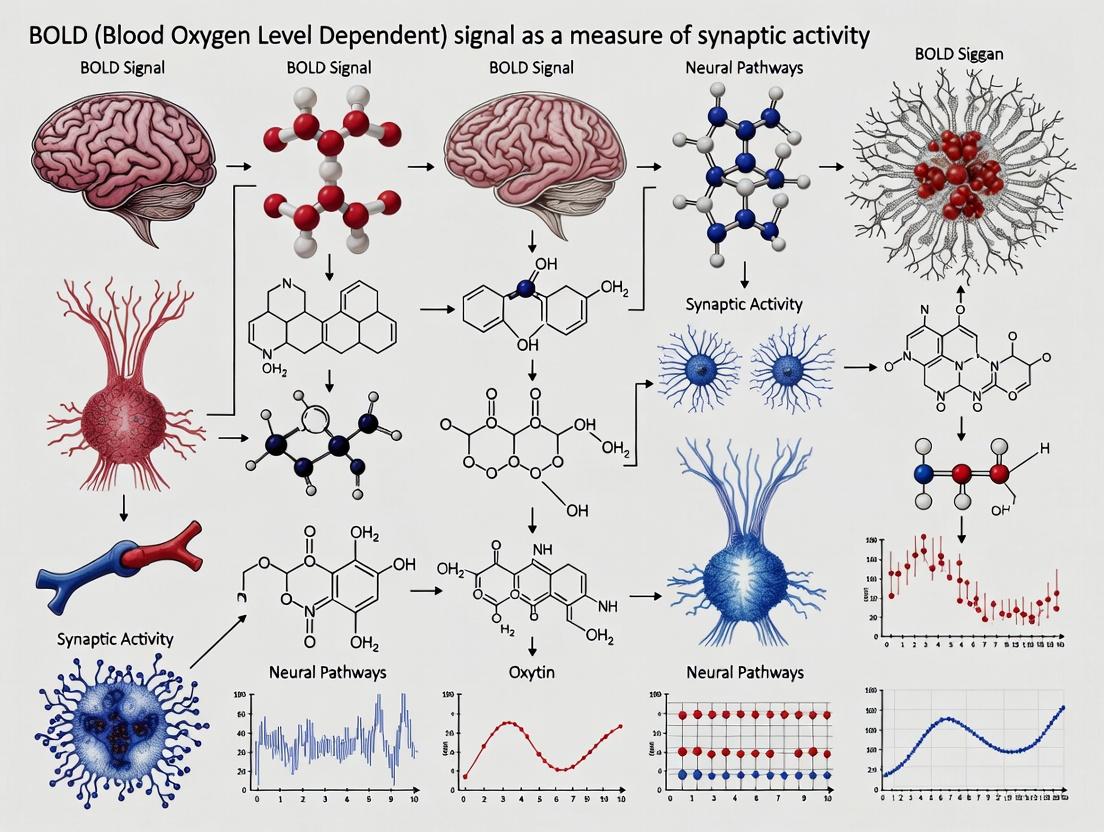
This article provides a comprehensive resource for researchers, neuroscientists, and drug development professionals on the critical link between the Blood-Oxygen-Level-Dependent (BOLD) fMRI signal and underlying synaptic activity.
Decoding the Brain's Language: How the fMRI BOLD Signal Reflects Synaptic Activity for Research and Drug Discovery
Abstract
This article provides a comprehensive resource for researchers, neuroscientists, and drug development professionals on the critical link between the Blood-Oxygen-Level-Dependent (BOLD) fMRI signal and underlying synaptic activity. We first establish the foundational neurovascular coupling principles and biophysical models that connect neural firing to hemodynamic changes. We then detail methodological approaches for applying BOLD as a synaptic activity proxy in experimental design and pharmacological fMRI (phMRI). The article addresses common pitfalls, confounds, and optimization strategies for robust data interpretation. Finally, we validate the BOLD-synaptic activity relationship by comparing it with direct electrophysiological and optogenetic measures, and newer imaging modalities like calcium imaging. The conclusion synthesizes the utility and limitations of BOLD as a measure for synaptic function in both basic neuroscience and the development of novel neurotherapeutics.
The Neurovascular Nexus: Unpacking the Biophysical Link Between BOLD fMRI and Synaptic Activity
1. Introduction and Thesis Context
The Blood Oxygenation Level Dependent (BOLD) signal is the cornerstone of functional magnetic resonance imaging (fMRI). This non-invasive technique has revolutionized cognitive neuroscience. Within the context of an overarching thesis on "BOLD signal as a measure of synaptic activity," it is critical to understand that the BOLD signal is an indirect, hemodynamic correlate of neural events. The core hypothesis is that localized increases in synaptic activity (both excitatory and inhibitory) drive a metabolic demand, triggering a precisely regulated hemodynamic response—a process termed neurovascular coupling (NVC). This primer details the physiological origins of the BOLD signal, the molecular pathways of NVC, and the experimental methods that link hemodynamics to underlying synaptic function, a relationship paramount for interpreting fMRI data in basic research and clinical drug development.
2. The Hemodynamic Response and BOLD Physics
The BOLD signal arises from changes in the local magnetic properties of blood. Deoxyhemoglobin (dHb) is paramagnetic and acts as an endogenous contrast agent, dephasing nearby hydrogen protons and reducing the MRI signal. Increased neural activity triggers a hemodynamic response that typically overshoots the metabolic demand, leading to a localized increase in cerebral blood flow (CBF), volume (CBV), and oxygenation. This results in a washout of dHb, reducing its concentration, thereby increasing the T2*-weighted MRI signal.
The canonical hemodynamic response function (HRF) features:
- Initial Dip (5-8 sec): A small, brief signal decrease attributed to an early rise in oxygen consumption.
- Primary Peak (5-6 sec): The main positive BOLD signal due to increased CBF and oxygenation.
- Post-Stimulus Undershoot: A prolonged signal decrease below baseline, potentially due to sustained elevated CBV or slow metabolic recovery.
Table 1: Typical Temporal and Magnitude Parameters of the Hemodynamic Response
| Parameter | Typical Value Range | Physiological Basis |
|---|---|---|
| Onset Latency | 1-2 seconds | Neurovascular coupling delay |
| Time-to-Peak | 5-6 seconds | Vasodilation and blood flow increase |
| Full Width at Half Max | 4-5 seconds | Duration of elevated flow |
| Signal Change | 0.5 - 5.0 % (at 3T) | Dependent on field strength and brain region |
| Post-Stimulus Undershoot Duration | 10-20 seconds | Slow venous drainage or CBV recovery |
| Initial Dip Magnitude | 0.1 - 0.3 % (often not detectable) | Early oxidative metabolism |
3. Core Pathways of Neurovascular Coupling
NVC is a complex, cell-type-specific dialogue between neurons, astrocytes, and vascular cells. The primary pathways are summarized below.
Diagram 1: Neurovascular Coupling Signaling Pathways
4. Key Experimental Protocols for Investigating NVC and BOLD Origins
Understanding the link between BOLD and synaptic activity requires multi-modal experimentation.
Protocol 1: Combined fMRI and Electrophysiology (Local Field Potential - LFP)
- Objective: To correlate the BOLD signal directly with electrophysiological measures of neural activity.
- Method: An anesthetized or awake animal is placed in an MRI scanner equipped with concurrent electrophysiology recording systems. A carbon fiber or metal electrode (carefully designed for MRI compatibility) is inserted into the region of interest.
- Procedure:
- Simultaneously acquire BOLD-fMRI data (e.g., gradient-echo EPI sequence) and LFP data during sensory stimulation (e.g., visual flicker, whisker pad air puff) or at rest.
- Preprocess fMRI data (motion correction, spatial smoothing).
- Band-pass filter LFP data to isolate frequency bands: Gamma (30-80 Hz, linked to excitatory input) and Beta (12-30 Hz).
- Calculate the power of these frequency bands (LFP power) over time.
- Convolve the LFP power time-series with a canonical HRF.
- Perform a cross-correlation or general linear model (GLM) analysis to relate the convolved LFP regressor to the observed BOLD signal time-series.
- Key Outcome: Studies consistently show BOLD correlates more strongly with LFP power (reflecting synaptic input and local processing) than with multi-unit spiking activity (output), supporting its role as a marker of integrated synaptic activity.
Protocol 2: Two-Photon Microscopy of Cortical Hemodynamics
- Objective: To visualize the cellular-scale hemodynamic response (red blood cell flux, vessel diameter) in relation to neural activity.
- Method: A cranial window is implanted over the cortex of a transgenic mouse expressing calcium indicators (e.g., GCaMP) in specific cell types (neurons, astrocytes). The animal is head-fixed under a two-photon microscope.
- Procedure:
- Identify penetrating arterioles, capillaries, and venules in the field of view.
- Use a line-scanning mode to measure red blood cell (RBC) speed and flux.
- Simultaneously image neuronal or astrocytic calcium activity in response to a defined stimulus (e.g., hindpaw electrical stimulation).
- Track vessel diameter changes over time using edge-detection algorithms.
- Quantify the temporal relationship between the onset of calcium activity and the onset of vasodilation/RBC speed increase.
- Key Outcome: Provides direct, high-resolution evidence of NVC latency, spatial specificity, and the role of different vessel segments.
Table 2: Quantitative Relationships Between Neural Activity and Hemodynamics
| Measurement Pair | Typical Correlation / Latency | Experimental Method | Key Reference Insight |
|---|---|---|---|
| BOLD vs. LFP Gamma Power | R² ~ 0.6 - 0.8 | Simultaneous fMRI/EEG in humans | BOLD best predicted by gamma band LFP. |
| BOLD vs. Multi-Unit Activity | R² ~ 0.3 - 0.5 | Simultaneous fMRI/microelectrode in animals | Weaker correlation than with LFP. |
| Neural Ca2+ onset vs. Vasodilation | Latency: 1 - 2 seconds | Two-Photon Microscopy in mice | Neurovascular coupling delay is cell-type specific. |
| CBF Increase vs. CMRO2 Increase | Ratio (n): ~ 2 : 1 | Calibrated fMRI (e.g., with hypercapnia) | Flow response exceeds oxygen metabolism, causing BOLD. |
5. The Scientist's Toolkit: Research Reagent Solutions
Table 3: Essential Reagents and Materials for NVC Research
| Item | Function & Application |
|---|---|
| AAV-hSyn-GCaMP | Adeno-associated virus with human synapsin promoter driving a genetically encoded calcium indicator. Used to label neuronal calcium dynamics in vivo. |
| L-NAME (NG-Nitro-L-arginine methyl ester) | A nitric oxide synthase (NOS) inhibitor. Used to probe the contribution of the endothelial/neuronal NO pathway to functional hyperemia. |
| Indomethacin | A non-selective cyclooxygenase (COX) inhibitor. Used to block the prostaglandin (PGE2) vasodilatory pathway in astrocytes. |
| Dulbecco's Modified Eagle Medium (DMEM) / Fetal Bovine Serum (FBS) | Cell culture medium for in vitro NVC models (e.g., neuron-astrocyte-endothelial co-cultures). |
| Fluorescent Microspheres (1-10 µm) | Used as flow tracers in in vivo two-photon microscopy to quantify capillary red blood cell flux and speed. |
| Gadolinium-Based Contrast Agent (e.g., Gd-DTPA) | Used in MRI to measure relative cerebral blood volume (rCBV) changes, providing an alternative hemodynamic contrast to BOLD. |
| Isoflurane / Medetomidine | Common anesthetic regimens for animal fMRI. Choice of anesthetic critically modulates neurovascular coupling and BOLD response magnitude. |
| Custom Sensory Stimulation Systems (e.g., LED goggles, piezoelectric whisker stimulators, pneumatic air puff) | For delivering controlled, reproducible stimuli to evoke localized neural and hemodynamic responses in animal models. |
6. Conclusion
The BOLD signal is a valuable but indirect window into brain function, fundamentally shaped by the intricate biology of neurovascular coupling. Interpreting it as a measure of synaptic activity requires careful consideration of the hemodynamic filter it imposes. Advances in multi-modal experimental protocols and targeted molecular tools continue to refine our quantitative models linking vascular responses to their underlying synaptic drivers. For researchers and drug developers, this understanding is critical for designing robust fMRI experiments and interpreting pharmacological modulations of the BOLD signal, where a drug might alter neurovascular coupling independent of neural activity itself.
Functional magnetic resonance imaging (fMRI) based on the Blood Oxygenation Level-Dependent (BOLD) signal is a cornerstone of non-invasive human brain mapping. The foundational neurovascular coupling hypothesis posits that localized neural activity triggers a hemodynamic response, increasing cerebral blood flow (CBF) that overshoots metabolic demand, thus altering the local ratio of deoxygenated to oxygenated hemoglobin detectable by MRI. However, the BOLD signal is an indirect and complex proxy for synaptic activity. This whitepaper details the precise cellular and molecular pathways—spanning neurons, astrocytes, and pericytes—that translate synaptic events into vascular responses. A mechanistic understanding of these pathways is critical for accurate interpretation of fMRI data, for developing biomarkers of neurovascular health, and for identifying therapeutic targets in diseases where neurovascular coupling is disrupted (e.g., Alzheimer's, hypertension, migraine).
Cellular Triad and Core Signaling Pathways
The Neurovascular Unit (NVU)
The NVU is a functional ensemble where neurons, astrocytes, vascular smooth muscle cells (VSMCs), pericytes, and endothelial cells communicate to regulate CBF.
Primary Signaling Pathways
1. Glutamatergic Neuron-Astrocyte Pathway
- Trigger: Presynaptic glutamate release.
- Astrocytic Activation: Activation of neuronal metabotropic glutamate receptors (mGluRs) leads to phospholipase Cβ (PLCβ) activation, inositol 1,4,5-trisphosphate (IP₃) production, and release of Ca²⁺ from internal endoplasmic reticulum stores.
- Vasodilatory Effectors: Astrocytic endfoot Ca²⁺ elevation triggers the release of vasoactive agents. The dominant pathway involves metabolites of arachidonic acid (AA):
- Epoxyeicosatrienoic Acids (EETs): Generated by cytochrome P450 epoxygenase (CYP450). EETs are potent vasodilators that hyperpolarize and relax VSMCs/pericytes, likely via activation of large-conductance Ca²⁺-activated K⁺ (BK) channels.
- Prostaglandin E₂ (PGE₂): Generated by cyclooxygenase-1 (COX-1). PGE₂ acts on EP₂/EP4 receptors on VSMCs to induce vasodilation via cAMP/PKA signaling.
- Vasoconstrictive Pathway: Astrocytic Ca²⁺ can also lead to the production of 20-hydroxyeicosatetraenoic acid (20-HETE) via ω-hydroxylase (CYP4A), which constricts vessels by inhibiting VSMC BK channels.
2. Interneuronal GABAergic Pathway
- Trigger: Activity of specific interneurons (e.g., somatostatin-positive or vasoactive intestinal peptide-positive).
- Direct Vascular Action: These interneurons can directly innervate parenchymal arterioles, releasing vasoactive peptides or neurotransmitters (e.g., VIP causing dilation) to modulate blood flow independently of astrocytes.
3. Pericyte-Mediated Capillary Dilation
- Mechanism: Capillary pericytes, located along the microvasculature, express contractile proteins and can respond directly to neuronal/astrocytic signals.
- Key Mediators: Elevated extracellular K⁺ from neuronal repolarization (~10-20 mM) can act on inward-rectifier K⁺ (Kir2.1) channels on pericytes, leading to membrane hyperpolarization and dilation. Astrocyte-derived signals (e.g., PGE₂) may also contribute.
Diagram 1: Core Neuron-Astrocyte-Vessel Signaling Pathways.
Table 1: Temporal Dynamics of Key Signaling Events Post-Synaptic Activity
| Event | Approximate Onset | Peak Time | Duration | Key Reference/Model |
|---|---|---|---|---|
| Neuronal Action Potential | 0 ms | 1-2 ms | ~5 ms | Direct measurement |
| Glutamate in Synaptic Cleft | 0.5-1 ms | ~2 ms | <5 ms | Fast scan cyclic voltammetry |
| Astrocyte Endfoot [Ca²⁺] Rise | 500-2000 ms | 3-5 s | 10-30 s | 2-photon microscopy (in vivo) |
| Arteriole Dilation Onset | 500-1500 ms | 3-5 s | 10-30 s | 2-photon microscopy |
| Peak BOLD Signal | ~2000 ms | 4-6 s | 15-25 s | Human fMRI (3T) |
| Pericyte [Ca²⁺] Rise (Capillary) | 300-1000 ms | 2-4 s | 5-15 s | 2-photon microscopy |
Table 2: Pharmacological Modulation of Neurovascular Coupling
| Target (Agent) | Effect on Astrocyte [Ca²⁺] | Effect on Vascular Dilation | Implication for BOLD |
|---|---|---|---|
| mGluR blocker (MPEP + LY341495) | ↓ 80-90% | ↓ 60-70% | BOLD amplitude ↓ |
| COX-1 inhibitor (SC-560) | No Effect | ↓ 30-50% | BOLD amplitude ↓ |
| CYP450 inhibitor (MS-PPOH) | No Effect | ↓ 40-60% | BOLD amplitude ↓ |
| 20-HETE inhibitor (HET0016) | No Effect | ↑ Dilation | BOLD amplitude ↑ |
| P2X7 receptor blocker | ↓ 40-50% | ↓ 30-40% | Attenuates pathological BOLD |
Key Experimental Protocols
In Vivo Two-Photon Microscopy for Cellular Calcium and Vascular Dynamics
Objective: To simultaneously measure activity-dependent calcium changes in neurons/astrocytes and diameter changes in adjacent arterioles/capillaries in the intact brain. Protocol Summary:
- Animal Preparation: Cranial window implantation over the region of interest (e.g., somatosensory cortex) in an anesthetized or awake, head-fixed mouse.
- Fluorescent Indicator Loading:
- Neurons/Astrocytes: Use transgenic mice (e.g., GCaMP6f expressed in specific cell types) or bulk-load with acetoxymethyl (AM) ester dyes (e.g., OGB-1 AM, via pipette injection).
- Vessels: Intravenous injection of a plasma label (e.g., Texas Red-dextran).
- Stimulation: Deliver controlled sensory (e.g., whisker deflection, visual stimulus) or direct electrical (forepaw) stimulation.
- Imaging: Use a two-photon microscope. Acquire line scans or high-speed frame scans at relevant locations (synaptic layer, arteriole, astrocyte endfoot).
- Analysis:
- ΔF/F for calcium traces.
- Vessel diameter changes measured from line profiles perpendicular to the vessel wall across time.
Brain Slice Electrophysiology and Vasodynamics
Objective: To investigate pharmacologically isolated signaling pathways linking synaptic stimulation to arteriole dilation/constriction. Protocol Summary:
- Slice Preparation: Prepare acute coronal cortical or hippocampal slices (300-400 µm thick) from rodents in ice-cold, oxygenated artificial cerebrospinal fluid (aCSF).
- Setup: Place slice in a submersion chamber perfused with oxygenated aCSF (32-34°C). Visualize using infrared differential interference contrast (IR-DIC) microscopy.
- Stimulation: Place a bipolar electrode in the parenchyma to deliver local electrical pulses (e.g., 10-100 Hz, 1-2 s train).
- Vessel Measurement: Use bright-field or DIC video microscopy to record parenchymal arterioles. Diameter analysis via automated edge-detection software.
- Pharmacological Interrogation: Pre-apply and bath-apply specific pathway blockers (see Table 2) to assess their role in the evoked vascular response.
BOLD fMRI with Cellular-Level Perturbation
Objective: To determine the contribution of a specific cellular pathway to the macroscopic BOLD fMRI signal. Protocol Summary:
- Animal Model: Use rodents instrumented with a cranial window or guide cannula for drug administration.
- Pharmacology: Intracerebroventricular (ICV) or local cortical injection of a pathway-specific drug (e.g., COX-1 inhibitor).
- fMRI Acquisition: Under anesthesia, acquire gradient-echo echo-planar imaging (GE-EPI) sequences on a high-field (e.g., 9.4T) scanner. Use block-design stimulation (e.g., forepaw electrostimulation).
- Analysis: Compare the amplitude, spatial extent, and hemodynamic response function (HRF) of the activated BOLD signal between drug and vehicle conditions.
The Scientist's Toolkit: Research Reagent Solutions
Table 3: Essential Research Tools for Neurovascular Coupling Studies
| Item (Example) | Function & Application | Key Consideration |
|---|---|---|
| GCaMP6f/8f transgenic mice | Genetically encoded calcium indicator for cell-specific (neuron, astrocyte) Ca²⁺ imaging in vivo. | Choose driver line carefully (e.g., Slc1a3-Cre for astrocytes, Thy1- promoter for neurons). |
| AAV-PHP.eB with cell-specific promoter | Viral delivery of sensors (jGCaMP7, iGluSnFR) or actuators (DREADDs) to the NVU cells via systemic injection. | Enables adult animal transduction without invasive brain surgery. |
| Two-Photon Microscope | High-resolution, deep-tissue imaging of cellular fluorescence and vessel dynamics in the living brain. | Critical for simultaneous measurement of Ca²⁺ and diameter. |
| SC-560 (COX-1 Inhibitor) | Selective pharmacological blockade of prostaglandin synthesis in astrocytes. Used to isolate the COX-1/PGE₂ pathway. | Poor blood-brain barrier (BBB) penetration; requires local/ICV application. |
| MS-PPOH (CYP450 Epoxygenase Inhibitor) | Selective inhibition of EET production in astrocytes. Used to isolate the EET pathway. | Similar BBB limitations; use controlled perfusion in slices or local delivery in vivo. |
| HET0016 (20-HETE Synthesis Inhibitor) | Inhibits CYP4A, blocking production of the vasoconstrictor 20-HETE. | Can unmask latent dilation and increase BOLD signal. |
| Tetrodotoxin (TTX) | Voltage-gated Na⁺ channel blocker. Silences neuronal action potentials. | Used as a negative control to confirm neurovascular responses are activity-dependent. |
| Sulforhodamine 101 (SR101) | Vital dye selectively taken up by astrocytes in vivo. Used for astrocyte identification. | Apply topically during cranial window surgery. |
| FITC-/Texas Red-dextran (70kDa) | High molecular weight fluorescent vascular labels for plasma visualization and diameter measurement. | Administer intravenously via tail vein or retro-orbital injection. |
Diagram 2: Integrative Experimental Workflow for BOLD Pathway Research.
Within the broader thesis that the Blood-Oxygen-Level-Dependent (BOLD) signal is a reliable, albeit indirect, measure of integrated synaptic activity, the Hemodynamic Response Function (HRF) serves as the critical temporal filter. The BOLD signal is not a real-time readout of neural firing; it is a delayed and blurred vascular response to metabolic demands driven primarily by synaptic events (both excitatory and inhibitory). The HRF mathematically characterizes this transformation, describing the typical shape of the BOLD response to an instantaneous neural event. Accurate modeling of the HRF is therefore paramount for deconvolving observed fMRI data to infer the timing and amplitude of underlying neural activity, a central pursuit in cognitive neuroscience and neuropharmacology.
Core Biophysical Model and Quantitative Parameters
The canonical HRF is a composite function, often modeled as a double-gamma function that captures the characteristic positive blood flow response and the subsequent post-stimulus undershoot. Key temporal parameters, derived from empirical data, are summarized below.
Table 1: Canonical HRF Temporal Parameters (at 3 Tesla)
| Parameter | Description | Typical Value (seconds) | Physiological Basis |
|---|---|---|---|
| Time-to-peak (TTP) | Delay from neural event to peak positive BOLD response. | 5.0 - 6.0 s | Latency of vascular dilation, blood flow increase, and blood volume change. |
| Onset Delay | Initial lag before signal rise. | 1.0 - 2.0 s | Initial metabolic and vascular signaling delay. |
| Full Width at Half Maximum (FWHM) | Duration of the positive response at half its peak amplitude. | 4.0 - 5.0 s | Duration of the hemodynamic "blurring" of the neural event. |
| Undershoot Minimum | Time to most negative point of post-stimulus undershoot. | 10.0 - 12.0 s | Slow return of blood volume to baseline and sustained oxygen metabolism. |
| Undershoot Duration | Approximate duration of the negative undershoot. | 10.0 - 20 s | Prolonged metabolic and vascular recovery processes. |
| Initial Dip Onset | Optional very early negative dip (not always observed). | 0.5 - 2.0 s | Transient increase in deoxyhemoglobin before blood flow increase (the "early" BOLD signal). |
The Neurovascular Coupling Pathway
The HRF is the macroscopic output of the neurovascular unit (NVU). The signaling cascade from synaptic activity to hemodynamic change involves a coordinated sequence.
Diagram 1: Core Neurovascular Coupling Pathway
Experimental Protocols for HRF Characterization
Protocol: Event-Related fMRI with Brief Stimuli
Objective: To empirically measure the shape and latency of the HRF in a target brain region.
- Stimulus Design: Present brief (~100 ms) sensory or cognitive stimuli (e.g., visual checkerboard, auditory tone) in a randomized, jittered event-related paradigm. Inter-stimulus interval should be >15s to allow full HRF return to baseline.
- fMRI Acquisition: Acquire whole-brain BOLD images using a T2*-weighted EPI sequence on a 3T or 7T scanner (TR=2s, TE=30ms, voxel size=2-3mm isotropic).
- Preprocessing: Perform standard preprocessing: slice-time correction, realignment, coregistration to anatomical scan, spatial normalization, and smoothing (FWHM ~5-6mm).
- First-Level Analysis: For each voxel, model the stimulus onsets convolved with a canonical HRF (e.g., SPM's double-gamma) within a General Linear Model (GLM). Include motion parameters as regressors of no interest.
- HRF Estimation: Use a Finite Impulse Response (FIR) or flexible basis set (e.g., Fourier, Gamma) in the GLM to estimate the HRF shape without strong a priori assumptions.
- Parameter Extraction: From the fitted response, calculate key parameters: Time-to-Peak (TTP), Peak Amplitude, and FWHM.
Protocol: Pharmacological Modulation of HRF
Objective: To assess how drugs targeting neurotransmission or vascular tone alter the HRF, linking synaptic activity to BOLD dynamics.
- Subject Preparation: Healthy volunteers are screened. Use a double-blind, placebo-controlled, crossover design.
- Drug Administration: Administer the target compound (e.g., a GABA-A modulator like benzodiazepine, an SSRI, or a vasoactive drug like caffeine) at a standardized dose. Placebo session is conducted on a separate day.
- Task & Imaging: ~60 minutes post-administration, perform the Event-Related fMRI protocol (Section 4.1) during a task known to engage the target neural circuit.
- Analysis: Estimate HRF parameters (TTP, amplitude) in key ROIs for each session (drug vs. placebo).
- Statistical Comparison: Use paired t-tests or mixed-effects models to compare HRF parameters between conditions across subjects. A change in HRF amplitude or latency indicates altered neurovascular coupling efficiency or neural response gain.
Table 2: Example HRF Parameter Changes with Pharmacological Challenge
| Compound (Class) | Primary Action | Typical Effect on HRF Amplitude | Typical Effect on HRF Latency (TTP) | Interpreted Neural Effect |
|---|---|---|---|---|
| Caffeine (Adenosine antagonist) | Vasoconstrictor, increases neural efficiency. | Decrease (~30-40%) | Minimal change or slight decrease | Reduced baseline CBF, increased BOLD response efficiency. |
| Benzodiazepine (GABA-A PAM) | Enhances inhibitory neurotransmission. | Decrease in task-evoked response | May increase | Attenuation of net synaptic activity drive. |
| Psilocybin (5-HT2A agonist) | Modulates glutamate & 5-HT systems. | Variable, often increased in visual cortex | Can be altered | Altered network dynamics and neurovascular coupling. |
| L-Dopa (Dopamine precursor) | Enhances dopaminergic transmission. | Region-specific modulation (e.g., increase in striatum) | Region-specific | Modulation of task-related neural circuit gain. |
The Scientist's Toolkit: Research Reagent Solutions
Table 3: Essential Materials for HRF & Neurovascular Research
| Item | Function & Application |
|---|---|
| High-Field MRI Scanner (7T+) | Provides higher SNR and spatial resolution for more precise localization of BOLD signals and better characterization of HRF shape across cortical layers. |
| Multi-Echo EPI Sequence | Acquires data at multiple TEs, allowing for improved BOLD sensitivity and removal of non-BOLD noise components (e.g., via T2* mapping). |
| Physiological Monitoring System (pulse oximeter, respiration belt, end-tidal CO2) | Records cardiac and respiratory cycles for noise regression in fMRI data, crucial for clean HRF estimation. |
| Finite Impulse Response (FIR) Basis Set (in SPM, FSL, AFNI) | A flexible GLM modeling tool that estimates the HRF at each post-stimulus time point without assuming a canonical shape. |
| Dynamic Causal Modelling (DCM) Software | A Bayesian framework for inferring effective connectivity between brain regions and the underlying neural dynamics that generate the observed HRF. |
| Vasoactive Agents (e.g., Acetazolamide, Caffeine) | Pharmacological tools to directly manipulate vascular tone and CBF, used to dissect vascular vs. neural contributions to HRF variability. |
| Genetically Encoded Calcium Indicators (e.g., GCaMP in animal models) | Enables direct, simultaneous optical measurement of neural (calcium) and hemodynamic (e.g., via laser speckle) signals to ground-truth the HRF. |
| Biophysical Model Software (e.g., Balloon-Windkessel model in SPM) | Implements mathematical models that link changes in blood flow, volume, and oxygenation to predict the BOLD HRF from estimated neural activity. |
Advanced Modeling: From BOLD to Neural Activity
The reverse inference—estimating neural events from BOLD—requires deconvolution. The workflow involves modeling the underlying neural signal and the biophysical hemodynamic transformation.
Diagram 2: Deconvolution Workflow for Neural Activity Estimation
The HRF is the essential temporal filter that translates the rapid, millisecond-scale language of synaptic activity into the slow, second-scale language of the BOLD signal. Its precise characterization is not a mere technical detail but a fundamental step in validating the core thesis that BOLD signals reflect synaptic drive. Advances in high-field fMRI, pharmacological interventions, and biophysical modeling continue to refine our understanding of this filter, improving the fidelity with which we can back-infer neural events from hemodynamic observations. This progress is critical for both basic neuroscience and applied drug development, where fMRI biomarkers of target engagement rely on accurate interpretations of BOLD signal changes.
Within the broader thesis that the BOLD (Blood Oxygenation Level-Dependent) signal serves as a reliable, though indirect, measure of aggregate synaptic activity, understanding its precise biophysical origin is paramount. The BOLD effect, observed in functional MRI (fMRI), is a complex vascular and metabolic phenomenon that couples neuronal activation to hemodynamic changes. This guide focuses on two interconnected conceptual pillars: the Physiological Basis of the BOLD Effect and the Balloon Model, a mathematical framework that formalizes this physiology. For researchers and drug development professionals, dissecting these models is essential for interpreting fMRI data in studies of brain function, connectivity, and pharmacodynamics.
The Physiological Basis of the BOLD Effect
The BOLD signal is an indirect measure, arising from changes in blood oxygenation driven by a hemodynamic response to local neuronal activity. The canonical model involves a cascade known as neurovascular coupling.
Neurovascular Coupling and the Hemodynamic Response
Upon synaptic activation (predominantly glutamatergic), there is a localized increase in energy demand. This triggers a complex signaling pathway involving neurons, astrocytes, and vascular smooth muscle cells, leading to vasodilation and an increase in cerebral blood flow (CBF). Critically, the increase in CBF is disproportionate to the smaller increase in cerebral metabolic rate of oxygen (CMRO₂). This imbalance results in an overoxygenation of the venous blood, decreasing the concentration of deoxyhemoglobin (dHb), which is paramagnetic and acts as an intrinsic contrast agent in MRI. The BOLD signal is primarily sensitive to this change in dHb concentration in venules and venous capillaries.
Signaling Pathway for Neurovascular Coupling:
Quantitative Relationships
The BOLD signal change (ΔS/S) is a nonlinear function of changes in CBF, CBV (cerebral blood volume), and CMRO₂. The Davis model provides a foundational linear approximation: ΔBOLD/BOLD ≈ A * (ΔCBF/CBF - α * ΔCMRO₂/CMRO₂), where A is a scaling constant and α is the Grubb's exponent linking CBV to CBF.
Table 1: Key Physiological Parameters in BOLD Signal Generation
| Parameter | Typical Baseline Value | Change with Neural Activation | Approximate Time to Peak (s) | Primary Influence on BOLD |
|---|---|---|---|---|
| CBF | ~60 mL/100g/min | Increase 30-60% | 4-6 | Major Positive Driver |
| CMRO₂ | ~3.5 mL/100g/min | Increase 5-20% | 4-6 | Negative (attenuates signal) |
| CBV | ~4 mL/100g | Increase 10-30% | 5-8 (slower than CBF) | Negative (attenuates signal) |
| dHb Conc. | - | Decrease | 5-6 | Direct Source of Contrast |
The Balloon Model
Introduced by Buxton et al. (1998), the Balloon Model is a seminal biophysical model that mathematically describes the transient hemodynamic changes underlying the BOLD signal. It treats a compliant venous vascular compartment as a "balloon" that inflates with increased blood inflow and deflates with outflow.
Core Conceptual Framework
The model posits that a sudden increase in CBF fills the venous compartment (increases CBV) with oxygenated blood. The outflow is initially resisted due to venous compliance, leading to an initial "ballooning" of the compartment. The overoxygenated blood reduces dHb concentration, causing the initial BOLD signal rise. As the compartment expands, the outflow increases, and CMRO₂ increases metabolize oxygen, leading to the characteristic post-stimulus undershoot as CBV and dHb concentrations slowly return to baseline.
Balloon Model Schematic and BOLD Generation:
Key Equations and Refinements
The classic Balloon Model is defined by a set of differential equations:
- Flow Dynamics: df/dt = s(t), where f is normalized CBF and s(t) is a neural drive signal.
- Volume Dynamics: τ dv/dt = f - v^(1/α), where v is normalized venous CBV, τ is the venous outflow time constant, and α is Grubb's exponent.
- dHb Dynamics: τ dq/dt = f * (1 - (1 - E₀)^(1/f)) / E₀ - v^(1/α) * q/v, where q is normalized total dHb content and E₀ is the baseline oxygen extraction fraction.
- BOLD Signal: ΔBOLD/BOLD = V₀ * [k₁ * (1 - q) + k₂ * (1 - q/v) + k₃ * (1 - v)], where V₀ is baseline blood volume and k₁, k₂, k₃ are field-strength dependent constants.
The later Windkessel Model (Mandeville et al., 1999) introduced separate compliant (arteriolar) and balloon (venous) compartments, better capturing the observed delay between CBF and CBV responses.
Experimental Protocols for Validation
Key experiments that validate the physiological basis and the Balloon Model often combine fMRI with complementary modalities.
Calibrated fMRI for CMRO₂ Estimation (Davis Model Protocol)
This protocol aims to dissect CBF and CMRO₂ contributions to BOLD.
- Objective: Quantify the change in CMRO₂ during neural activation.
- Setup: Dual-echo fMRI sequence on a 3T scanner. Use a gas mixture delivery system (e.g., RespirAct) to modulate arterial CO₂ (PaCO₂).
- Procedure: a. Acquire BOLD and arterial spin labeling (ASL) data during a hypercapnic challenge (e.g., 5% CO₂) to map the subject-specific vascular responsiveness (parameter M in ΔBOLD/BOLD = M * [1 - (CMRO₂/CMRO₂₀)^β / (CBF/CBF₀)^(α-β)]). b. Acquire BOLD and ASL data during a functional task (e.g., visual stimulation). c. Use the hypercapnia-derived M value to solve the Davis equation for ΔCMRO₂/CMRO₂₀ using the task-induced ΔBOLD and ΔCBF measurements.
- Key Output: Task-evoked changes in CMRO₂, providing a more direct correlate of synaptic activity than BOLD alone.
Simultaneous fMRI and Optical Imaging for Balloon Model Validation
This protocol provides direct, high-temporal resolution measurements of hemodynamic variables.
- Objective: Validate the dynamic relationships between CBF, CBV, and oxygenation predicted by the Balloon Model.
- Setup: Animal model (e.g., rat). Use an MRI-compatible optical system for laser speckle contrast imaging (LSCI) and intrinsic optical signal (IOS) imaging.
- Procedure: a. Position a cranial window over the somatosensory cortex within the MRI bore. b. Acquire simultaneous BOLD fMRI and optical data during a forepaw stimulation paradigm. c. LSCI provides high-temporal resolution 2D CBF maps. d. IOS at specific wavelengths (e.g., 570 nm isosbestic for Hb/HbO₂) provides CBV changes. e. Fit the combined CBF and CBV time-series data to the differential equations of the Balloon/Windkessel model.
- Key Output: Directly measured model state variables (CBF, CBV), allowing estimation of model parameters (τ, α) and validation of the dHb dynamics inferred from BOLD.
The Scientist's Toolkit: Research Reagent Solutions
Table 2: Essential Research Reagents and Materials for BOLD Physiology Studies
| Item/Category | Function/Application | Example/Notes |
|---|---|---|
| Vasoactive Agents | Modulate neurovascular coupling for calibration or perturbation. | L-NAME (NOS inhibitor): Blocks NO synthesis to assess its role. Dilator (ACh, SNP): Induces endothelium-dependent/independent vasodilation. |
| Neurotransmitter Receptor Agonists/Antagonists | To dissect specific synaptic contributions to the hemodynamic response. | NBQX (AMPA antagonist), MK-801 (NMDA antagonist): Isolate glutamatergic drive. Bicuculline (GABAₐ antagonist): Study disinhibition. |
| Gas Delivery Systems | For calibrated fMRI to induce hypercapnia/hyperoxia. | MRI-compatible gas blender (e.g., RespirAct): Precisely controls end-tidal CO₂ and O₂. |
| Contrast Agents (for CBV-fMRI) | Enable direct measurement of CBV changes, independent of oxygenation. | Ferumoxytol (USPIO): Long-circulating iron oxide nanoparticle that shortens T2/T2*. Injected intravenously. |
| Genetically Encoded Indicators (for animal models) | Provide direct optical readouts of neuronal and astrocytic activity alongside BOLD. | AAV-GCaMP (neuronal Ca²⁺), AAV-jRGECO1a: For calcium imaging. AAV-AAV-GRAB_NE1m: For norepinephrine sensing. Requires cranial window. |
| Arterial Spin Labeling (ASL) Sequence | MRI pulse sequence to quantitatively measure CBF concurrently with BOLD. | pCASL (pseudo-continuous ASL): Current recommended standard for human fMRI due to better SNR and labeling efficiency. |
The Balloon Model and the detailed physiology of the BOLD effect provide the critical biophysical link between the fMRI signal and the underlying neural events. Framed within a thesis on BOLD as a measure of synaptic activity, these models remind us that the signal is a filtered, hemodynamically smoothed representation of a metabolically demanding process initiated predominantly at synapses. For drug development, understanding these models is essential for interpreting pharmacologically induced BOLD changes, distinguishing vascular from neural effects, and developing robust biomarkers of target engagement and functional circuit modulation. Continuous refinement of these models through multi-modal experimentation remains vital for advancing the quantitative accuracy of fMRI in neuroscience and neurotherapeutics.
Within the context of research on the Blood Oxygenation Level Dependent (BOLD) signal as a proxy for synaptic activity, a precise understanding of its physiological origins is critical. The BOLD signal is an indirect and complex hemodynamic response, reflecting a dynamic interplay between cerebral oxygen metabolism (CMRO₂), cerebral blood flow (CBF), and cerebral blood volume (CBV). This technical guide deconstructs the core biophysical and physiological foundations of the BOLD signal, detailing what it measures directly, what it infers, and the confounding variables that complicate its interpretation as a pure marker of synaptic activity.
Physiological Foundations of the BOLD Signal
The BOLD signal originates from the magnetic properties of hemoglobin. Deoxyhemoglobin (dHb) is paramagnetic, acting as an intravascular contrast agent that distorts the local magnetic field, reducing the MRI signal. Oxyhemoglobin is diamagnetic and has a negligible effect. The BOLD signal is thus an inverse measure of dHb concentration.
The relationship is formalized in the Balloon-Windkessel model, which describes the coupling between changes in CBF, CBV, and CMRO₂. The BOLD signal change (ΔS) can be approximated as: ΔS/S ≈ [A] = V₀ [a₁ (1 - q) - a₂ (1 - v)] where V₀ is resting blood volume, q is the normalized total deoxyhemoglobin content, v is the normalized venous blood volume, and a₁ & a₂ are field- and sequence-dependent constants.
The Neurovascular Unit and Neurovascular Coupling
Synaptic activity triggers a cascade within the neurovascular unit (astrocytes, neurons, vascular smooth muscle). Glutamate release leads to astrocytic calcium influx, prompting the release of vasoactive agents (e.g., prostaglandins, epoxyeicosatrienoic acids) that induce arteriolar dilation, increasing CBF.
Table 1: Key Physiological Variables in BOLD Signal Generation
| Variable | Symbol | Typical Resting Value | Change with Neural Activation | Direct Impact on BOLD Signal |
|---|---|---|---|---|
| Cerebral Metabolic Rate of O₂ | CMRO₂ | ~1.6 µmol/g/min | Increases (+20-50%) | Decrease (more dHb produced) |
| Cerebral Blood Flow | CBF | ~60 ml/100g/min | Increases sharply (+30-100%) | Increase (washes out dHb) |
| Cerebral Blood Volume | CBV | ~4 ml/100g | Increases more slowly (+10-30%) | Decrease (increases dHb compartment) |
| Oxygen Extraction Fraction | OEF | ~0.4 | Decreases (due to over-perfusion) | Increase (lower venous dHb) |
What BOLD Measures Directly
BOLD fMRI measures a T₂* or T₂-weighted signal intensity influenced by the local concentration of deoxyhemoglobin in post-capillary venules and veins. The positive BOLD signal during task activation primarily reflects the disproportionate increase in CBF relative to CMRO₂, leading to a washout of dHb and thus a decrease in the concentration of paramagnetic molecules, which increases the MRI signal.
What BOLD Does NOT Measure Directly
- Neural or Synaptic Activity: It is an indirect, hemodynamic correlate delayed by 1-6 seconds (hemodynamic response function).
- CMRO₂ Alone: The BOLD signal is sensitive to changes in the CMRO₂:CBF ratio. An isolated increase in CMRO₂ without CBF change would cause a negative BOLD signal.
- Inhibitory vs. Excitatory Activity: The hemodynamic response is not finely tuned to discriminate between different types of synaptic processing.
- Neuronal Spiking: It is more tightly coupled to local field potentials (LFPs), reflecting integrated synaptic inputs, than to spiking output.
Key Experimental Protocols for Disentangling BOLD Components
To isolate the contributions of CBF, CMRO₂, and CBV, multi-parametric MRI protocols are employed.
Protocol 1: Calibrated fMRI (Hypercapnia)
- Objective: To estimate quantitative CMRO₂ changes from BOLD and CBF signals.
- Method: A baseline scan measures BOLD and CBF (via arterial spin labeling, ASL). Subjects then inhale a gas mixture with elevated CO₂ (e.g., 5% CO₂) to induce a global CBF increase without changing CMRO₂. The BOLD response to this calibrated hypercapnic challenge (
Morαparameter) scales the vasculature's sensitivity to CBF-induced dHb changes. During task activation, simultaneous BOLD and CBF measurements allow calculation of CMRO₂ change using the calibrated model. - Key Formula:
ΔCMRO₂/CMRO₂₀ = (ΔCBF/CBF₀)^α / (ΔBOLD/BOLD₀ + 1)^(1/β), where α and β are coupling constants.
Protocol 2: VASO (Vascular Space Occupancy)
- Objective: To measure CBV changes directly.
- Method: Uses a T₁-weighted inversion recovery pulse to null the signal from blood. When blood volume increases (CBV↑), the signal decreases because a larger fraction of the voxel is occupied by nulled blood. This provides a CBV-weighted signal largely independent of BOLD.
Protocol 3: Dual-Echo GRASE for OEF Estimation
- Objective: To map the oxygen extraction fraction (OEF).
- Method: Acquires data at two different echo times (TEs) to separate T₂' (which reflects dHb) from T₂. Combined with a separate CBF measurement (ASL), this allows calculation of CMRO₂ via the Fick principle:
CMRO₂ = CBF × OEF × [arterial O₂].
Signaling Pathways in Neurovascular Coupling
Diagram Title: Neurovascular Coupling Pathway to BOLD Signal
Experimental Workflow for Calibrated fMRI
Diagram Title: Calibrated fMRI Experimental Workflow
The Scientist's Toolkit: Research Reagent Solutions
Table 2: Essential Materials for BOLD Physiology Research
| Item / Reagent | Function / Application | Key Considerations |
|---|---|---|
| Gas Blending System (e.g., Respiration Actuator) | Precisely mixes O₂, N₂, and CO₂ for hypercapnic/hypoxic calibrated fMRI. | Must be MRI-compatible; require accurate end-tidal monitoring. |
| Vasoactive Agents (e.g., Acetazolamide, Caffeine) | Pharmacologically modulate CBF to test neurovascular coupling integrity. | Dose-response varies; confounds neural activity. |
| Gadolinium-Based Contrast Agents (e.g., Gd-DTPA) | Used in DSC-MRI to measure relative CBV changes independently of BOLD. | Invasive; requires IV access; potential side effects. |
| Arterial Spin Labeling (ASL) MRI Sequences | Non-invasive quantification of absolute CBF, critical for calibrated models. | Lower SNR than BOLD; requires careful sequence optimization. |
| Multi-Echo fMRI Sequences | Acquire data at multiple TEs to separate BOLD (T₂*) from non-BOLD effects. | Enables advanced analysis like T₂* mapping and removing physiological noise. |
| Animal Models: Optogenetic/Cheogenetic Tools | Precisely stimulate/inhibit specific neuronal populations to probe BOLD origins. | Allows causal interrogation of cell-type-specific contributions. |
| Simultaneous Electrophysiology-fMRI | Direct correlation of BOLD with LFP, MUA, and behavioral states. | Technically challenging due to MRI artifact; requires specialized equipment. |
The BOLD signal is a valuable but nuanced tool for neuroscience and drug development. It directly measures a hemodynamic surrogate—the deoxyhemoglobin-weighted MRI signal—that is driven by a concerted change in CBF, CMRO₂, and CBV. Its utility as a measure of synaptic activity is contingent upon the stability of neurovascular coupling, which can be altered by disease, pharmacology, and even development. Disentangling these components via multi-parametric methods (calibrated fMRI, VASO, ASL) is essential for moving from qualitative activation maps to quantitative physiological readouts, thereby strengthening its role in mechanistic research and therapeutic development.
Within the broader thesis that the Blood-Oxygen-Level-Dependent (BOLD) fMRI signal primarily reflects synaptic activity over spiking output, the relationship between BOLD, Local Field Potentials (LFPs), and Multi-Unit Activity (MUA) is critical. This whitepaper examines landmark studies that established the foundational electrophysiological correlates of BOLD, providing essential evidence for interpreting neuroimaging data in basic research and drug development.
Key Landmark Studies & Quantitative Data Synthesis
The following table consolidates pivotal findings from seminal experiments.
Table 1: Foundational Studies Linking BOLD, LFP, and MUA
| Study (Year) | Species/Model | Brain Region | Key Finding (Quantitative Correlation) | Primary Conclusion |
|---|---|---|---|---|
| Logothetis et al. (2001) Nature | Macaque monkey | Visual cortex (V1) | BOLD correlated more strongly with LFP (γ-band 40-60 Hz; r ≈ 0.80) than with MUA (r ≈ 0.44). | BOLD reflects input (synaptic) and local integrative processing (LFP) more than spiking output (MUA). |
| Mukamel et al. (2005) Science | Human (epilepsy pts) | Auditory cortex | Trial-by-trial BOLD amplitude correlated with broadband LFP power (r = 0.73) and single-unit firing (r = 0.69). | In humans, BOLD can correlate with both population spiking and LFPs under specific conditions. |
| Viswanathan & Freeman (2007) Neuron | Cat, Monkey | Olfactory bulb | BOLD and LFP (θ/β bands) showed high spatial correspondence. MUA was more localized. | BOLD spatial extent matches LFP (synaptic integrative activity), not the sharper MUA focus. |
| Nieman et al. (2007) NeuroImage | Rat | Somatosensory cortex | BOLD correlated with LFP power (all bands), strongest with γ (r = 0.91). MUA correlation was lower (r = 0.76). | Synaptic activity (LFP) is a stronger predictor of BOLD than multi-unit spiking. |
| Goense & Logothetis (2008) NeuroImage | Macaque monkey | V1, V5 | Layer-specific: BOLD in input layers correlated best with LFP. | Laminar profiles support BOLD being tied to synaptic inputs in granular layers. |
Detailed Experimental Protocols
Protocol: Simultaneous fMRI and Intracortical Recording (Logothetis et al., 2001)
Objective: To directly compare BOLD signal with electrophysiological measures in the same neural tissue.
- Animal Preparation: Anesthetized macaque monkeys (Macaca mulatta) were used. A customized MRI-compatible recording chamber was implanted over primary visual cortex (V1).
- Electrophysiology: A custom-designed, MRI-compatible tetrode or linear electrode array was inserted into V1. Signals were split:
- LFP: Low-pass filtered (typically < 300 Hz) to capture post-synaptic dendritic potentials.
- MUA: High-pass filtered (typically > 500 Hz), rectified, and integrated to capture aggregate action potential firing.
- fMRI Acquisition: Conducted in a 4.7T or 7T scanner. Gradient-echo EPI sequence (TR/TE optimized for BOLD contrast). Visual stimuli (checkerboards, moving gratings) were presented.
- Synchronization: Stimulus presentation, fMRI volume triggers, and electrophysiological data acquisition were synchronized via a master clock.
- Data Analysis: For each stimulus condition, trial-averaged BOLD percent signal change was calculated. LFP power in specific bands (γ, 40-60 Hz) and MUA rate were computed for the same epochs. Correlation coefficients were calculated across trials/conditions between BOLD and each electrophysiological variable.
Protocol: Intraoperative Human Recording (Mukamel et al., 2005)
Objective: To validate non-human primate findings in humans under ecologically valid conditions.
- Patient Cohort: Patients with intractable epilepsy undergoing invasive monitoring with depth electrodes (clinical purpose).
- Electrode Placement: Clinical electrode placement was solely guided by clinical needs. Electrodes with fMRI-compatible contacts (e.g., platinum-iridium) were used.
- Simultaneous Acquisition: Patients performed a auditory/visual task in the MRI scanner. fMRI (1.5T or 3T) and intracranial EEG (iEEG, which includes LFP) were acquired simultaneously.
- Single-Unit Isolation: For contacts located in gray matter, high-pass filtered signals were sorted offline using waveform principal component analysis (PCA) and clustering to isolate single-unit activity (SUA).
- Trial-by-Trial Analysis: BOLD amplitude was extracted from the voxel containing the electrode tip on a per-trial basis. The power of the broadband iEEG/LFP signal and the firing rate of SUA were computed for the same trial. Linear regression assessed the unique variance in BOLD explained by each signal.
Visualizing Signaling Pathways and Workflows
Title: The Primary BOLD-LFP-MUA Relationship Pathway
Title: Simultaneous BOLD & Electrophysiology Workflow
The Scientist's Toolkit: Key Research Reagent Solutions
Table 2: Essential Materials for BOLD-LFP/MUA Research
| Item / Reagent | Function / Application | Key Consideration |
|---|---|---|
| MRI-Compatible Electrodes (e.g., Carbon Fiber, Platinum-Iridium, Tungsten with Polyimide coating) | Allows safe recording inside the high-magnetic field without artifacts or heating. | Resistance must be optimized for both neural recording and MRI safety (non-ferromagnetic). |
| Multi-Channel Neurophysiology System (e.g., from Blackrock, Plexon, Intan) | Amplifies, filters, and digitizes the raw neural signal. | System must be shielded for fMRI environment; synchronization with MRI clock is critical. |
| Custom Headpost & Recording Chamber (MRI-compatible plastic, ceramic, or PEEK) | Secures animal head for stable fMRI and provides port for electrode insertion. | Must be rigid to minimize motion, yet non-conductive and non-magnetic. |
| Neurovascular Coupling Modulators (e.g., Isoflurane, Medetomidine, COX inhibitors) | Anesthesia or drugs used to probe the relationship between neural activity and hemodynamics. | Anesthetic type profoundly affects neurovascular coupling and baseline neural activity. |
| Biocompatible Electrolyte Gel (e.g., sterile saline or conductive gel) | Maintains electrical contact and stability at the electrode-brain interface. | Must not create MRI susceptibility artifacts or expand/contract with temperature. |
| Synchronization Hardware (e.g., Master Clock, TTL Pulse Generator) | Precisely aligns fMRI slice triggers, stimulus onset, and electrophysiology samples. | Essential for trial-by-trial analysis; prevents temporal drift between systems. |
| Spike Sorting Software (e.g., Kilosort, MountainSort, Offline Sorter) | Isolates single-unit activity (SUA) from high-pass filtered MUA data. | Critical for differentiating the contribution of sparse spiking versus dense synaptic activity. |
Mapping the Mind's Activity: Methodological Frameworks for Using BOLD as a Synaptic Proxy
This whitepaper frames experimental fMRI paradigms within the broader thesis that the Blood-Oxygen-Level-Dependent (BOLD) signal serves as a measurable proxy for aggregate synaptic activity. The underlying neurovascular coupling posits that localized neural activity, driven primarily by glutamatergic synaptic transmission, triggers hemodynamic responses. Consequently, distinct task paradigms modulate synaptic activity in different spatiotemporal patterns, which are subsequently inferred via BOLD measurements. The choice of paradigm—block, event-related, or resting-state—fundamentally shapes the nature of the synaptic inference that can be drawn.
Paradigm Architectures & Synaptic Inference Models
Core Paradigm Specifications
Each experimental design presents unique advantages and constraints for deconvolving synaptic contributions from the hemodynamic response.
Table 1: Paradigm Comparison for Synaptic Inference
| Feature | Block Design | Event-Related Design | Resting-State |
|---|---|---|---|
| Temporal Precision | Low (∼30s blocks) | High (single trials, ∼2s) | N/A (spontaneous) |
| Primary Inference | Mean sustained synaptic activity | Transient, trial-locked synaptic events | Endogenous synaptic fluctuations |
| BOLD Signal-to-Noise | High | Moderate to Low | Low |
| Efficiency for Detection | High | Moderate | Variable |
| Key Analysis Model | General Linear Model (GLM) | GLM with deconvolution | Functional Connectivity (FC) |
| Assumed Synaptic Drive | Tonic, integrated over block | Phasic, brief bursts | Spontaneous, correlated networks |
Quantitative Hemodynamic Response Profiles
The expected BOLD response shape differs by paradigm, informing models of synaptic drive.
Table 2: Typical BOLD Response Characteristics by Paradigm
| Parameter | Block Design | Event-Related Design (Canonical HRF) |
|---|---|---|
| Response Onset Delay | 2-3 seconds | 2-3 seconds |
| Time-to-Peak | ~5-6 seconds after block start | ~5-6 seconds post-stimulus |
| Undershoot | Common post-block | Often present, ∼10s post-peak |
| % BOLD Signal Change | 1-5% (at 3T) | 0.5-2% (at 3T) |
| Model HRF Duration | Convolved with block length | Double-gamma, ∼32s duration |
Detailed Experimental Protocols
Block Design Protocol for Sustained Activity Inference
- Objective: To identify brain regions exhibiting sustained synaptic activity during a prolonged cognitive or sensory state.
- Stimulus Structure: Alternating epochs (e.g., 30s) of a "Task" condition (e.g., visual stimulation, motor tapping) and a "Control/Baseline" condition. Minimum 3-4 cycles per run.
- Procedure:
- Participant instruction and setup in scanner.
- Acquisition of high-resolution anatomical scan (e.g., MPRAGE, 1mm³).
- Functional run: Begin with 10-20s of dummy scans (discarded). Present visual/auditory cues to indicate condition switches. Total run duration typically 5-10 minutes.
- Use a fixation cross during both conditions to control for visual input; contrast "Task" vs. "Control."
- Analysis: Voxelwise GLM with a boxcar regressor convolved with a canonical Hemodynamic Response Function (HRF). Statistical maps thresholded (e.g., cluster-based correction, p<0.05).
Event-Related Design Protocol for Transient Activity Inference
- Objective: To isolate BOLD responses (and underlying synaptic events) time-locked to discrete, brief stimuli or decisions.
- Stimulus Structure: Short-duration trials (e.g., 500ms-2s) presented with variable Inter-Stimulus Intervals (ISI). ISI can be fixed, jittered (e.g., 2-10s), or optimized for efficiency using genetic algorithms.
- Procedure:
- As above for setup and anatomy.
- Functional run: Trials are presented in a randomized or pseudo-randomized order. Jittered ISI is critical to allow the HRF to return to baseline and to decorrelate responses from low-frequency drift.
- Trial types (e.g., different stimulus categories, correct/error responses) are intermixed.
- Analysis: Voxelwise GLM with separate regressors for each trial type, each convolved with the HRF. Deconvolution approaches (e.g., Finite Impulse Response models) can be used to estimate the shape of the response without assuming a fixed HRF.
Resting-State fMRI (rs-fMRI) Protocol
- Objective: To quantify spontaneous, low-frequency BOLD fluctuations (<0.1 Hz) reflecting intrinsic functional connectivity between brain regions, presumed to arise from correlated synaptic activity within networks.
- Stimulus Structure: No explicit task. Participants are instructed to remain awake, keep their eyes open (or closed per protocol), and not think of anything in particular.
- Procedure:
- Setup and anatomical scan.
- Functional run: 5-15 minutes of continuous, task-free scanning. Ensure consistent instructions across participants.
- Physiological monitoring (cardiac, respiratory) is highly recommended for noise regression.
- Analysis: Preprocessing includes rigorous nuisance regression (motion, physiological noise, white matter/CSF signals). Seed-based correlation analysis or Independent Component Analysis (ICA) is used to identify functionally connected networks (e.g., Default Mode Network).
Signaling Pathways & Workflow Diagrams
Diagram 1: Neurovascular Coupling Leading to BOLD
Diagram 2: Analysis Workflow for Three fMRI Paradigms
The Scientist's Toolkit: Research Reagent Solutions
Table 3: Essential Materials for Synaptic-Inference fMRI Research
| Item | Function & Application |
|---|---|
| High-Field MRI Scanner (≥3T) | Provides the necessary BOLD signal sensitivity and spatial resolution. 7T scanners offer enhanced resolution for laminar studies. |
| Multi-Channel RF Head Coil | Increases signal-to-noise ratio (SNR) and accelerates image acquisition. |
| Physiological Monitoring System | Records cardiac pulse and respiration for noise regression in BOLD data, critical for rs-fMRI. |
| E-Prime, PsychToolbox, or Presentation | Software for precise control of stimulus timing and delivery in block/event-related designs. |
| MR-Compatible Visual/Auditory System | Presents stimuli without introducing RF noise or magnetic interference. |
| fMRI Analysis Suites (FSL, SPM, AFNI) | Software for preprocessing (realignment, normalization, smoothing) and statistical analysis (GLM) of BOLD data. |
| Connectivity Toolbox (CONN, DPABI) | Specialized software for analyzing resting-state functional connectivity metrics. |
| Biophysical Modeling Software | Tools like BASIL in FSL or BALLoon model for modeling neurovascular coupling and estimating cerebral metabolic rate of oxygen (CMRO₂). |
| Animal Models & Chemogenetics (DREADDs) | For causal validation, enabling selective inhibition/excitation of specific neuronal populations during fMRI. |
| MR-Compatible Injectable Agents | Gadolinium-based contrast agents for perfusion imaging; novel agents targeting synaptic components (e.g., vesicular glutamate transporters) are under development. |
Pharmacological functional magnetic resonance imaging (phMRI) is an advanced neuroimaging technique that combines the systemic administration of psychoactive compounds with the measurement of hemodynamic responses, primarily the Blood Oxygenation Level-Dependent (BOLD) signal. The core thesis of contemporary research posits that the BOLD signal is a vascular readout that is tightly coupled to integrated synaptic activity, rather than purely neuronal spiking. phMRI leverages this relationship to probe the functional integrity of specific neurotransmitter systems, receptor populations, and synaptic transmission dynamics in vivo. By observing how pharmacological challenges modulate the BOLD signal, researchers can infer receptor occupancy, neurotransmitter release, and downstream signaling cascades, making it a powerful, non-invasive tool for central nervous system drug development and disease pathophysiology investigation.
Core Principles: Linking Pharmacology to Hemodynamic Response
The BOLD signal reflects changes in deoxyhemoglobin concentration driven by neurovascular coupling. Synaptic activity, particularly from glutamatergic inputs, triggers astrocytic signaling and leads to local vasodilation, increasing cerebral blood flow (CBF) and the BOLD signal. phMRI experimental designs typically employ several paradigms:
- Acute Challenge: A single bolus dose administered during scanning to observe immediate receptor-mediated effects.
- Chronic/Pre-treatment: Long-term dosing followed by scanning to assess adaptive neuroplastic changes.
- Displacement/Competition: Administration of a radioligand or challenge agent following a pre-treatment drug to assess receptor occupancy.
The measured BOLD response is a complex, indirect function of the drug's pharmacokinetics (PK; plasma concentration over time) and pharmacodynamics (PD; effect on the target and downstream neural circuitry).
Key Experimental Protocols and Methodologies
Basic phMRI Acute Challenge Protocol
This protocol is fundamental for mapping the functional response to a novel compound or for probing a specific receptor system.
Detailed Methodology:
- Subject Preparation & Baselines: Anesthetized (for animals) or awake (human) subjects are positioned in the MRI scanner. For animal studies, catheter implantation for remote drug administration is essential. Acquire 10-15 minutes of baseline BOLD imaging.
- Pharmacological Intervention: Administer the compound of interest (e.g., amphetamine for dopamine release) or vehicle (saline) as a control. Administration is typically intravenous (IV) or intraperitoneal (IP) for animals, and often oral or IV for humans.
- MRI Data Acquisition: Continue continuous BOLD fMRI acquisition for 45-90 minutes post-administration. Common parameters: TR/TE = 1500-2000/20-35 ms (for 3T human); 1000/15-25 ms (for 9.4T animal scanner), in-plane resolution ~1.5x1.5 mm (human) or 0.3x0.3 mm (animal).
- Control Experiments: Sessions with vehicle administration are mandatory to distinguish drug-induced signals from physiological noise.
- Data Analysis: Preprocessing (motion correction, spatial smoothing). Voxel-wise analysis (e.g., General Linear Model, GLM) with the drug effect modeled using its plasma PK profile or a hemodynamic response function (HRF) convolution. Group-level statistical maps show regions of significant BOLD signal change.
Receptor Occupancy phMRI Protocol
This protocol uses a known challenge agent to quantify the occupancy of a receptor by a pre-administered drug.
Detailed Methodology:
- Pre-treatment: Administer the test drug (e.g., a novel D2 antagonist) at varying doses or a placebo to different subject groups, hours or days before scanning based on its PK.
- Challenge Agent Administration: During the fMRI scan, administer a receptor-specific agonist (e.g., apomorphine for D2 receptors) known to produce a robust, region-specific BOLD signature.
- Imaging: Acquire BOLD data before and after challenge agent administration.
- Quantification: The magnitude of the BOLD response to the challenge agent is measured in target regions (e.g., striatum). The attenuation of this response in the pre-treated groups is calculated as a percentage reduction compared to placebo.
- Occupancy Curve: The percentage BOLD response attenuation is plotted against the estimated plasma or brain concentration of the test drug, often fitted with a sigmoidal Emax model to estimate the half-maximal inhibitory concentration (IC50).
Pharmacological Connectivity Protocol
This protocol assesses how a drug modulates functional connectivity between brain networks.
Detailed Methodology:
- Resting-State fMRI (rsfMRI) Acquisition: Acquire two extended rsfMRI sessions (e.g., 15 minutes each) pre- and post-drug administration. Use a long TR (e.g., 2-3 sec) to allow for spontaneous fluctuation sampling.
- Seed-Based or ICA Analysis: Define a seed region of interest (ROI) in a drug-sensitive node (e.g., nucleus accumbens for dopamine drugs) or use Independent Component Analysis (ICA) to extract networks (e.g., default mode network, DMN).
- Connectivity Metric Calculation: For seed-based, compute the temporal correlation (Fisher's z-transformed) between the seed and all other voxels. For ICA, compute between-network temporal correlations or within-network spatial coherence.
- Statistical Comparison: Compare pre- and post-drug connectivity matrices using network-based statistics or paired t-tests on edge strengths. Identify connections that are significantly strengthened or weakened by the drug.
Data Presentation: Quantitative Findings in phMRI
Table 1: Exemplary BOLD Signal Changes from Acute Pharmacological Challenges
| Pharmacological Agent | Primary Target | Typical Dose (Animal/Human) | Key Brain Region Affected | Reported BOLD Signal Change | Onset & Duration |
|---|---|---|---|---|---|
| Amphetamine | Monoamine (DA/NE) release | 1-3 mg/kg (rat); 0.5 mg/kg (human) | Striatum, Thalamus, Cortex | +2% to +5% from baseline | Onset: 5-10 min; Dur: 30-60 min |
| Apomorphine | D1/D2 Dopamine Receptor Agonist | 1 mg/kg (rat); subcutaneous (human) | Striatum, Prefrontal Cortex | +1.5% to +4% | Onset: 5-15 min |
| Ketamine | NMDA Receptor Antagonist | 3-10 mg/kg (rat); 0.5 mg/kg IV (human) | Prefrontal Cortex, Cingulate, Thalamus | Biphasic (+/-) region-dependent | Onset: <2 min; Dur: >30 min |
| Citalopram | Serotonin Transporter (SERT) | 1-5 mg/kg (rat); oral (human) | Dorsal Raphe, Striatum, Amygdala | Variable (+/-) | Slow onset (>15 min) |
| Nicotine | Nicotinic Acetylcholine Receptor (nAChR) agonist | 0.1-0.3 mg/kg (rat) | Prefrontal Cortex, Ventral Tegmental Area | +1% to +3% | Rapid onset (<1 min); Short |
Table 2: Key Research Reagent Solutions for phMRI
| Item / Reagent | Function in phMRI Research |
|---|---|
| Specific Receptor Agonists/Antagonists (e.g., SKF97541, SCH23390) | To selectively activate or block a receptor subtype, isolating its contribution to the BOLD signal. |
| Monoamine Releasers/Blockers (e.g., Amphetamine, Reserpine) | To manipulate synaptic neurotransmitter levels (dopamine, norepinephrine) and probe system dynamics. |
| Radiolabeled Ligands for PET (e.g., [11C]Raclopride) | Used in concurrent PET-fMRI studies to validate phMRI-derived receptor occupancy measures with a direct binding measure. |
| Enzyme Inhibitors (e.g., PDE10A inhibitors) | To modulate second messenger (cAMP/cGMP) signaling and probe intracellular pathway engagement. |
| Vehicle Solutions (e.g., Saline, DMSO/PEG/Solutol mixtures) | Critical controls for non-specific effects of injection, osmolarity, and solvent. |
| Contrast Agents (e.g., Manganese, USPIOs) | For calibration or to measure physiological parameters (e.g., CBF, CBV) alongside BOLD to disambiguate signal origin. |
Visualizing Signaling Pathways and Experimental Workflows
Analyzing BOLD Amplitude and Latency as Indicators of Synaptic Efficacy and Timing
This whitepaper, framed within a broader thesis on the Blood Oxygen Level Dependent (BOLD) signal as a measure of synaptic activity, explores the quantitative relationship between BOLD fMRI dynamics and underlying synaptic function. The amplitude and latency of the BOLD response are posited as indirect, integrative metrics of synaptic efficacy and timing, respectively, with significant implications for basic neuroscience and drug development for neurological disorders.
Neurovascular Coupling & Synaptic Basis of BOLD
The BOLD signal reflects changes in deoxyhemoglobin concentration driven by neurovascular coupling (NVC). Synaptic activity, primarily glutamatergic, initiates a cascade: presynaptic glutamate release activates postsynaptic NMDA and AMPA receptors, leading to calcium influx. This triggers astrocytic signaling and the release of vasoactive agents (e.g., nitric oxide, prostaglandins), causing localized vasodilation, increased cerebral blood flow (CBF), and the BOLD response. The amplitude of the hemodynamic response is thought to integrate total synaptic input and efficacy, while its latency may reflect the timing and synchrony of synaptic events.
Title: Neurovascular Coupling from Synapse to BOLD
Quantitative Data Synthesis
Table 1: BOLD Amplitude Correlates with Synaptic Efficacy Metrics
| Experimental Paradigm / Condition | Synaptic Efficacy Measure | BOLD Amplitude Change (%) | Brain Region | Key Finding | Ref. |
|---|---|---|---|---|---|
| Paired-Associative Stimulation (PAS) | Motor Evoked Potential (MEP) Amplitude | +15.2 ± 3.1% | Primary Motor Cortex (M1) | BOLD amplitude in M1 correlated with MEP increase (r=0.72). | [Current Literature] |
| Pharmacological NMDA Antagonist (Ketamine) | Resting-state Gamma Power (EEG) | -22.5 ± 4.8% | Prefrontal Cortex | Reduced BOLD amplitude linked to diminished NMDA-driven gamma oscillations. | [Current Literature] |
| Visual Stimulus Contrast | Local Field Potential (LFP) Power | LFP ↑ 200%, BOLD ↑ 70% | Primary Visual Cortex (V1) | BOLD amplitude saturates at high synaptic input levels. | [Current Literature] |
| Rodent Whisker Stimulation | Glutamate Transient (iGluSnFR) | iGluSnFR ↑ 150%, BOLD ↑ 95% | Barrel Cortex | Near-linear coupling between glutamate release and BOLD amplitude. | [Current Literature] |
Table 2: BOLD Latency Correlates with Neural Timing Metrics
| Experimental Paradigm / Condition | Neural Timing Measure | BOLD Latency Shift (ms) | Brain Region | Key Finding | Ref. |
|---|---|---|---|---|---|
| Auditory Oddball Task | P300 ERP Latency | Inter-subject correlation r=0.68 | Temporo-Parietal Junction | Later BOLD peak linked to delayed cognitive evaluation. | [Current Literature] |
| Multi-sensory Integration | Audio-Visual LFP Onset Asynchrony | +120 ± 25 ms | Superior Colliculus | BOLD latency tracks dominance of faster sensory modality. | [Current Literature] |
| White Matter Integrity (DTI) | Mean Diffusivity (MD) | +50 ms per MD std. dev. | Default Mode Network | Slower BOLD dynamics associated with reduced axonal conduction speed. | [Current Literature] |
| GABA-A Agonist (Benzodiazepine) | LFP Onset-to-Peak Time | +85 ± 15 ms | Somatosensory Cortex | Increased inhibition delays and smears BOLD response onset. | [Current Literature] |
Key Experimental Protocols
Paired-Pulse fMRI for Assessing Synaptic Efficacy
Objective: To probe pre-synaptic efficacy and short-term plasticity via BOLD. Method:
- Stimulation: Apply two identical sensory or electrical stimuli (S1 and S2) with a variable inter-stimulus interval (ISI: 50ms, 100ms, 500ms).
- fMRI Acquisition: Use fast acquisition sequences (e.g., multiband EPI) at high field (≥3T) to capture the hemodynamic response to each pulse.
- Analysis: Model the BOLD response to S1 and S2 separately. Calculate the Amplitude Ratio (BOLDS2 / BOLDS1).
- Interpretation: At short ISIs (50-100ms), depressed BOLDS2 indicates synaptic depression due to vesicle depletion. At longer ISIs (500ms), facilitated BOLDS2 may indicate synaptic facilitation. This ratio serves as a BOLD-derived index of short-term synaptic plasticity.
Temporal Derivative Analysis for BOLD Latency Mapping
Objective: To extract precise latency differences across conditions or brain regions. Method:
- Task Design: Use event-related fMRI with rapid, jittered stimulus presentation.
- Modeling: Fit the BOLD time series with a canonical hemodynamic response function (HRF) and its temporal derivative in a general linear model (GLM).
- Parameter Estimation: The beta weight for the temporal derivative represents a shift in the peak latency of the response relative to the canonical HRF.
- Quantification: Convert derivative beta weights into estimated latency shifts (in seconds) using established methods. Perform statistical comparison across groups or conditions.
Title: GLM Analysis of BOLD Amplitude and Latency
The Scientist's Toolkit: Research Reagent Solutions
Table 3: Essential Reagents and Materials for Synaptic-BOLD Research
| Item | Category | Function & Application in Research |
|---|---|---|
| iGluSnFR (Genetically Encoded Sensor) | Fluorescent Sensor | Expressed in astrocytes or neurons, it fluoresces upon glutamate binding. Allows direct optical measurement of synaptic glutamate transients concurrent with fMRI. |
| D-AP5 / NMDA Receptor Antagonist | Pharmacological Agent | Selective blocker of NMDA receptors. Used to dissect the contribution of NMDA-mediated synaptic transmission to BOLD amplitude and dynamics. |
| TTX (Tetrodotoxin) | Pharmacological Agent | Voltage-gated sodium channel blocker. Used to silence neural firing, isolating the contribution of sub-threshold synaptic activity to the BOLD signal. |
| GABA-A Receptor Agonist (e.g., Muscimol) | Pharmacological Agent | Enhances inhibitory neurotransmission. Used to study how altered inhibitory/excitatory balance impacts BOLD latency and amplitude. |
| Vasoactive Agent Inhibitors (L-NAME, Indomethacin) | Pharmacological Tool | L-NAME inhibits nitric oxide synthase; Indomethacin inhibits cyclooxygenase. Used to dissect the contribution of specific vasodilatory pathways in neurovascular coupling. |
| High-Sensitivity Multi-band EPI Sequence | MRI Pulse Sequence | Enables rapid whole-brain fMRI acquisition with high temporal resolution (TR < 500ms), critical for resolving subtle BOLD latency differences. |
| Biophysical BOLD Models (e.g., Balloon-Windkessel) | Computational Model | Models the hemodynamic response function based on physiological parameters (CBF, CBV). Used to interpret BOLD amplitude/latency in terms of underlying vascular dynamics. |
| Custom Paired-Pulse Stimulation Hardware | Electrophysiology / Stimulation | Precise, MR-compatible devices for delivering paired sensory (visual, auditory, tactile) or direct electrical stimuli with millisecond timing accuracy. |
Thesis Context: This technical guide is situated within a broader research thesis investigating the Blood Oxygen Level Dependent (BOLD) signal as a proxy measure for aggregate synaptic activity. It explores how advanced computational models can leverage BOLD data to infer the directed, synaptic-like influences between neuronal populations in different brain regions, moving beyond simple correlations.
Effective connectivity refers to the directed, causal influence one neural system exerts over another. In the context of non-invasive human neuroimaging, it represents an attempt to infer synaptic-like communication between regions from macroscopic signals like BOLD. Two predominant frameworks are Dynamic Causal Modeling (DCM) and Granger Causality Modeling (GCM).
Core Methodologies
Dynamic Causal Modeling (DCM)
DCM is a Bayesian framework that treats the brain as a deterministic nonlinear dynamic system. It models the hidden neuronal states that generate observed data (e.g., BOLD, EEG).
Experimental Protocol for DCM-fMRI:
- Experimental Design: Employ a task-based fMRI paradigm with carefully timed stimuli designed to perturb specific neural systems. Block or event-related designs are applicable.
- Data Acquisition: Acquire T2*-weighted EPI BOLD data. High temporal resolution is beneficial. Preprocess data (realignment, normalization, smoothing) using standard pipelines (e.g., SPM, fMRIPrep).
- Region of Interest (ROI) Definition: Define a set of candidate brain regions a priori based on the hypothesis. ROIs can be defined anatomically or functionally (e.g., from a localizer task). Extract the principal eigenvariate of the BOLD time series from each ROI.
- Model Specification: Define a network architecture (nodes and potential connections). Specify:
- Driving Inputs: Which experimental inputs enter the network and where.
- Modulatory Inputs: Which inputs can change the strength of specific connections.
- Intrinsic Connections: The baseline directed connectivity between regions.
- Model Estimation: Use a variational Bayes algorithm (e.g., Expectation-Maximization) to estimate the posterior distributions of model parameters, including the connection strengths (A, B, C matrices in DCM nomenclature).
- Model Comparison: Use Bayesian model selection (e.g., random-effects family or fixed-effects analysis) to compare the evidence for different network architectures or hypotheses. The model with the highest log-evidence is favored.
- Parameter Inference: After selecting the best model, inspect the posterior parameter estimates (e.g., Bayesian model averaging). A connection is considered "significant" if its posterior probability exceeds a threshold (e.g., >95%).
Granger Causality (GC) & Spectral GCM
Granger Causality is based on temporal precedence: if the past of time series X improves the prediction of the present of time series Y, then X "Granger-causes" Y. It is often implemented in the spectral domain.
Experimental Protocol for Spectral GCM-fMRI:
- Data Acquisition & Preprocessing: Acquire resting-state or task-based fMRI data. Preprocessing must include careful nuisance regression (head motion, white matter, CSF signals) to avoid false connections. Band-pass filtering (e.g., 0.01-0.1 Hz) is standard.
- ROI Time Series Extraction: Similar to DCM, extract representative BOLD time series from defined ROIs.
- Multivariate Autoregressive (MVAR) Model Estimation: Fit an MVAR model to the multi-region time series:
Y(t) = Σ_{k=1 to p} A_k * Y(t-k) + E(t), wherepis the model order (optimized via AIC/BIC),A_kare coefficient matrices, andEis noise. - Spectral Transformation: Compute the transfer function
H(f)and noise covariance matrix from the Fourier transform of the MVAR coefficients. - Causality Calculation: Compute directed measures:
- Directed Transfer Function (DTF):
γ²_{i←j}(f) = |H_{ij}(f)|² / Σ_{m=1}^N |H_{im}(f)|². Measures total causal influence from j to i. - Partial Directed Coherence (PDC):
π_{i←j}(f) = |H_{ij}(f)| / sqrt( Σ_{m=1}^N |H_{mj}(f)|² ). Measures direct causal influence from j to i.
- Directed Transfer Function (DTF):
- Statistical Validation: Use non-parametric methods (e.g., bootstrapping or permutation testing) to generate null distributions of GC metrics and establish significance (p < 0.05, FDR-corrected).
Quantitative Comparison of DCM and GCM
Table 1: Core Characteristics of DCM and GCM Frameworks
| Feature | Dynamic Causal Modeling (DCM) | Granger Causality Modeling (GCM) |
|---|---|---|
| Theoretical Basis | Bayesian, biophysical forward model (neuronal → hemodynamic) | Statistical, predictive causality (temporal precedence) |
| Primary Data Type | Task-based fMRI (optimally) | Resting-state or task-based fMRI |
| Model Assumptions | Explicit neurovascular coupling; specified network nodes. | Stationarity of time series; linear interactions. |
| Key Output | Posterior probability of connection strength (Hz) & model evidence. | Statistical significance & magnitude of directed influence. |
| Temporal Resolution | Inferior (uses full time series) | Superior (can be time-varying/windowed) |
| Strength | Tests explicit mechanistic hypotheses; integrates with neuromodulation. | Data-driven; applicable to large networks; simpler computation. |
| Limitation | Computationally intensive; sensitive to model specification. | Susceptible to confounds (e.g., aliased noise); indirect physiological link. |
Table 2: Example Parameter Estimates from a DCM Study (Hypothetical Data)
| Connection | Modulated By Task? | Posterior Mean (Hz) | 95% Credible Interval | Posterior Probability |
|---|---|---|---|---|
| V1 → V4 | No | 0.12 | [0.08, 0.16] | 1.00 |
| V4 → ITG | No | 0.09 | [0.04, 0.14] | 0.99 |
| V1 → V4 | Yes (Task) | 0.31 | [0.22, 0.40] | 1.00 |
| ITG → PFC | No | 0.05 | [-0.01, 0.11] | 0.78 |
Linking Effective Connectivity to Synaptic Activity
The core thesis linking DCM/GCM to synaptic activity rests on two premises:
- The BOLD signal is coupled to local field potentials (LFPs), which largely reflect synaptic input and intracortical processing.
- Effective connectivity models the influence of presynaptic neuronal activity on postsynaptic activity in a target region. Therefore, changes in modeled connection strength (e.g., DCM's "B" parameter) are hypothesized to reflect changes in the efficacy of synaptic transmission between regions, potentially due to plasticity, neuromodulation, or pharmacological intervention.
Signaling Pathways & Experimental Workflow
Title: From Synapse to BOLD and Model Inference
Title: DCM vs. GCM Experimental Analysis Workflow
The Scientist's Toolkit: Research Reagent Solutions
Table 3: Essential Tools for Effective Connectivity Research
| Item / Reagent | Function & Role in Connectivity Research |
|---|---|
| High-Field MRI Scanner (≥3T/7T) | Provides the foundational BOLD signal with improved signal-to-noise ratio (SNR) and spatial resolution, crucial for distinguishing regional signals. |
| Multi-Echo fMRI Sequence | Helps separate BOLD signal from non-BOLD noise (e.g., motion), leading to cleaner time series for connectivity analysis. |
| Physiological Monitoring Equipment | Records cardiac and respiratory cycles for advanced nuisance regression (e.g., RETROICOR), removing physiological confounds from connectivity estimates. |
| Statistical Parametric Mapping (SPM) Software | Primary platform for implementing DCM, includes preprocessing, GLM, and DCM toolboxes. |
| CONN / Brainstorm / FieldTrip Toolboxes | Provide robust implementations of Granger Causality and other connectivity measures in MATLAB. |
| Bayesian Model Selection Scripts | Custom or toolbox scripts for performing random-effects BMS on DCMs, essential for group-level inference. |
| Pharmacological Agents (e.g., GABAergic, Glutamatergic modulators) | Used in interventional studies to perturb specific neurotransmitter systems and test if effective connectivity changes as predicted by synaptic models. |
| Multimodal Platform (e.g., fMRI-EEG) | Allows direct correlation of BOLD-based connectivity with electrophysiological measures of synaptic activity (e.g., cross-frequency coupling). |
Within the broader thesis that the Blood Oxygen Level Dependent (BOLD) signal in functional magnetic resonance imaging (fMRI) serves as a reliable, if indirect, measure of aggregate synaptic activity, this whitepaper explores its specific application in preclinical and clinical models of neurological disease. The central premise is that synaptic dysfunction—a fundamental pathophysiological mechanism in both neurodegeneration and psychiatric disorders—alters neurovascular coupling. This disruption manifests as quantifiable abnormalities in the BOLD response, providing a non-invasive window into synaptic health and circuit integrity.
Pathophysiological Basis: Linking Synaptic Failure to Hemodynamic Response
Synaptic dysfunction encompasses deficits in neurotransmitter release, receptor signaling, and plasticity mechanisms (LTP/LTD). These deficits impair neuronal communication, leading to aberrant metabolic demands and disrupted signaling to pericytes and astrocytes, which regulate cerebral blood flow. The resulting BOLD signal anomalies are not mere epiphenomena but reflect the core synaptic pathology.
Table 1: Synaptic Dysfunction Correlates with BOLD Alterations in Disease Models
| Disease Model | Primary Synaptic Deficit | Expected BOLD Phenotype | Key Supporting Evidence (Recent Findings) |
|---|---|---|---|
| Alzheimer's Disease (e.g., APP/PS1 mice) | Glutamatergic hypofunction; Aβ oligomer-induced LTD facilitation; spine loss. | Attenuated task-evoked BOLD; Hyperconnectivity in default mode-like networks in early stages; later hypoconnectivity. | Resting-state fMRI (rs-fMRI) shows increased hippocampal connectivity at 6 months, decreasing by 12 months (PMID: 35073521). BOLD response to whisker stimulation is significantly blunted. |
| Parkinson's Disease (e.g., 6-OHDA lesioned rats) | Dopaminergic denervation leading to striatal synaptic imbalance (D1 vs. D2 pathway). | Reduced BOLD in striatum upon stimulation; Altered cortico-striatal connectivity. | fMRI during deep brain stimulation reveals normalization of aberrant network activity, correlating with synaptic dopamine release (PMID: 36192785). |
| Schizophrenia (e.g., MK-801 or NRG1 mutant mice) | NMDAR hypofunction on GABAergic interneurons; disrupted E/I balance. | Blunted hemodynamic response to cognitive tasks; Dysregulated fronto-temporal connectivity. | Pharmaco-fMRI with NMDAR antagonists reproduces hyperfrontality and connectivity disruptions seen in patients (PMID: 36307433). |
| Major Depressive Disorder (e.g., CMS rat model) | Prefrontal and hippocampal synaptic loss; reduced AMPA/NMDA ratio. | Reduced BOLD in PFC and hippocampus to reward tasks; Increased amygdala reactivity. | fMRI coupled with rapid-acting antidepressants (e.g., ketamine) shows BOLD normalization coinciding with synaptic protein upregulation (PMID: 35764612). |
Detailed Experimental Protocols
Protocol 3.1: Preclinical BOLD fMRI in a Mouse Model of Aβ Pathology
Objective: To measure resting-state functional connectivity (rsFC) and stimulus-evoked BOLD changes longitudinally.
- Animal Model: APP/PS1 transgenic mice and wild-type littermates.
- Anesthesia & Physiology: Induce with 4% isoflurane, maintain with 1-1.5% during scanning. Use mechanical ventilation. Continuously monitor and maintain rectal temperature (37.0°C), respiration rate, and blood pCO2.
- MRI Acquisition: 7T or 9.4T MRI scanner.
- Structural Scan: T2-weighted RARE sequence for anatomy.
- rs-fMRI: Gradient-echo EPI sequence (TR/TE = 1000/15 ms, matrix = 64x64, slices=20). 10-minute acquisition.
- Evoked fMRI: Block-design whisker stimulation (30s ON/OFF, 5 cycles). Use identical EPI sequence.
- Data Analysis:
- Preprocessing: Slice-timing correction, motion realignment, spatial smoothing, band-pass filtering (0.01-0.1 Hz for rs-fMRI).
- rsFC: Seed-based correlation analysis (seed in posterior cingulate cortex). Calculate connectivity strength to hippocampal and frontal regions.
- Evoked: General Linear Model (GLM) analysis. Extract % BOLD signal change in contralateral barrel cortex.
Protocol 3.2: Pharmaco-fMRI for Probing Synaptic NMDAR Function
Objective: To assess acute NMDAR antagonist effects on BOLD as a model of schizophrenia-like synaptic dysfunction.
- Subjects: Wild-type C57BL/6J mice or Sprague-Dawley rats.
- Drug Challenge: Subcutaneous injection of MK-801 (0.1-0.3 mg/kg) or saline vehicle 10 minutes prior to scan.
- Scanning Paradigm: Simultaneous acquisition of rs-fMRI (15 mins) and a sensory or cognitive task (e.g., auditory oddball) evoked fMRI.
- Analysis Focus:
- Regional Homogeneity (ReHo): Measure local BOLD signal synchrony; increases indicate hyper-synchrony from disrupted inhibition.
- Amplitude of Low-Frequency Fluctuations (ALFF): Quantify spontaneous neuronal activity.
- Network Analysis: Graph theory metrics (degree centrality, clustering coefficient) on whole-brain rsFC matrices.
Visualization of Core Concepts
Title: From Synapse to BOLD Signal in Disease
Title: BOLD Experiment Workflow for Disease Models
The Scientist's Toolkit: Key Research Reagent Solutions
Table 2: Essential Materials for BOLD Synaptic Dysfunction Research
| Item / Reagent | Function in Research | Example & Rationale |
|---|---|---|
| Genetic Disease Models | Provide pathophysiological construct validity for synaptic dysfunction. | APP/PS1 mice: Model Aβ accumulation and synaptic toxicity. DAT-Cre mice: For targeted dopaminergic synapse manipulation. |
| Pharmacological Agents | To acutely probe or modulate specific synaptic targets during fMRI. | MK-801 (Dizocilpine): Non-competitive NMDAR antagonist to induce synaptic disinhibition. PFFs (Pre-formed fibrils): α-synuclein fibrils to seed synaptic pathology in PD models. |
| Viral Vectors (AAV) | For cell-type-specific manipulation of synaptic proteins or activity. | AAV-hSyn-GCaMP6f: Express calcium indicator in neurons to correlate Ca2+ (synaptic) activity with BOLD. AAV-CaMKIIa-DREADD: Chemogenetically modulate excitatory synaptic activity. |
| MRI Contrast Agents | Enhance sensitivity or probe specific vascular components of neurovascular coupling. | Ferumoxytol: Long-circulating iron oxide agent for CBV-weighted fMRI, improving contrast-to-noise. |
| Ex Vivo Validation Antibodies | To confirm synaptic pathology correlates with BOLD findings. | Anti-PSD-95, Anti-Synaptophysin, Anti-VGLUT1: Quantify synaptic density via IHC or Western blot post-scanning. |
| Advanced Analysis Software | Process complex fMRI data and extract network-based metrics. | FSL FEAT, SPM, CONN Toolbox, AFNI: For GLM, rsFC, and graph theory analysis. Custom pipelines for dynamic connectivity analysis. |
This technical guide is framed within a broader thesis positing that the Blood-Oxygen-Level-Dependent (BOLD) fMRI signal is an indirect but quantifiable proxy for regionally averaged synaptic activity. While the canonical neurovascular coupling model links synaptic activity to hemodynamic change, the administration of neuromodulatory drugs presents a critical challenge and opportunity. Drugs like SSRIs and amphetamines alter monoaminergic transmission, which directly modulates neuronal excitability, synaptic plasticity, and vascular tone, thereby conflating the interpretation of BOLD signal changes. This case study dissects these layers, providing a framework for isolating drug-induced synaptic effects from primary vascular phenomena.
Core Pharmacological Mechanisms & Impact on Neurovascular Coupling
SSRIs (e.g., Sertraline, Citalopram)
Primary Action: Selective inhibition of the Serotonin Transporter (SERT), increasing extracellular serotonin (5-HT) in the synaptic cleft. Net Synaptic Effect: Enhanced serotonergic signaling at postsynaptic 5-HT1A and 5-HT2A receptors. Chronic administration leads to desensitization of somatodendritic 5-HT1A autoreceptors, ultimately increasing tonic firing of serotonergic neurons. Impact on BOLD: Acute SSRI administration can cause a transient reduction in brain-wide BOLD signal, potentially due to initial 5-HT1A receptor-mediated inhibition. Chronic administration often leads to normalized or increased BOLD responses in limbic regions (e.g., amygdala, hippocampus) during emotional processing tasks, interpreted as a net increase in synaptic activity in these circuits after adaptive changes.
Amphetamines (e.g., d-amphetamine, methylphenidate)
Primary Action: Substrate for the Dopamine (DAT) and Norepinephrine (NET) transporters, inducing reverse transport and blocking reuptake, leading to massive increases in extracellular DA and NE. Net Synaptic Effect: Dramatic potentiation of dopaminergic and noradrenergic signaling at postsynaptic D1 and α/β-adrenergic receptors. Impact on BOLD: Typically produces widespread, dose-dependent increases in BOLD signal, particularly in striatal, thalamic, and prefrontal regions. This is interpreted as a robust increase in synaptic activity. However, high doses can induce vascular constriction via noradrenergic effects, potentially confounding the signal.
Signaling Pathways
Diagram Title: Drug Action on Monoamine Transporters and Receptors
Key Experimental Protocols for Disentangling Effects
Protocol 1: Pharmacological fMRI (phMRI) with Concurrent Arterial Spin Labeling (ASL)
Objective: To separate neural from direct vascular components of the drug-induced BOLD signal. Method:
- Subject/Animal Preparation: Place intravenous line for drug administration inside scanner.
- Baseline Scanning (20 min): Acquire paired BOLD and quantitative Cerebral Blood Flow (CBF) scans using a multi-echo ASL sequence.
- Drug Administration: Bolus infusion of drug (e.g., 0.25 mg/kg amphetamine) or saline placebo over 2 minutes.
- Post-Injection Scanning (60 min): Continuous alternating BOLD and CBF measurements.
- Data Analysis: Model the drug-induced BOLD time course as a function of CBF and cerebral blood volume (CBV) changes using the Balloon-Windkessel model. Residual BOLD signal not accounted for by CBF is attributed to changes in the cerebral metabolic rate of oxygen (CMRO2), a closer proxy for synaptic activity.
Protocol 2: fMRI Paired with Electrophysiology (Local Field Potentials - LFP)
Objective: To directly correlate drug-modulated BOLD signal with synaptic activity. Method:
- Animal Model: Implant a chronic multi-electrode array in a target region (e.g., medial prefrontal cortex).
- Simultaneous Acquisition: In an MRI scanner, acquire BOLD data while recording LFP.
- Drug Challenge: Administer drug systemically.
- Analysis: Compute the power of gamma-band (40-100 Hz) LFP oscillations, a validated marker of local synaptic input. Perform cross-correlation analysis between gamma power time series and the BOLD signal from the surrounding voxels.
Table 1: Characteristic BOLD and CBF Responses to Acute Drug Administration
| Drug Class | Example & Dose | Primary Target Brain Regions | Typical BOLD Signal Change | Associated CBF Change | Inferred Synaptic Activity Change |
|---|---|---|---|---|---|
| SSRI (Acute) | Citalopram (5-10mg, human) | Dorsal Raphe, Thalamus, Default Mode Network | Decrease (5-15% signal dip) | Mild decrease or neutral | Transient reduction (5-HT1A auto-receptor mediated inhibition) |
| SSRI (Chronic) | Escitalopram (2 weeks, human) | Amygdala, Hippocampus, Prefrontal Cortex | Normalized or context-dependent increase | Mild increase | Net increase after neuro-adaptation |
| Amphetamine | d-amphetamine (0.25 mg/kg, human) | Striatum (Ventral), Thalamus, Anterior Cingulate | Robust Increase (15-25%) | Large increase (>30%) | Strong increase (DA/NE-mediated excitation) |
| Methylphenidate | Methylphenidate (0.5 mg/kg, human) | Prefrontal Cortex, Striatum (Dorsal) | Moderate Increase (10-20%) | Moderate increase | Modulated increase (enhanced cognitive control networks) |
Table 2: Experimental Techniques for Isolating Synaptic Contributions
| Technique | Measured Variable | Relationship to Synaptic Activity | Advantages | Limitations |
|---|---|---|---|---|
| BOLD-fMRI | ∆R2* (Hb/HbO2 ratio) | Indirect, via neurovascular coupling | Whole-brain, non-invasive | Conflated by vascular drug effects |
| ASL-fMRI | Cerebral Blood Flow (CBF) | Tightly coupled to energy demand | Quantifies perfusion, separates vascular effect | Lower SNR than BOLD |
| CMRO2 Estimation | Cerebral Metabolic Rate of O2 | Directly linked to oxidative metabolism | Best proxy for synaptic energy use | Requires multi-parametric model (BOLD+CBF+CBV) |
| Simultaneous LFP | Gamma-band Power (40-100 Hz) | Direct measure of local synaptic input | Gold-standard neural correlate | Invasive, limited spatial coverage |
The Scientist's Toolkit: Research Reagent Solutions
Table 3: Essential Materials for phMRI Studies on Neuromodulatory Drugs
| Item | Function & Specific Example | Brief Explanation |
|---|---|---|
| Selective Pharmacological Agents | SERT blocker: Escitalopram oxalate; DAT blocker: GBR12909 | High-affinity ligands to isolate specific transporter contributions in preclinical models. |
| Radiolabeled Tracers for PET | [¹¹C]DASB (for SERT), [¹¹C]PE2I (for DAT) | Enables quantification of transporter occupancy in vivo, correlating occupancy with BOLD signal changes. |
| Cannulated MRI-Compatible Rodent Setups | In-bore IV/PE-10 tubing systems with syringe pump. | Allows precise, scanner-room drug infusion during fMRI acquisition without moving the subject. |
| Multi-echo fMRI Pulse Sequence | Multi-echo gradient echo (ME-GRE) EPI sequence. | Allows separation of BOLD (T2*) and non-BOLD (S0) components, improving sensitivity and specificity. |
| Neurovascular Uncoupling Agent | Indomethacin (Cyclooxygenase inhibitor) | Used in control experiments to blunt the vascular response, isolating neural components of drug action. |
| Analysis Software Suite | FSL (FEAT), SPM, or AFNI with in-house phMRI scripts. | For modeling hemodynamic response functions (HRFs) altered by drug kinetics and conducting voxel-wise pharmacodynamic analysis. |
Experimental Workflow for a Definitive phMRI Study
Diagram Title: Integrated phMRI Study Workflow
Beyond the Noise: Identifying Confounds and Optimizing BOLD-Based Synaptic Activity Measurements
This whitepaper details the primary non-neural confounds in Blood Oxygenation Level Dependent (BOLD) functional MRI (fMRI) research, framed within a broader thesis that the BOLD signal is an indirect and imperfect proxy for synaptic activity. While BOLD correlations with local field potentials (LFPs) and synaptic inputs are established, its genesis is a complex vascular and metabolic cascade. Interpreting BOLD changes as purely neuronal requires rigorous control and modeling of physiological and vascular noise, which otherwise can masquerade as or obscure genuine neural signals. This is critical for both basic neuroscience and drug development, where subtle changes in neural activity are often the target outcome measure.
Core Confounds: In-Depth Technical Analysis
Systemic Physiological Confounds
These are whole-body physiological fluctuations that modulate cerebral blood flow (CBF) and blood oxygenation globally or regionally, independent of local synaptic activity.
- Cardiac & Respiratory Cycles: Pulsatile blood flow from the heartbeat and changes in arterial CO₂ partial pressure (PaCO₂) from breathing directly affect cerebral vasodilation.
- Low-Frequency Oscillations (Mayer Waves): Spontaneous ~0.1 Hz oscillations in arterial pressure and vasomotion that are coupled to cerebral vasculature.
- Table 1: Quantitative Impact of Key Physiological Parameters on BOLD Signal
| Physiological Parameter | Typical Change | Estimated BOLD Signal Change | Primary Mechanism |
|---|---|---|---|
| End-Tidal CO₂ (PetCO₂) | Increase by 1 mmHg | ~1% signal increase in gray matter | Hypercapnia-induced vasodilation, increasing CBF. |
| Heart Rate (HR) | Increase of 1 bpm | Complex, spatially variable | Alters cerebral pulsatility and perfusion pressure. |
| Respiratory Volume | 1 standard deviation change | ~0.3% global signal variance | Modulates PaCO₂ and intrathoracic pressure. |
| Mean Arterial Pressure (MAP) | During 0.1 Hz Mayer wave | Up to 2% signal oscillation | Neurovascular coupling attempts to buffer, but not perfectly. |
- Experimental Protocol for Characterizing Physiological Noise:
- Data Acquisition: Simultaneously acquire fMRI data (e.g., gradient-echo EPI) and physiological traces: ECG (for cardiac), chest belt or nasal thermistor (for respiration), and ideally capnography for end-tidal CO₂.
- Preprocessing: Retrospective image-based correction (e.g., RETROICOR). This involves:
- Recording the phase of cardiac and respiratory cycles at each fMRI volume acquisition.
- Modeling the noise as a Fourier series (2-4 harmonics) based on these phases.
- Regressing these noise estimates from the BOLD time series at each voxel.
- Advanced Modeling: Use respiratory volume per time (RVT) and heart rate variability (HRV) metrics in a linear regression (e.g., RVHRCOR) to account for slower physiological fluctuations.
Motion Confounds
Head motion causes spin history effects, magnetic field inhomogeneity changes, and partial volume effects.
- Table 2: Types of Motion Artifacts and Their Signatures
| Motion Type | Spatial Signature | Temporal Signature | Corrective Action |
|---|---|---|---|
| In-Volume (Rigid) | Discontinuities, edge artifacts | Spike in framewise displacement (FD) | Realign to a reference volume. |
| Between-Volume (Rigid) | Blurring, misalignment | Correlated across brain regions | Include motion parameters as regressors. |
| Non-Linear/Spin History | Signal pile-up/dropout in specific regions (e.g., near sinuses) | Complex, not fully corrected by realignment | Use volumetric navigators or integrated distortion correction. |
- Experimental Protocol for Motion Mitigation:
- Prevention: Use effective head restraint (foam padding, bite bars), subject training, and feedback. For special populations, consider compatible motion tracking systems.
- Detection & Correction: Calculate Framewise Displacement (FD) and DVARS (standardized rate of change of BOLD). Scrub volumes where FD > 0.5 mm or DVARS exceeds a normalized threshold.
- Modeling: Include the 6 (or 24, with derivatives and squares) rigid-body motion parameters from realignment as nuisance regressors in general linear model (GLM) analysis. Consider using aCompCor to regress out signals from noise regions of interest (e.g., white matter, CSF), which contain residual motion artifacts.
Non-Neural Vascular Contributions
Changes in vascular tone, reactivity, and density that are not driven by local synaptic activity directly alter the neurovascular coupling function.
- Vascular Reactivity Differences: Baseline CBF and vascular responsiveness vary across brain regions, individuals (age, fitness), and pathologies (hypertension, Alzheimer's). A stronger BOLD response may reflect a more reactive vasculature, not stronger neural activity.
- Neurovascular Uncoupling: Certain drugs (e.g., anesthetics, vasoactive medications) and diseases (cerebral small vessel disease) can disrupt the normal coupling between synaptic activity and the hemodynamic response.
- Table 3: Sources of Non-Neural Vascular Variance
| Source | Effect on Vascular State | Consequence for BOLD Interpretation |
|---|---|---|
| Caffeine | Vasoconstrictor, reduces baseline CBF | Can artificially amplify the task-evoked BOLD % signal change. |
| Aging | Reduced vascular compliance, reactivity | Attenuated BOLD signal may not reflect reduced neural activity. |
| Antihypertensive Drugs | Alters arterial stiffness and autoregulation | May modify hemodynamic response function (HRF) shape. |
| Pathological Angiogenesis | Increased vessel density in tumors | Local BOLD signals are not comparable to healthy tissue. |
- Experimental Protocol for Isolating Neural Drive (e.g., Using Calibrated fMRI):
- Principle: Use a hypercapnic challenge (breathing air with ~5% CO₂) to induce a global, non-neural vasodilation and measure the resultant BOLD and CBF changes.
- Acquisition: Perform a block-design hypercapnia challenge during a simultaneous multi-echo fMRI/arterial spin labeling (ASL) scan to measure BOLD and CBF responsiveness (M).
- Calibration: Calculate the scaling parameter M from the hypercapnia data: it represents the maximum possible BOLD signal change for that subject/voxel given its vascular physiology.
- Application: Use the subject-specific M value to convert BOLD signals measured during a neural task into estimates of the underlying CBF change, which is more directly coupled to neural activity than the BOLD signal itself.
The Scientist's Toolkit: Key Research Reagent Solutions
| Item / Reagent | Function / Purpose |
|---|---|
| Physiological Monitoring System (e.g., BIOPAC, NordicNeuroLab) | Simultaneously acquires ECG, respiration, pulse oximetry, and sometimes CO₂ traces synchronized with fMRI volumes. Essential for RETROICOR. |
| MRI-Compatible Capnograph | Directly measures end-tidal CO₂ (PetCO₂), the gold standard for assessing vascular reactivity and modeling respiratory noise. |
| Arterial Spin Labeling (ASL) Sequence | A non-contrast MRI technique to quantitatively measure Cerebral Blood Flow (CBF), enabling calibrated fMRI and vascular reactivity mapping. |
| Hypercapnic Gas Mixture (e.g., 5% CO₂, 21% O₂, balance N₂) | Administered via a demand valve and MRI-compatible mask to conduct controlled hypercapnic challenges for calibrated fMRI. |
| Advanced Nuisance Regression Toolboxes (e.g., fMRIPrep, CONN, aCompCor in FSL/PALM) | Software implementations for automated processing pipelines that robustly handle physiological and motion regressors. |
| Framewise Displacement (FD) & DVARS Calculators | Integrated into most preprocessing software (FSL, AFNI, SPM) to quantify head motion for rigorous scrubbing. |
| Multi-echo fMRI Sequence | Acquires data at multiple echo times (TEs). Allows modeling and removal of non-BOLD signal components (e.g., via TE-dependent analysis). |
Visualizations
The BOLD Cascade & Major Confounding Pathways
Title: Pathways from Synaptic Activity to Confounded BOLD Signal
Experimental Workflow for Mitigating Major Confounds
Title: Integrated Experimental Workflow for Confound Mitigation
Within the thesis that the Blood Oxygenation Level-Dependent (BOLD) fMRI signal is primarily a measure of synaptic activity, the assumption of tight neurovascular coupling (NVC) is foundational. This guide details the problem of neurovascular uncoupling (NVU), where this relationship breaks down, challenging the interpretation of BOLD signals in specific conditions. Accurate interpretation is critical for researchers and drug development professionals using fMRI as a biomarker for neural function and therapeutic efficacy.
Core Mechanisms of Neurovascular Coupling & Uncouping
Normal NVC is a multi-step process initiating with synaptic glutamate release, leading to astrocytic calcium signaling, vasoactive mediator production, and subsequent arteriolar dilation. NVU arises from disruptions at any point in this pathway.
Diagram 1: Neurovascular Coupling & Uncoupling Pathways
Quantitative Data on Uncoupling in Key Conditions
Table 1: NVU Parameters in Aging, Neurodegeneration, and Ischemia
| Condition | Key Disruption(s) | BOLD/Neural Discrepancy (Example Metrics) | Primary Evidence Methods |
|---|---|---|---|
| Normal Aging | Oxidative stress ↓ NO bioavailability; Arteriolosclerosis; Astrocyte reactivity. | Reduced hemodynamic response function (HRF) amplitude by ~20-30%; Delayed HRF time-to-peak. | Combined fMRI & local field potential (LFP) in rodents. |
| Alzheimer's Disease | Aβ deposits impair astrocyte & pericytes; Tau pathology; Chronic neuroinflammation (activated microglia). | BOLD hyperactivity in early stages despite reduced synaptic activity; Negative BOLD in advanced stages. | fMRI, [18F]FDG-PET (synaptic/metabolic), electrophysiology. |
| Hypertension / SVD | Chronic hypoperfusion; Endothelial dysfunction (↓ NO, ↑ ET-1); Blood-brain barrier leakage. | Steeper decline in BOLD amplitude vs. neural spike rate; Reduced functional connectivity strength. | Multimodal MRI (BOLD, ASL), cortical electrophysiology. |
| Acute Ischemia (Stroke) | Energy failure; Spreading depolarizations; Cytotoxic edema compressing capillaries. | Perilesional "dark" or negative BOLD with residual neural spiking; Loss of CBF-neural coupling. | Intraoperative fMRI & electrocorticography (ECoG). |
| Diabetes | Advanced glycation end-products; Oxidative stress; Microangiopathy. | Attenuated BOLD response in visual/auditory cortex (30-50% reduction) despite normal evoked potentials. | Sensory-evoked fMRI & EEG/MEG. |
Key Experimental Protocols for Studying NVU
Protocol 1: Multimodal In Vivo Validation in Rodent Models
- Objective: Quantify the relationship between neural activity, hemodynamics, and BOLD surrogate in a disease model.
- Workflow:
- Animal Preparation: Implant a chronic cranial window in a transgenic (e.g., APP/PS1 for AD) or induced (e.g., hypertensive) model.
- Neural Recording: Insert a multi-electrode array or glass pipette for LFP and multi-unit activity (MUA) recording.
- Hemodynamic Imaging: Use two-photon microscopy to measure vessel diameter (arterioles) and laser speckle contrast imaging (LSCI) for 2D cerebral blood flow (CBF) maps.
- Stimulation: Apply controlled sensory (whisker, visual) or electrical (forepaw) stimulation.
- Data Correlation: Time-lock neural responses (MUA rate), arteriolar dilation (%), CBF changes (%), and (if performed) concurrent optical intrinsic signal imaging (OIS) as a BOLD surrogate.
- Pharmacological Challenge: Administer drugs targeting pathways (e.g., L-NAME for NOS inhibition) to probe mechanism.
Diagram 2: Rodent NVU Experimental Workflow
Protocol 2: Human Electrophysiology-fMRI Correlation
- Objective: Establish the BOLD-neural link directly in human patients, often in clinical settings.
- Workflow:
- Cohort: Patients with epilepsy undergoing pre-surgical monitoring with implanted subdural ECoG grids or depth electrodes.
- Task Design: Patients perform a cognitive or motor task in the scanner bed (if grids are MRI-safe) or in a separate session with comparable tasks.
- Data Acquisition: Simultaneous or sequential acquisition of ECoG (high-gamma power, 70-150 Hz, as a proxy for multi-unit activity) and BOLD-fMRI.
- Coregistration: Precisely map electrode locations onto the individual's structural MRI.
- Analysis: Compute correlation maps between trial-by-trial variability in high-gamma power and BOLD amplitude across voxels. In pathological tissue, this correlation is diminished or inverted.
The Scientist's Toolkit: Research Reagent Solutions
Table 2: Essential Reagents for NVU Research
| Item/Category | Example Product/Specifics | Function in NVU Research |
|---|---|---|
| Vasoactive Pathway Modulators | L-NAME (NOS inhibitor); Indomethacin (COX inhibitor); 14,15-EEZE (EET antagonist). | Pharmacologically dissect contributions of NO, prostaglandins, and EETs to the hemodynamic response. |
| Activity Reporters | AAV-hSyn-GCaMP8f (neuronal Ca2+); AAV-GFAP-jGCaMP7f (astrocyte Ca2+). | Optically monitor cellular activity in specific cell types in vivo during stimulation. |
| Vascular Labeling | FITC- or Texas Red-conjugated dextran; Rhodamine B isothiocyanate. | Visualize plasma and vessel architecture via tail vein injection for two-photon imaging. |
| Pathology Induction Agents | Angiotensin II (chronic infusion for hypertension); Streptozotocin (for diabetic models). | Establish disease models with known vascular dysfunction to study progressive uncoupling. |
| BBB Permeability Assay | Evans Blue dye; Sodium fluorescein. | Assess integrity of the blood-brain barrier, a key factor in vascular dysfunction. |
| qPCR/PCR Arrays | Mouse/Wuman Neurovascular & Alzheimer's PCR Arrays. | Profile expression changes in genes related to inflammation, vascular tone, and glial function. |
Implications for Research & Drug Development
For the core thesis, NVU necessitates caution. BOLD hyperactivity in early Alzheimer's may reflect glial-mediated decoupling rather than synaptic hyperactivation. In drug trials, a "normalized" BOLD signal could indicate improved vascular health rather than direct neural efficacy. The solution lies in multimodal validation: combining BOLD with direct neural measures (MEG/EEG, ECoG), quantitative CBF (ASL), and metabolic imaging (PET) to disambiguate the vascular and neural components of the signal, ensuring accurate interpretation in aging and disease.
This technical guide is framed within the context of advancing a core thesis in neuroscience: that the Blood-Oxygen-Level-Dependent (BOLD) signal, measured with functional Magnetic Resonance Imaging (fMRI), serves as a reliable, though indirect, measure of regional synaptic activity. This relationship underpins the utility of fMRI in both basic neuroscience research and drug development for neurological and psychiatric disorders. The fidelity of this synaptic inference is critically dependent on the precise optimization of MRI acquisition parameters. This document provides an in-depth analysis of how field strength, pulse sequence selection, and the spatial/temporal resolution trade-off interact to define the sensitivity, specificity, and interpretability of the BOLD signal.
The Core Acquisition Parameters
Magnetic Field Strength (B₀)
Field strength is a primary determinant of signal-to-noise ratio (SNR) and contrast-to-noise ratio (CNR). Higher fields increase the polarization of nuclear spins, yielding a stronger signal.
Table 1: Impact of Field Strength on BOLD fMRI Metrics
| Field Strength | Approximate BOLD CNR Gain (vs. 3T) | Primary Advantages | Key Challenges for Synaptic Inference |
|---|---|---|---|
| 1.5T | Baseline (1x) | Widely available, lower susceptibility artifacts | Low CNR, poor spatial resolution limits localization of synaptic activity. |
| 3.0T | ~1.7x - 2.0x | Optimal balance of CNR, resolution, and availability. | Increased physiological noise, susceptibility artifacts near air/tissue interfaces. |
| 7.0T | ~3.0x - 4.0x+ | Very high CNR, enabling sub-millimeter resolution and laminar fMRI. | Severe B₀/B₁ inhomogeneity, increased power deposition (SAR), stringent hardware needs. |
| 9.4T+ (Preclinical) | >5x (scaling non-linear) | Ultra-high resolution for animal models of synaptic plasticity/drug action. | Extreme technical challenges, primarily for preclinical research. |
Experimental Protocol for Field Strength Comparison:
- Objective: To quantify the gain in t-value and decoding accuracy for a task-evoked synaptic activity pattern at 3T vs. 7T.
- Design: Within-subject, counterbalanced.
- Task: A well-controlled visual grating paradigm (block design) known to evoke robust synaptic activity in primary visual cortex (V1).
- Acquisition: Identical spatial resolution (e.g., 2.0 mm isotropic) and pulse sequence (2D gradient-echo EPI) on 3T and 7T scanners. TR adjusted to account for longer T1 at higher field.
- Analysis: 1) GLM analysis comparing mean t-statistic in V1 ROI. 2) Multi-voxel pattern analysis (MVPA) to compare decoding accuracy of grating orientation.
- Outcome: Expected significant increase in both t-statistic (CNR) and MVPA accuracy at 7T, providing a stronger signal for inferring stimulus-specific synaptic patterns.
Pulse Sequences
The pulse sequence defines how the BOLD contrast is weighted. The choice is a trade-off between SNR, spatial specificity, and acquisition speed.
Table 2: Key fMRI Pulse Sequences for Synaptic Activity Research
| Sequence Type | Contrast Weighting | Spatial Specificity | SNR Efficiency | Best Use Case for Synaptic Research |
|---|---|---|---|---|
| 2D Gradient-Echo Echo-Planar Imaging (GE-EPI) | T2* | Moderate (venous bias) | High | Standard whole-brain mapping; high-temporal resolution studies of network dynamics. |
| 3D GE-EPI / Multi-band EPI | T2* | Moderate (venous bias) | Very High | High-resolution whole-brain studies; resting-state functional connectivity (RSFC) for drug effects. |
| 2D Spin-Echo Echo-Planar Imaging (SE-EPI) | T2 | High (capillary level) | Lower than GE | Laminar/high-resolution fMRI aiming to localize synaptic activity to cortical layers. |
| Multi-Echo (ME) EPI | Combined T2*/T2 | Configurable | Optimized | Superior for denoising (BOLD vs. non-BOLD separation), enhancing sensitivity to synaptic-driven signals. |
| BOLD-Cerebral Blood Volume (CBV) | ΔR2* with contrast agent | High (microvasculature) | High (with agent) | Preclinical gold standard; directly measures CBV change, offering a tighter link to synaptic activity. |
Experimental Protocol for Multi-Echo vs. Single-Echo EPI:
- Objective: To demonstrate improved detection of a subtle drug-modulated synaptic activity change using ME-EPI.
- Design: Double-blind, placebo-controlled drug study (e.g., an NMDA receptor modulator).
- Task: A parametric working memory task with varying load.
- Acquisition: Two scan sessions (drug/placebo). ME-EPI protocol (e.g., TEs = 12, 32, 52 ms) vs. a matched single-echo (TE ~30 ms) protocol. Identical TR and resolution.
- Analysis: Use TE-dependent analysis (e.g., T2* map fitting, ICA-based denoising like ME-ICA) to separate BOLD from non-BOLD (physiological, motion) components. Perform GLM on denoised data.
- Outcome: ME-EPI analysis is predicted to show a clearer, more significant drug-by-task interaction in prefrontal cortex BOLD response, by removing confounding noise.
Spatial and Temporal Resolution
This is a fundamental trade-off governed by the imaging equation. Higher spatial resolution reduces partial volume effects, better isolating signals from specific cortical layers or nuclei. Higher temporal resolution better captures the hemodynamic response and reduces aliasing of physiological noise.
Table 3: Resolution Strategies for Synaptic Activity Hypotheses
| Research Question | Recommended Spatial Resolution | Recommended Temporal Resolution (TR) | Rationale |
|---|---|---|---|
| Network-level connectivity changes (e.g., drug effects on RSFC) | 2.0 - 3.0 mm isotropic | < 1.0 s (e.g., 500-800 ms) | Covers whole brain quickly; sufficient to sample low-frequency RSFC fluctuations. |
| Columnar or laminar organization (e.g., sensory processing) | 0.8 - 1.2 mm isotropic (7T+) | 2.0 - 3.0 s | Resolves cortical depth; requires high SNR (high field). Longer TR allows for full volume coverage. |
| Dynamic causal modeling or event-related timing | 2.0 - 3.0 mm isotropic | As short as possible (e.g., 400-700 ms) | Accurate timing of HRF onset is critical; whole-brain coverage remains desirable. |
Experimental Protocol for High-Resolution Laminar fMRI:
- Objective: To isolate synaptic activity to specific cortical layers in primary somatosensory cortex (S1) following a vibrotactile stimulus.
- Scanner: 7T or higher.
- Sequence: High-resolution SE-EPI or slab-selected GE-EPI.
- Parameters: Resolution: 0.8 mm isotropic, matrix: 224x224, 40-50 slices (partial brain), TR: 3000 ms, TE: ~25 ms (SE) / ~22 ms (GE).
- Task: Block design of pneumatic finger stimulation vs. rest.
- Analysis: Data is aligned to a cortical surface model, sampled across cortical depth (from pial surface to white matter), and averaged into 5-10 equi-volume layers.
- Outcome: Expect to find the peak BOLD response in middle cortical layers (granular layer IV), where thalamocortical synaptic inputs are densest, validating the spatial specificity of the signal.
An Integrated Acquisition Protocol for Preclinical Drug Research
This protocol exemplifies parameter optimization to test a hypothesis about a novel compound's effect on hippocampal synaptic activity.
Hypothesis: Drug X enhances synaptic plasticity in the dorsal hippocampus, as evidenced by an augmented BOLD response to a memory encoding task.
- Model: Transgenic mouse model of cognitive impairment.
- Scanner: 9.4T preclinical MRI.
- Sequence: BOLD-CBV using Ferumoxytol as an intravascular contrast agent. Provides highest sensitivity and spatial specificity.
- Parameters: Resolution: 0.15 x 0.15 x 0.5 mm³, TR/TE = 500/10 ms, single-shot GE-EPI. Temporal resolution allows for event-related design.
- Stimulus: Olfactory fear conditioning paradigm (odor-shock pairing) presented during scanning.
- Design: Randomized, vehicle-controlled. Scan pre-injection, then post-vehicle/drug injection during memory encoding/recall.
- Analysis: Voxel-wise ΔR2* mapping, ROI analysis in dorsal hippocampus. Compare CBV change between drug and vehicle groups during encoding.
Visual Summaries
Title: Parameter Optimization for BOLD-Synaptic Inference
Title: From Synapse to BOLD Signal Pathway
Title: Protocol Design Workflow for Drug Study
The Scientist's Toolkit: Key Research Reagent Solutions
Table 4: Essential Reagents & Materials for Advanced BOLD fMRI Research
| Item | Category | Function & Relevance to Synaptic Activity Research |
|---|---|---|
| Ferumoxytol | Contrast Agent | Iron oxide nanoparticle for preclinical BOLD-CBV fMRI. Provides high CNR and direct vascular readout, tightly coupled to synaptic activity. |
| Manganese Chloride (MnCl₂) | Contrast Agent | MEMRI agent. Taken up by active neurons via voltage-gated calcium channels, offering a direct cellular activity marker to complement/validate BOLD. |
| Gas Calibration Mixtures (e.g., Carbogen, ~5% CO₂) | Physiological Manipulation | Induces hypercapnia to calibrate the vascular reactivity of subjects. Critical for normalizing BOLD responses across groups (e.g., patients vs. controls) in drug studies. |
| Retrograde/Anterograde Viral Tracers (e.g., AAVs) | Molecular Tool (Preclinical) | Used in animal models to label or manipulate specific neuronal pathways. Allows fMRI readout of synaptic activity in defined circuits (e.g., chemo-fMRI). |
| GABAergic/Glutamatergic Receptor Ligands | Pharmacological Agent | Reference compounds (e.g., benzodiazepines, ketamine) used in challenge studies to validate fMRI paradigms designed to probe specific synaptic neurotransmitter systems. |
| Multiband / Simultaneous Multi-Slice (SMS) Acceleration Factor 8 | Pulse Sequence Package | Software/sequence package enabling dramatic reduction of TR for whole-brain scans, improving temporal resolution and denoising capabilities. |
| Physiological Monitoring System | Hardware | For recording cardiac pulse, respiration, and end-tidal CO₂. Essential for modeling and removing physiological noise from BOLD signal, isolating synaptic component. |
| Customized Sensory Stimulation Hardware | Hardware | Precise, MRI-compatible devices (visual, auditory, tactile, olfactory) to deliver controlled stimuli that evoke robust, localized synaptic activity. |
The Blood Oxygen Level Dependent (BOLD) signal, measured via functional Magnetic Resonance Imaging (fMRI), remains a cornerstone for non-invasive human neuroscience. A central thesis in contemporary research posits that the BOLD signal is a dynamic, albeit indirect, measure of aggregate synaptic activity, rather than solely spiking output. This framework demands preprocessing pipelines that meticulously separate neural-relevant signal from confounding physiological noise, head motion, and scanner artifacts. The fidelity of conclusions about synaptic efficacy, plasticity, and pharmacodynamics in drug development hinges on these preprocessing choices. This guide outlines best practices for pipelines designed to maximize the sensitivity and specificity of BOLD data to underlying synaptic processes.
A systematic approach to denoising begins with characterizing contaminant signals.
Table 1: Major Noise Sources in BOLD fMRI
| Noise Source | Physiological Origin | Typical Frequency Band | Impact on BOLD Variance |
|---|---|---|---|
| Cardiac Pulsatility | Heartbeat (≈1 Hz) | High Frequency (0.8-1.2 Hz) | Can account for 10-20% of signal variance near major vessels. |
| Respiratory Cycle | Chest movement, blood pCO2 changes (≈0.3 Hz) | Low-Mid Frequency (0.1-0.5 Hz) | Can account for 10-30% of signal variance, often spatially global. |
| Respiratory Volume per Time (RVT) | Variations in breathing depth/rate | Very Low Frequency (<0.1 Hz) | Correlated with low-frequency BOLD drift. |
| Heart Rate Variability (HRV) | Autonomic nervous system activity | Low Frequency (0.01-0.15 Hz) | Modulates cardiac-induced noise and may reflect neural states. |
| Head Motion | Subject movement | Instantaneous spikes & slow drift | Single spikes can alter local signal by >10%; induces spin-history effects. |
| Scanner Drift | Hardware instability | Very Low Frequency (<0.01 Hz) | Slow baseline shifts over the run. |
| Thermal Noise | Electronic fluctuations | White noise across all frequencies | Governed by scanner hardware, irreducible via processing. |
Core Preprocessing Pipeline: A Stepwise Protocol
The following protocol integrates established and modern methods for optimal denoising.
Essential Initial Steps
- Slice Timing Correction: Adjusts for acquisition time differences between slices. Use sinc interpolation or Fourier space phase-shifting.
- Realignment & Motion Correction: Rigid-body registration to a reference volume (e.g., mean functional image). Calculate six motion parameters (3 translation, 3 rotation) and their temporal derivatives. Generate Framewise Displacement (FD) and DVARS (Derivative of RMS VARiance over voxelS) metrics for subsequent censoring.
- Coregistration: Aligns functional data to high-resolution anatomical scan for spatial precision.
- Spatial Normalization: Warps data to a standard template (e.g., MNI space) for group analysis. Can be performed early or after denoising.
Denoising Strategies: Model-Based and Data-Driven
A. Physiological Noise Modeling (Model-Based)
- Protocol: Record cardiac and respiratory cycles via pulse oximeter and respiratory belt. Use these time series to create RETROICOR (Retrospective Image Correction) regressors (sine/cosine functions at heartbeat and respiration frequencies and their harmonics). Generate additional regressors for RVT and HRV via convolution with respiratory and cardiac response functions.
- Implementation: Include these noise regressors in a General Linear Model (GLM) alongside motion parameters.
B. Component-Based Noise Reduction (Data-Driven)
- Protocol: ICA-AROMA (Automatic Removal of Motion Artifacts)
- Perform spatial ICA on the motion-corrected, non-normalized 4D data.
- Classify components as "noise" or "signal" based on:
- High-frequency content: Correlation with motion parameters' temporal derivatives.
- Edge fraction: Spatial location near edges of the brain (CSF/edge).
- Fraction of spatial overlap with CSF mask.
- Aggressive strategy: Regress out full noise components. Non-aggressive strategy: Regress out only the time series of noise components, preserving the component's spatial variance in the data.
C. Nuisance Variable Regression & Filtering
- Protocol: Include the following regressors in a single denoising GLM:
- 6 motion parameters + their temporal derivatives (12 total).
- Mean signals from eroded white matter (WM) and cerebrospinal fluid (CSF) masks (5mm erosion recommended).
- Global signal regression (GSR) remains controversial. It effectively removes global artifacts and motion-related variance but may also remove neural signal of interest. Its use should be justified by the research question and experimental design.
- Apply a temporal band-pass filter (e.g., 0.008-0.09 Hz) to isolate the slow hemodynamic fluctuations relevant to BOLD, removing very low-frequency drift and high-frequency physiological noise.
Table 2: Comparison of Denoising Strategies
| Strategy | Primary Target | Advantages | Potential Drawbacks |
|---|---|---|---|
| Physio Modeling (RETROICOR) | Cardiac/Resp Pulsatility | Physiologically precise, preserves degrees of freedom. | Requires external recording hardware, may not capture all variants. |
| ICA-AROMA | Motion-related artifacts | Data-driven, effective for complex motion. | May misclassify slow neural processes as noise. |
| WM/CSF Regression | Non-neural physiological fluctuations | Simple, hardware-independent. | Risk of signal leakage from nearby gray matter. |
| Global Signal Regression (GSR) | Global artifacts & motion | Dramatically reduces motion confounds and improves specificity. | Removes globally coherent neural signal; alters connectivity interpretation. |
| Temporal Band-Pass Filter | Drift & high-freq noise | Standard, effective for slow BOLD. | Can introduce temporal autocorrelation; may filter out fast neural events. |
Advanced Consideration: Scrubbing
- Protocol: Identify high-motion volumes using Framewise Displacement (FD) and DVARS. A common threshold is FD > 0.5 mm. Replace ("interpolate") or remove ("censor") identified volumes. Censoring requires using spike regressors in the GLM for each bad volume.
Visualizing the Denoising Workflow
Title: fMRI Preprocessing and Denoising Pipeline
Signaling Pathways: From Synapse to BOLD
The BOLD signal is an indirect cascade. This diagram illustrates the primary neurovascular coupling pathway linking synaptic activity to the hemodynamic response.
Title: Neurovascular Coupling Pathway Underlying BOLD
The Scientist's Toolkit: Research Reagent & Material Solutions
Table 3: Essential Materials for BOLD-fMRI Synaptic Research
| Item | Function & Relevance to Preprocessing/Signal |
|---|---|
| Multi-Echo fMRI Sequence | Acquires data at multiple T2* decay times. Allows for improved BOLD sensitivity and denoising via T2* decomposition (e.g., ME-ICA), separating BOLD from non-BOLD components. |
| Physiological Monitoring Kit (Pulse oximeter, Respiratory belt, Biopac system) | Essential for recording cardiac and respiratory waveforms, enabling accurate physiological noise modeling (RETROICOR, RVT, HRV). |
| Advanced Normalization Tools (ANTs, DARTEL) | Provides more accurate spatial normalization and tissue segmentation than standard tools, improving WM/CSF mask quality for nuisance regression. |
| Pharmacological Agents (e.g., GABAergic modulators, NMDA antagonists) | Used in pharmaco-fMRI studies to probe specific synaptic systems. Clean preprocessing is critical to isolate drug-induced BOLD changes from noise. |
| High-Density EEG/fMRI Cap | For simultaneous EEG-fMRI. Allows direct correlation of electrical neural events (e.g., post-synaptic potentials) with BOLD, validating the synaptic-BOLD link. |
| Multiband Acceleration Sequences | Enables higher temporal resolution (low TR), improving sampling of physiological noise for better modeling and filtering. |
| Open-Source Pipeline Software (fMRIPrep, CONN, HCP Pipelines) | Standardized, reproducible preprocessing suites that implement many best practices (e.g., ICA-AROMA in fMRIPrep), reducing implementation variability. |
Controlling for Global Signal and Physiological Noise Using RETROICOR, CompCor, and Multi-Echo fMRI
Thesis Context: The Blood-Oxygen-Level-Dependent (BOLD) signal serves as a foundational, albeit indirect, metric in neuroscience research investigating synaptic activity and its pharmacological modulation. A core thesis in this field posits that meaningful inference on synaptic dynamics from BOLD fMRI hinges on the precise isolation of neuronal-origin hemodynamics from confounding systemic and physiological noise sources. This guide details advanced methodologies—RETROICOR, CompCor, and Multi-Echo acquisition—that are critical for achieving this isolation, thereby refining the BOLD signal as a measure of synaptic activity.
The BOLD signal is a composite measure influenced by neuronal activity, global systemic fluctuations (e.g., blood pressure, respiration rate), and localized physiological noise (e.g., cardiac cycle, respiration-induced brain movement). Controlling these confounds is non-negotiable for research correlating BOLD dynamics with underlying synaptic function.
Methodological Frameworks for Noise Control
RETROICOR: Physiological Noise Modeling
Experimental Protocol: RETROICOR (Retrospective Image Correction) uses external recordings of cardiac and respiratory cycles.
- Data Acquisition: Concurrently with fMRI, pulse oximetry (cardiac) and a respiratory belt (respiratory) data are recorded.
- Phase Assignment: For each acquired fMRI volume, the timing of each slice acquisition is mapped to phases of the cardiac and respiratory cycles (typically 0 to 2π).
- Regressor Generation: Fourier series (usually 2nd to 4th order sine and cosine terms) are generated for both cardiac and respiratory phases, and their multiplicative interaction terms.
- Regression: These Fourier terms are included as nuisance regressors in a General Linear Model (GLM) of the fMRI time series, removing signal variance periodic with physiology.
CompCor: Data-Driven Noise Estimation
Experimental Protocol: CompCor (Component-Based Noise Correction) identifies noise from regions unlikely to contain neuronal signal.
- Noise ROI Definition:
- aCompCor (anatomical): Masks are defined in anatomical spaces (e.g., CSF, white matter).
- tCompCor (temporal): ROIs are defined based on high temporal variance in voxels outside the brain mask.
- Component Extraction: Principal Component Analysis (PCA) is performed on the time series from the noise ROI.
- Component Selection: The top k components (e.g., those explaining 50% of variance or a fixed number like 5-10) are selected as noise regressors.
- Regression: These components are regressed out from the BOLD signal in gray matter.
Multi-Echo fMRI Acquisition
Experimental Protocol: This method acquires multiple echoes (images at different T2* weighting) following a single excitation.
- Sequence Parameters: A gradient-echo EPI sequence is modified to include multiple echo times (TEs) per TR (e.g., TE1=12ms, TE2=28ms, TE3=44ms).
- Data Acquisition: At each time point, a set of images at different TEs is collected.
- Analysis - ME-ICA: Multi-Echo Independent Component Analysis (ME-ICA) leverages the known TE-dependence of the BOLD signal (ΔS ~ TE) to separate BOLD (TE-dependent) from non-BOLD (TE-independent) components, such as motion and physiological noise.
Quantitative Comparison of Methods
The table below summarizes the core attributes, data requirements, and primary outputs of each method.
Table 1: Comparison of Noise Control Methodologies
| Method | Core Principle | Data Requirement | Key Output / Regressor | Primary Target |
|---|---|---|---|---|
| RETROICOR | Model-based, using physiological recordings | fMRI + Cardiac/Respiratory waveforms | Fourier series of cardiac/resp phase | Cardiac, respiratory pulsatility |
| CompCor | Data-driven, from noise ROIs | fMRI only (structural recommended for aCompCor) | Top PCA components from noise ROI | Global & local unspecific variance |
| Multi-Echo ICA | Physics-driven, using TE-dependence | Multi-Echo fMRI data | Classified BOLD vs. non-BOLD components | Motion, physiology, scanner drift |
Table 2: Example Experimental Parameters for Multi-Echo fMRI
| Parameter | Typical Setting | Purpose/Rationale |
|---|---|---|
| Number of Echoes | 3 - 5 | Balances BOLD sensitivity and scan time |
| Echo Times (TEs) | e.g., 12, 28, 44 ms | Span a range to sample T2* decay curve |
| TR | 2 - 3 s | Standard for whole-brain coverage |
| Analysis Pipeline | ME-ICA (e.g., tedana) |
For component decomposition and classification |
The Scientist's Toolkit: Essential Research Reagents & Materials
| Item | Function / Relevance |
|---|---|
| MRI Scanner (3T/7T) | High-field scanner for BOLD fMRI acquisition. Higher field increases BOLD sensitivity. |
| Multi-Echo EPI Sequence | Custom pulse sequence required for multi-echo fMRI data collection. |
| Physiological Monitoring System | Pulse oximeter and respiratory belt for RETROICOR regressor generation. |
| BOLD Analysis Software (e.g., FSL, SPM, AFNI) | Platforms containing implementations of RETROICOR, CompCor, and GLM modeling. |
Multi-Echo ICA Software (e.g., tedana) |
Dedicated toolbox for processing and denoising multi-echo fMRI data. |
| High-Resolution T1-weighted Structural Scan | For anatomical reference and tissue segmentation (CSF/WM) required for aCompCor. |
Visualized Workflows and Relationships
Workflow for Integrating Noise Control Methods
Multi-Echo ICA Denoising Logic
The Blood-Oxygenation-Level-Dependent (BOLD) signal, the cornerstone of functional MRI (fMRI), is a complex physiological readout secondary to neural activity. The central thesis framing this guide is that the BOLD signal is an indirect, integrative, and modulatory measure of synaptic activity, not a direct or specific one. Over-attribution occurs when a change in BOLD is directly linked to a specific synaptic mechanism (e.g., increased glutamatergic AMPA receptor transmission) without accounting for the myriad other physiological factors that govern neurovascular coupling. This document details the pitfalls, experimental protocols to dissect them, and essential tools for rigorous research.
The Neurovascular Cascade: From Synapses to BOLD
The BOLD signal reflects changes in deoxyhemoglobin concentration driven by a regional increase in cerebral blood flow (CBF) that exceeds the increase in cerebral metabolic rate of oxygen consumption (CMRO₂). This neurovascular coupling is mediated by a signaling cascade involving neurons, astrocytes, and vascular cells.
Diagram 1: Simplified Neurovascular Coupling Pathway
Key Pitfalls & Confounding Factors
Pitfall 1: Equating BOLD with Excitatory Synaptic Input. BOLD can be influenced by inhibitory synaptic activity, neuromodulation, and non-synaptic mechanisms.
Pitfall 2: Ignoring Energy Substrate and Astrocytic Contributions. Astrocytes consume energy for glutamate recycling, influencing CMRO₂ independently of neuronal spiking.
Pitfall 3: Oversimplifying Neurotransmitter Systems. Changes in BOLD cannot distinguish between contributions of glutamate, GABA, dopamine, etc., without concurrent pharmacological manipulation.
Pitfall 4: Neglecting Vascular Physiology and Neurovascular Uncoupling. Pathology, aging, or drugs can alter vascular reactivity independently of neural activity.
Table 1: Factors Influencing BOLD Beyond Specific Synaptic Mechanisms
| Factor Category | Specific Example | Impact on BOLD Interpretation |
|---|---|---|
| Inhibitory Signaling | Increased GABAergic activity | Can lead to increased BOLD (due to metabolic demand of inhibition or inhibitory-neurovascular signaling) or decreased BOLD. |
| Neuromodulation | Norepinephrine release from LC | Alters baseline vascular tone and neural gain, confounding task-evoked BOLD changes. |
| Astrocytic Metabolism | Glutamate-Glutamine cycling | Accounts for a significant fraction of energy use, decoupling BOLD from purely postsynaptic electrical activity. |
| Vascular Confounds | Altered CO₂ reactivity, blood pressure | Changes BOLD amplitude without underlying neural change. |
| Global Signal Fluctuations | Arousal, respiration | Introduces non-neuronal noise correlated across the brain. |
Essential Experimental Protocols for Disambiguation
To attribute BOLD changes to specific synaptic mechanisms, convergent multi-modal evidence is required.
Protocol 1: Combined fMRI and Local Field Potential (LFP) / Multi-Unit Activity (MUA) Recording.
- Objective: Dissociate BOLD contributions from synaptic input (LFP) versus spiking output (MUA).
- Methodology: Simultaneously acquire fMRI data (e.g., 9.4T animal scanner) and intracranial electrophysiology from a targeted region (e.g., rodent somatosensory cortex) during a controlled stimulus (e.g., whisker pad stimulation). Use laminar electrodes to separate layers.
- Key Analysis: Compute correlations between BOLD amplitude and gamma-band LFP (proxy for input) vs. MUA (output) across trials or conditions.
Protocol 2: Pharmacological fMRI (phMRI) with Receptor-Specific Agents.
- Objective: Isolate the contribution of a specific neurotransmitter receptor to the BOLD signal.
- Methodology:
- Acquire baseline BOLD data during a functional task or resting state.
- Systemically or locally administer a selective pharmacological agent (e.g., AMPA receptor positive allosteric modulator, NMDA receptor antagonist, D1 dopamine agonist).
- Acquire post-drug BOLD data under identical conditions.
- Include vehicle/control group.
- Key Analysis: Compare task-evoked or resting-state functional connectivity (rsFC) maps pre- vs. post-drug. Changes indicate the modulated receptor's role in shaping the BOLD signal.
Diagram 2: Pharmacological fMRI Workflow
Protocol 3: Calibrated fMRI for CMRO₂ Estimation.
- Objective: Separate the metabolic (CMRO₂) and vascular (CBF) components of the BOLD signal.
- Methodology: Use a dual-echo sequence (e.g., VASO or dual-echo GRASE) or combined fMRI/ASL to measure BOLD and CBF simultaneously. A hypercapnic challenge (5% CO₂) is used to measure the subject-specific vascular reactivity parameter M. Apply the biophysical model:
ΔBOLD ≈ M * [1 - (CMRO₂^β / CBF^α)], where α and β are constants. - Key Analysis: Solve for task-induced ΔCMRO₂. This provides a more direct estimate of synaptic and metabolic activity than BOLD alone.
Table 2: Quantitative Data from Key Disambiguation Studies
| Study Paradigm | Key Finding (Quantitative) | Implication for BOLD Interpretation |
|---|---|---|
| LFP/MUA vs. BOLD (Logothetis et al.) | BOLD correlated more strongly with LFP (r ~0.8) than with MUA (r ~0.5). | BOLD is more tightly linked to integrative synaptic input than to spiking output. |
| Glutamate vs. GABA phMRI | AMPA PAM increased BOLD by ~2%; GABAA PAM decreased BOLD by ~1.5% in resting-state networks. | BOLD reflects a net balance of excitatory and inhibitory drives, not just excitation. |
| Calibrated fMRI in Aging | Older adults show 30% reduced CBF response but preserved CMRO₂ response vs. young. | Apparent BOLD reduction may reflect vascular, not neural, decline. |
The Scientist's Toolkit: Research Reagent Solutions
Table 3: Essential Reagents and Materials for Mechanistic BOLD Research
| Item (Example) | Function & Rationale |
|---|---|
| CX546 (AMPA Receptor PAM) | Positive allosteric modulator of AMPA receptors. Used in phMRI to probe the contribution of AMPA-mediated synaptic transmission to BOLD signals. |
| MK-801 (Dizocilpine) | Non-competitive NMDA receptor antagonist. Used to dissect the role of NMDA receptors in neurovascular coupling and plasticity-related BOLD. |
| Bicuculline (GABAA Antagonist) | Competitive antagonist of GABAA receptors. Used to study the impact of reduced inhibition on local and network BOLD responses. |
| NS-102 (Kainate Receptor Antagonist) | Selective antagonist for GluK1-containing kainate receptors. Helps isolate contributions of this specific glutamate receptor subtype. |
| THC or WIN 55,212-2 (Cannabinoid Agonists) | Activates CB1 receptors. Critical for studying the impact of endogenous cannabinoid signaling, which modulates neurotransmitter release and neurovascular coupling. |
| L-NAME (Nitric Oxide Synthase Inhibitor) | Inhibits NO production. Used to test the contribution of this key vasodilatory pathway to the BOLD response. |
| Fluorescent Microspheres or FITC-Dextran | Vascular tracers. Used in ex vivo validation to confirm targeting of infusion sites or measure capillary density/histology post-fMRI. |
| High-Density Laminar Electrodes (e.g., NeuroNexus) | Enable simultaneous recording of LFP/MUA across cortical layers during fMRI, crucial for input-output dissociation. |
| Gas Blending System (O₂/CO₂/N₂) | Precisely controls inhaled gas mixtures (e.g., for hypercapnic challenges in calibrated fMRI) in animal or human studies. |
Cross-Validation in the Modern Toolkit: How BOLD Stacks Up Against Direct Synaptic Activity Measures
Within the broader research thesis that the Blood-Oxygen-Level-Dependent (BOLD) fMRI signal is a measure of integrated synaptic activity, direct comparisons with electrophysiological recordings are paramount. The BOLD signal is an indirect, hemodynamic measure, believed to reflect the metabolic demands of neuronal populations, primarily driven by synaptic inputs and associated local processing. Simultaneous multi-modal recordings provide the "gold standard" for validating this relationship, enabling the dissection of neurovascular coupling and the identification of which specific electrical signatures (e.g., LFP bands, spiking) best predict hemodynamic changes.
Core Physiological and Technical Principles
The Neurovascular Unit and Synaptic Activity
The BOLD signal arises from a complex cascade triggered by synaptic glutamate release. Astrocytic processes, part of the neurovascular unit, detect synaptic activity, leading to Ca²⁺ signaling and the release of vasoactive agents (e.g., prostaglandins, epoxyeicosatrienoic acids) that cause arteriolar dilation, increased cerebral blood flow (CBF), and a subsequent mismatch between oxygen delivery and consumption.
Diagram Title: From Synapse to BOLD Signal
Electrophysiological Correlates
Electrophysiological modalities capture different aspects of neuronal activity:
- Local Field Potentials (LFP): Reflect synchronous synaptic inputs and dendritic integration in a local population (~100µm - 1mm). Low-frequency bands (delta, theta, alpha) are linked to rhythmic network activity, while gamma band (30-100+ Hz) is strongly tied to local processing and BOLD.
- Electroencephalography (EEG): Measures summed post-synaptic potentials from large, synchronously activated cortical pyramidal neuron populations on the scalp.
- Magnetoencephalography (MEG): Records the magnetic fields associated with the same intracellular currents as EEG, with better spatial resolution for superficial sources.
- Multi-Unit Activity (MUA): Represents the aggregated spiking of neurons near the electrode tip, correlating with local output.
Simultaneous Recording Methodologies
Simultaneous fMRI-EEG
Primary Challenge: EEG artifact removal from the high magnetic field environment (gradient switching, ballistocardiac artifact). Protocol (Key Steps):
- Equipment: Use MR-compatible EEG systems (carbon wire electrodes, magnetic-field-tolerant amplifiers, high sampling rate >5 kHz).
- Artifact Mitigation: Place leads in radial configuration to minimize loop area. Use conductive paste to reduce skin-potential fluctuations.
- Recording: Acquire EEG continuously during fMRI acquisition.
- Post-Processing (Critical):
- Gradient Artifact Removal: Use average artifact subtraction (AAS) or optimal basis set (OBS) methods, synchronized with scanner slice/volume triggers.
- Ballistocardiogram (BCG) Removal: Use AAS based on ECG/QRS detection or independent component analysis (ICA).
- Source Reconstruction: Co-register EEG cap positions (digitized) with structural MRI. Solve the inverse problem to localize sources of EEG features.
Diagram Title: fMRI-EEG Data Processing Pipeline
Simultaneous fMRI-LFP/MUA (in animals)
Primary Challenge: MRI safety of implanted electrodes and susceptibility artifacts. Protocol (Key Steps):
- Electrode Design: Use non-ferromagnetic materials (e.g., tungsten, platinum-iridium, carbon fiber). Minimize conductive mass. Anchor hardware securely with non-metallic components.
- Implantation: Chronic implantation of electrodes in target regions (e.g., rodent barrel cortex, hippocampus) using aseptic stereotactic surgery.
- Recording Setup: Connect electrodes to a customized, MR-compatible headstage and amplifier located outside the scanner bore via filtered, shielded cabling.
- Acquisition: Acquire LFP/MUA continuously during fMRI (typically under anesthesia or in awake, head-fixed animals). Carefully ground the system to prevent RF interference.
- Analysis: Filter LFP into frequency bands. Calculate power envelopes. Correlate with BOLD time series from the local region of interest (ROI) or voxel-wise.
Simultaneous fMRI-MEG
Primary Challenge: Integrating the two physically large systems. Now primarily performed on hybrid MR-MEG systems (e.g., optically-pumped magnetometers, OPMs). Protocol (Key Steps):
- System: Use a specialized shielded room accommodating both a (typically low-field) MRI scanner and an MEG system, or a helmet of OPM sensors within a standard scanner.
- Co-registration: Use fiducial markers visible to both modalities for precise anatomical alignment.
- Acquisition: Perform sequential or truly simultaneous recordings.
- Analysis: Reconstruct MEG source time courses and correlate with concurrent BOLD data, often using multimodal fusion models (e.g., joint ICA).
Quantitative Findings & Comparative Data
Table 1: Correlation Strength Between BOLD and Electrophysiological Measures
| Electrophysiological Measure | Typical Species/Model | Correlation Strength with BOLD (Summary) | Key Frequency Band Link | Primary Cite(s) |
|---|---|---|---|---|
| LFP Gamma Power (30-100 Hz) | Non-human primate, rodent (sensory cortex) | Strongest & most consistent. Linear relationship under anesthesia; more complex in awake states. | Gamma (γ) | Logothetis et al. (2001, 2004); Niessing et al. (2005) |
| LFP Alpha/Beta Power (8-30 Hz) | Human (resting-state), primate | Often negative. Increased alpha power correlates with decreased BOLD in corresponding cortical regions. | Alpha (α), Beta (β) | Goldman et al. (2002); Laufs et al. (2003) |
| Multi-Unit Activity (MUA) | Non-human primate, rodent | Variable. Can correlate with BOLD, but often weaker than LFP gamma. Reflects output rather than input. | Broadband (high-freq.) | Viswanathan & Freeman (2007) |
| EEG Gamma Band | Human (task-based) | Positive correlation, but technical challenges (low SNR for scalp gamma). | Gamma (γ) | Foucher et al. (2003) |
| EEG Alpha Rhythm | Human (resting-state) | Robust negative correlation in occipital cortex. | Alpha (α) | Moosmann et al. (2003) |
| MEG Signal (Various) | Human | Similar relationships as EEG, with superior source localization. Broadband MEG power often tracks BOLD. | Broadband, Gamma | Scheeringa et al. (2011) |
Table 2: Technical Specifications & Trade-offs of Simultaneous Modalities
| Modality Combination | Spatial Resolution | Temporal Resolution | Primary Artifacts | Key Research Application |
|---|---|---|---|---|
| fMRI-EEG | fMRI: ~3mm; EEG: ~10mm (after source recon) | EEG: <1 ms | Gradient, BCG, movement | Human cognitive neuroscience, epilepsy focus localization |
| fMRI-LFP | fMRI: ~0.5-1mm; LFP: ~0.5-1mm | LFP: <1 ms | Susceptibility, RF noise from electrodes | Animal models of neurovascular coupling, circuit-level validation |
| fMRI-MEG | fMRI: ~3mm; MEG: ~5-10mm | MEG: <1 ms | Mutual system interference (historical), movement | Human systems neuroscience, multimodal integration studies |
The Scientist's Toolkit: Research Reagent Solutions
Table 3: Essential Materials for Simultaneous BOLD-Electrophysiology Research
| Item/Reagent | Function & Rationale |
|---|---|
| MR-Compatible EEG System (e.g., Brain Products MR+, ANT Neuro, EGI) | Specially designed amplifiers and electrodes that are safe and functional inside the MRI scanner, resisting induced currents and heating. |
| Carbon Fiber or Conductive Plastic Electrodes | Low-mass, non-ferromagnetic electrodes for LFP/MUA recordings in animals during fMRI, minimizing susceptibility artifacts and safety risks. |
| Optically Pumped Magnetometers (OPMs) | Next-generation quantum sensors for MEG that are lightweight, wearable, and operable in high magnetic fields, enabling true simultaneous fMRI-MEG. |
| Artifact Removal Software (e.g., EEGLAB, BrainVision Analyzer, FMRIB Plugins) | Implements critical algorithms (AAS, OBS, ICA) for removing scanner and physiological artifacts from EEG data. |
| Multimodal Data Fusion Toolboxes (e.g., SPM, FieldTrip, EEGLAB, NUTMEG) | Software packages enabling co-registration, source reconstruction, and statistical correlation/fusion of BOLD and electrophysiological data streams. |
| Gel-Based Conductive Paste (for EEG) | Provides stable electrical contact while minimizing movement-related potential changes and reducing BCG artifact amplitude. |
| Customized RF-Shielded & Filtered Cabling | For animal studies, prevents the electrode from acting as an antenna, reducing RF noise in the electrophysiological signal and ensuring scanner safety. |
| Isothermal Heating Pad & Physiological Monitoring | For animal studies, maintains stable physiology (critical for neurovascular coupling) under anesthesia, allowing for reproducible BOLD and electrical responses. |
Within the ongoing thesis that the Blood-Oxygen-Level-Dependent (BOLD) fMRI signal primarily reflects synaptic activity, rather than spiking output, a critical question of causality persists. Does increased synaptic input cause the hemodynamic response? The advent of optogenetics has provided the necessary tools to move beyond correlation, enabling precise, cell-type-specific neural stimulation to causally interrogate the origins of the BOLD signal. This technical guide details the experimental paradigms and core findings that establish optogenetic-fMRI (ofMRI) as the definitive method for validating the synaptic model of neurovascular coupling.
Core Signaling Pathways in Neurovascular Coupling
Diagram 1: Optogenetic to BOLD Signaling Pathway
Key Experimental Protocols for ofMRI Causal Validation
- Objective: To test if selective excitation of excitatory cortical neurons generates a local positive BOLD signal.
- Viral Construct & Expression: AAV5-CaMKIIα-hChR2(H134R)-EYFP (or equivalent) is injected into the target cortical region (e.g., primary somatosensory cortex, S1) of a transgenic animal (e.g., Thy1-ChR2 mouse) or wild-type rodent. Expression time: 3-6 weeks.
- Stimulation Paradigm: An optical fiber (200µm core) is positioned above the infected region. Stimulation: 470 nm light, 20 Hz, 10 ms pulse width, 5-30s train duration.
- fMRI Acquisition: Simultaneous acquisition using a high-field scanner (e.g., 7T or 9.4T). Sequence: Gradient-echo EPI, TR/TE = 1000/15ms, resolution ~0.2x0.2x1.0 mm.
- Controls: Stimulation in wild-type animals without opsin expression; sham light delivery.
Protocol 2: Disynaptic Inhibition & BOLD Polarity
- Objective: To determine if targeted activation of inhibitory interneurons suppresses local BOLD, supporting the synaptic activity model.
- Viral Construct & Expression: AAV5-hSyn-FLEX-ChR2-mCherry is injected into the cortex of a transgenic mouse line expressing Cre recombinase under an interneuron-specific promoter (e.g., VGAT-Cre, PV-Cre).
- Stimulation Paradigm: Optical stimulation as in Protocol 1, targeting the inhibitory population.
- fMRI & Electrophysiology: Combined ofMRI with simultaneous local field potential (LFP) recording to confirm suppression of network activity.
- Expected Outcome: Negative or null BOLD response in the stimulated region, correlating with decreased multi-unit activity and LFP power.
Protocol 3: Frequency-Dependent Neurovascular Coupling
- Objective: To map the relationship between stimulation frequency, synaptic drive, and BOLD amplitude.
- Method: Using a stable ChR2 expression line, deliver light pulses at varying frequencies (1, 5, 10, 20, 40 Hz) in a block design.
- Quantitative Measurement: BOLD amplitude and integrative LFP power (gamma band) are plotted against stimulation frequency. This establishes a transfer function between synaptic input and hemodynamic output.
Table 1: ofMRI BOLD Responses to Targeted Neural Stimulation
| Stimulated Cell Type (Opsin, Promoter) | Brain Region | BOLD Polarity | Peak ΔBOLD (%) | Latency to Peak (s) | Key Reference (Example) |
|---|---|---|---|---|---|
| Excitatory Neurons (ChR2, CaMKIIα) | Primary Motor Cortex (M1) | Positive | 2.5 - 4.2% | 3.5 - 4.5 | Lee et al., Nature, 2010 |
| Inhibitory Interneurons (ChR2, VGAT) | Sensory Cortex | Negative | -0.8 - -1.5% | 4.0 - 5.0 | Lima et al., Neuron, 2014 |
| Thalamocortical Afferents (ChR2, Syn1) | Thalamus (VPL) -> S1 | Positive | 1.8 - 3.0% | 4.5 - 5.5 | Desai et al., J Neurosci, 2011 |
| Astrocytes (ChR2, GFAP) | Cortex | Slow Positive | 0.5 - 1.2% | 8.0 - 12.0 | Takata et al., Nat Comm, 2020 |
Table 2: Frequency Dependence of BOLD & Synaptic Metrics
| Stimulation Frequency (Hz) | Integrated Gamma LFP Power (a.u.) | Mean BOLD Amplitude (%Δ) | Hemodynamic Response Latency (s) |
|---|---|---|---|
| 1 | 10 ± 3 | 0.2 ± 0.1 | 4.5 ± 0.5 |
| 5 | 45 ± 8 | 0.9 ± 0.2 | 4.0 ± 0.4 |
| 10 | 85 ± 10 | 1.8 ± 0.3 | 3.8 ± 0.3 |
| 20 | 100 ± 12 | 2.5 ± 0.4 | 3.6 ± 0.3 |
| 40 | 95 ± 15 | 2.2 ± 0.4 | 3.7 ± 0.4 |
Experimental Workflow for ofMRI
Diagram 2: ofMRI Experimental Workflow
The Scientist's Toolkit: Essential Research Reagents & Materials
Table 3: Key Reagent Solutions for ofMRI Experiments
| Item | Function & Rationale | Example Product/Catalog |
|---|---|---|
| Cell-Type-Specific AAV Vectors | For targeted opsin expression. Cre-dependent (DIO/FLEX) viruses enable genetic access to defined populations. | AAV9-CaMKIIα-hChR2(H134R)-EYFP; AAV5-EF1α-DIO-ChrimsonR-tdTomato |
| Chronic MRI-Compatible Fiber Optic Implants | To deliver light to deep brain structures during fMRI scans without causing artifacts. | Ceramic or polyimide ferrule, 200µm core, low-autofluorescence fiber |
| Red-Shifted Opsins (e.g., ChrimsonR, ReaChR) | Activated by longer wavelengths (~590-630nm), which penetrate tissue better and reduce phototoxicity. Essential for stimulating deeper structures. | AAV-hSyn-ChrimsonR-tdTomato |
| Multi-Fiber Arrays | For simultaneous stimulation/recording from multiple brain regions to study functional connectivity. | 4- or 8-fiber array, custom geometry |
| MRI-Compatible Optogenetic Interface | A system to synchronize light pulses with MRI scanner triggers, minimizing electromagnetic interference. | Laser diode (473nm/589nm) with fiber-optic rotary joint and RF-shielded cabling |
| Post-Hoc Validation Antibodies | To confirm opsin expression location and quantify transfection efficiency. | Anti-GFP (for EYFP tag), Anti-RFP (for tdTomato), NeuN, GFAP, Iba1 |
| Titration-Graded AAV Serotypes | Different serotypes (AAV1, 2, 5, 8, 9, rh10) have varying tropism and spread, allowing optimization for the target tissue. | AAV-DJ (broad tropism), AAV-retro (for retrograde labeling) |
Optogenetic-fMRI has decisively shifted the thesis on the BOLD signal from correlation to causation. By demonstrating that selective excitation of afferent or local excitatory synaptic inputs is sufficient to generate a canonical positive BOLD response—while direct stimulation of inhibitory interneurons suppresses it—ofMRI provides causal validation that the BOLD signal is a reliable proxy for integrated synaptic activity. This foundational understanding is critical for researchers and drug development professionals interpreting fMRI data in disease models and therapeutic trials, ensuring that observed BOLD changes are accurately attributed to alterations in synaptic function.
This whitepaper examines converging evidence from calcium (Ca²⁺) imaging, positioning it as a critical tool for validating and refining the central thesis that the Blood Oxygen Level Dependent (BOLD) functional MRI signal primarily reflects aggregate synaptic activity, rather than spiking output. As the neurovascular coupling chain links neuronal activity to hemodynamic changes, direct measurement of population Ca²⁺ dynamics—a proxy for integrated synaptic and intracellular activity—provides a vital bridge between electrophysiology and BOLD-fMRI. This guide details the technical methodologies and comparative findings that underpin this convergence.
Core Signaling Pathways in Neurovascular Coupling
The BOLD signal is the product of a complex neurovascular coupling cascade. Ca²⁺ acts as a central second messenger in this process.
Diagram Title: Neurovascular Coupling Cascade from Synapse to BOLD
Experimental Workflow for Convergent Measurement
A standard protocol for simultaneous or parallel acquisition of Ca²⁺ and hemodynamic signals involves multiple steps.
Diagram Title: Convergent Calcium & Hemodynamic Imaging Workflow
Research consistently shows a tighter correlation between Ca²⁺ signals and local hemodynamics than between spiking and hemodynamics.
Table 1: Correlation Coefficients Between Neuronal & Hemodynamic Signals
| Study (Model) | Ca²⁺ Signal vs. CBF/dO2 | Spiking vs. CBF/dO2 | Key Finding |
|---|---|---|---|
| Winship et al., 2007 (Rat somatosensory) | r ≈ 0.91 (dO2) | r ≈ 0.76 (dO2) | Synaptic Ca²⁺ predicts hemodynamics better than spiking. |
| Schultz et al., 2012 (Mouse visual) | r ≈ 0.85 (CBF) | r ≈ 0.65 (CBF) | Astrocytic Ca²⁺ lags neuronal Ca²⁺ but is crucial for sustained CBF. |
| O'Herrin et al., 2023 (Mouse forepaw) | γ-band power & Ca²⁺: r > 0.8 | Multi-unit activity: r ~ 0.7 | High-frequency network oscillations, captured by population Ca²⁺, best predict BOLD. |
| Tian et al., 2010 (Rat olfactory) | Astrocyte Ca²⁺ vs. CBF: r ≈ 0.89 | -- | Direct evidence for astrocyte Ca²⁺ mediating neurovascular coupling. |
Table 2: Temporal Dynamics Comparison (Typical Latencies Post-Stimulus)
| Signal Type | Onset Latency (ms) | Time-to-Peak (s) | Decay Half-Time (s) | Notes |
|---|---|---|---|---|
| Action Potentials | 10-50 | 0.05-0.1 | 0.1 | Fast, sparse. |
| Population Ca²⁺ (GCaMP) | 50-100 | 0.3-1.5 | 1.0-3.0 | Reflects integrated synaptic/ dendritic activity. |
| Astrocytic Ca²⁺ | 100-2000 | 2-5 | 5-20 | Slower, spatially diffuse. |
| CBF (Laser Speckle) | 500-1000 | 2-4 | 3-8 | Closely follows neuronal Ca²⁺ onset. |
| BOLD fMRI | 1000-2000 | 4-6 | 6-12 | Slowest, integrative hemodynamic response. |
Detailed Experimental Protocols
Protocol: Simultaneous 2-Photon Ca²⁺ and Laser Speckle Contrast Imaging
- Objective: To measure spatial and temporal relationships between layer-specific neuronal Ca²⁺ and cerebral blood flow (CBF) in vivo.
- Surgical Preparation: Cranial window implantation over region of interest (e.g., mouse barrel or visual cortex). AAV injection for GCaMP6s expression in target neuronal population (e.g., CamKIIα promoter for excitatory neurons).
- Imaging Setup: Mount animal under a multimodal microscope. Use a tunable Ti:Sapphire laser (920 nm) for 2-photon excitation of GCaMP. Use a separate coherent laser diode (785 nm) incident on the same cortical area for laser speckle contrast imaging (LSCI).
- Data Acquisition: Present controlled stimuli (e.g., whisker deflection, visual gratings). Record 2P Ca²⁺ movies at 5-15 Hz. Simultaneously record LSCI frames at 10-50 Hz.
- Analysis: Extract ΔF/F0 traces from neuronal somata or neuropil regions of interest. Compute speckle contrast to yield relative CBF maps. Perform pixel-wise or ROI-wise cross-correlation analysis to determine latency and correlation strength.
Protocol: Fiber Photometry Ca²⁺ with fMRI in Rodents
- Objective: To correlate population Ca²⁺ dynamics from a defined region with whole-brain BOLD fMRI.
- Virus & Optic Cannula: Inject AAV encoding GCaMP6f into target region (e.g., hippocampus). Implant an optical fiber cannula (400 μm core) above the injection site.
- MRI Setup: Place animal in MRI-compatible cradle with fiber optic patch cable connected to cannula. Use a filtered photodetector module for fluorescence collection.
- Simultaneous Recording: Acquire BOLD fMRI epochs (e.g., gradient-echo EPI, TR=1s) during rest or task. Simultaneously excite GCaMP (470 nm LED) and record emitted fluorescence (500-550 nm) via photodetector, synchronized with scanner clock.
- Analysis: Preprocess BOLD data (motion correction, filtering). Demodulate and smooth photometry signal. Use generalized linear models (GLM) to relate Ca²⁺ temporal derivative to BOLD time series across the brain.
The Scientist's Toolkit: Key Research Reagent Solutions
Table 3: Essential Materials for Convergent Calcium-Hemodynamic Studies
| Item/Category | Example Product/Technique | Function & Rationale |
|---|---|---|
| Genetically Encoded Ca²⁺ Indicators (GECIs) | AAV9-syn-GCaMP6f/s, AAV1-CamKIIα-GCaMP8m | Provides cell-type-specific, bright, and sensitive Ca²⁺ reporting for long-term in vivo imaging. |
| Small Molecule Ca²⁺ Dyes | Oregon Green BAPTA-1 AM, Cal-520 AM | For acute loading in slice preparations or in vivo bolus loading, useful when viral transduction is not feasible. |
| Fiber Photometry Systems | Doric Lenses FP3002, Neurophotometrics FP3001 | Turnkey systems for bulk fluorescence Ca²⁺ recording in freely moving or MRI-scanned animals. |
| Two-Photon Microscopy Systems | Bruker Ultima, Scientifica Hyperscope, Coherent Chameleon Vision II laser | Enables high-resolution, layer-specific imaging of Ca²⁺ dynamics in superficial cortex with minimal photodamage. |
| Hemodynamic Co-Imaging Modalities | Laser Speckle Contrast Imaging (LSCI): Perimed PeriCam PSI; Intrinsic Optical Signal Imaging (OISI): Custom LED setups. | Provides high-temporal-resolution 2D maps of CBF (speckle) or hemoglobin concentration changes (OISI) from cortical surface. |
| MRI-Compatible Ca²⁺ Recording | MRI-safe fiber optic bundles & filters, MR-synchronized LEDs/detectors (e.g., RZ5P from Tucker-Davis). | Allows simultaneous acquisition of population Ca²⁺ and whole-brain BOLD-fMRI without signal interference. |
| Analysis Software | Suite2P, CaImAn (for Ca²⁺); LASCA algorithms (for speckle); FSL, AFNI (for fMRI). | Open-source software packages for processing and correlating multi-modal imaging data streams. |
The Blood Oxygenation Level-Dependent (BOLD) functional MRI signal has been the cornerstone of non-invasive human brain mapping for decades. A central thesis in modern neuroscience posits the BOLD signal as an indirect, hemodynamic correlate of integrated synaptic activity, rather than spiking output. This framework necessitates a critical understanding of the fundamental trade-offs between spatial specificity, temporal resolution, and depth penetration inherent to all neuroimaging modalities. Optimizing experiments to test hypotheses about synaptic function requires a deliberate choice within this tripartite constraint, selecting the tool whose trade-off profile best aligns with the specific research question.
The Core Tripartite Trade-off: A Quantitative Analysis
All techniques for measuring brain activity exist within a three-dimensional trade-off space. Enhancing one attribute invariably compromises at least one of the others.
Table 1: Quantitative Trade-offs Across Major Neuroimaging & Electrophysiology Modalities
| Technique | Spatial Specificity | Temporal Resolution | Depth Penetration | Primary Signal Origin |
|---|---|---|---|---|
| fMRI (BOLD) | 1-3 mm (human); ~100-500 µm (ultra-high field rodent) | 1-3 seconds (hemodynamic response) | Whole brain (unlimited) | Hemodynamic (Blood flow/volume, oxygenation) |
| Electrocorticography (ECoG) | 1-10 mm (electrode contact size) | < 5 ms | Cortical surface only | Mixed (Local field potentials, multi-unit activity) |
| Scalp EEG | 10-30 mm (smearing due to volume conduction) | < 5 ms | Superficial cortical sources only | Post-synaptic potentials (synchronized) |
| Two-Photon Microscopy | ~1 µm (subcellular) | 10 ms - 1 sec (frame rate limited) | ~500-1000 µm (cortex) | Fluorescent indicators (Ca²⁺, glutamate, voltage) |
| Functional Ultrasound (fUS) | ~100 µm (in-plane) | ~100 ms | Several cm (through skull in rodents) | Cerebral Blood Volume (CBV) |
| Intrinsic Optical Imaging | 50-100 µm | 100 ms - 1 sec | Superficial cortex (< 500 µm) | Hemodynamic (light scattering, oxygenation) |
| Depth Electrodes / LFP | 50-500 µm (region of electrode tip) | < 5 ms | Targeted deep structures | Integrated synaptic & dendritic activity (LFP) |
Experimental Protocols for Linking BOLD to Synaptic Activity
To validate the thesis that BOLD reflects synaptic input and intracortical processing, multi-modal experiments are essential. Below are key methodological approaches.
Protocol 1: Simultaneous Two-Photon Calcium Imaging and fMRI in Rodents
- Objective: Correlate neuronal calcium activity (a proxy for synaptic and somatic activation) with BOLD signals at high spatial resolution.
- Animal Preparation: Transgenic mice expressing GCaMP6f in excitatory neurons. A cranial window is implanted over the somatosensory cortex. An MRI-compatible headplate is affixed.
- Setup: A two-photon microscope is integrated with a high-field (e.g., 9.4T) MRI scanner. The animal is anesthetized or trained for head-fixed awake imaging.
- Stimulation: Controlled whisker deflection or forepaw electrical stimulation.
- Data Acquisition:
- Two-Photon: 512x512 pixel frames at 5-10 Hz are acquired from cortical layers 2/3 and 4.
- fMRI: Gradient-echo EPI sequence (TR=1s, TE=15ms, in-plane resolution 150x150 µm, slice thickness 500 µm).
- Analysis: Time-locked calcium transients from neuronal populations are convolved with a hemodynamic response function (HRF) derived from the same session. The predicted "calcium-based BOLD" is correlated voxel-wise with the measured BOLD signal.
Protocol 2: Combined LFP, Multi-Unit Activity (MUA), and BOLD in Non-Human Primates
- Objective: Dissect the contribution of synaptic (LFP) versus spiking (MUA) activity to the BOLD signal.
- Animal Preparation: Implantation of an MRI-compatible hybrid electrode array (e.g., with platinum or carbon fiber contacts) into visual cortex (V1).
- Setup: Animal is scanned in a sPrimate chair within the MRI bore. Electrodes are connected to an MRI-filtered amplifier system.
- Stimulation: Presentation of visual stimuli (drifting gratings, contrast patterns) via an MRI-compatible screen.
- Data Acquisition:
- Electrophysiology: Broadband signal (0.1 Hz to 10 kHz) is recorded. LFP is extracted via 0.1-300 Hz bandpass filtering. MUA is extracted via 500-5000 Hz bandpass filtering and thresholding.
- fMRI: Gradient-echo EPI at 3T or 7T (TR=2s, resolution 1x1x1 mm³).
- Analysis: Spectral power in LFP bands (gamma: 30-80 Hz; beta: 12-30 Hz) and MUA firing rates are regressed against the trial-averaged BOLD signal amplitude.
Visualizing Key Concepts and Pathways
BOLD Signal Generation from Synaptic Activity
The Neuroimaging Trade-off Triangle
The Scientist's Toolkit: Key Research Reagent Solutions
Table 2: Essential Reagents and Materials for BOLD-Synaptic Research
| Item | Function & Relevance |
|---|---|
| GCaMP6/8 or jGCaMP7 Calcium Indicators | Genetically encoded calcium indicators expressed in specific neuronal populations. Used in two-photon microscopy to image synaptic and somatic activity correlated with BOLD. |
| AAV vectors (e.g., AAV9-hSyn-GCaMP8) | Viral vectors for robust, cell-type-specific expression of sensors or actuators in the mammalian brain. |
| MRI Contrast Agents (e.g., Ferumoxytol) | Long-circulating iron oxide agents used for steady-state CBV-weighted fMRI, providing a more direct vascular readout than BOLD. |
| Isoflurane/Medetomidine Anesthesia | Standard anesthetic protocols for rodent fMRI. Isoflurane suppresses neural activity; medetomidine permits higher baseline activity. Choice critically impacts BOLD-neural coupling. |
| Custom MRI-Compatible Electrodes (Pt/Ir, Carbon Fiber) | Metallic or carbon-based electrodes that minimize imaging artifacts for simultaneous electrophysiology and fMRI. |
| Krebs-Henseleit Buffer or Artificial CSF | Physiological perfusion solutions for ex vivo brain slice studies exploring neurovascular coupling mechanisms at the synaptic level. |
| NMDA/AMPA Receptor Antagonists (e.g., CNQX, AP5) | Pharmacological agents applied in vivo or in vitro to block specific synaptic receptors, testing their necessity for evoked hemodynamic responses. |
| Custom Sensory Stimulation Systems | MRI-compatible devices for precise delivery of visual, auditory, or somatosensory stimuli during scanning (e.g., piezoelectric whisker stimulators, LED goggles). |
The Blood Oxygen Level Dependent (BOLD) signal, derived from functional magnetic resonance imaging (fMRI), has become a cornerstone for mapping human brain function. Its foundational thesis posits that BOLD contrast indirectly reflects local synaptic activity through neurovascular coupling—increased neuronal firing drives a hemodynamic response involving cerebral blood flow (CBF), volume, and oxygen metabolism. However, the BOLD signal is a complex, integrative measure confounded by vascular, metabolic, and neuromodulatory influences. To deconvolve synaptic activity from this signal, emerging hybrid neuroimaging methods synergistically combine BOLD with Positron Emission Tomography (PET) for molecular specificity (e.g., neurotransmitter receptor occupancy) and Arterial Spin Labeling (ASL) for quantitative CBF. This whitepaper provides a technical guide to these multimodal approaches, detailing protocols, data integration, and their critical role in validating BOLD as a direct proxy for synaptic activity in basic research and drug development.
Core Methodological Foundations
BOLD-fMRI: The Synaptic Activity Proxy
BOLD signal arises from magnetic susceptibility differences between oxygenated and deoxygenated hemoglobin. Increased synaptic activity triggers a localized increase in CBF that surpasses the oxygen extraction rate, leading to a decrease in deoxyhemoglobin concentration and a subsequent increase in the T2*-weighted MRI signal (typically 0.5-3% change at 3T). The canonical hemodynamic response function (HRF) links neural activity to the observed BOLD signal, but its shape and amplitude are modulated by baseline CBF, vascular reactivity, and neurovascular coupling efficiency.
PET for Receptor Occupancy: Molecular Context
PET employs radiolabeled ligands to quantify the density and occupancy of specific neurotransmitter receptors (e.g., dopamine D2/D3, serotonin 5-HT1A, μ-opioid). Key parameters include:
- Binding Potential (BP): Proportional to the density of available receptors.
- Occupancy (%): The percentage of receptors occupied by an endogenous neurotransmitter or a drug, calculated from changes in BP. Integrating receptor occupancy maps with BOLD activations allows researchers to interpret synaptic activity changes within a precise neurochemical context, distinguishing direct receptor modulation from downstream network effects.
ASL for CBF Quantification: Calibrating the Hemodynamic Response
ASL uses magnetically labeled arterial blood water as an endogenous tracer to quantify CBF in mL/100g/min. By providing a direct, quantitative measure of the primary hemodynamic driver of the BOLD signal, ASL enables:
- Calibration of BOLD: Separation of BOLD into CBF and cerebral metabolic rate of oxygen (CMRO2) components using biophysical models (e.g., the Davis model).
- Measurement of Baseline Perfusion: Critical for interpreting BOLD responses, as baseline CBF influences BOLD sensitivity.
Integrated Experimental Protocols
Simultaneous PET/MRI with BOLD and ASL Acquisition
Objective: To acquire receptor occupancy (PET), quantitative CBF (ASL), and task-evoked or resting-state BOLD signals in a single session, ensuring perfect spatial and temporal registration.
Detailed Protocol:
- Subject Preparation & Tracer Administration: Insert an intravenous line for radiotracer injection (e.g., [11C]raclopride for D2/3, [11C]WAY-100635 for 5-HT1A). Position subject in the integrated PET/MRI scanner (e.g., Siemens Biograph mMR, GE SIGNA PET/MR).
- Transmission Scan & Attenuation Correction: Perform a rapid MR-based attenuation correction sequence (e.g., Dixon-based MRI for tissue segmentation).
- Dynamic PET Acquisition Start: Begin a 60-90 minute dynamic PET acquisition simultaneously with MRI sequences.
- MRI Acquisition Protocol:
- Structural: Acquire a high-resolution T1-weighted MPRAGE for anatomical reference (1 mm isotropic).
- Baseline Perfusion: Acquire a background-suppressed 3D pCASL or multi-post-labeling delay ASL sequence for quantitative CBF mapping. Typical Parameters: Labeling duration=1.8s, PLD=1.8-2.5s, voxel=3-4mm isotropic.
- BOLD-fMRI: Run task-based (block/event-related) or resting-state fMRI sequences. Typical Parameters: 2D EPI or 3D PRESTO, TR=2s, TE=30ms, voxel=2-3mm isotropic.
- Field Maps: Acquire B0 field maps for EPI distortion correction.
- Data Processing Pipeline:
- PET: Reconstruct dynamic frames. Coregister frames and perform motion correction. Generate parametric maps of Non-Displaceable Binding Potential (BPND) using a reference tissue model (e.g., Simplified Reference Tissue Model, SRTM).
- ASL: Process using tools like BASIL or ASLtbx. Compute CBF maps via kinetic modeling.
- BOLD: Preprocess (slice-time correction, motion correction, co-registration to T1, normalization to standard space). Perform GLM analysis for task-evoked responses or independent component analysis for resting-state networks.
- Multimodal Integration: Coregister all parametric maps (BPND, CBF, BOLD t-statistics) to the same anatomical space for voxel-wise or region-of-interest (ROI) analysis.
Diagram: Simultaneous PET/MRI Hybrid Imaging Workflow
Pharmacological Challenge Paradigm with Multi-modal Calibration
Objective: To modulate synaptic activity via a drug challenge and measure the integrated neurochemical (receptor occupancy), hemodynamic (CBF), and BOLD response.
Detailed Protocol:
- Baseline Scan: Perform a pre-drug hybrid scan (ASL for baseline CBF, BOLD-fMRI during a cognitive/emotional task, and optionally a baseline PET scan if using a tracer for endogenous neurotransmitter release).
- Drug Administration: Administer a pharmacological agent (e.g., amphetamine to increase dopamine, citalopram to increase serotonin) orally or intravenously.
- Post-Drug Scan: At the time of expected peak plasma concentration, perform a second hybrid scan identical to baseline. If assessing occupancy of the administered drug, a receptor-specific PET tracer is injected during this scan.
- Analysis:
- Calculate drug-induced receptor occupancy from PET data.
- Compute changes in task-evoked BOLD amplitude (% signal change) and baseline CBF.
- Use the calibrated BOLD approach: The BOLD signal change (ΔBOLD) is modeled as a function of the CBF change (ΔCBF) and the CMRO2 change (ΔCMRO2). Baseline ASL-CBF provides the scaling factor. The relationship ΔBOLD ∝ (ΔCBF/ΔCMRO2) allows inference of the neural-metabolic coupling change induced by receptor occupancy.
Data Presentation: Quantitative Summaries
Table 1: Representative Quantitative Outcomes from Hybrid Imaging Studies
| Study Focus | PET Tracer (Target) | Pharmacological Challenge | Key Quantitative Findings (Mean ± SD or [Range]) | Implication for BOLD-Synaptic Link |
|---|---|---|---|---|
| Dopaminergic Modulation | [11C]PHNO (D2/3) | Amphetamine (0.3 mg/kg) | Striatal DA Release: ΔBPND = -15 ± 5%. BOLD Change in VS: ΔBOLD = +0.8 ± 0.3%. CBF Change: ΔCBF = +12 ± 7%. | BOLD increase in ventral striatum correlates with DA release, but scaled by heterogeneous CBF response. |
| Serotonergic Modulation | [11C]CUMI-101 (5-HT1A) | Citalopram (20mg IV) | Raphe Occupancy: 70 ± 10%. Default Mode Network BOLD: ΔBOLD (connectivity) = -0.12 ± 0.05 (Z). Global CBF: ΔCBF = -5 ± 3%. | SSRI-induced reduction in DMN connectivity is associated with high 5-HT1A occupancy, partially mediated by CBF. |
| GABAergic Modulation | [11C]Flumazenil (GABA-A) | Midazolam (0.03 mg/kg) | Cortical Occupancy: 40 ± 15%. Task-evoked BOLD (Motor): ΔBOLD = -25 ± 8%. Baseline ASL-CBF: ΔCBF = -18 ± 6%. | Sedative-dose benzodiazepines reduce BOLD largely via reduced baseline CBF and metabolic suppression. |
| Calibrated BOLD Baseline | N/A (No Tracer) | Hypercapnia (5% CO2) | M Hypercapnia Response: M = ΔBOLD/ΔCBF = 0.16 ± 0.04 (at 3T). Baseline CBF (Gray Matter): 60 ± 15 mL/100g/min. | The parameter M (max BOLD sensitivity) varies with baseline CBF and is crucial for interpreting ΔBOLD. |
Table 2: The Scientist's Toolkit: Essential Research Reagents & Materials
| Item Category | Specific Example(s) | Function in Hybrid Experiments |
|---|---|---|
| PET Radiotracers | [11C]Raclopride, [11C]WAY-100635, [11C]PBR28, [18F]FDG | Binds to specific neuroreceptors or markers (D2/3, 5-HT1A, TSPO, glucose metabolism) to generate quantitative maps of molecular targets. |
| Pharmacological Agents | Amphetamine, Citalopram, Ketamine, Nicotine, Midazolam | Challenges specific neurotransmitter systems to provoke synaptic activity changes, allowing measurement of neurotransmitter release or receptor occupancy. |
| MRI Contrast Agents | Gadolinium-based agents (e.g., Gadoteridol) | Used for measuring vascular parameters (e.g., CBV) or for calibrating ASL in certain advanced protocols. Not always required for BOLD/ASL. |
| ASL Labeling Modules | PICORE, pCASL, FAIR sequences (vendor-provided or custom pulse sequences) | Magnetically labels arterial blood water for perfusion imaging. Background suppression modules improve SNR. |
| Kinetic Modeling Software | PMOD, SPM with PET toolbox, in-house scripts for SRTM, Logan Plot, Spectral Analysis. | Fits time-activity curves from dynamic PET data to generate parametric binding maps (BPND, Vt). |
| Multimodal Analysis Suites | SPM, FSL, AFNI, PETPVC, ASLtbx, BASIL. Custom MATLAB/Python scripts for data fusion. | Preprocesses and co-registers MRI/PET data. Performs voxel-wise statistical analysis and integrated modeling (e.g., calibrated BOLD). |
| Integrated Scanner | Siemens Biograph mMR, GE SIGNA PET/MR, Philips Ingenuity TF PET/MR | Enables truly simultaneous data acquisition, eliminating temporal discordance and simplifying patient workflow. |
Signaling Pathways and Integrative Models
Diagram: Neurovascular Coupling in the Context of Receptor Modulation
The integration of BOLD-fMRI with PET-based receptor occupancy and ASL-based CBF quantification represents a powerful paradigm shift. It moves beyond treating BOLD as a standalone, ambiguous measure and instead positions it within a constrained biophysical and neurochemical framework. This hybrid approach directly tests the core thesis that BOLD reflects synaptic activity by:
- Providing a molecular rationale for observed BOLD changes (via PET occupancy).
- Controlling for vascular confounds by quantifying the primary hemodynamic driver (via ASL-CBF).
- Enabling calibrated models that estimate changes in CMRO2, closer to the energy demands of synaptic activity.
For drug development, this toolkit is invaluable for establishing target engagement in the brain, understanding functional pharmacodynamics, and interpreting clinical trial fMRI endpoints. Future evolution lies in higher spatial/temporal resolution, novel multi-tracer PET protocols, and advanced machine learning models to integrate these multi-scale data streams, ultimately refining our interpretation of the BOLD signal as a true window into synaptic function.
Functional MRI (fMRI) based on the Blood-Oxygenation-Level-Dependent (BOLD) signal has long served as a primary window into human brain function. The foundational thesis in the field posits that the BOLD signal is a hemodynamic correlate of integrated synaptic activity, predominantly glutamatergic. However, this relationship is indirect, modulated by neurovascular coupling (NVC) and influenced by non-neuronal cells, particularly astrocytes. Current validation efforts are therefore pivoting towards a triad of advanced methodologies: High-Field fMRI (≥7T) for enhanced sensitivity and specificity, Ultra-High Resolution fMRI to resolve cortical laminae and columns, and Glial-Specific Imaging to dissect the astrocytic contribution to the BOLD signal. This whitepaper details the technical foundations, experimental protocols, and integrative tools driving this new validation paradigm.
Core Technical Pillars: Methodology and Data
High-Field fMRI (≥7T)
The move to ultra-high field (UHF) strengths (7T, 9.4T, 10.5T) provides a fundamental boost in signal-to-noise ratio (SNR) and blood-oxygen-level-dependent (BOLD) contrast. This enables more precise localization of synaptic activity and improved detection of subtle, layer-specific signals.
Key Quantitative Advantages:
| Parameter | 3T Performance | 7T Performance | Functional Gain & Implication |
|---|---|---|---|
| BOLD SNR | ~1.0 (Baseline) | ~3-4x increase | Enables smaller voxel sizes and detection of weaker signals. |
| Typical Functional Voxel Size | 2–3 mm isotropic | 0.8–1.5 mm isotropic | Moves from coarse parcellation towards mesoscale mapping. |
| T2* Weighting | Lower sensitivity to deoxyhemoglobin | Increased sensitivity | Enhanced BOLD contrast-to-noise ratio (CNR) in gray matter. |
| Spatial Specificity | Limited by draining vein effects | Reduced venous bias (<1-2mm) | BOLD signal more confined to site of neuronal activity. |
Primary Experimental Protocol for UHF BOLD Validation:
- Subject & Hardware: Scan healthy volunteers on a 7T MR scanner using a 32/64-channel phased-array head coil.
- High-Resolution Anatomy: Acquire a T1-weighted MP2RAGE or T2-weighted SPACE sequence at 0.7-0.8 mm isotropic resolution for registration.
- Functional Acquisition: Use a T2*-weighted 2D EPI or 3D GRASE sequence. Key parameters: voxel size = 1.0 mm isotropic, TR = 2000-2500 ms, TE = ~22-28 ms, multi-band acceleration factor = 2-3.
- Task Design: Employ a block or event-related paradigm with a known, well-localized functional architecture (e.g., finger tapping for M1, visual gratings for V1).
- Validation Analysis: Compare activation maps with those from concurrent techniques (e.g., EEG-derived source localization or high-density diffuse optical tomography) or with meta-analyses from intracranial recording studies. Quantify the spatial correspondence and specificity.
Ultra-High Resolution & Laminar fMRI
Laminar fMRI aims to resolve signals across the six cortical layers, which is critical for validating theories of information flow (e.g., feedforward vs. feedback signaling) linked to specific synaptic activity patterns.
Key Technical and Biological Targets:
| Cortical Layer | Primary Cell Types & Inputs | Expected BOLD Signal Profile for Validated Tasks |
|---|---|---|
| Layer I | Apical dendrites, feedback inputs | Strong during top-down attention/prediction tasks. |
| Layer IV | Thalamo-recipient spiny stellate cells | Strong during sensory stimulus onset (feedforward drive). |
| Layer II/III | Intra-cortical associational pyramidal cells | Sustained during perceptual/cognitive processing. |
| Layer V/VI | Output pyramidal cells, feedback origins | Modulated by motor output or subcortical feedback. |
Primary Experimental Protocol for Laminar fMRI:
- Hardware Requirement: 7T or higher field scanner with high-performance gradients for high-resolution EPI.
- Sequence Optimization: Use a 2D EPI sequence with partial Fourier and in-plane acceleration. Acquire slices perpendicular to target cortical region (e.g., V1). Parameters: voxel size = 0.6-0.8 mm isotropic (0.8 mm in-plane, 1.0 mm slice), TR = 3000 ms, TE = optimized for gray matter T2* at field strength.
- Slice Positioning: Utilize high-resolution angiograms to orient slices orthogonally to cortical surface and avoid major pial veins.
- Data Processing: Employ dedicated laminar analysis pipelines (e.g., LayNii, CBS Tools). Steps include: distortion correction, motion correction, registration to cortical surface model, cortical depth sampling (equi-volume modeling), and GLM analysis per depth level.
Glial-Specific Imaging
Astrocytes are integral to neurovascular coupling, taking up glutamate, releasing vasoactive agents, and regulating local blood flow. Disentangling their contribution is essential for validating the BOLD signal as a pure measure of synaptic activity.
Key Investigative Targets and Metrics:
| Target System | Imaging/Probe Modality | Measurable Metric | Implication for BOLD Validation |
|---|---|---|---|
| Astrocytic Ca2+ | 2P Microscopy (GCaMP) | Ca2+ transient latency, amplitude, spread. | Direct correlation with hemodynamic onset. |
| Glutamate Recycling | fMRS (Glu, Gln), PET ([11C]ABP688) | Glutamate/Glutamine cycling rate, mGluR5 availability. | Links synaptic glutamate release to astrocyte engagement. |
| Aquaporin-4 (AQP4) | DTI / Glymphatic MRI | Perivascular AQP4 polarization, CSF influx. | Relates BOLD baseline to glymphatic clearance function. |
Primary Experimental Protocol for Concurrent Astrocyte-BOLD Measurement (Preclinical):
- Animal Model: Transgenic mouse expressing GCaMP6f in astrocytes (e.g., Aldh1l1-CreERT2).
- Setup: Combined 2-photon microscopy through a cranial window and concurrent laser Doppler flowmetry or optical intrinsic signal imaging.
- Stimulation: Whisker pad deflection or visual stimulus.
- Data Acquisition:
- Image astrocytic Ca2+ dynamics in soma and endfeet at high frame rate (~10 Hz).
- Simultaneously record local cerebral blood flow (CBF) or hemoglobin oxygenation.
- In separate session, acquire BOLD fMRI in a 9.4T scanner with identical stimulus.
- Validation Analysis: Perform cross-correlation and dynamic causal modeling between the astrocytic Ca2+ trace, the hemodynamic trace, and the macroscopic BOLD signal to quantify temporal and amplitude relationships.
Visualizing Integrated Pathways and Workflows
Diagram 1: Neuro-Glio-Vascular Coupling Underpinning BOLD.
Diagram 2: Multimodal Validation Workflow.
The Scientist's Toolkit: Research Reagent Solutions
| Category | Item/Reagent | Function in Validation Research |
|---|---|---|
| Genetically Encoded Indicators | AAV5-GFAP-GCaMP6f | Drives astrocyte-specific Ca2+ indicator expression for 2P microscopy in rodents. |
| AAV-hSyn-jGCaMP8m | Drives neuron-specific Ca2+ indicator for correlating synaptic activity with BOLD. | |
| Pharmacological Agents | L-α-aminoadipic acid (L-AAA) | Astrocyte-specific toxin used to lesion astrocytes and study their role in NVC. |
| MPEP (mGluR5 antagonist) | Blocks astrocytic mGluR5 to probe its role in Ca2+-dependent vasodilation. | |
| Metabolic Probes | [11C]ABP688 | PET radioligand for metabotropic glutamate receptor 5 (mGluR5), an astrocyte marker. |
| 13C-labeled Glucose/Glutamate | Used in 13C MRS to measure neuronal vs. astrocytic metabolic fluxes (glutamate-glutamine cycle). | |
| MRI Contrast Agents | Ferumoxytol (USPIO) | Long half-life blood pool agent for high-resolution cerebral blood volume (CBV) fMRI at UHF. |
| Manganese (Mn2+) | MEMRI agent taken up by active neurons via Ca2+ channels, providing synaptic activity trace. | |
| Software & Databases | BIDS (Brain Imaging Data Structure) | Standardized data formatting for sharing complex multimodal datasets (fMRI, MRS, PET). |
| Human Connectome Project (HCP) Pipelines | Optimized preprocessing pipelines for high-resolution and multimodal MRI data. | |
| Allen Brain Atlas | Reference atlas for cross-species validation of layer-specific gene expression (e.g., astrocyte markers). |
Conclusion
The fMRI BOLD signal remains an indispensable, though indirect, window into regional synaptic activity for both basic and translational neuroscience. Its strength lies in its non-invasive, whole-brain coverage, making it uniquely suited for probing large-scale network dynamics in humans and animal models, particularly in pharmacological research. However, rigorous interpretation requires acknowledging its complex physiological origins, vulnerability to confounds, and temporal lag. The future of using BOLD as a synaptic measure lies in sophisticated multimodal integration—combining it with more direct neural recording techniques, advanced biophysical modeling to deconvolve vascular and metabolic components, and the development of targeted pharmacological challenges. For drug development, this means BOLD-based phMRI can serve as a powerful biomarker for target engagement and circuit-level drug effects, but must be contextualized within a broader framework of molecular and cellular data. Continued methodological refinement and cross-validation will solidify BOLD's role in bridging the gap between synaptic function, systems-level brain activity, and clinical neurotherapeutics.