Advanced Microdialysis Protocols for Extracellular Neurotransmitter Sampling: A Comprehensive Guide for Preclinical Research
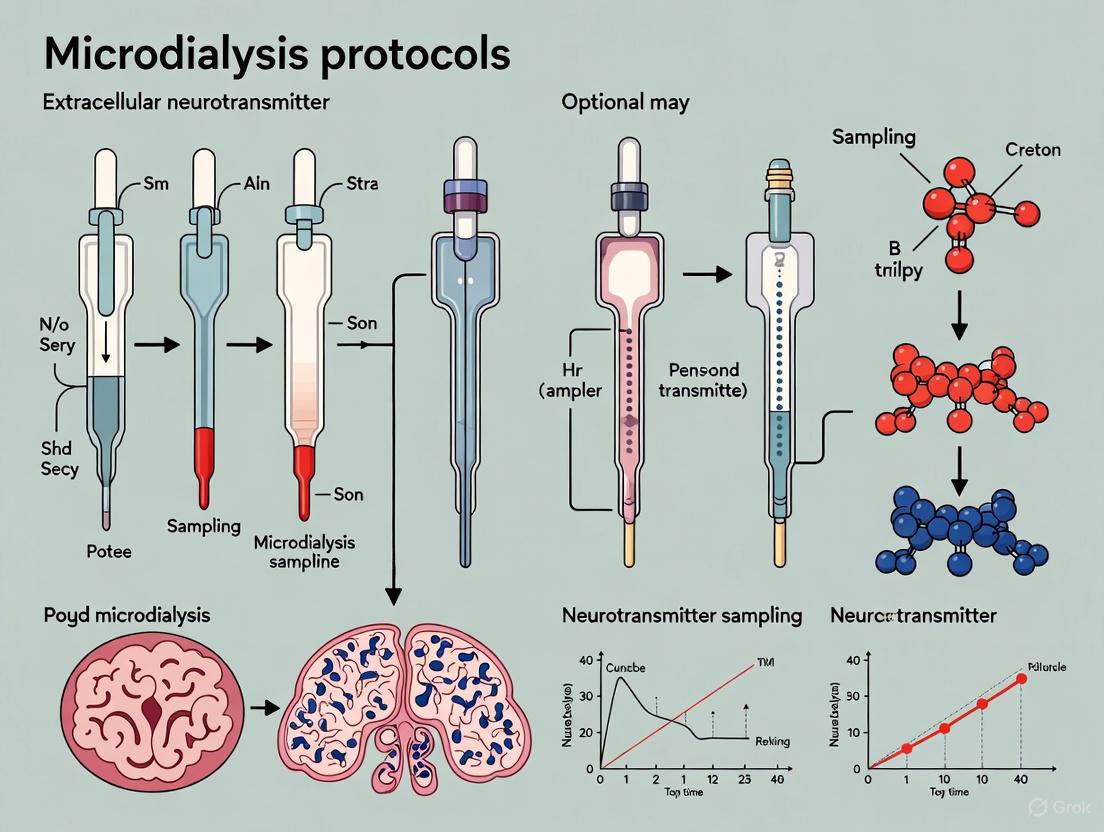
This article provides a comprehensive guide to in vivo microdialysis for sampling neurotransmitters in the brain extracellular space.
Advanced Microdialysis Protocols for Extracellular Neurotransmitter Sampling: A Comprehensive Guide for Preclinical Research
Abstract
This article provides a comprehensive guide to in vivo microdialysis for sampling neurotransmitters in the brain extracellular space. Aimed at researchers and drug development professionals, it covers foundational principles, advanced methodological protocols for deep metabolome coverage, critical troubleshooting for hydrophobic compounds, and integrative validation techniques like simultaneous PET imaging. The content synthesizes current best practices to enable reliable, temporally-resolved monitoring of neurochemical dynamics in freely moving animals, supporting robust pharmacokinetic/pharmacodynamic (PK/PD) assessments and CNS drug development.
Principles of Brain Extracellular Space Sampling and Microdialysis Fundamentals
The Role of the Extracellular Space in Neurochemical Communication and Brain Function
The brain extracellular space (ECS) is the narrow, fluid-filled microenvironment that surrounds every cell of the central nervous system [1]. Once considered a passive gap filler, it is now recognized as a dynamic and complex compartment that is critical for brain function. It contains interstitial fluid (ISF) resembling cerebrospinal fluid and a rich extracellular matrix (ECM) of proteoglycans, hyaluronan, and link proteins [1] [2]. The ECS serves as a reservoir for ions essential for electrical activity and forms a crucial intercellular chemical communication channel, facilitating the diffusion of neurotransmitters, neuromodulators, and other neuroactive substances [1]. This Application Note details the role of the ECS in neurochemical communication and provides specific protocols for studying it, framed within the context of microdialysis sampling for neurotransmitter research.
Fundamental Properties and Functions of the Brain ECS
Biophysical and Structural Parameters
The brain ECS is characterized by several key biophysical parameters, which are summarized in Table 1. The structure is not a simple void but a complex network of nano-to-micrometer-scale tunnels and reservoirs, often described as resembling the "water phase of a foam" [1] [2].
Table 1: Key Biophysical Properties of the Healthy Brain Extracellular Space
| Parameter | Typical Value | Description & Methodological Notes |
|---|---|---|
| Volume Fraction (α) | 0.20 (20%) | ECS volume relative to total brain tissue volume. Measured via radiotracer equilibration or real-time iontophoresis with TMA+ [1] [2]. |
| Tortuosity (λ) | 1.5 - 1.6 | Hindrance to diffusion, representing the increase in path length due to cellular obstacles and ECM. Calculated as λ = √(D / D), where D is the free diffusion coefficient and D is the effective diffusion coefficient in the brain [1] [2]. |
| ECS Width | ~20 - 60 nm | Predominant gap size between cells. Wider local expansions (e.g., >1 µm) also exist, creating a highly heterogeneous environment [1] [2]. |
The ECS in Neurochemical Signaling
The ECS is fundamental to two primary modes of neurochemical communication:
- Synaptic Transmission: The ECS forms the synaptic cleft, the ultra-narrow space where neurotransmitters are released from the presynaptic neuron and bind to receptors on the postsynaptic neuron [2].
- Volume Transmission (VT): Neurotransmitters and neuromodulators escape the synaptic cleft and diffuse through the ECS to bind to extrasynaptic receptors located on neurons and glial cells far from the release site [1] [2]. This form of communication allows for longer-lasting, more diffuse modulation of neural networks. Key signaling agents involved in volume transmission include glutamate, GABA, dopamine, ATP, and neuropeptides [1] [2]. The range and efficacy of VT are determined by receptor sensitivity, presence of uptake transporters, and the diffusion characteristics (tortuosity) of the ECS [1].
The following diagram illustrates the core concepts of synaptic and volume transmission within the ECS.
Quantitative Analysis of the ECS and Neurotransmitters
The Point-Source Paradigm for ECS Structure
To quantify the structural properties of the ECS (α and λ) in living tissue, the real-time iontophoresis method with tetramethylammonium (TMA+) is a gold standard [1]. This technique implements a point-source paradigm.
Protocol: Real-Time Iontophoresis with TMA+
- Objective: To determine the volume fraction (α) and tortuosity (λ) of the brain ECS in vivo.
- Principle: A small ion (TMA+) is released from a point source (iontophoresis pipette) and its concentration over time is measured a short distance away (~100 µm) with a TMA+-sensitive ion-selective microelectrode (ISM). The diffusion profile is fitted to a model to extract α and λ [1].
- Key Reagents:
- TMA+ Chloride: The probe ion.
- Artificial Cerebrospinal Fluid (aCSF): Perfusion solution.
- Ion-Selective Microelectrodes: For TMA+ detection.
- Procedure:
- Implant a TMA+ iontophoresis pipette and a TMA+-ISM into the brain region of interest.
- Apply a constant current pulse to the iontophoresis pipette to eject TMA+ ions into the ECS.
- Record the time-dependent change in TMA+ concentration at the ISM.
- Fit the concentration-time data to the diffusion equation (a modified Fick’s second law) to calculate the effective diffusion coefficient (D).
- Calculate tortuosity: λ = √(D / D), where D is the free diffusion coefficient of TMA+ in water.
- The volume fraction (α) is derived from the steady-state concentration level relative to the amount of TMA+ released [1].
Microdialysis for Neurotransmitter Sampling
Microdialysis is a cornerstone technique for sampling and quantifying neurotransmitters from the brain ECS in behaving animals [3]. A probe with a semipermeable membrane is implanted in the brain and perfused with aCSF. Molecules from the ECS diffuse into the probe based on their concentration gradient, and the dialysate is collected for analysis.
Table 2: Key Neurotransmitters and Analytes Accessible via Microdialysis
| Analytic | Role | Relevance to Brain Function & Disease |
|---|---|---|
| Glutamate (L-Glu) | Primary excitatory neurotransmitter | Implicated in learning, memory, epilepsy, stroke, and Parkinson's disease [4] [2]. |
| GABA | Primary inhibitory neurotransmitter | Regulates neuronal excitability; dysfunction linked to anxiety, epilepsy, and Huntington's disease [4] [2]. |
| Dopamine | Neuromodulator | Central to reward, motivation, and motor control; key role in Parkinson's disease and addiction [3]. |
| Norepinephrine | Neuromodulator | Regulates arousal, attention, and stress response [3]. |
| Serotonin | Neuromodulator | Regulates mood, appetite, and sleep; target of antidepressants [3]. |
| Adenosine | Neuromodulator | Involved in sleep regulation and energy metabolism [3]. |
| Ions (K+, Ca2+) | Electrolytes | Fluctuations correlate with brain state and neuronal activity; K+ spatial buffering is crucial [1] [2]. |
Protocol: Conventional In Vivo Microdialysis in Rodents
- Objective: To collect and quantify extracellular neurotransmitter levels from a specific brain region in a freely moving animal.
- Probe Configuration: A concentric cannula design is standard for brain implantation [5].
- Key Reagents & Solutions:
- aCSF: (e.g., 126 mM NaCl, 2.4 mM KCl, 1.2 mM CaCl2, 1.2 mM MgSO4, 1.2 mM NaH2PO4, 22 mM NaHCO3, pH 7.4). Must be filtered and degassed.
- Microdialysis Probes: With appropriate molecular weight cutoff (e.g., 20 kDa).
- Procedure:
- Surgery: Implant a guide cannula stereotaxically above the target brain region. After a recovery period (typically 24-48 hours to minimize gliosis and inflammation [5]), insert the microdialysis probe through the guide cannula.
- Perfusion: Connect the probe to a microinfusion pump via liquid-tight tubing. Perfuse with aCSF at a low, constant flow rate (0.5 - 2.0 µL/min).
- Equilibration: Allow the system to equilibrate for 1-2 hours after probe insertion to establish stable baseline neurotransmitter levels.
- Sample Collection: Collect dialysate samples into microvials at fixed time intervals (e.g., every 5-20 minutes). For offline analysis, samples are stored at -80°C until analysis. For online analysis, the outlet tubing is connected directly to an analytical instrument [5].
- Analysis: Analyze samples using a sensitive method such as:
- Liquid Chromatography-Tandem Mass Spectrometry (LC-MS/MS): Provides high selectivity and sensitivity for multiple analytes [4].
- High-Performance Liquid Chromatography with Electrochemical Detection (HPLC-EC): Traditional method for monoamines.
- Capillary Electrophoresis (CE): For high temporal resolution [5].
- Data Interpretation: Account for probe recovery (the ratio of analyte concentration in the dialysate to its true concentration in the ECS). Use relative recovery for semi-quantitative data. For absolute quantification, employ quantitative methods like no-net-flux [3].
The workflow for a typical microdialysis experiment, from probe implantation to data analysis, is outlined below.
Advanced Tools and Reagents for ECS Research
Modern research employs advanced analytical techniques to improve the temporal resolution and sensitivity of neurotransmitter monitoring.
Advanced Protocol: PESI/MS/MS for Rapid Neurotransmitter Quantification
Probe Electrospray Ionization tandem Mass Spectrometry (PESI/MS/MS) allows for the direct analysis of microdialysates without tedious sample preparation, greatly improving temporal resolution [4].
- Objective: To achieve rapid, near real-time quantification of glutamate and GABA in microdialysates.
- Key Reagents:
- Internal Standards: L-Glutamic acid-13C5,15N1 and GABA-D6 for accurate quantification.
- Ethanol (50%): Serves as an ionization enhancer for PESI.
- Mobile Phase: 0.1% Formic acid in water.
- Procedure:
- Microdialysis: Perform in vivo microdialysis as described, using a low flow rate (e.g., 1 µL/min).
- Sample Mixing: Directly mix a small volume of microdialysate (e.g., 3 µL) with internal standard solution and 50% ethanol (e.g., 12 µL) in an online or offline format.
- PESI/MS/MS Analysis: Inject the mixture via PESI. The solid needle probe directly samples the liquid and introduces it to the MS source.
- MS Parameters: Operate the triple quadrupole MS in multiple reaction monitoring (MRM) mode for optimal sensitivity and selectivity. Example transitions: L-Glu m/z 148.0 → 84.0; GABA m/z 104.1 → 87.1 [4].
- Data Analysis: Employ a Bayesian state-space model for longitudinal data analysis to properly account for autocorrelation in the time-series data, providing a more robust statistical interpretation [4].
The Scientist's Toolkit: Essential Research Reagents
Table 3: Essential Research Reagents for ECS and Microdialysis Studies
| Reagent / Solution | Function & Application |
|---|---|
| Artificial Cerebrospinal Fluid (aCSF) | Isotonic perfusion solution that mimics the ionic composition of brain ISF; used as the perfusate in microdialysis and slice experiments. |
| Tetramethylammonium (TMA+) Chloride | Small probe ion used in real-time iontophoresis to measure ECS volume fraction and tortuosity [1]. |
| Enzymes for ECM Digestion (e.g., Chondroitinase ABC, Hyaluronidase) | Selectively digest components of the extracellular matrix (chondroitin sulfate, hyaluronan) to study its role in diffusion barriers and synaptic plasticity [2]. |
| Aquaporin-4 (AQP4) Inhibitors (e.g., TGN-020) | Pharmacological tools to investigate the role of the astrocytic water channel AQP4 in water homeostasis and ECS dynamics [2]. |
| Stable Isotope-Labeled Internal Standards (e.g., GABA-D6) | Essential for accurate and precise quantification of neurotransmitters in complex biological samples using LC-MS/MS or PESI/MS/MS [4]. |
| Ion Channel & Transporter Modulators (e.g., Kir4.1 inhibitors, NKCC1 inhibitors) | Used to dissect the molecular machinery, such as astrocytic Na+/K+ ATPase, involved in ion homeostasis and activity-dependent cell swelling [2]. |
| Rapid Equilibrium Dialysis (RED) Devices | Commercial equipment used for in vitro quantitative microdialysis to study protein-ligand binding affinities and nonspecific binding [6]. |
The brain extracellular space is a dynamically regulated microenvironment that is fundamental to neurochemical communication through both synaptic and volume transmission. A comprehensive understanding of its structure and function is paramount for neuroscience research and drug development. The application of robust and advanced methodologies, such as real-time iontophoresis for ECS parameter quantification and highly sensitive microdialysis techniques like PESI/MS/MS for neurotransmitter monitoring, provides researchers with the tools necessary to investigate the ECS in health and disease. These protocols, supported by a well-characterized toolkit of reagents, form a critical foundation for advancing our knowledge of brain function and for developing novel therapeutic interventions for neurological disorders.
Core Principles and Theoretical Foundation
Microdialysis is a bioanalytical sampling technique used to monitor the chemical composition of the extracellular space in living tissues. The core principle relies on passive diffusion driven by a concentration gradient across a semipermeable membrane [7] [8]. This process mimics the passive function of a capillary blood vessel [7].
The technique involves implanting a probe with a semipermeable membrane into the tissue of interest. A physiological solution (perfusate) is continuously pumped through the probe. Molecules from the extracellular fluid (ECF) diffuse down their concentration gradient from the tissue (an area of higher concentration) into the perfusate (an area of lower concentration) [8]. The resulting solution, the dialysate, is collected for analysis [7]. Conversely, the technique can administer exogenous compounds, such as drugs, into the tissue by including them in the perfusate, allowing them to diffuse out into the ECF [7] [8].
The passive diffusion process is governed by Fick's laws [9]. The exchange efficiency, or recovery, is defined as the ratio between the analyte concentration in the dialysate and its true concentration in the surrounding ECF [10]. Recovery is influenced by several factors, including the membrane's material and surface area, the perfusion flow rate, and the physicochemical properties of the analyte itself, such as its molecular size and hydrophobicity [10] [7].
Quantitative Recovery Data and Calibration Methods
The recovery of analytes is not 100%; thus, calibration is essential to determine the true ECF concentration. The table below summarizes standard calibration methods and their key characteristics.
Table 1: Common Calibration Methods in Microdialysis [10]
| Calibration Method | Principle | Advantage | Disadvantage |
|---|---|---|---|
| Retrodialysis | The analyte is added to the perfusate, and its disappearance rate is measured. | Accounts for in vivo mass transfer resistance. | Requires a drug-free brain environment; not suitable for endogenous compounds. |
| No-Net-Flux | The probe is perfused with different concentrations of the analyte. | Well-investigated and robust method. | Requires a steady state and a large number of animals. |
| Ultra-Slow Flow Rate | The flow rate is drastically reduced to increase equilibration. | Increases recovery rate. | Results in very small sample volumes. |
The recovery of specific compounds can vary significantly based on their properties. Hydrophobic drugs, for instance, present a particular challenge due to pronounced non-specific binding to the microdialysis system components, leading to low recovery and substantial carry-over effects [10].
Table 2: Experimental Recovery Data for Hydrophobic Compounds [10]
| Compound | Property | Key Challenge | Optimization Strategy |
|---|---|---|---|
| Actinomycin D | Hydrophobic | Pronounced non-specific binding to apparatus. | Surface coating of equipment; use of optimized materials. |
| Selinexor | Hydrophobic | Low recovery rates; carry-over effects. | Addition of carriers like BSA to perfusate. |
| Ulixertinib | Hydrophobic | Low recovery rates. | Use of additives like DMSO and BSA in perfusate. |
Detailed Experimental Protocols
Protocol: In Vivo Microdialysis in the Rat Brain
This protocol details the steps for sampling neurotransmitters from the brain of a freely moving rodent, a common application in neuroscience research [11] [12].
Materials:
- Stereotaxic instrument
- Microdialysis probe (e.g., CMA 7, CMA 12, or MD-2211)
- Microperfusion pump (e.g., U-864 Syringe Pump)
- Ringer's solution (140 NaCl, 1.2 CaCl₂, 3.0 KCl, 1.0 MgCl₂ in mmol/L) [11] or artificial cerebrospinal fluid (aCSF)
- Guide cannula and healing dummy
- Fraction collector
- Analytical instrument (e.g., UPLC-MS/MS)
Procedure:
- Animal Preparation and Surgery: Anesthetize the animal (e.g., using isoflurane) and secure it in a stereotaxic frame. Maintain body temperature with a heating pad [11] [12].
- Probe Implantation: Make a sagittal incision to expose the skull. Drill a hole above the target brain region (e.g., Nucleus Accumbens: A/P +1.85, M/L -1.4, D/V -7.8 relative to bregma). Implant a guide cannula secured with anchor screws and dental cement [11]. Insert a healing dummy into the guide cannula.
- Recovery: House the animal individually and allow a recovery period of at least 48 hours to re-establish normal tissue physiology and blood-brain barrier function [7] [11].
- Microdialysis Experiment: On the day of the experiment, remove the healing dummy and carefully insert the microdialysis probe into the guide cannula, ensuring the membrane is positioned in the target region.
- Perfusion and Equilibration: Connect the probe to the microperfusion pump and perfuse with Ringer's solution or aCSF at a low, constant flow rate (typically 0.5-2.0 µL/min). Begin perfusing for 1-2 hours to allow the system to equilibrate before sample collection [11] [12].
- Baseline Sample Collection: Collect dialysate samples at regular intervals (e.g., every 20 minutes) into microvials to establish baseline levels of the analyte(s) of interest. Keep samples on ice during collection [12].
- Intervention: Administer the treatment (e.g., systemic drug injection or local drug delivery via the probe).
- Post-Intervention Sample Collection: Continue collecting samples for the desired duration following the intervention.
- Sample Analysis: Store collected dialysate samples at -80°C until analysis using a sensitive method such as UPLC-MS/MS [10] [12].
Flowchart of the general microdialysis process and the principle of passive diffusion.
Protocol: Assessing Adsorption and Recovery
For challenging compounds like hydrophobic drugs, preliminary tests are crucial to validate the method [10].
Aim: To evaluate potential drug loss due to non-specific binding to the tubing and components of the microdialysis system.
Materials:
- Test drug solution at a known concentration (e.g., 100 ng/mL)
- Microdialysis syringe pump
- Different tubing materials (e.g., FEP, PEEK)
- Collection vials
- Analytical instrument (e.g., UPLC-MS/MS)
Procedure:
- Nominal Concentration Test: Prepare a solution with a known drug concentration. Transfer it through different vial types (polypropylene, plastic microdialysis tubes, glass). Measure the concentration after each transfer to calculate recovery and identify binding to vial surfaces [10].
- Tubing Adsorption Test: Load the drug solution into a microdialysis syringe. Pump the solution through a long tubing system (e.g., 1 m of FEP or PEEK tubing) at a low flow rate (e.g., 0.5 µL/min). Collect samples at the outlet at several time points. Also, collect samples directly from the syringe before and after perfusing the tubing [10].
- Carry-Over Test: After the adsorption test, clean the syringes, fill them with a blank Ringer's solution (without drug), and repeat the pumping process. Collect samples from the tubing outlet and syringe to check for the release of previously adsorbed drug [10].
- Calculation: Calculate recovery rates using the formula: ( RR = C{dialysate} / C{nominal} ), where ( C_{nominal} ) is the known initial concentration. Significant deviation from 100% indicates adsorption.
The Scientist's Toolkit: Essential Research Reagents and Materials
Table 3: Key Research Reagent Solutions for Microdialysis
| Item | Function | Application Notes |
|---|---|---|
| Microdialysis Probe | The core unit for sampling; features a semipermeable membrane. | Select membrane material and molecular weight cut-off (e.g., 6-100 kDa) based on analyte size and properties [10] [12] [9]. |
| Physiological Perfusate | Mimics the ionic composition of extracellular fluid to minimize tissue disturbance. | Ringer's solution or artificial CSF (aCSF) are standard choices [7] [11] [12]. |
| Syringe Pump | Provides pulse-free, continuous flow of perfusate through the probe at low rates (0.1 - 5 µL/min). | Essential for stable and reproducible sampling [13] [12]. |
| BSA (Bovine Serum Albumin) | Used as a carrier protein in the perfusate. | Critical for recovering hydrophobic compounds by reducing non-specific binding to the system [10]. |
| DMSO (Dimethyl Sulfoxide) | A solvent used to enhance the solubility of hydrophobic drugs in the perfusate. | Used at low concentrations (e.g., 0.01-0.1%) in addition to BSA for challenging compounds [10]. |
| Fraction Collector | Automates the collection of dialysate samples at defined time intervals. | Enables high temporal resolution for pharmacokinetic and pharmacodynamic studies [10] [13]. |
Workflow of a typical microdialysis setup and the role of key components.
Microdialysis is a cornerstone technique for in vivo sampling of unbound analytes from the extracellular space of living tissues. Its value in neuroscience and drug development is unparalleled, providing critical data on neurotransmitter dynamics, drug pharmacokinetics, and pharmacodynamics directly at the site of action. The reliability and accuracy of data obtained through microdialysis are fundamentally dependent on three core components: the probe design, the membrane characteristics, and the perfusate composition. This application note details the essential aspects of these components, providing structured data, detailed protocols, and visual guides to empower researchers in designing robust and reproducible microdialysis studies.
Core Component Analysis
Microdialysis Probes
Microdialysis probes are the physical interface with the tissue of interest. Their design dictates spatial resolution, tissue damage, and compatibility with different experimental models.
Table 1: Microdialysis Probe Types and Characteristics
| Probe Type | Typical Diameter | Key Features | Ideal Applications | Recovery Considerations |
|---|---|---|---|---|
| Concentric Probes [14] [15] | Commercial: >220 µm [16]Custom/Microfabricated: 45-180 µm [16] | Most common design; inlet and outlet in a concentric arrangement. | General use in brain, subcutaneous tissue; high reliability. | Recovery is flow-rate dependent. |
| Linear Probes [14] | Varies | Membrane located along a shaft between inlet/Outlet tubing. | Superficial tissues or surface applications. | Similar to concentric probes. |
| Dual/Multi-Channel [17] [18] | Larger than single-channel | Enables simultaneous sampling from multiple sites or delivery alongside sampling. | Complex pharmacological studies or mapping chemical gradients. | Requires individual calibration for each channel. |
Advanced Probe Designs and Miniaturization
Technological advancement is focused on miniaturization and multifunctionality:
- Microfabricated Probes: Silicon-based probes with dimensions as small as 45 µm thick by 180 µm wide have been developed, reducing the cross-sectional area by 79% compared to the smallest conventional probes. This minimizes tissue damage and allows sampling from smaller brain nuclei in models like mice [16].
- Hybrid Probe Designs: Emerging technologies combine microdialysis with other modalities, such as implanted electrodes for simultaneous electrophysiological recording (EEG) and neurochemical sampling. This provides unprecedented insights into the relationship between electrical activity and biochemistry in diseases like epilepsy and glioma [19].
Semipermeable Membranes
The membrane is the critical selective barrier of the probe, allowing passive diffusion of analytes based on their size and physicochemical properties.
Table 2: Membrane Molecular Weight Cut-Off (MWCO) and Analyte Recovery
| Membrane MWCO | Target Analytic Size | Example Analytes | Approximate Relative Recovery In Vitro | Notes and Limitations |
|---|---|---|---|---|
| 6 - 20 kDa [14] | Small Molecules | Glucose, Lactate, Acetylcholine (≤ 200 Da) | ~20% or higher [15] | High recovery for classic neurotransmitters and metabolites. |
| 30 kDa [15] | Small Molecules & Peptides | ATP (~500 Da), Angiotensin II (~1,000 Da) | ATP: ~20%Neuropeptides (1,000-1,600 Da): 2-6% [15] | Common choice for a balance of small molecule and small peptide recovery. |
| 100 kDa [14] [19] | Small Proteins & Cytokines | Cytokines, Growth Factors (e.g., ~25 kDa) | 1-5% for cytokines at standard flow rates [19] | Recovery for proteins is low and unpredictable; not a sharp cut-off. |
Membrane Material and Biofouling
The choice of membrane material (e.g., polysulfone, polyethersulfone) influences biocompatibility and the tendency for biofouling—the accumulation of proteins and cells on the membrane surface which reduces recovery over time [19]. Retrodialysis of anti-inflammatory agents like dexamethasone has been shown to mitigate glial scarring and improve probe performance in long-term brain implants [14].
Perfusate Composition
The perfusate is the solution pumped through the probe, and its composition is vital for maintaining tissue homeostasis and ensuring accurate analyte recovery.
Table 3: Common Perfusate Components and Their Functions
| Component | Standard Concentration | Function | Key Considerations |
|---|---|---|---|
| Iso-osmotic Salts [14] [10] | e.g., 145 mM NaCl, 2.68 mM KCl, 1.22 mM CaCl2 | Mimics ionic composition of extracellular fluid; prevents osmotic fluid shift and tissue damage. | The solution is often referred to as Artificial Cerebrospinal Fluid (aCSF) or Ringer's solution. |
| Albumin (BSA/HSA) [10] [20] | 0.5% - 4% | Reduces non-specific binding (NSB) of hydrophobic drugs to tubing and membrane; acts as an osmotic agent. | Critical for hydrophobic compounds (e.g., ulixertinib). Concentrations ≥ 2% are often needed to significantly improve recovery [10] [20]. |
| Antioxidants [15] | e.g., Ascorbic Acid (concentration varies) | Prevents oxidative degradation of unstable analytes (e.g., catecholamines, neuropeptides) during collection. | |
| Solvents (DMSO) [10] | Low concentration (e.g., 0.01%-0.1%) | Can be necessary to solubilize highly lipophilic drugs in the perfusate for retrodialysis. | Use the minimum concentration required to avoid tissue toxicity. |
Essential Research Reagent Solutions
The following table catalogues key materials required for assembling and conducting a microdialysis experiment.
Table 4: Research Reagent Solutions for Microdialysis
| Item | Function/Description | Example Uses |
|---|---|---|
| Microdialysis Probe | The implantable device featuring a semipermeable membrane for sampling. | Brain extracellular fluid sampling in rodents [14] [15]. |
| Semipermeable Membrane | The selective barrier of the probe with a defined Molecular Weight Cut-Off (MWCO). | Differentiating analyte collection by size [14] [19]. |
| Perfusate (aCSF/Ringer's) | An isotonic solution mimicking extracellular fluid. | Standard perfusion fluid for most applications to maintain tissue health [14] [10]. |
| Albumin (BSA/HSA) | A protein additive to minimize non-specific binding. | Essential for recovering hydrophobic drugs like selinexor and ulixertinib [10]. |
| Precision Syringe Pump | A pump that delivers perfusate at a constant, low flow rate (µL/min). | Controlling perfusion flow rate, a key variable affecting recovery [14] [10]. |
| Microfraction Collector | A device for automatically collecting dialysate at defined time intervals. | Time-resolved sampling for pharmacokinetic studies [10]. |
| Analytical Instrumentation | Highly sensitive equipment (e.g., UPLC-MS/MS, HPLC-EC) for analyte quantification. | Detecting low (pico- to nanomolar) concentrations of analytes in small volume samples [14] [10]. |
Detailed Experimental Protocols
Protocol: Determination of In Vitro Relative Recovery
Purpose: To calibrate each probe and determine the fraction of the true external concentration that is recovered in the dialysate for a specific analyte [15].
Materials:
- Microdialysis probe
- Precision syringe pump
- Microvials for collection
- Stirred solution containing a known concentration of the analyte of interest (Cexternal)
- Perfusate (without the analyte)
- Appropriate analytical equipment (e.g., HPLC, UPLC-MS/MS)
Procedure:
- Immerse the microdialysis probe into a vigorously stirred solution containing a known concentration of your target analyte(s).
- Perfuse the probe with analyte-free perfusate at your intended experimental flow rate (typically 0.5 - 2.0 µL/min).
- Allow the system to equilibrate for at least 30-60 minutes.
- Collect at least three consecutive dialysate samples, ensuring the collection time is noted for each.
- Analyze the dialysate samples to determine the analyte concentration (Cdialysate).
- Calculation: Relative Recovery (RR) = (Cdialysate / Cexternal) × 100% [15].
Protocol: In Vitro Recovery Assessment for Hydrophobic Compounds
Purpose: To evaluate and mitigate the impact of non-specific binding (NSB) on the recovery of hydrophobic drugs [10].
Materials:
- All materials from Protocol 4.1.
- Model hydrophobic drug solution.
- Albumin (BSA or HSA) at various concentrations (e.g., 0.5%, 2%, 4%).
- Different tubing materials (e.g., FEP, PEEK).
Procedure:
- Nominal Concentration Test: Prepare a solution with a known drug concentration. Transfer it through the intended microdialysis tubing (e.g., FEP or PEEK) into different collection vials (polypropylene, glass). Measure the concentration after each transfer to identify points of significant drug loss [10].
- Adsorption Test: Pump the drug solution through a length of tubing at the experimental flow rate. Collect samples at the outlet at timed intervals and compare the concentration to the initial solution. Follow by flushing with blank perfusate to test for carry-over effects [10].
- Recovery with Albumin: Perform the In Vitro Relative Recovery protocol (4.1) using perfusate supplemented with increasing concentrations of albumin (e.g., 0%, 0.5%, 2%, 4%). This identifies the optimal albumin concentration to maximize recovery by saturating NSB sites [10] [20].
Workflow and Decision-Making Visualizations
Microdialysis Experimental Setup and Workflow
The following diagram illustrates the core components and fluidic path of a standard microdialysis system.
Perfusate Composition Selection Logic
This decision tree guides the selection of an appropriate perfusate based on the properties of the target analyte.
Microdialysis is a vital bioanalytical sampling technique for continuous monitoring of unbound analyte concentrations in the extracellular space of living tissues [8]. Its unique capability to sample endogenous neurotransmitters and deliver exogenous compounds directly to a tissue site makes it indispensable for neuroscience research and drug development [8]. This protocol focuses on the three most critical experimental design parameters—probe selection, membrane length, and flow rate—that collectively determine the success of microdialysis experiments targeting extracellular neurotransmitter sampling. Proper configuration of these parameters enables researchers to obtain quantitatively accurate measurements of neurochemical dynamics with appropriate spatial and temporal resolution.
Core Principles and Parameter Interrelationships
The fundamental principle of microdialysis relies on passive diffusion driven by concentration gradients across a semipermeable membrane [8]. A physiological solution is constantly perfused through an implanted probe, allowing molecules from the extracellular fluid to diffuse into the perfusate for collection and analysis [8]. The efficiency of this process is governed by several interrelated parameters that must be optimized for specific research applications.
Figure 1: Parameter Interrelationships in Microdialysis. This diagram illustrates the complex relationships between core experimental parameters and their collective impact on microdialysis outcomes. Probe characteristics and flow rates interact to determine multiple performance metrics that must be balanced for experimental success [21] [8].
The diagram illustrates how probe selection, membrane length, and flow rate collectively influence critical performance metrics including spatial resolution, temporal resolution, absolute recovery, relative recovery, and tissue damage. These interrelationships necessitate a balanced approach to experimental design where optimizing one parameter often requires compensating adjustments to others.
Probe Selection Guidelines
Probe Types and Configurations
Microdialysis probes are available in multiple configurations, each with distinct advantages for specific applications and tissue types. The molecular weight cutoff of commercially available probes ranges from approximately 6-100 kD, with specialized probes extending to 1 MD for sampling larger biomolecules [22].
Table 1: Microdialysis Probe Types and Their Applications
| Probe Type | Physical Characteristics | Optimal Applications | Key Advantages | Limitations |
|---|---|---|---|---|
| Cannula (Concentric) | Concentric design with tubular membrane tip (0.2-0.6 mm diameter) [21] | Brain neurophysiology studies [8] | Standardized design, high reproducibility | Requires guide cannula for implantation |
| Linear | Flexible configuration with linear membrane segment | Dermal, peripheral tissue sampling [21] | Adaptable to various tissue geometries | Potentially lower recovery efficiency |
| Loop | Circular membrane configuration | Larger animals and structures [21] | Enhanced surface area for exchange | Larger tissue displacement |
| High MW Cut-off | Specialized membranes (100 kDa-3 MDa) [23] | Protein collection (e.g., tau, cytokines) [23] | Enables sampling of large biomolecules | Requires push-pull mode to prevent fluid loss [23] |
Membrane Material Considerations
The selection of membrane material significantly impacts recovery characteristics and biocompatibility:
- Material Options: Commercial probes utilize cuprophane, polyarylethersulphone (PAES), polyethersulphone (PES), polyurethane, or cellulose membranes with varying molecular weight cut-offs [21].
- Molecular Weight Cut-off: For most neurotransmitter applications (typically <500 Da), standard membranes with 6-20 kDa cut-offs are sufficient. However, sampling larger molecules like neuropeptides requires high cut-off membranes (up to 100 kDa) [21] [23].
- Lipophilicity Concerns: Highly lipophilic compounds may adsorb to tubing and probe materials, potentially causing significant analyte loss and distorted concentration-time profiles [21]. Preliminary in vitro testing with different tubing materials or adding 0.25-0.5% albumin to the perfusate can mitigate adsorption issues [21].
Membrane Length Optimization
Membrane length directly influences exchange efficiency across the dialysis membrane. Longer membranes provide greater surface area for molecular exchange, thereby enhancing absolute recovery.
Table 2: Membrane Length Selection Guidelines by Application
| Target Application | Recommended Length | Rationale | Technical Considerations |
|---|---|---|---|
| Rat Striatum | 3-4 mm | Optimal balance of recovery and spatial specificity | Compatible with striatal dimensions |
| CSF Sampling (Cisterna Magna) | 1 mm | Limited by anatomical constraints [21] | Minimizes tissue disruption in delicate areas |
| Vena Jugularis | Up to 10 mm | Maximizes recovery in accessible vasculature [21] | Suitable for blood sampling applications |
| Protein Collection | 2-4 mm | Adequate for low-abundance biomarkers [23] | Requires high MW cut-off membranes (1000 kDa) [23] |
Membrane length selection must balance recovery requirements against the size of the target structure. While longer membranes generally yield better recovery, the choice is ultimately constrained by the anatomical dimensions of the implantation site [21] [8].
Flow Rate Optimization
Perfusion flow rate represents a critical adjustable parameter that directly governs both relative recovery and temporal resolution of microdialysis sampling.
Table 3: Flow Rate Optimization for Neurotransmitter Sampling
| Flow Rate Range | Relative Recovery | Temporal Resolution | Recommended Applications |
|---|---|---|---|
| 0.1-0.3 µL/min | Very High (>70%) | Low (30-60 min samples) | Quantitative studies requiring near-equilibrium conditions [21] |
| 0.5-1.0 µL/min | Moderate (30-50%) | Medium (10-20 min samples) | Standard neurotransmitter monitoring [24] [25] |
| 1.0-2.0 µL/min | Lower (10-30%) | High (1-5 min samples) | Rapid dynamic studies despite lower concentration [21] |
| ≥2.0 µL/min | Very Low (<10%) | Very High (<1 min samples) | Rarely used except for specific pharmacological applications |
The relationship between flow rate and recovery follows a predictable pattern: lower flow rates yield higher relative recovery but poorer temporal resolution, while higher flow rates provide better temporal resolution at the cost of reduced relative recovery [21] [8]. This fundamental trade-off must be carefully considered based on specific experimental goals.
Integrated Experimental Protocol
Stereotaxic Surgery and Probe Implantation
This protocol outlines the standardized procedure for rat striatal implantation, adaptable to other brain regions with appropriate coordinate adjustments.
Materials Required:
- Stereotaxic apparatus with rodent adaptor
- Microdialysis guide cannula and probe
- Surgical instruments (scalpel, drill, forceps)
- Anesthesia system (isoflurane or ketamine/dexdomitor [25])
- Dental cement and skull screws
- Heating pad for thermal support
Step-by-Step Procedure:
- Anesthesia and Positioning: Anesthetize the rat using approved anesthetic protocols (e.g., ketamine 65 mg/kg with dexdomitor 0.25 mg/kg) [25]. Securely place the animal in the stereotaxic frame using ear bars and nose clamp, ensuring complete stabilization [23].
- Surgical Exposure: Make a sagittal incision on the scalp, retract skin, and remove connective tissue to expose the skull surface. Identify bregma and lambda landmarks [23].
- Skull Leveling: Adjust the stereotaxic apparatus to ensure the skull surface is level in both anterior-posterior and medial-lateral planes. This critical step ensures accurate coordinate targeting [23].
- Guide Cannula Implantation: Drill a burr hole at the target coordinates relative to bregma (e.g., A/P +0.2 mm, M/L ±2.3 mm for cortex [25]). Insert and secure the guide cannula using dental cement anchored with skull screws [23].
- Postoperative Recovery: Allow 1-2 days recovery for peripheral tissue studies or up to 2 weeks for sleep-wake studies requiring full habituation [23].
Microdialysis Setup and Sampling
Materials Required:
- Microdialysis probe with appropriate membrane characteristics
- Precision infusion pump capable of low flow rates (0.1-2 µL/min)
- Microdialysis tubing and connectors
- Perfusate solution (modified artificial cerebrospinal fluid)
- Fraction collector or automated sampling system
Step-by-Step Procedure:
- Probe Preparation: Condition probes according to manufacturer specifications. For high molecular weight cut-off probes (>1000 kDa), perform pre-use quality checks by gently infusing distilled water while covering vent holes to verify membrane integrity [23].
- System Priming: Connect the probe to the perfusion system and carefully prime with perfusate to eliminate air bubbles from the fluid path.
- Probe Implantation: On experiment day, carefully remove the dummy probe from the guide cannula and insert the microdialysis probe, ensuring proper seating depth.
- Perfusion Parameters: Initiate perfusion with artificial cerebrospinal fluid at the predetermined optimal flow rate (typically 0.5-1.0 µL/min for neurotransmitter sampling) [24] [25].
- Equilibration Period: Allow 1-2 hours for system stabilization after probe insertion to establish stable baseline conditions before sample collection [8].
- Sample Collection: Collect dialysate fractions at predetermined intervals based on flow rate and analytical requirements. Immediately freeze samples at -80°C if not analyzing immediately.
Figure 2: Microdialysis Experimental Workflow. This diagram outlines the sequential steps in a complete microdialysis experiment, showing how initial parameter selection guides subsequent procedural stages from surgery through data interpretation [23] [25] [8].
Analytical Considerations
Sample Derivatization and Analysis: For enhanced detection of polar neurotransmitters like glutamate and GABA, chemical derivatization significantly improves chromatographic retention and sensitivity [24]:
- Benzoyl Chloride Derivatization: Mix microdialysate samples with 100 mM sodium tetraborate and benzoyl chloride (2% in acetonitrile) in a 2:1:1 ratio [24] [25].
- Isotopic Labeling: For quantitative precision, include internal standards derivatized with 13C6-benzoyl chloride [24] [25].
- LC-MS/MS Analysis: Utilize reversed-phase chromatography (e.g., HSS T3 column) with tandem mass spectrometry detection for high-sensitivity quantification [24] [25].
Research Reagent Solutions
Table 4: Essential Research Reagents for Microdialysis Applications
| Reagent/Chemical | Specification/Purpose | Application Examples | Technical Notes |
|---|---|---|---|
| Artificial CSF | 145 mM NaCl, 2.68 mM KCl, 1.01 mM MgSO₄, 1.22-1.40 mM CaCl₂, phosphate buffer [24] [25] | Standard perfusate for neurological studies | Maintains physiological ion balance |
| Benzoyl Chloride | Derivatizing reagent (2% in acetonitrile) [24] | Enhancement of LC-MS detection for polar neurotransmitters | Enables detection of 872 metabolic features [24] |
| 13C6-Benzoyl Chloride | Isotopically labeled derivatization standard [24] | Internal standard for quantitative accuracy | Corrects for analytical variability |
| Tetrodotoxin (TTX) | Sodium channel blocker (500 nM-1 μM) [25] | Differentiation of neuronal vs. non-neuronal glutamate release | Validates neuronal origin of neurotransmitters |
| 13C5-Glutamine | Metabolic precursor (2.5 μM in perfusate) [25] | Labeling of neuronal glutamate pools via glutamate-glutamine shuttle | Enables specific tracking of neuronal glutamate [25] |
| α-(methylamino)isobutyric acid | Glutamine transport inhibitor (20 mM) [25] | Inhibition of neuronal glutamine uptake | Confirms neurotransmitter synthesis pathways |
Troubleshooting and Quality Control
Common Technical Challenges and Solutions:
- Low Relative Recovery: Verify flow rate accuracy, check for membrane damage, consider reducing flow rate or increasing membrane length.
- Sample Carryover: Ensure proper cleaning between experiments; implement blank runs between samples if needed.
- Inconsistent Baselines: Extend equilibration time post-implantation; verify anesthetic stability; monitor animal physiological parameters.
- Clogged Probes: Pre-filter all solutions; inspect probes before implantation; consider alternative membrane materials.
Quantitative Validation Methods:
- No-net-flux Method: Perfuse with at least four different analyte concentrations to determine recovery and extracellular concentration simultaneously [26] [22].
- Retrodialysis: Use the disappearance of compound from perfusate to calculate in vivo recovery, particularly suitable for exogenous compounds [21] [22].
- Low-flow-rate Method: Extrapolate to zero flow rate by measuring recovery at multiple flow rates to estimate true extracellular concentration [22].
The strategic optimization of probe selection, membrane length, and flow rate parameters forms the foundation of successful microdialysis experimentation. By carefully balancing these interrelated variables according to the guidelines presented in this protocol, researchers can achieve the spatial resolution, temporal resolution, and quantitative accuracy required for meaningful investigation of extracellular neurotransmitter dynamics. The integrated approach outlined here—combining appropriate probe configuration with rigorous surgical implantation and analytical methodologies—enables reliable assessment of neurochemical processes in both basic research and drug development contexts.
Spatial and Temporal Resolution Advantages for Time-Resolved Neurochemical Monitoring
Time-resolved microdialysis has established itself as a cornerstone technique for in vivo neurochemical monitoring, enabling researchers to capture the dynamic fluctuations of neurotransmitters and other molecules in the living brain [27]. This application note details the specific advantages and methodologies for enhancing spatial and temporal resolution within this paradigm, providing a structured guide for researchers and drug development professionals. The ability to monitor chemical dynamics at high resolution is critical for relating neurotransmitter fluctuations to behavior, drug effects, and disease states, thereby offering profound insights into brain function and dysfunction [28]. The content herein is framed within a broader thesis on optimizing microdialysis protocols for extracellular neurotransmitter sampling.
Quantitative Advantages of High-Resolution Monitoring
Enhancing resolution in time-resolved microdialysis directly translates to more precise and biologically relevant data. The following tables summarize key quantitative parameters and their relationship to resolution.
Table 1: Characteristic Resolution Parameters in Microdialysis Sampling
| Parameter | Standard Microdialysis | High-Temporal Resolution | High-Spatial Resolution |
|---|---|---|---|
| Temporal Resolution | 5-10 minutes [14] | Seconds to under 15 seconds [27] [28] | 20 minutes (low-flow, unoptimized) to sub-second (with segmented flow) [28] |
| Spatial Resolution (Probe Size) | 200-400 μm diameter, 1-4 mm length [14] [28] | Similar to standard, but with segmented flow | <200 μm diameter; Push-pull probes sampling from ~4 nL voxels [28] |
| Typical Flow Rates | 1-2 μL/min [14] | <1 μL/min to increase relative recovery [14] | ≤50 nL/min (push-pull perfusion) [28] |
| Sample Volume per Fraction | ~5-10 μL [14] | Nanoliter droplets [28] | Sub-microliter, directly coupled to analysis [28] |
Table 2: Impact of Resolution on Measurable Neurobiological Phenomena
| Biological Process | Approximate Timescale | Relevant Spatial Scale | Suitable Microdialysis Approach |
|---|---|---|---|
| Phasic Neurotransmitter Release | Sub-second to seconds [28] | Specific sub-nuclei (<1 mm³) [28] | Segmented flow coupled to rapid assays (e.g., MS, electrophoresis) [28] |
| Tonic Neurotransmitter Levels | Minutes to hours | Brain region-level | Standard microdialysis |
| Response to Acute Drug Challenge | Seconds to minutes | Circuit-level (distributed brain systems) | High-temporal resolution microdialysis |
| Concentration Gradients within Nuclei | Stable over time | Sub-millimeter gradients [28] | High-spatial resolution (e.g., push-pull, microfabricated probes) [28] |
Protocols for Enhanced Resolution
Protocol: Achieving High Temporal Resolution with Segmented Flow
This protocol enables the monitoring of neurochemical dynamics on a timescale of seconds by minimizing sample mixing during transport.
- Principle: The outflow from a microdialysis probe is segmented into nanoliter droplets separated by an immiscible fluid (e.g., fluorinated oil), which prevents flow and diffusion broadening [28].
- Workflow Diagram:
Materials:
- Standard microdialysis probe and pump.
- Fluorinated oil.
- Microfluidic tee connector (can be mounted on the animal's head).
- On-line analytical system (e.g., microchip electrophoresis, mass spectrometry, enzyme assay).
Methodology:
- Implantation: Implant a microdialysis probe into the target brain region of an anesthetized or freely moving animal.
- Perfusion Setup: Perfuse the probe with an artificial cerebrospinal fluid (aCSF) at a flow rate optimized for recovery (e.g., <1 μL/min).
- Segmentation: Direct the outflow tubing to the microfluidic tee. Simultaneously, introduce the immiscible oil at a controlled flow rate to segment the aqueous dialysate stream into discrete droplets.
- Transport & Analysis: The segmented flow can be transported over longer distances without loss of temporal fidelity. Direct the droplet stream to an on-line analytical system for rapid separation and detection.
- Data Collection: Correlate the analysis results from each droplet with its collection time to construct a high-temporal resolution concentration profile.
Protocol: Achieving High Spatial Resolution with Push-Pull Perfusion
This protocol allows for sampling from extremely small, well-defined brain volumes, enabling the detection of fine-scale neurochemical gradients.
- Principle: A "push" capillary delivers make-up fluid while a closely apposed "pull" capillary withdraws sample directly from the tip, confining the sampled volume to a tiny voxel of tissue [28].
- Workflow Diagram:
Materials:
- Custom-fabricated push-pull probe (e.g., from fused silica capillaries or microfabricated Si probes).
- High-precision, low-flow syringe pumps.
- Sensitive analytical system capable of handling small volumes (e.g., capillary electrophoresis, nanoLC-MS).
Methodology:
- Probe Fabrication/Selection: Assemble a push-pull probe from two closely spaced capillaries or procure a microfabricated Si probe. The goal is a minimal tip geometry.
- Implantation: Stereotactically implant the probe tip into the precise brain nucleus or sub-region of interest.
- Low-Flow Perfusion: Initiate the "push" and "pull" pumps at very low, balanced flow rates (e.g., 50 nL/min or less) to minimize tissue damage and maintain fluid balance.
- Sample Collection & Analysis: The withdrawn sample is collected directly. For best temporal resolution, couple the outlet directly to a low-volume, high-speed analysis technique like capillary electrophoresis. Alternatively, use a segmented flow system to preserve temporal information.
- Validation: Post-experiment, validate the probe placement histologically to confirm the spatial origin of the neurochemical data.
The Scientist's Toolkit: Essential Research Reagents and Materials
Table 3: Key Research Reagent Solutions for High-Resolution Microdialysis
| Item | Function/Description | Application Note |
|---|---|---|
| Semi-Permeable Membrane | A membrane with a defined molecular weight cut-off (6-100 kDa) that allows diffusion of analytes from the extracellular fluid into the probe [14]. | Choice of cut-off determines the size range of collected molecules. Smaller pore sizes may be used for classic neurotransmitters, while high cut-off membranes are needed for proteins like amyloid-β [28]. |
| Artificial Cerebrospinal Fluid (aCSF) | An isotonic, buffered perfusion solution that mimics the ionic composition of brain extracellular fluid. | The composition must be physiologically relevant to avoid perturbing the local tissue environment during sampling. |
| Fluorinated Oil | An immiscible, inert fluid used to segment the aqueous dialysate stream into discrete droplets [28]. | Prevents dispersion of analyte zones, preserving high temporal resolution during sample transport from the probe to the analysis platform. |
| Affinity Enhancement Agents | Antibodies or other binding agents added to the perfusate to increase the recovery of specific, low-concentration analytes like neuropeptides [28]. | Can improve recovery several-fold by increasing the effective concentration gradient across the dialysis membrane. |
| Enzyme Assays | Highly specific and sensitive assays that can be coupled on-line for rapid detection of specific neurotransmitters like glutamate [28]. | Ideal for achieving high temporal resolution, with some assays providing data every 30 seconds [28]. |
| Microfabricated Si Probes | Miniaturized sampling probes fabricated using silicon-based microtechnology, offering superior spatial resolution [28]. | Enable sampling from much smaller tissue volumes and can be integrated with other features, such as electrodes for combined chemical and electrical recording. |
The strategic enhancement of spatial and temporal resolution in time-resolved microdialysis moves the technique beyond simple monitoring towards capturing the true dynamics of brain chemistry. The protocols detailed herein—employing segmented flow and push-pull perfusion—provide a concrete pathway to achieve resolution on the scale of seconds and sub-millimeter brain volumes. When integrated with sensitive, rapid analytical methods, these approaches empower researchers to dissect neurochemical signaling with unprecedented detail, offering powerful insights for fundamental neuroscience and the development of novel therapeutics for neurological and psychiatric disorders.
Advanced Protocols for Deep Neurotransmitter and Metabolome Coverage
The brain extracellular space is a critical compartment containing a diverse chemical milieu of neurotransmitters, neuromodulators, and metabolites that reflect the real-time functional status of neural circuits [24]. Understanding this chemical landscape is essential for deciphering the molecular underpinnings of behavior, learning, and neurological disease. In vivo microdialysis serves as a key technique for sampling from this space, yet its full potential has been limited by analytical challenges. Traditional analyses provide scant knowledge of the compartment's composition, offering limited depth due to small sample volumes and low physiological concentrations of analytes [24]. This protocol details an advanced liquid chromatography-tandem mass spectrometry (LC-MS/MS) approach designed to overcome these hurdles, enabling the identification of hundreds of compounds in brain dialysate and establishing methods for deep, routine monitoring of brain chemistry in time-resolved studies [24].
Experimental Workflow and Signaling Pathways
The following diagram illustrates the comprehensive experimental workflow for deep metabolomic analysis of brain dialysate, from in vivo sampling to compound identification.
Materials and Reagents
Research Reagent Solutions
The following table catalogues the essential materials and reagents required for the successful execution of this protocol.
| Item | Function/Application in Protocol |
|---|---|
| CMA 12 Elite Microdialysis Probes | In vivo sampling from brain extracellular space with 4mm membrane and 20,000 Da MWCO [24]. |
| Artificial Cerebrospinal Fluid (aCSF) | Perfusion fluid during microdialysis sampling, mimicking ionic composition of native CSF [24]. |
| LC-MS Grade Solvents (Acetonitrile, Methanol, Water) | Mobile phase preparation and sample reconstitution to minimize background interference [24]. |
| Benzoyl Chloride (Light and ¹³C₆-Labeled) | Chemical derivatization reagent to enhance detection of polar neurotransmitters [24]. |
| MetaSci Human Metabolite Library | Library of ~1000 compounds for retention time matching and prediction model generation [24]. |
| Neurochemical Standards | Reference compounds for method validation and confirmation of identifications [24]. |
Methods and Protocols
Microdialysis Sampling Protocol
- Animal Preparation and Probe Implantation: Perform stereotaxic surgery on adult male Sprague-Dawley rats (≈75 days old) to implant a CMA 12 Elite microdialysis probe with a 4 mm membrane into the striatum. Allow a post-surgical recovery period (typically 24-48 hours) to re-establish normal neurochemical levels [24] [29].
- Dialysate Collection: Connect the implanted probe to a microinfusion pump and perfuse with aCSF at a flow rate of 1 μL/min. Collect samples from awake, freely moving animals over a 12-hour period. For deep identification studies, pool dialysate from six animals to obtain sufficient sample volume and concentration. Confirm probe placement post-experiment via histology [24].
Sample Preparation Protocols
Preconcentration for Untargeted Analysis
- Transfer a 750 μL aliquot of pooled dialysate to a tapered glass HPLC vial.
- Dry the sample completely in a vacuum centrifuge at ambient temperature for over 3 hours.
- Reconstitute the dried sample in 75 μL of reconstitution solvent (9:1 water:methanol for RPLC; 85:15 acetonitrile:water for HILIC), achieving a 10-fold concentration [24].
Benzoyl Chloride Derivatization
- Prepare separate aliquots of dialysate for derivatization with light (BzCl) and heavy (¹³C₆-BzCl) reagents.
- Follow established benzoylation procedures as previously described [24]. Briefly, mix the sample with carbonate buffer and the appropriate benzoyl chloride reagent. The reaction proceeds rapidly, converting primary and secondary amines into more hydrophobic and readily ionizable derivatives.
LC-MS/MS Analysis Conditions
Liquid Chromatography
- Reversed-Phase (RPLC): Use a 2.1 × 100 mm, 1.8 μm HSST3 column. Employ a gradient elution with water and acetonitrile, both containing 0.1% formic acid.
- Hydrophilic Interaction (HILIC): Use a 2.1 × 100 mm, 1.7 μm BEH Amide column. Employ a gradient elution with acetonitrile and water, both containing ammonium formate and formic acid.
- Analyze derivatized samples using positive mode RPLC only [24].
Mass Spectrometry
- Instrument Configuration: Utilize a high-resolution Orbitrap mass spectrometer (e.g., Orbitrap ID-X) coupled to a UHPLC system (e.g., Vanquish Horizon).
- Full Scan (MS1) Settings:
- Resolution: 120,000
- Scan Range: 70–800 m/z
- Sheath Gas: 40; Aux Gas: 10
- Ion Transfer Tube Temp: 325 °C
- Data-Dependent MS/MS (dd-MS2) Settings:
- MS1 Resolution: 60,000
- MS2 Resolution: 30,000
- Intensity Threshold: 1.0 × 10⁴
- Dynamic Exclusion: 3 seconds (± 5 ppm)
- Collision Energies: 20, 40, and 80% (HCD)
- Ionization: Set spray voltage to +3200 V for positive mode and -3200 V for negative mode [24].
Data Processing and Compound Identification
- Process untargeted MS/MS data using specialized software such as MetIDTracker.
- Search acquired MS/MS spectra against major spectral libraries including NIST20, MassBank of North America (MONA), and the MS-Dial fork of LipidBlast [24].
- For derivatized samples, identify pairs of features differing by the mass shift corresponding to the light and heavy benzoyl labels.
Key Quantitative Outcomes of the Method
The application of the described LC-MS/MS methods enables deep coverage of the brain extracellular metabolome. The table below summarizes the key quantitative results achieved.
| Analysis Method | Key Results and Identifications | Sample Volume for Detection |
|---|---|---|
| Concentrated Pooled Sample (Untargeted) | 479 unique compounds identified from rat striatal dialysate using RPLC and HILIC [24]. | 750 µL (concentrated to 75 µL) |
| Single Analysis (5 µL) | 60% of identified compounds (≈287 compounds) detected without preconcentration in a 20-min analysis [24]. | 5 µL |
| Benzoyl Chloride Derivatization | 872 non-degenerate benzoylated features detected, encompassing most small molecule neurotransmitters and dopamine pathway metabolites [24]. | Not Specified |
Discussion
This protocol outlines a powerful strategy for in-depth annotation of the brain extracellular space, significantly expanding the number of compounds that can be monitored relative to previous studies which identified 36–120 metabolites [24]. The dual-path approach—combining deep, sample-intensive identification with streamlined, volume-compatible detection—provides a practical framework for both discovery and routine monitoring. The integration of chemical derivatization successfully addresses the long-standing analytical challenge of detecting highly polar, low-abundance neurotransmitters like GABA and acetylcholine using standard RPLC methods, which are often poorly retained and difficult to detect [24] [29] [30].
While microdialysis is a well-established "golden technique" for in vivo sampling, it has inherent limitations, including tissue trauma from probe insertion and poor temporal resolution compared to the millisecond scale of neural signaling [29]. The methods described here maximize the informational yield from each collected sample. The ability to detect hundreds of compounds in a 5 μL volume is a significant advance, making deep metabolomic profiling compatible with the temporal constraints of behavioral neuroscience experiments. This workflow provides a launching point for defining the chemistry underlying brain states in both health and disease, offering insights that could accelerate drug development for neurological and psychiatric disorders [24].
In vivo neurochemical monitoring is crucial for understanding brain function, disease states, and the effects of pharmacological treatments. Microdialysis sampling enables the collection of small-molecular-weight substances from the brain extracellular space, providing valuable insights into neurotransmitter dynamics in awake, freely-moving animals [3] [31]. However, a significant analytical challenge persists: many key neurotransmitters and metabolites are highly polar molecules that exhibit poor retention on conventional reversed-phase liquid chromatography (LC) columns and often demonstrate suboptimal ionization efficiency for mass spectrometry (MS) detection [32] [33]. This limitation has traditionally restricted comprehensive neurochemical profiling.
Chemical derivatization with benzoyl chloride (BzCl) presents an effective strategy to overcome these analytical hurdles. This approach transforms polar neurotransmitters into less polar derivatives through a simple and rapid reaction, significantly enhancing their chromatographic properties and detection sensitivity [34] [35]. When coupled with LC-MS/MS, benzoylation allows researchers to simultaneously monitor dozens of neurochemicals in small-volume microdialysate samples, providing a powerful tool for deep chemical analysis of the brain extracellular space [24] [33]. This protocol details the application of benzoyl chloride derivatization for the analysis of polar neurotransmitters, framed within the context of microdialysis-based research.
Principles and Advantages of Benzoyl Chloride Derivatization
Benzoyl chloride derivatization operates on the principle of the Schotten-Baumann reaction, where BzCl reacts with nucleophilic functional groups under basic conditions [32]. This reagent is particularly valuable for neurochemical analysis due to its broad reactivity, targeting primary and secondary amines, phenols, and ribose-hydroxyl groups present on a wide range of biologically relevant compounds [24] [35]. The reaction is exceptionally fast, typically requiring less than one minute at room temperature, and yields stable products suitable for long-term storage [32] [35].
The analytical benefits of this derivatization are threefold. First, the addition of hydrophobic benzoyl groups markedly improves retention on reversed-phase LC columns, enabling effective separation of otherwise poorly retained polar compounds and reducing co-elution with matrix interferents [32] [33]. Second, the process significantly enhances MS detection sensitivity, with reported signal increases of over 100-fold for compounds like dopamine due to improved ionization efficiency [32]. Third, the commercial availability of 13C6-labeled benzoyl chloride allows for straightforward preparation of isotope-coded internal standards, which correct for variability in derivatization efficiency and MS analysis, thereby improving quantification accuracy [34] [35].
Table 1: Functional Group Reactivity and Mass Shifts with Benzoyl Chloride Derivatization
| Functional Group | Reaction Product | Mass Addition per Derivatization (Da) | Example Neurochemicals |
|---|---|---|---|
| Primary Amines | Benzamide | +104 | GABA, Glutamate, Spermidine |
| Secondary Amines | Benzamide | +104 | Serotonin, Spermine |
| Phenols | Phenyl Ester | +104 | Dopamine, Norepinephrine |
| Aliphatic Alcohols* | Ester | +104 | Adenosine, Inosine |
| *Reaction efficiency for aliphatic alcohols is highly dependent on base catalyst used [36]. |
Experimental Protocols
Reagent Preparation
- Carbonate Buffer (1 M, pH ~11): Dissolve 1.06 g of sodium carbonate (Na₂CO₃) or 1.43 g of sodium tetraborate (borax) in 10 mL of LC-MS grade water. The choice of base can impact derivatization efficiency for certain analyte classes [34] [36].
- Benzoyl Chloride Solution (2% v/v): Dilute 20 µL of unlabeled (light) benzoyl chloride in 980 µL of acetonitrile. Prepare fresh daily.
- Isotopically Labeled Internal Standard Solution: Derivatize a standard mixture of target analytes with 13C6-benzoyl chloride following the main derivatization protocol. Quench the reaction, and dilute the mixture 100-fold in 20% acetonitrile containing 1% (v/v) sulfuric acid. Spike with deuterated acetylcholine and choline (e.g., d4-ACh and d4-Ch) to a final concentration of 20 nM, as these quaternary amines do not derivatize with BzCl [35].
Derivatization Procedure
The following protocol is optimized for a 5 µL sample of microdialysate, standard, or quality control material [34] [35].
- Aliquot Sample: Pipette 5 µL of sample into a low-adhesion microcentrifuge tube.
- Basify Reaction: Add 2.5 µL of 1 M carbonate buffer to the sample. Vortex briefly to mix. The final pH should be >9 for efficient derivatization.
- Derivatize: Add 2.5 µL of 2% (v/v) benzoyl chloride in acetonitrile. Vortex immediately and vigorously for 10-15 seconds.
- Quench and Add IS: After a reaction time of 60 seconds at room temperature, add 2.5 µL of the prepared isotopically labeled internal standard solution. This step quenches the reaction and introduces the internal standards for quantification [35].
- Analysis: Centrifuge the mixture briefly (~30 seconds) to collect the contents at the bottom of the tube. The derivatized sample is now ready for LC-MS/MS analysis.
LC-MS/MS Analysis Conditions
Chromatography:
- Column: C18 reversed-phase (e.g., Waters BEH C18, 1.0 x 100 mm, 1.7 µm)
- Mobile Phase A: 10 mM ammonium formate with 0.15% formic acid in water
- Mobile Phase B: Acetonitrile
- Gradient: 0-0.1 min (15% B), 0.1-8.0 min (15-60% B), 8.0-8.1 min (60-95% B), 8.1-10.0 min (95% B), 10.0-10.1 min (95-15% B), 10.1-13.0 min (15% B) for column re-equilibration [34] [33].
- Flow Rate: 0.1 mL/min
- Temperature: 40 °C
- Injection Volume: 5-10 µL
Mass Spectrometry:
- Ionization: Positive electrospray ionization (ESI+)
- Detection: Multiple Reaction Monitoring (MRM)
- Ion Source Settings: Sheath gas: 40, Aux gas: 10, Sweep gas: 1, Ion transfer tube temp: 325 °C, Vaporizer temp: 300 °C, Spray voltage: 3200 V [24].
- MRM Transitions: For each benzoylated analyte, the precursor ion is the [M+H]+ species. The most abundant and characteristic product ion is typically the benzoyl fragment at m/z 105 for light derivatives and m/z 111 for 13C6-labeled internal standards [32] [35].
Performance Data and Applications
The benzoyl chloride derivatization method enables robust, high-sensitivity quantification of a broad panel of neurochemicals. The performance characteristics for a subset of key neurotransmitters and metabolites are summarized below.
Table 2: Analytical Performance of Benzoyl Chloride Derivatization for Selected Neurochemicals
| Analyte | LOD (nM) | Linear Range | Precision (% RSD) | Key MRM Transition |
|---|---|---|---|---|
| Dopamine (DA) | 0.05 - 0.2 | 3 orders of magnitude | < 7% | 104.0 (Precursor) -> 105.0 (Product) |
| Serotonin (5-HT) | 0.05 - 0.2 | 3 orders of magnitude | < 7% | 104.0 (Precursor) -> 105.0 (Product) |
| Norepinephrine (NE) | 0.05 - 0.2 | 3 orders of magnitude | < 7% | 104.0 (Precursor) -> 105.0 (Product) |
| GABA | 2 - 5 | 3 orders of magnitude | < 10% | 104.0 (Precursor) -> 105.0 (Product) |
| Glutamate (Glu) | 50 - 250 | 3 orders of magnitude | < 10% | 104.0 (Precursor) -> 105.0 (Product) |
| Acetylcholine (ACh) | 0.5 | 3 orders of magnitude | < 7% | 146.0 -> 87.0 (Underivatized) |
| Adenosine (Ado) | 5 - 25 | 3 orders of magnitude | < 10% | 104.0 (Precursor) -> 105.0 (Product) |
| LOD: Limit of Detection; RSD: Relative Standard Deviation. Data compiled from [34] [35] [33]. |
This method has been successfully applied to profile neurochemicals in various matrices, including rat brain microdialysate, human cerebrospinal fluid (CSF), human serum, and tissue homogenates, demonstrating its broad utility [35]. The high sensitivity allows for monitoring in small sample volumes (1-5 µL), which is critical for high temporal resolution microdialysis or sampling from small brain regions [34] [33]. Furthermore, the ability to monitor dozens of compounds simultaneously has enabled the discovery of previously unappreciated neurotransmitter interactions and metabolic pathway changes in response to pharmacological stimuli or behavioral paradigms [24] [35].
The Scientist's Toolkit
Table 3: Essential Research Reagent Solutions for BzCl Derivatization
| Item | Specification / Function | Critical Notes |
|---|---|---|
| Benzoyl Chloride (Light) | Derivatizing agent for amine and phenol groups in samples and calibration standards. | Purity ≥99%. Prepare 2% (v/v) solution in ACN fresh daily. |
| 13C6-Benzoyl Chloride | Generation of stable isotope-labeled internal standards (SIL-IS) for quantification. | Corrects for matrix effects and derivatization yield variability. |
| Sodium Carbonate | Provides alkaline pH (pH >9) required for efficient derivatization reaction. | Preferred over tetraborate for sensitive detection of some analytes [35]. |
| HPLC-MS Grade ACN | Solvent for BzCl solution and key component of mobile phase. | Low UV absorbance and minimal MS background signal are essential. |
| Ammonium Formate | Mobile phase additive for LC-MS separation of benzoylated analytes. | Use 10 mM concentration with 0.15% formic acid for optimal ionization. |
| C18 UHPLC Column | Stationary phase for reversed-phase separation of derivatives. | 1.7 µm, 1.0 x 100 mm dimensions recommended for optimal resolution [32]. |
| Deuterated ACh/Ch (d4-) | Internal standards for acetylcholine and choline, which do not derivatize with BzCl. | Added to the SIL-IS solution to final conc. of 20 nM [35]. |
The analysis of complex biological samples, particularly in neurochemical research, demands separation techniques capable of resolving compounds with diverse physicochemical properties. Reversed-phase liquid chromatography (RPLC) has long been the workhorse for analytical separations but provides inadequate retention for highly polar compounds such as neurotransmitters. Hydrophilic interaction liquid chromatography (HILIC) has emerged as a powerful complementary technique that retains polar analytes poorly separated by RPLC. This application note details optimized protocols combining these orthogonal separation mechanisms within the context of microdialysis sampling for extracellular neurotransmitter analysis, providing researchers with comprehensive methodologies to enhance separation coverage for complex biological samples.
Theoretical Background and Rationale
Separation Mechanism Synergy
The orthogonal retention mechanisms of RPLC and HILIC provide complementary selectivity for compounds spanning a wide polarity range. In RPLC, separation occurs through hydrophobic interactions with a non-polar stationary phase using a hydrophilic mobile phase, typically water-methanol or water-acetonitrile mixtures. Conversely, HILIC employs a polar stationary phase with an organic-rich mobile phase (typically containing >60-70% acetonitrile), where retention is primarily mediated through hydrophilic partitioning into a water-enriched layer on the stationary phase surface, with additional contributions from hydrogen bonding and electrostatic interactions [37] [38].
This mechanistic difference results in reversed elution orders for many analytes. Polar compounds that elute near the void volume in RPLC are strongly retained in HILIC, while hydrophobic compounds show weak HILIC retention. When combined, these techniques provide a comprehensive separation platform ideal for complex samples like microdialysates containing neurotransmitters, amino acids, metabolites, and drugs with varying polarities.
Application to Microdialysis Research
Microdialysis sampling enables continuous monitoring of unbound, pharmacologically active compounds in extracellular fluid through a semi-permeable membrane implanted in tissue [3] [39]. This technique provides protein-free samples ideal for direct chromatographic injection but presents analytical challenges due to low analyte concentrations (particularly for neurotransmitters) and small sample volumes. The combination of RPLC and HILIC methodologies addresses these challenges by:
- Providing complementary retention for polar neurotransmitters (glutamate, GABA, acetylcholine) and their metabolites
- Entaining comprehensive metabolite profiling from limited sample volumes
- Offering orthogonal confirmation of analyte identity
- Increasing overall analytical coverage of the neurochemical space
Experimental Optimization and Parameters
HILIC Method Development and Optimization
Stationary Phase Selection
Different HILIC chemistries provide distinct selectivity profiles based on their interaction mechanisms:
Table 1: HILIC Stationary Phase Selection Guide
| Stationary Phase | Acidic Analyte Retention | Basic Analyte Retention | Neutral Analyte Retention | Primary Interactions |
|---|---|---|---|---|
| Bare Silica | Weak | Very Strong | Medium | Partitioning, Ion-exchange |
| Diol | Strong | Weak | Strong | Hydrogen bonding |
| Amide | Weak | Medium | Strong | Hydrogen bonding |
| Zwitterionic | Strong | Medium | Strong | Dipole-dipole |
For neurotransmitter analysis, amide and zwitterionic phases often provide balanced retention for amino acid transmitters (GABA, glutamate) and their ionic metabolites [40].
Mobile Phase Optimization
Proper mobile phase construction is critical for robust HILIC performance:
- Organic Modifier: Acetonitrile is preferred over methanol due to better hydrophilic partitioning and lower viscosity [37]
- Aqueous Content: Optimize between 5-40% aqueous for gradient elution; higher percentages disrupt the water layer essential for HILIC retention [40]
- Buffer Selection: Use volatile ammonium salts (acetate or formate, 5-20 mM) for MS compatibility
- pH Control: Maintain pH between 3-7 to preserve silica-based columns; adjust to manipulate ionization and retention
To address the buffer concentration challenge in HILIC gradients, prepare mobile phases with equivalent salt concentrations:
- Mobile Phase A: 95/5 (v/v) acetonitrile/200 mM ammonium acetate
- Mobile Phase B: 5/95 (v/v) acetonitrile/10 mM ammonium acetate
This approach maintains constant buffer concentration (10 mM) throughout the gradient, improving method robustness and column re-equilibration [40].
Gradient Optimization
For HILIC scouting gradients, employ aqueous content from 5% to 40% over 10-15 column volumes. Avoid higher aqueous percentages that disrupt the HILIC retention mechanism [40]. A representative HILIC gradient for neurotransmitter analysis is provided in Section 5.1.
Reversed-Phase HPLC Optimization
For ultrafast separations required in high-throughput microdialysis applications, systematic optimization of performance parameters is essential:
Table 2: HPLC Performance Optimization Schemes
| Optimization Scheme | Adjustable Parameters | Optimal Column Length | Optimal Velocity | Maximum Plates (t0=4s) | Notes |
|---|---|---|---|---|---|
| One-Parameter (Velocity only) | Flow rate | Fixed (e.g., 30 mm) | u = L/(t0·λ) | ~7,500 | Limited optimization, often operates below pressure limits |
| Two-Parameter (Length + Velocity) | Column length, Flow rate | L = (Pmax·t0·εt·dp²)/(η·B) | u = (Pmax·dp²)/(η·B) | ~10,500 | Poppe plot optimization for fixed particle size |
| Three-Parameter (Particle size + Length + Velocity) | Particle size, Column length, Flow rate | L = (Pmax·t0·εt·dp²)/(η·B) | u = √(B/C) | ~14,800 | Knox-Saleem limit; requires availability of optimal particle sizes |
For dissolution testing or high-throughput microdialysis analysis targeting 30-second run times, the two-parameter optimization approach typically provides the best compromise between performance and practical column availability [41].
Comprehensive Two-Dimensional Liquid Chromatography (LC×LC)
The combination of HILIC and RPLC in a comprehensive 2D-LC system provides exceptional peak capacity and orthogonality. Recent advances demonstrate that reversed HILIC (revHILIC), using a bare silica stationary phase with a gradient increasing from low (1-5%) to high (40%) acetonitrile content, provides complementary selectivity to both RPLC and conventional HILIC [38].
For online comprehensive HILIC×RPLC, the following considerations apply:
- Orthogonality: HILIC/RPLC combination provides greater orthogonality than RPLC×RPLC, with different selectivity and elution order [38] [42]
- Modulation: Active or passive modulation may be required to overcome solvent incompatibility when transferring fractions from a HILIC first dimension (high organic) to RPLC second dimension (high aqueous) [42]
- Peak Capacity: The theoretical peak capacity of comprehensive 2D-LC is the product of the peak capacities in each dimension, dramatically enhancing separation power for complex samples [42]
Research Reagent Solutions
Table 3: Essential Research Reagents and Materials
| Item Category | Specific Examples | Function/Application |
|---|---|---|
| HILIC Columns | BEH Amide, Silica, Diol, Zwitterionic | Polar compound retention; provides orthogonal selectivity to RPLC |
| RPLC Columns | C18, C8, Phenyl, Biphenyl | Hydrophobic compound separation; workhorse for most applications |
| Mobile Phase Additives | Ammonium acetate, Ammonium formate, Formic acid, Trifluoroacetic acid | pH control, ion pairing, MS compatibility |
| Microdialysis Probes | Concentric cannula (brain), Linear (muscle, tumor), Shunt (bile) | In vivo sampling of extracellular fluid [39] |
| Analytical Standards | Neurotransmitters (GABA, glutamate, monoamines), Metabolites, Internal standards (deuterated analogs) | Quantification, method development, quality control [43] |
Detailed Experimental Protocols
HILIC Separation of Neurotransmitters from Microdialysates
Materials: BEH Amide column (100 × 2.1 mm, 1.7 μm); LC system capable of low-dispersion gradients; MS-compatible detector.
Mobile Phase Preparation:
- Mobile Phase A: 95% acetonitrile containing 10 mM ammonium formate (pH 3.0)
- Mobile Phase B: 50% acetonitrile containing 10 mM ammonium formate (pH 3.0)
- Note: Constant buffer concentration eliminates gradient-related baseline drift
Chromatographic Conditions:
- Column temperature: 40°C
- Flow rate: 0.4 mL/min
- Injection volume: 5-10 μL (using partial loop injection)
- Gradient program: 0-1 min: 0% B; 1-8 min: 0-30% B; 8-8.5 min: 30-100% B; 8.5-10.5 min: 100% B; 10.5-11 min: 100-0% B; 11-15 min: 0% B (re-equilibration)
- Detection: MS/MS with ESI+ for monoamines; ESI- for amino acid transmitters
Sample Preparation: Collect microdialysates on ice, centrifuge at 10,000 × g for 5 min, and inject directly without further processing. For low-abundance analytes, lyophilize and reconstitute in a smaller volume of initial mobile phase.
Ultrafast RPLC for High-Throughput Analysis
Materials: C18 column (30 × 2.1 mm, 1.8 μm); UHPLC system with pressure capability ≥ 1000 bar.
Mobile Phase Preparation:
- Mobile Phase A: Water with 0.1% formic acid
- Mobile Phase B: Acetonitrile with 0.1% formic acid
Chromatographic Conditions:
- Column temperature: 60°C (elevated temperature to reduce viscosity)
- Flow rate: 1.2 mL/min
- Injection volume: 2 μL
- Gradient program: 0-0.2 min: 5% B; 0.2-1.2 min: 5-95% B; 1.2-1.5 min: 95% B; 1.5-1.6 min: 95-5% B; 1.6-2.0 min: 5% B
- Detection: UV at 254 nm or MS detection
Performance Metrics: This method achieves a cycle time of 2.0 minutes with a dead time (t0) of approximately 0.2 minutes, enabling rapid analysis suitable for high-temporal resolution microdialysis sampling [41].
Comprehensive HILIC×RPLC for Metabolite Profiling
Materials: HILIC column (100 × 1.0 mm, 1.7 μm); RPLC column (30 × 3.0 mm, 1.8 μm); 2D-LC system with two-position/four-port duo valve interface.
First Dimension (HILIC) Conditions:
- Mobile phase: A: 95% acetonitrile/5% water with 10 mM ammonium acetate; B: 50% acetonitrile/50% water with 10 mM ammonium acetate
- Gradient: 0-30% B over 30 minutes
- Flow rate: 0.05 mL/min
- Temperature: 40°C
Second Dimension (RPLC) Conditions:
- Mobile phase: A: water with 0.1% formic acid; B: acetonitrile with 0.1% formic acid
- Gradient: 5-95% B over 0.3 minutes
- Flow rate: 3.0 mL/min
- Temperature: 60°C
Interface Configuration:
- Modulation time: 30 seconds
- Loop volume: 25 μL (approximately 50% of first-dimension effluent per modulation)
- Active solvent modulation may be employed to reduce the organic strength of HILIC effluent before RPLC separation
Workflow and Data Analysis Diagrams
Comprehensive 2D-LC Workflow for Microdialysis Samples
Figure 1: Comprehensive 2D-LC Workflow for Microdialysis Samples
Method Development Strategy for Combined RPLC/HILIC
Figure 2: Method Development Strategy for Combined RPLC/HILIC
Applications in Neurotransmitter Research
The combination of RPLC and HILIC methodologies enables comprehensive analysis of neurochemicals in microdialysis studies. Recent applications include:
- Rapid quantification of extracellular neurotransmitters: PESI/MS/MS coupled with microdialysis enables monitoring of L-glutamic acid and GABA in mouse striatum with 1-minute temporal resolution, revealing 2-7 fold increases during high-K+ induced depolarization [43].
- Metabolite profiling: Comprehensive HILIC×RPLC provides separation of neurotransmitters, precursors, and metabolites in a single analytical run, facilitating systems-level understanding of neurochemical pathways.
- Pharmacokinetic studies: Monitoring drug penetration across the blood-brain barrier and subsequent effects on neurotransmitter dynamics.
The strategic combination of reversed-phase and HILIC modalities provides researchers with a powerful analytical toolkit for comprehensive compound separation in microdialysis research. Through optimized method parameters, appropriate stationary phase selection, and implementation of comprehensive 2D-LC where necessary, this orthogonal approach significantly enhances coverage of the neurochemical space. The protocols detailed in this application note provide robust starting points for method development that can be adapted to specific research needs, ultimately advancing our understanding of neurochemical dynamics in health and disease.
Sensitive Analysis of Monoamines, Amino Acids, and Acetylcholine with UHPLC-ECD
Analytical chemistry plays a crucial role in biomedical sciences, enabling precise detection of various molecules essential for studying biological mechanisms [44]. In neuroscience, the precise measurement of neurotransmitter levels is fundamental for understanding neuronal circuit function, drug dependence, neurological disorders, and aging processes [44]. Neurotransmitters constitute a chemically diverse group of compounds, including monoamines (dopamine, serotonin, norepinephrine), amino acids (glutamate, GABA, glycine, aspartate), and acetylcholine [44]. These molecules mediate communication between neurons and regulate numerous physiological and behavioral processes, including mood, sleep, appetite, reward, attention, and stress responses [45].
Given their critical regulatory roles and extremely low concentrations (10⁻⁹–10⁻⁶ g/mL) in biological systems, highly sensitive analytical methods are required for their quantification [44]. Ultra-High Performance Liquid Chromatography with Electrochemical Detection (UHPLC-ECD) has emerged as a powerful technique that combines selective chromatographic separation with the high sensitivity of electrochemical detection, making it particularly suitable for analyzing electroactive neurotransmitters in complex biological matrices [44] [45]. This application note details protocols for the sensitive analysis of monoamines, amino acids, and acetylcholine using UHPLC-ECD within the context of microdialysis-based extracellular neurotransmitter sampling.
Neurotransmitter Systems and Metabolic Pathways
The Serotonergic System
Serotonin (5-hydroxytryptamine or 5-HT) is synthesized from the essential amino acid tryptophan through a two-step enzymatic process [45]. Tryptophan hydroxylase first converts tryptophan to 5-hydroxytryptophan (5-HTP), which is then decarboxylated to 5-HT by aromatic amino acid decarboxylase (AADC) [45]. Following release, serotonin's action is terminated primarily through reuptake into the presynaptic neuron, where it can be degraded by monoamine oxidase (MAO) to form 5-hydroxyindoleacetic acid (5-HIAA), the main metabolite measured to assess serotonergic activity [45].
The Dopaminergic System
Dopamine (DA) synthesis begins with the amino acid tyrosine, which is converted to L-DOPA by tyrosine hydroxylase, the rate-limiting enzyme in this pathway [45]. AADC then decarboxylates L-DOPA to form dopamine [45]. Dopamine is packaged into vesicles and released into the synaptic cleft upon neuronal activation. Its metabolic degradation occurs through multiple pathways, primarily involving MAO and catechol-O-methyltransferase (COMT), producing 3,4-dihydroxyphenylacetic acid (DOPAC) and homovanillic acid (HVA) as major metabolites [45].
Amino Acid Neurotransmitters and Acetylcholine
Amino acid neurotransmitters include excitatory (glutamate, aspartate) and inhibitory (GABA, glycine) compounds [44]. Glutamate is the primary excitatory neurotransmitter in the central nervous system, while GABA serves as the main inhibitory neurotransmitter [44]. Acetylcholine (ACh), an ester neurotransmitter, was the first identified neurotransmitter and plays crucial roles in neuronal excitability, learning, and memory processes [44] [46].
Microdialysis Sampling Protocol
Principles of Microdialysis
Microdialysis is an in vivo sampling technique that enables the collection of extracellular neurotransmitters from specific brain regions of behaving animals [12]. This method operates on the principle of passive diffusion, where molecules move from an area of higher concentration (the extracellular space) across a semi-permeable membrane into a perfusate solution [45] [12]. The technique allows continuous monitoring of neurotransmitter dynamics in awake, freely moving animals, providing valuable insights into neurochemical correlates of behavior [47].
Experimental Workflow
The complete microdialysis and UHPLC-ECD analysis workflow encompasses surgical preparation, sample collection, chromatographic separation, electrochemical detection, and data analysis stages.
Detailed Sampling Procedure
Surgical Preparation: Implant a guide cannula stereotaxically into the target brain region (e.g., striatum, prefrontal cortex) under anesthesia using aseptic techniques [24] [47].
Recovery Period: Allow 5-7 days for surgical recovery before conducting microdialysis experiments to ensure stable physiological conditions and minimize inflammation.
Microdialysis Probe Insertion: On the experiment day, carefully insert a microdialysis probe (e.g., CMA 12 Elite with 4 mm membrane length, 20,000 Dalton molecular weight cutoff) through the guide cannula into the target brain region [24].
Perfusion Setup: Connect the probe to a microinfusion pump and perfuse with artificial cerebrospinal fluid (aCSF: 145 mM NaCl, 2.68 mM KCl, 1.40 mM CaCl₂, 1.01 mM MgSO₄, 1.55 mM Na₂HPO₄, 0.45 mM NaH₂PO₄, 0.25 mM ascorbic acid) at a flow rate of 1.0 μL/min [24] [12]. Ascorbic acid is included as an antioxidant to prevent neurotransmitter degradation.
Equilibration Period: Allow 60-90 minutes for baseline stabilization after probe insertion before sample collection to establish stable neurotransmitter levels.
Sample Collection: Collect dialysate samples into microvials on ice at predetermined intervals (typically 10-20 minutes, yielding 10-20 μL samples) [12]. For behavioral experiments, coordinate sample collection with specific task phases or stimuli presentation.
Sample Preservation: Immediately freeze collected samples at -80°C until analysis to prevent analyte degradation [12].
Histological Verification: Following experiments, perfuse animals transcardially with paraformaldehyde, remove brains, and section to verify probe placement using cresyl violet staining [24].
UHPLC-ECD Analytical Methodology
Principles of UHPLC-ECD
Electrochemical detection coupled with UHPLC represents a powerful tool for neurotransmitter analysis, offering exceptional sensitivity and selectivity for electroactive compounds [46]. The technique operates on the principle of electrolysis, where separated analytes undergo oxidation or reduction at a working electrode surface, generating an electrical current proportional to their concentration [46]. Two main types of electrochemical detection are employed: amperometric detection, which offers higher sensitivity with partial electrolysis, and coulometric detection, which provides complete electrolysis but with potentially higher noise levels [46].
UHPLC-ECD System Configuration
- UHPLC System: Binary or quaternary solvent delivery system capable of high-pressure operation (up to 1000 bar)
- Autosampler: Temperature-controlled with injection capability for small volumes (1-10 μL)
- Analytical Column: Reverse-phase C18 column (100 × 2.1 mm, 1.7-1.8 μm particle size) for monoamines; HILIC column for polar neurotransmitters [45]
- Electrochemical Detector: Equipped with glassy carbon working electrode, reference electrode, and counter electrode [45]
- Mobile Phase: Optimized for specific neurotransmitter classes (see Section 4.3)
- Data Acquisition System: Software for instrument control, data collection, and peak integration
Chromatographic Conditions for Neurotransmitter Classes
Table 1: UHPLC-ECD Conditions for Monoamine Neurotransmitters
| Parameter | Specification | Notes |
|---|---|---|
| Column | Reverse-phase C18 (100 × 2.1 mm, 1.7 μm) | HSST3 or equivalent [24] |
| Mobile Phase | 75-100 mM phosphate or acetate buffer, pH 3.0-4.0, with ion-pairing reagents (e.g., octanesulfonic acid), 5-10% methanol or acetonitrile [45] | Ion-pairing reagents enhance retention of polar compounds |
| Flow Rate | 0.2-0.4 mL/min | |
| Temperature | 25-35°C | |
| Injection Volume | 1-5 μL | |
| Applied Potential | +0.6 to +0.8 V vs. reference electrode | Optimized for target analytes [46] |
| Run Time | 8-15 minutes | Enables high-throughput analysis [45] |
Table 2: UHPLC-ECD Conditions for Acetylcholine
| Parameter | Specification | Notes |
|---|---|---|
| Column | Polymer-based cation exchange (100 × 3.0 mm) | For separation of acetylcholine and choline |
| Mobile Phase | 50-100 mM phosphate buffer, pH 8.0-8.5, containing 0.5-2.0 mM tetramethylammonium hydroxide | Alkaline pH enhances separation |
| Flow Rate | 0.3-0.5 mL/min | |
| Temperature | 30-35°C | |
| Injection Volume | 5-10 μL | |
| Enzyme Reactor | Acetylcholinesterase and choline oxidase immobilized post-column | Converts acetylcholine to betaine and H₂O₂ |
| Applied Potential | +0.5 V vs. reference electrode | For detection of generated H₂O₂ |
| Run Time | 10-15 minutes |
Method Optimization Guidelines
Optimal UHPLC-ECD performance requires careful optimization of multiple parameters [46]:
- Mobile Phase pH: Significantly affects retention and separation efficiency; typically pH 3.0-4.0 for monoamines.
- Ion-Pairing Reagents: Essential for retaining polar neurotransmitters on reverse-phase columns.
- Organic Modifier Concentration: Affects retention times and peak shape; requires optimization.
- Applied Potential: Should be set 100-150 mV above the oxidation potential of target analytes to ensure sensitivity while maintaining selectivity [46].
- Electrode Maintenance: Regular polishing of glassy carbon electrodes with alumina powder is necessary to maintain sensitivity and reproducibility [45].
Analytical Performance Characteristics
Table 3: Typical Limits of Detection and Linear Range for Neurotransmitters Using UHPLC-ECD
| Analyte | Limit of Detection (LOD) | Limit of Quantification (LOQ) | Linear Range |
|---|---|---|---|
| Dopamine (DA) | 0.1-0.5 fmol | 0.3-1.5 fmol | 1-1000 fmol |
| Serotonin (5-HT) | 0.5-1.0 fmol | 1.5-3.0 fmol | 5-2000 fmol |
| Norepinephrine (NE) | 0.2-0.8 fmol | 0.6-2.4 fmol | 2-1500 fmol |
| Epinephrine (E) | 0.3-1.0 fmol | 0.9-3.0 fmol | 3-1500 fmol |
| DOPAC | 5-15 fmol | 15-45 fmol | 50-5000 fmol |
| HVA | 10-25 fmol | 30-75 fmol | 100-10000 fmol |
| 5-HIAA | 5-20 fmol | 15-60 fmol | 50-8000 fmol |
| Acetylcholine | 5-20 fmol | 15-60 fmol | 50-10000 fmol |
Data compiled from referenced sources [45] [46] [48].
UHPLC-ECD offers exceptional sensitivity, capable of detecting neurotransmitters in the femtomolar range (10⁻¹⁵ M), making it ideal for microdialysis applications where sample volumes are small (5-25 μL) and analyte concentrations are extremely low [48]. The technique provides high throughput with analysis times as short as 5-15 minutes per sample, enabling the processing of over 100 samples daily with automated systems [48].
Research Reagent Solutions
Table 4: Essential Materials and Reagents for UHPLC-ECD Neurotransmitter Analysis
| Item | Function/Application | Specifications |
|---|---|---|
| Microdialysis Probes | In vivo sampling of extracellular fluid | CMA 12 Elite with 4 mm membrane, 20 kDa cutoff [24] |
| Artificial CSF | Perfusion fluid for microdialysis | Contains ions (Na⁺, K⁺, Ca²⁺, Mg²⁺, Cl⁻) and ascorbic acid [24] |
| UHPLC-ECD System | Instrumentation for separation and detection | Amperometric detection preferred for sensitivity [46] |
| Analytical Columns | Chromatographic separation | Reverse-phase C18 for monoamines; HILIC for polar compounds [45] |
| Electrochemical Cell | Detection of electroactive compounds | Glassy carbon working electrode [45] |
| Mobile Phase Buffers | Liquid chromatography eluent | Phosphate or acetate buffers with ion-pairing reagents [45] |
| Neurotransmitter Standards | Calibration and quantification | Pure analytical standards for target analytes |
| Antioxidants | Sample preservation | Ascorbic acid added to perfusate and samples [24] |
Advantages and Limitations
Advantages of UHPLC-ECD
UHPLC-ECD offers several significant advantages for neurotransmitter analysis [44] [45] [48]:
- Exceptional Sensitivity: Capable of detecting neurotransmitters at femtomolar levels, which is essential for microdialysis samples with limited volumes and low physiological concentrations.
- Cost-Effectiveness: Lower instrumentation and maintenance costs compared to mass spectrometry, making it accessible for individual laboratories.
- High Throughput: Rapid analysis times (5-15 minutes per sample) enable processing of large sample sets.
- Selectivity for Electroactive Compounds: Specifically detects oxidizable/reducible analytes, reducing interference from non-electroactive matrix components.
- Operational Simplicity: Straightforward maintenance with weekly electrode polishing sufficient to maintain performance.
Limitations and Considerations
Despite its advantages, UHPLC-ECD has certain limitations [44]:
- Electroactive Compound Requirement: Analytes must possess electroactive properties, though derivatization can address this for some compounds.
- Electrode Maintenance: Requires regular cleaning and polishing to maintain sensitivity and reproducibility.
- Selectivity Challenges: May be susceptible to interference from other electroactive compounds with similar retention times and oxidation potentials.
- Limited Compound Identification: Unlike mass spectrometry, provides identification based primarily on retention time matching rather than structural confirmation.
UHPLC-ECD represents a powerful analytical platform for the sensitive quantification of monoamines, amino acids, and acetylcholine in microdialysis samples. The technique combines the superior separation efficiency of UHPLC with the exceptional sensitivity of electrochemical detection, making it ideally suited for monitoring dynamic changes in extracellular neurotransmitter levels in behaving animals. When implemented with optimized microdialysis protocols and appropriate chromatographic conditions, UHPLC-ECD provides researchers with a robust, cost-effective tool for investigating neurochemical correlates of behavior, drug effects, and disease states. The methodologies detailed in this application note enable reliable, reproducible neurotransmitter analysis with the sensitivity required for contemporary neuroscience research.
Applications in Pharmacological Challenges, Disease Models, and Behavioral Studies
Microdialysis is a robust in vivo bioanalytical sampling technique that enables continuous monitoring of unbound analyte concentrations in the extracellular space of living tissues [8]. This method provides a unique window into intercellular chemical communication by sampling neurotransmitters, neuromodulators, and drugs directly from their site of action in awake, freely behaving animals [49]. The technique relies on the passive diffusion of substances across a semipermeable membrane driven by concentration gradients, effectively mimicking the function of a blood capillary [49] [8].
When applied to pharmacological challenges, disease models, and behavioral studies, microdialysis offers unparalleled temporal and spatial resolution for understanding neurochemical correlates of drug action, pathological states, and cognitive functions [8]. The ability to simultaneously monitor multiple neurotransmitters while manipulating system components through local drug administration makes microdialysis particularly valuable for elucidating complex neurochemical mechanisms [50] [51]. This protocol details standardized methodologies for applying microdialysis across these key research domains, with an emphasis on technical considerations for generating reliable, reproducible data.
Technical Foundations and Principles
Core Principles of Microdialysis Sampling
The microdialysis technique employs a probe with a semipermeable membrane implanted into the target tissue. A physiological solution (perfusate) is continuously pumped through the probe at low flow rates (typically 0.1-2 µL/min) [8]. Molecules from the extracellular fluid diffuse across the membrane into the perfusate, which is collected as dialysate for analysis [49]. The process is bidirectional, allowing both sampling of endogenous compounds and local administration of exogenous substances [8].
The concentration measured in the dialysate represents only a fraction of the true extracellular concentration, necessitating calibration to determine recovery rates [10]. Multiple calibration approaches exist, each with distinct advantages and limitations (Table 1).
Table 1: Microdialysis Calibration Methods
| Calibration Method | Principle | Advantages | Disadvantages |
|---|---|---|---|
| In Vitro Dialysis | Probe placed in solution with known analyte concentration | Simple setup; no animals required | Does not account for in vivo mass transfer resistance |
| Retrodialysis | Analyte added to perfusate; loss to tissue measured | Accounts for in vivo conditions | Requires drug-free brain tissue for accurate measurement |
| No-Net-Flux | Multiple analyte concentrations perfused; equilibrium point determined | Well-validated; provides absolute concentrations | Time-consuming; requires steady-state conditions |
| Ultra-Slow Flow Rate | Flow rate decreased to increase equilibrium | Increased relative recovery | Small sample volumes; extended collection times |
The Scientist's Toolkit: Essential Research Reagents and Materials
Table 2: Essential Materials for Microdialysis Research
| Category | Item | Specifications | Function |
|---|---|---|---|
| Probe Components | Dialysis Membrane | Molecular weight cutoff (1-100 kDa); 1-4 mm length | Selective filtration of analytes based on size |
| Probe Design | Concentric, linear, or flexible designs | Tissue-specific implantation and sampling | |
| Perfusion System | Perfusion Fluid | Artificial CSF (aCSF): 145 mM NaCl, 2.68 mM KCl, 1.40 mM CaCl₂, 1.01 mM MgSO₄, 1.55 mM Na₂HPO₄, 0.45 mM NaH₂PO₄, pH 7.4 [51] | Physiological compatible medium for tissue sampling |
| Microsyringe Pump | Precise flow control (0.1-5 µL/min) | Controlled delivery of perfusate through system | |
| Sampling Apparatus | Microfraction Collector | Cooled collection chamber | Preservation of sample integrity during collection |
| Collection Vials | Polypropylene or glass | Minimal analyte adsorption during storage | |
| Analytical Instruments | HPLC-EC | Coulometric or amperometric detection | Sensitive detection of electroactive compounds (monoamines) |
| LC-MS/MS | Triple quadrupole or high-resolution systems | Multiplexed detection of diverse neurochemicals | |
| Specialty Reagents | Isotopically Labeled Standards | ¹³C, ²H, or ¹⁵N labeled neurotransmitters | Internal standards for quantitative mass spectrometry |
| Pharmacological Agents | TTX, receptor agonists/antagonists | Validation of neuronal origin and pharmacological manipulation |
Application I: Pharmacological Challenges
Protocol: Local Drug Administration via Retrodialysis
Purpose: To evaluate the direct effects of pharmacological agents on local neurochemistry in specific brain regions while simultaneously monitoring neurotransmitter release.
Experimental Workflow:
Procedural Details:
Probe Implantation and Stabilization:
- Implant microdialysis probe (e.g., CMA 7, CMA 8, or MD-2211) into target brain region using stereotaxic coordinates [10].
- Allow 24-72 hours post-surgical recovery for freely moving animals to minimize effects of acute implantation trauma on neurotransmitter baseline [52].
- On experiment day, perfuse probe with aCSF at 0.5-1.0 μL/min for 60-90 minutes to establish stable baseline [8].
Drug Administration Phase:
Sample Collection and Analysis:
- Collect dialysate fractions at pre-determined intervals (1-10 minutes) throughout baseline, drug administration, and recovery phases.
- Immediately freeze samples at -80°C until analysis.
- Analyze samples using appropriate analytical method (HPLC-EC for monoamines, LC-MS/MS for multiple analyte classes) [53] [51].
Key Technical Considerations:
- Flow Rate Optimization: Lower flow rates (0.1-0.5 μL/min) yield higher relative recovery but longer temporal resolution [51].
- Membrane Selection: Higher molecular weight cutoff membranes (e.g., 20-100 kDa) enable sampling of neuropeptides but may increase nonspecific binding [10].
- Validation Controls: Include internal standards (e.g., deuterated neurotransmitters) to account for analyte recovery and matrix effects [51].
Representative Data: Pharmacological Challenge Outcomes
Table 3: Exemplar Pharmacological Challenge Data
| Drug Administered | Concentration | Target | Neurochemical Effect | Onset/Duration |
|---|---|---|---|---|
| NMDA | 500 μM | Glutamate receptors | Increased neuronal firing followed by suppression | Initial increase within 10 min, suppression within 20-30 min [50] |
| Ethanol | 1 M | Multiple CNS targets | Principal suppression of neuronal firing | Within 10 min of administration [50] |
| Amphetamine | 100 μM | Monoamine systems | Increased dopamine, norepinephrine release | Within 5-10 min, sustained 60+ min [51] |
| High K+ | 100 mM | Neuronal depolarization | Calcium-dependent vesicular release of multiple neurotransmitters | Rapid onset (<30 s), duration 5-10 min [51] |
| Tetrodotoxin (TTX) | 1-10 μM | Voltage-gated sodium channels | Inhibition of neuronal release (validation of neuronal origin) | 5-15 min for >90% reduction [52] |
Application II: Disease Models
Protocol: Neurochemical Monitoring in Brain Disorder Models
Purpose: To characterize neurochemical alterations in animal models of neurological and psychiatric disorders, identifying potential biomarkers and therapeutic targets.
Experimental Workflow:
Procedural Details:
Model Selection and Validation:
- Select appropriate disease model (neurodegenerative, psychiatric, or injury models) with known neuropathology.
- For neurodegenerative studies (Alzheimer's, Parkinson's), utilize transgenic models or neurotoxin lesions (e.g., 6-OHDA, MPTP) [54].
- For brain injury studies, employ controlled cortical impact, fluid percussion, or ischemia models while monitoring markers like lactate/pyruvate ratio and glutamate [49].
Chronic Sampling Approach:
- Implant guide cannula above target region during model induction or after model establishment.
- Insert microdialysis probe 24-48 hours before sampling to minimize acute tissue reactions while capturing chronic neuroadaptations [52].
- For longitudinal studies across disease progression, use repeated sampling with 3-4 day intervals between sessions to limit tissue damage [50].
Comprehensive Metabolite Profiling:
- Employ advanced analytical platforms such as LC-MS/MS with iterative tandem mass spectrometry for deep coverage of the extracellular metabolome [24].
- Utilize derivatization techniques (e.g., benzoyl chloride) to enhance detection of highly polar neurotransmitters like GABA and glutamate [24].
- Apply untargeted and targeted analysis to identify both known and novel biomarkers of disease states.
Technical Considerations for Disease Models:
- Tissue Reactivity: Account for potential gliosis and inflammatory responses around the probe implantation site, particularly in chronic neurodegenerative models [52].
- Blood-Brain Barrier Integrity: Verify BBB integrity in disease models, as compromise can significantly alter extracellular concentrations of neurotransmitters and drugs [10].
- Temporal Dynamics: Consider disease stage-dependent neurochemical changes, requiring appropriate sampling timepoints across disease progression.
Application III: Behavioral Studies
Protocol: Neurochemical Correlates of Behavior in Freely Moving Animals
Purpose: To establish direct correlations between extracellular neurotransmitter dynamics and specific behavioral states, cognitive processes, or sensory experiences.
Experimental Workflow:
Procedural Details:
Chronic Implantation and Recovery:
- Implant guide cannula targeted to brain region of interest using aseptic stereotaxic surgery.
- Allow 5-7 days post-surgical recovery with daily handling and habituation to experimental environment.
- On experimental days, insert microdialysis probe (extending 1-2 mm beyond guide) and perfuse for 60-120 minutes to establish baseline before behavioral testing.
Behavioral Paradigm Integration:
- Design behavioral tasks with discrete trial structures or state transitions that can be temporally aligned with neurochemical measurements.
- Employ behavioral setups compatible with liquid swivels and counterbalancing systems to allow free movement during sampling.
- Synchronize behavioral event markers (task onset, reward delivery, stimulus presentation) with dialysate collection timestamps.
High-Temporal Resolution Sampling:
- For capturing rapid neurochemical fluctuations, utilize low-flow rates (0.1-0.5 μL/min) coupled with sensitive detection methods [51].
- Implement droplet microfluidics interfaces to achieve second-scale temporal resolution by segmenting dialysate into nanoliter droplets in an immiscible carrier fluid [51].
- Apply ESI-MS/MS analysis for multiplexed monitoring of multiple neurotransmitter systems simultaneously during behavior.
Technical Considerations for Behavioral Studies:
- Stress Minimization: Thorough habituation to experimental procedures is essential to prevent stress-induced neurochemical changes from confounding behavioral measurements.
- Temporal Alignment: Precise synchronization of behavioral events with neurochemical sampling is critical for establishing causal relationships.
- Multivariate Analysis: Employ statistical approaches that can handle the complex, time-series nature of combined neurochemical and behavioral data.
Advanced Methodological Considerations
Addressing Hydrophobic Compound Challenges
Hydrophobic compounds with superior blood-brain barrier permeability present unique technical challenges in microdialysis studies due to pronounced nonspecific binding to system components [10]. Strategic approaches to mitigate these issues include:
- Surface Coatings and Materials: Utilize surface-modified membranes and tubing materials (e.g., fluorinated ethylene propylene) to minimize hydrophobic interactions.
- Carrier Agents: Add low concentrations of protein (0.5-1.5% BSA) or organic modifiers (0.01-0.1% DMSO) to perfusate to compete for binding sites and improve recovery [10].
- System Conditioning: Pre-treat entire microdialysis system with drug solutions to saturate nonspecific binding sites before experimental sample collection.
Validation of Neuronal Origin
Interpretation of microdialysate neurotransmitter levels requires demonstration of neuronal origin, particularly for amino acid transmitters [52]. Essential validation approaches include:
- Tetrodotoxin (TTX) Sensitivity: Assess dependence on action potential-dependent release by perfusing sodium channel blocker TTX (1-10 μM); neuronal release shows >70% reduction [52].
- Calcium Dependence: Evaluate requirement for extracellular calcium by perfusing calcium-free aCSF; vesicular release demonstrates strong calcium dependence.
- Receptor-Activated Responses: Verify appropriate responses to receptor-specific agonists and antagonists.
Table 4: Neuronal Validation Criteria for Key Neurotransmitters
| Neurotransmitter | TTX Sensitivity | Calcium Dependence | Established Neuronal Origin |
|---|---|---|---|
| Dopamine | High (>90% reduction) | Strong | Yes [52] |
| Norepinephrine | High (>90% reduction) | Strong | Yes [52] |
| Serotonin | High (>90% reduction) | Strong | Yes [52] |
| Acetylcholine | High (>90% reduction) | Strong | Yes [52] |
| GABA | Variable/Moderate | Partial | Context-dependent [52] |
| Glutamate | Low/Variable | Partial | Significant non-neuronal contributions [52] |
The protocols presented herein provide a comprehensive framework for applying microdialysis to pharmacological, disease modeling, and behavioral research. The unique strength of microdialysis lies in its ability to simultaneously monitor multiple neurochemical systems while intervening through local administration in awake, behaving subjects - a combination unavailable with other techniques. When properly implemented with attention to the methodological considerations outlined, microdialysis delivers unparalleled insights into the neurochemical basis of drug action, disease processes, and behavior.
Future methodological advances, particularly in the areas of miniaturized detection systems, increased temporal resolution through microfluidics, and expanded metabolome coverage through high-resolution mass spectrometry, will further solidify the role of microdialysis as an essential tool in neuroscience research and drug development [24] [54] [51].
Solving Common Challenges: Non-Specific Binding, Recovery, and Data Quality
Mitigating Non-Specific Binding of Hydrophobic Compounds to System Components
The accurate measurement of unbound drug concentrations in the brain extracellular space is critical for central nervous system (CNS) drug development. Cerebral microdialysis represents a robust technique for quantifying the pharmacologically relevant unbound fraction of drugs, enabling calculation of the unbound plasma-to-brain partition coefficient (Kp,uu), a critical parameter for understanding drug penetration across the blood-brain barrier (BBB) [10]. However, the application of microdialysis to hydrophobic compounds presents significant challenges due to their pronounced tendency for non-specific binding (NSB) to microdialysis system components [10]. This non-specific binding leads to low recovery rates, substantial carry-over effects, and ultimately, inaccurate measurements of drug concentrations [10] [55].
Hydrophobic compounds often exhibit superior BBB permeability, making them attractive drug candidates for CNS targets. Paradoxically, these advantageous physicochemical properties also create methodological challenges for microdialysis sampling [10]. When hydrophobic molecules encounter the various surfaces of a microdialysis system—including tubing, probe membranes, and collection vials—they can adsorb through hydrophobic interactions, electrostatic forces, hydrogen bonding, and Van der Waals forces [56] [57]. This comprehensive application note provides a structured framework for identifying, quantifying, and mitigating NSB to ensure the reliability of microdialysis data for hydrophobic compounds.
Understanding Non-Specific Binding Mechanisms
Fundamental Principles of NSB
Non-specific binding represents a form of adsorption resulting from non-covalent bonding forces between analytes and system surfaces [57]. In microdialysis systems, NSB occurs when hydrophobic compounds interact with the various solid surfaces they encounter throughout the experimental workflow. The extent of adsorption depends on three primary factors: the properties of the solid surfaces, the composition of the solution, and the physicochemical characteristics of the analyte [57].
The quantity and strength of adsorption are influenced by additional parameters including ambient temperature, solution pH, exposure time between the solution and solid surface, and even the number of freeze-thaw cycles the solution undergoes [57]. Understanding these mechanisms is essential for developing effective mitigation strategies.
Material-Specific Binding Propensities
Different materials employed in microdialysis systems exhibit distinct adsorption principles:
Table 1: Adsorption Properties of Microdialysis System Components
| Contact Surface Type | Adsorption Principle | Impact on Hydrophobic Compounds |
|---|---|---|
| Glassware | Ion-exchange, bond-breaking reaction with silica-oxygen | Moderate adsorption for charged hydrophobic compounds |
| Polypropylene and Polystyrene Consumables | Electrostatic effect, hydrophobic effect | High adsorption due to hydrophobic interactions |
| Fluorinated Ethylene Propylene (FEP) Tubing | Hydrophobic effect | Variable adsorption depending on compound hydrophobicity |
| Polyetheretherketone (PEEK) Tubing | Electrostatic effect, hydrophobic effect | Moderate to high adsorption potential |
| Metal Liquid Phase Lines and Columns | Electrostatic effect | Significant for compounds with metal-binding groups |
Systematic Assessment of Non-Specific Binding
Preliminary Binding Evaluation
Before conducting in vivo microdialysis experiments, perform these essential in vitro tests to characterize NSB for your specific compound:
Nominal Concentration Test: Prepare a solution with known drug concentration in Ringer's solution or artificial cerebrospinal fluid (aCSF). Transfer this solution to three different vial types: polypropylene reaction tubes, plastic microdialysis reaction tubes, and glass tubes. Measure drug concentrations after each transfer and calculate recovery using [10]:
Significant losses indicate substantial NSB to container surfaces [10].
Adsorption to Tubing Test: Prepare a solution with predefined drug concentration (e.g., 100 ng/mL) and load into a 1 mL microdialysis glass syringe. Pump the solution through 1-meter long tubing systems made of different materials (FEP, PEEK) at a flow rate of 0.5 μL/min. Collect samples at three time points over a 3-hour period. Additionally, collect samples directly from the syringe before and after perfusing the tubing [10]. Calculate recovery rates to quantify tubing-specific adsorption.
Probe Recovery Studies
Determine microdialysis recovery for each probe using in vitro retrodialysis:
- Immerse probes in stirred blank Ringer's solution containing 0.5%-1.5% bovine serum albumin (BSA) at 37°C.
- For extremely hydrophobic compounds, add 0.01% or 0.1% dimethylsulfoxide (DMSO) in addition to BSA [10].
- Perfuse each probe with drug solution (e.g., 100 ng/mL) at flow rate of 0.5 μL/min.
- After equilibration, collect three consecutive fractions at 1-hour intervals.
- Calculate relative recovery using [10]:
- Store dialysate samples at -80°C for subsequent analysis.
Strategic Approaches to Reduce Non-Specific Binding
Solution-Based Mitigation Strategies
Table 2: Solution Additives for Reducing NSB in Microdialysis
| Additive Type | Concentration Range | Mechanism of Action | Application Notes |
|---|---|---|---|
| Bovine Serum Albumin (BSA) | 0.5% - 1.5% | Competes for binding sites, shields analyte from surfaces | Particularly effective for proteinaceous compounds; may interfere with some analytical methods [10] [56] |
| Non-ionic Surfactants (Tween 20) | 0.01% - 0.1% | Disrupts hydrophobic interactions | Effective for strongly hydrophobic compounds; optimize concentration to avoid analytical interference [56] [57] |
| Organic Solvents (DMSO) | 0.01% - 0.1% | Increases compound solubility in aqueous media | Use minimal effective concentration to maintain physiological relevance; may affect membrane properties [10] |
| Salt Solutions (NaCl) | 100 - 200 mM | Shields charge-based interactions | Particularly effective for charged hydrophobic compounds; consider osmotic effects [56] |
Material Selection and Surface Modification
Strategic selection of microdialysis system components can significantly reduce NSB:
- Surface Coating: Employ surface-modified materials with reduced binding characteristics specifically designed for hydrophobic compounds [10].
- Low-Adsorption Consumables: Utilize specially treated low-adsorption tubes and plates designed for proteins and hydrophobic compounds [57].
- Optimized Probe Materials: Select probe membranes with surface modifications that minimize hydrophobic interactions while maintaining recovery efficiency [10] [55].
- Tubing Selection: Test multiple tubing materials (FEP, PEEK) for each specific compound and select the option with demonstrated lowest NSB [10].
Methodological Optimizations
Flow Rate Considerations: Lower flow rates (e.g., 0.5 μL/min) increase relative recovery but may exacerbate NSB due to prolonged contact time. Determine the optimal balance for each compound through systematic testing [10].
Temperature Control: Maintain consistent temperature throughout the system, as temperature fluctuations can affect binding kinetics. Perform stability studies at relevant temperatures (4°C, room temperature, 37°C) to identify potential degradation or binding hotspots [10].
Sample Collection Handling: Pre-treat collection vials with appropriate blocking agents or use low-binding surfaces. Minimize sample transfer steps and process samples promptly after collection [57].
Experimental Design and Protocol
Comprehensive NSB Mitigation Workflow
The following diagram illustrates the systematic approach to assessing and mitigating non-specific binding in microdialysis experiments:
Systematic NSB Mitigation Workflow for Microdialysis
Step-by-Step Protocol for Hydrophobic Compound Microdialysis
Phase 1: Preliminary Assessment (In Vitro)
- Solution Preparation: Prepare drug solution in Ringer's solution with 1% BSA at physiologically relevant concentration.
- Container Compatibility: Perform nominal concentration test across glass, polypropylene, and plastic microdialysis tubes.
- Tubing Evaluation: Conduct adsorption test with 1-meter tubing segments at flow rate of 0.5 μL/min.
- Probe Characterization: Determine in vitro probe recovery using retrodialysis method with appropriate additives.
- Stability Assessment: Evaluate compound stability under experimental conditions (-20°C, 4°C, room temperature, 37°C).
Phase 2: System Optimization
- Additive Selection: Based on preliminary tests, select optimal additive combination (BSA, surfactant, organic solvent).
- Material Selection: Choose tubing and probe materials demonstrating lowest NSB.
- Flow Rate Optimization: Test recovery at different flow rates (0.2-2.0 μL/min) to balance recovery efficiency and temporal resolution.
- Collection Protocol:
- Pre-treat collection vials with appropriate blocking solution
- Maintain consistent collection intervals
- Process samples immediately or flash-freeze at -80°C
Phase 3: Validation
- Recovery Efficiency: Establish consistent recovery rates >15% for hydrophobic compounds (may require optimization for very hydrophobic compounds).
- Carry-over Assessment: Include blank samples between concentrations to quantify and minimize carry-over.
- Linearity Verification: Demonstrate linear response across expected concentration range.
Phase 4: In Vivo Application
- System Equilibration: Perfuse system with optimized solution for 60-90 minutes before sample collection.
- Baseline Collection: Collect 3-5 baseline samples before intervention.
- Quality Control: Include internal standards where possible to monitor recovery consistency throughout experiment.
- Sample Processing: Maintain cold chain during sample processing and storage.
The Scientist's Toolkit: Essential Research Reagents
Table 3: Research Reagent Solutions for NSB Mitigation
| Reagent/Material | Function | Application Considerations |
|---|---|---|
| Bovine Serum Albumin (BSA) | Protein-based blocking agent that competes for binding sites | Use 0.5-1.5% in perfusate; monitor for potential microbial growth during long experiments [10] [56] |
| Tween 20 | Non-ionic surfactant that disrupts hydrophobic interactions | Effective at 0.01-0.1%; optimize to avoid analytical interference in LC-MS/MS [56] [57] |
| Dimethyl Sulfoxide (DMSO) | Organic cosolvent that increases compound solubility | Use minimal concentration (0.01-0.1%) to maintain physiological relevance [10] |
| Low-Binding Consumables | Surface-treated tubes and plates that minimize adsorption | Essential for sample collection and storage; validate for each compound [57] |
| Artificial Cerebrospinal Fluid (aCSF) | Physiological perfusate mimicking brain extracellular fluid | Standard composition: 145 mM NaCl, 2.68 mM KCl, 1.40 mM CaCl₂, 1.01 mM MgSO₄, 1.55 mM Na₂HPO₄, 0.45 mM NaH₂PO₄ [24] |
| Surface-Passivated LC Columns | Chromatographic columns with modified surfaces to reduce adsorption | Critical for analytical phase; significantly improves peak shape and sensitivity [57] |
Mitigating non-specific binding of hydrophobic compounds in microdialysis requires a systematic, multi-faceted approach. By implementing the comprehensive strategies outlined in this application note—including thorough preliminary characterization, strategic selection of solution additives and materials, and methodological optimization—researchers can significantly improve data quality and reliability for hydrophobic compounds.
The successful implementation of these protocols enables more accurate determination of unbound drug concentrations in the brain, facilitating improved calculation of Kp,uu values and better understanding of BBB penetration mechanisms. This approach strengthens the application of microdialysis in preclinical drug development, particularly for CNS-targeted therapeutics with challenging physicochemical properties.
Regular validation of NSB mitigation strategies should be incorporated into ongoing quality control procedures, as even minor changes in experimental conditions or compound characteristics can influence binding behavior. Through diligent application of these principles, researchers can overcome the significant challenge of non-specific binding and generate reliable, reproducible microdialysis data for hydrophobic compounds.
Within the framework of microdialysis protocols for extracellular neurotransmitter sampling, quantitative interpretation of dialysate data presents a significant challenge. Microdialysis is a minimally-invasive sampling technique that enables continuous measurement of unbound analyte concentrations in the extracellular fluid of virtually any tissue [22]. However, as the technique operates under non-equilibrium conditions due to continuous perfusion, the analyte concentration in the collected dialysate represents only a fraction of the true extracellular concentration [22] [58]. This fraction, termed the extraction efficiency (EE) or recovery, must be precisely determined to convert dialysate measurements into accurate extracellular concentrations [22] [58]. Without proper calibration, microdialysis data remain semi-quantitative at best.
This Application Note details two established in vivo calibration methodologies—retrodialysis and no-net-flux—that enable researchers to overcome this fundamental limitation. These methods are essential for producing reliable, quantitative data in neurotransmitter research, pharmacokinetic studies, and drug development programs investigating central nervous system targets.
Theoretical Foundations of Calibration
The Calibration Imperative in Microdialysis
The core principle of microdialysis involves the diffusion of analytes across a semipermeable membrane driven by a concentration gradient between the extracellular fluid and the perfusate [22]. Because fresh perfusate continuously flows through the probe, a complete equilibrium is never established, resulting in dialysate concentrations (Cd) that are lower than the true extracellular concentration (Cs) [22] [58]. The relationship is defined by the extraction efficiency: EE = (Cd - Cp) / (Cs - Cp), where Cp is the perfusate concentration [58].
Critically, the EE determined in vitro does not reliably match the EE in vivo [58]. Biological factors—categorized as passive (tissue tortuosity, volume fraction) or active (metabolism, uptake and release mechanisms, microvascular transport)—significantly alter mass transport in living tissue [58]. Consequently, calibration must be performed in vivo to account for these complex physiological variables.
Comparative Analysis of Calibration Methods
The following table summarizes the key characteristics of the primary in vivo calibration methods, highlighting the operational distinctions between no-net-flux and retrodialysis.
Table 1: Comparison of In Vivo Microdialysis Calibration Methods
| Method | Fundamental Principle | Key Advantage | Key Limitation | Ideal Application |
|---|---|---|---|---|
| No-Net-Flux (NNF) | Perfuses probe with at least four analyte concentrations; determines where no net flux occurs across membrane [22] [58]. | Directly measures the true extracellular concentration (Cs) at the x-intercept; makes no assumptions about tissue properties [22] [58]. | Time-consuming (requires >8 hours); not suitable for monitoring rapid concentration changes [58]. | Determining absolute basal levels of endogenous compounds (e.g., neurotransmitters) [59]. |
| Retrodialysis | Perfuses probe with a calibrator; EE is calculated from its disappearance: EE = (Cp - Cd) / Cp [22] [58]. | Can be performed concurrently with sampling; suitable for dynamic studies [60] [58]. | Requires a suitable calibrator with properties nearly identical to the analyte [60] [58]. | Pharmacokinetic studies of exogenous drugs [60] [22]. |
| Dynamic No-Net-Flux | A variant of NNF using multiple subjects, each perfused with a single concentration for regression analysis over time [22]. | Allows determination of recovery under non-steady-state conditions (e.g., after drug challenge) [22]. | Logistically complex, requiring data combination from multiple subjects at each time point [22]. | Studies evaluating the response of endogenous compounds to drug challenges over time [22]. |
| Low-Flow-Rate Method | Perfuses probe at different low flow rates and extrapolates EE to zero flow, where Cd = Cs [22] [58]. | Conceptually simple. | Impractically slow flow rates and long calibration times; technically challenging with small sample volumes [58]. | Limited applications where other methods are not feasible. |
The following diagram illustrates the fundamental principles of mass transfer and calibration for both retrodialysis and no-net-flux methods.
Experimental Protocols
Protocol: No-Net-Flux Calibration for Dopamine
This protocol details the steps for determining the absolute extracellular concentration and extraction efficiency of dopamine in the mouse brain using the no-net-flux method, adapted from established procedures [59] [61].
Materials and Preparation
- Animals: Adult mice (e.g., 6- to 8-week-old).
- Surgical Supplies: Guide cannula (e.g., MBR-5 from Bioanalytical Systems, Inc.), stereotaxic apparatus, standard surgical tools.
- Microdialysis System: MBR-2-5 brain microdialysis probe (e.g., MB-2212), infusion pump capable of low flow rates (1 µL/min), liquid swivel for freely moving animals.
- Perfusate: Artificial Cerebrospinal Fluid (aCSF): 145 mM NaCl, 2.7 mM KCl, 1.0 mM MgCl₂, 1.2 mM CaCl₂, pH 7.4 [61].
- Dopamine Standards: Prepare at least four concentrations of dopamine in aCSF (e.g., 0, 1, 10, 20 nM) [61]. Ensure solutions are prepared fresh and protected from light.
- Analysis: HPLC system with electrochemical detection (e.g., CoulArray detector), suitable analytical column (e.g., Pursuit XRs 3.0 mm), and mobile phase.
Step-by-Step Procedure
- Guide Cannula Implantation: Anesthetize the mouse and implant the guide cannula into the target brain region (e.g., Nucleus Accumbens: AP +0.9 mm, ML +1.7 mm, DV -2.0 mm relative to bregma) using standard stereotaxic techniques [61]. Allow a recovery period of at least 3 days.
- Probe Insertion and Equilibration: On the experimental day, carefully lower the microdialysis probe through the guide cannula so the membrane extends into the target tissue. Perfuse the probe with aCSF at a flow rate of 1.0 µL/min for a 120-minute equilibration period before collecting the first sample [61].
- Establish Basal Levels: Collect dialysate samples (e.g., every 40 minutes) into vials containing preservative (e.g., 5 µL of HeGA) until stable basal levels of dopamine are established [61].
- No-Net-Flux Perfusion: Perfuse the four different concentrations of dopamine (0, 1, 10, 20 nM) in a random order. For each concentration, perfuse for long enough to collect at least 3-5 dialysate samples to ensure a steady-state measurement is obtained [58] [61].
- Sample Analysis: Immediately analyze the dialysate samples via HPLC-ECD to determine the dopamine concentration (Cd) for each perfused concentration (Cp).
- Data Analysis and Calculation: For each perfusate concentration, calculate the net gain or loss of dopamine: ΔC = Cd - Cp.
- Plot ΔC (y-axis) against the corresponding Cp (x-axis).
- Perform linear regression on the data points.
- The x-intercept of the regression line is the point of no-net-flux and represents the true extracellular concentration, Cs.
- The slope of the regression line is the extraction efficiency, EE [22] [58] [61].
The workflow for this protocol is summarized below.
Protocol: Retrodialysis Calibration for Drug Distribution Studies
This protocol employs retrodialysis by calibrator to study the distribution of an exogenous drug, such as zidovudine (AZT), to the rabbit thalamus and cerebrospinal fluid, based on a seminal study [60].
Materials and Preparation
- Calibrator Selection: The critical step is selecting an appropriate calibrator. It must have physiochemical properties (molecular weight, diffusibility) nearly identical to the analyte of interest. For example, AZdU (a structural analog differing by only a methylene group) was used as a calibrator for the drug AZT [60]. Validate the similarity of their PeA (permeability-surface area product) in vitro prior to in vivo use [60].
- Test System: Animal model (e.g., rabbit), appropriate anesthetic and surgical setup.
- Microdialysis System: Suitable microdialysis probes and perfusion system.
- Perfusate: Physiological solution (e.g., aCSF or Ringer's solution) containing the calibrator at a known concentration.
- Analysis: Analytical system (e.g., HPLC-MS/MS) capable of quantifying both the calibrator and the target drug in plasma and dialysate.
Step-by-Step Procedure
- In Vitro Validation: Prior to in vivo experiments, validate that the calibrator and the drug of interest have similar recovery and loss characteristics in vitro across the intended flow rate range (e.g., 0.5 to 5 µL/min) [60].
- Probe Implantation: Implant the microdialysis probe into the target tissue (e.g., thalamus) or fluid space (e.g., lateral ventricle).
- Retrodialysis Calibration Phase: Perfuse the probe with a solution containing the calibrator (e.g., AZdU) at a constant flow rate (e.g., 1 µL/min). Continue perfusion until the relative loss of the calibrator stabilizes, which may take 2-6 hours [60]. Collect multiple dialysate samples during the stable period.
- Analyze Calibrator Loss: Measure the concentration of the calibrator in the perfusate (Cp) and the dialysate (Cd). Calculate the extraction efficiency for the calibrator: EEcalibrator = (Cp - Cd) / Cp [60] [58]. This EE is used as the recovery for the drug (analyte) itself.
- Drug Administration and Sampling: Administer the drug (e.g., AZT) systemically (e.g., intravenous infusion) to achieve steady-state plasma concentrations. Simultaneously, perfuse the probe with blank perfusate (no calibrator or drug) and collect dialysate samples from the target tissue [60].
- Calculate Extracellular Concentration: For each dialysate sample, measure the drug concentration (Cd, drug). Calculate the true extracellular concentration (Cs, drug) using the EE determined from retrodialysis: Cs, drug = Cd, drug / EEcalibrator.
Applications in Neurotransmitter Research
Quantitative calibration is paramount for generating reliable data in neuroscience and drug development. The no-net-flux method has been successfully used to monitor basal neurotransmitter dynamics and detect pharmacologically-induced changes in dopamine uptake in the nucleus accumbens of behaving mice [59]. For instance, this method detected an increased extraction fraction for dopamine following kappa-opioid receptor antagonism, indicating an enhanced rate of dopamine clearance [59].
Retrodialysis, conversely, is particularly valuable in pharmacokinetic studies that investigate the distribution of exogenous drugs, especially across the blood-brain barrier [60] [62]. Its ability to provide real-time calibration makes it suitable for monitoring dynamic processes. Furthermore, retrodialysis is not limited to sampling but can also be used as a minimally invasive method for local drug delivery to target tissues, combining delivery with the ability to sample the microenvironment's response [62] [63].
The Scientist's Toolkit: Essential Research Reagents and Materials
Table 2: Key Research Reagent Solutions for Microdialysis Calibration
| Item | Function & Specification | Example Use Case |
|---|---|---|
| Artificial Cerebrospinal Fluid (aCSF) | Isotonic perfusion fluid mimicking the ionic composition of brain extracellular fluid. Typical composition: 145-148 mM NaCl, 2.7-2.8 mM KCl, 1.0-1.2 mM MgCl₂, 1.2 mM CaCl₂, pH 7.4 [61]. | Standard perfusate for brain microdialysis to maintain physiological ionic environment [61]. |
| Microdialysis Probes | concentric design with semipermeable membrane (MW cutoff: 6-100 kDa). Active membrane length varies by target region (e.g., 2-5 mm for rodent brain nuclei) [22]. | MBR-2-5 probe for mouse nucleus accumbens sampling [61]. |
| Calibrator Compounds | Structurally similar analogs or the analyte itself for retrodialysis. Must have similar in vitro recovery/loss to the analyte (e.g., AZdU for AZT) [60]. | Used in retrodialysis to determine the in vivo extraction efficiency for a drug [60]. |
| Analytical Standards | High-purity reference compounds for HPLC calibration (e.g., dopamine, GABA, glutamate, acetaminophen, caffeine) [64] [58]. | Preparing standard curves for quantitative analysis of dialysate samples [64] [58]. |
| HPLC with Electrochemical Detection (ECD) | Analytical system for detecting oxidizable neurotransmitters (e.g., catecholamines, serotonin) at low femtomole levels [64] [61]. | Detection of dopamine in dialysate samples from no-net-flux experiments [61]. |
| HPLC-Mass Spectrometry (HPLC-MS) | Highly sensitive and specific detection for a wide range of neurotransmitters, metabolites, and drugs [64]. | Measurement of acetylcholine, GABA, and drugs in complex dialysates [64]. |
Optimizing Perfusate Composition and Flow Rates for Maximum Analytic Recovery
Microdialysis is a minimally invasive sampling technique for the continuous measurement of unbound analyte concentrations in the extracellular fluid of virtually any tissue [22]. It is a versatile tool in neuroscience and drug development, enabling researchers to quantify neurotransmitters, peptides, hormones, and pharmaceuticals in the behaving animal [3]. The core principle involves implanting a probe with a semipermeable membrane into the tissue, perfusing it with an aqueous solution (perfusate), and collecting the dialysate for analysis [22]. The quality of the data, however, is highly dependent on the analytic recovery, which is the ratio of the analyte concentration in the dialysate to its actual concentration in the extracellular fluid [22]. Achieving maximum recovery is paramount for obtaining accurate, physiologically relevant data. This requires meticulous optimization of two key parameters: perfusate composition and flow rate. This application note provides detailed protocols and evidence-based recommendations for this optimization process, framed within the context of extracellular neurotransmitter sampling research.
Theoretical Principles and Key Optimization Parameters
The recovery of an analyte is influenced by a complex interplay of factors related to the probe, the analyte itself, and the surrounding tissue. Recovery is defined as the ratio between the concentration of a substance in the dialysate (Cdialysate) and that in the fluid surrounding the probe (Cexternal) [65]. This recovery is never 100% due to the constant perfusion of fresh solution, which prevents total equilibrium [22]. Key parameters affecting recovery include:
- Diffusion Characteristics: The velocity of the diffusion process across the membrane and through the extracellular space [65].
- Flow Rate: The perfusate flow rate is inversely related to relative recovery; lower flow rates allow more time for diffusion equilibrium, increasing recovery but reducing temporal resolution and sample volume [22] [65].
- Membrane Properties: The surface area, molecular weight cutoff (MWCO), and material of the semipermeable membrane [22] [65].
- Perfusate Composition: The ionic and colloidal composition of the perfusate can significantly impact recovery, especially for hydrophobic or protein-bound compounds, by influencing non-specific binding and osmotic balance [10] [20].
The following diagram illustrates the core optimization workflow and the relationship between critical parameters and experimental outcomes.
Optimizing Perfusate Composition
The choice of perfusate is critical for maintaining tissue health and ensuring accurate analyte recovery. While artificial cerebrospinal fluid (aCSF) or Ringer's solution are standard, specific additives are often necessary to mitigate experimental challenges.
The Challenge of Non-Specific Binding
Hydrophobic compounds have a pronounced tendency for non-specific binding (NSB) to the surfaces of the microdialysis system (tubing, membrane, collection vials), leading to low recovery rates and substantial carry-over effects [10]. This is a significant issue for many modern drugs, which are often designed to be hydrophobic to cross the blood-brain barrier [10].
Recommended Additives and Protocols
Protein Additives: The most common strategy to reduce NSB is the addition of proteins like Bovine Serum Albumin (BSA) or Human Serum Albumin (HSA) to the perfusate.
- Function: Albumin acts as a carrier for hydrophobic drugs in the perfusate, competing with binding sites on the apparatus and thereby reducing analyte loss [10] [20]. It also helps maintain colloid osmotic pressure, minimizing fluid shift into the tissue [20].
- Concentration: Studies have successfully used concentrations ranging from 0.5% to 4% BSA/HSA [10] [20]. The optimal concentration may depend on the hydrophobicity of the analyte and should be determined empirically.
Protocol 1: In Vitro Assessment of Non-Specific Binding and Perfusate Optimization
- Objective: To quantify NSB for a new analyte and determine the optimal concentration of BSA/HSA to maximize recovery.
- Materials:
- Test analyte
- Perfusate base (e.g., Ringer's solution)
- BSA or HSA
- Microdialysis system (pump, tubing, probe)
- Appropriate analytical system (e.g., UPLC-MS/MS)
- Procedure:
- Prepare a solution of the test analyte at a known concentration (e.g., 100 ng/mL) in the base perfusate.
- Transfer this solution through different components of the system (e.g., into different vial materials, through tubing).
- Measure the drug concentration after each transfer step. Calculate recovery using:
Recovery (%) = (C_measured / C_nominal) × 100[10]. - Repeat steps 1-3 using perfusates supplemented with increasing concentrations of BSA (e.g., 0%, 0.5%, 1%, 2%, 4%).
- Compare recovery rates to identify the perfusate composition that minimizes NSB.
Perfusate Composition Table
Table 1: Common perfusate components and their functions in microdialysis.
| Component | Typical Concentration | Primary Function | Considerations |
|---|---|---|---|
| aCSF / Ringer's Solution | N/A | Isotonic base solution mimicking extracellular fluid. Provides ionic balance. | Standard for most applications; starting point for optimization. |
| Bovine Serum Albumin (BSA) | 0.5% - 4% | Reduces non-specific binding of hydrophobic compounds; osmotic agent. | Critical for drugs like ulixertinib, selinexor; concentration must be optimized [10]. |
| Human Serum Albumin (HSA) | 0.5% - 4% | Functions similarly to BSA; may be preferred for human translational studies. | Can alter gradient for protein-bound drugs; use at physiological levels (~0.6%) is common [20]. |
| Dextran | Varies | Macromolecular osmotic agent to prevent fluid loss and tissue edema. | Useful in prolonged experiments to maintain tissue viability. |
| Antioxidants | Varies | Stabilizes oxidizable analytes (e.g., catecholamines). | Example: Ascorbic acid can be added to preserve dopamine. |
Optimizing Flow Rate and Calibration
Flow rate is a primary determinant of recovery and temporal resolution. Selecting the correct rate requires balancing the need for high analyte yield with the desired detail in the data's time course.
The Flow Rate-Recovery Relationship
The relative recovery of an analyte is inversely related to the perfusate flow rate [22] [65]. At very low flow rates (e.g., 0.1-0.5 µL/min), the dialysate concentration approaches equilibrium with the extracellular fluid, resulting in high recovery but small sample volumes collected over long intervals, which obscures rapid physiological changes [65]. Conversely, high flow rates (e.g., >2 µL/min) yield larger sample volumes more frequently, improving temporal resolution, but the recovery is significantly lower because the perfusate spends less time in the membrane [65] [66].
Advanced Calibration Methods
Because recovery is never 100%, calibration is essential to estimate true extracellular concentrations. The choice of calibration method depends on whether steady-state conditions can be assumed.
Retrodialysis (or Reverse Dialysis): This is the most common method for exogenous compounds (drugs) [10] [22].
- Principle: The probe is perfused with a known concentration of the analyte (Cin), and the disappearance of the drug from the probe is monitored (Cout). The assumption is that the diffusion rate out of the probe is the same as the diffusion rate into the probe.
- Recovery Calculation:
Recovery (%) = [(C_in - C_out) / C_in] × 100[10] [22]. - Protocol 2: In Vitro Probe Recovery via Retrodialysis
- Objective: To determine the relative recovery of a probe for a specific analyte and flow rate before in vivo use.
- Procedure:
- Immerse the microdialysis probe in a stirred vessel containing blank Ringer's solution with 0.5%-1.5% BSA at 37°C.
- Perfuse the probe with a solution of the analyte at a known concentration (e.g., 100 ng/mL) at the desired flow rate (e.g., 0.5 µL/min).
- After an equilibration period, collect three consecutive dialysate fractions.
- Analyze the dialysate concentrations and calculate the relative recovery using the formula above [10].
No-Net-Flux (NNF): This method is ideal for determining the basal concentration of endogenous compounds [3] [22] [66].
- Principle: The probe is perfused with at least four different concentrations of the analyte. The concentration at which there is no net flux of the analyte across the membrane (the point where Cin = Cout) corresponds to the true extracellular concentration [22].
Flow Rate and Temporal Resolution Table
Table 2: Impact of flow rate on key experimental parameters in microdialysis.
| Flow Rate (µL/min) | Relative Recovery | Temporal Resolution | Sample Volume (per 10 min) | Ideal Application |
|---|---|---|---|---|
| 0.1 - 0.5 | High | Low (10-30 min samples) | 1 - 5 µL | Measuring stable basal levels; analytes at very low concentrations. |
| 1.0 - 2.0 | Medium | Medium (5-10 min samples) | 10 - 20 µL | Balanced studies of pharmacodynamics or slow neurochemical shifts. |
| > 2.0 | Low | High (1-3 min samples) | > 20 µL | Capturing rapid neurochemical fluctuations (e.g., serotonin release after mild stress) [66]. |
The Scientist's Toolkit: Essential Research Reagents and Materials
A successful microdialysis experiment relies on a suite of specialized materials and instruments. The following table details key solutions and their critical functions.
Table 3: Essential research reagents and solutions for microdialysis experiments.
| Item | Function / Explanation | Example Use Case |
|---|---|---|
| Artificial Cerebrospinal Fluid (aCSF) | Isotonic solution mimicking the ionic composition of brain extracellular fluid; standard perfusate base. | Used in virtually all cerebral microdialysis studies to maintain tissue health and normal function [3]. |
| Ringer's Solution with BSA | Physiological salt solution with added protein to combat non-specific binding. | Critical for recovering hydrophobic drugs like ulixertinib and selinexor [10]. |
| Dimethylsulfoxid (DMSO) | Organic solvent used to solubilize highly lipophilic compounds. | Used in addition to BSA for exceptionally challenging compounds like ulixertinib [10]. |
| Ultra Performance Liquid Chromatography (UPLC) system | High-pressure chromatography system for separating analytes in small sample volumes with high sensitivity. | Coupled with tandem mass spectrometry (MS/MS) for precise quantification of drugs in dialysate [10]. |
| Electrochemical (EC) Detector | Highly sensitive detector for electroactive compounds; ideal for monoamine neurotransmitters. | Used in the ALEXYS Neurotransmitter Analyzer for sub-nanomolar detection of dopamine and serotonin in microdialysis samples [67] [66]. |
Optimizing perfusate composition and flow rates is not a one-time exercise but an iterative process that is crucial for the validity of microdialysis data. For hydrophobic compounds, the addition of BSA or HSA to the perfusate is a necessary strategy to mitigate non-specific binding and achieve quantifiable recovery [10] [20]. Simultaneously, the selection of an appropriate flow rate requires a careful balance between the analytical need for high recovery and the physiological question demanding high temporal resolution [65] [66]. By following the systematic protocols and recommendations outlined in this document—including in vitro probe calibration, NSB testing, and the selective use of perfusate additives—researchers can ensure the generation of robust, reproducible, and physiologically relevant data, thereby advancing both basic neuroscience and CNS drug development.
The accurate analysis of low-abundance compounds presents a significant challenge in biomedical research, particularly in the field of extracellular neurotransmitter sampling. Understanding the chemical basis of memory, behavior, and neurological disorders requires the ability to monitor subtle changes in neurotransmitter levels within specific brain regions of freely behaving animals. Microdialysis has emerged as a pivotal technique for this purpose, allowing continuous monitoring of neurotransmitters and other molecules in interstitial tissue fluid [3].
This application note details established and emerging strategies to enhance the sensitivity of analytical methods for detecting low-abundance compounds, with a specific focus on applications within microdialysis-based research. The core challenge lies in the fact that the extracellular concentrations of many neurotransmitters are exceptionally low, and the sample volumes collected via microdialysis are minute. Consequently, sensitivity enhancement through sample preconcentration and advanced detection schemes is not merely beneficial but essential for obtaining meaningful data [39].
Core Principles and Key Challenges
Microdialysis sampling involves the use of a probe implanted in the tissue, through which a perfusion fluid is slowly pumped. Small molecules from the extracellular fluid diffuse across a semi-permeable membrane into the perfusate, which is then collected for analysis. A key advantage of this technique is that it yields protein-free samples, making them amenable to direct injection into analytical systems without complex clean-up procedures [39].
However, the technique has inherent limitations for low-abundance analytes:
- Low absolute recovery: The amount of analyte collected is influenced by factors such as flow rate, membrane length, and the diffusion coefficient of the compound [68].
- Small sample volumes: To maintain temporal resolution, especially in mice, collection volumes can be as low as 5 µl, placing high demands on analytical sensitivity [69].
- Analytical interference: The complex chemical milieu of the brain requires highly selective methods to isolate the analyte of interest from endogenous compounds [39].
Overcoming these hurdles requires a dual approach: optimizing the sampling protocol itself and employing sophisticated analytical methods for sample analysis.
Sensitivity Enhancement Methodologies
On-Line Sample Preconcentration with Capillary Electrophoresis
Capillary Electrophoresis (CE) is a powerful separation technique that, when combined with on-line preconcentration, offers a unique platform for high-throughput screening. One demonstrated strategy for phosphoamino acids involves dynamic pH junction in conjunction with chemical derivatization.
- Principle: The technique focuses analytes into a narrow zone within the capillary by exploiting a discontinuity in pH between the sample and the background electrolyte. This is combined with derivatization using a chromophore like 9-fluorenylmethyloxycarbonyl chloride (FMOC) to enable UV detection [70].
- Performance: This single-step analysis method achieved approximately a 200-fold enhancement in concentration sensitivity compared to conventional off-line derivatization, yielding a detection limit of 0.1 µM for phosphoamino acids [70]. This approach is particularly valuable for metabolites without intrinsic chromophores.
Advanced Chromatography and Mass Spectrometry
Liquid chromatography coupled with tandem mass spectrometry (LC-MS/MS) represents the gold standard for sensitive and specific quantification of multiple analytes simultaneously.
- High-Sensitivity LC-MS/MS Protocol: A state-of-the-art method enables the simultaneous quantification of 16 neurotransmitters and metabolites—including serotonin, dopamine, norepinephrine, acetylcholine, and GABA—in a single 6.5-minute chromatographic run [69].
- Miniaturization Compatibility: The extreme sensitivity of this method (with limits of detection ranging from 0.025 pg for choline to 85.5 pg for HVA on-column) allows for a miniaturized microdialysis protocol. This permits the use of low flow rates (0.5 µl/min) and small collection volumes (down to 5 µl), which is crucial for pharmacological and optogenetic studies in mice [69].
- Key Advantages:
- Selectivity: The biphenyl column and mass spectrometer provide high specificity, even distinguishing isobaric structures like acetylcholine and its isobaric analog, deoxycarnitine (iso-ACh) [69].
- Precision: The method demonstrates excellent accuracy, with recoveries between 83-111% and low intra-day and inter-day coefficients of variation (7.6% and 11.2%, respectively) [69].
Preconcentration via Anion Exchange Chromatography
For elemental analysis in geological samples, a robust low-blank preconcentration technique using anion exchange chromatography coupled with Isotope Dilution ICP-MS has been developed. While applied to Platinum Group Elements (PGEs), the underlying principle is transferable.
- Procedure: Samples are digested, and the analytes are preconcentrated and separated from a complex matrix using anion exchange chromatography. The use of isotope dilution allows for highly reproducible and accurate quantification [71].
- Performance: This method achieved remarkably low total procedural blanks (less than 10 pg/g for most elements) and provided sufficient reproducibility to identify inter-element fractionations even at the parts-per-trillion (ppt) level [71].
Experimental Protocols
Protocol: On-Line Preconcentration and Derivatization for CE
This protocol is adapted from a method for phosphoamino acids [70].
1. Probe Implantation and Sampling:
- Implant a concentric cannula microdialysis probe (e.g., 250-350 µm diameter) into the brain region of interest in an anesthetized or freely-moving rat using a guide cannula.
- Perfuse the probe with an isotonic solution (e.g., artificial cerebrospinal fluid) at a low flow rate (e.g., 1.0 to 0.1 µl/min) to optimize recovery.
- Collect dialysate fractions directly into the CE system for on-line analysis.
2. On-Line Preconcentration and Derivatization:
- Buffer System: Prepare a background electrolyte with optimal pH and ionic strength to facilitate dynamic pH junction.
- Derivatization: Introduce FMOC chloride reagent into the sample stream or capillary inlet for on-line derivatization.
- Capillary Electrophoresis: Perform separation using a fused-silica capillary. Apply a voltage for electrophoretic separation with UV detection.
3. Critical Parameters:
- Optimize buffer pH, ionic strength, sample injection length, and FMOC concentration for maximum focusing efficiency and labeling yield.
Protocol: Sensitive LC-MS/MS for 16 Neurotransmitters
This protocol summarizes the method for multiplexed neurotransmitter analysis [69].
1. Microdialysis Sampling:
- Use a microdialysis probe suitable for mice (smaller diameter). Implant in the target region (e.g., striatum).
- Perfuse with artificial cerebrospinal fluid at 0.5 µl/min.
- Collect microdialysate samples into low-adsorption vials. Short collection times (e.g., 10 minutes) yielding 5 µl volumes are feasible.
2. Sample Preparation:
- Thaw microdialysate samples on ice.
- Add a known volume of isotopically-labeled internal standard (IS) solution to each sample. The IS corrects for matrix effects and losses during analysis.
- Vortex mix briefly. The sample is now ready for injection—no further clean-up is needed.
3. LC-MS/MS Analysis:
- Chromatography:
- Column: Use a biphenyl column (e.g., 2.1 x 100 mm, 2.6 µm).
- Mobile Phase: A and B; typically, aqueous and organic phases with modifiers like formic acid.
- Gradient: Employ a fast gradient for separation within 6.5 minutes.
- Flow Rate: ~0.4 ml/min.
- Mass Spectrometry:
- Instrument: Triple quadrupole or QTrap mass spectrometer.
- Ionization: Electrospray Ionization (ESI) in positive mode.
- Detection: Multiple Reaction Monitoring (MRM). Optimize MRM transitions for each analyte and its internal standard for maximum sensitivity.
Data Presentation and Analysis
Quantitative Performance of Analytical Methods
Table 1: Sensitivity and Performance Metrics for Featured Techniques
| Methodology | Analytes | Limit of Detection (LOD) | Key Performance Metrics | Application Context |
|---|---|---|---|---|
| CE with On-line Preconcentration [70] | Phosphoamino acids | 0.1 µM | ~200-fold sensitivity enhancement vs. off-line | Analysis of low-abundance metabolites without chromophores |
| LC-MS/MS [69] | 16 Neurotransmitters & Metabolites | 0.025 pg (Ch) to 85.5 pg (HVA) on-column | Recovery: 83-111%; Intra-day CV: 7.6% | Multiplexed monitoring in mouse striatal microdialysate |
| Anion Exchange + ID-ICP-MS [71] | Platinum Group Elements (PGEs) | Low ppt range | Total Blanks: <10 pg/g; High reproducibility | Precise quantification in low-abundance geological samples |
The Scientist's Toolkit: Essential Research Reagents and Materials
Table 2: Key Reagent Solutions and Materials for Microdialysis and Analysis
| Item | Function / Application | Specific Example / Note |
|---|---|---|
| Microdialysis Probes | Sampling from extracellular space. Choice depends on target tissue. | Concentric cannula (brain), Linear (muscle, skin), Flexible (blood vessels) [39]. |
| Artificial Cerebrospinal Fluid (aCSF) | Isotonic perfusion fluid for microdialysis sampling. | Mimics ionic composition of brain extracellular fluid [68]. |
| Biphenyl LC Column | Chromatographic separation of complex samples. | Provides selectivity for structurally similar neurotransmitters [69]. |
| Isotopically-Labeled Internal Standards | Enables precise quantification via isotope dilution mass spectrometry. | Corrects for matrix effects and analyte loss; essential for low-abundance targets [69]. |
| Derivatization Reagents (e.g., FMOC-Cl) | Chemically tags analytes to enable or enhance detection. | Adds a chromophore or fluorophore for UV/fluorescence detection [70]. |
| Anion Exchange Resin | Preconcentration and purification of ionic analytes from complex matrices. | Removes interfering species and concentrates target analytes [71]. |
Workflow and Pathway Visualizations
Microdialysis to LC-MS/MS Analysis Workflow
Sensitivity Enhancement Strategy Decision Pathway
The relentless pursuit of greater analytical sensitivity is fundamental to advancing our understanding of complex neurochemical processes. For researchers employing microdialysis, a combination of sophisticated sampling techniques and cutting-edge analytical instrumentation is key. Methodologies such as on-line preconcentration CE and, most powerfully, high-sensitivity LC-MS/MS provide the necessary tools to quantify low-abundance neurotransmitters and metabolites with the precision and accuracy required for modern neuroscience and drug development. By implementing the detailed protocols and strategies outlined in this application note, researchers can overcome the significant challenges associated with low-abundance compound analysis and generate robust, high-quality data to drive scientific discovery.
Addressing Carry-Over Effects and Ensuring Sample Stability
Carry-over effects and sample instability represent significant challenges in microdialysis studies, particularly when measuring hydrophobic compounds or neurotransmitters at low concentrations. These issues can compromise data integrity, leading to inaccurate quantification of unbound drug concentrations in the brain and misinterpretation of pharmacokinetic parameters [10]. Carry-over occurs when analytes adsorb to system components and subsequently leach into later samples, while sample instability encompasses chemical degradation or losses during collection and storage. This application note provides detailed protocols to identify, quantify, and mitigate these critical issues, ensuring the reliability of microdialysis data in preclinical drug development and neurochemical research.
Core Challenges and Their Impact
Carry-over in microdialysis systems primarily stems from non-specific binding (NSB) of analytes to the surfaces of tubing, probes, and collection vials. This phenomenon is particularly pronounced for hydrophobic compounds like selinexor and ulixertinib, which exhibit strong adsorption tendencies [10]. The consequences include artificially elevated baseline measurements in subsequent samples, reduced recovery rates, and inaccurate calculation of critical pharmacokinetic parameters such as the unbound plasma-to-brain partition coefficient (Kp,uu) [10].
Experimental investigations with hydrophobic compounds demonstrate that non-specific binding to microdialysis apparatus components leads to substantial carry-over effects, necessitating comprehensive system characterization [10].
Factors Affecting Sample Stability
Sample stability in microdialysis is influenced by multiple factors throughout the experimental workflow:
- Photodegradation: Exposure to light can degrade photosensitive compounds during collection and processing.
- Thermal degradation: Insufficient cooling or inappropriate storage temperatures accelerates decomposition.
- Chemical degradation: Enzymatic activity or chemical interactions in the collection matrix can alter analyte structure.
- Adsorption losses: Adherence to collection vial surfaces reduces measurable concentrations, especially critical for low-abundance neurotransmitters [64].
The requirement for highly sensitive analytical techniques like UPLC-MS/MS for dialysate analysis underscores the vulnerability of microdialysis samples to stability issues, as even minor losses can significantly impact data quality [10] [64].
Experimental Protocols for Assessment and Mitigation
Protocol 1: Systematic Assessment of Carry-Over Effects
Objective: To quantify analyte retention and release within the microdialysis system.
Materials:
- Microdialysis system (pump, probes, tubing)
- Test compound solution (100 ng/mL in Ringer's solution with 0.5-1.5% BSA)
- Polypropylene, plastic, and glass collection vials
- UPLC-MS/MS system for analysis
Methodology:
- Tubing Adsorption Test: Pump a known drug concentration (100 ng/mL) through 1-meter lengths of different tubing materials (FEP, PEEK). Collect samples at three time points over 3 hours at 0.5 μL/min [10].
- Comprehensive System Passage: Collect samples directly from the syringe before and after perfusing the tubing, then flush system with blank Ringer's solution and collect subsequent samples to detect leaching [10].
- Recovery Calculation: Determine recovery rates using the formula: Recovery (%) = (Cmeasured / Cnominal) × 100 where Cmeasured is the concentration detected after system passage and Cnominal is the original concentration [10].
Interpretation: Recovery values <85% indicate significant adsorption issues requiring system modification. Consistent detection in post-flush samples confirms substantial carry-over.
Protocol 2: Evaluation of Sample Stability
Objective: To identify optimal handling and storage conditions for microdialysis samples.
Materials:
- Drug solutions in Ringer's solution with 1% BSA
- Temperature-controlled storage units (-20°C, 4°C, room temperature)
- Light exposure apparatus
- UPLC-MS/MS system for analysis
Methodology:
- Thermal Stability Assessment: Aliquot identical drug solutions and store under controlled conditions (-20°C, 4°C, room temperature, 37°C) for 24 hours. Analyze concentrations after storage [10].
- Photostability Testing: Expose drug solutions to light versus dark conditions for 24 hours. Compare concentration measurements [10].
- Matrix Compatibility: Test stability in different perfusion solutions (aCSF, Ringer's solution with varying BSA concentrations 0.5-1.5%, and with DMSO additives 0.01-0.1% for hydrophobic compounds) [10].
Interpretation: Significant concentration changes (>15%) under specific conditions indicate instability requiring protocol adjustments. Optimal conditions maintain 85-115% of original concentrations.
Protocol 3: Surface Modification to Minimize Non-Specific Binding
Objective: To implement and validate surface treatments that reduce analyte adsorption.
Materials:
- Different microdialysis probe membranes (cellulose, PES, cuprophan)
- Surface coating agents (BSA, pluronic F127)
- Test drug solutions
- Analysis system
Methodology:
- Probe Material Comparison: Test recovery rates for identical drug solutions across different probe membranes (CMA7, CMA8, MD-2211) [10].
- Surface Coating Application: Pre-treat system with BSA (0.5-1.5%) or pluronic F127 solutions to passivate adsorption sites [10] [6].
- Additive Optimization: Incorporate additives like DMSO (0.01-0.1%) to perfusate for hydrophobic compounds to improve solubility and reduce NSB [10].
Interpretation: Coated systems showing ≥20% improvement in recovery indicate effective NSB reduction. Optimal coatings are compound-specific and require empirical determination.
Quantitative Data and System Characterization
Table 1: Recovery Rates for Different Tubing Materials with Hydrophobic Compounds
| Tubing Material | Compound | Recovery (%) | Carry-over Effect |
|---|---|---|---|
| FEP | Selinexor | 45.2 ± 3.5 | High |
| PEEK | Selinexor | 62.8 ± 4.1 | Moderate |
| FEP | Ulixertinib | 38.7 ± 2.9 | High |
| PEEK | Ulixertinib | 58.3 ± 3.7 | Moderate |
Table 2: Impact of Storage Conditions on Analyte Stability
| Condition | Temperature | Time | Actinomycin D Recovery (%) |
|---|---|---|---|
| Dark, frozen | -20°C | 24 h | 98.5 ± 2.1 |
| Light, room temp | 25°C | 24 h | 75.3 ± 3.8 |
| Dark, refrigerated | 4°C | 24 h | 94.2 ± 2.7 |
| Dark, heated | 37°C | 24 h | 68.9 ± 4.2 |
Table 3: Recovery Improvement Through Surface Modification
| Probe Type | Membrane Material | Without Coating (%) | With BSA Coating (%) |
|---|---|---|---|
| CMA7 | Polyarylethersulfone | 42.3 ± 3.1 | 75.6 ± 4.2 |
| CMA8 | Polycarbonate | 38.7 ± 2.8 | 71.9 ± 3.9 |
| MD-2211 | Cellulose | 65.2 ± 4.1 | 89.3 ± 3.7 |
Workflow Visualization
Diagram 1: Carry-over and stability assessment workflow
Diagram 2: Microdialysis system with risk points and mitigations
The Scientist's Toolkit: Essential Research Reagents
Table 4: Key Reagents for Managing Carry-Over and Stability
| Reagent/Material | Function | Application Notes |
|---|---|---|
| Bovine Serum Albumin (BSA) 0.5-1.5% | Surface passivation to reduce NSB | Pre-coat system; add to perfusate; particularly effective for hydrophobic compounds [10] |
| Dimethyl Sulfoxide (DMSO) 0.01-0.1% | Solubility enhancement for hydrophobic drugs | Minimize concentration to maintain physiological compatibility [10] |
| Artificial Cerebrospinal Fluid (aCSF) | Physiological perfusate | Maintain tissue viability; compatible with most analytes [72] |
| Pluronic F127 | Surface-active agent to reduce adsorption | Alternative to BSA for specific applications [6] |
| Polyetheretherketone (PEEK) Tubing | Reduced adsorption material | Superior to FEP for hydrophobic compounds [10] |
| Polypropylene Collection Vials | Minimal analyte adherence | Preferred over other plastics for sample collection [10] |
| Antioxidant Cocktails (e.g., Ascorbic Acid) | Prevent oxidative degradation | Particularly important for catecholamines and easily oxidized compounds [29] |
Advanced Applications and Future Directions
The principles outlined in this application note extend beyond conventional microdialysis applications. Recent innovations include modified ultraslow microdialysis (MetaQuant) techniques that achieve near-100% recovery by employing flow rates of 0.1 μL/min combined with a carrier fluid, significantly reducing NSB and carry-over effects [73]. Additionally, microdialysis sampling has been adapted for in vitro lipolysis studies to distinguish truly dissolved drug molecules from colloid-associated fractions, demonstrating the technique's versatility in addressing complex bioanalytical challenges [74].
Future developments will likely focus on miniaturized probe designs with optimized membrane materials that further minimize surface area for adsorption, and integrated analytical systems that reduce sample handling and transfer steps. The growing emphasis on green analytical chemistry continues to drive innovations in microdialysis, reducing solvent consumption while improving data quality through enhanced stability and reduced carry-over [75].
Integrating Microdialysis with Neuroimaging and Other Analytical Modalities
Combining Microdialysis with PET to Validate Radioligand Binding as a Release Marker
The validation of positron emission tomography (PET) radioligands as surrogate markers for endogenous neurotransmitter release is a critical advancement in neurochemical imaging. This protocol details a methodologically rigorous approach that combines in vivo microdialysis with simultaneous PET imaging to establish a direct correlation between changes in synaptic neurotransmitter levels and radioligand binding parameters. The core principle relies on competitive binding dynamics, where an increase in synaptic neurotransmitter concentration competes with the radioligand for receptor binding sites, leading to a measurable decrease in the PET signal [76]. This integrated technique is particularly vital for studying neuromodulator systems like noradrenaline, which are implicated in numerous neuropsychiatric and neurodegenerative disorders but for which validated in vivo markers have been historically scarce [77] [78].
The following workflow diagram illustrates the core experimental process and the underlying neurochemical principle of competition binding that this protocol is designed to validate.
Experimental Protocols
Integrated Microdialysis and PET Imaging in Large Animals
This protocol describes the simultaneous measurement of extracellular neurotransmitter concentration and radioligand binding in the Göttingen minipig brain, a well-established translational model with a brain size adequate for both imaging and stereotaxic surgery [77].
2.1.1 Animal Preparation and Surgical Procedures
- Animals: Use young adult female Göttingen minipigs (weight range: 24–36 kg). House animals in pairs with environmental enrichment and acclimate for at least 3 weeks prior to any procedure [77].
- Anesthesia: Induce anesthesia with an intramuscular (IM) mixture of 1.25 mg/kg midazolam and 6.25 mg/kg s-ketamine. Upon arrival in the PET suite, insert an ear vein catheter and administer 1.25 mg/kg midazolam and 3.13 mg/kg s-ketamine intravenously (IV) for intubation. Maintain anesthesia with 2.0–2.3% isoflurane, and mechanically ventilate with a mixture of O₂ and medical air [77].
- Analgesia: Administer buprenorphine (1 mL/3 micrograms) IM prior to surgery. Inject local analgesia (1 mL bupivacaine 1%) at the zygoma screw sites and infiltrate 8 mL at the surgical site on the head [77].
- Stereotaxic Setup: Secure the animal in a 3-point fixation head-holder compatible with PET and MRI. Perform a midline incision on the head, expose and dry the skull. Drill small holes at bregma and lambda for temporary fiducial markers [77].
- Probe Implantation: Obtain a high-resolution CT scan to determine stereotaxic coordinates for the thalamus, striatum, and cortex. Remove fiducial markers and drill new holes above the target regions. Gently puncture the dura and insert human CMA70 microdialysis probes (1 cm membrane length), cutting the shaft to allow 1 cm protrusion into the brain parenchyma. Secure probes firmly with surgical adhesive (Bioglue) and loosely suture the skin around the shafts [77].
2.1.2 Simultaneous Data Acquisition
- Microdialysis Setup: Connect each probe to a syringe pump located outside the PET/CT gantry. Perfuse with artificial cerebrospinal fluid (aCSF). Collect dialysate samples every 10 minutes into vials containing 5 µL of perchloric acid (5 mM HClO₄ and 100 µM EDTA), kept on ice [77].
- PET Imaging Protocol: Acquire three sequential 90-minute [¹¹C]yohimbine PET scans under the following conditions [77] [79]:
- Baseline Scan
- First Post-Challenge Scan
- Second Post-Challenge Scan
- Pharmacological Challenges: Administer one of the following IV challenges after the baseline scan to evoke noradrenaline release [77]:
- Amphetamine (1–10 mg/kg): A non-specific releaser of noradrenaline and dopamine, causing a rapid increase in extracellular noradrenaline.
- Nisoxetine (1 mg/kg): A specific noradrenaline transporter (NET) inhibitor, inducing a slow increase in extracellular noradrenaline over hours.
2.1.3 Data Processing and Analysis
- PET Data: Reconstruct dynamic PET data and co-register with CT images. Define regions of interest (ROIs) for the thalamus, striatum, and cortex. Calculate the volume of distribution (VT) of [¹¹C]yohimbine using the Logan graphical analysis method [77].
- Microdialysis Data: Analyze dialysate samples for noradrenaline content using high-performance liquid chromatography (HPLC) with electrochemical detection or liquid chromatography-tandem mass spectrometry (LC-MS/MS) for greater sensitivity and metabolome coverage [77] [24].
- Statistical Correlation: Perform linear regression or correlation analysis between the percent change in extracellular noradrenaline concentration (from microdialysis) and the percent change in [¹¹C]yohimbine VT (from PET) across all post-challenge time points. A significant inverse correlation validates the radioligand as a release marker [77] [79].
Advanced Metabolomic Analysis of Brain Dialysate
Modern microdialysis can be coupled with advanced LC-MS/MS to achieve deep coverage of the brain extracellular metabolome, moving beyond single analyte measurement [24] [80].
2.2.1 Sample Preparation for Untargeted Metabolomics
- Sample Collection: Collect dialysate from the target brain region (e.g., rat striatum) at a slow flow rate (e.g., 1 µL/min) over an extended period (e.g., 12 hours) from awake, freely moving animals. Pool samples from multiple subjects if necessary [24].
- Pre-concentration: Transfer a 750 µL aliquot of pooled dialysate to a tapered glass HPLC vial. Dry the sample in a vacuum centrifuge at ambient temperature. Reconstitute the dried sample with 75 µL of reconstitution solvent (e.g., 9:1 water:methanol for Reversed-Phase Liquid Chromatography (RPLC) or 85:15 acetonitrile:water for Hydrophilic Interaction Liquid Chromatography (HILIC)) to achieve a 10-fold concentration [24].
- Chemical Derivatization for Neurotransmitters: To enhance the detection of highly polar, low-abundance neurotransmitters, derivatize dialysate samples using benzoyl chloride (BzCl) [24].
- Prepare a 100 mM sodium carbonate solution (pH ~11.5).
- Mix a 5 µL aliquot of dialysate with 5 µL of the carbonate buffer.
- Add 10 µL of 2% benzoyl chloride in acetonitrile.
- Vortex vigorously and incubate at room temperature for 30-60 minutes.
- Quench the reaction by adding 70 µL of water. Centrifuge and analyze the supernatant by LC-MS [24].
2.2.2 LC-MS/MS Analysis for Compound Identification
- Chromatography: Analyze underivatized samples using both RPLC (e.g., 2.1 × 100 mm, 1.8 µm HSST3 column) and HILIC (e.g., 2.1 × 100 mm, 1.7 µm BEH Amide column) methods to separate a wide range of metabolites. Use derivatized samples with RPLC only [24].
- Mass Spectrometry: Operate the mass spectrometer in positive and negative ionization modes. Use iterative, data-dependent acquisition (DDA) methods for untargeted identification. Key settings [24]:
- Full Scan (MS1): Orbitrap resolution: 120,000; scan range: 70–800 m/z.
- MS/MS Scan: Orbitrap resolution: 30,000; intensity threshold: 1.0 x 10⁴; dynamic exclusion: 3 seconds.
- Data Processing: Use software like MetIDTracker to search acquired MS/MS spectra against spectral libraries (e.g., NIST20, MassBank of North America) for compound identification [24].
The application of the described protocols yields quantitative data that directly tests the sensitivity of a radioligand to neurotransmitter release. The following tables summarize typical results and analytical performance.
Table 1: Summary of Pharmacological Challenge Effects on [¹¹C]Yohimbine Binding and Noradrenaline Release
| Challenge Agent | Mechanism of Action | Effect on Noradrenaline (Microdialysis) | Effect on [¹¹C]Yohimbine VT (PET) | Correlation Outcome |
|---|---|---|---|---|
| Amphetamine (1-10 mg/kg IV) | Non-specific monoamine releaser [77] | Significant, rapid increase [77] [79] | Significant decrease [77] [79] | Inverse correlation validated [77] [79] |
| Nisoxetine (1 mg/kg IV) | Selective Noradrenaline Transporter (NET) inhibitor [77] | Significant, slow increase [77] [79] | Significant decrease [77] [79] | Inverse correlation validated [77] [79] |
Table 2: Performance of Advanced Metabolomic Analysis of Brain Dialysate
| Analytical Method | Sample Volume & Preparation | Number of Compounds Identified | Key Advantages | Recommended Application |
|---|---|---|---|---|
| Untargeted LC-MS/MS (RPLC & HILIC) | 750 µL, 10x preconcentrated [24] | 479 unique compounds [24] [80] | Deep, untargeted coverage of the extracellular metabolome | Discovery-phase research to identify novel biomarkers |
| Benzoyl Chloride Derivatization + LC-MS | 5 µL, derivatized [24] | 872 unique features, including key neurotransmitters [24] [80] | Enhanced detection of highly polar, low-abundance neurotransmitters (e.g., dopamine, serotonin) | Targeted investigation of neurotransmitter pathways |
| Routine Monitoring LC-MS | 5 µL, unconcentrated [24] | ~60% of identified compounds (from the 479) [24] | Fast, requires minimal sample volume, compatible with high-temporal-resolution studies | Validated, targeted monitoring in time-resolved studies |
The Scientist's Toolkit: Research Reagent Solutions
Table 3: Essential Reagents and Equipment for Combined PET-Microdialysis Validation
| Item | Specification / Example | Function / Rationale |
|---|---|---|
| Radioligand | [¹¹C]Yohimbine | PET tracer; selective antagonist for α₂-adrenoceptors used to monitor noradrenergic competition [77] [78]. |
| Challenge Agents | Amphetamine, Nisoxetine | Pharmacological tools to manipulate synaptic noradrenaline levels via different mechanisms [77]. |
| Microdialysis Probes | Human CMA70 | In vivo sampling; 1 cm membrane length, 20 kDa molecular weight cutoff for collecting extracellular fluid [77] [24]. |
| Perfusion Fluid | Artificial Cerebrospinal Fluid (aCSF) | Physiological buffer for perfusing microdialysis probes, mimicking the ionic composition of brain extracellular fluid [24]. |
| LC-MS/MS System | Orbitrap-based Mass Spectrometer | High-sensitivity, high-resolution identification and quantification of neurotransmitters and metabolites in dialysate [24] [80]. |
| Chemical Derivatization Reagent | Benzoyl Chloride (BzCl) | Enhances LC-MS detection sensitivity and retention of polar neurotransmitters like dopamine and serotonin [24]. |
| Animal Model | Göttingen Minipig | Large animal model with brain size suitable for both PET imaging and stereotaxic probe implantation [77]. |
The relationship between the core scientific principle, the experimental workflow, and the key reagents is summarized in the following systems diagram.
Correlating Extracellular Neurotransmitter Levels with Receptor Occupancy Measurements
Understanding the relationship between extracellular neurotransmitter levels and the subsequent occupancy of their target receptors is fundamental to neuroscience research and central nervous system (CNS) drug development. This correlation provides critical insights into neurochemical dynamics, synaptic plasticity, and the pharmacodynamic effects of therapeutic compounds. Cerebral microdialysis represents a robust and versatile technique for quantifying the pharmacologically relevant unbound fraction of neurotransmitters and drugs in the brain extracellular fluid [10]. When combined with receptor occupancy measurement techniques, such as positron emission tomography (PET), it enables a comprehensive analysis of the causal chain from neurotransmitter release to receptor engagement and ultimately to biological effect [81] [82]. This Application Note details integrated protocols for the simultaneous determination of extracellular neurotransmitter levels and receptor occupancy, framed within the context of advanced microdialysis methodologies. The provided guidance is essential for researchers aiming to obtain accurate, physiologically relevant data to inform drug discovery and development pipelines for neurological and psychiatric disorders.
Background and Significance
Neurotransmitters are essential chemical messengers that facilitate neuronal communication. The concentration of these molecules in the synaptic cleft and extracellular space is a dynamic indicator of neuronal activity [83]. Meanwhile, receptor occupancy—the proportion of receptors bound by a ligand—directly determines the magnitude of the biological response, influencing the efficacy and potency of both endogenous neurotransmitters and exogenous pharmacological agents [82].
The integration of microdialysis with receptor occupancy measurement is powerful because it bridges a critical knowledge gap. While microdialysis measures the availability of a signaling molecule, receptor occupancy quantifies the downstream engagement of its primary target. For instance, an increase in extracellular dopamine concentration, as measured by microdialysis, is a key event in reward processing [11]. However, the functional impact of this increase is determined by the degree of dopamine D2 receptor occupancy it produces, which can be quantified by PET imaging with a radioligand like [¹¹C]raclopride [81] [82]. Establishing a correlation between these two variables allows researchers to model the input-output relationships of neural systems and determine the level of target engagement required for a drug's therapeutic efficacy.
Experimental Protocols
Cerebral Microdialysis for Extracellular Neurotransmitter Sampling
This protocol describes the setup and execution of in vivo microdialysis in rodent models for the continuous monitoring of unbound neurotransmitter concentrations in the brain.
Materials
- Microdialysis Probes: Custom-made I-shaped probes with a semipermeable membrane (e.g., 20 kDa molecular cut-off) and a defined active space (e.g., 2 mm) [11].
- Perfusate: Ringer's solution (140 NaCl, 1.2 CaCl₂, 3.0 KCl, 1.0 MgCl₂ in mmol/L) [11]. For hydrophobic compounds, additives like Bovine Serum Albumin (BSA, 0.5-1.5%) or DMSO (0.01-0.1%) can be included to minimize non-specific binding [10].
- Microperfusion Pump: A syringe pump capable of maintaining low, constant flow rates (e.g., 0.5 - 2.0 µL/min) [10] [11].
- Fraction Collector: For automated collection of dialysate samples at defined intervals.
- Analytical Instrumentation: UPLC-MS/MS or HPLC coupled with electrochemical, fluorometric, or mass spectrometric detection [10] [83].
Procedure
- Probe Implantation: Under deep anesthesia (e.g., isoflurane), stereotactically implant a guide cannula targeting the brain region of interest (e.g., nucleus accumbens, striatum). Secure it to the skull with anchor screws and dental cement [11].
- Recovery: House animals individually and allow for a post-surgical recovery period (typically 24-48 hours) to re-establish the integrity of the blood-brain barrier and normalize neurochemical levels around the probe [29] [11].
- Perfusion Equilibrium: On the experimental day, carefully insert the microdialysis probe through the guide cannula. Connect the probe to the perfusion pump and perfuse with Ringer's solution at a flow rate of 2.0 µL/min for 1-2 hours to establish equilibrium [11].
- Baseline Sample Collection: Collect dialysate samples (e.g., 40 µL collected every 20 minutes at 2.0 µL/min) until stable baseline levels of the analyte are established (typically 2-3 samples) [11].
- Intervention: Administer the intervention (e.g., systemic drug injection, local drug perfusion via reverse microdialysis, or behavioral task).
- Post-Intervention Sample Collection: Continue collecting samples for the desired duration to monitor the dynamic response.
- Sample Analysis: Immediately store collected dialysate samples at -80°C. Analyze neurotransmitter concentrations using a validated UPLC-MS/MS or HPLC method [10].
- Recovery Calibration: Determine the relative recovery of each probe in vivo using methods such as retrodialysis. Perfuse the probe with a known concentration of the analyte and calculate recovery as (Cperfusate - Cdialysate) / Cperfusate. The actual extracellular concentration (CECF) is calculated as Cdialysate / recovery [10].
Table 1: Microdialysis Protocol Parameters for Different Neurotransmitters
| Neurotransmitter | Brain Region | Flow Rate (µL/min) | Collection Interval | Analytical Method |
|---|---|---|---|---|
| Dopamine | Nucleus Accumbens | 2.0 | 20 min | HPLC-EC / UPLC-MS/MS |
| Glutamate | Prefrontal Cortex | 2.0 | 10-15 min | HPLC-FD |
| GABA | Striatum | 0.5 - 1.0 | 15-30 min | HPLC-FD / LC-MS |
| Serotonin | Raphe Nuclei | 0.5 - 1.0 | 20 min | HPLC-EC |
| Acetylcholine | Hippocampus | 2.0 | 10 min | HPLC-EC |
Abbreviations: HPLC-EC: High-Performance Liquid Chromatography with Electrochemical Detection; HPLC-FD: HPLC with Fluorescence Detection; UPLC-MS/MS: Ultra-Performance Liquid Chromatography with Tandem Mass Spectrometry.
Receptor Occupancy Measurement via Positron Emission Tomography (PET)
This protocol outlines the use of PET imaging to quantify receptor occupancy in vivo, which can be applied in parallel or sequentially with microdialysis studies.
Materials
- Radioligand: A positron-emitting tracer with high affinity and specificity for the target receptor (e.g., [¹¹C]Raclopride for Dopamine D2/D3 receptors) [81] [82].
- PET Scanner: A high-resolution scanner (e.g., Siemens HR+).
- Compartmental Modeling Software: Software for kinetic analysis of dynamic PET data.
Procedure
- Baseline Scan: Perform a baseline PET scan following a bolus injection of the radioligand into the subject. Dynamic image acquisition typically lasts for 60-90 minutes to capture tracer uptake and clearance [81] [82].
- Drug Challenge: Administer the drug or intervention whose target engagement is under investigation.
- Post-Drug Scan: In a separate session, administer the drug, followed by a second injection of the radioligand and a subsequent PET scan.
- Image Reconstruction and Analysis: Reconstruct dynamic PET images. For quantitative analysis, use a compartmental model to estimate the Binding Potential (BP), defined as the ratio of receptor density (Bmax) to the radioligand's dissociation constant (KD) [82].
Occupancy Calculation: Receptor occupancy is calculated as a percentage based on the reduction in BP between the baseline and post-drug scans [82]:
Occupancy (%) = [(BPbaseline - BPdrug) / BPbaseline] × 100
Table 2: Example Radioligands for Receptor Occupancy Studies
| Target Receptor | Example Radioligand | Primary Application |
|---|---|---|
| Dopamine D2/D3 | [¹¹C]Raclopride, [¹⁸F]Fallypride | Antipsychotic efficacy and side effect profiling [82] |
| Serotonin 5-HT1A | [¹¹C]WAY-100635 | Depression, anxiety disorders |
| Serotonin 5-HT2A | [¹¹C]MDL 100,907 | Atypical antipsychotic action |
| Mu-Opioid (MOR) | [¹¹C]Carfentanil | Pain, addiction |
| GABAA/BZ | [¹¹C]Flumazenil | Epilepsy, anxiety |
Integrated Correlation Strategies
To directly correlate extracellular neurotransmitter levels with receptor occupancy, two primary experimental strategies can be employed.
Temporal Correlation in the Same Subject
This approach involves conducting microdialysis and PET imaging in the same subject across different sessions. The neurochemical response to an intervention (e.g., drug administration) is first characterized using microdialysis. In a subsequent session, an identical intervention is administered during a PET scan to measure the resulting receptor occupancy. The time-course data from microdialysis (e.g., dopamine concentration) can then be plotted against the occupancy data to establish a temporal and quantitative relationship [81] [11].
Validation of Novel PET Methods
Microdialysis serves as a gold standard for validating novel PET-based methods for estimating neurotransmitter dynamics. For example, the ntPET (neurotransmitter PET) technique uses dynamic [¹¹C]raclopride data and computational models to generate movies of dopamine concentration changes over time [81]. The temporal patterns of dopamine release estimated by ntPET can be validated against direct, concurrent measurements obtained via intracerebral microdialysis in animal models, ensuring the non-invasive method's accuracy [81].
The Scientist's Toolkit: Research Reagent Solutions
Table 3: Essential Materials for Correlative Neurotransmitter and Occupancy Studies
| Item | Function/Description | Example Use Case |
|---|---|---|
| CMA Microdialysis Probes | Semi-permeable membrane probes for sampling molecules from extracellular fluid. | Continuous monitoring of dopamine in nucleus accumbens in response to alcohol [11]. |
| Artificial Cerebrospinal Fluid (aCSF) | Ionic solution mimicking CSF, used as perfusate. | Standard medium for microdialysis to maintain physiological ionic environment [10]. |
| Bovine Serum Albumin (BSA) | Protein additive to perfusate. | Reduces non-specific binding of hydrophobic drugs (e.g., ulixertinib) to the microdialysis system [10]. |
| [¹¹C]Raclopride | Radioligand for dopamine D2/D3 receptors. | PET measurement of D2 receptor occupancy by antipsychotics or endogenous dopamine release [81] [82]. |
| UPLC-MS/MS System | Highly sensitive analytical instrument. | Quantification of low concentrations of neurotransmitters and drugs in small-volume dialysates [10] [83]. |
Signaling Pathways and Experimental Workflows
The following diagrams illustrate the core signaling concepts and integrated experimental workflow.
Diagram 1: Neurotransmitter Signaling and Measurement Correlation. This pathway shows the sequence from neurotransmitter release to receptor-mediated effects, and how microdialysis and PET measurements are taken at key points to establish a correlation.
Diagram 2: Integrated Experimental Workflow. This flowchart outlines the sequential and parallel steps for conducting correlated microdialysis and receptor occupancy studies, from animal preparation to final data analysis.
Critical Considerations and Troubleshooting
- Non-Specific Binding (NSB): Hydrophobic compounds are prone to NSB to microdialysis system components (tubing, probe), leading to low recovery and carry-over. Mitigation strategies include surface coatings, using optimized materials like FEP or PEEK tubing, and adding BSA or small amounts of DMSO to the perfusate [10].
- Temporal Resolution Mismatch: Microdialysis typically has a lower temporal resolution (minutes) compared to the rapid dynamics of neurotransmitter release. Biosensors can be considered for real-time monitoring, though they may have stability and reproducibility challenges [29].
- Probe Implantation Damage: Probe insertion causes local tissue injury and glial scarring, which can alter neurotransmitter recovery. A proper recovery period after surgery is critical to minimize this confound [29].
- Interpreting Occupancy Data: The relationship between occupancy and effect is not always linear due to phenomena like receptor reserve, where a maximal biological response can be achieved with only a fraction of receptors occupied [82].
In the field of neuroscience and drug development, the accurate measurement of extracellular neurotransmitter dynamics is crucial for understanding brain function and the efficacy of pharmacological treatments. Microdialysis sampling is one of the primary techniques enabling the continuous monitoring of neurochemicals in the extracellular fluid of awake, freely moving animals [3]. This technique allows researchers to collect samples containing neurotransmitters and other small molecules from specific brain regions over time, providing valuable insights into neuronal communication under various physiological and pathological conditions [5]. The analysis of these microdialysis samples presents significant analytical challenges due to the low concentrations of neurotransmitters (typically in the nanomolar to picomolar range), small sample volumes (often microliters or less), and complex biological matrixes [44] [84].
This application note provides a comprehensive comparative analysis of three principal detection methodologies—Liquid Chromatography-Tandem Mass Spectrometry (LC-MS/MS), High-Performance Liquid Chromatography with Electrochemical Detection (HPLC-ECD), and Biosensors—for the quantification of neurotransmitters from microdialysis samples. We present structured experimental protocols, performance metrics, and practical guidance to assist researchers in selecting the most appropriate analytical method for their specific research applications in neurotransmitter analysis.
Technical Principles and Comparative Performance
Principles of Operation
Each detection method operates on distinct physical and chemical principles, which directly influences its application scope and performance characteristics.
HPLC-ECD relies on the separation of analytes by liquid chromatography followed by their detection based on electrochemical properties. Electroactive compounds undergo oxidation or reduction at a working electrode maintained at a specific potential, generating a current proportional to their concentration [85] [86]. This method is particularly suited for monoamine neurotransmitters (dopamine, serotonin, norepinephrine) and their metabolites, which are inherently electroactive [44] [45].
LC-MS/MS combines the separation power of liquid chromatography with the high sensitivity and selectivity of tandem mass spectrometry. Analytes are first separated chromatographically, then ionized (commonly via electrospray ionization), and detected based on their mass-to-charge ratio (m/z) and characteristic fragmentation patterns [87] [84]. This method provides unequivocal identification of compounds through their mass spectra and retention times [84].
Biosensors integrate a biological recognition element (enzyme, antibody, or tissue) with a physicochemical transducer [85]. The biological element provides high specificity for the target analyte, while the transducer (which may be electrochemical, optical, or piezoelectric) converts the biological interaction into a quantifiable signal [85]. These devices are often miniaturized and can enable direct, real-time monitoring without extensive sample preparation.
Comparative Performance Metrics
The table below summarizes key performance characteristics of each detection method for neurotransmitter analysis, particularly in the context of microdialysis samples.
Table 1: Comparative Performance of Detection Methods for Neurotransmitter Analysis
| Parameter | HPLC-ECD | LC-MS/MS | Biosensors |
|---|---|---|---|
| Sensitivity | Femtomole to attomole levels [86]; ~0.5 fmol for serotonin [45] | Femtomole levels; suitable for basal dopamine levels [84] | Variable; highly dependent on biological element and transducer |
| Selectivity | High for electroactive compounds; susceptible to interference from other electroactive substances [44] | Excellent; based on mass and fragmentation pattern [84] | Excellent for specific analytes; based on biological recognition [85] |
| Linear Dynamic Range | >6 orders of magnitude [85] | >6 orders of magnitude | Typically narrower than chromatographic methods |
| Sample Throughput | Moderate; analysis times ~12-20 minutes [45] | High; faster analysis with gradient elution [84] | Very high; potential for continuous real-time monitoring |
| Multiplexing Capability | Limited to ~6-8 compounds per run [45] | High; can monitor dozens of compounds simultaneously [87] | Limited; typically single analyte or small panels |
| Operational Costs | Low to moderate [44] [86] | High (instrument acquisition and maintenance) [86] | Low to moderate (after development) |
| Temporal Resolution | Minutes (5-20 min sampling intervals) [5] | Minutes (5-20 min sampling intervals) [5] | Seconds to minutes [5] |
Applications in Neurotransmitter Analysis
Each detection method offers distinct advantages for specific research applications:
HPLC-ECD is particularly well-suited for routine monitoring of monoamine neurotransmitters and their metabolites, offering an excellent balance between performance and cost [45] [86]. Its high sensitivity for electroactive compounds like dopamine, serotonin, and norepinephrine makes it ideal for monitoring basal neurotransmitter levels and drug-induced changes in these systems [44] [45].
LC-MS/MS provides superior capabilities for comprehensive neurotransmitter profiling, simultaneous analysis of multiple neurotransmitter classes, and definitive compound identification [87] [84]. It is particularly valuable when analyzing compounds without natural electroactivity or when studying complex metabolic pathways involving multiple analytes.
Biosensors excel in applications requiring real-time monitoring with high temporal resolution, such as studying neurotransmitter release during specific behavioral tasks or pharmacological challenges [5]. Their ability to provide continuous measurements makes them valuable for capturing rapid neurochemical fluctuations that might be missed with discrete sampling approaches.
Method Selection Workflow
The following diagram illustrates the decision-making process for selecting an appropriate detection method based on research objectives and practical constraints:
Experimental Protocols
HPLC-ECD Protocol for Monoamine Neurotransmitters
Objective: Simultaneous quantification of dopamine (DA), serotonin (5-HT), norepinephrine (NE), and their metabolites in brain microdialysates.
Materials and Reagents
Table 2: Research Reagent Solutions for HPLC-ECD
| Reagent/Solution | Composition/Specification | Function |
|---|---|---|
| Mobile Phase | 50-75 mM phosphate or citrate buffer, pH 3.0-3.6, 1-2 mM octanesulfonic acid (ion-pairing reagent), 5-10% methanol [45] | Chromatographic separation |
| Standard Solutions | DA, 5-HT, NE, DOPAC, 5-HIAA, HVA in 0.1 M perchloric acid or mobile phase [45] | Calibration and quantification |
| Perfusion Fluid | Artificial cerebrospinal fluid (aCSF): 147 mM NaCl, 2.7-4.0 mM KCl, 1.2 mM CaCl₂, 0.85 mM MgCl₂, pH 7.4 [3] | Microdialysis sampling |
| Working Electrode | Glassy carbon electrode [45] [86] | Electrochemical detection |
| Reference Electrode | Ag/AgCl [86] | Potential reference |
Equipment Setup
- HPLC System: Binary or quaternary pump, autosampler with cooling capability, column oven
- Electrochemical Detector: Amperometric or coulometric flow cell with glassy carbon working electrode, Ag/AgCl reference electrode, and stainless steel counter electrode [86]
- Analytical Column: Reverse-phase C18 or C8 column (e.g., 150×4.6 mm, 5 µm) [45]
- Microdialysis System: Microsyringe pump, microdialysis probes (1-4 mm membrane length, 20,000 Da MWCO), liquid swivel for freely moving animals [3]
Step-by-Step Procedure
Mobile Phase Preparation: Prepare 2 L of mobile phase containing 75 mM phosphate buffer, pH 3.2, 1.5 mM octanesulfonic acid, and 8% methanol. Filter through 0.22 µm membrane and degas under vacuum with sonication for 15 minutes.
Standard Curve Preparation: Prepare stock solutions of each analyte (1 mg/mL) in 0.1 M perchloric acid. Prepare working standards by serial dilution in mobile phase to cover the expected concentration range (typically 0.1-100 nM). Store at -80°C in aliquots.
Microdialysis Sample Collection:
- Implant microdialysis probe in target brain region (e.g., striatum, prefrontal cortex) using stereotaxic surgery [3].
- Allow 24-hour recovery period after surgery to minimize tissue trauma effects [5].
- Perfuse with aCSF at 1.0 µL/min flow rate.
- Collect baseline samples every 10-20 minutes in microvials containing 5 µL of 0.1 M perchloric acid to prevent degradation.
- Maintain samples at 4°C until analysis (preferably within 24 hours).
Chromatographic Conditions:
- Flow rate: 0.8-1.0 mL/min
- Column temperature: 25-30°C
- Injection volume: 10-20 µL
- Detection potential: +0.65-0.85 V vs. Ag/AgCl (optimize for target analytes)
System Calibration:
- Inject standard mixtures at beginning and end of each analytical run.
- Construct calibration curves using peak area vs. concentration.
- Include quality control samples at low, medium, and high concentrations.
Data Analysis:
- Identify analytes based on retention time comparison with standards.
- Quantify using external standard method.
- Normalize data to perfusion recovery using no-net-flux or retrodialysis methods when absolute concentrations are required [3].
LC-MS/MS Protocol for Comprehensive Neurotransmitter Profiling
Objective: Simultaneous quantification of multiple neurotransmitters including dopamine, serotonin, norepinephrine, glutamate, GABA, and acetylcholine in a single run.
Materials and Reagents
- Mobile Phase A: 0.1% formic acid in water
- Mobile Phase B: 0.1% formic acid in acetonitrile or methanol
- Internal Standards: Deuterated analogs of target neurotransmitters (e.g., dopamine-d4, serotonin-d4)
- Analytical Column: Reverse-phase C18 column (100×2.1 mm, 1.7-2.7 µm) or HILIC column for polar compounds [87]
Equipment Setup
- LC System: UHPLC system capable of delivering precise gradients at 0.2-0.5 mL/min
- Mass Spectrometer: Triple quadrupole mass spectrometer with electrospray ionization (ESI) source
- Data System: Software for data acquisition and processing (e.g., MassHunter, Analyst, Xcalibur)
Step-by-Step Procedure
Sample Preparation:
- Mix 10 µL of microdialysate with 10 µL of internal standard solution in 0.1% formic acid.
- Centrifuge at 14,000 × g for 10 minutes at 4°C.
- Transfer supernatant to LC vial with insert for analysis.
LC Conditions:
- Column temperature: 40°C
- Flow rate: 0.3 mL/min
- Gradient program: 2% B to 95% B over 8-12 minutes
- Re-equilibration time: 5 minutes
MS/MS Conditions:
- Ionization mode: Positive electrospray ionization for monoamines; negative mode for metabolites
- Source temperature: 300°C
- Nebulizer gas: 30-50 psi
- Drying gas flow: 10-12 L/min
- Multiple Reaction Monitoring (MRM) transitions optimized for each analyte
Data Analysis:
- Use internal standard method for quantification
- Determine analyte concentrations from calibration curves using peak area ratios
Experimental Design Considerations for Microdialysis Studies
Proper experimental design is critical for obtaining meaningful data from microdialysis studies:
Temporal Resolution: Balance the need for high temporal resolution with analytical sensitivity. Lower flow rates (0.2-0.5 µL/min) provide better temporal resolution but lower absolute recovery, while higher flow rates (1-2 µL/min) increase recovery but reduce temporal resolution [5].
Recovery Estimation: Determine relative recovery for each probe and analyte using retrodialysis or no-net-flux methods [3]. Recovery is affected by flow rate, membrane characteristics, and tissue environment.
Control Experiments: Include appropriate controls for tissue trauma effects, which can alter basal neurotransmitter levels, especially in acute preparations [5].
Analytical Method Integration with Microdialysis
The relationship between microdialysis sampling and detection methods can be visualized as follows:
The selection of an appropriate detection method for microdialysis samples depends on multiple factors including target analytes, required sensitivity, temporal resolution, and available resources. HPLC-ECD remains the gold standard for routine analysis of electroactive monoamine neurotransmitters, offering an excellent balance of sensitivity, cost-effectiveness, and reliability [44] [45]. LC-MS/MS provides superior capabilities for comprehensive neurotransmitter profiling and definitive compound identification, making it ideal for discovery-phase research and simultaneous analysis of multiple neurotransmitter classes [87] [84]. Biosensors offer unique advantages for real-time monitoring with high temporal resolution, enabling researchers to capture rapid neurochemical fluctuations during behavioral tasks or pharmacological challenges [5].
Researchers should carefully consider their specific experimental needs when selecting a detection method. For many applications, a combination of techniques may provide the most comprehensive understanding of neurochemical dynamics. By following the detailed protocols and guidelines provided in this application note, researchers can optimize their analytical approaches to obtain reliable, reproducible data on extracellular neurotransmitter dynamics in various experimental contexts.
Cross-Validation with Tissue Homogenates and Cerebral Spinal Fluid Analysis
Accurately measuring the concentration of drugs and neurotransmitters in the brain is a fundamental challenge in neuroscience research and drug development. The brain's protective barriers, namely the blood-brain barrier (BBB) and blood-cerebrospinal fluid barrier (BCSFB), create a unique biochemical environment. This application note details robust protocols for cross-validating unbound analyte concentrations in the brain using two key matrices: brain tissue homogenate and cerebrospinal fluid (CSF). The data and methods presented are framed within the critical context of optimizing microdialysis protocols, the gold standard for in vivo sampling of extracellular fluid, to ensure that simpler, high-throughput methods provide biologically relevant results.
The core principle of this cross-validation is that the unbound drug concentration in brain interstitial fluid (ISF), best measured by brain microdialysis, is the pharmacologically relevant entity. However, microdialysis is a technically demanding and low-throughput technique. Research has demonstrated that the unbound concentration measured in brain homogenate ((C{ub})) and the concentration in CSF ((C{CSF})) can serve as reliable surrogates for the unbound concentration in brain ISF ((C_{m})), provided they are properly validated [88]. This document provides a structured framework for that validation, ensuring data generated in pre-clinical drug discovery accurately informs decisions for clinical development.
The Scientist's Toolkit: Essential Research Reagent Solutions
The following table catalogues key reagents and materials essential for conducting the experiments described in the subsequent protocols.
Table 1: Essential Research Reagent Solutions for Cross-Validation Studies
| Research Reagent | Function and Application |
|---|---|
| Artificial CSF (aCSF) | Isotonic perfusion fluid used in microdialysis to collect analytes from the brain interstitial space without inducing osmotic stress [89]. |
| LC-MS/MS-grade Solvents & Buffers | High-purity solvents (e.g., methanol, acetonitrile) and buffers (e.g., ammonium formate) for sample preparation and mobile phases to ensure sensitive and specific analyte detection [90] [91]. |
| Stable Isotope-Labeled Internal Standards | Chemically identical analogs of target analytes (e.g., Serotonin-d(4), 5-HIAA-d(2), HVA-d(_3)) used in LC-MS/MS for precise quantification, correcting for matrix effects and recovery variations [90]. |
| Propyl Chloroformate / n-Propanol | Derivatization reagents used to stabilize and enhance the detectability of low-concentration monoamine neurotransmitters and metabolites in CSF for LC-MS/MS analysis [91]. |
| Recombinant Prion Protein (e.g., SHrPrP 90-231) | Substrate protein used in Real-Time Quaking-Induced Conversion (RT-QuIC) assays to detect disease-associated prion proteins in CSF and tissue homogenates [92]. |
| Monoamine Neurotransmitter Standards | Certified reference materials for neurotransmitters (e.g., Serotonin, Dopamine) and their metabolites (e.g., 5-HIAA, HVA) for calibration curve preparation and method validation [90]. |
Quantitative Cross-Validation Data: Surrogate Performance
A foundational study provides critical quantitative evidence supporting the use of (C{ub}) and (C{CSF}) as surrogates for (C_{m}). The research evaluated nine pharmacologically diverse compounds (acids, bases, and neutrals) in rats, comparing the predictive power of different matrices against microdialysis measurements [88].
Table 2: Predictive Performance of Surrogate Matrices for Unbound Brain ISF Concentration ((C_m))
| Surrogate Matrix | Prediction Performance | Number of Compounds (out of 9) |
|---|---|---|
| Unbound Brain Homogenate ((C_{ub})) | Predicted (C_{m}) within 3-fold error | 8 |
| Predicted (C_{m}) within 4-fold error | 1 | |
| Cerebrospinal Fluid ((C_{CSF})) | Predicted (C_{m}) within 3-fold error | 8 |
| Predicted (C_{m}) within 5-fold error | 1 | |
| Unbound Plasma ((C_{up})) | Predicted (C_{m}) within 3-fold error | 5 |
| Overpredicted (C_{m}) by 6-14 fold | 4 |
This data strongly supports the use of brain homogenate and CSF as scientifically justified surrogates for the pharmacologically active, unbound brain concentration, while highlighting the potential for significant misprediction when relying solely on unbound plasma concentrations for certain compounds [88].
Experimental Protocols
Protocol 1: Determination of Unbound Concentration in Brain Homogenate
This protocol outlines the procedure for measuring the unbound fraction of a drug or endogenous analyte in brain tissue using equilibrium dialysis.
Materials:
- Fresh or freshly frozen brain tissue
- Isotonic phosphate buffer (pH 7.4)
- Equilibrium dialysis system (e.g., 96-well Teflon dialyzer)
- Semi-permeable membranes (e.g., 12-14 kDa MWCO)
- Water bath or incubator (37°C)
- LC-MS/MS system for analysis
Procedure:
- Tissue Homogenization: Homogenize the brain tissue in a 4-fold volume (w/v) of isotonic phosphate buffer to create a 20% (w/v) homogenate. Maintain the homogenate on ice or at 4°C throughout the process.
- Sample Loading: Spike the compound of interest into the brain homogenate at a therapeutically relevant concentration. Load the spiked homogenate into the donor chamber of the dialysis device. Load an equal volume of plain phosphate buffer into the receiver chamber.
- Equilibrium Dialysis: Assemble the dialysis device and incubate at 37°C with gentle agitation (e.g., 100 rpm) for 6 hours to achieve equilibrium.
- Sample Collection & Analysis: After incubation, collect aliquots from both the buffer (receiver) and homogenate (donor) chambers.
- Note: The homogenate sample may require a 1:1 dilution with blank buffer and subsequent centrifugation to obtain a clear sample for analysis.
- Analyze the concentration of the analyte in both chambers using a validated LC-MS/MS method.
- Data Calculation: Calculate the unbound fraction in brain ((f{u,brain})) using the formula:
f_{u,brain} = [Analyte] in Buffer Chamber / [Analyte] in Homogenate ChamberThe unbound brain concentration ((C{ub})) can then be derived from the total brain concentration:C_ub = f_u,brain * C_total,brain[88].
Protocol 2: Analysis of Neurotransmitters in CSF via LC-MS/MS
This protocol describes a robust, simplified method for the simultaneous quantification of key monoamine neurotransmitters and their metabolites in CSF, serum, and urine [90].
Materials:
- Cerebrospinal fluid (CSF) samples
- Stable isotope-labeled internal standards (e.g., Serotonin-d(4), 5-HIAA-d(2), HVA-d(_3))
- Protein precipitation solvent (e.g., methanol or acetonitrile)
- HPLC vials
- LC-MS/MS system with an Atlantis dC18 or equivalent column (2.1 x 150 mm, 3 µm)
Procedure:
- Sample Preparation: Thaw CSF samples on wet ice. Centrifuge at a high speed (e.g., 10,000 x g) for 5 minutes to pellet any debris.
- Protein Precipitation: Transfer a 50 µL aliquot of clear CSF to a clean tube. Add a working solution containing the internal standards. Precipitate proteins by adding 150 µL of cold methanol or acetonitrile. Vortex mix vigorously for 1 minute.
- Clean-up: Centrifuge the mixture at >14,000 x g for 10 minutes at 4°C. Transfer the clear supernatant to a new HPLC vial for analysis.
- LC-MS/MS Analysis:
- Chromatography: Inject 5-10 µL of the sample. Use a gradient elution with mobile phase A (0.1% formic acid in water) and mobile phase B (0.1% formic acid in acetonitrile) at a flow rate of 0.3 mL/min. The total run time is approximately 6.5 minutes.
- Mass Spectrometry: Operate the mass spectrometer in multiple reaction monitoring (MRM) mode. Detect Serotonin and 5-HIAA under positive electrospray ionization (ESI+), and HVA under negative electrospray ionization (ESI-). Use the specific transitions for each analyte and its corresponding internal standard for quantification [90].
- Quantification: Generate a calibration curve using analyte standards in the same matrix (or a surrogate). Use the ratio of the analyte peak area to the internal standard peak area for calculation. The method should be validated for linearity, precision, and accuracy.
Workflow Visualization of Cross-Validation Strategy
The following diagram illustrates the integrated experimental strategy for cross-validating brain interstitial fluid concentrations using tissue homogenates and CSF analysis.
Visual Workflow for Cross-Validation Strategy
Application in Broader Research Context
The cross-validation of CSF and brain tissue data extends beyond pharmacokinetics into advanced biomarker research and diagnostics.
- Neurodegeneration Biomarkers: Novel CSF biomarkers like alpha-internexin (AINX), a central nervous system-specific intermediate filament, are being validated against established markers like neurofilament light (NfL) to provide specific indicators of CNS damage [93]. Similarly, homovanillic acid (HVA) levels in CSF have been correlated with motor impairment in Parkinson's disease, providing a quantifiable link to disease pathology [90].
- Infectious Disease Diagnostics: The implementation of C-reactive protein (CRP) measurement in CSF has been validated as a highly reliable marker for distinguishing bacterial meningitis from other CNS infections, demonstrating high sensitivity and specificity across multiple clinical cohorts [94].
- Prion Disease Detection: The Real-Time Quaking-Induced Conversion (RT-QuIC) assay has been successfully cross-validated across multiple laboratories for the antemortem detection of chronic wasting disease (CWD) in cervids using rectal biopsy homogenates, showing strong correlation with conventional immunohistochemistry [92].
The cross-validation of data from brain tissue homogenates and cerebral spinal fluid is a cornerstone of rigorous neuroscience and drug development research. The protocols and data presented herein provide a clear roadmap for establishing the reliability of these surrogate matrices. By systematically validating these high-throughput methods against the gold standard of microdialysis, researchers can generate robust, reproducible, and biologically relevant data on CNS exposure, thereby de-risking the pipeline for bringing new neurotherapeutics to market and advancing our understanding of brain function and pathology.
The central noradrenaline (NA) system is implicated in a range of neurological and psychiatric conditions, including mood disorders, Alzheimer's disease, and Parkinson's disease [77]. A significant challenge in studying this system has been the lack of well-validated, non-invasive methods to assess its function and dynamic release in the living brain [77]. This application note details a integrated methodology that combines simultaneous Positron Emission Tomography (PET) with [11C]yohimbine and in vivo microdialysis to directly validate the use of this radioligand as a surrogate marker for acute changes in synaptic noradrenaline. This protocol was developed within a broader research thesis aiming to refine and validate microdialysis techniques for extracellular neurotransmitter sampling, providing a powerful approach for drug development professionals to quantify neurotransmitter dynamics in vivo.
Background
[11C]Yohimbine as a PET Radioligand for α2-Adrenoceptors
[11C]Yohimbine is a selective antagonist radioligand for α2-adrenoceptors (α2-ARs) [77]. These receptors are expressed both presynaptically, where they act as autoreceptors to inhibit NA release, and postsynaptically [77]. At tracer concentrations, [11C]yohimbine exhibits a binding distribution consistent with the known density of α2-ARs in the brain (cortex and thalamus > mesencephalon > cerebellum) and has been validated for quantitative assessment of α2-AR occupancy in vivo in several species, including humans [77] [95]. The core principle of its use is based on competition between the radioligand and endogenous noradrenaline for receptor binding sites. An increase in synaptic NA is expected to reduce [11C]yohimbine binding, observable as a decrease in its volume of distribution (VT) or binding potential (BPND) [77] [96].
In Vivo Microdialysis for Neurochemical Sampling
In vivo microdialysis is a classical technique designed to monitor the chemistry of extracellular fluid in living tissue [68]. It involves implanting a probe with a semi-permeable membrane into a brain region of interest. A perfusion fluid is slowly pumped through the probe, and molecules from the extracellular fluid, such as neurotransmitters, diffuse across the membrane for collection. These dialysates are then analyzed, typically with high-performance liquid chromatography (HPLC), to quantify extracellular concentrations [68] [29]. While considered a "golden technique," its temporal resolution is limited compared to the speed of neuronal signaling, and probe insertion can cause local tissue injury [29]. This protocol was designed to account for these limitations while leveraging the technique's direct chemical measurement capability.
Table: Key Characteristics of the Primary Techniques
| Technique | Principle | Measured Endpoint | Key Advantage | Key Limitation |
|---|---|---|---|---|
| [11C]Yohimbine PET | Radioligand-Receptor Binding Competition | Volume of Distribution (VT) or Binding Potential (BPND) | Non-invasive, provides full-brain coverage | Indirect measure of neurotransmitter release |
| In Vivo Microdialysis | Diffusion-Based Sampling of Extracellular Fluid | Concentration of Noradrenaline (and other analytes) | Direct, chemically-specific measurement | Invasive, limited temporal and spatial resolution |
Experimental Protocol & Workflow
The following integrated protocol is adapted from a study conducted in Göttingen minipigs, a species with a brain size adequate for both imaging and stereotaxic probe placement [77].
Materials and Reagents
Table: Essential Research Reagent Solutions and Materials
| Item | Specification / Function | Application in Protocol |
|---|---|---|
| Radioligand | [11C]Yohimbine, selective α2-AR antagonist | PET imaging of α2-adrenoceptor availability. |
| Microdialysis Probes | Human CMA70; 1 cm membrane length | Implanted in brain regions (thalamus, striatum, cortex) for extracellular fluid sampling. |
| Perfusion Fluid | Physiological salt solution | Pumped through microdialysis probe to collect extracellular analytes. |
| Analysis Vials | Containing 5 µL of 5 mM HClO4 and 100 µM EDTA | Preservation of dialysate samples (e.g., prevents noradrenaline degradation). |
| Pharmacological Challenges | Amphetamine (non-specific NA/DA releaser); Nisoxetine (specific NA transporter inhibitor) | Induce increases in extracellular noradrenaline via different mechanisms. |
| Anesthesia & Analgesia | Midazolam, s-ketamine, isoflurane, bupivacaine, buprenorphine | Maintenance of anesthesia and peri-operative analgesia. |
| Analytical Instrument | HPLC system with electrochemical or fluorimetric detection | Quantification of noradrenaline concentration in dialysate samples. |
Integrated Procedure
Animal Preparation and Surgical Implantation:
- Anesthetize the subject and secure it in a stereotaxic head-holder compatible with the PET/CT scanner.
- Perform a midline incision on the skull and drill small burr holes at stereotaxic coordinates determined from a prior MRI or CT atlas.
- Gently puncture the dura and implant microdialysis probes (e.g., CMA70) into the regions of interest (e.g., thalamus, striatum, cortex). Secure the probes firmly with surgical adhesive.
- Connect the probes to a microdialysis pump assembly located outside the scanner gantry, initiating perfusion with a suitable physiological solution at a low flow rate (e.g., 1-2 µL/min) [77] [68].
Simultaneous Data Acquisition:
- Acquire a CT scan for attenuation correction and to confirm probe placement.
- Initiate the dynamic PET scan simultaneously with the intravenous bolus injection of [11C]yohimbine.
- Collect microdialysis samples continuously in pre-chilled vials at fixed intervals (e.g., every 10 minutes) throughout the PET scanning session.
- Following a baseline scan (90 min), administer the chosen pharmacological challenge.
- Acquire two additional sequential post-challenge PET scans to capture the time-course of the response.
Sample and Data Analysis:
- Microdialysis Samples: Analyze the dialysate samples using HPLC to determine the extracellular concentration of noradrenaline in each fraction.
- PET Data: Reconstruct dynamic PET images and use a kinetic model (e.g., Logan graphical analysis) with an appropriate input function to generate parametric images of [11C]yohimbine's volume of distribution (VT) for each scan period.
- Correlation Analysis: Correlate the changes in extracellular noradrenaline concentrations from microdialysis with the concurrent changes in [11C]yohimbine VT across baseline and post-challenge conditions.
Workflow and Noradrenergic Signaling Pathway
The diagram below illustrates the experimental workflow and the core noradrenergic signaling pathway that is being probed, highlighting the sites of action for the pharmacological challenges and the radioligand.
Key Data and Validation
The combined application of these techniques with two different pharmacological challenges provides robust validation.
Table: Summary of Pharmacological Challenge Effects on Noradrenaline and [11C]Yohimbine Binding
| Challenge | Mechanism of Action | Effect on Extracellular NA (Microdialysis) | Effect on [11C]Yohimbine VT (PET) | Temporal Profile |
|---|---|---|---|---|
| Amphetamine | Non-specific releaser of NA and Dopamine | Significant Increase | Significant Decrease | Rapid onset, reflecting fast release mechanism [77]. |
| Nisoxetine | Selective blocker of the Noradrenaline Transporter (NET) | Significant Increase | Significant Decrease | Slow increase over hours, reflecting transporter blockade mechanism [77]. |
Critical Finding: The study demonstrated a statistically significant inverse correlation between the extracellular concentration of noradrenaline measured by microdialysis and the [11C]yohimbine volume of distribution measured by PET [77]. This direct, simultaneous relationship confirms that a reduction in [11C]yohimbine binding is a valid indicator of an increase in synaptic noradrenaline, fulfilling the requirements for a surrogate marker of NA release.
Discussion
This case study establishes a validated protocol for assessing noradrenergic transmission in vivo. The strength of this approach lies in the complementary nature of the two techniques: microdialysis provides direct, chemical proof of increased noradrenaline concentrations, while PET imaging with [11C]yohimbine translates this phenomenon into a non-invasive, quantifiable measure of receptor occupancy that can be applied to full-brain imaging studies [77].
The use of two pharmacologically distinct challenges (amphetamine and nisoxetine) strengthens the validation by showing that [11C]yohimbine binding is sensitive to increased NA regardless of the specific mechanism, and that the time-course of the binding changes reflects the underlying pharmacology [77]. This protocol provides drug development professionals with a powerful tool to investigate the role of the noradrenaline system in disease models and to evaluate the mechanism of action of novel therapeutics targeting this system.
Conclusion
Microdialysis remains an unparalleled technique for direct, time-resolved sampling of neurotransmitters in the living brain, providing critical insights into neurochemical dynamics under physiological and pathological conditions. The integration of advanced analytical methods like LC-MS/MS and chemical derivatization has dramatically expanded the detectable neurochemical landscape, while robust troubleshooting protocols ensure data reliability, especially for challenging hydrophobic compounds. Future directions point toward deeper multi-modal integration with neuroimaging, the exploration of novel neurotransmitter candidates, and the translation of these refined protocols to enhance CNS drug development and our fundamental understanding of brain function and dysfunction. The continued refinement of microdialysis protocols promises to unlock further secrets of the brain's complex chemical language.
References
- 1. Brain Extracellular Space: The Final Frontier of Neuroscience [https://pmc.ncbi.nlm.nih.gov/articles/PMC5700249/]
- 2. Advancement in modulation of brain extracellular space ... [https://link.springer.com/article/10.1007/s44258-024-00021-7]
- 3. Overview of Brain Microdialysis - PMC - PubMed Central - NIH [https://pmc.ncbi.nlm.nih.gov/articles/PMC2953244/]
- 4. Rapid quantification of extracellular neurotransmitters in ... [https://www.sciencedirect.com/science/article/abs/pii/S0039914021005415]
- 5. Recent trends in microdialysis sampling integrated with ... [https://pmc.ncbi.nlm.nih.gov/articles/PMC3744124/]
- 6. Quantitative Microdialysis: Experimental Protocol and ... [https://pmc.ncbi.nlm.nih.gov/articles/PMC7563421/]
- 7. Microdialysis - an overview [https://www.sciencedirect.com/topics/biochemistry-genetics-and-molecular-biology/microdialysis]
- 8. Microdialysis Education [https://microdialysis.com/microdialysis-education.html]
- 9. Monitoring Macromolecules Directly from the Cerebral ... [https://encyclopedia.pub/entry/24273]
- 10. Experimental Insights and Recommendations for Successfully ... [https://pmc.ncbi.nlm.nih.gov/articles/PMC12033007/]
- 11. Alcohol-induced accumbal dopamine- and taurine release ... [https://link.springer.com/article/10.1007/s00702-025-02928-w]
- 12. In vivo microdialysis for sample collection. [https://bio-protocol.org/exchange/minidetail?id=6984834&type=30]
- 13. What Is Brain Microdialysis and Its Application in PK ... [https://dmpkservice.wuxiapptec.com/articles/467-what-is-brain-microdialysis-and-its-application-in-pk-studies-for-cns-drugs/]
- 14. Microdialysis - an overview | ScienceDirect Topics [https://www.sciencedirect.com/topics/neuroscience/microdialysis]
- 15. Custom-made Microdialysis Probe Design - PMC [https://pmc.ncbi.nlm.nih.gov/articles/PMC4545111/]
- 16. Microfabrication and In Vivo Performance of a Microdialysis ... [https://pmc.ncbi.nlm.nih.gov/articles/PMC5111822/]
- 17. Microdialysis Probe 2025-2033 Analysis: Trends, ... [https://www.archivemarketresearch.com/reports/microdialysis-probe-763839]
- 18. Microdialysis Probe Strategic Insights: Analysis 2025 and ... [https://www.marketreportanalytics.com/reports/microdialysis-probe-277846]
- 19. Microdialysis and microperfusion electrodes in neurologic ... [https://fluidsbarrierscns.biomedcentral.com/articles/10.1186/s12987-021-00292-x]
- 20. Impact of protein binding on drug sampling by ... [https://www.sciencedirect.com/science/article/abs/pii/S1773224725004411]
- 21. Microdialysis as an Important Technique in Systems ... [https://link.springer.com/article/10.1208/s12248-017-0108-2]
- 22. Microdialysis [https://en.wikipedia.org/wiki/Microdialysis]
- 23. In Vivo Microdialysis Method to Collect Large Extracellular ... [https://www.jove.com/t/57869/in-vivo-microdialysis-method-to-collect-large-extracellular-proteins]
- 24. In Depth Chemical Analysis of Brain Extracellular Space using ... [https://pmc.ncbi.nlm.nih.gov/articles/PMC12117515/]
- 25. Detection of Neuronal Glutamate in Brain Extracellular Space ... [https://pmc.ncbi.nlm.nih.gov/articles/PMC12418293/]
- 26. Quantitative aspects of brain microdialysis [https://www.sciencedirect.com/science/article/abs/pii/S0003267099008399]
- 27. Time-resolved microdialysis for in vivo neurochemical ... [https://pubmed.ncbi.nlm.nih.gov/20636092/]
- 28. Emerging Trends in in Vivo Neurochemical Monitoring by ... [https://pmc.ncbi.nlm.nih.gov/articles/PMC3823805/]
- 29. An Update of the Classical and Novel Methods Used for ... [https://pmc.ncbi.nlm.nih.gov/articles/PMC4428024/]
- 30. Current advances in the detection of neurotransmitters by ... [https://www.sciencedirect.com/science/article/pii/S0165993619302705]
- 31. Microdialysis and its use in behavioural studies [https://www.sciencedirect.com/science/article/abs/pii/S0165027017302947]
- 32. Using Benzoyl Chloride Derivatization to Improve Small ... [https://www.chromatographyonline.com/view/using-benzoyl-chloride-derivatization-improve-small-molecule-analysis-biological-samples-lc-msms-0]
- 33. Microdialysis Coupled with LC-MS/MS for in vivo ... [https://pmc.ncbi.nlm.nih.gov/articles/PMC7964927/]
- 34. In Vivo Neurochemical Monitoring using Benzoyl Chloride ... [https://pmc.ncbi.nlm.nih.gov/articles/PMC3259198/]
- 35. Benzoyl Chloride Derivatization with Liquid Chromatography ... [https://pmc.ncbi.nlm.nih.gov/articles/PMC4845038/]
- 36. Systematic evaluation of benzoylation for liquid ... [https://www.sciencedirect.com/science/article/abs/pii/S0021967324002462]
- 37. HILIC Overview | Thermo Fisher Scientific - US [https://www.thermofisher.com/us/en/home/industrial/chromatography/chromatography-learning-center/liquid-chromatography-information/hilic-hplc-uhplc-columns-information/hilic-overview.html]
- 38. Reversed HILIC Gradient: A Powerful Strategy for On-Line ... [https://pmc.ncbi.nlm.nih.gov/articles/PMC10179806/]
- 39. Analytical considerations for microdialysis sampling [https://www.sciencedirect.com/science/article/abs/pii/S0169409X00001149]
- 40. HILIC method optimisation using combined mobile phases [https://www.elementlabsolutions.com/uk/chromatography-blog/post/hilic-method-optimisation-combined-mobile-phases]
- 41. A Simple Approach to Performance Optimization in HPLC ... [https://www.chromatographyonline.com/view/simple-approach-performance-optimization-hplc-and-its-application-ultrafast-separation-development]
- 42. Optimizing separations in online comprehensive two ... [https://pmc.ncbi.nlm.nih.gov/articles/PMC5814945/]
- 43. Rapid quantification of extracellular neurotransmitters in ... [https://pubmed.ncbi.nlm.nih.gov/34364429/]
- 44. Neurotransmitter analysis using liquid chromatography ... [https://www.sciencedirect.com/science/article/abs/pii/S0731708525004613]
- 45. The High-Precision Liquid Chromatography with ... [https://pmc.ncbi.nlm.nih.gov/articles/PMC10818480/]
- 46. HPLC-ECD (Electrochemical Detection) Fundamentals [https://www.amuzainc.com/eicom-electrochemical-detection-ecd-fundamentals/?srsltid=AfmBOorY370-BWdmJ231tu1HxpQPJiWXDYcQzosLm2Ezv_OmsK0an1gt]
- 47. Establishing In-vivo brain microdialysis for comparing ... [https://www.sciencedirect.com/science/article/pii/S0165027025000020]
- 48. Benefits of using HPLC-ECD for Neurotransmitter Detection [https://www.amuzainc.com/blog/benefits-of-using-hplc-ecd-for-neurotransmitter-detection/?srsltid=AfmBOooZTkHs53BAs4XYUFktNeOHFDOOcjxOh3Mg0vls4YlmwB6SfSda]
- 49. Microdialysis - an overview [https://www.sciencedirect.com/topics/agricultural-and-biological-sciences/microdialysis]
- 50. Delivering drugs, via microdialysis, into the environment of ... [https://pubmed.ncbi.nlm.nih.gov/10719268/]
- 51. Microdialysis coupled with droplet microfluidics and mass ... [https://pubs.rsc.org/en/content/articlehtml/2024/an/d4an00112e]
- 52. Do neurotransmitters sampled by brain microdialysis reflect ... [https://www.sciencedirect.com/science/article/abs/pii/S0003267098004073]
- 53. Detection and Quantification of Neurotransmitters in Dialysates [https://pmc.ncbi.nlm.nih.gov/articles/PMC2950641/]
- 54. Exploring Neurotransmitters through In Vivo vs. In Vitro ... [https://www.mdpi.com/1424-8220/24/2/647]
- 55. Approach to reduce the non-specific binding in microdialysis [https://pubmed.ncbi.nlm.nih.gov/22732212/]
- 56. 4 Ways to Reduce Non-Specific Binding in SPR Experiments [https://nicoyalife.com/blog/4-ways-reduce-non-specific-binding-spr/]
- 57. Nonspecific Binding: Main Factors of Occurrence and ... [https://dmpkservice.wuxiapptec.com/articles/44-nonspecific-binding-main-factors-of-occurrence-and-strategies/]
- 58. Comparison of calibration by delivery versus no net flux for ... [https://www.sciencedirect.com/science/article/abs/pii/S0003267098003638]
- 59. Quantitative No-Net-Flux Microdialysis Permits Detection of ... [https://pubmed.ncbi.nlm.nih.gov/16466808/]
- 60. Microdialysis calibration using retrodialysis and zero-net flux [https://pubmed.ncbi.nlm.nih.gov/8272401/]
- 61. No-Net-Flux Microdialysis. [https://bio-protocol.org/exchange/minidetail?id=2722692&type=30]
- 62. Retrodialysis: A Review of Experimental and Clinical ... [https://pubmed.ncbi.nlm.nih.gov/23751503/]
- 63. Quantitative monitoring and modelling of retrodialysis drug ... [https://www.nature.com/articles/s41598-023-28915-3]
- 64. Measurement of neurotransmitters from extracellular fluid ... [https://www.sciencedirect.com/science/article/abs/pii/S0731708505005078]
- 65. Microdialysis—theoretical background and recent ... [https://www.sciencedirect.com/science/article/pii/S0928098705000564#!]
- 66. Physiologically Relevant Changes in Serotonin Resolved by ... [https://pmc.ncbi.nlm.nih.gov/articles/PMC3656759/]
- 67. Making the Most of Microdialysis for Neurotransmitter ... [https://www.news-medical.net/news/20190206/Making-the-Most-of-Microdialysis-for-Neurotransmitter-Analysis.aspx]
- 68. Changes in Neurotransmitter Extracellular Levels during ... [https://www.ncbi.nlm.nih.gov/books/NBK3921/]
- 69. Sensitive and simultaneous quantification of 16 ... [https://www.sciencedirect.com/science/article/pii/S0039914022007615]
- 70. Single-step analysis of low phosphoamino acids via... abundance [https://pubmed.ncbi.nlm.nih.gov/16096672/]
- 71. Development ICP-MS isotope dilution preconcentration techniques for... [https://etheses.dur.ac.uk/4316/]
- 72. Experimental and numerical investigation of microdialysis ... [https://pubs.rsc.org/en/content/articlehtml/2024/ay/d4ay00699b]
- 73. Quantitative microdialysis using modified ultraslow ... [https://www.sciencedirect.com/science/article/abs/pii/S0165027008006845]
- 74. Looking behind the Solubilization Curtain: Microdialysis ... [https://pmc.ncbi.nlm.nih.gov/articles/PMC12587442/]
- 75. Steady state microdialysis of microliter volumes of body ... [https://www.sciencedirect.com/science/article/abs/pii/S000326702301334X]
- 76. Application of cross-species PET imaging to assess ... [https://link.springer.com/article/10.1007/s00213-015-3938-6]
- 77. Combined In Vivo Microdialysis and PET Studies to Validate ... [https://pmc.ncbi.nlm.nih.gov/articles/PMC10136072/]
- 78. Novel Imaging Biomarkers for Brain PET Imaging [https://www.mdpi.com/2218-273X/15/4/517]
- 79. Combined In Vivo Microdialysis and PET Studies to ... [https://pubmed.ncbi.nlm.nih.gov/37189421/]
- 80. In-Depth Chemical Analysis of the Brain Extracellular Space ... [https://pubmed.ncbi.nlm.nih.gov/39360623/]
- 81. Noninvasive Visualization of Human Dopamine Dynamics ... [https://pmc.ncbi.nlm.nih.gov/articles/PMC3725608/]
- 82. Receptor Occupancy - an overview [https://www.sciencedirect.com/topics/neuroscience/receptor-occupancy]
- 83. How to Measure Neurotransmitter Levels? [https://metabolomics.creative-proteomics.com/resource/how-to-measure-neurotransmitter-levels.htm]
- 84. High-performance liquid chromatography/tandem mass ... [https://www.sciencedirect.com/science/article/abs/pii/S0165027004001281]
- 85. Review of the Analytical Methods Based on HPLC-Electrochemical Detection Coupling for the Evaluation of Organic Compounds of Nutritional and Environmental Interest [https://www.mdpi.com/2673-4532/3/1/5]
- 86. HPLC-ECD (Electrochemical Detection) Fundamentals [https://www.amuzainc.com/eicom-electrochemical-detection-ecd-fundamentals/]
- 87. Development of an Efficient HPLC-MS/MS Method for the ... [https://www.mdpi.com/2297-8739/12/10/257]
- 88. Unbound Drug Concentration in Brain Homogenate and ... [https://www.sciencedirect.com/science/article/abs/pii/S0090955624020099]
- 89. In vivo brain microdialysis: advances in ... - PubMed Central [https://pmc.ncbi.nlm.nih.gov/articles/PMC3083031/]
- 90. Quantification of three neurotransmitters in cerebrospinal ... [https://www.sciencedirect.com/science/article/abs/pii/S0021967325001396]
- 91. A sensitive liquid chromatography-tandem mass ... [https://pubmed.ncbi.nlm.nih.gov/37433402/]
- 92. Cross-validation of the RT-QuIC assay for the antemortem ... [https://pmc.ncbi.nlm.nih.gov/articles/PMC6984646/]
- 93. development and validation of a novel CSF assay [https://link.springer.com/article/10.1007/s00415-025-13428-y]
- 94. Validation and clinical implementation of cerebrospinal fluid C ... [https://pmc.ncbi.nlm.nih.gov/articles/PMC12237792/]
- 95. Modeling [11C]yohimbine PET human brain kinetics with ... [https://www.sciencedirect.com/science/article/pii/S1053811921006042]
- 96. Methods for Quantifying Neurotransmitter Dynamics in the ... [https://www.frontiersin.org/journals/physiology/articles/10.3389/fphys.2020.00792/full]